Tuesday, August 21, 2018

A Little Bit of Stream Time

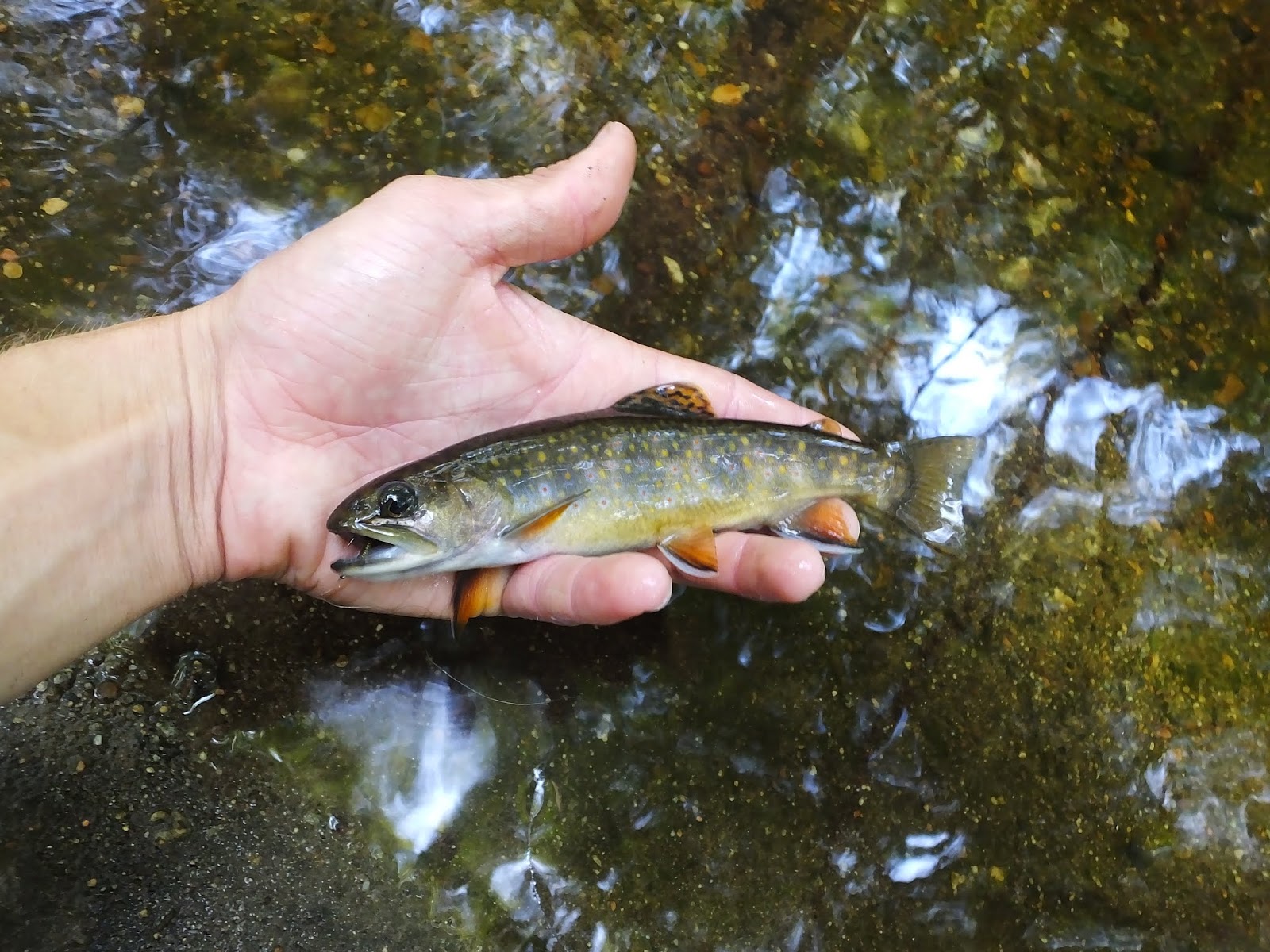
I got in a little bit of stream time yesterday, which was a good idea because I'll be in Central PA tomorrow afternoon to start out a two night outing on Spring Creek and maybe some other area waters. I find it is always a good idea to warm up my trout fishing muscles before going on a trout trip.

We've been getting plenty of rain, but a lot of it from thunderstorms, so not cold rain. But then we had a couple colder nights and cooler days. So I payed my home river a visit. The water temperature when I got there wasn't great at 68 degrees. I opted to catch just one wild brown and then leave there. I put on a beadhead muddler variation and 4x. I fished up one bend, caught a stocker rainbow right at the beginning, got the brown right around the corner, and packed up.


Instead of quitting altogether I went to a stream where I could adequately exercise my nymphing muscles. Smallmouth and fallfish are plenty happy in warm water. Unfortunately they made me work pretty hard. With the water fairly high all summer is seems the larger bass haven't pushed into that water, and may not at all given it is mid August. 


I caught a few tiny bass and not even one fallfish, but felt pretty comfortable with how I was fishing. We'll see how Spring Creek treats me. As with February, it is going to be a high water situation. Better than low and warm for sure. 

Monday, August 20, 2018

The Ecstasy of Grass

White amur, more commonly known as grass carp, are not a common species in CT waters. There are only a handful of places with targetable grass carp populations. Their native range exists in East Asia, from Vietnam to the Amur River. Grass Carp are the largest reported aquaculture in the world.  In the United States, their introduction can be attributed in large part to people not wanting their ponds to be completely filled with weeds. You see, grass carp aren't called grass carp because they like sitting in the grass. No, they like eating grass. The bulk of a grass carp's diet consists of plants and algae. They also eat insects, and fortunately for me, bread.

I've found exactly one place in my exploration in which grass carp are targetable. It is a small park pond with a few dozen small commons and a handful of grass carp, a couple of which are absolute behemoths. The grassers don't often present themselves as viable fly targets here, but it is possible to make them show themselves by throwing out small bits of white bread. But, just because it is easy to get a grasser to eat the bread you've thrown out doesn't make it any easier to fool them and subsequently land them, it just gives you more shots. Grass carp might be the smartest fish I've ever targeted. They seem to have the ability to memorize bank structure. And if something in their frame of vision wasn't there the last time they looked at that bit of shoreline and isn't just a typical part of the environment like a fallen branch, they become less comfortable. With any other fish I've targeted, if I was wearing natural colors and not moving I had little to worry about. But with grassers, they new something was wrong and went on edge. They'd come back for the bread, but they weren't completely comfortable and it made them harder to catch. I say harder because even if they didn't spook from the sight of my hunched down 10 feet away from the bank, the leader, the rod tip, or just the fly itself put the fish on edge more than any other species I've seen. Then there was the problem of hooking up. Even if the fish grabbed the fly, it took no time at all for it to either reject it or to react so violently that it just broke clean off. Time after time I was rejected, missed the fish, or just couldn't keep them engaged. But I knew it was a game of odds, so I kept going back, over and over again.

And yesterday it payed off finally. While hiding behind a tree with my rod laying flat in the grass next to me and just the 14 foot leader over the water, I watched a grasser come up and suck my modified foam Humpy down. I picked up the rod and set the hook in one swift motion. About 15 minutes later Noah tailed the fish for me.


This grass carp was a long time coming. I was ecstatic. One of my biggest freshwater fish, #84 on my life-list: Ctenopharyngodon idella. No fish feels better than the one that takes a couple years of hard work to catch. If you don't fish non-stop like I do I'm not sure I can adequately explain it to you. Hopefully some of the photos Noah got with my new camera might do the trick. 


And that's that. I got my grasser. And I don't really know that I'll be targeting them in CT for a while again, they are a pain! 

Saturday, August 18, 2018

Reef Stripers

Late summer is an interesting time to fly fish for stripers. It can be a very frustrating time for shore bound anglers in many areas in Southern New England. Much of the reason for this is the temperature of near shore waters. The shallow marshes and flats can get downright hot. I mean bathwater warm, and striped bass don't like that. Lots of stripers will congregate on reefs and around islands in August, including large fish. When the conditions are right and the tide flushes bait over the reefs, stripers go into a feeding frenzy. If you have a boat and know what you're doing, this ca be one of the best times of year to get good striped bass on the fly. On Thursday my good friend Mark Philippe got into some nice fish. When he sent me a photo of a 32 inch bass that morning and asked if I wanted to go the next morning, I didn't have to do much thinking. I was in.

Mark and Myron picked me up just after 3:30a.m. I had been out late the night before fishing, catching fluke and porgies but none of the fish I was really looking for, and I got less than three hours of sleep. But the potential for this to be a great morning out on the reefs kept me awake and excited.

We had to get out early because this fishing is no secret. Even on a weekday when the bite is on you are likely to be out there with a bunch of other boats, many of them also fly casting. Through the haze we traveled and were lucky to get on the reef before anyone else. It took no time at all for stripers to make their presence known. We all quickly hooked up. Mark and I started with poppers, and had a bunch of fish blasting our flies out of the water.


On one of our last few drifts over a real sweet spot before it became to risky to drift and too crowded Mark hooked up with a big fish that broke him off by diving into the rocks. This is a common tactic of bigger, smarter bass anywhere there are rocks. This makes strong tackle and tough fish fighting skills mandatory if you don't want to loose flies and every strong bass you hook. But no matter how you play them some fish are just going to bury you.


We slid over to a little slot where fish were working as batches of bait pushed through. One drift it would be butterfish. The next it would be small squid. three drifts later it would be peanut bunker. But each drift, if the fish were up, I was getting them to take a large white Hollow Fleye. I think by that time Myron was using a squid and was getting plenty of takes on it, and Mark had switched back to a popper and got more fish up on that.


On one of the last five good drifts we got I had a very big bass take the Hollow just inside the rough water (reef rips have a smooth side and a rough side). She showed herself very clearly, it was a big fish, likely would have been my biggest. I say would because I didn't even start fighting her. She was there and gone in exactly the time it took me to totally blow the hookset. I cannot hook big stripers to save my life and it is killing me. If I hooked half the number of bass over 40 inches I've had take in the last three years I'd have a consistent string of big fly caught fish. But every time I blow it. Nerves get to me and I do the wrong thing. I need to break that barrier and get just one 20lb bass. It is killing me, very slowly.


Big missed fish aside, we had a great morning. For me this was a view into what was typical when the fishery was better. I can never thank Mark enough for giving me the opportunity to experience more these things. Striped bass have become what I live for and any time I get a to look through a window into their life I feel blessed. They are amazing animals. And we are might loose them if we stay on the path we are following.

If you enjoy what I'm doing here, please share and comment. It is increasingly difficult to maintain this blog under dwindling readership. What best keeps me going so is knowing that I am engaging people and getting them interested in different aspects of fly fishing, the natural world, and art. Follow, like on Facebook, share wherever, comment wherever. Every little bit is appreciated! 
Thanks for joining the adventure, and tight lines. 

Friday, August 17, 2018

Brook Trout Streams in the Heat of Summer

The other day I spent some time checking the conditions on a bunch of local brook trout streams. What I found was not great.
The first stream I checked was lower than I expected but probably cooler than it would have been were it up as a few shallow ponds expel water into it, especially after a lot of rain. It was 69 degrees.

Skip.

The next stream comes out of a reservoir but the dam is surface draw. It was 78 degrees despite a great flow.

Definitely skip.

Stream number three also descends from a stillwater. Unlike the others I had not caught brook trout there. 82 degrees. There's why. 

S K I P. 

Stream four was cooler, being a mountain freestone with only a few small beaver pools way up the watershed. But it still wasn't comfortably cold at a balmy 72 degrees. 


Okay, stream six. Finally, fishable water temperatures! 65 degrees. I'll take it. My plans to catch a bunch of fish were foiled though when a mink made his presence known. NO! I had to hike a fair distance past where I saw the mink to find unspooked brookies. I caught just one, on a caddis pupa. The day, then was made worth while.


But I decided then I needed something more, and with time running out and temperatures being as high as they were I didn't want to bother any more brook trout. So I went to bother some snakes. 


This outcropping has become such a reliable spot if I want to photograph one Connecticut's most spectacular animals. It's no secret, I love snakes and timber rattlesnakes hold a special place in my heart. They are so impressive. A garter snake is a dainty little creature, sleek and smooth and light.  Timber rattlesnakes are massive. Thick. Heavy. Rough. Their scales look like dried seeds. Their heads give away they mean business. As with any pit viper their venom sacs make them look diamond shaped rather than round.


Wednesday, August 15, 2018

Champlain on the Fly Redux Day 2: Slamming Bass


Northern leopard frogs, Lithobates pipiens, are a very common sight around Champlain. They are common in a handful of places in Connecticut but I have never seen one at home. Often when someone sees what they think is a leopard frog in CT they are really looking at a pickerel frog. If you fish Champlain though, odds are you'll see a few of these along the way at a boat launch or campsite. Noah saw anglers catching them for pike bait on one of his trips up here. I could never do that, they're too adorable. But I will imitate them with flies. And on this day that would be very relevant. 

 For our second morning we drove north to fish the South Hero area. The are we had fished in June with a deep weed bed had turned into a shallow flat. It is easy to forget that this lake's height drops massively throughout the summer. But this drop actually put us at a sight fishing advantage, and there were bowfin, bass, and small esox all over this flat. What I didn't expect to see were tench, a species introduced from Europe. I really, really wish I had successfully hooked one. For a rough fish angler in the U.S., tench are kind of Holy Grail-ish. They are not common. The bowfin, atleast the ones that weren't completely buried in the weeds, were pushovers. I was able to find a few that were only partially buried, and each one took. I boated three of them, matching the previous day's bowfin success.


One thing I noted as I cruised over the flat and carefully observed the bottom and the fish was a couple of deep holes in which taller weeds were growing to the surface. Bass and a few bowfin were residing in these holes, and I was pretty sure I could get the largemouth very easily on a foam topwater fly called the Bass Plopper. The first pass at the first hole resulted in two solid bass on consecutive casts. Both just hammered the fly, absolutely slammed it, and fought like hell.


I gave it a 15 minute rest, came back, and kapow! Another good bass.


Another rest. I came back. Same fly, same hole. Another good fish.


We wandered off for a while, Noah caught a small pike and we both got a bunch of yellow perch. By that time we had pretty much used up our time in that area and decided to head out. On the way back through, same fly, same hole, another really nice bass.


We drove back south to an area we had never fished, The Narrows. The hope was to find a few gar so Noah could finally add that species to his list. They were around but they were catchable. Eventually, I decided to target bass. I had seen some frogs around when I "answered the call" before we launched there. Dragonflies were everywhere. And I saw more than one sizable largemouth blow up on baitfish right at the surface. So the choice was pretty clear. I tied on a weedless frog pattern, attached to a short 30lb leader and the 10wt. That may seem a little overkill for largemouth bass, but I've been trying to master catching big bass in the slop on the fly for years now, and using the 10wt has absolutely transformed my game. I can slam the hook home after I feel the fish and haul them right out of the think mats with little concern.


The bass were hungry and all worked up. Again and again they came out of the weeds to eat my fly as violently as any bass I've ever encountered. The fly I was using was tied on a weedless worm hook and mono extension, to ride point up, shield the bend of the hook to keep it from collecting weeds, and still have a great hooking percentage. It worked as well as I could have hoped. I hooked 3/4 of the bass that took.


There were pike and pickerel in there too, including some exceptionally large ones, but for some reason neither Noah nor I could keep one of them pinned until the very end, when I got a good pickerel in. I would have loved to add a big pike to the list of fish I caught on this trip but just the hits alone were worth it. Oh if only I had a camera rolling for every bite. None were boring.


I don't know how many bass I pulled out of the weeds on that day. At least a couple dozen. Some where of a pretty fair size. Nothing humongous. There was always a lot that attracted me to fishing weed mats for topwater bass. It was always about the unexpected. You never new when that ten pound hawg was going to blast through the pads for your frog. And unlocking the doors to exploring this world with a fly rod has become borderline obsession. I yearn to get the biggest bass out of the thickest crap on fly tackle. And Champlain seems to be a great place to do so. Though there are only a handful of new species I'd like to get in Champlain, I'll undoubtedly be back there again and again. It is an incredible and diverse fishery.