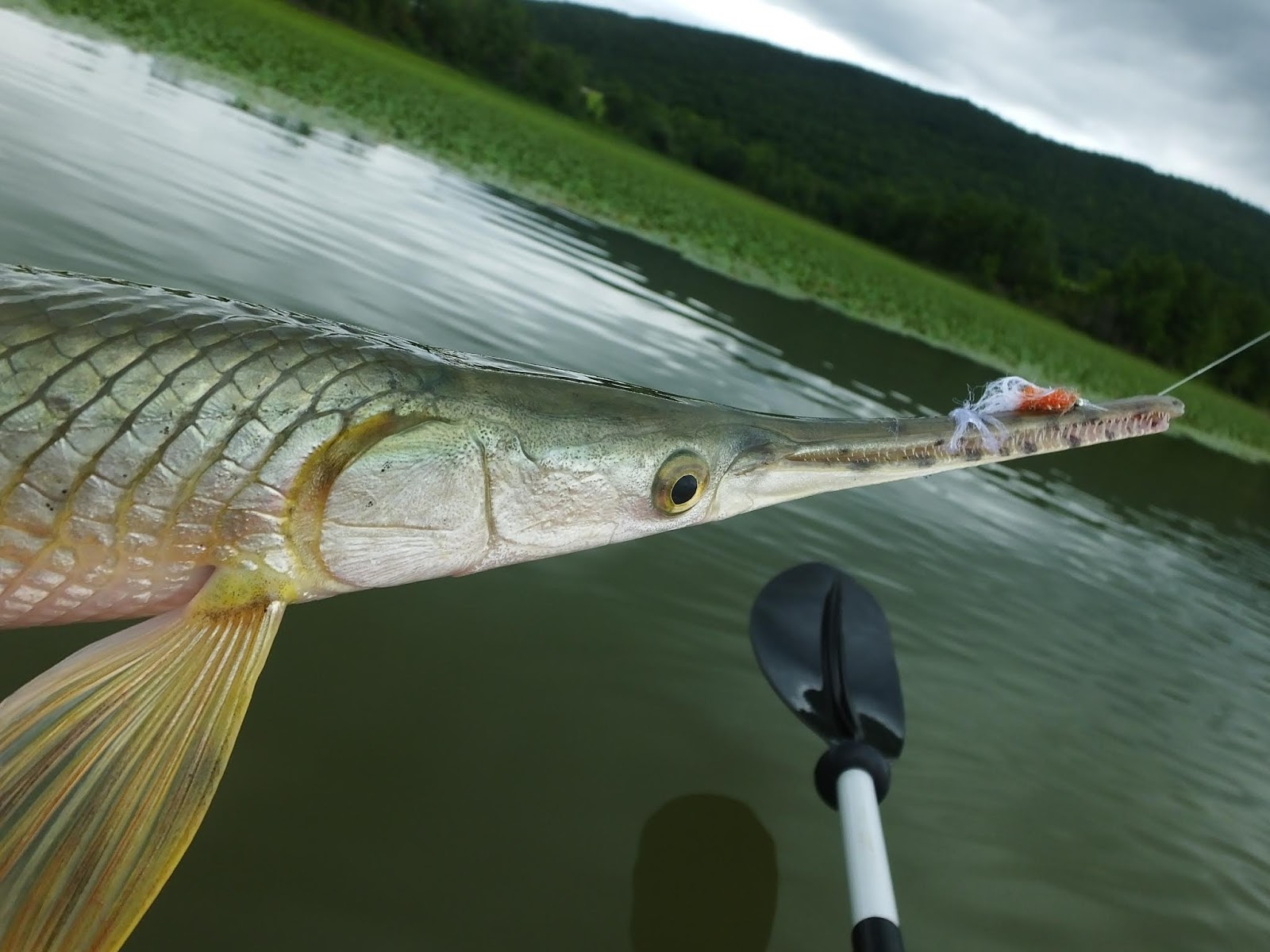
I have become a bit dinosaur obsessed in the last year. Not the extinct variety (though those are wicked cool), the fish variety. Gar. Bowfin. Snakeheads. There is very little in freshwater that I have become more interested in recently than these armor plated, bony mouthed, prehistoric fish. They fascinate me endlessly. I have a life goal revolving around these fish: catch at least one of every gar species and one of every snakehead species on the fly. I am much closer to my gar goal with both Florida and longnose gar under my belt; I haven't caught either northern or bullseye snakehead yet but I will. To get the rest of the snakehead species I will have to go to Southeast Asia. And I promise I will before I die. But bowfin are very similar in behavior and shape to snakeheads, so I can shed some light on hooking them even though I personally haven't yet.
This is not a guide to finding these species. It isn't a guide to specific fly patterns. It isn't about presentation either. This is a guide to how to make sure, if you are going to target these species, that you can do the single most important thing after the fish eats: Get them stuck and stuck good. Because driving a hook into these specie's rock hard mouths can be very difficult, sometimes even impossible. This is...
RM Lytle's Complete Guide to Stickin' Gar, Bowfin, and Snakeheads
KEEP YOUR HOOKS SHARP
There are no excuses. If your hooks are dull you are going to blow that shot at the gar, 'fin, or 'snake of a lifetime. Buy sharp hooks and sharpen them after each use. You should already be carrying a hook hone with you. If you aren't, get one. Snagged in a log? Sharpen that hook. Hit a rock on the backcast? Sharpen that hook. Just caught a good fish? Sharpen that hook. It should be so sharp that it only takes minimal pressure on the point with your finger tip to make you bleed... but I don't recomend doing that on purpose, so test it on newspaper instead. It the barb doesn't bury in a rolled up newspaper with one sharp pull... sharpen that hook.
KEEP YOUR HOOKS STOUT, BUT NOT TOO STOUT
This is not the scenario in which you want some sissy aberdeen hook. It's also not the scenario straight up shark hooks either. You need a hook that is thin enough in diameter to bury in cartilage with one big swing or a few strip-sets, and stout enough to put up with being chomped on by some of the toughest jaws of any freshwater fish all the while being pulled on really hard with heavy tippet and a heavy rod. One of my favorite hooks for this application is the Tiemco TMC811S. They come real sharp out of the package, maintain that sharpness well, and set into a bony fish's mouth with relative ease.
ALL ABOUT THAT TREBLE
Flies with treble hooks are probably not a common product in your local shops, but you may want to consider tying some if you intend to target gar species other than longnose. Don't go really big, Just use a size 8 treble and a 28mm Chocklett's Articulated Big Game Shank to tie your fly. Once again, make sure you keep those points needle sharp.
GO SMALL
So you aren't about trebles, that's okay too. Go small if you want a better chance to stick Florida or spotted gar. Use an articulated fly or topwater with two size 10's, 8's, or 6's. These small hooks will bury with less effort than a big hook, and these smaller gar species aren't going to bend them out. They'll eat almost anything anyway, I actually got a few to eat small nymphs in the Tamiami canal and they stayed stuck far longer than any that took a big streamer. In fact, had I not gone down to a very small fly I doubt I would have caught even one.
SHORT LEADER, HEAVY TIPPET
There's no sense in trying to hide your leader from these fish, they're so tough and gnarly they don't even care. Instead, tie up a short very strong leader that will stand up to the strain of a really hard hook set. A five foot leader to 20lb tippet will do exactly that. Fluorocarbon is preferable for subsurface presentations, especially since all these fish are very toothy and will abrade your line, but I use Trilene big game any time I'm fishing topwater since it floats and is dirt cheep. I have not yet had a bowfin or gar bite off, but I have had to change tippets after landing them.
RODS WITH BACKBONE
Don't screw around with light rods for these fish either. If you want to stick them well, use a rod with backbone. Rods in 8, 9, and 10 are appropriate, even though it would be possible to fight these fish effectively with a 6wt (hell, I got my first gar on a 5/6 glass rod). But at close range I've found a hard set up and to the side is optimal, and a noodle glass rod or super slow action graphite won't provide the brute force I want. An 8wt is ideal for small gar an bowfin. For larger gar, big bowfin, and snakeheads, a 10wt is not at all overkill. And for real monsters like alligator gar, a 12wt or even a 14 or bigger is ideal. Fast action graphite with a good comfortable fighting but and a lot of pulling power will help you drive that hook home.
STRIP UNTIL YOU CAN STRIP NO MORE
All of these species hold onto the fly after they'v eaten it. Unlike a trout mouthing bits of organic matter, nymphs, and other junk in the drift and spitting half of it back out, a bowfin or snakehead or gar has already decided that your fly was food before it put it in its mouth, and it's going to keep it there for a little while. Give the fish a second to really suck it down. Then strip set like you're trying to bury that hook into a cinder block and don't stop until the fish forces you too. You may have to tape your fingers after four or five fish, so be it. This is just what you have to do. When sight-fishing bowfin or snakeheads in the weeds or on fry balls this won't really fly. Instead, got straight up Jimmy Houstan on that sucker, cross his eyes and cross them good. Sweep that rod back and to the side and strip hard at the same time.
DON'T EVEN USE HOOKS
So, longose gar are a little bit special in this realm. You probably won't hook one, so don't try. Not only is their snout bony as hell, it's so skinny their's not much between the inside of the mouth and the outside of the mouth for a hook to encounter. Instead of frustrating yourself trying to actually hook one, Use rope flies. Nylon rope and other fine-fiber materials tangle in a longnose gar's many needle-like teeth, acting almost like velcro. I would't forgo the hook entirely, but not because it might stick in a gar... you don't want to miss out on the bass of a lifetime because it came along and sucked down a hookless gar fly. When a gar eats a rope fly, just let it toy with it for a couple seconds to get the fibers all nice and tangled in its teeth, then lift the rod gently to begin the fight. You'll want both a jaw spreader and pliers to get a longnose gar unstuck, not only for your safety but because letting one swim off with a bunch of nylon stuck in his teeth is just rude.
For for big spotted, Florida, and alligator gar, rope flies won't work nearly as well though.
NO STRETCHING!
There's no room in this game for a stretchy fly line. Use a floating line with a strong core. Less than supple is not a problem fishing for these species as the water is rarely cold enough to make your coating even more stiff and prone to tangling. You want is little give as possible. I, personally, am still looking for the optimal line for this fishing, but I've gotten much closer with Airflo.
LOST FISH ARE A PART OF THE GAME
When you fish for bowfin, gar, and snakeheads, you are going to miss and loose fish no matter how sharp your hooks are, no matter how hard you set, no matter how perfectly tuned your gear is. It is just a part of the deal. Get over it, get back to fishing, and put every ounce of available effort into sticking the next one.
Stick them hard.
If you enjoy what I'm doing here, please share and comment. It is increasingly difficult to maintain this blog under dwindling readership. What best keeps me going so is knowing that I am engaging people and getting them interested in different aspects of fly fishing, the natural world, and art. Follow, like on Facebook, share wherever, comment wherever. Also, consider supporting me on Patreon (link at the top of the bar to the right of your screen, on web version). Every little bit is appreciated!
Thanks for joining the adventure, and tight lines.