Wednesday, August 21, 2019

The Chub Mackerel Invasion

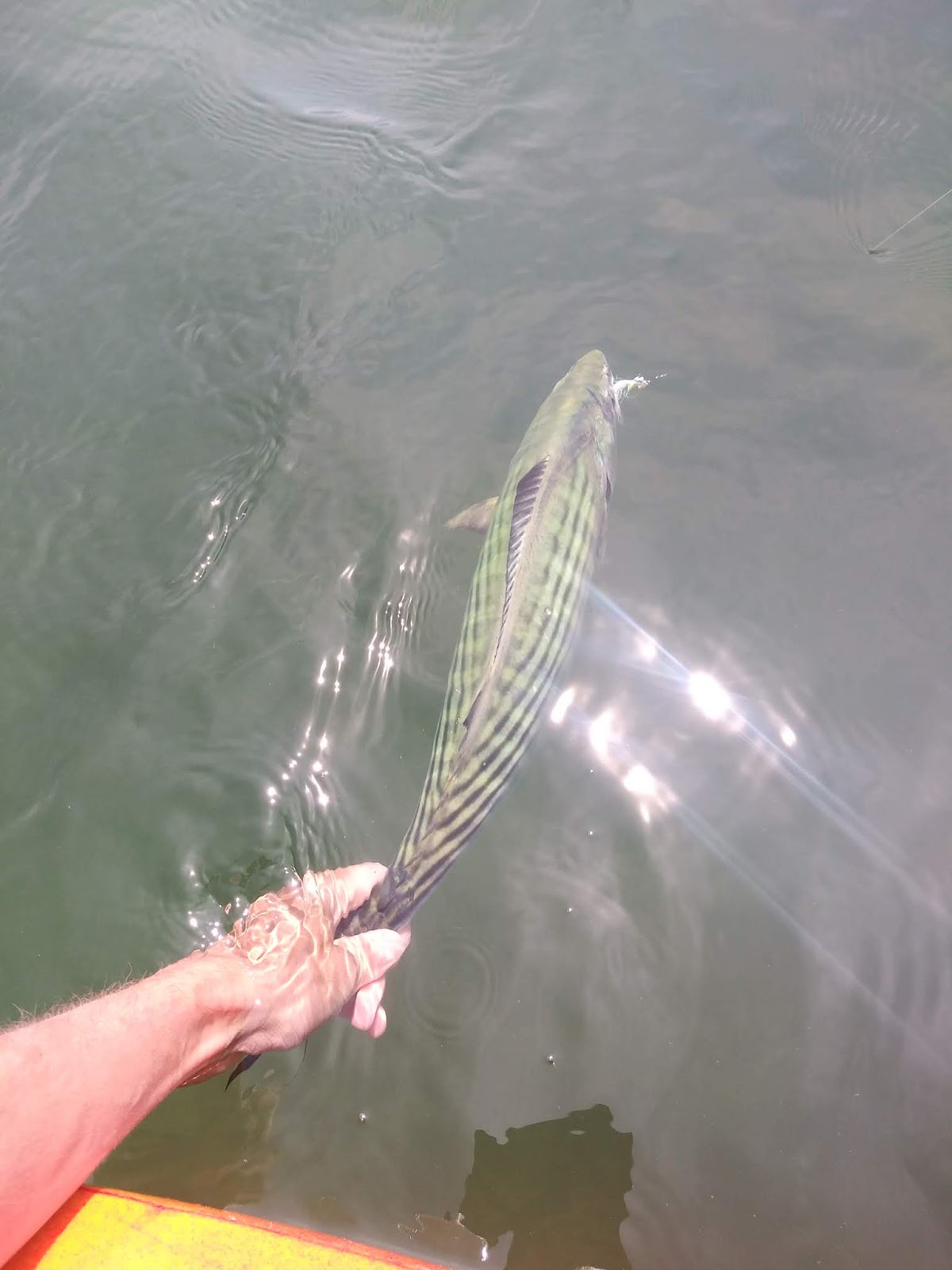
Atlantic chub mackerel, Scomber colias, were once essentially absent from our little corner of the Atlantic. The species started to show up in offshore waters in the late 2000's and were being substantially commercially harvested by 2013 and had become an important baitfish for large pelagic fish, as according to a fissues article by Angelo Peluso in 2017. That year, 2017, schools of chub mackerel showed up at Watch Hill, and I caught my first of the species with Mark Philippe in August of that year (flyfishingcts.blogspot.com).


In 2018, chub mackerel were definitely around in shore and near shore again, though I didn't see them. They seemed a little more spread out. Then came 2019....
This year, I've seen chub mackerel all the way from Point Judith to Niantic and friends have seen them almost to the mouth of the Connecticut River. There are tons of them, they are all over, and they are absolutely chewing through small bait. The froth feeds performed by these fish are both audible and visible from a long way off, sounding like a waterfall or a very isolated heavy downpour. If not in a concentration of bait in a single spot, they move up and down slicks so rapidly they are hard to catch up to even in a boat at times. And they are indeed fairly sporting on light tackle. Over the last few weeks, Noah and I have chased them around in kayaks, and I've targeted them on a number of friends' boats. I fished for them with small flies tied on size 3-6 hooks, and on both a 5wt and a 10wt. Interestingly, what rod I was using made next to no difference in the quality of the fight. This is something my friend Captain Ian Devlin has noticed as well. Regardless, they have been abundant and it's fun to pull on a few, though watching them feed is more than enough for me to be happy!


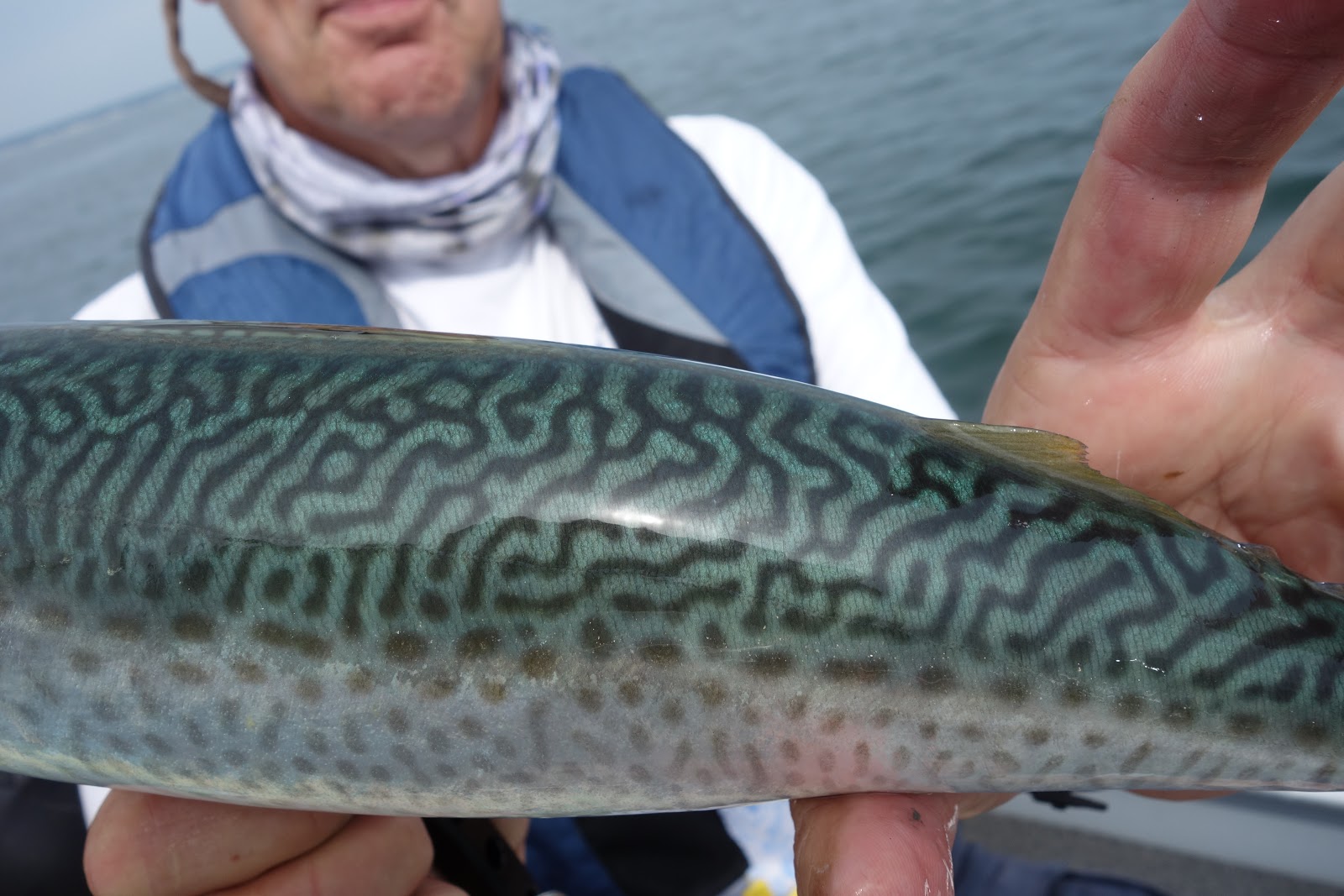

They do bleed a lot.


On there own the chub mackerel a pretty cool, but this year they've become so abundant that they may be turning into viable forage for sharks, bluefish, and potentially striped bass. While drifting in an area where tons of chub mackerel were feeding, Patrick Barone was jigging a metal while I continued to fish the kind of small flies the chub mackerel were eating. All of a sudden, Patrick stuck a decent sized bass. When he got it up, it was being followed by a much bigger fish. I quickly tied on a big Game Changer, hoping the follower would stay around and give me a shot at it. Unfortunately that didn't happen. But it was pretty clear that these fish were there because the mackerel were, either to eat the mackerel themselves, eat whatever the mackerel may have been leaving behind, or possibly even eating the scraps dropped by bluefish that may have been eating the mackerel. But where we were, there were really limited reasons for there to be sizable bass in that particular spot at that time of year. They must have been drawn to the chub mackerel. I'm a bit skeptical that large stripers would chase down these fish too often, they aren't exactly like adult bunker or Atlantic mackerel, much harder to pin in an ambush spot. So these won't be a viable replacement for menhaden, not for striped bass forage. But they may well become a viable and important inshore baitfish in the future. Time will tell, and time will tell if they need to be regulated outside of the commercial sector. Bunker are, so these certainly should be, being both useful bait and a good food fish. Be vigilant in the future for opportunities for advocacy in that department, I'll be paying attention. And obviously the Fissues team is paying attention to chub mackerel. This is a rare circumstance of a new native fish abruptly showing up, it's a really fascinating thing to see.

photo courtesy Ian Scott Devlin


photo courtesy Ian Scott Devlin
I'm not sure what I was looking at.

Until next time.
Fish for the love of fish.
Fish for the love of places fish live.
Fish for you.


 If you enjoy what I'm doing here, please share and comment. It is increasingly difficult to maintain this blog under dwindling readership. What best keeps me going so is knowing that I am engaging people and getting them interested in different aspects of fly fishing, the natural world, and art. Follow, like on Facebook, share wherever, comment wherever. Also, consider supporting me on Patreon (link at the top of the bar to the right of your screen, on web version). Every little bit is appreciated! Thank you to my Patrons; Erin, David, john, Elizabeth, and Christopher, for supporting this blog.

Monday, August 19, 2019

Connecticut Bonito

Before I'd even heard any rumors of bonito in CT this year I was already out hoping I'd get shots at them. I'm not one to follow reports, so I'm sure somewhere somebody had reported in one of the local publications that there were a few around, but I didn't look for that information and didn't even want to see it  if it did exist. I'll chase a really good report, but I'd also rather find my own bite. Often, its just on a whim. In 2017, Noah and I were among the first catch little tunny from shore in CT on September 11th. I saw the conditions line up, we went, and they were there. I hadn't heard a single report yet and nobody else was there targeting them at a quite popular location. Well, on the 4th of August I went to likely water with plans to target other species, but fully prepared for shots at the elusive and beautiful Sarda sarda. Nothing showed, as I expected. There was bait but it wasn't the right tide. I fished for bottom dwelling species, catching some bergals and the first fluke I've brought to hand on the fly in a long while.


A move was made that provided futile, and with very little time left to fish I decided I wanted to go back to the first location. The tide was right, and as if on command, there they were. Nothing locally feeds quite like bones. Superficially, blues or albies could be mistaken for them, but if you have been chasing these fish for a while, there can be no doubt. I was seeing my first definitive bonito blitz in CT waters. I got one shot, a few boils behind my fly, then I had to leave. But you know I was going back the very next day! 

On August 5th, Noah and I got out before I thought the fish would show, always a good policy when tunoids, bass, or bluefish are involved, especially in the days of phone chain bite finding, when a good blitz gets pounced on faster than ever. Before the bonito showed, we sight fished sea robins and drifted for scup and fluke. 


Then, around the top of the tide, I saw some big splashes to my west. I shouted to Noah and we paddled like hell towards the chaos being wrought on a school of silversides. I was the first to get a take, and it was a good one. But I had also just stopped paddling, so the fish and I were both traveling straight towards each other. Lots of slack, no way to really catch up, no hookup. Noah took first blood on a small plug we are inclined to keep a secret for now. Suffice to say, it's going to be a serious game changer for bonito and albies and NOBODY up here is using it right now but him.

Noah's lifer Atlantic bonito.

The fish stayed on a predictable course and I missed another take before hooking up. My first tunoid of the year in the first week of August, and my first bonito in CT! A small chartreuse and white clouser did the job. I managed to keep some amount of tension through the fish's rapid direction changes. These little bonito don't make the long initial run larger member of their species of their cousins the little tunny do, so they end up turning sooner and more and can really make things, uh, exciting for one using a reel with a one to one gear ratio. Keeping tension can be tricky, especially in a kayak and without current. Don't use barbless if you like getting to touch your fish.


We didn't really get another shot that day, though we did bottom fish a bit more. Suffice to say, tunoids were around, we were on them, and I could now think of very little else. It was time to hammer down on the salt.
Until next time.
Fish for the love of fish.
Fish for the love of places fish live.
Fish for you.


 If you enjoy what I'm doing here, please share and comment. It is increasingly difficult to maintain this blog under dwindling readership. What best keeps me going so is knowing that I am engaging people and getting them interested in different aspects of fly fishing, the natural world, and art. Follow, like on Facebook, share wherever, comment wherever. Also, consider supporting me on Patreon (link at the top of the bar to the right of your screen, on web version). Every little bit is appreciated! Thank you to my Patrons; Erin, David, john, Elizabeth, and Christopher, for supporting this blog.

Sunday, August 18, 2019

White Mountain Brook Trout and Bears

New Hampshire's White Mountains have long held a special place in my heart. Every time I go there I find something special. The last time I fished there was in 2015 (Brookies in the White Mountains). It has been a while. I've missed the place. To say it had been too long would be an understatement. In the case of the White Mountains, it's the place that attracts me more than the fish. It doesn't have the diversity of species that many other places do, or particularly large wild fish either, but it does have a handful of colorful native fish species living in some of the most dramatic terrain in the Northeast. The white Mountains are proper mountains. Big, rocky, steep, with a real tree line in places... they look like mountains, not like the hills that are mountains in most Appalachia. Granite. I love granite. In the past I'd gone to the Whites specifically to dig for smokey quartz, microcline, flourite, and other minerals in open cavities in the granite. I can't help but poke around looking for new prospects while fishing  any time I'm there now, but it's been even longer since I've been there specifically to dig crystals. I didn't get to dig on my latest trip either, but it was just wonderful to be there.


My mom, brother. old dog and I made the drive up in the rain but got to where we'd camp as skies cleared. The mountains were draped in fog and evening light, and the air was clean and cool. I could breath again here. We camped basically right on one of my favorite streams I've fished up there, and I was able to catch a few brookies before it got dark, but the next morning would be the start of the real fishing.
I was up before everyone else, including the sun, because I had a few miles to walk to get to my destination and they were all up will. After a a brisk walk, I reached the upper boreal zone and and isolated small aquamarine pond that contained one and only one species of fish, Salvelinus fontinalis. When I got there, a cow moose was having breakfast on the far side. It left before I could get close enough to get a shot, but it was a beautiful thing to see.


Being that it was summer and the surface water was quite warm, there wasn't much rise activity except over the spring holes. The springs themselves. seeping out of the ground around the pond, into tiny streams that entered it, and up through the bottom of the pond itself, were so cold that I assume that ground they were seeping from may well have still been frozen not that long ago. Just sitting down near one of the springs I'd get really cold even in a flannel and long pants with the sun on me. One seep I found was 38 degrees... fathom that. Only six degrees above freezing, in July! The larger streams further down in elevation were about 60 degrees and the surface temperature of the pond itself was 68, though just two feet down is was cold enough to induce shivers. The fish were deep, and it took me a while to get the message that they were so deep I ought to be fishing with a fair number of shot and just as slow as I could tolerate. I kept with a slow pick for almost an hour before I changed to a beadhead Hare's Ear Soft Hackle and two shot, and even that alone wasn't enough. Once I started counting the fly down for seven to nine second and slow figure eight crawling it along. That worked really well, and though I caught a ton of gorgeous fish, it was the two largest that got me really excited. See, this pond is big enough that it could circumstantially produce fish to, say, 18 inches, but it is at an elevation where the fish get a really short growing season. Too warm in late summer, too cold in the winter. Of course, were it lower it may get too warm for the fish to survive, were it higher it could ice too much for them to make it either. Trophies are relative, and for this little pond in the mountains these two fish were extraordinary trophies.


As the sun reached the upper end of the pond the activity dissipated and I headed back down slope. I fished the outlet stream of the pond and every other body of water I passed on my way back to camp. I caught brook trout in all of them. I encountered a little black bear at close range. I got some serious exercise too. The sloped down to some of those creeks are no joke, nor the brush you need to plow through getting up and down them.

(Beaver stick from Deboullie)
After I got back, we went for a drive to see some of the area that I've come to love so much. I really wished I'd had my camera on this trip, but it was being mailed back because it had a periodically occurring issue and needed to be replaced.


A while after getting back and having lunch, I set out to fish a couple miles of the stream we were camped on.


My dad and I had done well here when we'd been four years before and I'd already fished it just enough to know that it was about as good as it had been back then, but I wasn't prepared for just what I'd find.


For most of the long stretch I fished, I got the sort of steady pick of four to six inch brook trout on dries and wet flies that I'd come to expect from freestones in this area. They are gorgeous and aggressive fish, and most of the larger ones are fairly old because these streams don't have much in the way of food for these fish. The only baitfish are smaller brook trout and these streams don't have the kind of macro invertebrate populations that slower, warmer, muckier and sandier streams do. So these fish just don't grow that fast or that big.


Then, somewhat inexplicably, I stumbled into one 100yd stretch of water where the fish were just bigger for some reason. I'm not really sure why they were there, nothing above or below seemed particularly different from that stretch. But they were, and they were quite spectacular old specimens, likely 4 to 6 year old fish. They all took a classic Picket Pin.


I stuck to it for a while but eventually bored of bothering brook trout and headed back to camp to just relax for a while.


Not long after getting back there, a little male black bear showed up. He crossed the creek and headed up the other side, then doubled back and went back the way he came.


That night, my brother and I hiked up to the pond to see the night sky. Watching the light fade there, the stars and planets start to reveal themselves, and then the milky way itself, all while a hexegenia hatch was going one and brook trout were splashing all over the pond... that was just magical. Again... I wished I'd had my real camera.


The next morning I went back up again for one last blast in the pond. Really, I don't feel the need to explain how it went. It was... it was special.


Until next time.
Fish for the love of fish.
Fish for the love of places fish live.
Fish for you.


 If you enjoy what I'm doing here, please share and comment. It is increasingly difficult to maintain this blog under dwindling readership. What best keeps me going so is knowing that I am engaging people and getting them interested in different aspects of fly fishing, the natural world, and art. Follow, like on Facebook, share wherever, comment wherever. Also, consider supporting me on Patreon (link at the top of the bar to the right of your screen, on web version). Every little bit is appreciated! Thank you to my Patrons; Erin, David, john, Elizabeth, and Christopher, for supporting this blog.