Showing posts with label Bluefish. Show all posts

Tuesday, February 14, 2023

Drug

One of many spell in the fall of 2022 that I spent living out of my vehicle started with eating tortilla chips and queso in a park and ride. The tide wasn't what I wanted just yet for the one spot I'd intended to fish in the dark that night, so time needed to be killed. I threw on a podcast, got comfortable, and put calories in my body. The inside of my 4Runner probably didn't smell especially savory that night; with multiple saltwater soaked items of clothing drying in the back and my own sweaty, haggered self in the driver's seat. My overall mental state at the time reflected that of a fish obsessed hippy. I was nominally single, still occasionally hooking up with my ex but not bound into a time consuming relationship. I was guiding sporadically. My rig was finally behaving itself after half a year of mechanical problems. This was subsequently be my first fall run with my own vehicle, no partner, and no job. This was the first fall run during which I could do what I'd always wanted to do for years- live at the whims of the fish, tide, and wind alone. The conditions controlled what I did, not anything else. I had grown a tight little network of other anglers of the same mind and similar situational freedom. Our focus was honed on one of the most spectacular natural events on the east coast. The mass migration of baitfish was already underway and the predatory fish and birds were snapping at their heals. Those of us who simply couldn't resist the call of such spectacular biological occurrences came from all corners of the northeast and convened at our chosen churches, a fishing pilgrimage, if you will. Some worshipped on the sand beaches and long jetties of Rhode Island. Others boarded boats to pray from within the melee. I myself would be headed to my place of prayer in a short time, a rocky bit of shoreline in Eastern Connecticut where an estuary emptied into the sound. As I polished off my bag of chips, I saw that it was around midnight- almost time for the mass to begin -and dawned my ceremonial garb. I slipped neoprene socks onto my feet, and a beaten pair of sneakers over them. I tightened the belt of my khaki shorts and threw on a salt stained navy blue hoody. Into a sling pack went a few wallets of flies and some spools of heavy tippet. 

I parked a fair distance from the spot and outside of an open gate. Despite the fact that it was already late, I knew there was a fair chance this gate would be closed by the time I got back to the parking lot. A police officer had already had already warned me of this likelihood a few weeks prior when the tide timing was similar. I didn't at all mind adding to the walk anyway. The darkness enveloped me as the street lights began to disappear behind the trees and a sense of calm arose. In time, the pavement under my feet gave way to sand, then the sand to rock, then the rock to slat water. Wading into the inlet, I could hear the occasional pop and swirl of schoolie striped bass feeding on silversides. Affixed to the tippet at that time was a white Tabory Snake fly, a scraggly looking offering that I'd swing in hopes of drawing attention from a larger, more opportunistic predator. Bypassing the shallow feeding schoolies, I maneuvered the edge of the rocks out to the very mouth of the inlet. There, the estuary emptied out over a sandy delta into a deep area. Behind my lay a large bar on which stripers often roamed. In theory, the outgoing tide and baitfish in the estuary mouth might draw bass either from deep water of the rock bar to feed in the current plume. My second cast was greeted by a jarring strike. Not a bass though. The fish went airborne shortly after the hook-set. It jumped repeatedly and made spastic, energetic runs. This was certainly a bluefish. That poor Tabory snake fly stood no chance. 

After encountering that toothy critter, the destroyed Snake Fly was replaced by something more durable and I was treated to a pick of modestly sized bluefish for the rest of the tide. Though the bite was nothing to write home about, a few fish got the Tibor to sing nicely and the rod stayed bent for an hour or so. Who could complain about that? I made my way back to the parking spot exhausted and satisfied. Sleep would be minimal, though, as the sun still rises early in September and I had no intention of missing what would likely be a fiery false albacore feed right after dawn. 

I caught a couple hours right there in the parking lot, moderately comfortable in my fully reclined car seat with a pillow supporting my back and a blanket hiding my face from the one glaring streetlight. I moved an hour before sunrise just to be close to where I'd fish and got one more hour of rest before the light of the new day filtered through the fogged up windshield. Cracking a can of peanuts, I stretched and yawned. Almost reluctantly I climbed out into the morning air, binoculars in one hand and breakfast in the other. From the roof of my truck I'd eat my "meal" and watch for the first signs of fast fish. Before the first rays of sun even graced the Sound's lightly choppy surface the tunny were sending spray and piercing the waves out in the deeper water. I hurried my pace and called my friend Alex. There's a stretch in there that my tired mind did not commit to memory, but I cannot possibly forget the highlight of the morning. I know Alex had caught a rather nice striped bass on an Albie Snax and I'd lost one of his creative popper flies to a substantial blue, the I looked a point over and saw birds working in tight. Reluctant to make immediate moves, I let the situation fold out a bit longer. In time though it seemed there was no reason to stay where I was. I waved to Alex, who was further way and likely couldn't see the action from his position and began scampering across the rocks towards the unfolding blitz. I got out in front of the mayhem, tunny still blasting through the silversides just off the rocks, and fired a gurgler out into the fray. A mere few casts later I was treated to the sight of a tunny, shimmering like something carved out of a block of chrome with blue and green reflecting off of it's surface, blasted through the surface and engulfed the skittering fly. I was tight, and soon Alex was too. Any sense of exhaustion or lingering effects of car sleep melted away as though it were the backing leaving the reel as the tunny ran, taking every other problem in my life with it. There are a lot of different kinds of drugs out there and this, well this is mine. It's cliche, it's overused. But some of us sleep in parking lots, ruin relationships, and risk mental and physical health to pull on fish. Our brains crave the chemical stimulation enforced by evolving to predate, to acquire sustenance, and we take advantage of it to feel good, to get high for a moment in time. Some of us get addicted to it. It's not as dangerous as some other drugs, but it can still effect our well being. I must say, sometimes I just don't care. I'd rather look for that next high, and I feel I get so much enrichment through the process of hunting it. Moderation is good though. Sometimes you have to go home and sleep in a real bed.. Eat real meals. Foster healthy relationships. Like many drugs, you can have a moderately healthy balance if you try. Do I?


Nope.


Thank you to my Patrons; Erin, David, John, Elizabeth, Brandon, Christopher, Shawn, Mike, Sara, Franky, Geof, Luke, Noah, Justin, Sean, Tom, Mark, Jake, Chris, Oliver, and oddity on Display for making Connecticut Fly Angler possible. If you want to support this blog, look for the Patreon link at the top of the right side-bar in web version.

Monday, November 15, 2021

Late Season Jack Crevalles and Blue Runners in CT

 I particularly enjoy catching wandering pelagic and semi pelagic species in Connecticut waters. Each year a lot of fish that are ubiquitous in southern waters end up in Long Island Sound, and though they are often smaller than those I could catch elsewhere it is cool to encounter these species close to home. After all, they can often be caught in relative proximity to species we are much more used to seeing around here. Catching a crevalle jack and a striped bass within a half hour of each other is perfectly possible at some times of year in Connecticut and Rhode Island. November is one of those times, and perhaps the easiest time to make it happen at will. The warm water species get concentrated in, well, warm water as the environment around them cools off. Noah and I visited one of these concentrated warm water environments a little while ago. There were indeed loads and loads of jacks and blue runners present, and they were very willing and these species generally are. 


Though small in stature, these fish actually fight stupid hard. They're built for chasing down prey and swimming like hell away from predators. In the pelagic world, the predators really haul ass, so it pays to be really fast if you need to run away from those critters. That translates to a pretty sweet bend in the rod when you hook these guys. I was lucky to get the largest crevalle I've caught locally, and in heavy current that fish gave a phenomenal fight- even with a bit of its tail being missing.

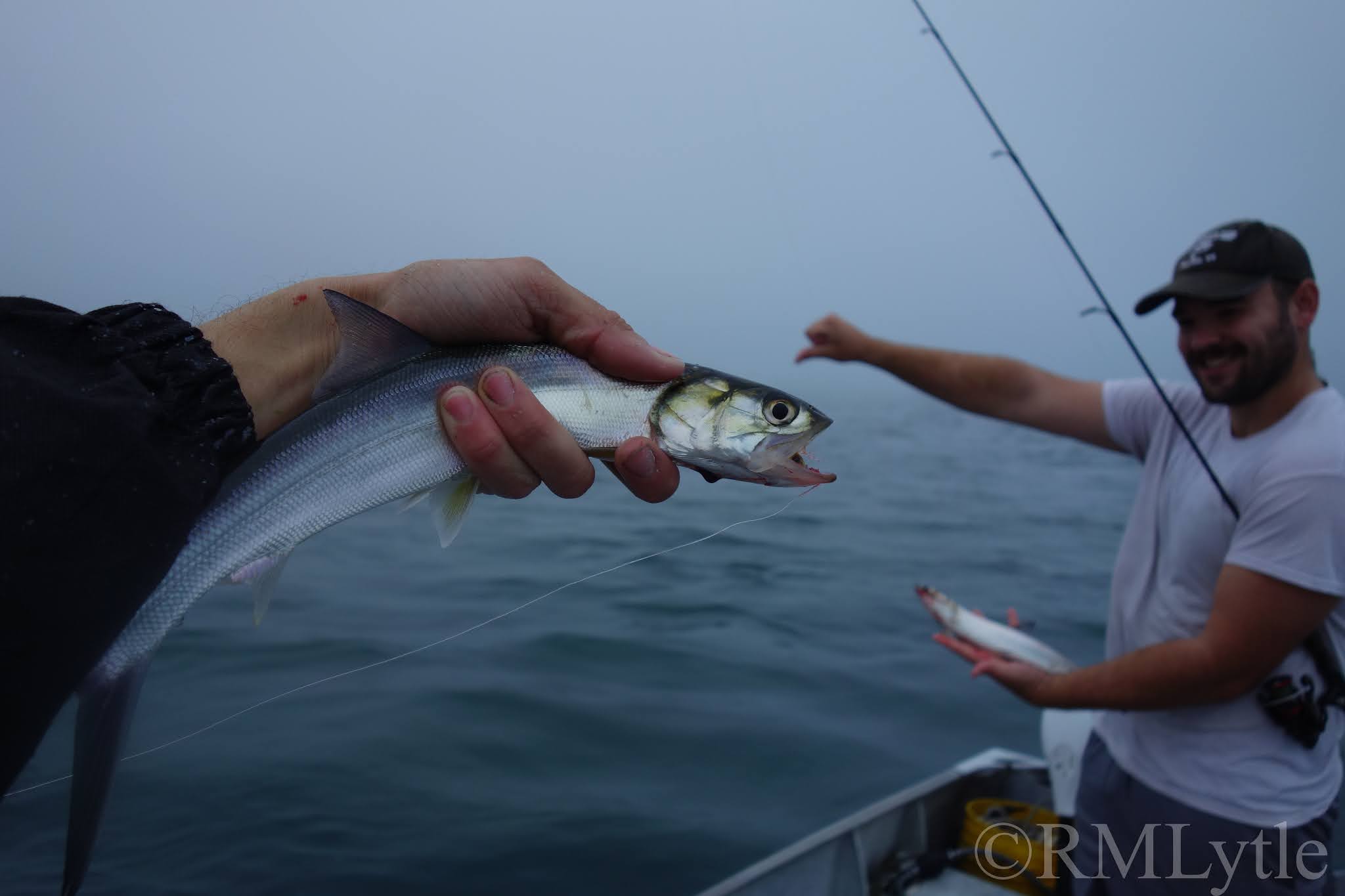
The blue runners actually pull a bit harder, and we got some nice little football shaped runners that made our drags sing. 

I ended up keeping one of the blue runners; I pan fried it with olive oil and a little salt and pepper, the flavor and texture were fantastic. I'll certainly be eating more of these little buggers going forward. I haven't tried a crevalle yet, in part because I've seen videos of them being cleaned. It seems if they're of any size at all, they're loaded with parasites. Of course these are Florida-caught ones we're talking about, and I don't know if that would be true of the ones we get in CT. I should try and see at some point. 

The fishing was very fast paced. At times blitzes broke out and there were dozens of fish breaking around us. Mixed in were a few of the expected bluefish, but they were far outnumbered by the jacks and blue runners. It would have been particularly nice to encounter some other species mixed in, perhaps lesser amber jacks or banded rudderfish. Banded rudders are notable common in Connecticut some years but this wasn't one of them.


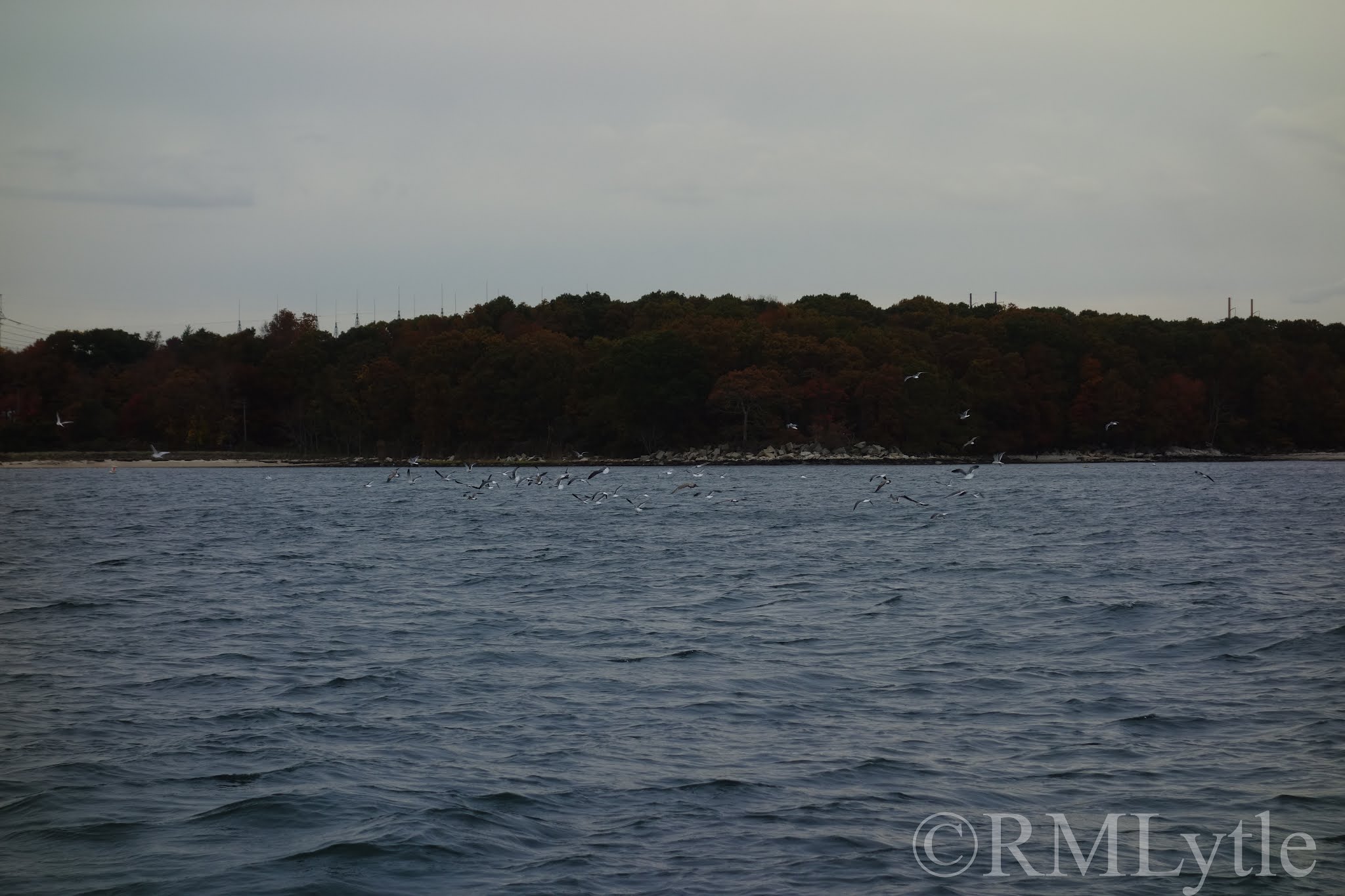
Eventually a flock of gulls to our east drew our attention, and we went off to get the sort of fish anglers actually expect to get in CT in November: the sort with stripey sides and an affinity for peanut bunker.


It's kind of cool when worlds collide. Of course, there was historically a strong Gulf Coast striped bass population. The extirpation of that population was driven by human action, no surprise. Were it not for that course of events it would be possible not only to catch jacks and stripers on the gulf coast but to catch a particularly large jack and good sized stripers in the same day. That certainly isn't a likely scenario any more. It's a cool oddity to be able to catch great numbers of both fish in Connecticut, but the jack schools Noah and I encountered were present as a result of humans altering the environment. Sure, jack crevalles and blue runners have naturally made it into CT waters for years, but they wouldn't linger into November were it not for artificially warm water. So, in essence, this is a novelty fishery. 

That doesn't stop it from being pretty damn fun though.

Until next time, 

Fish for the love of fish.
Fish for the love of places fish live.
Fish for you.
And stay safe and healthy.


Thank you to my Patrons; Erin, David, John, Elizabeth, Brandon, Christopher, Shawn, Mike, Sara, Leo, C, Franky, Geof, Luke, Streamer Swinger, and Noah for making Connecticut Fly Angler possible. If you want to support this blog, look for the Patreon link at the top of the right side-bar in web version.

Saturday, October 23, 2021

Big Fly, Small False Albacore

 With the season dragging on and a few good weather windows missed, I was starting to get awfully irritated with the tunny. It had long since ceased being fun and I was now just slugging it out hoping to save my dignity. Turns out there really is no dignity in fly fishing for little tunny and I should probably just fish for striped bass unless it's clearly going to be a good year for the latter. It would be pretty easy for me to go get the appropriate spinning gear and drastically improve my catch rate, filling in those days where a fly rod just isn't the right tool for the job, but I've caught tunny on spinning gear already. It just didn't do it for me. It wasn't fun. So the question is, how do you turn it around during a depressing and obnoxious season when people around you are catching on spinning gear and soft plastics and you aren't able to get the fish to eat normal flies? 

I'd had a few big and brightly colored Tabory Snake Flies in my box the whole season, and more than once I'd thought to myself, "boy I could really get that to act like an Albie Snax if I fish it right." Twelve trips into my season I finally tied it on. Within five casts I was tight. Honestly it wasn't even exciting, it was just a relief. The previous afternoon I'd briefly had one on that broke off due to a nicked leader. Luckily this little fish stayed on for me. The fight was fairly run of the mill. The fish careened into the backing like only a little tunny can, and I then brought it back to me and scrambled down the rocks to get the fish in hand. It was a very small one, but it had eaten the largest fly I'd ever thrown for this species.


Of course I figured I'd had it solved and that I'd be able to get a couple more fish before the day was over. I did, but not little tunny. Some bluefish had come around, and they weren't the tiniest bluefish either so they provided some enjoyment. I like bluefish any time they aren't ruining flies and leaders.


As the afternoon wore on, the tunny started exhibiting some very interesting feeding behavior, which we'll delve into next time. 

Until next time, 

Fish for the love of fish.
Fish for the love of places fish live.
Fish for you.
And stay safe and healthy.


Thank you to my Patrons; Erin, David, John, Elizabeth, Brandon, Christopher, Shawn, Mike, Sara, Leo, C, Franky, Geof, Luke, Streamer Swinger, and Noah for making Connecticut Fly Angler possible. If you want to support this blog, look for the Patreon link at the top of the right side-bar in web version.

Edited By Cheyenne Terrien

Saturday, October 2, 2021

The Blitz Is On

 The cold north wind really got things going. The bait is flushing out of the estuaries, the bass and tunny are on the move, and there a few bonito and bluefish around too. This is the season of chaos, fast action and visually spectacular feeds. I you'd like to fish the fall run with me, book soon! I'm running trips along the Rhode Island beaches until the end of November. Day and night, weekdays and weekends. Email me at brwntroutangler@gmail.com if you're interested!

Thursday, September 2, 2021

Catching Bait

 There is such an incredible amount and variety of bait in Long Island Sound this year. An absurd amount. If you are a fly angler fishing saltwater, this is a year to take advantage of of it. Not because of the fish that will eat them this year, which of course will be wild, but to catch the baits themselves. 

Okay, you might have raised an eyebrow at that. But whether you find catching the baitfish themselves fun or not, it is important to understand what your query eats. Fishing for those baitfish is a fantastic way to gather information about them to better design flies and alter your presentation when striped bass, bluefish, or hardtails are eating those very same fish. This is an aspect to fly fishing that is all too often ignored. 

A bit after Henri rolled in I was doing just that. Instead of looking for stripers I was after their food. There wasn't much striper fishing to be done anyway on this day. It was much too hot, the air pressure was high, and the wind and tide weren't good for it. I had with me my 1wt and a handful of small flies. I really hoped to encounter some Northern puffer but that's not what I found. Instead, I encountered hoards of finger mullet. Mullet are not a rare bait species in CT and RI but I don't always encounter them in any notable numbers. This year I'm seeing hundreds upon hundreds of mullet in places I've never seen any before. I just observed them for a while, watching how the school behaved and seeing if anything fed on them. It gave me a very good idea of how I should retrieve a fly when finger mullet are the bait of choice.


To get a better look at the fish themselves I had to catch one. Small mullet are very difficult to catch on hook and line, and all I needed was a reference photo and some quick notes, so I simple snagged one of them.


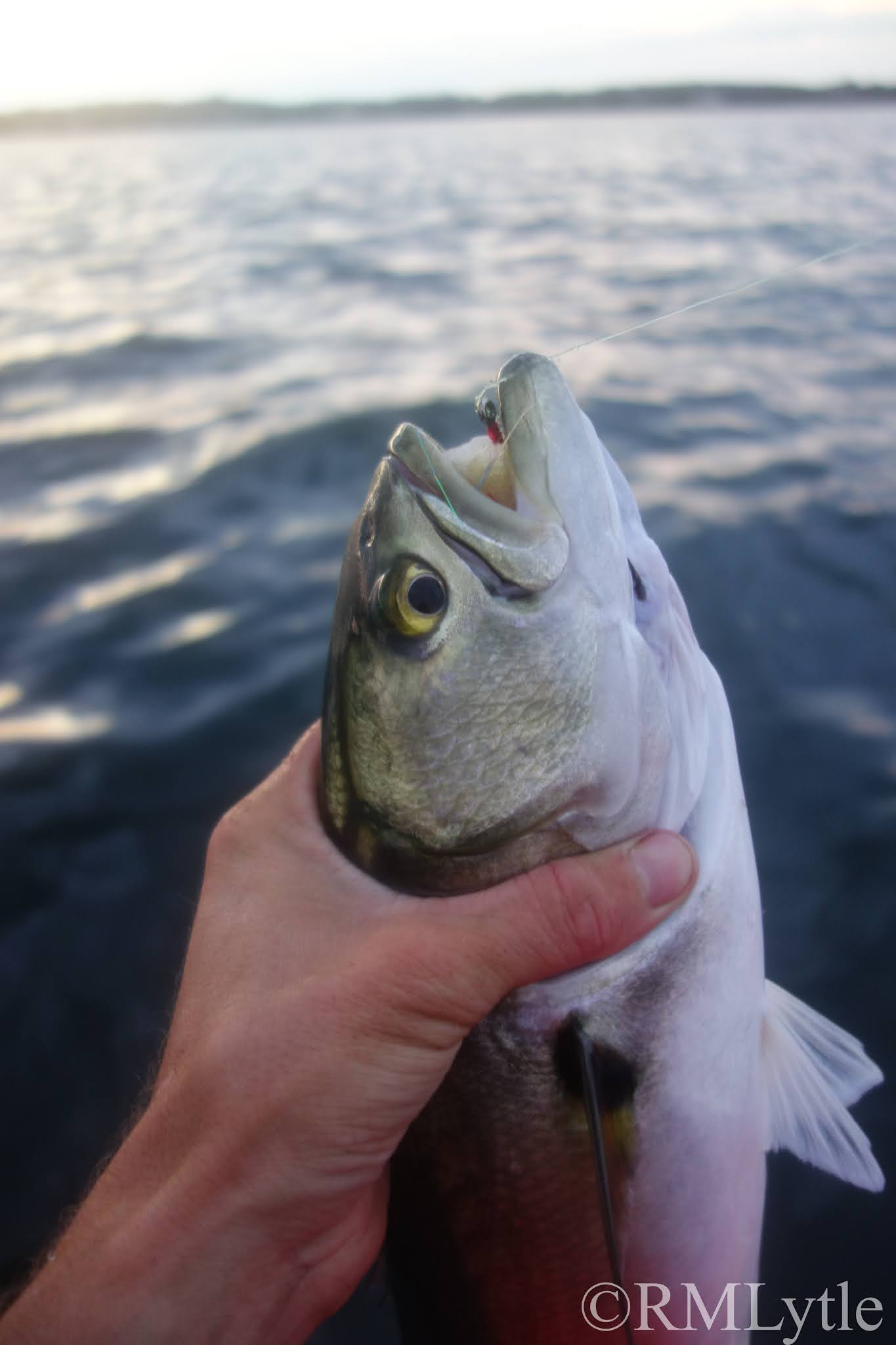
In the process of catching the mullet I noted the presence of loads of very small snapper bluefish. This is another species that striped bass often feed on. In fact, when striped bass are chasing down juvenile blues that are trying to migrate into the marshes from the open water where they were born, it is a prime opportunity to get some pretty nice bass on the fly. Sometimes the striper get downright reckless when feeding on these guys, but sometimes they get more picky and knowing how best to imitate the little blues will make a huge difference. My favorite flies and lures imitate their darting surface motions more than their profile and color, but sometimes a better mach is warranted.


Fishing for and handling baitfish shows you how the look both in the water and out, how they move, what profile predators see what they are looking at one, and so on. This is stuff you can't learn at the tying desk and sometimes something you can't learn if you're too focused on the predator fish themselves. I highly recommend taking out a light rod and small flies and specifically looking for the species your favorite fish eat.

Until next time, 

Fish for the love of fish.
Fish for the love of places fish live.
Fish for you.
And stay safe and healthy.


Thank you to my Patrons; Erin, David, John, Elizabeth, Brandon, Christopher, Shawn, Mike, Sara, Leo, C, Franky, Geof, Luke, Streamer Swinger, and Noah for making Connecticut Fly Angler possible. If you want to support this blog, look for the Patreon link at the top of the right side-bar in web version.

Monday, December 7, 2020

Catching Ladyfish and Jacks in Connecticut

 Over the last few years I've encountered a number of generally considered southern species that find their way into Connecticut waters in late summer and early fall as ocean temperatures peak. I've caught blue runners, banded rudderfish, and Spanish mackerel, and seen cobia and mangrove snappers. This year was an exceptional one for such vagrants locally: abundant cownose rays and Spanish macks in the western sound, frigate mackerel in RI and and even Eastern CT, and plenty of other anomalies. I lucked out with one frigate mackerel and saw some banded rudderfish but didn't really get in on the action until October, when the cooling temperatures lead the less tolerant fish to either leave or seek what warm water they could find. It was a day like many other October days, except instead of finding stripers blitzing Noah and I found jacks and ladyfish along with uncountable Atlantic needlefish and the odd Spanish mackerel.

At first it was all needlefish. There were hundreds if not thousands of them. Any cast got followed by a squadron of these odd shaped monsters, all snapping at any lure or fly we ripped past them. They'd even blast a spook. It was nuts.

Strongylura marina


Then came the ladyfish. I'd caught my first ladyfish a few years ago in Florida, where they are a year-round resident and often considered irritating, sometimes even trash fish. Of course I quickly fell in love with these acrobatic silvery fish. Catching them locally is something I've long known was possible and has been a goal of mine, I was very pleased to see it come to fruition. Soon ladyfish were making their way into the little Lone Star Skiff with regularity, including at least one that jumped into the boat still green. Noah and I were having a hysterical time catching these high flying fish, in greater numbers than we ever got in Florida. We'd never really gotten to savor the experience there, so it was exceptionally unique to catch enough locally to really get a good feel for it... and these fish are seriously fun. There's nothing in New England waters that fights quite the same. Bluefish and hickory shad don't jump as much or as high, and landlocked salmon don't zip away quite so fast, though they're probably the closest in fighting style.


Noah with the first large one.

If you look at the tail on a ladyfish, it's not dissimilar from that of some of the fastest running saltwater species like bonefish and milkfish. It's not surprising that they fight as hard as they do. It is a little surprising that people don't enjoy catching them more. Sure, they are aggressive and easily duped; and yes their maxillary has a sandpaper texture and can snarl too light a leader, but damn is it a riot when they take off. 


It wasn't long before we became aware of another southerner in our midst when the aquatic equivalent of a swarm of bees followed my fly in... a school of tiny crevalle jacks, and one of them did find steel.

Caranx hippos. On a Woolly Bugger. In CT. 

Yet another member of the Caranx genus turned up just a few casts later, the blue runner. Unlike ladyfish and crevalle jacks this is a species I'd caught locally, and New England is actually where I got my lifer. 

Caranx crysos, blue runner, this one took a gurgler.

The slay fest continued as fish suddenly began to blitz. There were clearly bluefish and ladyfish there but I also saw some scombrid like slashes and jumps. Though I managed to maintain my season long skunking of  larger scombridae and only piked up a few bluefish, Noah managed a nice Spanish mackerel. By now it really felt like we were actually fishing in Florida.


When the blitzes subsided we resumed the ladyfish and jack beat-down along the rocky shoreline. For someone who likes variety, getting these species mixed in with more locally and seasonally ubiquitous ones like needlefish and bluefish was awesome. We were doubling up on ladyfish constantly and laughing hysterically for hours. It was just visually spectacular uncomplicated fun. 


I've been playing around a lot with flies tied on lead and tungsten jigs this year. Their applications for trout, bass and panfish were already well explored but they definitely have application in the salt too.


As darkness fell we weren't sure what would happen, whether the bite would slow or stop, or change at all. It actually improved because the needlefish seemed to stop feeding, and because they are so difficult to hook we were getting a higher percentage of fish hooked and boated once the needlefish stopped biting. They were still so balled up though that I was regularly foul hooking them. I received a few bites from needlefish, they are unpleasant to say the least. I'll lump needlefish in with bluefish, mangrove snapper, and skates as fish that seem to very intentionally try to bite you, and needlefish are very good at it. 

As darkness fell I hooked the biggest of the ladyfish I'd gotten. The initial run was so hard and fast I thought it must be a Spanish mackerel, but when it came up that silver slender form was a nice surprise. This was one of my favorite fish fights this year, actually. And there have been some memorable ones.


The night proceeded with loads more ladyfish and one especially memorable visitation from a huge predator. We left genuinely shaken, but so excited we came back the next day for more.


Those two evenings will surely remain some of my most memorable saltwater days in the northeast. 
I love what I get to do.  
Fish for the love of fish.
Fish for the love of places fish live.
Fish for you.
And stay safe and healthy.


Thank you to my Patrons; Erin, David, John, Elizabeth, Brandon, Christopher, Shawn, Mike, Sara, Leo, C, and Franky for supporting this blog on Patreon

Tuesday, September 29, 2020

It All Went Down in Buzzards Bay

 I could still hear the frantic calls of gulls and terns ringing in my ears as we hit the road home. It had been one of those events. Bait, predator fish, and birds all collided under the right conditions, and massive blitzes were scattered all over. We paddled till our bodies wouldn't let us, bent rods on bass and blues, a few of them large, and almost died in raging and turbulent currents. This was the stuff I live for. This was the goods. Everything broke and we lost our minds over the course of two days in Buzzards Bay.


 Until next time,

Fish for the love of fish.
Fish for the love of places fish live.
Fish for you.
And stay safe and healthy.


Thank you to my Patrons; Erin, David, John, Elizabeth, Brandon, Christopher, Shawn, Mike, Sara, Leo, and Franky for supporting this blog on Patreon.