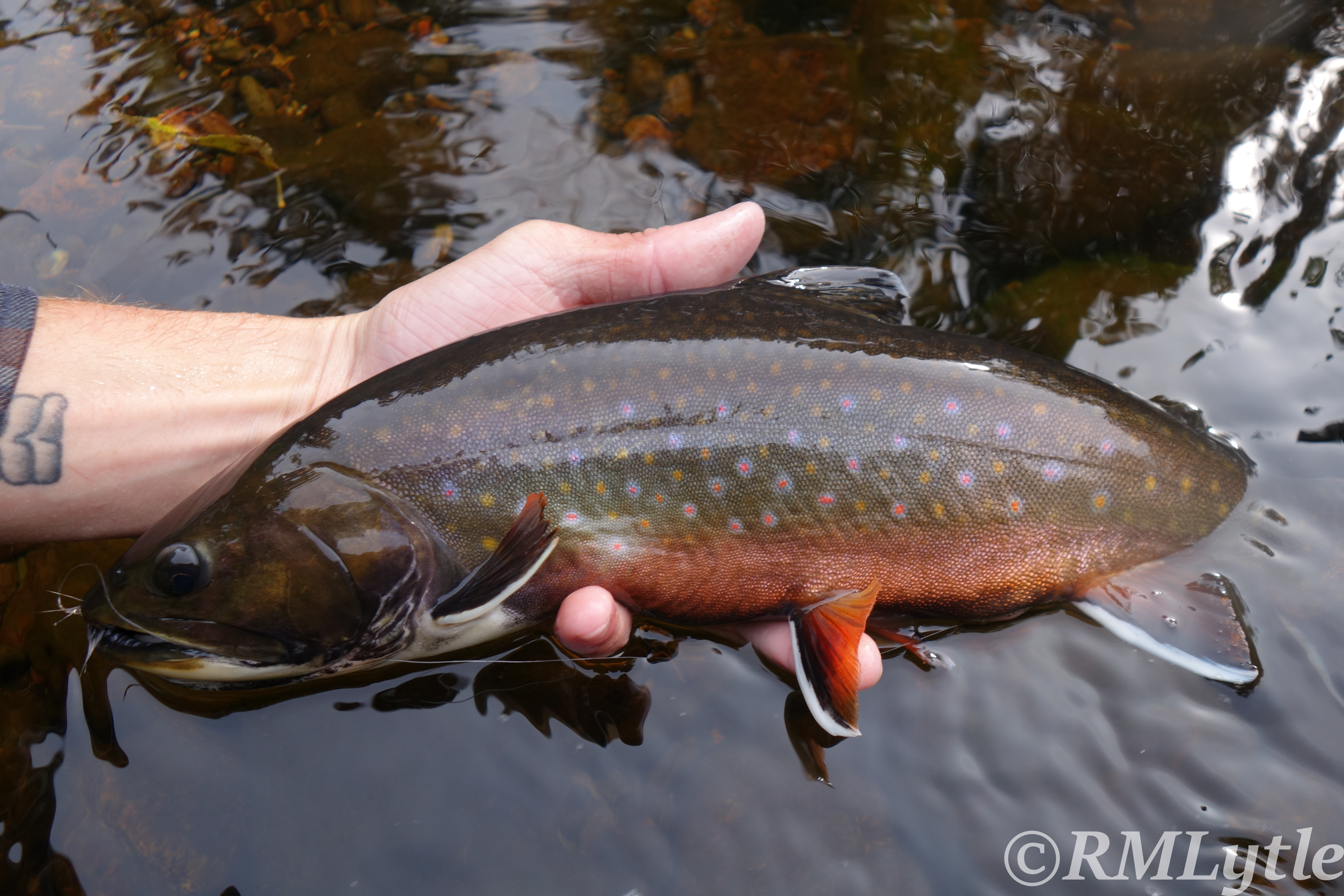
Hey all! We're shifting into winter mode for sure now here in Connecticut, and with that comes some slight programs shifts. Let's start with the late fall recap, though. November was a fair month for clients with a few good catches, with some good some decent chunks of time for me to get out and do my own thing. Water levels were up and down, providing both good wading and a few floatable days on the Shetucket. My client Dar hit the best window I've had yet with a fairly steady bite until the water started to rise and shut things down for the day.
Saturday, December 6, 2025
Early Winter Guiding Updates & Report
Saturday, March 1, 2025
Solitudinous
There's no such word, but these are the sorts of things that come to mind when you are by your lonesome, laying on the forest floor focusing on breathing and stretching to relive tension in your back. I find I really feel do fatigue now, that close to two decades of tromping around in the woods, rivers, and urban landscape with a variety of shoulder-mounted carrying cases- be the slings or back packs -loaded up with cameras, fishing tackle, and necessities did eventually start to do damage. So I can't just ignore it anymore. I have to pick and chose what I carry and how I carry it, and I need to rest and stretch. And so that's what I was doing, twisted into an odd pose on the forest floor, trying to get my diaphragm to do what I'm told it should do instead of what years of bad posture have taught it to do; and trying to stretch the muscles in my shoulder so I wouldn't keep wanting to kill myself so much. It would be a rather odd sight were anyone to come upon me, but such an encounter would be doubtful. This was BFE, if ever such a place existed. I'd just caught the first fish of the day. She was a lovely little brook trout no more than four and a half inches in length and had come up for a dark colored deer-hair caddis. I was fishing the way I wanted to this day: with a dry fly. This was to spite fairly cool water temperatures. I'm sure that I could have tempted a few more and perhaps larger fish with a nymph of some sort, but there was no need. Some bugs were active, including the cursory winter stones which occasionally skittered across the pools. I only saw one meet its demise in the rise form of a fish, though. A few hundred yards in and the plop of the little char as I dropped it from by barbless hook back into the stream told me I could take a rest.
So there I lay in the dappled light on the forest floor, stretching and thinking about everything and nothing. It was a very bright, bluebird day. A cold front had passed through overnight, draped from a low pressure center that tracked through Canada. In front of it had been seasonably warm air in the mid to high fifties, as well as some rain and clouds. Though the air behind the front wasn't cold necessarily it was cold-er. And wind came with it. It whipped the tree tops about a bit and I occasionally heard a branch come down. Not big ones, really, but enough to make me wonder if one might clock me in the head at some point. The sun and the deep blue sky felt a bit contrary to the wind, but the two do often come in tandem. Those dry, clear, bright post-frontal day are wind makers. The blue was brilliant though, and the radiant heat from our burning gas ball was doing wonders for my hands that had gotten a little chilled coming in contact with the water.
When I did finally stand back up I felt a fair bit better, but everything was bluer than it ought to be. The bright sky had left a lasting tint to my vision that lingered a good few minutes. I shouldered my sling pack, this time backwards to try to counteract the lingering soreness in my right shoulder, and told myself to just leave it in the car next time. I'd be far better off pocketing a box of flies and spool of tippet, and did I really need the camera?
I worked my way down stream, being picky about where I fished. This wasn't the time to try to eek a fish out of every nook and cranny, I just wanted to fish some of the longer runs and pools. I didn't used to fish down very often. It was Alan Petrucci that changed my direction in that regard. Prior to knowing Alan I fished pretty strictly upstream, trying to stay behind and out of sight of the trout. This worked fine, but I learned from Alan that I could put my fly in places while going down that one just couldn't get it to while going up. I still fish up sometimes, but not always.
I reached a run that that looks perfect, and eased into a position on the bank well above it. I gathered my fly line in hand, pulled back, and let it fly in a short bow and arrow cast. I then fed line to let the fly drift down the run. When it had drifted a distance I felt sufficient, I let it come about and hang in the current. A waking dry fly like this has almost universal appeal to Salvelinus fontinalis. On one of the popular and pressured stretches of river in northern Maine I was told to fish stonefly nymphs, that a mono rig would serve me well, that these brook trout were harder. I listened, but only for a bit. Frustration and my own rationale wouldn't let me fish a mono rig to a big wild brook trout, it felt counter to what should be done. Perhaps luck is a better friend to me than I usually suspect it is, but I had absolutely no difficulty catching robust brookies and landlocked salmon on a skated Hornberg. Don't let these nymphing nerds fool you; brook trout love a skated fly. And even in that barely forty degree water in Central Connecticut, it worked a charm. Up came a brookie, and I whiffed him like I was trying to. I played with that fish for a little while, getting it to come up again and again. Eventually, despite my best efforts, the hook did get stuck in that trout's mouth.
I took another break, though not a stretching one. My camera had come out of my bag for the fish, may as well use it. I'm not sure why photography has always been a compulsion for me. From a technical standpoint, I remain very much an amateur. But there's been a camera in my hand on and off for almost as long as I have memories... pointed at the sky, at animals, at water. It's just something I do because it feels good and because I like pretty things.
Thank you to my Patrons; Erin, David, John, Elizabeth, Brandon, Christopher, Shawn, Mike, Sara, Franky, Geof, Luke, Noah, Justin, Sean, Tom, Mark, Jake, Chris, Oliver, oddity on Display, Sammy, and Cris & Jennifer, Courtney, Hunter, Gordon, Thomas, Trevor, Eric, and Evan for making Connecticut Fly Angler possible. If you want to support this blog, look for the Patreon link at the top of the right side-bar in web version.
Sunday, February 11, 2024
Traprock Brookies
I've fished wild trout streams through all sorts of substrate and geology. Classic limestoners, freestones through limestone bedrock, marble, quartzite, granite, gneiss, schist, sandstone, brownstone, conglomerate, alluvial substrate from clay to cobble, glacial till, even muddy lake beds. But it occurred to me not long ago that I'd never caught a brookie in a stream flowing out of and through traprock bedrock.
Traprock is a reminder of our continent's volcanic past. Millenia ago, tectonic motion let magma seep up into cracks in the Earth's crust in what is now the Mid Atlantic and Southern New England area. This magma hardened into the two kinds of rock referred to as traprock: basalt and diabase. Basalt is generally extrusive, meaning the magma cooled on the Earth's surface. Diabase typically cools below the surface. Of the two, basalt is a little more common in Connecticut. The massive, imposing mountains and ridges that run North from New Haven to Holyoke, then arc east to a terminus between Belchertown and Amherst are all volcanic remnants. Today, we drive on a lot of this, and I don't mean that our roads go over these rocky slopes. Basalt is very uniform in it's crystallization and also very hard, so it makes great aggregate for road and railroad beads, and is used in concrete and asphalt as well. Basalt is a staple of the development, industry, and infrastructure of our world whether you knew it or not. Unfortunately that means the quarrying of it has negatively impacted the species that utilize the environments that evolved around these geological features. That includes species like red cedar, blue spotted and Jefferson's salamanders, northern copperheads, red squirrel, and peregrine falcons.
| Female Northern copperheads often rely on the crevices on open trap rock ridges to gestate and birth their young. |
But what about brook trout? Are there any small streams on or along these traprock ridges, and do they have brook trout in them?
The very nature of these geologic features doesn't make for an ideal situation for a coldwater stream habitat to arise. First of all, spatially they aren't huge, so there just isn't that much room. Traprock ridges are narrow and tall, their shape lends better to streams running along or between them in the sedimentary rock they intrude rather than on the dykes themselves. But there are a couple streams that emerge from them and run some distance, and they have heavy spring influence so those that aren't season seem to stay cold.
My decision to try to catch a traprock brookie was followed by the sort of oddball research I don't often hear about other small stream anglers doing but which isn't at all unfamiliar to me. I lined up bedrock maps with topographic maps to find streams that ran not just near trap rock but through it. Then I examined some satellite imagery to get an idea of the stream's consistency. I have enough experience to tell when a mapped stream is likely to be the sort that can hold water and therefore fish year round. It also gives me an idea of the forest type and what I might be in for as far as bushwhacking. Eventually I found one that looked very promising. An added confidence booster, though it had never been sampled another in the watershed had been with brook trout, albeit very few, in the 1990's and there were no dams preventing cross pollination, if you will, between the two streams. Some culverts could throw a wrench in that. Access would suck though, with questionable parking and a long circuitous walk. When the time came though, I suited up and hit the road.
My parking spot turned out to be legal, thankfully, but proved to be a reminder of why I got an off-road capable vehicle. I parked grabbed my rod and sling pack quickly, as I had a decent distance to walk down the road and I hate being seen with a fly rod in hand. I hustled to a bridge, not on the stream I wanted to fish but the one it flowed into. This was down in the basin, in mudstone rather that traprock. I then traversed this low gradiant creek down. There was one ominously deep pool in about a half mile of difficult to negotiate water and I hooked a brook trout there. Not only did that put a new stream on my list automatically but it gave me even more hope as the survey site at the rod I'd parked on had no brook trout in the two years it was sampled. This was likely just wintering water though. Eventually I reached my stream. I looked at my map quickly as I'd saved where it crossed the line from basalt to sedimentary bedrock on the bedrock map as my starting point. It also didn't look very favorable at the bottom end, very straight on the map and shallow in real life, but where I wanted to start there were some bends and much steeper gradient. So I hoofed it upstream, staying out of the water but stopping to fish the two decent looking runs I did see.
Just as I reached the point I'd marked I could see a good deep, slow pool upstream. The hope was there to put this goal to bed and fast. I had on a size 12 Ausable Ugly and was fishing each pool upstream, which would work well with this one as it was blocked by brush near the head. I covered the tail- as there is often at least one fish in the tail of a pool like this in the winter -to no avail. But as I extended my cast the water I was fishing held promise in the for of exceptional depth. I let the fly fall and there was a discernable but delicate tap. The next cast in the same spot I was ready and the fish was on. Success! The fish was diminutive and far from the most colorful example of her species, but that was all I'd needed. I continued upward and caught one more fish and missed some others, all very small, and decided to bother them no more. The day had been a fantastic one already.
Though this may seem like an extremely trivial goal to have achieved and perhaps an unnecessary one for just a couple tiny brook trout, I think many anglers miss some significant keys to the understanding of fish and fisheries. Frankly I'll be blunt... I've only twice been legitimately impressed by the comprehensiveness of understanding an individual trout angler had of not only wild trout but the totality of their habitat, movement, behavioral patterns, and the nature of their whole lives. The geology of the land and rivers plays a HUGE roll in how trout survive, grow, and behave and it is one of the foremost factors I look at to understand a stream and what potential it has. And though I may only very rarely fish traprock trout, it is a piece of the puzzle and another step toward my end goal of having the most thorough understanding of the natural world I can.
Thank you to my Patrons; Erin, David, John, Elizabeth, Brandon, Christopher, Shawn, Mike, Sara, Franky, Geof, Luke, Noah, Justin, Sean, Tom, Mark, Jake, Chris, Oliver, oddity on Display, and Sammy for making Connecticut Fly Angler possible. If you want to support this blog, look for the Patreon link at the top of the right side-bar in web version.
Thursday, January 18, 2024
Giant Brook Trout
I can catch oodles of eight inch brook trout in Connecticut. Those are wonderful, special little fish, and I never take them for granted, but I try to make a point not to travel for a fish I can catch at home. Maine has big brook trout, still. Certainly not as many as it once did, but they are there. When I go to Maine, that's what I want to catch: brook trout that thoroughly dwarf those I could catch back at home. That hasn't always happened, but I've gotten better and better at manufacturing it with each trip.
Back in Late September with Noah, I'd already gotten some fantastic and healthy fish to hand (read here), but was very much hoping for something even a little bit larger than those. It had become fairly clear from that experience that fairly thoroughly covering quite a lot of water would be necessary in order to find larger fish in these small creeks with lake runners, as they were clearly not evenly distributed and even some of the nicest looking water may not be holding.
Though we were only about six hours from home, this was very different territory. I traversed high grassy banks along shallow, gravely runs before dropping onto sand bars pocked with moose tracks, staying low and moving swiftly but with intent so as not to spook any fish that might be in shallow, visible lies. I didn't really see fish for a long time, it was clear that most were holding in the very deep, slow pools. That made sense, it wasn't spawning time yet so there was little need for the fish to put themselves at risk in the shallow tailouts and pockets just yet. They were likely hopping from deep spot to deep spot on their way up, with some time in the faster runs with lots of cover as well like where I'd caught them the day before.
But even those didn't always seem to provide the pull I was looking for. Then I came to one dark, deep bend pool with an overhanging tree and loads of wood in the water. This one had to be harboring something large. The head looked extremely juicy, with the main current dumping over a beautiful gravel shelf into the depths of the pool and a foam covered eddy on the other side with branches sticking through. I dangled and tightlined the big, heavy Ausable Ugly through the faster current, then pulsed and retrieved it through the eddy. Not believing there wasn't a fish there to be caught, I then went back through it again making extra certain the fly got down deep. As small one obliged, maybe 10 inches... that wasn't it. I moved on to the heart of the pool, counting the fly down and retrieving gradually, forming figure eights with the line in the palm of my hand then raising the rod tip in little jumps as the leader neared the tip. Still no satisfying thump. I had moved down to the tail when Noah rounded the corner. We both remarked how incredible this pool looked and that there must be a large fish in it. Looking back to what I was doing I saw a large dark shadow streak out from one of the many logs. I struck, my rod flexing as the hook point found purchase, and said "Oh there she is!"
Large brook trout often don't have the piss and vinegar of other salmonid species, and though this was one of the heavier trout I'd stuck in a while it wasn't terribly hard to control. We had it in the net in just a short time. The fish of the trip was indeed a hefty one, and dressed up in proper brook trout finery.
It had been a number of years since I'd tied into a Maine brook trout this size, and to do so in a lesser known fishery made it all the more satisfying. It was yet another reminder of the magic these fish I've long adored hold. Brook trout were one of the fish that brought me to fly fishing and made me obsess over it, hiking and biking sometimes 60 miles in a day to try to find new streams before I could drive. I'm less brook trout obsessed than I was back then, but they do remain a driving force in my angling- the hard headed, gaudy, and aggressive native that they are. It is hard to deny the appeal. They stand both for wilderness and the fact that we haven't quite snuffed out wild things yet, even when we've done our damnedest to do so. In Connecticut, there are still wild brook trout swimming behind shopping centers and through neighborhoods. In Maine, there are still big, darkly colored brookies residing in lakes and ponds and a few rivers. They are a stubborn relic of what this land once was.
Thank you to my Patrons; Erin, David, John, Elizabeth, Brandon, Christopher, Shawn, Mike, Sara, Franky, Geof, Luke, Noah, Justin, Sean, Tom, Mark, Jake, Chris, Oliver, oddity on Display, and Sammy for making Connecticut Fly Angler possible. If you want to support this blog, look for the Patreon link at the top of the right side-bar in web version.
Wednesday, November 8, 2023
One Run (Big Maine Brookies)
Thank you to my Patrons; Erin, David, John, Elizabeth, Brandon, Christopher, Shawn, Mike, Sara, Franky, Geof, Luke, Noah, Justin, Sean, Tom, Mark, Jake, Chris, Oliver, oddity on Display, and Sammy for making Connecticut Fly Angler possible. If you want to support this blog, look for the Patreon link at the top of the right side-bar in web version.
Wednesday, April 5, 2023
Go Back
Thank you to my Patrons; Erin, David, John, Elizabeth, Brandon, Christopher, Shawn, Mike, Sara, Franky, Geof, Luke, Noah, Justin, Sean, Tom, Mark, Jake, Chris, Oliver, and oddity on Display for making Connecticut Fly Angler possible. If you want to support this blog, look for the Patreon link at the top of the right side-bar in web version.
Wednesday, December 21, 2022
Trouting About in Vermont (Pt. 3): The Wild Trifecta
I've caught scant few wild rainbow trout in New England, which is okay. They shouldn't really be here and they can create significant competition for brook trout especially in small, cold, headwater streams. Because they require very cold runoff in the spring for their early spawning behavior, they're restricted to northern New England, largely Vermont and New Hampshire. Most of the wild rainbows I've caught have in fact been in Vermont. I personally love O. mykiss as a species. They're insectivorous, surface oriented, vibrant, and also as adaptable as is any salmonid. They possess substantial diversity, with forms and subspecies that behave and look quite differently. Unfortunately, most New Englanders' experience is limited to the worst examples of the species: the hideous, hardly functional, barely even real trout hatchery raised version. I'm always looking forward to getting to interact with wild ones again, and when I get to fish for them within their native range I will enjoy that even more. After getting our butts handed to us on the Battenkill on our second morning, I suggested we try a river that was known to hold wild rainbows. In fact, all three trout species we'd have opportunity to target on this trip would be present in this stream.
This was a classic New England trout stream showing multiple characters; descending from the granite hills as a clear, broken freestone before lazily twisting and turning into the valley, gaining size but meandering and creating wonderful cut banks and slow pools. We took a top-down approach, starting in the picturesque and boulder filled upper end. This was a stunning, classic piece of New England brook trout water.
We quickly found, though, that when we say a salmonid in these clear waters with visibly white-tipped fins, it was pretty much without fail a rainbow. I was a bit surprised by how much the rainbows looked like a brook trout in the water, and I'm not quite sure why it was the case. But each time I spotted a fish and watched it for a time, I eventually realized that I was looking at an Oncorhynchus. These elegant little fish acted much like brook trout would in the same water, often hovering mid water column and rising to intercept anything and everything they could. It's an eat or be eaten world for a small trout. Tiny brown trout occupied some of the same water, and they proved easier to bring to hand initially. Perhaps just because I was far less interested in them.
When we reached our next destination, I promptly came to the conclusion that this was my kind of stream. Down here, it had a very different character. Meandering through dense brush and farmland, this felt like the kind of small water where some trout of not-small proportions might lurk. Garth and I went separate ways. He headed off downriver while I went up. In the first good run I came to, with another fly of Adirondack origins on (the Ausable Ugly) I deceived three small trutta. Each looked similar, but had very different character from those I've caught in other waters. This is something you'll notice as you begin to really know wild trout. They take on different appearances and characteristics based on where they live. These browns lived in extremely clear water with light colored sandy bottom, they were notably pale by comparison to brown trout I'd catch in other streams on this same trip. I would go so far as to say that I could tell you what stream certain brown trout were caught in just by their appearance alone. The browns in this stream had very plain fins, pale red spots, and salt-and peppery heads. There was variation within the stream, of course, but it was just variation on an identifiable theme. Were I to catch a brown that looked dramatically different here I'd be inclined to believe that it had moved in from a part of the watershed with different habitat.
The unfortunate reality is, though the whole length of this stream would indeed have wild salmonidae and be spectacular brook trout habitat, the only brook trout we'd catch in that stream was one Garth got that looked to me to be a stocker. I caught one brook trout that morning on the Battenkill and she was a stunner of a wild fish.
It was quite clear that the abundant rainbows, which more or less match the niche that brook trout would fill in this small stream environment, with the added factor of brown trout also being present, is keeping this from being the incredible native brook trout stream it so easily could and should be. It's a shame that our species so often feels the need to play God. Though I enjoyed fishing for these wild rainbows, had that been a mid-teens brook trout I hooked in that one pool I'd have been no less happy. Where possible both physically and socially, we should be reclaiming these streams. This stream likely isn't the easiest one to reclaim. There are so many others like it across the country that could be thriving native fisheries no less interesting and fishable than the currently existing non-natives.Thursday, November 17, 2022
Trouting About in Vermont (Pt. 1)
Back in mid September, with some rains bringing rivers back to life and temperatures on the fall, the trout itch started to need scratching. With the Farmington still too low to be of particular interest in daylight, Garth and I set our sights further afield. The Rangeley region seemed like one decent choice, it had been a while since I'd tangled with large brook trout. Night fishing in the Catskills also didn't seem like a bad plan. We settled on an area between the two, and one I'd not spent as much time exploring. Though I'd fished Vermont many times, rarely ever have trout been the target. With input from Drew Price of Masterclass Angling, a lot of research trough USGS data, satellite imagery, and the limited available fishery data, I created a hit-list of rivers and specific spots within rivers. I packed up the 4Runner and picked up Garth after he got home from work one evening and we headed north.
The plan was simple: car camp, fish, and explore. We had a few days and nights to work with on some of the prettiest trout waters in the Northeast. The Green Mountains have a rich trout and fly fishing history; being home to Orvis's headquarters, the famed and fickle Battenkill, and some exceptionally beautiful and large wild salmonidae. It is a stronghold of native brook trout, though some of the Green's streams are now dominated by nonnative brown trout and in some cases, rainbows as well. We hoped to catch all three species in some beautiful and at times quite remote waters.
We arrived in the dark and caught some rest near the stream I wanted to fish first. It was the most remote of them and a totally blank slate for us. It was going to be cold and there'd be trout in it, we just didn't know how many, what species, or how big. When I first got a look at the river I liked what I saw. Flows were strong, the water was a little tanic, and the surrounding woods were beautiful mixed forest dripping with moss. Spring seeps poured out of the hills and the river valley itself was spotted with beaver meadows. Varied habitat makes the best habitat, and this felt like a clean and healthy ecosystem. I was getting pretty excited.
This environment may actually have had the highest density of Eastern newts I'd ever encountered. The wetland areas, be they active beaver ponds or the remnants of abandoned ones, were crawling with hundreds upon hundreds of the aquatic form. Walking through the woods we turned up the bright orange terrestrial form as well, know as red efts.
Also occupying the beaver ponds were creek chubs and a variety of dragonfly species. The stream itself was cold and fast and seemed fairly sterile, harboring caddis and midges but very little in the way of mayflies as far as I could tell. It seemed a bit too "clean" and nutrient deficient to be brown trout habitat- remember that point - and out initial visit seemed to indicate that the stream was very rich with brook trout and hardly any other fish of any kind. These fish were beautiful, dark specimens averaging 6 inches. Some exceeded that mark, but it didn't feel like encountering one much in excess of 10 inches was likely. They were quite numerous though. I fished the ever reliable Ausable Ugly, and it produced handsome fontinalis one after another for a few hours.
After months of fishing urban, industrial, and suburban habitats almost exclusively, it was a relief to get away from people and signs of people. Unfortunately some of this was an illusion. Neither the forest itself nor the stream were in a fully natural state. The land it was contained within was is fact, in essence, a protected tree farm open to recreation. It was timber in reserve. We passed patch cuts on the long dirt road in. But at the very least signs of human presence were limited down in the river valley. There weren't angler foot paths. The fish didn't have the injuries so common in pressured fisheries where trout are caught and released repetitively throughout their lives. Trash wasn't merely scarce, there was none. It was rejuvenating.
I can only catch so many small brook trout in a day, though, before I feel bad for disrupting their natural rhythms. Garth and I then decided to go disrupt the rhythm of some non-natives. It was time to look for a big brown trout. Though not a widely known big trutta destination, Garth and I had a bit of intel to act on. Perhaps we'd stop somewhere along the way that we knew nothing about as well. This was an exploratory mission after all.
Thank you to my Patrons; Erin, David, John, Elizabeth, Brandon, Christopher, Shawn, Mike, Sara, Franky, Geof, Luke, Noah, Justin, Sean, Tom, Mark, Jake, Chris, and Oliver for making Connecticut Fly Angler possible. If you want to support this blog, look for the Patreon link at the top of the right side-bar in web version.
Tuesday, October 4, 2022
The Prettiest Brook Trout in Connecticut
I first met Alan Petrucci at the Comstock Covered Bridge. If you live outside of central Ct you likely don't know what that is, but it's well known here. The Comstock Bridge is lovely restored relic of a by-gone era, crossing Connecticut's Salmon River. I stood near it's west entrance, having just walked there from my home, at the time about four miles away. Connecticut Fly Angler was in its infancy then, being written by a kid trying to sound like he wasn't a kid. I didn't even have a drivers license yet. I was finding fishing spots by shear physical effort in those days, looking at maps and walking or biking as far as I could. I didn't know many other anglers. But there was this guy writing this blog called Small Stream Reflections.
I almost idolized Alan. In those I was completely obsessed with small stream and wild brook trout. I think it was because such pursuits felt almost childish to me. I believe that play is intrinsically important to humans well beyond childhood though society today may try to beat it out of us. And brook trout fishing felt so much like play. It reminded me of my formative years, when my mother would bring me and later my brother too to state parks around my first home; Franklin, Pennsylvania. Playing in creeks was an integral part of my upbringing. Flipping rocks and looking for salamanders, catching crayfish, and watching fish were the most important tasks. Small stream fly fishing felt more like that than other hobbies, and it seemed to me that this Alan Petrucci had held onto that simple, childlike joy. I wanted to fish with him.
I recognized Alan's vehicle immediately, that little black hatch-back with the BRK TRT license plate will live in my memory forever. He parked and walked over to introduce himself. I was an awkward teenager then, and I recall acting like it. I was bad at talking to new people then. I'm not sure what Alan's immediate impression was though hist struck me. Alan was a quiet man. No word he spoke was unnecessary. If he wanted to be funny, he was funny. If he wanted to be serious, he was serious. But generally he was a quiet man and that aptly carried over to his pursuit of small stream trout. We got along well, possibly because I was old for my age. Or perhaps he was young for his. Our appreciation for the environment where brook trout live, which Alan called "Brook Trout Forest" was really what brought us together. It was a simple, un-fancy appreciation of the natural and small. Brook trout in CT are not big, and indeed Alan always found the smaller char far prettier. He'd caught large ones, stories of which he told me while we drove to a new stream. "Those are ugly," he'd say, "those big males... big and ugly."
Alan seemed to know every stream. As he drove me to a place I'd never been he'd point out road crossings of other streams and ask "Ever fish down there?", and he'd always have a few words about each one. He'd describe a wild brown trout he'd caught, gesturing with his fingers to show the size, or describe the colors of the brook trout. I realize, now, that that's what I've become since. I already covered water beyond my reasonable means then. Spurred on by Alan and his apparent ability to find a brook trout anywhere, though, I began scouring with a fine toothed comb, and now much like Alan I have quiet anecdotes to fill in what had been holes on my personal map. He and I always talked about new streams. He was an old man then but he was not done exploring. He wanted to know what places held these wonderful fish and what didn't, as did I.
We were winding through a hemlock forest on one of the prettiest roads in CT when Alan looked over and said "I'm taking you to a stream that has the most beautiful brook trout in CT". Soon we arrived at a tumbling brook full of plunge pools. Alan was right. The brook trout there were some of the most colorful I'd seen anywhere.
Friday, July 8, 2022
My Best CT Brook Trout Yet
My hunt for giant wild brook trout was going quite well this spring when I started to ply anew stretch of stream. I'd caught 11 fish between 12 and 14 inches already in two other streams, and this one had similar characteristics. It had everything I've learned to look for with one exception: it had brown trout. I was a bit worried this might be hamper the brook trout from reaching their potential. Generally, where brown trout exist, if brook trout persist they do so in a compromised state. They don't attain the sort of size that they could otherwise while they compete with the more piscivorous and more warm water tolerant browns. The result is often a somewhat stunted brook trout population. I had hope for this stream in spite of that, why I'm not exactly sure.
On my first visits this spring I didn't even catch a brook trout. It was browns with a few large fallfish mixed in. A few of the browns were quite decent but the largest fish I caught on the second visit was a one pound fallfish. Each time I fished evening into dark, fishing down with streamers then back up with a small mouse pattern. The streamer fishing predictably outperformed, but I managed a few fish on the mouse as well. During those trips, the flow was moderate. I pinpointed a particular hole that I felt could really hold something special. It had all the right ingredients: cut bank, notable depth, a nice incoming run. I was surprised it didn't produce a fish on those first few attempts.
On my fourth visit, the water was much lower and I was struggling to find the success I had hoped for. The brown trout were turned off and either darting for cover or already underneath, and just not receptive. I tried being extremely slow and cautious but it just wasn't working. Then I came to that hole, the one I had high expectations for. I tied on larger fly than I'd been using, switching from a #10 Ausable Ugly to a #4 Half Pint. This hole was, after all, multiple feet deeper than anywhere I'd yet fished and I felt I needed not only to get down but to have something fairly meaty on. In four casts, I came tight. A torpedo shaped salmonid came out of the water, leaping as spectacularly as a fish of such size possibly could. To my astonishment I could clearly see that this was a brook trout and an extraordinary one at that. It actually had some control for a few moments, taking nine and dogging towards the cut bank. That's not something I'm used to with CT brook trout. I was fishing a 5wt though, as well as 8lb tippet, and it couldn't win. When I got her in the net I uttered a low guttural laugh of astonishment and gratification. I'd put a lot of effort in over the late winter and spring after large salmonids, split between rogue brown trout and giant brookies. Now I had my heaviest CT brookie in my hands.
I know, of course, that there exist some wild char in CT that are even larger than this one. But for the summer, I think I'm mostly done with big brookies locally. It's been dry and hot. No need to over-pressure them. I may well end up of a bender again when the water starts to cool down, but I'm not sure.
Thank you to my Patrons; Erin, David, John, Elizabeth, Brandon, Christopher, Shawn, Mike, Sara, Leo, Franky, Geof, Luke, Noah, Justin, Sean, Tom, Mark, and Jake for making Connecticut Fly Angler possible. If you want to support this blog, look for the Patreon link at the top of the right side-bar in web version.
Tuesday, May 17, 2022
Monster Connecticut Brook Trout
I've been on the hunt for big brookies this spring. After a number of years of less dedicated wild brook trout fishing, wherein I'd just occasionally revisited easy spots already well known to me and caught very typically sized fish, I'd got the bug again this year and wanted to find something impressive. I hadn't caught a wild brook trout of over a foot in Connecticut in quite a while. Catching fish like that can sort of just happen if you fish for brook trout enough, but I didn't just want to go out and hammer brookies every day. That isn't really my thing anymore, and I don't think it does the fish any favors. I've taken to resting streams and having a measured approach. I'm not trying to catch every brookie in the water I fish, just the largest ones. I'm also not just fishing any old water. I've come, over time, to understand what makes big brook trout in CT, and it doesn't happen just anywhere there are brook trout. If you think I'm going to just go ahead and tell you the magic ingredients, well... I'm sorry to disappoint you, but I won't. They make sense though. If you follow the natural patterns, understand the biomass factors, and think about how different habitats work you'll figure it out on your own. That's a great feeling and I don't want to deprive you of that.
Once I'd figured out the formula it was just a matter of time, and not much time. I'd stacked the deck in my favor, if I caught brook trout at all in the places I was fishing there was a strong probability one would be a monster. To catch the fish, I'd also stack the deck by using larger flies than I might otherwise. I've never been a big fly for brook trout guy, in large part because bigger hooks and small delicate fish do not mix. But I wasn't after small fish, and there wouldn't even really be any small fish in the places I was fishing. I'd fish larger streamers, mice, gurglers, and things of that sort unless I saw fish actively feeding. I wasn't taking that strategy because the fish would want really big meals, more so because I needed flies with a bit of calling power because I didn't know exactly where the fish would be sitting a lot of the time and wanted to fish in a way that would potentially draw a big brook trout from further away.
It's funny, frankly, just how quickly it came together. Of course that's ignoring the years it took to put everything in place to make it easy to do, but once I had the idea in my head it was a matter of days. The location I had the most confidence in showed me two giant brook trout on my first visit of the year, though I didn't catch either one. On my second visit, I caught one of the largest brook trout I've ever caught in CT. At fourteen and a half inches and carrying about a pound, it was an extraordinary specimen of a native salmonid.
As we shift into what feels like a very early summer here in CT, I do intend to devote a bit more time over the coming month or so to these big brook trout. Since I got that one I managed a few other monsters as well, but I'd really like to break the 18 inch mark here in CT. I think it's possible, though I don't know of anyone that has done so recently. If nothing else, it's a relief to see that our only remaining wild native salmonid is doing well enough to kick out specimens as big as a pound. That certainly is a good thing.
Thank you to my Patrons; Erin, David, John, Elizabeth, Brandon, Christopher, Shawn, Mike, Sara, Leo, C, Franky, Geof, Luke, Streamer Swinger, Noah, Justin, Sean, Tom, Mark, and Jake for making Connecticut Fly Angler possible. If you want to support this blog, look for the Patreon link at the top of the right side-bar in web version.