Showing posts with label Photography. Show all posts

Friday, July 17, 2026

Smoked Out (Photo Essay)

 Photographs taken in the Canadian forest fire smoke haze in Central CT, 15 July 2026. These have not been at all white-balance adjusted. This was the natural light. 


Thank you to my Patrons; Erin, David, John, Elizabeth, Brandon, Christopher, Shawn, Mike, Sara, Franky, Geof, Luke, Noah, Justin, Sean, Tom, Mark, Jake, Chris, Oliver, oddity on Display, Sammy, and Cris & Jennifer, Hunter, Thomas, Trevor, Eric, Evan, Javier, Ryan, Dar, Eric, and Collin for making Connecticut Fly Angler possible. If you want to support this blog and access more informative content, look for the Patreon link at the top of the right side-bar in web version!

Monday, May 4, 2026

Vehemently Anti Crepuscular

 There are little things, little visual evidences, that pop up in our world to tell us how incredibly small we are. One such phenomena that has that effect on me is the appearance of anticrepuscular rays. See, the suns rays are parallel. It really, really doesn't feel like it, because the sun is so comparatively large and far away that the more common way we see rays of light from the sun- crepuscular rays -they appear to diverge from the source. 

This is a scale issue, though, of the same order that a road's painted lines appear to  get closer together the further away they are... it's just something we're much less familiar with seeing. Crepuscular rays are not remotely rare. They occur all the time when sun shine through clouds, leaves, or even sky scrapers in hazy conditions early or late in the day. The optical conditions that let those rays extend overhead are rarer, but they do occur. When they do, its spectacular.

Anticrepuscular rays occur when the suns ray are visible meeting again at infinity on the opposite wide of the sky from the sun. Very, very rarely, crepuscular rays meet anticrepuscular rays meet and span the whole sky, supposedly. I've never seen such an occurrence. One day in Florida, though, with the sun rising out over the Atlantic, I turned to the West and gasped at the sight of the best anticrepuscular rays I'd ever had the pleasure to see. It may seem a silly thing to feel small observing this, but in some sense this optical phenomena represents the scale of the light from our sun and the clouds in our atmosphere, going so far and visually spreading apart in such away that when you can see those rays on the other side of the sky, it looks like they just go on forever. 

That's pretty darned cool if you ask me. 

Thank you to my Patrons; Erin, David, John, Elizabeth, Brandon, Christopher, Shawn, Mike, Sara, Franky, Geof, Luke, Noah, Justin, Sean, Tom, Mark, Jake, Chris, Oliver, oddity on Display, Sammy, and Cris & Jennifer, Hunter, Gordon, Thomas, Trevor, Eric, Evan, Javier, Ryan, Dar, Eric, and Collin for making Connecticut Fly Angler possible. If you want to support this blog and access more informative content, look for the Patreon link at the top of the right side-bar in web version!

Monday, February 10, 2025

My Search for a Connecticut Moose

 The late Douglas Adams will always be one of my favorite writers. Though it was his fictional work, The Hitchiker's Guide to the Galaxy and its sequels were my first introduction, thanks to my father, I later found an grainy presentation by Adams on YouTube in which he read a portion of a non fiction work of his called Last Chance to See, in which Adams and zoologist Mark Carwardine travel to see species on the brink. His description of a critically endangered, flightless parrot from New Zealand called the kakapo bit me hard, I had to read the book. Some time later I came across a documentary series that took place after Adams' passing, in which Carwardine was joined by Stephen Fry to revisit the places and species from the book. Sadly, in the intervening time, one species, the Yangtze River dolphin, had been declared extinct, and another, the Northern white rhino, was right on the precipice. 

I must say, I'm not a mammal guy. I've never been than smitten by megafauna or by mammals of any kind really, not in the way some people are. That isn't to say I dislike or disrespect them in any way, they just don't appeal in the way reptiles, amphibians, and fish do. But something about the episode on the Northern white rhino stirred a curiosity in me. Now, there's little chance I'll get to Africa any time soon, and very sadly in the time since that episode the subspecies has dropped to just too female individuals. The last male, an individual that had been named Sudan, died in 2018. Though scientists are trying hard to find a way to save the genetic lineage of the Northern white rhino, there is little to no hope that I'd ever get to see one in the wild. But it did make me want to see big mammals. Perhaps that's because I have an innate need to be made to feel small by the things I pursue, like I could be crushed, consumed, or trampled. There are a few things that have made me feel really, truly alive and they all revolve around that. An apt description of the feeling I get alludes me, but it is a form of excitement that nothing else has matched. It's sort of an out of control but in control feeling... something big and indomitable has the stage and is actually in control, but if I can stay quick of wit and reactive, I have just enough control to still see the show and not be killed. I get this from seeing large sharks and I get it from being in the path of violent weather. And one time I got it when a moose charged me. 

Northwest Maine is a very good place to be if you like moose, though they've never been the reason for my own visits. But they're out there. One day, solo and ambitious, I ventured from a rented cabin out miles of logging roads in search of beaver ponds with brook trout. The woods in Northern Maine are essentially a farm, patch worked by clear cuts and plots in various stages of re-growth, some re-planted with pine, others left to their own devices. They're interlaced with roads that vary in width, dryness, and ease of travel. One I happened upon had been booby-trapped by beavers. A small culvert underneath was plugged with wood and the tiny stream ventured out onto the road grade, flowing through the deep ruts of whatever truck had been through last. Astonishingly, there were tiny brook trout in those ruts. The water wasn't much more than a foot deep but they were there, rising occasionally to who knows what. So I caught wild brook trout out of a road. Just a few hundred yards past that though, I was stopped dead in my tracks by what sounded like a car driving through the woods. To my northeast was a plot that was filling in with paper birch, often a tree that will take hold first in these clear cuts. These were young trees no more than twenty feet tall and most much shorter than that, bunched so tightly that you couldn't see into the tree-line more than ten feet or so. I could see the tops of trees moving further back as something wicked this way came. That is as disconcerting a thing as I'd ever seen. I quickly backed off the road into similar tightly bunched birch of the other side, not turning my back, until I could just barely see the road. I never actually saw it, but a moose was back there, huffing and stomping around, and they say moose don't bluff charge. I figured I was out of sight so I just stayed as still as I could, trying to control my breathing and slow my heart back down to something appropriate while hoping that the breeze wouldn't give away my position. The moose moved on after a bit of pacing, and I waited until I couldn't hear him (perhaps more likely her, given the early summer time frame?) and moved on myself. That experience was a very, very exciting one. It gave me that feeling, whatever it is. I think seeing massive rhinos reminded me that large mammals can give me that feeling. So it was decided that it was very much time to see a Connecticut moose. 


CT DEEP estimates that there are more than 100 individuals in CT's established moose population. They do a fair job of remaining elusive though, as the number of sighting each year is generally much smaller than the estimated population. In a busy, developed state this may shock some but it doesn't surprise me much. Non-human animals are cleverer than we like to believe, and that includes their intelligence in keeping away from us. Not all that long ago, though, there weren't many moose here at all. Likely owing to the vast deforestation that took place not long after colonization, there were no moose in CT for better than a century. In fact, the first photograph of a Connecticut moose was taken in 1956. With forests re-growing across Massachusetts, moose were filtering south, and by present day have established themselves well despite some habitat deficiencies. 

If you're a good angler- one with a naturalist's eye -you know how to discern the habitat of your query. Knowing what the fish need and are evolved for is most of the battle. With time, discerning what makes good habitat becomes second nature. This is no different in hunting, even if that hunting is with a camera instead of a firearm. Drawing from past experiences in moose territory, everything I'd read or watched about New England's largest land animal, and available sighting information, I hit the maps. I read satellite imagery like I'd read a river. Instead of rocks and current I was looking for topography and forest age. I looked for sparse canopy, logged areas, and wetlands. I picked a spot to focus on much in the way I'd pick a stretch of river, then my partner Emily and I went there to try our luck at finding some tracks or sign. 

Though Connecticut's moose population has seen a fairly recent bump in numbers, New England's largest land animal isn't without its threats. One of the scarier risks comes from a different, far smaller animal. As warmer winters become progressively more and more normal in this part of the world, some species are taking advantage. One species, Dermacentor albipictus, is breeding and proliferating at unprecedented rates. At just millimeters in length, the winter tick might seem a poor opponent of the moose. But by the thousands their impact can be fatal. An adult moose might survive a severe infestation, but calves, it seems, are not. Data from Maine indicates the loss of almost 90% of tracked calves... that's pretty staggering. The Maine Department of Inland Fisheries and Wildlife has increased the number of cow permits to hunters to determine if lowering densities can break the tick's cycle. A changing climate compounds other anthropogenic and natural problems, and in one example of many, forces active management to preserve an iconic species that may otherwise not need any such help.

I hoped we'd get to see a robust, healthy Connecticut moose instead of one infested in winter ticks, but beggars can't be choosers. The more I read about moose the more I wanted to see one close to home. Stepping foot in the field for the first time with that specific goal in mind made me feel alive. And when, not hours later, I was looking at a quite fresh set of tracks in the snow, it wasn't an insignificant morale boost. Fresh tracks, a few piles of poo, and even two spots where she'd bedded down convinced me this was a place to put a trail camera. 

I'm not quite sure why my affinities for certain animals are so much stronger than others. Usually preference is only a thing I notice in their absence. When I'm not around any animals, reptiles and fish are my favorites, but as soon as I'm looking at a flying squirrel, well that's the greatest thing that has ever existed. This is even true of species I've claimed not to like, such as dolphins. Dolphins are a bit too much like us sometimes. They're clever and have the capacity to be sadistic, they have a propensity toward un-consensual acts, and they can be a bit mean sometimes. But put me near  a wild dolphin and I can't help but smile. They're beautiful animals, and I can't help but be happy to see them. So, though I don't call myself a mammal guy, I can't help but feel a bit more alive when I see a bear, hear coyotes calling in the dark, or look down at a big ol' pile of moose poop on the forest floor. 

One of my favorite places I've ever fished is a serene, high elevation brook trout pond in northern New England. Though certainly not alpine, or even all that close to it, it's the closest I'll feel to it within ten hours of home. The stunted pines and pale granite boulders that line the perimeter aren't something we see at lower latitudes and elevations. Nor, as I experienced one July morning, is the hypothermia that you can still get if you sit too still for too long next to one of the spring seeps that keep the pond cold and the brook trout that live there happy. The air coming off that spring had me shivering in very little time, and when I dipped my thermometer in the water it read an astounding 39 degrees! In July! But as cold, stunted, and stark as that ecosystem always felt- and indeed, there are only two fish in that pond, dace and brook trout, neither of which need much nutrients to eek out an existence -there are also some large terrestrial mammals up there sometimes. I remember coming across moose poop just the other side of the same ridge once, while prospecting for smoky quart in miarolitic cavities in the granite. It was on a very steep grade, in habitat my uninformed mind didn't at all associate with those large ungulates. But what I did expect to see up there, and would run into on my way back from that pond after that morning of catching stunning native char after getting far too cold, were bear. This was national forest, and patch work logging occurs just a step or two down in elevation. There, after a year or two, emergent vegetation dominates the small logging cuts. Some of it produces berries. The bears take advantage of that, the dead wood harboring loads of insects, and of course the large number of mindless campers, some of whom do a poor job of keeping their own food under wraps. As I popped off the steep trail back onto the logging road on my way down from the pond, a sharp "whufff" caught my attention. My eyes snapped over to the other side of the road, and at the base of a big old pine sat an adolescent black bear. He made a sort of motion that would probably have been associated with a gruff "I'll f*** you up bro" had this been an adolescent human. I raised my arms, made a forward stomp, and said "No you won't, bear". He turned is head behind the tree for a second and then glanced back with an almost sheepish look, then dismounted from the tree and took off down the hill. It wasn't my first interaction with a bear, nor would it be my last, even just that day. They're one of the more common large mammals in the northeast now, and they've done a good job of making themselves at home even in suburban areas. Unlike moose here in Connecticut, which are more of a novelty encounter than anything, bears have become a divisive issue. They're here in numbers again and that has implications on how people live. We need to know how to respond to their presence and they force us to be more aware of our surroundings and behavior. I wonder if the moose population will continue to rise it Connecticut, and is so, whether it will have similar implications and effects? 

Back in the woods after a freshly fallen snow, I broke trail to check a camera I'd put in the area with all the moose sign. There's a magic about the woods when it has a fresh coat of snow. Sound gets muffled, things feel still, and any animal's recent movements on the ground gets recorded cleanly. Out in the open mixed hardwood forest there was a crunchy layer on top of the snow that prevented me from being as stealthy as I'd have liked. When I dropped into the valley toward the meadows, and under the canopy of the hemlocks, the character of the snow changed. Down there it was a soft white powder, and my footsteps became as muffled as everything else. There were tracks here and there: deer, coyotes, red squirrel, bobcat... but this time no moose. 


No matter. I carefully made my way to the camera trap to see what may have passed in front of it over the previous weeks. 

Thank you to my Patrons; Erin, David, John, Elizabeth, Brandon, Christopher, Shawn, Mike, Sara, Franky, Geof, Luke, Noah, Justin, Sean, Tom, Mark, Jake, Chris, Oliver, oddity on Display, Sammy, and Cris & Jennifer, Courtney, Hunter, Gordon, Thomas, Trevor and Eric for making Connecticut Fly Angler possible. If you want to support this blog, look for the Patreon link at the top of the right side-bar in web version.

Saturday, November 23, 2024

Vernalis

 It took a fair bit of effort to get to the cleared, grassy hilltop my partner in field herping, Bruce, and I walked on warm, sunny late summer eve. Admittedly, Bruce had done most of the research, pouring over research papers, range maps, and even birding forums for what clues they might contain. It that was careful online sleuthing, more than a few highway hours, a night in a junky motel, then a variety of other chaotic transport that had led us to this place. Bruce and I were probably a few hundred feet apart at the time, just walking slowly in the grass and looking at the ground in front of us. To any passer by, we probably looked like we were looking for a lost wallet or phone. That wasn't our task though. We were looking for one of the most striking native animals in the northeast, and I was about to see one in the weirdest way. 

I zigzagged along, slowly, looking carefully for something pretty much the same color as the grass. I happened to look up though, in the general direction of a utility building. It was a fairly plain, windowless structure with reddish lap siding. There was about a foot and a half gap between the siding and the ground below it, and I watched as a roughly ten inch long bright green snake dropped out from the gap under the siding to the ground and slithered quickly into the vegetation. Watching this from a distance of a couple hundred feet, I cracked a smile and chuckled lightly. I wouldn't have believed it if someone told me I would see such a thing, but this place was so loaded with smooth green snakes that it wasn't as shocking as it might otherwise be. 

The smooth green snake, Opheodrys vernalis is native to the Northeastern US, Canadian Maritimes, great Lakes Region, and Upper Midwest, as well as scattered, discrete populations in Northern Mexico, Texas, Colorado, and New Mexico. They are small, dainty snakes that typically max out at 20 inches long, most being quite a bit smaller than that. Their standout trait is their bright green coloration, which can vary from olive to almost chartreuse. There's a few examples of tan colored smooth green snakes from Wisconsin, affectionately called smooth tan snakes by some herpers. When a bright green vernalis dies, the yellow pigmentation in their scales breaks down and the snake turns blue. Both living and dead, a smooth green snake is a creature that looks out of place in the northeast. Finding one, particularly for someone like myself that absolutely adores wild animals and appreciates the aesthetics of a brightly colored scale and the way light plays on it, looking under a stone and seeing an almost absurdly bright green snake in a perfect coil underneath never fails to inspire awe. Smooth green snakes look like they should come from the rainforest. And yet Bruce and I had traveled substantially northward to try to see as many as we could. Even before that one dropped out of the side of the building, we'd had a phenomenal amount of success with a variety of snake species, and smooth greens were the most numerous. 


This was especially exciting for us because smooth green snakes are a much declined species across much of their range in southern New England, where Bruce and I spend most of our time looking for snakes. The species needs meadowy, low brush, grassland habitat to persist. This can come in the form of coastal habitat where salty, dry conditions, sandy soil, and wind keep vegetation relatively low, old farmland that is lightly maintained and kept grassy and lively, and mountain top balds where trees grow slowly and open low brush persists. Unfortunately for green snakes, the way southern New England has developed hasn't favored meadows. A lot of farmland has now been developed, and some areas that were allowed to remain early successional habitat have now become wooded. Without easy travel corridors that they once would have benefited from, isolated pockets of smooth green snakes must make do with diminishing habitat and can't move to re-populate areas that change to become more favorable. The species' diet has also given it problems. Vernalis favor grasshoppers, soft bodied caterpillars, and spiders. Pesticide and insecticide use has taken a significant toll on these wonderful little snakes. Mosquito spraying, pesticide use on crops, and other chemical use in their habitat mean that otherwise suitable land often no longer has green snakes.  To find the abundance we'd dreamed of, we had gone somewhere that never had pesticide use, was built on very minimally, and had plentiful open habitat. It was a shame we had to go so far, nor should we have had to. Not that long ago they were more numerous in Connecticut, on Long Island, along coastal Rhode Island, and into Massachusetts. It isn't uncommon to run into older folks that will tell you "Oh, those green grass snakes? We used to see lots when we were kids". 


The habitat we searched had an exceptional abundance of another species I see in Connecticut but generally have to put a lot of effort into: the Northern redbelly snake. Redbelly snakes are not the most popular among the recreational herping world, they're widespread and can be quite numerous and are a diminutive species. But they are variable, often vibrant, and in my opinion photogenic. They can also be quite secretive, often going undetected for years even in fairly populated areas with a significant number of eyes out looking. 


Overall, the abundance of wildlife and native flora was robust in this place. It was refreshing when compared to some of the habitat left in CT that still holds a few green snakes, much of which is loaded with invasive plants and suffers from a compromised food chain, with perhaps too many of some species and far too few of others. One of the sites I visit that has records of vernalis is progressively more and more packed with bittersweet and large stands of mugwort. Another is so surrounded by development that it's hard to imagine that it could last forever, though the species does manage too eek out an existence in narrow corridors of habitat even in natural circumstances. That said, those populations don't have to worry so much about being hit by a car, chopped up in a mower, or poisoned by chemicals. In Connecticut, this has led to the species being listed "Special Concern", a designation that doesn't give a species a ton of protections, but means that its habitat is limited and the species isn't stable because of it. 


The story of the smooth green snake in much of Southern New England is subsequently a sad one, one made of lists of places that had but no longer have the species. There was even a time when human activity wasn't harmful but helpful to the vibrant snakes. Widespread land clearing coupled with slow moving farm equipment, no pesticide use, no motor vehicles, and a lower human population density meant that the special likely thrived in the farmlands and grasslands not long after colonization. They were quickly overtaken by the industrial revolution, though, and then really took hits as insecticides like DDT became heavily used, suburban sprawl continued, and traffic increased. The decline of any species is a sad one, much less such an iconic and vibrant one. Many New Englanders may never get to see that shockingly green flash of scales as a skittish smooth green snakes vanishes into the grass. In Missouri, where there hasn't been a report in more than 50 years, there is little to no hope or the species. In some other midwestern states they are listed endangered or threatened. Hopefully, with awareness and care, we can stem the tide. 


If you see a smooth green snake, observe and appreciate it for what it is. Take steps to reduce your impact in their habitat, like avoiding moving rock (cairns suck!) and logs or trampling low brush. And fight against further development that could continue to extirpate these animals from more and more of their range. 

Walking through town on our last day in the promised land of green snakes, I noticed a little bit of plastic tarp overlapping a rock wall at the edge of a garden. I gently lifted the corner of it and spotted the largest individual we'd seen all trip, a robust female that was thick from her head to her cloaca and had incredible coloration and robust crocodile jaws. It was one of the most stunning snakes I'd ever laid my eyes on and it was just under some plastic tarp in a garden. If we encourage the right behaviors, there's no reason there can't be diversity right in our backyards, whether it be brightly colored little snakes, bobcats, or butterflies. A lively yard and diverse, healthy habitat is much better for the soul than plain, mowed lawns devoid of diversity outside a few Lyme carrying ticks and some ants. This place was rife with that, liveliness was abundant, and everyone that lived there was happier that most Southern New Englanders I'm used to running into on the day to day. It's hard not to draw some correlation. 

Thank you to my Patrons; Erin, David, John, Elizabeth, Brandon, Christopher, Shawn, Mike, Sara, Franky, Geof, Luke, Noah, Justin, Sean, Tom, Mark, Jake, Chris, Oliver, oddity on Display, Sammy, and Cris & Jennifer, Courtney, Hunter, Gordon, Thomas, Trevor and Eric for making Connecticut Fly Angler possible. If you want to support this blog, look for the Patreon link at the top of the right side-bar in web version.

Wednesday, June 19, 2024

Eclipse

 Emily and I trod out into a snow-covered clear cut in Northwestern Maine, with hardly a cloud in the sky and the sun bright overhead. It was warm despite the snow, perhaps 55 degrees at that time. We'd come to this place for a very specific reason, and for once it wasn't fish or snakes that had gotten me to Maine. We were two of many in fact. People of all walks of life had driven to a strip of Northern New England to watch a quirk of astronomy that has been stunning earthlings for as long as there've been such critters scrambling around the surface of this planet. We had all come here for the solar eclipse. 

I've been captivated by the world in a very absolute way as long as I can remember, from microorganisms to such cosmic displays. I'm drawn to see and experience as much as I can while I'm here. That all consuming need to be wherever something huge, powerful, and awe inspiring is what drives my storm chasing. The feeling of being in front of the updraft of a supercell or braced against the wind of a landfalling hurricane isn't easily described, but I know I need it like I need water, food, and sleep. I can't stand when I miss a tornado within 10 hours of home. The idea of missing the eclipse was similar, if not more so considering how easily predicted they are. But I must say, my excitement was tempered a little. Not knowing what to expect was the tricky thing. How many people would there be? Would there be an immense traffic jam that would stop us from getting there? would it actually live up to the hype?

But that had all settled when we found that clear cut. There were two other small groups, each a hundred yards or more away, so we more or less had a spot to ourselves. The view was tremendous, and the clean snow would make a canvas for a mysterious phenomena known as shadow bands to dance across. We laid down a blanket and made a snowman to where an extra pair of glasses, then settled in to watch as the moon slowly began to traverse the face of the sun. 


Shadows on the ground soon began to take a crescent like shape, mirroring the shadow being cast by the moon. The light began to take a more and more bizarre quality. Though every morning the sun is shadowed the same amount as it rises and sets, the way that light looks is so familiar. It's refracted by the atmosphere in just such a way, coming from just such an angle. Coming from almost over head its something else entirely. Then, as totality approached, shadow bands wavered across the snow. And in moments it was nighttime, if only for a few minutes. 


It's pretty easy to understand why people without the knowledge of the earth's orbit around the sun and the moon's orbit around earth though the world might be ending for just a moment, then chalk the event up to a higher power's wrath, or even a warning. It was astonishingly surreal and breathtaking, more so than I'd anticipated. It moved me nearly to tears. 

I'll be 47 the next time an eclipse's path of totality will cross the contiguous United States. There's not much that could stop me from being there to see it happen again. It's very much one of those things that must be seen at least once, and to me left a need to fulfill that same feeling the next time the opportunity arises. Like seeing a humpback whale breach. Or flipping a rock and seeing the vibrance of a smooth green snake underneath. Or looking up into the heart of a massive, rotating thunderstorm that could at any moment touch the earth with the ferocity to kill and destroy. When people don't feel a raw and intense emotion from such experiences, I don't understand that. When they do, to the point of taking off time from work, getting friends and family in the car gathering in a place far from home all to see the same natural spectacle, it makes much more sense. And in some ways it's almost as beautiful as the spectacle itself. 

hank you to my Patrons; Erin, David, John, Elizabeth, Brandon, Christopher, Shawn, Mike, Sara, Franky, Geof, Luke, Noah, Justin, Sean, Tom, Mark, Jake, Chris, Oliver, oddity on Display, Sammy, and Cris & Jennifer, Courtney, and Hunter for making Connecticut Fly Angler possible. If you want to support this blog, look for the Patreon link at the top of the right side-bar in web version. 

Thursday, November 30, 2023

Jack Attack

 The cook-an-egg-hot Florida sand barely registered beneath my calloused feet as I wandered a mostly vacant beach. As it turns out, an August weekday with a heat index of 118 degrees can provide fair solitude on what might otherwise be busy beaches. I'd surprised myself with how rapidly I adjusted to the conditions, and as with many prior trips to Florida I was routinely being asked the sort of questions that would be asked of a local. My physique didn't hurt the "from here" impression: barefoot with stained khaki shorts and an unbuttoned blue long sleeve, a sling pack, a stripping basket, worn and sun bleached ball cap, 8 weight fly rod in hand, and the ends of my shoulder-length hair blonding from half a season's worth of sun and salt damage. The heat wasn't phasing me, I brushed it off like I do any natural factor. I take some pride in my ability to adapt to different places and conditions. I feel there's a lot to be said for being just as comfortable on a sun bathed strip of southern sand in mid summer as on an icy, dark urban trout river in the depths of January. At least there's merit if you intend to be as versatile an angler as I'd like to be. There's also merit, outside of fishing, to being able to relate to people anywhere you go.

I'd been on the hunt for tarpon for days now. The hope was to encounter balls of bait along the beach being marauded by silver kings, and though I'd seen tarpon there was a distinct lack of minnows to pull them in tight to the beach. The hours and miles covered had jaded me enough that for this excursion I'd left the 12 weight in the car. This beach had produced a couple small snook for me the previous day on the same tide, so I was hoping just to get tight to a favorite species of mine, size irrelevant. And that's how I found myself entirely under-gunned when one of the most remarkable shows I'd ever seen made its way up the beach. 

I'd been working my way north towards a point, picking deeper parts of the trough as I went, when I looked back south and saw absolute melee in progress. large menhaden were being flung as much as eight feet into the air in car-sized whitewater explosions. My jaw about hit the sand and I began jogging in that direction. The attackers were crevalle jacks... huge ones. Suddenly, the Helios in my hand was not the tool for the job at all. It felt like a toothpick. I was quickly tying on the biggest fly in my limited arsenal though, with the chaos rapidly approaching at the same time. As the sounds of death and ravenous consumption became audible the Yak Hair Deceiver entered he fray. It was quickly consumed, followed by about 10 seconds of screeching drag before I thought better of my decisions and buttoned down to let what would have been an unlandable trophy jack break off. I traded the rod for the lens and chased the fish northward, at times just walking, at times at a full on sprint. 

The visuals were incredible. Menhaden beached themselves in a desperate bid to get away from an unescapable death at the hands of one of the fastest and most powerful fish in these waters. The jacks surfed waves over the bar in groups as numerous as 30 or more, then layed siege on the desperate baits in as little as a couple feet of water. Their yellow dorsal fins sliced though the foam in a way that seemed both coordinated and erratic at the same time. 


The fish were so widely spread that at the same time as I had jacks zipping around almost at my feet I could see more over the outer bar and yet more still exploding beyond the breakers. It was a blitz like I'd never seen before, putting any striped bass feed I'd seen to shame in terms of shear ferocity. It was fast too. Before I realized what had happened I was out of breath a solid mile from where I'd started chasing them, watching the fish continue northward. 


In a desperate bid to try to catch up and have a shot at hooking and landing one of these fish, I ran full tilt back to that car, physically spent put pushing myself forward be shear will alone. I threw my gear in the back and tied a large slammer on the 12 weight with my teeth and one hand as I sped north to another access. Even in a vehicle, it was too slow. I had just a couple mediocre shots at stragglers coming down the beach. The whitewater eruptions were just visible a half mile to my north. I'd try to run north again but lost the fish. Ah well, what a show it was while it lasted. These are the moments I live for. 

Thank you to my Patrons; Erin, David, John, Elizabeth, Brandon, Christopher, Shawn, Mike, Sara, Franky, Geof, Luke, Noah, Justin, Sean, Tom, Mark, Jake, Chris, Oliver, oddity on Display, and Sammy for making Connecticut Fly Angler possible. If you want to support this blog, look for the Patreon link at the top of the right side-bar in web version.

Friday, November 17, 2023

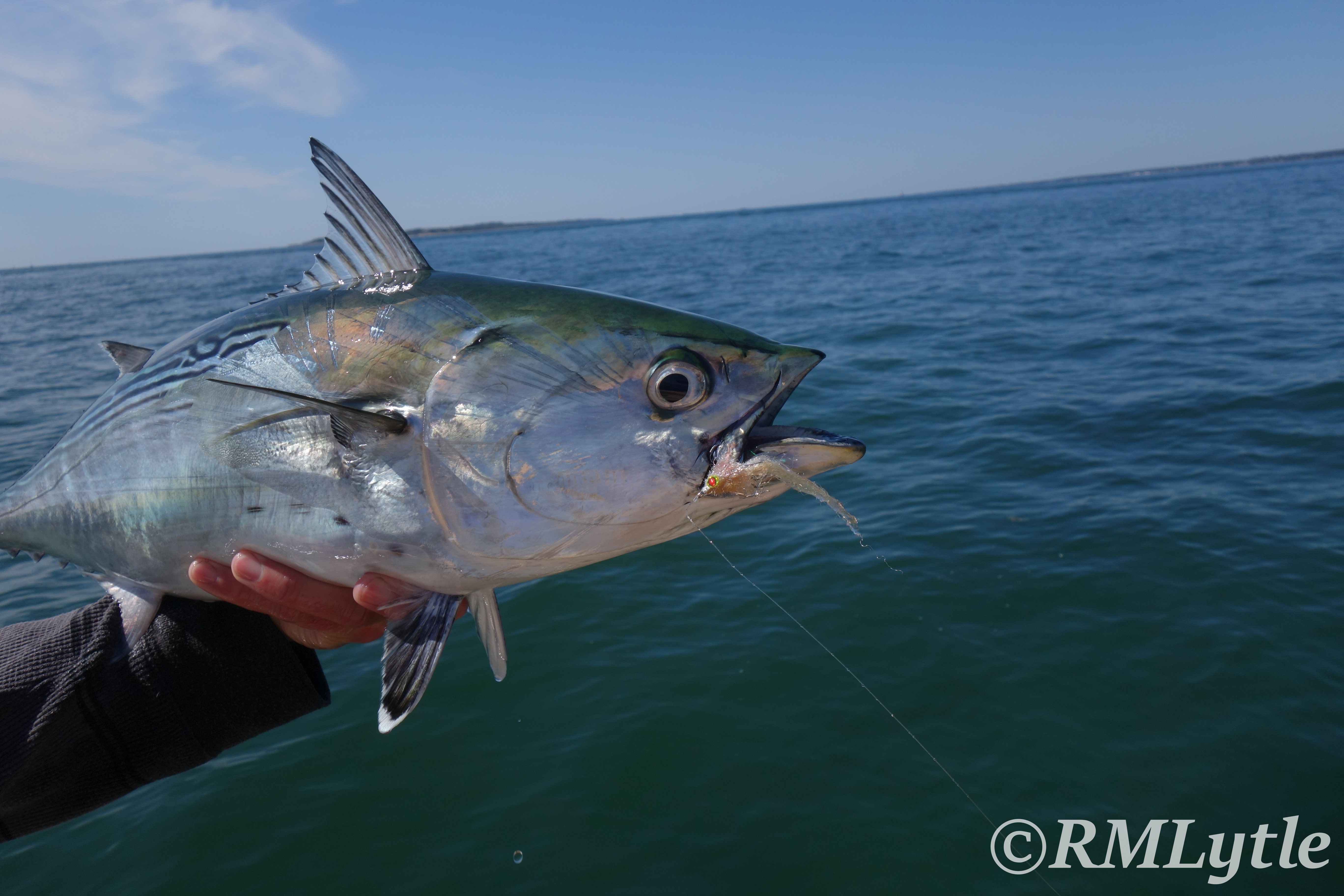
Albie Season

 I'm not hardtail obsessed. I have been from time to time over the last six years, but I've found that I actually fish them better if they're more of an aside to my late summer and fall season rather than the main course. I'm a striped bass guy. They appeal to me more. I like large flies, large baitfish, and huge brutish stage fish that will hold a spot and work it. I also like night fishing. I feel as comfortable wading into a boulder field at night as I do sitting at my desk typing this chronicle out. That's my fish. Morone saxatilis and I were made for each other. Little tunny can honestly get a little boring to me. For many seasons, they've meant standing on the same five or six rocks across southern Connecticut and Rhode Island for hours at a time casting my arm off for fish that all ate more or less the same way, all on quite small flies, looked the same, and were only a few pounds larger or smaller than each other. There's no way to get an edge over other hardtail chasers to catch bigger ones, just more of them... and I'm just not a numbers guy. But there's undeniable thrills there too. I find immense satisfaction in the take and hookup. I fish near and on-surface flies and floating lines a lot unless conditions force my hand in using an intermediate or full sink. That means nine times out of ten an albie is breaking the surface to eat my fly. Gurglers are by far my favorite method, and damned deadly too. I'm far from the first to throw these flies at hardtails. In fact Jack Gartside had a gurgler variation tailored specifically to them, and Alan Caolo has talked up their effectiveness as well. It may be one of the best albie flies there is. When a little tunny pile drives a Gurgler and the line tightens in my hands, it feels like everything is right in the world. 

Early in the 2023 season I found myself on the bow of my good friend Mark Alpert's Amesbury Dory watching acres of crazed albies mowing down anchovies under the shadow of an iconic Southern New England lighthouse. It was the perfect day. The weather was gorgeous, and though a fair number of other anglers and boaters were out there were ample fish for everyone and in rare form, I didn't see anyone acting like a complete buffoon, plowing into fish, or cutting off other boats. It bordered on miraculous, with visual spectacle to match. Bright green and chrome reflections cut through the light chop, with rust colored anchovies spraying in their desperate attempts to evade the lightning fast predators. Frantic gulls added another auditory element beyond the impact like sounds of feeding fish and the excited voices of other anglers. Mark and I were privy to quite a show that day. And though the fish weren't the easiest, I was able to get them to eat the gurgler with exceptional regularity, even blind casting along travel routes when they weren't actually showing. 


It was my first day putting my Orvis Helios 3D 8wt that Shawn Combs extremely generously passed along to me to a really solid test on hardtails. One summertime bonito and a few chub mackerel didn't really give it the complete range of necessary tasks. It was a wonderfully precise bit of weaponry for little tunny sniping and very enjoyable to battle these late summer speed demons with. 


After the gurgler party east of the point began to fizzle, we ranged out looking to find more concentrated action. The reward was a mix of bass and albies feeding in a more delicate manner, less interested on the smaller bay anchovies. I took the opportunity to fiddle with a fly I'd been developing over the past two seasons, a sort of hybrid derivation of Dave Skok's White bait Mushy but with a stiff spine rather than Softex, and a body form and tying method inspired by Jonny King's Kinky Muddler. The fly rarely ever fouls (never at all if tied right), has an extremely natural profile from all sides, and has a great action in the water. I'd put it to the test on small bait blitzes of striper earlier in the year and found myself tight to fish any time I landed the fly close to breaking fish while other boats struggled, but given the fly's intent being tunoids it needed to work this time too. And it did. A memory that will forever be burned in my brain from that day was watching an albie race a group of striped bass to the fly and inhale it boat-side. I was forced to trout set at close range but got a great corner hookup and was treated to yet another quick ride into the backing. 


Outside of enjoying days on friends' boats, I only had a couple other goals for the 2023 albie season, those being to catch little tunny with my feet on sand, avoid fishing popular and ever more crowded spots, and catch more fish in new places or old places I'd been snubbed at in previous seasons. My motivation was driven by the growing popularity and changing culture around this fishery along with my own conviction to learn new things in new places. I've only been shore-based albie fishing for a short 5 years, but somehow that half a decade is enough to see changes in the game. My first season, I was being dropped off and could only get to locations I could walk to from a centralized relatively well known spot. On multiple occasions I had that place to myself for prime windows, and even when I didn't the etiquette was a bit different from what it has shifted toward. One day, I was struggling on a less than ideally positioned rock when one of the OG's, after getting three fish in fairly short order, reeled up and said "You're up, kid". That set a bit of a precedent and was a good lesson. Admittedly I've had my moments of greed, but I try my best to not be a camper and yield a hot rock if the next guy down the line isn't catching just because he isn't standing in the right spot that day. I also recognize that as a younger and more physically able angler, I could easily take up easy standing space from less able bodied folks in popular accesses, and don't feel that doing so is respectful or fair. A twenty or thirty something with good balance doesn't need to have the flattest, driest rock with the easiest cast into the travel lane. So this year I set out to fish other places and probably caught fewer fish than I otherwise would have as a result. That's okay. I fished with the people I wanted to fish with and had a better overall experience. I don't say any of this to denigrate those that fish the well known places, but I do want some anglers to rethink the way they go about this fishery and frankly fishing in general. More respect needs to be shown toward the locations, the fish, and the people that were out on those same rocks before us young guys even knew what a false albacore was. 

It all come together one morning when John Kelly and I met before sunup on a lonely beach that some schools of little tunny had been visiting with some consistency. The day before John had a couple fish to hand, and even with a late day arrival I had a couple shots. We knew there'd be fish, it was just a matter of being patient and making the shots. Sure enough, as the sun crested the horizon some splashed began to disrupt the otherwise only gently wind rippled surface. And then they were in front of us. John hooked up first. 

I've become more and more of a beach fishing addict over the years. Walking the open sand with a fly rod in hand is inherently contradictory; taking on the ocean and its predatory species with what is generally considered very light tackle (whether that actually portrays the real power a fly rod can have as a fish fighting tool is another story) feels at times like a David and Goliath situation. Though little tunny are far from goliath both in name and stature, they are quite a fish to tackle with light fly gear. The gentler slope of a beach adds even more to the fight. Unlike fish hooked from boats, jetties, or rock ledges, there's less opportunity for the fish to dive, making their runs a bit longer and faster than they otherwise would be. Add to that the mystique of catching a truly pelagic species- a tuna -just yards from the beach in a few feet of water and the pursuit of beach tunny becomes very appealing. John's fish came to hand after the predictable battle, and we took a quick moment to photograph it in the grey morning light. 

Not long thereafter, a group of fish came in toward me at an angle. I waited as they breached closer and closer, then fired a shot that I felt should lead them perfectly and began slowly two hand retrieving. The lead fish ate my pink minnow and tore off. A big gob of tangled line came out of the stripping basket and caught up in the first guide which resulted in a breakoff. I re-rigged, frustrated but not dejected, and looked in my fly wallet for the next soldier. A Gummy Minnow, incidentally given to me by John months prior, jumped out. The next time a pod of albies broke in range I got that Gummy in the right spot and one ate. 

Photo Courtesy John Kelly

That was a special fish for me for a number of reasons, very high on the list being that it was the first I'd managed to get to hand on the very first strip of sand I'd ever fished little tunny from. Back in 2017, after being dropped off to go about my own devices one September day, I opened my phone to look for new options after an unproductive few hours on ledges. I saw an appealing looking spot and I walked there. It was quite a long walk on a very hot day, though over that season I'd end up learning miles of shoreline on foot. I knew getting albies from sand beaches with a fly rod was a tall order, but within my first 15 minutes I had one boil on and refuse my fly. To redeem myself six years late was a huge sigh of relief. 

As the season rolled on, it continued to be productive. I went at my leisure, focusing on other fisheries most days. A few more good boat trips were had: most notably, one with my good friend Mark Phillipe. We were surrounded by feeding little tunny most of the day. The bait was absolutely miniscule, like metal shavings in the water, and the formation feeding fish demanded exceptional patience, numerous presentations, and the understanding that imitating the bait was not possible nor beneficial in order to catch. The task was much easier with a camera. The slow, deliberate feeding method these fish we performing in the slicks made for incredible visuals all day. 


   I did manage one fish that day, early of out of a large formation feed. I'd made a quick reaction cast at the right angle to their path of travel and once again my pink minnow fly drew a strike. Later it got taken a second time, putting me and 1 for 2 and Mark at 0 for 1 that day. It was tough, but certainly worthwhile. 


Not more than a couple days later I found myself on the beach again, this time with Garth. The feeding patterns were very similar to what Mark and I had experiences, but right in tight to shore. The bait the albies were feeding on was so small that adult silversides were actually eating it as well. I managed to lead a small pod of fish that came down the beach from my left, a perfect cast, and sure enough one ate the fly but I turned my body as I strip set and pulled the fly out of its mouth. A bit frustrated with that missed opportunity and the progressively smaller number of fish showing themselves, I made my way to a jetty. One the slack side, one decent pod was periodically coming in a feeding ravenously on snapper blues. It would have been a perfect opportunity at a very easy bite and they were clearly larger fish as well, but they stayed out of range save for one brief moment. On the opposite side, fish occasionally rolled as they swam past on their travel lane. These would be much harder to feed. Eventually I saw one rolling at 50 foot intervals and on course to get within range. I carefully times my cast, timing the rolls and realizing it would stay down went it got perpendicular to me. I waited for the closest roll I expected it to make then fired a 90 foot cast just beyond its track and began slowly twitching the fly. Sure enough, right when I expected their paths to cross the fish came to my fly. Though it was a very small fish, that one ranks amongst some of my most satisfying presentations and catches. 


As the day continued we'd find more fish and other locations, but a combination of exhaustion from a full night of cow hunting prior and a plethora of tautog fisherman in inconvenient location prevented us from fully taking advantage. Still, after quite a few years of poor albie fish close to home, fits and starts, fish arriving in mass then leaving just a couple weeks later, and getting frustrated with ever increasing crowds, it was just nice to have fish in front of me at a favorite location that doesn't fish well all the time but well enough to make it worth staying away from the hungry masses for. 


As the season continued to progress toward its end, I'd make it out a few more times here and there. Each trip presented interesting challenges and spectacular small bait ram-feeds. One particular day with Mark Alpert features some of the most spectacular and long lived feeds I've ever had the privilege to watch. Not only were the fish hard to feed though, but boat motion almost always made it tougher. We'd position upwind of the fish, and given  their uni-directional feeding you needed to lead them head on and pull the fly in the same direction they were going. I ended up going 0 for 3, because by the very nature of that presentation managing slack was absurdly difficult. Both boat and fish were traveling quickly towards each other each time I got bit and coming tight in that situation, with added heavy chop rocking the boat, isn't easy. Given how much everyone was struggling to catch during that time frame though I was just happy to convince those fish to eat. Can you guess which fly? Oh man, and was the photography ever special. 


Ya know, I really do love those stupid little fish. 2023 was a good season for them, from my perspective. I fished for them about as much as I wanted to, which wasn't much compared to some years (42 days in 2021, 12 days this year). I avoided crowds entirely and only fished with the small handful of people I really wanted to, sharing great memories with some of the best friends this obsessive passtime has allowed me to make over the years. I didn't have to see the scourge of insta heroes horribly mishandling albies just for a photo op. I only kept one fish that John had bleed out on him and it was one of the best tasting little tunny I've ever had.  I finished development on a new fly that seems to work really darned well. I captured both beautiful fish and compelling imagery. When all is said and done I feel very content with the 2023 albie season. 


Thank you to my Patrons; Erin, David, John, Elizabeth, Brandon, Christopher, Shawn, Mike, Sara, Franky, Geof, Luke, Noah, Justin, Sean, Tom, Mark, Jake, Chris, Oliver, oddity on Display, and Sammy for making Connecticut Fly Angler possible. If you want to support this blog, look for the Patreon link at the top of the right side-bar in web version.