Showing posts with label Chub Mackerel. Show all posts

Monday, October 18, 2021

Black Seabass on the Fly

 As my tunny season continued to be a grind, I started seeking other species to fill in my time on the rocks. I generally don't enjoy the process of catching tunny and bonito from shore. I do get to see some cool things, but it's a lot of standing around on the same rock all day waiting for something to happen. It helps to be able to catch some sort of fish from that rock, and early in the tunny season one of the most readily available species is black seabass. Black seabass, Centropristis striata, belong to the family Serranidae. This family includes groupers and anthias, and black seabass are certainly the most grouper like fish present in New England aside from the occasional visiting actual black grouper that swirls in on an eddy of the Gulf Stream. The genus includes four other species that are generally smaller and rarely encountered by anglers. Black seabass are considered by many anglers in the Northeast to be a very delicious fish, and I have to agree. They're also a fun fish to catch on a fly rod, something people don't intentionally do very often. When I'm standing on a jetty waiting for tunny that probably won't eat my fly anyway, It's a fantastic relief to have some seabass around that are willing to chew on a fly.


One morning there were seabass and chub mackerel feeding on peanut bunker at the surface along one stretch of the jetty. Generally I need a sink tip line to get flies down to the seabass, but I've encountered a handful of surface feeds over the years and this one provided some of the largest fish. Other fly anglers were catching big back seabass even on intermediate lines with a fast two hand retrieve. It was an impressive show of what can happen when the conditions line up right. I've encountered a number of "bottom fish" not being bottom fish at all when enough bait is present. Seabass and different scombrids feeding near-surface are actually a pretty common theme. On the Cape I've seen seabass breaking alongside king mackerel, in Connecticut I've found them right in tunny feeds. Now in Rhode Island I was finding them alongside chub mackerel. 


The next time around there were no surface antics, but there were still loads of seabass. I utilized a sink tip, small flies, and count-down tactics to catch the fish. When fishing a jetty with a fly rod for fluke, scup, seabass, or tautog, knowing how to run a fly deep without hanging up constantly is key. The angler should know the sink rate of their line and the depth of the water. It is also important to know the contour of the jetty, which depends heavily on it's age, location, and construction. Old jetties break up in big storms, and the jumble of rocks create a sloping contour, while some well maintained and carefully built jetties drop off more steeply. The inside edge of  the Rockland Breakwater in Maine is almost vertical compared to the Scusset Beach Jetty at the east end of the Cape Cod Canal. That determines how what line you need to use and how you fish these places. 

I find that erring on the lighter side with your line is often a good idea, and if you are struggling to find bottom simply add split shot. I know this isn't something people think about in salt water fly fishing, but I like breaking new ground. Strategically targeting scup, fluke, tautog, and seabass on the fly isn't exactly the most well trodden topic. Retrieving should be fast enough to keep the fly and line from hanging up but slow enough to keep it within a foot or two of the bottom.


Getting keeper size black seabass from the shore seems to be a very tricky thing to do. I've only gotten a handful of legal sized fish from the rocks and only in one location. That said, I haven't put too much effort into patterning them... yet. It is something I intend to do. It is certainly fun to catch them when I'm waiting around for unwilling tunny but the way to really catch a fish is to focus on it. Of course it could be said that my being distracted from tunny by black seabass prevented me from catching my target, but when there simply aren't any of your target fish in casting range what's the point of standing around without a line in the water when different perfectly willing fish are right in front of you?

Until next time, 

Fish for the love of fish.
Fish for the love of places fish live.
Fish for you.
And stay safe and healthy.


Thank you to my Patrons; Erin, David, John, Elizabeth, Brandon, Christopher, Shawn, Mike, Sara, Leo, C, Franky, Geof, Luke, Streamer Swinger, and Noah for making Connecticut Fly Angler possible. If you want to support this blog, look for the Patreon link at the top of the right side-bar in web version.

Monday, October 11, 2021

False Albacore Fly Woes: Bigeye Scad


Time for yet another day with tunny around and me not catching. Yeah, this was day six. My sixth day with tunny around and no tunny to show for it. This time the conditions felt a bit better and there was at least bait present, though no he ideal bait. Peanut bunker are only the ideal bait if the tunny actually eat them, and I've only seen it happen a handful of times. It seems to be far more common on the south side of the Cape and around the Elizabeth Islands. Maybe the size of the peanuts varies as one go up the coast and the Connecticut and Rhode Island peanuts are bigger and less appealing to the tunny when they get here. What was strange though was how willing the chub mackerel seemed to be to pick of a peanut. I dragged flies below the bait and picked off the first chub mackerel of the year- very late compared to the last four. I was using a 12 weight though and the fights were subpar. 


It's a bit regrettable that I'd still yet to get even a bonito, Spanish mackerel, or frigate before I got those chubs, but at least a scombrid had found it's way to my fly. 2021 had shaped up to be an odd year. 

As the morning progressed so did my frustration as I watched a couple of casters pick off tunny on epoxy jigs. There just wasn't anything for it, I could get my fly to the lane the fish were running but I could pull it through it and that's what really matters. Confounded by some of the same line twist and tangling issues that had already plagued me this season, I started to consider giving up. Then I caught something interesting. 

Bigeye scad are most numerous in tropical regions around the world. There are a lot of species of scad, including yellowstripe scad, mackerel scad, and torpedo scad, but I'm primarily familiar with bigeye due to their presence on the East Coast. In Florida they're a commonly used bait species and called goggle-eye. It isn't unusual for some bigeye scad to wander up the Gulf Stream and end up in parts north. This year I'd seen a few examples from New Jersey. Now, I was holding one from Southern Rhode Island. It had latched onto the Surf Candy I was fishing, a fly not much shorter than it's own body length. Unknowingly it had put me just 15 fish away from #200 on my lifelist. Yup, another wandering tropical species proved that my tunny obsession was worthwhile despite the fact that I couldn't seem to catch a little tunny.

Lifelist Fish #185, Bigeye scad, Selar crumenophthalmus. 

With my first scad ever on the books, I was satisfied enough to stop torturing myself and walk back to the car. Well, it was really only a temporary cessation in torture. I'd be back in fruitless action soon. 

Until next time, 

Fish for the love of fish.
Fish for the love of places fish live.
Fish for you.
And stay safe and healthy.


Thank you to my Patrons; Erin, David, John, Elizabeth, Brandon, Christopher, Shawn, Mike, Sara, Leo, C, Franky, Geof, Luke, Streamer Swinger, and Noah for making Connecticut Fly Angler possible. If you want to support this blog, look for the Patreon link at the top of the right side-bar in web version.

Friday, September 25, 2020

Scomber Colias From the Rocks

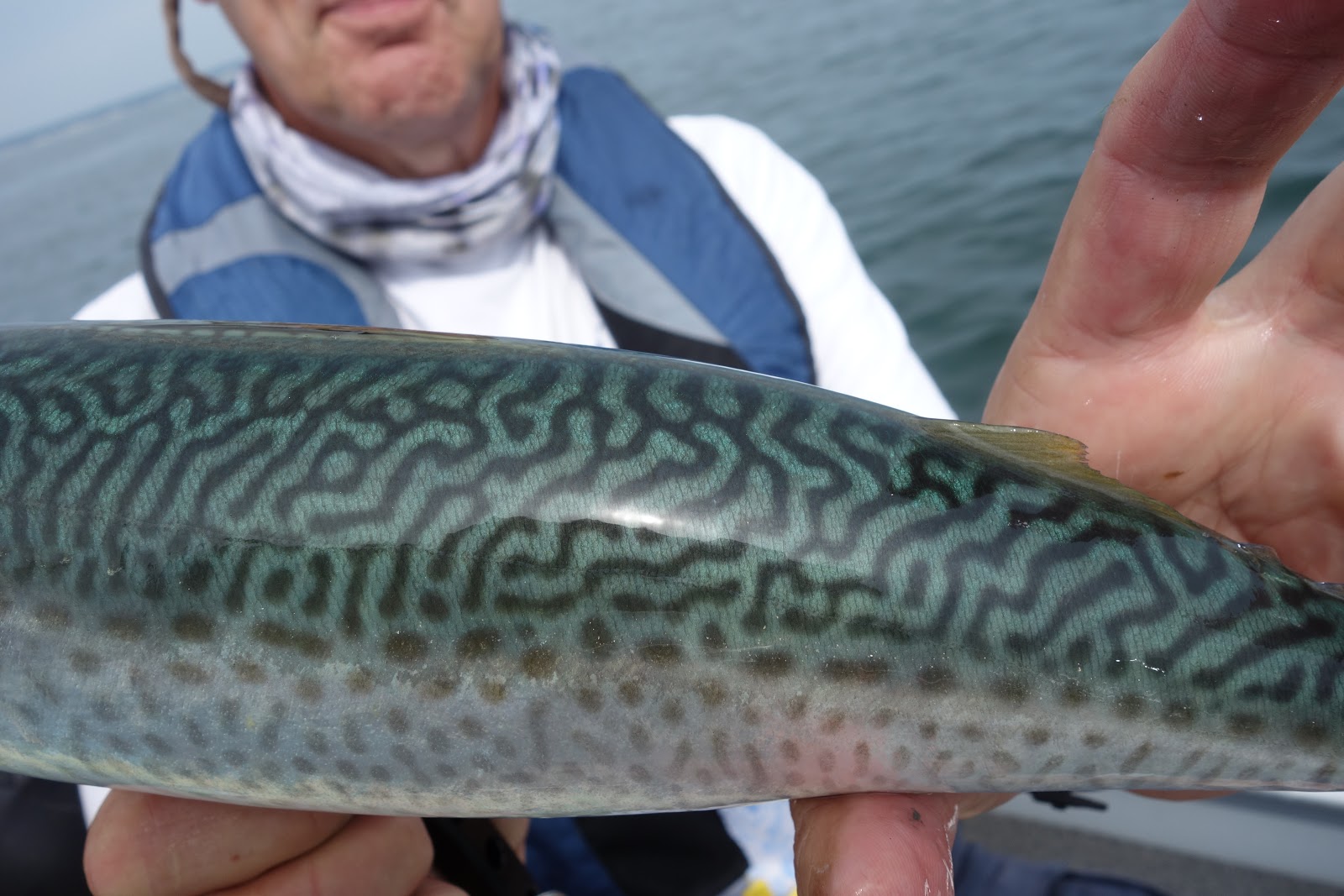
 Atlantic chub mackerel have been in Long Island and Block Island Sound each summer for a few years, but I'd yet to target them from shore until this August. Really I wasn't looking for them when I first ended up on the bite, I was looking for bonito. They had and still have yet to show in any notable amount in Connecticut waters. But on that first rainy morning I was looking for bonito, I ended up catching a huge chub mackerel, bigger than any I'd ever seen in photos. Though it gave me pause, it wasn't enough to make me pull my camera out in the rain... which I now regret. It was a seriously large chub mackerel and I may never see one like that again. 

The next evening though I wondered if I might find some feeding at the same spot, on a similar tide, but with the sun setting. It turned out I could. This time I was using my 5wt rod with the specific intent of catching Scomber colias. I'd tied some very small, simple flies on fine wire hooks to try to avoid issues with missing or hooking and loosing chub mackerel that had become obvious over the last three years of fishing for them from boats. One was a simple small version of a Gartside Soft Hackle Streamer, and the fish both showed a strong preference for this fly and stayed pinned without fail. (I thought this would be solution, but subsequent tests proved less successful.)


With the skies ablaze at sunset and the tide dropping, I caught chub mackerel from "my rock" until I was content, which was conveniently about when they wandered out of range. A slow, steady double had retrieve was periodically halted by abrupt and violent takes, then jarring fights that tested the limits of my five weight rod. I'd used a five weight for these fish from the boat and my experience was that it was not much different than an 8wt. Not so from the rocks. This was exciting fishing.
 
 There was once a time when catching a similar species from the rocks and beaches of southern New England wouldn't have been unusual. Atlantic mackerel used to make showing here. They still do sometimes in Rhode Island, on Long Island, and even on occasion in New Jersey, but really if I want to catch them from the rocks I have to go to Maine. That's the place. But now that these chub mackerel have made themselves at home in Long Island Sound, there's a great opportunity to catch a beautiful small scombrid in the surf at home. Of course, chub mackerel are actually bigger than Atlantic mackerel. I'm still not quite used to them, though they've been around for more than half of my time consistently fishing these waters. They still make me giggle and smile, as just about any pretty, hard fighting little fish does. Getting my first few from the rocks made me smile all the wider.


 Until next time,

Fish for the love of fish.
Fish for the love of places fish live.
Fish for you.
And stay safe and healthy.


Thank you to my Patrons; Erin, David, John, Elizabeth, Brandon, Christopher, Shawn, Mike, Sara, Leo, and Franky for supporting this blog on Patreon.

Thursday, August 20, 2020

Micro Bait Season

In August, our coastal waters get flushed with young of the year baitfish. Minuscule in size but numbering in the billions, juvenile menhaden, bay anchovies, silversides, and butterfish fuel some of the most visually spectacular surface feeds of the year. The last few years the weather has been awful most of October and November, which would normally be big blitz time here. August and September, the micro bait season, have surpassed the following months for heavy action and visual spectacle in Eastern Long Island Sound, South County Rhode Island, and Narragansett Bay for the last three years. In August this year and last, schoolie bass and chub mackerel have put on some of the greatest shows while feeding on bay anchovies less than an inch long.

My friend Captain Ian Devlin asked if I'd like to make a run east with him on August 1st to partake in the early days of the chaos. Promise of chub mackerel froth feeding and rafting stripers was also accompanied by trustworthy reports of frigate tuna, a small scombrid species only occasionally found in these waters. Of course I was game. So it was that Ian and I readied to launch his Lake & Bay skiff as the sun rose on the first day of August, watching a greater black-backed gull admire his own reflection in the chrome bumped of a parked truck. Soon we were on the water and speeding towards Watch Hill. We didn't get there before finding a couple big schools of chub mackerel froth feeding.


The sound these fish make when a big school surface feeds is really something to behold. From the calm ocean surface arises the sudden roaring of hundreds of fish blasting through the surface in a frenzy to get as many bay anchovies in their mouths as possible. Every once in a while though, one of those little bait fish is a fake.


It's amazing to think that Scomber colias were unheard of inshore just five or six years ago.Now for at least a couple weeks each summer, it's difficult to run a boat along any four mile stretch of shoreline between Niantic and Point Judith between sunrise and sunset and not see at least a small school some where along the way. They're fun, beautiful little fish, and bend a five weight a lot better than any trout of similar size.

We had our fill with those schools, then headed further east. Watch was a zoo in terms of blitzing fish, slowly becoming a zoo in terms of boats as well, but we got some time without too much traffic to photograph and cast to schools of both bass and chub mackerel.


When the crowds descended we continued east and found a third of a mile of chub mackerel working east to west down the beach, literally making waves in their wake. The biomass of fish in these waters at this time of year is quite astounding. We were able to get ahead of the school and get shot after shot as pods came by the boat.


The chub mackerel school led us way back west, right to a school of bass up near the beach.


Eastward bound again, we glimpsed a handful of brief blows that were certainly not bass but didn't seem to be chub mackerel either. They appeared like tiny false albacore slashing through bait balls... these must have been the frigate tuna we'd so hoped to encounter, but they were up and down quickly and we got no shots at them.

The final blitz we encountered was an interesting mixed bag. There were bass and chub mackerel up top, scup just below, and hickory shad on the bottom. I got one each of the scup and hickories, making for a unique mixed bag of scombrid, moronid, sparid, and colubrid species. A wide range of fish were taking advantage of the plethora of micro bait. (I didn't photograph the hickory as it was bleeding heavily)


We ended our day on the flats, expecting very little there but finding loads of bass. In the heat of August stripers typically seek deeper, cooler water, but the micro bait had lead some to the shallows, were fish were inhaling tennis-ball sized schools of tiny menhaden. This fish have proved over the years to be just about impossible to deceive, and we certainly didn't figure it out this time. But just seeing that there was so much going on in all sorts of areas and in different depths was exiting. Stripers in particular are remarkably versatile fish. It never ceases to amaze me how broad their range of comfort is. 
But then again apparently scup are quite versatile too, as I got another up on that flat on a Jiggy. 


A few weeks later, micro bait season continues in these parts... and honestly things have gotten pretty wild. But I still have a lot of catch up to do before we get to that.
Until next time,
Fish for the love of fish.
Fish for the love of places fish live.
Fish for you.
And stay safe and healthy.

Thank you to my Patrons; Erin, David, John, Elizabeth, Brandon, Christopher, Shawn, Mike, Sara, Leo, and Franky for supporting this blog on Patreon. 

Wednesday, August 21, 2019

The Chub Mackerel Invasion

Atlantic chub mackerel, Scomber colias, were once essentially absent from our little corner of the Atlantic. The species started to show up in offshore waters in the late 2000's and were being substantially commercially harvested by 2013 and had become an important baitfish for large pelagic fish, as according to a fissues article by Angelo Peluso in 2017. That year, 2017, schools of chub mackerel showed up at Watch Hill, and I caught my first of the species with Mark Philippe in August of that year (flyfishingcts.blogspot.com).


In 2018, chub mackerel were definitely around in shore and near shore again, though I didn't see them. They seemed a little more spread out. Then came 2019....
This year, I've seen chub mackerel all the way from Point Judith to Niantic and friends have seen them almost to the mouth of the Connecticut River. There are tons of them, they are all over, and they are absolutely chewing through small bait. The froth feeds performed by these fish are both audible and visible from a long way off, sounding like a waterfall or a very isolated heavy downpour. If not in a concentration of bait in a single spot, they move up and down slicks so rapidly they are hard to catch up to even in a boat at times. And they are indeed fairly sporting on light tackle. Over the last few weeks, Noah and I have chased them around in kayaks, and I've targeted them on a number of friends' boats. I fished for them with small flies tied on size 3-6 hooks, and on both a 5wt and a 10wt. Interestingly, what rod I was using made next to no difference in the quality of the fight. This is something my friend Captain Ian Devlin has noticed as well. Regardless, they have been abundant and it's fun to pull on a few, though watching them feed is more than enough for me to be happy!


They do bleed a lot.


On there own the chub mackerel a pretty cool, but this year they've become so abundant that they may be turning into viable forage for sharks, bluefish, and potentially striped bass. While drifting in an area where tons of chub mackerel were feeding, Patrick Barone was jigging a metal while I continued to fish the kind of small flies the chub mackerel were eating. All of a sudden, Patrick stuck a decent sized bass. When he got it up, it was being followed by a much bigger fish. I quickly tied on a big Game Changer, hoping the follower would stay around and give me a shot at it. Unfortunately that didn't happen. But it was pretty clear that these fish were there because the mackerel were, either to eat the mackerel themselves, eat whatever the mackerel may have been leaving behind, or possibly even eating the scraps dropped by bluefish that may have been eating the mackerel. But where we were, there were really limited reasons for there to be sizable bass in that particular spot at that time of year. They must have been drawn to the chub mackerel. I'm a bit skeptical that large stripers would chase down these fish too often, they aren't exactly like adult bunker or Atlantic mackerel, much harder to pin in an ambush spot. So these won't be a viable replacement for menhaden, not for striped bass forage. But they may well become a viable and important inshore baitfish in the future. Time will tell, and time will tell if they need to be regulated outside of the commercial sector. Bunker are, so these certainly should be, being both useful bait and a good food fish. Be vigilant in the future for opportunities for advocacy in that department, I'll be paying attention. And obviously the Fissues team is paying attention to chub mackerel. This is a rare circumstance of a new native fish abruptly showing up, it's a really fascinating thing to see.

photo courtesy Ian Scott Devlin


photo courtesy Ian Scott Devlin
I'm not sure what I was looking at.

Until next time.
Fish for the love of fish.
Fish for the love of places fish live.
Fish for you.


 If you enjoy what I'm doing here, please share and comment. It is increasingly difficult to maintain this blog under dwindling readership. What best keeps me going so is knowing that I am engaging people and getting them interested in different aspects of fly fishing, the natural world, and art. Follow, like on Facebook, share wherever, comment wherever. Also, consider supporting me on Patreon (link at the top of the bar to the right of your screen, on web version). Every little bit is appreciated! Thank you to my Patrons; Erin, David, john, Elizabeth, and Christopher, for supporting this blog.