Showing posts with label Catch & Cook. Show all posts

Monday, December 13, 2021

December Hardtails in Southern New England

 Now you might be thinking I'm nuts based on that title, but it's true. Long after the last little tunny has left and the hopes and prayers for those mythical late season bonito have come up empty, a well kept, small scale hardtail bite manifests as winter begins. Old timers may talk about mackerel fishing in Long Island sound in the good old days, and though there is nothing like that apparently was- nor much of the wild late season fishing that could be had back then -there are still some Atlantic mackerel to be caught. Spurred on by whispers and a long held desire to figure out this very infrequently discussed bite, I went out mostly blind with a 5wt and small flashy streamers. 

I've caught Atlantic mackerel many times in Maine, where they are present for most of the warm season in huge numbers. I'd also seen them in Massachusetts, but more as a baitfish than a target. I'd never seen one South of the Cape. Though these fish are pretty small compared to bonito or tunny, I welcomed the idea of catching a scombrid of any kind in a month when saltwater fishing is getting less and less diverse by the day. December signals the end of the fall abundance and species diversity as the water cools rapidly. But mackerel like this cold water, and that's exactly when they come around. Most of the time they are caught incidentally by folks fishing for herring. I couldn't be sure they were very targetable, but I liked the idea and was willing to risk skunking. 

On my first attempt, skunking was exactly what I did. I ruled out some tides and times though, at least for one spot that looked like it had potential, and in one location I did watch people catch some herring and mackerel. The very next day I came back much earlier. The first spot was basically a dud, though I had a fish swirl on my fly at the end of one retrieve and on other brief hookup. I remained hopeful on the short drive to stop number two. There, I found exactly what I was looking for.


I must say I was almost surprised to catch one at all, even though I'd combed through what little information was available and poured over the maps for days prior. It felt like a wild goose chase, but there I was holding the goose. Many more came over the next few hours, and I felt pretty good about myself, especially since I was far from the only one fishing that spot and I was doing much better than anyone else there at the time. It does feel good, being the only one in a lineup with a fly rod and putting more meat in the bucket than anyone else. 

And yes, I was putting meat in the bucket. Mackerel are wonderful table fare and plenty abundant, so I wanted to take advantage of this opportunity to try a new fish. When I was catching them sometimes two at a time, it was quite a good opportunity indeed. 


Small though Atlantic mackerel may be, they still have that hardtail spirit. They pull really well, doing nice little runs and circling once brought in close just like their larger cousins. They don't have the weight to put on a big screaming run, but they makeup for that with an unwillingness to quit. They're excellent light tackle fodder. 

I ended up with a pretty nice pile of them that day. When I got home and started processing them I found that the only baitfish they had in their stomach was juvenile menhaden. I'd expected small sand eels or even silversides, but there are indeed lots of peanuts still lingering around southern New England. The odds of encountering stripers chowing on them are still pretty good as I write this on December 12th. IF you know where to look...


I've been making regular trips for mackerel over the first weeks of December and will be continuing to as winter rolls along. It's become a short-term obsession. They're fun little fish, and I enjoy how obscure this bite is. Oh, and they were absolutely delicious. 

Until next time, 

Fish for the love of fish.
Fish for the love of places fish live.
Fish for you.
And stay safe and healthy.


Thank you to my Patrons; Erin, David, John, Elizabeth, Brandon, Christopher, Shawn, Mike, Sara, Leo, C, Franky, Geof, Luke, Streamer Swinger, and Noah for making Connecticut Fly Angler possible. If you want to support this blog, look for the Patreon link at the top of the right side-bar in web version.

Wednesday, November 17, 2021

Eating An Albie

 I've heard all manor of descriptions of what little tunny taste like, and very little of it good. Something I've learned throughout the years, though, is that most fish are very palatable and usually better than that. Being adept at handling the fish after you've harvested it, cleaning it properly, and cooking it appropriately make all the difference. Of course there are some fish that some people just won't like- everyone has different tastes. I used to be incredibly picky about fish. Now I think it's all about how they're done, though. I've eaten quite a few fish species that I've seen anglers turn their noses up to- walking catfish and sea robin to name two of the oddest. The only fish that was genuinely unappealing was chub mackerel, and that's just because we didn't get it on ice fast enough. So, naturally, it was only a matter of time before I brought home an albie.

The opportunity arose the morning of a gnarly storm that brought heavy rain and wind to southern CT. It was absolutely pouring just minutes after I arrived and there was very little sign of activity, but I wasn't there to sit in the dry car and wish I were home. I cast, and I cast some more. Then suddenly one of my retrieves was stopped by the abrupt take of the fastest fish a fly angler can tie into with their feet on the New England shoreline. And here I was, ready to fight it with a cheap Bass Pro Shops brand fly rod. The 9wt Heat did the job admirably, and soon I had a beautiful and hopefully delicious fish at hand. I'll say it one more time: expensive gear isn't pivotal to success. I'm having a lot of fun with that silly rod. 


That was my only fish of the day, but that's all I really needed. I quickly bled it and left it out- no need to get it on ice, it was being pelted by cold rain. After being drenched to the bone and beaten up I went home with my little tunny in a bag in the trunk. I filleted it like one would any small tuna, and trimmed off the darkest bits of meat. That left rather a lot, about four meals worth if paired with another dish. 

There are quite a few ways to prepare little tunny. If you're already used to cleaning and cooking tuna, I recommend treating a little tunny the way you like to prepare a bluefin, yellowfin, or blackfin tuna. Expect it to have a little less shelf-life than those species, but the same cooking or sushi preparation techniques are applicable. It'll also allow you to compare the quality of the meat to the fish you're already familiar with.

I cook mine essentially the same way I cook myself a burger. I put a splash of olive oil in a pan, sprinkle some salt and pepper on the piece of meat, and cook it until it's just a bit pink in the middle. 


The texture and flavor is great. I loved it, and my partner really enjoyed it as well when she tried it. As long as you treat it right and eat it soon after it's caught, there's no reason not to eat an albie if you want to. And, frankly, lots and lots of dead ones are being thrown back in the water. Being an extremely fine-tuned, warm-blooded fish, little tunny have a very short shelf life when removed from the water. A lot of released ones die, that is very clear. I reckon the number could be as high as 45 to 50%. Grip n' grins are probably very close to a death sentence for these fish. 

I know I've thrown back tunny that didn't survive, and though I don't subscribe to the idea that a fish that died after release has been completely wasted (nothing organic goes to waste in the ocean), I don't think it's a good look to be killing large numbers of a species for the sake of of sport and believing you're doing right by the species. Little tunny are one of the most abundant predator fish species in the Atlantic Ocean, if they're going to be killed by even fairly careful catch and release methods, we may as well eat them. Since they aren't, in fact, horribly disgusting as many people make them out to be, I'll likely be keeping every one I decide to photograph from now on, knowing full well there are some fly caster that will dislike me for doing so. That's a lot better than such a magnificent animal being eaten by invasive green crabs. 

Until next time, 

Fish for the love of fish.
Fish for the love of places fish live.
Fish for you.
And stay safe and healthy.


Thank you to my Patrons; Erin, David, John, Elizabeth, Brandon, Christopher, Shawn, Mike, Sara, Leo, C, Franky, Geof, Luke, Streamer Swinger, and Noah for making Connecticut Fly Angler possible. If you want to support this blog, look for the Patreon link at the top of the right side-bar in web version.

Edited by Cheyenne Terrien

Saturday, September 25, 2021

Sea Robin Appreciation Day

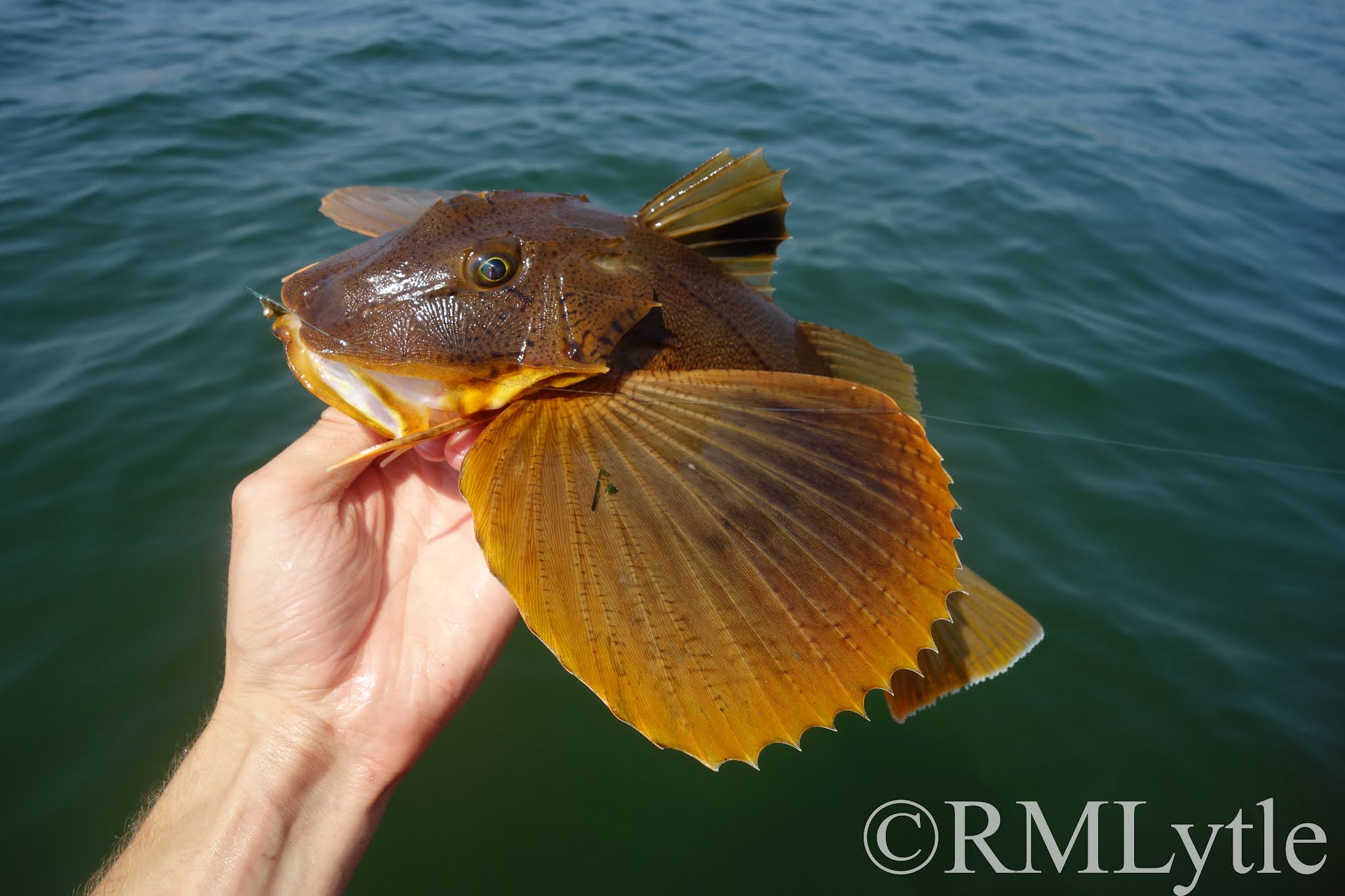
 I'm back folks, and now wellll behind. For the next week or two this blog will still be stuck in summer. And one of my favorite things about summer is goofy orange fish with wings. I didn't spend as much time this summer getting rods bent by casting at sea robs as I sometimes do, but I did have a couple crazy bites. 

Sea robins get a lot of dislike, and frankly I am sick of it. More and more anglers are coming around, but I still find dead striped sea robins left on jetties and dumped on the side of the road regularly. It's disgusting and unacceptable, and as with any fish that meets a similar fate the reasons many anglers treat sea robins in such a manor are based in ignorance and silly entrenched misconceptions. Fluke anglers often hate sea robins as they are frequently the fish they catch most. Perhaps they have no idea that the fish they are releasing is every bit as good eating as the fluke they are after, and a far more sustainable fish to utilize?

Cleaning sea robins is intimidating, I can certainly confirm that. Filleting them is difficult, but well executed it does utilize enough of the meat. Perhaps a better way to do it is to basically turn the fish into a drumstick. This is the video, put out my "The Fisherman" magazine, that I used to learn how to clean sea robins: HOW TO: FILLET A SEA ROBIN.

If you like keeping and eating saltwater species and don't already eat sea robins perhaps you should! Diversifying our take and easing pressure off of over-harvested species like winter flounder, fluke, stripers, bluefish, and tautog can only benefit things. I've found that fresh sea robin bled and kept on ice tastes every bit as good as fluke, and there are certainly a lot more sea robins around. The species spawn repeatedly throughout the season, leading to their high abundance. However, responsible and conscious angler should release the very fat, large individuals. These are almost always egg filled females, and they'll bear no more meat than a male of the same length but lesser weight anyway. As with an fish holding onto a strong spawning stock is important; I'm promoting harvest not depletion. 

Another critique I hear about sea robins is that the are ugly. And, frankly, what!? That's just dumb. Look at these things. Look at the colors, look at their wings! Look at those cool little legs! I'll never understand the beauty standards anglers hold for fish. I think sea robins are one of the wildest, prettiest, coolest looking fish we have around here!

We should all learn to be a bit more appreciative of the fish species that aren't popular. Man of them fight hard, some of them taste good, some of them are just really really cool. All fish are important both as species and as individuals when present within their native range, and it's about time more anglers learned to know and respect ALL of the species the catch. 

Until next time, 

Fish for the love of fish.
Fish for the love of places fish live.
Fish for you.
And stay safe and healthy.


Thank you to my Patrons; Erin, David, John, Elizabeth, Brandon, Christopher, Shawn, Mike, Sara, Leo, C, Franky, Geof, Luke, Streamer Swinger, and Noah for making Connecticut Fly Angler possible. If you want to support this blog, look for the Patreon link at the top of the right side-bar in web version.

Thursday, April 23, 2020

Comfort Food

Is it odd to find a little clearing in a swamp with just enough room to park a van in, pitch a tent, and have a small fire start feeling like home? I began to feel that sort of affection for the little WMA campsite Noah and I stayed in on our 2018-19 trip and our 2020 trip only strengthened that. The sunsets every night and the sunrises every morning there were spectacular. The mist rising off the wet prairie softened the horizon line of sorts where the deep green, sparse pines became a solid mass and met the burn umber of the grasses. That mist gathered on the tent and, without fail, it was soaking wet when we put it away every morning except the one we decided to sleep in. Before the sun hit the pond next to camp, the gar rolled everywhere. As Noah is slower to get up than I, taking advantage of the gar and bass in the pond became habitual.


 I'd walk around the edge of the pond barefoot with my fly rod and a handful of flies and my camera in my pocket, maybe casting a time or two in the pond itself but really just aiming for the slough on the east end, where the gar and bass were more concentrated and seemingly more willing.


I was using the 10wt for this fishing, which was a little overkill, but I wasn't using rope flies, which tangle in a gar's teeth, so I was happy with a good lever to drive the hook home. I have caught numerous gar on my 5wt now but for casting a long distance and retrieving and absolutely jamming the fish when they take a diver or gurgler, I'd prefer an 8 and I didn't have one. The 10wt did what I asked of it though. It is my go-to rod size for predatory species, believe it or not. I think a 10wt fly rod is one of the most versatile tools in fishing.

Lepisosteus platyrhincus, Florida gar


After spending almost three whole days doing quite a bit of micro fishing and targeting reef fish species that don't respond to active presentations much,  Noah and I wanted a change of pace. Small snook, juvenile tarpon, and largemouth bass in narrow freshwater environments were to be our targets, though other fish were a sure bet as well. We'd fished this water before, even on this trip, so it would be comfortable territory and for me much more exciting than targeting reef fish had been. Active presentations and abundant fish that would be willing to take the right fly presented the right way would be a great reprieve from abundant fish that were, on the whole, not willing to eat any artificial presented any way. The added excitement of these being very engaging species made me even more excited. Tarpon would be hard to find, we had found snook in this system before but not yet on this trip, and though bass, including some specimens over the magical 10 pound mark, were everywhere, we'd found them to be very discerning on our 2018-19 trip. I started out fishing a black an purple gurgler, an everything fly, and everything is what I got. I caught a number of small bass and some sunfish on my way down river before I found a more interesting fish. I hit the fly on a leafy bottomed bit of bank water and, stripping it out, watched a brownish colored, elongated fish come full tilt up to slam it. Either I missed or it missed, but it came back on the next cast, and I got a good look at it before I missed again. It was a bigmouth sleeper. Not a fish I completely expected to hit a gurgler, but it really wasn't that surprising once you've gotten to know the species. Having a photo of it with the foam topwater fly in its maw would have been nice though. Less excitingly but still an absolute pleasure, I landed a sleeper just down river subsurface.

Gobiomorus dormitor, bigmouth sleeper


We worked the roll dam hole for a little while as it had proven time and time again to be a fish magnet. Noah caught a spectacularly colored male bluegill and I caught some oversized spotted sunfish, but there just didn't seem to be any larger predators there this time.

L. macrochirus purpurescens, Coppernose bluegill (rank under debate)


Lepomis punctatus, spotted sunfish
We made our way back upriver to search parts unknown, areas we'd pinpointed using satellite imagery that could hold snook and Tarpon. On the way though, I was prepared to make casts to likely bass holding spots. I really wanted to catch one over a foot long as I hadn't yet here and that really was quite a low bar. After covering a bit of ground without any hookups, I dropped the gurgler next to a a small point and a decent bass gulped it down with a most satisfactory pop. The battle was not unexciting, I'm firmly convinced Micropterus floridanus (under debate) have northern largemouth, Micropterus salmoides, well beat in the fighting ring. Smallmouth though, are still king... that's my black bass and probably always will be. That said, floridanus is, until I catch other black bass species, firmly at number two. These fish do pull. This one wasn't quite slob status but it was still a quality fish, especially given our prior experience on this water.


Noah made a quick stop at the van as we passed the kayak launch, and while he was preoccupied with that I bothered some gar hiding under a shade tree. They were very willing to eat the gurgler but I had a harder time hooking them from the kayak than I had while on the back of the pond in the morning. I got annoyed enough to start working upstream before Noah had gotten done, but not that far. He caught up to me right as I spotted a small, shiny, dark animal moving around up on the bank. I assumed initially it must be a snake struggling with a captured fish, but instead it turned out to be a vermiculated sailfin, well above the waterline and trying to get back in. I hypothesized that a bird had likely caught it, but upon fining it completely armored and impossible to swallow or break into, had left it there. I did the same, these are invasive fish and it's death would not be a bad thing. 

Around the corner, now fishing a buzz toad, Noah had a good blowup and hooked into another quality bass. It was starting to feel that we'd cracked the code on these bass. 


We headed up a long canal arm, a straightened slough basically, at the end of which we knew was a spillway. The whole way up though the water looked great and indeed proved to be so. My first fish of note was a large coppernose bluegill, a studly gorgeous male perfectly capable of eating the same size two gurgler I'd been using the whole time.  


The bass continued to chew as well, though neither Noah nor myself caught another the size of each of our first.good ones. We did each see an absolute behemoth though, a fish every bit of fifteen pounds, so incredulously large looking in the water that it had to be something else. But it was a bass, the largest I had ever seen in person. 


As we made our way to the upper end of the canal, we came into a stretch that was loaded with Mayan cichlids. I caught the first on the gurgler, making Mayan cichlids only the second cichlid I've caught on the surface, behind butterfly peacock bass. After it was clear that there were a bunch of them around and we'd be able to get enough for a meal, we decided to keep a bunch for dinner. Mayan cichlids are my favorite freshwater fish to eat of the number of species I have taken.

Cichlasoma urophthalmus


When we did get to the spillway that was our main objective, it didn't take many casts to prove that what we hoped was true was true. Spillways are tarpon and snook magnets. I retrieved the gurgler about five feet from where my third cast fell and then let it sit for a moment. While it was still a 15lb tarpon came up and smoked it. I whiffed completely. Now excited, Noah and I peppered that spillway for a while, to no avail. So we made our way back downriver, taking time to catch as many cichlids as we could. I also stopped, cast at, and missed the largest bowfin I had ever seen. That was an unpleasant experience. We deemed this stretch of water worth a return visit and headed back to camp to fry up some fish. Fried panfish is a comfort food for me these days. Fried panfish are reliable, they always get the job done. There are certain experiences that make these budget fishing/camping trips worthwhile over a more luxurious alternative. These are some of those thing...


...comfort food and sunsets. Living in the swamp is pretty enjoyable. 
Until next time,
Fish for the love of fish.
Fish for the love of places fish live.
Fish for you.
And stay safe and healthy.


Thank you to my Patrons; Erin, David, John, Elizabeth, Brandon, Christopher, Shawn, Mike, Sara, Leo, and Franky for supporting this blog on Patreon.

Tuesday, December 17, 2019

A Traditional Swamp Fly & The Act of Killing for Food

Perch might be the most reliable fish in the winter in CT. I really enjoy fishing for big fat yellow perch an abundant white perch where they stack up to overwinter. The biomass can be truly spectacular, with fish at times stacked from top to bottom of the water column. There are a variety of reasons why perch will stack up in certain areas in the winter ranging from escaping dirty water to staging to spawn, but whatever the reason, when you find one perch anytime between early December and late March, it is safe to assume there are hundreds more there. But as fun as it is to catch hundreds of perch and as pretty as they are, perhaps the best thing about finding where perch are stacked up in the winter is that they taste really really good. Eating fish is, in my opinion, an important part of fishing. There is no way to avoid killing fish, even if you are completely catch and release, barbless hooks only, never handling fish for a significant length of time... killing is an unavoidable result of the act of fishing. As such, I believe it is important for every angler to hold a beautiful, living fish in their hand and then take its life. Nobody should completely enjoy the act of killing, as being at least a little uncomfortable with it will make a more ethical angler. Killing shouldn't be glorified, the animal should be glorified, in my opinion. But if you just can't bring yourself to kill a fish, you may want to reconsider ever sticking a hook in one again. A lot of my fishing this winter is going to involve killing fish, and though I don't enjoy the process, I'm very proud of the fact that I'm able to provide meat by my own means. There is little better meat in southern New England freshwater than perch.


The fly that has been providing the meat lately is a very interesting pattern that originated in the backwaters of Southern Georgia. That isn't something that can be said of many flies, but it is true of the Okefenokee Swamp Sally. My friend Mark Alpert gave me one after he took a trip down there this fall and I finally put it to use this weekend. It proved very productive. About 70 fish came to hand, four of which met their demise and provided my lunch.

The fly itself is very simple, with a small butt of red chenille, a yellow chenille body, and yellow  hackle wrapped behind the eye then puled back and tied down to form a head of sorts. The Swamp Sally is traditionally fished with a cane pool for warmouth, redear, and fliers, all collectively often called "bream" in the south. They're finding use now here in CT for panfish, and I'm sure would be deadly for brook trout as well.  


Until next time.
Fish for the love of fish.
Fish for the love of places fish live.
Fish for you.


Thank you to my Patrons; Erin, David, John, Elizabeth, Brandon, Christopher, and Shawn for supporting this blog on Patreon.

Wednesday, September 11, 2019

CT Bonito and Spanish Mackerel

The albies are taking their sweet time getting into Long Island Sound this year. They've been around the Cape for a while now, and in Rhode Island for at least a week. I know a few pods have wandered into CT waters but not enough to reliably go out and find them. For me, the lack of albies hasn't been a disappointment. They typically out-compete the other pelagic species and push them out of the sound, though in years past there'd often be another shot at bonito right at the end of the hardtail season. So for at least a little while longer, there are bonito around. But of greater interest to me is the even less frequent visitor to CT waters that has showed in force this early fall: Atlantic Spanish mackerel. In three trips to Florida I'd never really gotten a shot at Spanish, despite having been in a lot of places they'd be likely to show up. This year they started appearing along New Jersey in late June. Then on Long Island, Cape Cod, the islands, Rhode Island in August. At the start of September some had made their way into Long Island Sound. I kept missing the bite though or just not making it to the shore on good days. I was worried that Dorian would push the albies in had and I'd miss my chance. Turns out, it actually pushed more Spanish mackerel in instead. Two days after the storm passed Noah and I set out in search of scombrids not really knowing exactly what we'd find. Before we even launched though we could see bonito and Spanish leaping and breaking. Between staring at the water and rushing to get out there, I'm not sure how much time we wasted. But I do know that we both got bonito on pretty much our first casts. Mine absolutely ripped off, putting up the hardest fight I've had from a bonito, almost making me think it might be an albie or at least a much bigger bone. It ended up just being the same small size fish that we've had around.


These fish were actually in quite shallow water, ambushing a school of silversides that as holding over a patch of eel grass. We could see the grass patch, which was excellent because it afforded us the opportunity to stick to that spot and just wait for the hardtails to come blasting into the bait again. Noah hooked up next, and it was a Spanish mackerel. Of course the guy who has already caught the species is the one that gets the first one of the day!


I wasn't too worried  though as the short chaotic blitzes kept erupting over our little grass patch. Often, these fish were less than five feet from us. It was wild and beautiful. 


I hooked up next and of course it was another bonito. I was starting to worry. Little did I know, by day's end I'd have more of that species than I'd ever have thought I'd get a shot at in CT waters.


Our grass patch bite kind of fizzled out eventually, and we moved out into deeper water where we'd seen fish before. As we did so I glanced southwest and saw a cloud of birds. We hurried in that direction and in a short time I could see the fish breaking. We got there just in time for the action to fizzle out, of course. I decided to hang around there for a bit though as I'd encountered clouds of bait in the same area every year, seemingly for no reason at all but always in the same small patch of deep water. Noah decided he wanted to go check out another spot. I decided to stay. It wasn't that long after we'd parted ways when the fish came back up again. I got into them fairly quickly and hooked up to the third bonito of the day. As I fought that fish the school basically followed me, blowing up at arms reach all around my kayak. I boated and released that bonito as quick as I could and was hooked up again on the very next cast. 


Noah got back over just in time for one brief shot at the bonito, and then they didn't come up heavy again for a while though there were stray boils and leaps. We blind cast, and both got takes from what were almost certainly Spanish, then again I looked Southwest and saw birds. Again Noah and I headed different directions, but by this time things didn't really get going hard until he caught back up to me and now it was all Spanish. I finally added this wacky, beautiful species to my lifelist. 

Lifelist fish #141, Atlantic Spanish mackerel, Scomberomorus maculatus, Rank: Species
After that fish the floodgates opened. Noah and I hammered Spanish for the rest of the evening. It was incredible hardtail fishing. This ended up being far and away the best day targeting scombrids I'd ever had. We both caught tons of Spanish. I very quickly learned that, unlike bonito which have rounded teeth, Spanish mackerel have quite sharp teeth. They destroyed my flies and damaged my leader.


Fortunately these buggers weren't super abundant, they do more damage than the mackerel.


These were only little ones unfortunately so they weren't really that good a fight on a 10wt, frankly the bonito kicked their butts and they aren't that impressive either. We pretty much left them chewing in that spot for our own safety as the sun set. I got one striper and a couple bluefish on the way back in, and we shark fished after dark, but it wasn't anything to write home about. It did mean I didn't get much sleep though, so I was pretty tired when Rick and I headed out to fish the same area the next morning. The conditions were different, and though they were behaving a bit differently the fish were still there. The fly rod proved to be the winning tool this time, far out performing spinning. 


This time, a few went in the cooler. I botched the 2nd fillets a bit on the first and second fish. The fist fish especially. But the meat was remarkably white for a hardtail. These fish have got Bonito beat in terms of food quality, at least by my tastes. Broiled they were delicious. I might try some pan seared next time.

There's about two more weeks during which encounters with crazy exotic fish are possible. I'm hoping to run into at least a few more new species in the coming month. 
Until next time.
Fish for the love of fish.
Fish for the love of places fish live.
Fish for you.


 If you enjoy what I'm doing here, please share and comment. It is increasingly difficult to maintain this blog under dwindling readership. What best keeps me going so is knowing that I am engaging people and getting them interested in different aspects of fly fishing, the natural world, and art. Follow, like on Facebook, share wherever, comment wherever. Also, consider supporting me on Patreon (link at the top of the bar to the right of your screen, on web version). Every little bit is appreciated! Thank you to my Patrons; Erin, David, john, Elizabeth, and Christopher, for supporting this blog.