Showing posts with label Nymphing. Show all posts

Wednesday, July 5, 2023

Impromptu Redhorse Hunt

 I was in Vermont for my younger brother's graduation, and only for a couple days. Fishing time was limited. My partner, Haley, was also with me. Options weren't as broad as they might otherwise be. Contingencies aside, when I'm somewhere I don't always get to be I'm going to fish at least a little. With finite time and a limited number of options within hitting distance, my friend Drew Price pulled through for me with a close to sure bet for shorthead redhorse. Having only caught one lone smallmouth redhorse in western Pennsylvania and being interested in the rest of the Moxostoma genus, this seemed as good an option as any. So I dragged my very tolerant girlfriend with me to a Lake Champlain tributary to look for a new species. 

Redhorse are a diverse genus of North American suckers that includes more than 20 distinct species. Moxostoma are spread across over a substantial chunk of the Eastern half of the continent. Like their other sucker relatives they are often underappreciated, poorly treated, and frequently badly managed by state fisheries agencies. As in all cases, I just don't get that- they're cool as hell. redhorse are native, they fight hard, live in beautiful rivers and creeks, are often hard to fool, and look darned cool. They don't taste half bad either. What isn't to love? Any time redhorse are an option I perk up. I adore targeting them on the fly and don't get to at all often enough. My confidence in success bordered on certainty given Drew's report and we jetted out the door the moment it looked like we might have time. The drive south to the tributary he suggested was about 45 minutes and we only had a few hours to work with so time was of the essence. 

The stream was a lightly-stained freestone over dark grey calcareous shale and blueish limestone from the Ordovician period. Where the stream cut to the bedrock, the step-like fractures allowed sand and gravel from different bedrock layers upstream to collect, and along with algae growth made the riverbed became a rainbow of pastel coloration. Some stretches meandered and featured deep pools with some mud bottom. I was keeping my eyes sharply peeled for any red tails waving in the riffles. The first fish I saw were big smallmouth bass on beds. I half heartedly presented a small Ausable Ugly to the first large one I saw and she ate. The fight was pretty intense as the fish tried to lodge under every large rock in the run. 

I continued upstream a little ways, catching a few more bass and a very large white sucker. It was nice to get a native species but I was getting a little worried that the redhorse had managed to make their way out of the system already since I wasn't seeing them. A text from Drew changed the trip... I'd gone the wrong way!

Counter to my instinct to walk upstream, we turned tail and headed down. It didn't take long to encounter a couple of pools absolutely packed full of redhorse. They stood out quite well in both the pools and the riffles, though I found the fish in the shallow fast water entirely too finicky. The pools were more comfortable territory though- I already know how to catch suckers holding in pools, that's pretty much my typical white sucker fishing scenario back at home. I rigged up with an indicator and left on the Ausable Ugly. The redhorse weren't exactly obliging, but after some time I did convince one to eat: another new species thanks to Drew. He's been responsible for two so far this year. 

Lifelist fish #190: Shorthead redhorse, Moxostoma macrolepidotum. Rank: Species

After bringing the lifelist up to 190, I relaxed a bit and went about enjoying the action. I caught three more shortheads; one with a couple hangers on in the form of sea lamprey. Unlike the ocean, where lamprey parasitize large fish that are capable of handling the the blood loss, in landlocked environments they can be a big problem to native species. I removed both lamprey from this redhorse accordingly. 


Presumably, as anadromous lamprey sometimes do, these guys had latched on to catch a ride up to spawning territory. If so it is remarkable how small they are to be of reproductive age. Of course the landlocked lamprey don't get anywhere near as big as their oceanic counterparts, which attain sizes in excess of 30 inches. 


After getting my fill of Moxostoma glory, we hustled back to get ready for graduation related events. Vermont has one other redhorse species to offer though, the greater redhorse. Perhaps next year I'll get to target them up there. Or, better yet, I get out to Pennsylvania again before then to target Moxostoma and a variety of other species again in the waters near where I was born. It's been a while since I had a dedicated lifelisting trip.


Thank you to my Patrons; Erin, David, John, Elizabeth, Brandon, Christopher, Shawn, Mike, Sara, Franky, Geof, Luke, Noah, Justin, Sean, Tom, Mark, Jake, Chris, Oliver, oddity on Display, and Sammy for making Connecticut Fly Angler possible. If you want to support this blog, look for the Patreon link at the top of the right side-bar in web version


Friday, March 3, 2023

Podded up Wintertime Suckers

 Suckers. Just the name alone has a complete lack of glamour. Who waxes poetic about the lowly sucker? Not enough people, if you ask me. White suckers are a fabulous and difficult fish, averaging larger than most trout in Southern New England. Plenty of times an angler will hook what they think is a large trout only to be disappointed by a modestly sized sucker. Why? That 16 inch sucker just fooled you into thinking you had a 22 inch brown trout! Imagine what the 22 inch sucker will feel like.... Well, if you're very experienced you know that a sucker fights a bit differently from a trout. They twist and death roll more, and stay deeper generally.  Fighting aside, a lot of people think suckers are ugly. I tend to think describing any living organism as ugly is a very archaic and perhaps even immoral prescription. There is beauty in survival, and when I think about the form and function of any living fish I feel the same deep feeling that life is beautiful. Suckers evolved in their environment to fill a nice, and their oft-thought unappealing head and mouth structure is a remarkable work of natural art, at least to me. Different species have very different shapes, be they longnose suckers, shorthead redhorse, river redhorse, or indeed our locally abundant white suckers. And then there's their coloration and scaling. White suckers look like they've adorned thousands of tiny pennies, shining copper under a late afternoon sun. They're a lovely fish, deserving of as much respect as any other. 

They're also infinitely more interesting to angle for than are hatchery trout. So it was that I dropped my plans completely one evening while doing some mono rig practice when I came across a large school of wintering suckers in a crystal clear deep pool. These fish would not be eating as readily as the holdover rainbows I'd been catching. I promptly made some rig alterations and tried to figure out how best to present to the school. The task was made difficult by a significant amount of ice and depth between myself and the fish. I opted to fish to them from below, though it was a little further away. I went through a quick rotation of flies before deciding that the fly wasn't as much of an issue as the presentation. I schlepped on an indicator and that problem was solved. it wasn't lock an load, despite the tightly packed school. It rarely is with suckers on artificials. But I started to pick off fish on a large Hare's Ear, their takes registering as gentle double and triple ticks on the indicator. 

A couple came up fouled, a regrettable but unavoidable aspect of fishing tightly packed sucker schools. Happily though, I managed a half dozen to hand hooked squarely in the upper lip. Funny enough I did rotate through some other flies, including a mop and some tiny pheasant tails, and the preference leaned decisively to the size 10 Hare's Ear. I tend to find that if suckers are being picky smaller in better, but it wasn't in this case this time. The key, especially in the winter, is having the fly roll right along the bottom. I was accomplishing that with ease with each fly by adding and removing small shot, though the hare's ear didn't need any. That may have been the difference maker. When I've been in position to closely observe the suckers I'm presenting to I've noticed that they'll move out of the way if they feel the tipped, and with a split shot rolling ahead of the fly they're far more likely to encounter the tippet before the fly makes it to them. This can be negated by utilizing the down and across technique often employed for Great Lakes salmon and steelhead, but I'd found this results in a higher percentage of snagged fish. 


I've fished intentionally for suckers for many years now, and on many a day found myself completely unable to convert opportunities even when there were large schools of them in front of me. Back in my formative years, we'd revert to snagging them. It was silly, but as kids there was this urge to see these weird, big-ish fish out of the water and hold them. When we found them much more picky and moody than the stocked trout, sunfish, and largemouth bass we were used to, we forced our will upon them  I feel bad for doing it now, of course. But I think it somewhat speaks to the intrinsic curiosity these fish resulted in. We'd see them plastered to the river bottom in so many of the places we fished, and just had to catch them. It wasn't until I started fly fishing that I had any thought of them being undesirable. The stupid, pointless hierarchy so common in fishing- that which sticks certain species on a pedestal while considering anything else as worthless trash -almost got to me. But the child-like curiosity won out, thankfully. Those odd, big fish plastered to the river bed still capture my imagination. All that really changed is that now I know how to properly catch them. 


Thank you to my Patrons; Erin, David, John, Elizabeth, Brandon, Christopher, Shawn, Mike, Sara, Franky, Geof, Luke, Noah, Justin, Sean, Tom, Mark, Jake, Chris, Oliver, and oddity on Display for making Connecticut Fly Angler possible. If you want to support this blog, look for the Patreon link at the top of the right side-bar in web version.

Saturday, December 3, 2022

Trouting About in Vermont (Pt. 2): Tag-Team Sight Fishing Brook Trout

A washboard dirt road was shaking up everything in the 4Runner as Garth and I descended the hill from our first stream of the trip. At the base of the hill, we knew there was another river. We'd crossed it on the way in the previous night and I'd examined satellite imagery of it prior to the trip. It looked marginal, but if you don't check the bridge pool on a new stream on and exploratory trout trip, can you even call yourself a trout angler? We pulled off just before the bridge and hopped out. There was an man leaning against the upstream rail, looking at the water. We looked at the downstream side, scanning the slow, mirror calm pool for signs of salmonids, and patiently waited for the man to continue on his morning walk. We just didn't want to encroach. When he left, Garth took his place on the upstream side. "Oh", he said, having spotted what the gentleman had been looking at. There was a school of brook trout there, maybe 20 strong, some of them quite substantial. These couldn't possibly be wild fish, but when presented the opportunity to sight fish anything I take that opportunity. At very least they'd been in the river for a while and would be very selective in the slow pool. 

Knowing they'd not be visible from the position we'd have to cast from and that accurate casts would be necessary, we decided to tag team sight fish for them. We'd take turns, one of us would make the casts while the other stood on the bridge and called out the shots. This is a very fun way to fish and can be a fantastic learning experience. We rigged up a long, light leader with a small dry initially. My recollection of what that fly was is a little fuzzy, I believe it was a tiny nameless emerger pattern. Garth was at bat first. I positioned on the bridge while he waded slowly and quietly into place. It took a short time to dial the operation in, but he soon landed the fly over the fish and I watched one peel out and rise to the fly. 


We each managed a fish on the dry, but had other plans in mind. We opted to move on but return later in the trip if we didn't get distracted by something interesting somewhere else. 

A couple days later, there we were on that bridge again looking at that school of brook trout. This time they were un-inclined to rise, so we'd fish small and lightly weighted nymphs. I was exited. Though these were merely hatchery raised trout, one of my favorite sorts of fishing is fishing small nymphs or wet flies to salmonids in nearly still water. It s a game of long leaders, careful stalking, and diligent observation. There's no room for carelessness, lest the angler want to spook fish and cast to dead water all day. It is best played by sight, whether tag teaming as Garth and I were or independently when conditions allow, or with intimate knowledge of the water you're fishing. Whether its a lake, pond, or big flat on a river, there are places the trout will be and places they won't. This style of fishing grew on me first when fishing the East Branch of the Delaware, where brown trout dwelling in long flats feed on tiny mayfly nymphs blend in so well in the cobbled, multi-colored bottom that I would lose track of them even if they didn't move just by glancing away for a second. It progressed to Maine, where I approached weed edges and spring holes in a pond where trophy wild brook roamed in search of damselfly nymphs and could be caught with long, delicate casts and traditional wetflies. Then at home in Connecticut, when I found that trout rising in the slowest pools on misty summer mornings could be deceived better with minuscule pheasant tail nymphs than with any dry fly in my boxes. These scenarios all require similar presentations, and we'd be employing them on these brook trout in Vermont. 

Of course these char would be quite a bit more forgiving than a lot of those mentioned in the scenarios. We'd use a slightly shorter leader than I often would, somewhat larger flies, and they'd likely give us more opportunities. Whereas pulling one large wild brown out might spook and entire tightly packed pod sometimes, we could almost certainly get quite a few of these stocker brookies before the school got too nervous.  

We set about the process. I got up on the bridge while Garth got into position. I called out the location of fish, Garth made the most accurate cast he could, then I announced what the fish did, suggested presentation changes, and called out when a fish ate. Then we switched. This fish were indeed pretty easy. It didn't take all that much to draw them and it took much more to put the school down. We periodically rested them, remained delicate in our approaches, and Picked off fish after fish. There weren't any particularly big takeaways from fly selection, presentation, or anything else like that for you all to learn from. Those stocker brookies just weren't picky enough for that. What I took away and want to impart on you fellow anglers regards to setting the hook. Regardless of what the guy on the bridge said about the fish taking, the angler casting had to be patient with the hook set. The set itself was nothing special, a pointed but gentle lift. It was all about timing. I noted that no matter what Garth  said, If I waited a moment after he said I had a take, oftentimes until I felt the fish, I got a good hook set. If I set the moment he said I had a take I usually missed. This isn't really a surprise but it is a clear-cut example. Trout don't always spit a fly in an instant, I'd even go so far as to say they don't often do so, and giving the fish time to turn results in more fish to net. 
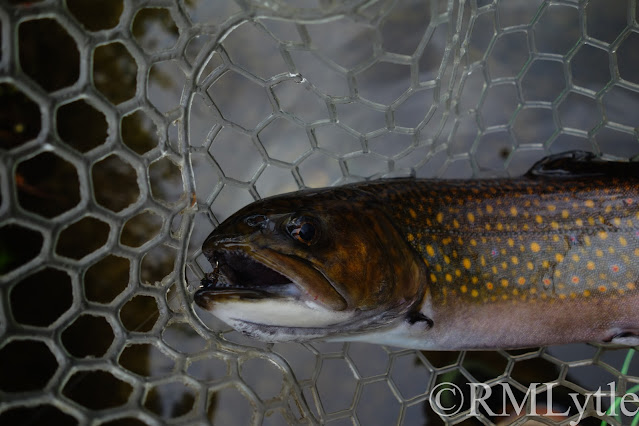


There were a few really big males mixed in with this school and obviously we wanted to catch one of those. I like to say, if I'm going to fish for fake trout that were raised in a concrete tank, they may as well at least be big. It came to a point of intentionally missing and pulling away from smaller fish, which were consistently getting to the fly first. One of the fatter males did make it to net, though it was still dwarfed by a couple of the fish in the school. 


Garth and I each ended up having goes at one of the largest fish. He missed a take from one of the giants. I ended up loosing one. It was frankly one of the heftier brook trout I've ever hooked, taking off on an exceptional run of the bat and putting a deep bend in the 5wt. The size 18 pheasant tail while rolling on the surface well downstream of where it had taken the fly. 

One of the things this trip was doing, quite unintentionally, was reminding me that I enjoy warm season daytime trout fishing. In recent years, I've been reserving it for the late fall, winter, and spring. In the warmer months I've pretty much just fished at night in recent years. CT's summer fisheries, with the exception of the Farmington (which I just don't enjoy anymore) and some small stream (which I don't like putting pressure on with frequent summer visits). There are also just plenty of other things to do close to home, things I often like more. For the last couple years, it's been carp. It can be hard for those of us who like to fly fish for any and every fish in all kinds of water to pick what to do. Here in the northeast there are an awful lot of options. Perhaps next season trout will be on the agenda for me a little bit more often. Though I tend to shirk the way many fly anglers hold salmonids up as the supreme fish to target, I devoted quite a few years to hard focused trout fishing for a reason. I know a lot more than I did then, and I'd like to improve my game a bit more. 

We shall see; come next summer the pull of double digit bowfin might be a impossible to resist. 

Thank you to my Patrons; Erin, David, John, Elizabeth, Brandon, Christopher, Shawn, Mike, Sara, Franky, Geof, Luke, Noah, Justin, Sean, Tom, Mark, Jake, Chris, and Oliver for making Connecticut Fly Angler possible. If you want to support this blog, look for the Patreon link at the top of the right side-bar in web version.

Thursday, November 17, 2022

Trouting About in Vermont (Pt. 1)

 Back in mid September, with some rains bringing rivers back to life and temperatures on the fall, the trout itch started to need scratching. With the Farmington still too low to be of particular interest in daylight, Garth and I set our sights further afield. The Rangeley region seemed like one decent choice, it had been a while since I'd tangled with large brook trout. Night fishing in the Catskills also didn't seem like a bad plan. We settled on an area between the two, and one I'd not spent as much time exploring. Though I'd fished Vermont many times, rarely ever have trout been the target. With input from Drew Price of Masterclass Angling, a lot of research trough USGS data, satellite imagery, and the limited available fishery data, I created a hit-list of rivers and specific spots within rivers. I packed up the 4Runner and picked up Garth after he got home from work one evening and we headed north. 

The plan was simple: car camp, fish, and explore. We had a few days and nights to work with on some of the prettiest trout waters in the Northeast. The Green Mountains have a rich trout and fly fishing history; being home to Orvis's headquarters, the famed and fickle Battenkill, and some exceptionally beautiful and large wild salmonidae. It is a stronghold of native brook trout, though some of the Green's streams are now dominated by nonnative brown trout and in some cases, rainbows as well. We hoped to catch all three species in some beautiful and at times quite remote waters. 

We arrived in the dark and caught some rest near the stream I wanted to fish first. It was the most remote of them and a totally blank slate for us. It was going to be cold and there'd be trout in it, we just didn't know how many, what species, or how big. When I first got a look at the river I liked what I saw. Flows were strong, the water was a little tanic, and the surrounding woods were beautiful mixed forest dripping with moss. Spring seeps poured out of the hills and the river valley itself was spotted with beaver meadows. Varied habitat makes the best habitat, and this felt like a clean and healthy ecosystem. I was getting pretty excited. 

This environment may actually have had the highest density of Eastern newts I'd ever encountered. The wetland areas, be they active beaver ponds or the remnants of abandoned ones, were crawling with hundreds upon hundreds of the aquatic form. Walking through the woods we turned up the bright orange terrestrial form as well, know as red efts. 


Also occupying the beaver ponds were creek chubs and a variety of dragonfly species. The stream itself was cold and fast and seemed fairly sterile, harboring caddis and midges but very little in the way of mayflies as far as I could tell. It seemed a bit too "clean" and nutrient deficient to be brown trout habitat- remember that point - and out initial visit seemed to indicate that the stream was very rich with brook trout and hardly any other fish of any kind. These fish were beautiful, dark specimens averaging 6 inches. Some exceeded that mark, but it didn't feel like encountering one much in excess of 10 inches was likely. They were quite numerous though. I fished the ever reliable Ausable Ugly, and it produced handsome fontinalis one after another for a few hours. 


After months of fishing urban, industrial, and suburban habitats almost exclusively, it was a relief to get away from people and signs of people. Unfortunately some of this was an illusion. Neither the forest itself nor the stream were in a fully natural state. The land it was contained within was is fact, in essence, a protected tree farm open to recreation. It was timber in reserve. We passed patch cuts on the long dirt road in. But at the very least signs of human presence were limited down in the river valley. There weren't angler foot paths. The fish didn't have the injuries so common in pressured fisheries where trout are caught and released repetitively throughout their lives. Trash wasn't merely scarce, there was none. It was rejuvenating. 


I can only catch so many small brook trout in a day, though, before I feel bad for disrupting their natural rhythms. Garth and I then decided to go disrupt the rhythm of some non-natives. It was time to look for a big brown trout. Though not a widely known big trutta destination, Garth and I had a bit of intel to act on. Perhaps we'd stop somewhere along the way that we knew nothing about as well. This was an exploratory mission after all.

Thank you to my Patrons; Erin, David, John, Elizabeth, Brandon, Christopher, Shawn, Mike, Sara, Franky, Geof, Luke, Noah, Justin, Sean, Tom, Mark, Jake, Chris, and Oliver for making Connecticut Fly Angler possible. If you want to support this blog, look for the Patreon link at the top of the right side-bar in web version.

Monday, August 8, 2022

Monster Carp on The Fly at Night

 Quick reminder: I'm doing a talk this coming Thursday, August 11th, at 7:00pm at the Middle Haddam Library on fly fishing for Connecticut River Carp. It should run about an hour, I hope to see some of you there!

The Hex hatch is a CT summer featurette. It's tough to pinpoint, devilishly so, and doesn't last. If the conditions aren't just so there often aren't even that many fish feeding on it. When it does come together though, wow is it ever magical. The water boils with a multitude of fish species frenzying on the huge mayflies. This year, so far as I do occasionally run into later August hatches, the fishing has been average, which is to say an exciting experience but not one that resulted in a significant number of notable catches. Last year was subpar but one night yielded giant crappies slurping spinners, which was just incredible. This year it was mostly average sized white perch and smallmouth bass making up my catch each night. With one exception. 

I always linger after the hatch, especially early in the event. If it's marginal, the nymphs will often swim for a little while after the ones that are going to emerge do so. It's slower, slightly less exciting fishing but It has produced some of the larger fish. One night, I was standing under a streetlight casting  Pat's Rubber Legs- an un-ideal but passable hex nymph imitation -when a shadowy form emerged from the depths into the lit area. It was a carp, a decent sized one at that. I let it approach then presented my fly to it. It moved forward and flaired its lips, so I set. I was into something solid. Too solid, I thought, it felt snagged. I started to attempt to detach the fly, knowing full well the carp was going to spook off. It left fairly passively, which was odd. Suddenly, line was coming out of my had. "Oh, she is on" I muttered aloud. The fish left with patient autority, buckling my 5wt but in no real rush. I knew it was big, though at that point I wasn't quite sure just how big. 


Yeah, uhhh... she was huge. She was actually tough to lift. I've only had that issue with a small handful of carp. I suppose the takeaway here isn't extremely clear, so in case that's true: keep fishing. You can't always predict when a trophy fish is going to present itself. Some are a result of fishing hard, planning, predicting... and then others just sorta happen. In either case, you can't be sitting at home. Fish when you can, always. 

Thank you to my Patrons; Erin, David, John, Elizabeth, Brandon, Christopher, Shawn, Mike, Sara, Leo, Franky, Geof, Luke, Noah, Justin, Sean, Tom, Mark, and Jake for making Connecticut Fly Angler possible. If you want to support this blog, look for the Patreon link at the top of the right side-bar in web version.

Thursday, January 20, 2022

Big Unfriendly Trout

 Back around the holidays, I was able to make a bit of time to get out on the water with my good friend Joe. Boots and I hadn't gotten on the water together since July so it had been a long time coming. It was to be a simple morning fishing local trout water in relatively mild though damp winter weather, both an enjoyable setup and the sort that has the fish a bit active. The water was a bit low for the time of year and the fish were spread out a bit, meaning we'd have a slow pick rather than finding fish piled up in typical wintering holes and laying the hammer on them. 

Most of the fish were typically sized stockie rainbows, but I was aware that there were some large browns in one of the short stretches we fished. I saw one, actually, just a short time after we arrived. Then a bit later I found two more milling around with each other. We both took shots at the fish, and I was shocked neither ate one of Joe's worms. Eventually I laid a drift past the smaller of the two with a Walt's Worm under an indicator and saw the tell-tale white mouth flash. I set the hook and the fish angrily dropped out of its lie shaking its head. The other one decided to follow. For much of the fight, the two fish were almost glued to each other. I tried to get Joe to cast at the follower but he insisted I land my fish first. I really hoped he'd hook one of these big yellow monstrosities as well, but I also respected that he didn't want to mess up the chances of me landing mine. There's a lot to be said of a fishing buddy that will forgo a shot to make sure you land the fish you've got on. 


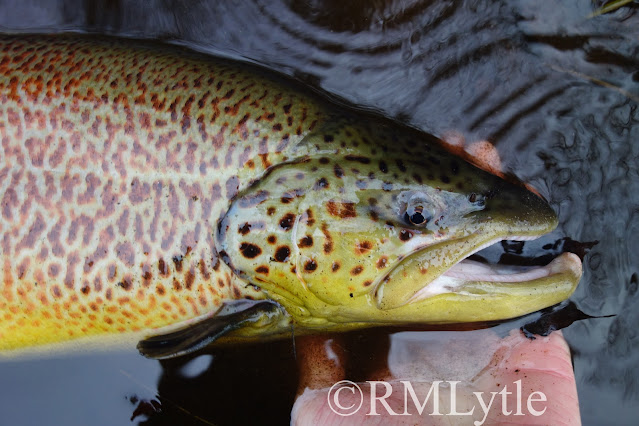
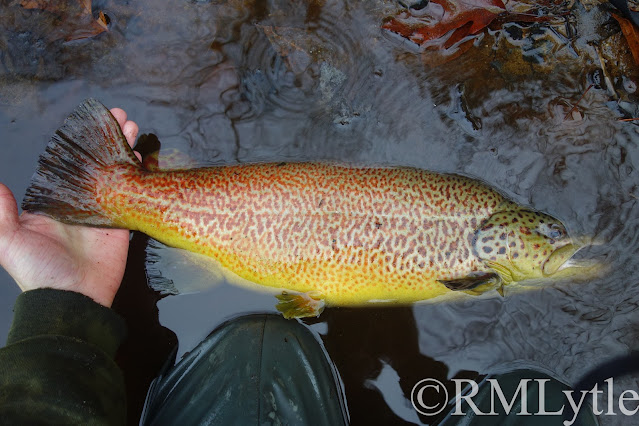
This big broodstock Cortland strain brown was vibrant but very domestic looking- shaped like the schedule fed animal it was. Both Cortlands and Romes, which were originally produced in hatcheries in NY then brought to CT, often have the almost marbled pattern that this male did, and I regularly see them mistaken for tiger trout which they most certainly are not. Male seeforellens produced in CT hatcheries regularly have this patterning too, though less extreme. Frankly the domestication seems to be to some extent accentuating this trait, as I've seen it in wild trout but never even close to this extreme. I could imagine some koi-like genetic art being done with brown trout. That might be pretty cool, though I'd rather not catch them in rivers and lakes that have wild native fish. 

We tried for awhile to find and tempt the other Cortlands, and I had two follows with a streamer by another one, but it wasn't to be. We spent the rest of out time talking about life and fishing and landing the odd rainbow here and there. It was an enjoyable, relaxed, pressure free morning on the water, something I always need to balance out the intensely focused trips.

Until next time, 

Fish for the love of fish.
Fish for the love of places fish live.
Fish for you.
And stay safe and healthy.


Thank you to my Patrons; Erin, David, John, Elizabeth, Brandon, Christopher, Shawn, Mike, Sara, Leo, C, Franky, Geof, Luke, Streamer Swinger, and Noah for making Connecticut Fly Angler possible. If you want to support this blog, look for the Patreon link at the top of the right side-bar in web version.

Tuesday, January 18, 2022

Rejuvenation

It was the 24th of December. A light, clean blanket of snow had carpeted the landscape and dressed the trees. It hadn't yet been sullied by the boot prints of other people; I was the first to disrupt the scene. Traversing the steep slope down to the creek, everything was tranquil and there. When I slipped my boots into the dark, cold water reached into the fabrics and padding and strained against neoprene, slowly but surely sucking the heat out. 

I'd been away from this water for a long while for a variety of reasons. The few times I had been in the last couple years never felt right. The fishing was in a bad way and so was I. If I'm unable to enjoy my time in a special place there's not much sense in being there right then. This time though the magic seemed to have returned. Perhaps it was just wonderful wintertime lack of disturbance. Spring and summer are easy and comfortable. So people that aren't really anglers are out fishing. During the early eruption of the pandemic there were more people than I cared to see down in this creek, which is frankly anyone that isn't me or the occasional friend I've invited with me. In the winter I can be assured solitude. 


As I made my first casts my mind wandered back to other moments casting into the same water: fish I'd lost, fished I'd landed... strong spring hatches, fall streamer bites. I'd done an awful lot here over the years. A take jolted me back to present. I of course missed it, I'd been day dreaming. Refocused, I worked the water in front of my carefully and thoroughly until my leader paused in the right sort of way and I set the hook on a wild brown trout. Then I kept doing that until it felt completely right again.


None of the fish I caught were really that impressive in the grand scheme of things. They weren't especially large, nor did they fight notably hard. I was in awe of them though, vocally so. I caught myself quietly saying "wow, what an animal" just under my breath when I let a long-faced male brown of about 14 inches slip back into the current. I think that's important. Don't take a good fish for granted- and I mean of any species -or you'll forever be frustrated. And let's be honest here, with very, very few exceptions there really isn't a bad fish out there.


I've been reminding myself of these lessons a lot lately, but on this day it was particularly important because I was on my home water. I'd grown far apart from my home water for a while. I haven't even been living particularly near it. I'll never fish it as hard as I used to, nor do I need to. But it would also be a shame to lose that connection. This reminded me how many connections I had in fact lost. There are a lot of places I used to fish hard that I haven't in years, places with wonderful memories and amazing fish. Sometimes looking for something bigger and better pulls too hard. Don't lose sight of the gems you found when everything was new and fresh. They're still very special. 

I followed my own tracks out that day feeling a lot better than I had in a while. I stopped on the path to look at the footprints small birds had made around some seedy grasses. They'd turned the surface of the snow into a swirling, streaking painting. It was wonderful. Take nothing for granted. 

Until next time, 

Fish for the love of fish.
Fish for the love of places fish live.
Fish for you.
And stay safe and healthy.


Thank you to my Patrons; Erin, David, John, Elizabeth, Brandon, Christopher, Shawn, Mike, Sara, Leo, C, Franky, Geof, Luke, Streamer Swinger, and Noah for making Connecticut Fly Angler possible. If you want to support this blog, look for the Patreon link at the top of the right side-bar in web version.

Monday, December 27, 2021

A Lone Tiger in the Bridge Pool

Cheyenne and I walked down to the Bridge Pool one dull, chilly November day. This was the first time she'd ever been to my home river with me, which made it special. Few places have had such a significant impact on my life. The Bridge Pool is pretty much the epicenter of my fly fishing world. It was quite a playground for a fly fishing obsessed teenager; a stream stolen from the Rockies and hidden in CT, just a short bike ride from home and hidden from view. 


The Bridge Pool has changed a lot over the years, but was especially different this time as the old cart bridge that was the pool's name sake was gone. The pool is still there but the bridge is gone. That was a bit sad, as I can remember many years ago going on hikes with my mother and younger brother and walking across that bridge. I can remember looking down at that pool and wondering what sort of creatures might be hiding in its depths. 

I've had a whole lot of years and chances since then to figure out exactly the sort of things that swim in that pool. I'd caught everything from crappies to 22 inch wild brown trout in there, and a whole lot in between. Today, though, the Bridge Pool would give up a fish I'd never caught within its confines before. Kneeling on the bank, with Cheyenne behind me, I cast an Ausable Ugly under an indicator into the heart of the pool. On the fifth cast, the bobber dropped and I set the hook into a substantial trout. It wasn't a trout, actually. It was a trout char hybrid; a big holdover tiger. I'd caught rogue holdover tigers and even a few wild ones out of my home water before, but never out of the bridge pool. It was a handsome specimen, though one that I didn't feel should be permitted to live there any longer. Stocked tigers are ravenous predators that can have a notable individual impact in a small system like this one.


Cheyenne and I ate that fish that night, along with a rainbow I'd caught at another river later in the day, baked wrapped in tinfoil with lemon and spices. There was a time I would have released that fish and scoffed at another angler for deciding to take it. 

I've grown a lot since I first cast a fly into the Bridge Pool.

Until next time, 

Fish for the love of fish.
Fish for the love of places fish live.
Fish for you.
And stay safe and healthy.


Thank you to my Patrons; Erin, David, John, Elizabeth, Brandon, Christopher, Shawn, Mike, Sara, Leo, C, Franky, Geof, Luke, Streamer Swinger, and Noah for making Connecticut Fly Angler possible. If you want to support this blog, look for the Patreon link at the top of the right side-bar in web version.

Monday, December 20, 2021

Autumn Char Stalking

 I was sitting on my tailgate peeling off wet waders when a local stopped with his window rolled down and asked "how'd you do?"

"Just got here" I replied. 

Seeing that I was clearly removing waders that had very recently been fished in, he gave me a sideways look before moving on. He probably thought I was being an asshole, but I wasn't lying. I'd left my waders on while driving between streams and really had no need for them here. More and more these days I enjoy fishing a small brook trout streams in just my boots and jeans. I don't feel that tromping through the water is in the best interest of the fish, especially between late October and mid March when the next generation of char are still growing in the gravel. But I've also come to relish the challenge of getting into position without getting my feet wet. Wading up the middle of these tiny streams is a short-cut that keeps me from learning important skills, be it casting, stalking techniques, or just the skill of sitting and watching, either unnoticed by my query or just still for long enough that they'd forgotten I was there. 

Brook trout get to be their most spectacular in autumn, and that revolves around their spawn. The males are particularly stunning, and to me it has nothing to do with elegance. Late winter, spring, and summer brook trout are elegant. In the fall these char ugly up, especially the males. They turn into little demons with dark bellies and mouths, red fins and lower flanks, big teeth, and bad attitude. I personally find it spectacular when fish ugly-up, regardless of the reason. Most fish ugly-up to spawn, especially the males, and to me that's often when they look really really cool. I was sneaking around this stream where the fish had probably just quit spawning a week or two prior hoping to find some gnarly looking males. It isn't that hard to find those guys, they're trying to bulk back up for winter. 


Appropriately, I caught the first dozen fish this day on the Ausable Ugly. Ugly eats ugly, I suppose. After a spell the urge to use something a tiny bit more elegant arose. I switched Adirondack tyers from Garfield to Betters, and though Betters' style could perhaps best be described as messy, the Ausable Bomber is a lovely little fly. It ended up taking the best fish of the day.


Noah and I were talking a little while ago about just how large brook trout's mouths are. This is no more evident than in the late fall when most of the fish's mouths are enlarged for the purpose of biting each other. An 8 inch male brookie might have a mouth the same size as a foot long smallmouth bass, loaded with much larger teeth. Those large mouths can fit a lot of food, too. Autumn char really are aggressive little eating machines at their most impressive.

Until next time, 

Fish for the love of fish.
Fish for the love of places fish live.
Fish for you.
And stay safe and healthy.


Thank you to my Patrons; Erin, David, John, Elizabeth, Brandon, Christopher, Shawn, Mike, Sara, Leo, C, Franky, Geof, Luke, Streamer Swinger, and Noah for making Connecticut Fly Angler possible. If you want to support this blog, look for the Patreon link at the top of the right side-bar in web version.

Wednesday, December 1, 2021

Freestone Wild Brown Trout Redemption Day

 It had been a good long while since I last poked around some new freestones to look for wild trout. A preoccupation with bigger fish had held my attention for a while, but it was inevitable that I'd need to get back out on some boulder strewn creeks to make sure I could, in fact, still catch trout. Sometimes it feels like I've lost a lot of my muscle memory when it comes to trout fishing. I certainly do it far less than I used to. Of course it doesn't help at all that a lot of the small streams I used to fish are a mere shadow of what they used to be like, with far fewer and much smaller fish on average. CT wild trout has seemed to be in the downswing over the last 5 years especially, with some historically productive wild brown trout streams that produced very large fish being almost wiped out. I watched the collapse of my favorite brown trout river, and my home water as well. Fewer fish certainly makes it feel like I've gotten worse at fishing. Thankfully when I actually do fish areas that remain strongholds, I'm reminded that I've still got the touch. 

Such was the case where I went one day last week. I dropped Cheyenne off at work and headed to a stream I'd fished before but to a stretch I'd not been on. The flow was moderate, the water lightly stained. The stream was structurally very similar to my home water. It was a classic New England freestone. The gradient was steep and the substrate was mostly boulders with some cobble and gravel. 

I knew wild brown and brook trout were present here though I wasn't sure of their abundance. I was very quickly catching fish though... so evidently they were pretty numerous. They were mostly small wild browns with some stocked fish mixed in. There was a fish everywhere there should have been one, too. If I dropped my Ausable Ugly into a prime lie, it got eaten. 


I took a mental note of where I got takes, looking back upstream (I was working down) as I went and memorizing each spot I'd missed or hooked a trout. This is something I do a lot, I think its every bit as important as knowing how to present flies well, matching forage, or knowing when the conditions are best. Remembering where you hooked fish allows an angler to draw comparisons: trout don't act any differently anywhere in the world, really. If you see a the same sort of holding or feeding lie you've caught a trout out of before and the conditions and time of year are similar, there will probably be a trout there, whether you're fishing in Argentina, Montana, or Massachusetts. 

Such was the case with this stream. Though I'd never stepped foot there before I wasn't fishing unfamiliar water. I fished pockets, runs, troughs, and plunges I knew and had fished before. I'd seen that back eddy before, and caught that brown trout next to the log- they weren't the same, but they kind of were. Do you know what I mean? 


I picked pockets with a big grin on my face, happy to feel very much at home. Everything was familiar, simple, and wonderful. The fish were gorgeous and the habitat was perfect. I was pulling on trout with regularity and tallying them in my head. By the time I left, I'd caught 38 fish. One was a fallfish, two were substantial holdovers, and the rest were a mix of wild fish and fish stocked as fingerling.


I wasn't done fishing that day, but I'll save that for another post. For now, I'll leave you with a suggestion: fish thoughtfully and thoroughly. Sometimes I find myself rushing along, especially on new water, sure that there must be better water somewhere ahead. Don't assume that. Work what's in front of you first. Analyze it, fish it in a way the has produced fish for you before in a similar spot. then, if that doesn't work, do something new to you. 

I've been very much enjoying the videos put out by Jensen Fly Fishing. They are perhaps the best proponent out there right now of methodical, well thought-out approaches to trout fishing. Watching their videos has made me rethink why I've been successful in the past and what I need to do in the future. There's always more to learn. 

Until next time, 

Fish for the love of fish.
Fish for the love of places fish live.
Fish for you.
And stay safe and healthy.


Thank you to my Patrons; Erin, David, John, Elizabeth, Brandon, Christopher, Shawn, Mike, Sara, Leo, C, Franky, Geof, Luke, Streamer Swinger, and Noah for making Connecticut Fly Angler possible. If you want to support this blog, look for the Patreon link at the top of the right side-bar in web version.