Showing posts with label Wild Rainbow Trout. Show all posts

Thursday, July 24, 2025

17 Years

"What's up dog, want some coffee?" Levi whispered as I entered the kitchen, a little groggy but full of anticipation none-the less. "Morning, sure, thanks," I whispered back. "Hell yeah," he replied, "How stoked are you?"

"Pretty stoked."

When the cicadas last came to Central Pennsylvania, I was 11 years old. I'll be 45 when the come back next. That's a lot of time elapsed, and a lot changes. I hadn't yet picked up a fly rod in 2008, in 2042 who knows what life will be like. This year the bugs came again on their cycle and my silly addicted ass trucked it westward thrice, chasing a sickness so good it can't be beat. I've raved about the periodical cicadas before; in 2021 when I intercepted the periodicity in Maryland, and last year when a dual emergence took me to Illinois, Arkansas, Missouri, and Iowa. When magicicadas come out of the ground, I want to be there. They make up one of the last great biomass events of the sort here in the US, and while many were constant, like the buffalo, and some were annual migrations, like the passenger pigeon, there's something extra special and enchanting about an event that occurs more than a decade apart each time. It is miraculous that we still have these bugs at all, the landscape they live under is different every time the nymphs come up. That they still come up from one of the best regions for wild trout fishing East of the Mississippi... How lucky is that? Though, I suppose the same factors that have allowed the cicadas to persist have not been insignificant in providing habitat advantages for the wild trout either. 

Levi and I stepped out into the humid, warm morning air about ten minutes later with a little bit of our gear and a lot of hope for the day. "Hold on, before we go we gotta move the bugs", I said. We were staying at Levi's good friend's, Paul and Kathryn, and they were going to take down a tree in their backyard that day. It was time for a quick rescue mission. We walked over with our phone flashlights on to see dozens of pale, ghostly looking imagos and instars on the tree trunk and low branches. We collected as many as we could and moved them to nearby bushes. When periodical cicadas first emerge they come out of the ground through simple little holes, or sometimes, through turrets of soil that poke up above the ground, small towers of their own design that are made pre-emergence in wet areas in what is presumed to be a bid to keep mud and water from getting into their holes before the emerge. Those final instar nymphs climb out and go for the closest tree or bush, shed their nymphal shuck into imagos- the last, adult stage of their life cycle -and like many emerging insects, take a little while to harden up and get ready to go about their business. They'll go from pale and soft to firm, glistening, black and orange bugs, maintaining deep red eyes through the process. We shuttled as many as we could to safety before hopping in the car to head to the river. 


Central Pennsylvania holds fond memories for both Levi and I, though mine are more limited in number and a tad more recent. Levi fished trout in the limestone region the last time the cicadas came out in 2008, I first fished the area with my good friend Michael Carl in 2018. I've since returned a handful of times to poke into places I'd fished that first time, and a few new ones. Much of Pennsylvania is still Bucolic and beautiful, with sparse populations and varied terrain. Here, the Appalachians  form a series of arching, near parallel ridges. These start near Meyersdale, and you cross or cut through about a dozen spines headed East towards Chambersburg which sits in a wide lowland with rolling hills and the classic carts topography associated with limestone. East of Chambersburg is a less defined but similarly arching range of hills, encompassing Michaux State Forest and extending, broken by the Susquehanna, almost all the way to Reading. Throughout the main crux of the ridges to the west and north are smaller versions of the same sort of lowlands that Chambersburg and Carlisle sit in, each pocked with farmland and hugged on either side by tall ridges. In many of those low areas between the ridges is where the limestoners or limestone influenced creeks live, though each audaciously cuts through the ridges at some point on their journeys toward the Susquehanna, some more defiantly than others. The Little Juniata scrapes starkly through the ridge above Barree, Fishing Creek winds tightly under the steep topography on her way toward Lamar. And then Spring Creek, toward the apex of the curve of the ridges, gently wanders through a less strip of rock between Bellefonte and Milesburg. The millennia that allowed these streams to eat through these seemingly immovable stone ridges is too substantial for our simple human minds to fully grasp. It inspires aww though, when you stop and look at the landscape for a moment. 


Though not as diverse as the southern end of Appalachia, which boast the highest diversity of salamanders in the world and the largest of freshwater fish in the country, these Pennsylvania ridges aren't lacking in life. It's no surprise given that large swaths of this land are still very wild. Though logging has occurred for decades, as well as that farming down low and a slow hum of building in some towns, much of this place is still rugged. The terrain is gnarly and thick, and one can get lost if the try. This is the one of the last places in the country that still allows hunting of timber rattlesnakes, albeit in very limited and regulated form. Indeed they're quite stable here... still, I'd love to see this archaic hunt done away with. Why mess with one of the last best places this species has as a stronghold? Up on those high ridges though, we weren't hearing many cicadas. It was early though, as evidenced by the nymphs crawling out of the ground en masse that morning. We'd need to find an area where the bugs had already been out and flying for a while. Soil temperature has everything to do with emergence timing, and some places warm faster than others. We were committed though, and with windows open and ears trained to a familiar buzz, it didn't take long to find what we were looking for. 


"Mark says the shops the guys at the shop basically told him the fish aren't on them yet and not to waste his time fishing cicadas" Levi reported as we drove between spots. "Oh yeah, it's not worth it at all yet" I retorted snidely and we both laughed. We'd just had exactly the sort of fishing we'd driven over five hours for. Not size, albeit, but numbers? Whoa did we ever have that. And we'd had it to ourselves too, leap frogging up a piece of water neither of us had fished in years with not a soul in sight. Just brown trout sucking down big bugs without consequence... until our hooks pierced their lips. It was... absurd? Deranged? What dreams are made of? All of the above. When I fished Brood X in 2021, I got a modest taste of what trout fishing the periodicals could be, with a couple absurdly fat and happy wild brown trout. This was a more complete picture, as good as you hear it is. We traded remarks and shook our heads in disbelief each time we leap frogged, both reveling in the success of timing things well enough not only to have good fishing, but beat the masses. And, so long as the shops were still downplaying things, it felt like we had good chances to find pockets of stellar fishing throughout the trip. 
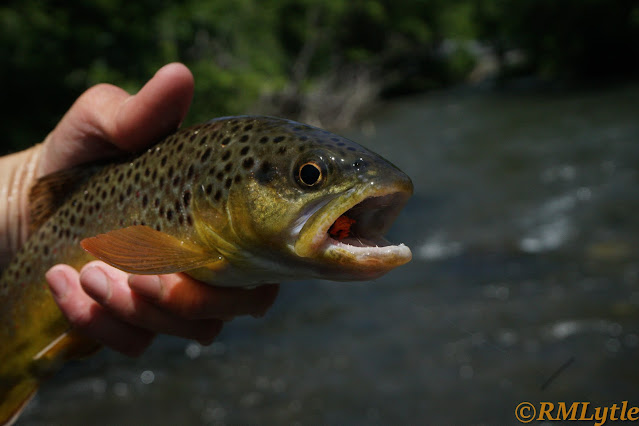


Where we were for that first pound-down wasn't a big fish location, but that didn't matter. Having trout come out of every riffle and pocket to hammer our big foam dry flies was thrilling. You can certainly work through similar water with similar flies- especially early in the morning and at times when some golden stoneflies or hoppers are present, or even if there's a modest number of annual cicadas -and pick up a few fish. This wasn't that. This was interacting with possibly as much as a quarter of the trout biomass of the stretch we fished and catching a disproportionate chunk of it. The fish were giddy. I had more than one nice fish (for this place that was 13-14") charge straight upstream a foot or more in fast shallow riffles to eat my fly. This was the dream. 

We were on our way to another spot on the same creek when we received that report from Mark, a stretch I'd fished before and done well with wild rainbows and some browns. The sound out the window as we closed in on our destination and the empty pull off when we got there said we were going to step in it again. 


The storied history of trout fishing in the area of State College is an interesting one, and though many eastern trout anglers may know bits and pieces of the story I think a lot of it has been glossed over. Spring Creek has one of the more distinct histories of course. Many may be aware that Spring Creek was a brook trout dominated fishery into the end of the 1800's, when introduced brown trout began to supplant the native char. By 1950 a native trout in Spring Creek's main stem was a rare occurrence. The origins of some of the rainbow trout that exist in the now mostly un-stocked stream remain a bit controversial, though I'd argue on behalf of some being stream born given the alkalinity, relative temperature stability, and shear perfectness of both par and adults of some specimens. of course, hatchery escapees from Benner Springs and Fisherman's Paradise, and stocked fish moving up from Bald Eagle creek contribute. Anyone who wants to can see the results of this in a tiny stretch right in Bellefonte, where you can pay a quarter or two for some pellets from a dispenser and toss them into a short, closed-to-fishing stretch where trout bigger than some of the carp present in the same spot will greedily take whatever you give them. Levi, Paul and I stood on the wall in Bellefonte one day, tossing leftover french fries and watching giant trout eat them. Those fish aren't Spring Creek's calling card though. If you've heard of the place but never been, your familiarity may start and end with the existence of the famed Fisherman's Paradise section. This piece of water was bought by the state Fish Commission in 1930 for construction of a hatchery and to demonstrate and test new stream improvement methods¹. A hatchery was built four years later. With heavy stocking and stream improvement that are now known in some cases to improve fishing more so that fishery health, the place soon boomed in popularity with anglers. The regulations then imposed ended up being quite unprecedented, and even in today's ecosystem might be though of as incredibly strict. Fishing was restricted to May through July, barbless flies were enforced, wading was prohibited, and there was a small and finite number of visits you could make. Even though some of the stricter regulations haven't carried over to present day, the popularity rivals the present day. More than 44,000 angler trips were registered in 1952. Photos from that era reflect this, with a parking lot jam full and anglers standing shoulder to shoulder on the banks of a Spring Creek that looks so different today it may as well be a different river entirely. 

In 1982, triggered by kepone and mirex contamination, the commission stopped stocking trout in Spring Creek and enforced no-harvest regulations. In turn, the wild trout population, brown trout specifically, absolutely exploded. It has been said that there have been as many as 3,000 trout per mile in Spring Creek, making it very high on (if not at the top) of the list of most densely trout populated streams in the Eastern United States. That population density has changed with time, of course, having apparently increased until 2000 and being on a downward trend since. That downward trend is likely tied to development in the watershed, and PFBC notes as much:

"In other watersheds, impervious surface area has been used as a good surrogate of urban development; when imperviousness reached 7-11%, trout populations were lost. The Spring Creek watershed had 12% impervious cover in 1995, and in the upper one-half of the watershed, impervious cover was 19%. We suggest that the reason Spring Creek is still able to sustain wild trout with this degree of urbanization is the relatively large input of groundwater into the stream. Further development that increases impervious cover, reduces groundwater recharge, or both, will certainly increase the stress on Spring Creek and reduce its ability to support wild trout."²

As development continues in the area around State College, and as climate change continues, its hard to say what the future holds for Spring Creek. What remains abundantly clear to me is that it, and even some of the more marginal trout streams in Central Pennsylvania, make even the best places we have in Connecticut look like a joke. Part of that is the nature of limestone, but part of it is an indictment on what building can do. Connecticut and our rapidly dying coldwater fisheries should be a good example of what NOT to do if you want to keep strong wild trout fisheries around when it comes to development, road salt use, lack of riparian protection, over-stocking, on and on and on. 


One thing Connecticut doesn't fail with is common carp. Europe's most popular "course" fish is highly abundant in the state and isn't going anywhere. Recently, after a number of fish had been caught over the years that could have cracked the former record, someone finally clocked one over fifty pounds. Well over, in fact. At over 58 pounds, Norbert Samok's record fish is a significant achievement. Of course, Pennsylvania has carp too. The state record was caught in 1962 by an angler named George Brown. The fish weighed 52 pounds... ha! We've got you beat there, PA. I can't gloat too much though, because instead of getting the chance to fish periodical cicada eating carp, I can't really wait around in Connecticut. It turned out Pennsylvania was going to give me a challenge too, though. 

Levi and I met Mark Hoffman in Boalsburg on our second morning for our first serving of warm water cicada mania. Haze clung to the hills as the light came up, that sort of low morning humidity that suggested a very hot day was incoming. We hopped in with Mark and headed toward a place where carp, overhanging trees, deep lake shore, and periodical cicadas all overlapped. Surface disturbance was visible as we crossed a bridge over the lake on the way in. There was heavy calling as we pulled into the launch. Anticipation was high, especially for me. I know this game a little bit, I've caught some carp on cicadas. But something was going on at the ramp that put a more than slight kink in the plan. The back cove was all muddy, and in various spots on both the near and far side there was a ruckus going on. Splashing, crashing, tail slapping, jumping... these carp were busy humping, not eating cicadas. The thing with the carp spawn is that it can kind of happen any time the water gets warm. I've seen carp spawn as early as April 10th and as late as September 3rd. Sometimes that's just a few pods of fish and plenty are still happily and busily feeding away. This wasn't that, though. We motored all over the lake and for the most part found nothing but carp making more carp. It got hotter and hotter as the day went on, and though I picked up some largemouth on cicada patterns and Levi ran a little chartreuse bugger and put a smackdown on white crappie, this wasn't what we hoped for. 


As the heat became more and more oppressive, frustration boiled over. We bailed, sweaty and ready for lunch. It wouldn't be for a couple days, right as our trip came to an end in fact, that we got a shot at the carp again. We met Mark at the same launch, just hours to spare before we needed to hit the road. This time there was no thrashing and crashing on that far bank. The carp should be feeding now, of that I was fairly confident. The most confident, in fact, as the previous attempt had shaken Levi's. In fact it had taken a bit to convince him that this could be worthwhile. We motored out of the launch and rounded the corner, travelling down the shoreline where cicadas were calling their little tymbals off. It wasn't long before I saw it: a carp tipped the wrong way, with it's head up and its tail down, orange lips at the surface, sucking down one of the bugs that had so haplessly bumbled onto the lake surface. The were here....

They weren't easy though, and we weren't the only ones on the water. A few other boats were out with fly rods, all working the banks looking for targets. Any pressure can complicate things, especially with carp. These are sensitive, shy fish. Before we found a couple willing carps, Levi managed to catch one of the nicer largemouth bass I've seen in a while. Getting big bucketmouths on cicadas isn't a bummer at all. 


Largemouth bass are America's favorite gamefish. An estimated 16 billion dollars a year is spent on bass fishing. To put that in perspective, the estimated annual market for fly fishing in the US is 750 million dollars. The people love bass, enough so that they've been moved here and there and everywhere. Where we were, just one watershed divide separated us from the native range of the northern bass, but we were fishing to non-native fish where we were. Given their widespread introduction and infusion in the fishing culture, many anglers don't realize when bass aren't native where they fish. In Connecticut, neither smallmouth nor largemouth bass were present historically, and that information is relatively available to anyone who cares to look. That said, it isn't hard at all to find anglers who insist that they are a native fish. Aa great many angler believe a great many things to be true that just aren't though, that is a reality that no longer surprises me. I just roll my eyes with my lips pursed in a tight, straight line and repeat the same statements again-- "actually, the only larger native freshwater predator species in Connecticut were chain pickerel, brown bullhead, and brook trout...." It's remarkable how much of our fisheries are made up of introduced species. In much of the northeast, we're looking at as much as, even more half of the popular target species. Even somewhere like Maine, where landlocked salmon and lake trout did exist naturally, they've been scattered about in all sorts of places they never were before. We think of fishing as a way to be in nature, failing frequently to realize that what we fish isn't actually natural. 

Even the lake we were on wasn't natural. In fact, large natural lakes are essentially non-existent in Pennsylvania. The largest natural lake in the state is Conneaut, in Crawford County. At just 243 acres, it is a piddly body of water compared to the Pymatuning Reservoir just miles away, and even it wasn't immune to human alteration. In 1834 connection to the French Creek canal raised the lake by 11 feet. The geology in Pennsylvania just doesn't make big lakes, unless you count Erie, of course. I wonder how the fishing was in the river that made this reservoir we were fishing before the dam went up, and I wondered how many more cicadas there'd been before the land they lived under was flooded. What fish would I have caught here in 1685, just 20 emergence cycles ago. Would I have been catching 20 inch fallfish here? Giant brook trout? How many billions more cicadas must there have been?

What was is now gone, and there's little left to do but find a carp, put a piece of foam in front of it, and not set the hook too early. 


¹ Tom Burrell, The Express. Dec 14 2024 The Evolution of Fisherman's Paradise

² Carline, R. F., R. L. Dunlap, J. E. Detar, and B. A. Hollender. 2011. The fishery of Spring Creek – a watershed under siege. Pennsylvania Fish and Boat Commission, Technical Report Number 1, Harrisburg, PA.

Thank you to my Patrons; Erin, David, John, Elizabeth, Brandon, Christopher, Shawn, Mike, Sara, Franky, Geof, Luke, Noah, Justin, Sean, Tom, Mark, Jake, Chris, Oliver, oddity on Display, Sammy, and Cris & Jennifer, Hunter, Gordon, Thomas, Trevor, Eric, Evan, Javier, Ryan and Dar for making Connecticut Fly Angler possible. If you want to support this blog, look for the Patreon link at the top of the right side-bar in web version. 

Wednesday, December 21, 2022

Trouting About in Vermont (Pt. 3): The Wild Trifecta

 I've caught scant few wild rainbow trout in New England, which is okay. They shouldn't really be here and they can create significant competition for brook trout especially in small, cold, headwater streams. Because they require very cold runoff in the spring for their early spawning behavior, they're restricted to northern New England, largely Vermont and New Hampshire. Most of the wild rainbows I've caught have in fact been in Vermont. I personally love O. mykiss as a species. They're insectivorous, surface oriented, vibrant, and also as adaptable as is any salmonid. They possess substantial diversity, with forms and subspecies that behave and look quite differently. Unfortunately, most New Englanders' experience is limited to the worst examples of the species: the hideous, hardly functional, barely even real trout hatchery raised version. I'm always looking forward to getting to interact with wild ones again, and when I get to fish for them within their native range I will enjoy that even more. After getting our butts handed to us on the Battenkill on our second morning, I suggested we try a river that was known to hold wild rainbows. In fact, all three trout species we'd have opportunity to target on this trip would be present in this stream. 

This was a classic New England trout stream showing multiple characters; descending from the granite hills as a clear, broken freestone before lazily twisting and turning into the valley, gaining size but meandering and creating wonderful cut banks and slow pools. We took a top-down approach, starting in the picturesque and boulder filled upper end. This was a stunning, classic piece of New England brook trout water. 


We quickly found, though, that when we say a salmonid in these clear waters with visibly white-tipped fins, it was pretty much without fail a rainbow. I was a bit surprised by how much the rainbows looked like a brook trout in the water, and I'm not quite sure why it was the case. But each time I spotted a fish and watched it for a time, I eventually realized that I was looking at an Oncorhynchus. These elegant little fish acted much like brook trout would in the same water, often hovering mid water column and rising to intercept anything and everything they could. It's an eat or be eaten world for a small trout. Tiny brown trout occupied some of the same water, and they proved easier to bring to hand initially. Perhaps just because I was far less interested in them. 


I fished bombers, the perfect sort of fly for this water. In fact this was probably the closest I'd fished the Ausable Bomber to its home of origin. I wasn't that close, really. The waters where Fran Betters had tested his messy yet immensely productive flies were more than 50 miles away. But his flies were just as at home on the surface of this lovely brook in the Green Mountains as they'd be in the Adirondacks. That bright orange thread, fuzzy possum dubbing, buggy hackle, and buoyant and visible calf tail wing pull up surface oriented and opportunistic trout on small streams everywhere. Eventually, I manged to draw up a wild rainbow with mine and kept it stuck long enough to come to hand. 


That upper end proved to be difficult as it had just been fished prior to our passing through. We managed just a handful of fish and covered quite a lot of water. I felt it was time to go downriver, into the flat lands. There we might find larger fish and hopefully less pressure. 

When we reached our next destination, I promptly came to the conclusion that this was my kind of stream. Down here, it had a very different character. Meandering through dense brush and farmland, this felt like the kind of small water where some trout of not-small proportions might lurk. Garth and I went separate ways. He headed off downriver while I went up. In the first good run I came to, with another fly of Adirondack origins on (the Ausable Ugly) I deceived three small trutta. Each looked similar, but had very different character from those I've caught in other waters. This is something you'll notice as you begin to really know wild trout. They take on different appearances and characteristics based on where they live. These browns lived in extremely clear water with light colored sandy bottom, they were notably pale by comparison to brown trout I'd catch in other streams on this same trip. I would go so far as to say that I could tell you what stream certain brown trout were caught in just by their appearance alone. The browns in this stream had very plain fins, pale red spots, and salt-and peppery heads. There was variation within the stream, of course, but it was just variation on an identifiable theme. Were I to catch a brown that looked dramatically different here I'd be inclined to believe that it had moved in from a part of the watershed with different habitat. 


Continuing upstream, I found an active riser. It was clearly more substantial than any of the other fish I'd cast at, and I figured it would be a fairly easy sell. I tied the bomber back on, and one cast later stuck a very feisty, colorful wild rainbow. 


So began a stint of wildly productive small stream dry fly fishing. Most of the fish I'd catch would be rainbows, with the occasional small brown mixed in. Many were fish I spotted prior to making a cast, I luxury I don't always have on Connecticut's small streams. I was having a very enjoyable time. 


When I reached the limit of what I could fish headed upstream to meet back up with Garth. Though he wasn't skunked, he'd yet to catch a wild rainbow and I wanted to make sure he did on this trip. We ate lunch before heading out to try to find another stretch even further down to fish.. Both access and cell service were poor and we failed to locate another area to park and fish. That was alright, because on the way down to meet back up with Garth I'd seen a rather impressive fish, a rainbow in the mid teens residing in a classic meadow pool. I though we might get a shot at that fish if and evening rise started. 

We found ourselves on that pool as the sun set. Tiny mayflies, I think they were needhami or something similar, and a few caddis were emerging. There was maybe a half dozen trout rising in the pool. I gave Garth the first go, knowing most of these would be rainbows. Two were sipping bugs towards the back of the pool. We were careful and deliberate in getting into position as well as presenting to the fish. I figured they wouldn't all that selective given their behavior throughout the day and the mixed hatch. When caddis are mixing in with small mayflies, I find that trout will often pick caddis out willingly even when slurping the slough of smaller bugs. I figured a Sedgehammer would be an effective fly.

Garth got into place and began casting to the furthest back of the fish in the pool. It took a little time, he isn't well practiced in the dry fly game, but he finally got his wild rainbow. Now I was up at bat. I set my sights further up the pool where what I suspected was the larger fish I'd spotted earlier in the day was rising. I landed the Sedgehammer in the seem and the trout promptly rose to it. I lifted the rod and a silver bullet went airborne, flying across the pool. It landed darn near on the bank and caught some loose grass on the leader. Moment late it came off. Bummer though it was to lose the king of that pool, that was quite a spectacle to end the day on as well. Rainbows fight especially well. The spirit of a sizable wild rainbow is almost unbeatable. 


The unfortunate reality is, though the whole length of this stream would indeed have wild salmonidae and be spectacular brook trout habitat, the only brook trout we'd catch in that stream was one Garth got that looked to me to be a stocker. I caught one brook trout that morning on the Battenkill and she was a stunner of a wild fish. 

It was quite clear that the abundant rainbows, which more or less match the niche that brook trout would fill in this small stream environment, with the added factor of brown trout also being present, is keeping this from being the incredible native brook trout stream it so easily could and should be. It's a shame that our species so often feels the need to play God. Though I enjoyed fishing for these wild rainbows, had that been a mid-teens brook trout I hooked in that one pool I'd have been no less happy. Where possible both physically and socially, we should be reclaiming these streams. This stream likely isn't the easiest one to reclaim. There are so many others like it across the country that could be thriving native fisheries no less interesting and fishable than the currently existing non-natives. 

Thank you to my Patrons; Erin, David, John, Elizabeth, Brandon, Christopher, Shawn, Mike, Sara, Franky, Geof, Luke, Noah, Justin, Sean, Tom, Mark, Jake, Chris, and Oliver for making Connecticut Fly Angler possible. If you want to support this blog, look for the Patreon link at the top of the right side-bar in web version.


Friday, July 2, 2021

Brood X: Big Trout Cicada Chaos

 I almost didn't even try. My familiarity with the extent and distribution of Brood X as well as my complete lack of experience fishing the trout waters of Western Maryland added up to a big uncertainty. But my second day looking for carp and cats was slow... I got shots of rising carp and I caught some smallmouth, and the photos from that day will at least end up on my Patreon page, but the fishing was brutally frustrating. So on my final day, and at the very end, I headed the opposite direction from home. I'd heard good things from Western Maryland, and I hoped I'd find both cicadas and wild trout feeding on them. 


I went through a couple of areas on the highway on my way west where I was splattering enough cicadas to worry about my windshield. Then, when I got off the main drag onto some lovely winding back roads I left my windows open. Often enough, I passed through an area where the bugs were deafening. I was starting to get pretty confident when I found myself parked next to a gorgeous stretch of pocket water with loads of cicadas around. Maybe it would happen after all! 

An hour later I was starting to have my doubts. The water was gorgeous and there were plenty of the periodical cicadas around, but I just wasn't getting reactions. That was precisely when a 16 inch brown torpedoed my fly and made me a believer. I missed him, but at least I knew it could work.


Not that long later, I got the first of a pair of football shaped stocker rainbows to hand on the Cicada. They certainly weren't what I was looking for but at least lifted my spirits.

I quickened my pace, sensing that the sun was on its way down. Rounding the next bend I took a spill, whacking my hand as well as my knee and shin on rocks. I got up feeling that sense that I'd be very sore in the morning, and that the river now owed me something. That is never a good thing to feel. If you feel owed a fish, you will not get it. 

That came back to bite me a short time later when an 18 inch wild brown came up and smoked my big foam cicada. I set the hook pretty well, I though. The fish tore downstream before doing some serious, powerful, deep digs. Then it just came off, leaving me standing there, slumped and dejected. There was another angler just downstream, so I opted to leave that stretch and go elsewhere. So began a short time of driving semi-aimlessly, wasting daylight, wishing I'd gotten there earlier. 

Finally I settled on an entirely different and much larger river. There I struggled to find fishy water for a little while. When I did, I missed the first fish that ate then broke of the next. Both were browns and clearly very nice ones. I was really starting to hurt now, both physically and mentally. 

But the day is always darkest right before the dawn. In this case, it was darkest for me right before the sun set. Then a football shaped male brown took my cicada, fought like a demon, and actually let me touch and photograph it. Yup, he wasn't the biggest, but I felt I'd actually earned that one. And he was gorgeous. 


Then, just 30 feet away, another good fish ate. I stuck her and like her smaller male friend she fought like an absolute psycho. This one was particularly nice. Again, not huge, but impressive in stature. It was pretty clear how full of cicadas these trout were. 


That was that, mostly. I did catch a tiny wild rainbow towards the end but those two browns, caught in quick succession, were the beginning and end of my Brood X trout success. I was happy with that. I'd gotten a couple fantastic fish from water I didn't know at all with very minimal research. All I had was prior experience in similar fisheries to go off of. Until you really know the fish in your neighborhood, you can't expect to know how to catch the same fish anywhere else they exist. 

I started heading home that night. My periodical cicada pilgrimage had ended. It was a hell of an experience. Not long after I'd return home, these bugs would finish their breeding and die. The woods would be quiet again, but the eggs of the next generation would be hidden away in dark places. I hope to encounter I get to encounter the next generation when the emerge in 17 years. I don't know where I'll be though, so I'm glad I got to experience it this time. But for now, our story ends in a cold river in Western Maryland, where a beaten and bruised angler stood smiling, looking at a sunset and woods full of cicadas that had gone quiet for the night.


Until next time, 

Fish for the love of fish.
Fish for the love of places fish live.
Fish for you.
And stay safe and healthy.

Thank you to my Patrons; Erin, David, John, Elizabeth, Brandon, Christopher, Shawn, Mike, Sara, Leo, C, Franky, Geof, Luke, and Noah for making Connecticut Fly Angler possible. If you want to support this blog, look for the Patreon link at the top of the right side-bar in web version. I truly would not be able to keep this going without you wonderful folks!

Wednesday, August 14, 2019

Hawaiian Wild Rainbow Trout

(Editors note: I met my good friend Matthew Kimball (@plumber_mattyk on instagram) through mineral collecting years ago. We've dug and prospected together all over CT and in NH, and had some great adventures. Matt fishes as well and a while back moved to Hawaii and has periodically been telling me about some of his fishing there, from mountain stream smallmouth bass to free diving and spear fishing. I've been hoping he'd do a guest post for the blog for a while, and, well... here it is.)

The cool mountain air of Kokee felt refreshingly crisp compared to the unbearable heat and humidity we'd been experiencing down at the coast for the past week. A dense layer of mist still lingered. As I signed in at the self-serve angler station covering the park's upper stream system, I noted with satisfaction that the log book's last entry was my own nearly a month ago. The bucket crowd seems plenty satisfied with the overgrown goldfish the state chucks into the reservoir each year. I really can't blame them. Navigating miles of poorly maintained 4wd roads followed by hiking some truly gnarly terrain definitely doesn't appeal to everyone. Of course, there are the adventurous few out there who need a good challenge.

Hawaiian Rainbow
A brief history:

Sugar plantation owners first introduced rainbow trout to the Hawaiian island of Kauai around 1920. While a tropical island would generally not be considered the most optimal trout habitat, the fish thrived in the cool higher altitude freestone streams of the remote Kokee region on the island's west side. Stocking occurred regularly until being abruptly discontinued in the early 90's due to concerns regarding the trout's impact on native damsel fly populations. These days stocking is limited to a single reservoir that receives rather high fishing pressure during the short 3 month season. Meanwhile, in a select few remote mountain streams, far removed from the hook of your average would-be angler, trout still swim in the cool, tea stained waters. Wild trout in one of the single most unique natural settings you'll ever encounter. An angler's dream to be sure.

Waimea Canyon, Grand Canyon of the Pacific

My primary focus was to explore the downstream section of a particular small stream. Completely new territory for me. Stream flow was down. Way down from my last visit. Signs of fish were scant, a stark contrast to the abundance of fingerlings and fry I was encountering in the stream's upper reaches during my last visit. Definitely doesn't help that trout season takes place smack dab in the middle of the island's dry season (love to know who's brilliant idea that was). I worked my way downstream in search of larger pools that could offer refuge during dry spells. Invasive ginger and blackberry bushes choked the banks in many places, making travel difficult. I pressed on deeper into the valley. About an hour was spent trying to negotiate a single waterfall that dropped a sheer 60 feet. Then another 80 footer.

surprisingly easier climbing back up than down

Having gained access into the lower valley, the terrain changed. Ginger and blackberry were almost absent. Huge boulders, some refrigerator sized, littered the valley floor. Steep slopes climbed hundreds of feet on either side. Definitely a flash flood zone in the wetter months. By this point the stream had been joined by a few tributaries and had much better flow. I spotted a fair size trout in one of the waterfall pools and made a sight cast with a size 10 woolly bugger. The result was instantaneous. After a short but frantic scramble from the ledge on which I was perched I had in hand a truly stunning little fish.


I continued downstream, catching a few more trout as I went, though nothing quite like the first of the day.


Finally, I reached a third falls. I managed to carefully pick my way halfway down before determining further progress to be impossible. A sheer drop of at least 100 feet, likely more, lay below. The valley below was tantalizingly close yet simultaneously unobtainable (Not without repelling gear, anyway). A double step pair of falls dropped hundreds of feet on the valley's opposite wall. Deep pools interrupted by long stretches of riffles enticingly scattered the valley floor. 

forbidden valley
After a few minutes to drink it all in, it was time to begin the slog back up the valley. The pools yielded up a few more of it's precious little living gems. Finally, I had to tear myself away. there was a bowl of warm chili back at the lodge with my name on it. Until next time, Kokee...


 If you enjoy what I'm doing here, please share and comment. It is increasingly difficult to maintain this blog under dwindling readership. What best keeps me going so is knowing that I am engaging people and getting them interested in different aspects of fly fishing, the natural world, and art. Follow, like on Facebook, share wherever, comment wherever. Also, consider supporting me on Patreon (link at the top of the bar to the right of your screen, on web version). Every little bit is appreciated! Thank you to my Patrons; Erin, David, john, and Christopher, for supporting this blog.

Thursday, January 24, 2019

Central PA Wild Rainbows and Joe's 90th (Pt. 2)


Late Friday evening we made our way to The State Theatre right in town to watch a screening of "Live The Stream", and visit with Joe Humphreys and his family. This was the reason we had come to State College this time... the fishing was secondary.

The documentary was spectacular. The producers, Meigan and Lucas Bell, managed to capture an awful lot of what makes Joe such an exceptional person and put it together in a beautiful way that tells the story well. I was hooked in from the first moments. A scene shows Joe crawling through think brush to get into position on a tiny brook trout stream, them performing what can only be described as a miraculous cast. This hit home for me in a big way because it was watching a video of Joe fishing a small brookie stream that planted the seed that grew into my obsession for seeking out these types of waters and the incredible little animals that swim in them. Joe Humphreys is honestly probably the best small stream caster alive today, and quite possibly in history. The firsts minutes of the film set the standard high for me, and the rest did not disappoint. If you fly fish, you should make an effort to see this movie. Screenings can be found on the website, www.livethestreamfilm.com, and hopefully it will be coming out in DVD form in the near future. It is worth getting on the mailing list.

The theater was packed. We exchanged pleasantries with Joe and his daughters and Mike and I got a photo with him, but it was tough to carry a conversation with so many others looking to meet him and chat with him. One of these times, hopefully, I will get to actually sit and chat with the man. He turned 90 the very next day. Still tough as nails.


The next morning, we planned to fish right up until the snow started then run out ahead of it and get back to CT before the storm got there. We went to the stretch of spring creek we had started at the day before. This time Mike went up and I went down. I did not go far before bringing quite sizable, though beat up, wild rainbow to the dropper nymph. Then a much cleaner smaller one on the tail fly.


I had gotten into the rhythm quickly, which was ideal, then went through a lot of water without a touch which wasn't, but I know why and it didn't have to do with how I was fishing that water... the fish had moved a little bit. I figured out the type of water I should be fishing and was into fish again. Eventually I stuck one that I though was going to by a nice brown. It turned out to be a fat, egg laden rainbow of hatchery origin. Not ideal, but a hard fighter that made me work for it. 


I continued downstream, steadily picking off small rainbows, all from the same sort of water. I was expecting at some point to hit something pretty big, and eventually I thought I had. I picked up on tiny rainbow from this seem and on the very next cast set into something heavy and very authoritative. I couldn't stop this fish. It stuck to the seem for a few moments before running out into the middle of the pool in the fast water, where it freaked out for a second, then just slowly started moving up. I put a lot of pressure on the fish trying to turn it. I hadn't even seen it yet. It turned fast and just tore off downstream. I gave chase. At that point, it came to the surface. It was a rainbow, maybe 16 inches... hooked in the tail. I stumbled, lost tension, and the hook popped out. I was very disappointed, not to have lost a 16 inch bow but because that fish hadn't turned out to be the behemoth brown I thought it was before I saw it. Weirdly though after that point I stopped catching rainbows altogether and got only browns.


I should add at this point that I had been wading like a complete madman the entire time. Going way too deep, crossing in crazy spots, bouncing my way to rocks that I could cast from... right before I turned back upstream I almost got myself in a bit of a predicament. I had my eyes on water downstream and just sort of bounced down through a stretch of moderate speed wast-belly button deep water with a steep bank on either side. Eventually it became clear that I wasn't getting to the water I wanted to, it just kept getting deeper. The bank I was next to was just peoples yard and I honestly wasn't sure I could make it back to the other side. I turned to see if going back up was an option. Nope, too deep and too swift. I briefly considered just climbing the bank and crossing somebody's back lawn. But I looked at the curve of the river and thought I could possibly just be on the deep side. That did turn out to be the case, I barely got across without fully soaking the bottom half of my jacket. My pocket hand warmers did get soaked through. Rivers can be deceptive. Be careful, especially in the dark and in the winter. This is a good demonstration of the kind of thing that can really screw you while night fishing, and it's the reason I don't night fish stretches of river I haven't thoroughly explored during the day.


As we pulled out of Milesburg and got on the highway it was snowing pretty well, but we were just chasing the leading edge. As we got close to an area where we had found a quite exceptional small stream, Mike suggested we stop just to get some photos: fresh snow on the hemlocks and laurels, dark winter water, it would definitely be beautiful and worth the stop. Naturally we ended up rigging rods and trying to find a few brook trout. Yeah, it was beautiful... but it's hard to pass up even a brief opportunity to catch something special. 


In the back of my mind was this one pool we had stopped at when we came here last August. I decided I was going to fish that pool. I remembered what it looked like and where the fish had been sitting at the pool and planned my approach out in my head before I even got there. I had to cross the creek twice to get up there which was fun. I made one crossing on a log and the other on partly submerged rocks (keep in mind I didn't have waders on). Then I had to shove myself though briers and rhododendron to get to where the pool was. I was going to approach it from the opposite side we had before this time. It was a difficult approach, most of that bank was steep and undercut, excepting just one spit of rocks which was my objective. I basically Tarzaned my way to that casting spot. From there, my battle had just begun. The deep bucket of the pool was upstream from me right under a big hemlock bough. Downstream, more limbs were there to catch a typical back cast. I was at an advantage here using my 5wt. I would have the muscle to power a cast through the gap I was presented with.  But I would have to compensate for the very overkill 9ft length of the rod (only stick I brought). I made an initial bow and arrow cast just to get the fly out there. Then I used the water to load the rod and made the lowest back cast I could, then hauled hard and shot my Ausable Ugly 20 feet upstream underneath and past that bough. I let the fly sink, stripping line to maintain contact, then saw my fly line jump. I set the hook and quickly had a stunning brook trout at hand. 

For me, that was the fish of the trip.  


Mike and I made it to CT before the storm got there. It has been very cold since and the only fishing I've done in the intervening time has been on the ice. The rain yesterday ruined that and has blown out all the rivers. Hopefully this weekend will provide some opportunities. 

But there is a lot more Florida content to come, so stay tuned.