Showing posts with label Weather. Show all posts

Monday, May 4, 2026

Vehemently Anti Crepuscular

 There are little things, little visual evidences, that pop up in our world to tell us how incredibly small we are. One such phenomena that has that effect on me is the appearance of anticrepuscular rays. See, the suns rays are parallel. It really, really doesn't feel like it, because the sun is so comparatively large and far away that the more common way we see rays of light from the sun- crepuscular rays -they appear to diverge from the source. 

This is a scale issue, though, of the same order that a road's painted lines appear to  get closer together the further away they are... it's just something we're much less familiar with seeing. Crepuscular rays are not remotely rare. They occur all the time when sun shine through clouds, leaves, or even sky scrapers in hazy conditions early or late in the day. The optical conditions that let those rays extend overhead are rarer, but they do occur. When they do, its spectacular.

Anticrepuscular rays occur when the suns ray are visible meeting again at infinity on the opposite wide of the sky from the sun. Very, very rarely, crepuscular rays meet anticrepuscular rays meet and span the whole sky, supposedly. I've never seen such an occurrence. One day in Florida, though, with the sun rising out over the Atlantic, I turned to the West and gasped at the sight of the best anticrepuscular rays I'd ever had the pleasure to see. It may seem a silly thing to feel small observing this, but in some sense this optical phenomena represents the scale of the light from our sun and the clouds in our atmosphere, going so far and visually spreading apart in such away that when you can see those rays on the other side of the sky, it looks like they just go on forever. 

That's pretty darned cool if you ask me. 

Thank you to my Patrons; Erin, David, John, Elizabeth, Brandon, Christopher, Shawn, Mike, Sara, Franky, Geof, Luke, Noah, Justin, Sean, Tom, Mark, Jake, Chris, Oliver, oddity on Display, Sammy, and Cris & Jennifer, Hunter, Gordon, Thomas, Trevor, Eric, Evan, Javier, Ryan, Dar, Eric, and Collin for making Connecticut Fly Angler possible. If you want to support this blog and access more informative content, look for the Patreon link at the top of the right side-bar in web version!

Wednesday, March 18, 2026

A Lyme-Haver's Tick Season Warning

 We all love ticks (he says entirely facetiously). These little parasitic arachnids suck, literally, and if you thought we might get a break from them to some degree this early spring, you are sorely mistaken... at least here in southern New England, where heavy snow has blanketed the ground for most of the last few months. 

The unmistakable and devilish lone star tick, Amblyomma americanum

It is generally understood that  harsh winter kills ticks. Why, then, have I already picked more than one off of my pants? It was certainly colder than average, and though it felt snowier than average it barely was at just two inches more than the statewide average. We've gotten all too used to mild winters in recent years. That snow, ironically, was the ticks' savior. In a dry stretch of extremely cold conditions, it is true that there is a higher tick mortality through the winter leading to a lower number around come spring. When a heavy snow blankets the ground, though, it provides an insulating layer that gives ticks a shot. Think of it like the ticks all having some sort of mega-igloo. They remain alive under that protective shelter, just waiting to come out once things do finally thaw. Yayyy.

Unfortunately, that provides us outdoorsman no hope of a break from tick precautions, something everyone should be taking seriously. I've been diagnosed with Lyme a number of times. Lyme is a nasty disease that takes many forms. Mine came with severe muscle aches, joint pain, and a fever bad enough to spur hallucinations. It isn't worth acquiring Lyme. Lyme isn't alone, though. Powassan, tularemia, Rocky Mountain spotted fever and plenty of other diseases all find their way around within ticks. Unfortunately, human activity has worsened this to an exceptional extent. Suburban sprawl reduces predator populations while allowing dear, rodents, and other small mammals that are ideal tick hosts to continue to thrive, not only increasing the total volume of ticks and increasing the odds that humans come in contact with them, but increasing the percentage of ticks that are carriers of these diseases. Climate change has expanded north and eastward the ranges of tick species like lone star ticks, which were not historically abundant in New England. They are becoming increasingly common as the conditions become more similar in climate to their historic range. Since not every tick species is a vector for every tick borne illness, this really does matter. 

So, treat your pants with permethrin and cuff sleeves with tick tape. Do regular checks and pay very close attention to symptoms of potential tick borne illnesses. Medicate your pets and make sure they don't carry any arachnid hangers on home. 

Thank you to my Patrons; Erin, David, John, Elizabeth, Brandon, Christopher, Shawn, Mike, Sara, Franky, Geof, Luke, Noah, Justin, Sean, Tom, Mark, Jake, Chris, Oliver, oddity on Display, Sammy, and Cris & Jennifer, Hunter, Gordon, Thomas, Trevor, Eric, Evan, Javier, Ryan, Dar, Eric, Truman, Collin, and Josey for making Connecticut Fly Angler possible. If you want to support this blog and access more informative content, look for the Patreon link at the top of the right side-bar in web version!

Friday, January 16, 2026

Bomb Cyclone on Lake Ontario

"Explosive cyclogenesis (also referred to as a weather bomb, meteorological bomb, explosive development, bomb cyclone, or bombogenesis) is the rapid deepening of an extratropical cyclonic low-pressure area. The change in pressure needed to classify something as explosive cyclogenesis is latitude dependent. For example, at 60° latitude, explosive cyclogenesis occurs if the central pressure decreases by 24 millibars (0.71 inHg) or more in 24 hours. This is a predominantly maritime, winter event, but also occurs in continental settings.

-Wikipedia contributors. (2025, December 30). Explosive cyclogenesis. In Wikipedia, The Free Encyclopedia. Retrieved 03:47, January 13, 2026, from https://en.wikipedia.org/w/index.php?title=Explosive_cyclogenesis&oldid=1330226435

On December 29th, 2025, I had a morning doctor's appointment. I felt a little rushed- getting there, getting it done, getting the heck out of there -because the atmosphere was doing something very interesting in the area of the Great Lakes. Models showed a rapidly deepening closed low sweeping a gnarly jet across the whole region, bringing intense winds to the surface with the potential to create massive waves in the places with the most fetch. It was a continental bomb cyclone, a low almost reaching hurricane levels of intensity. Although I'm a warm season convective weather chaser at my core, the winter is long and I live in the northeast. The gaps between towering, rotating supercells are extremely long for me. I've gotta take what I can get. When mother nature decides to put on a show, I can't help but be compelled to be there for it. It was especially appealing after visiting the Great Lakes Shipwreck Museum. Experiencing a taste of the sort of event that was responsible for such dirty work seemed fitting. Forecasts even suggested that conditions on parts of Lake Superior could be worse that the night the Edmund Fitzgerald sank, and that storm didn't quite make the pressure drop grade to qualify for bombogenesis. The Dec. 28-29 storm performed a 20mb pressure drop in 24 hours. 


National Weather Service, Twin Cities, MN. December 28 2025 Winter Storm and Blizzard Conditions. https://www.weather.gov/mpx/Dec28Blizzard 

The most intense conditions would occur on Superior, and there was no shot at getting that far. Lake Erie would certainly see some exceptional waves and wind and probably a big seiche; where the wind pushes enough water that it significantly drops the water level at the west end of the lake and creates flooding on the East end, at least in westerly wind. My morning doctor's appointment negated getting to Lake Erie in a timely fashion. Ontario it was, with time to spare and familiarity both playing rolls in my decision making. I knew the shoreline of Oswego and Jefferson Counties would be getting battered, and the road network there is a familiar one to a tributary fisherman. I initially set sights on Oswego, then Sandy Pond as we got closer. We passed through some of the monster cyclone's dirty work on the way, where ice accretion was bringing down tree limbs and slippery spots were causing accidents. Clouds broke before we arrived at the lake, but the blue sky with puffy white clouds scudding quickly overhead was really evidence of the incoming high winds. Soon, gusts in Ellisburg would exceed 50mph, and the wind hitting the exposed lake shore would be even more intense as the pressure gradient on the backside of the cyclone approached. The temperature was also falling quickly. Soon, spending ten minutes outside the car would become pretty hard to tolerate. 


The lakes are impressive- a little uncanny even, if you're used to the ocean -but I'd never seen them in big weather. The way the waves broke along the beaches in northern Oswego County was a little different from anything I can recall seeing. They'd break way out, more than a mile off the beach, then come come rolling in as stacked whitewater. I'm sure this is owing to the very slight depth gradient on that part of the lake shore. Though it didn't make for the most impressive shore break size-wise, it was very loud. The wind was more impressive, blowing sand and whipping trees about, even taking down fences in the parks. 


To the north, at Henderson Shores, cliffs set a more dramatic stage for breaking waves being funneled between Stoney Island and the mainland. Far out, white caps broke and were bowled over by the strong winds, sending plumes of spray like smoke swirling across the waters. it would be quite a scary time to be out there in a vessel. There's also some sick part of me that wants to know what that experience is like. Standing on those cliffs is such  different vantage point, above it all and completely safe. Being out there in it, immersed in the chaos with no immediate escape... that's a whole other thing entirely. 


To my knowledge no boats sank during the 28th-29th storm, and even the large freighters find safe port nowadays when these conditions do arriver. We've advanced forecasting dramatically since the 1970's and a storm like this is something meteorologists today have a good handle on well in advance. That saves a lot of mariners and has made the Great Lakes a fair bit less deadly than they once were.  It's no less impressive to experience nature's intensity on the shoreline as these storms will rear their ugly heads for centuries to come. As it got later, it was just getting harder and harder to be outside as conditions continued to deteriorate. Driving perpendicular to the winds I had to work to keep the car on track. We headed home, satisfied with the experience. 

Thank you to my Patrons; Erin, David, John, Elizabeth, Brandon, Christopher, Shawn, Mike, Sara, Franky, Geof, Luke, Noah, Justin, Sean, Tom, Mark, Jake, Chris, Oliver, oddity on Display, Sammy, and Cris & Jennifer, Hunter, Gordon, Thomas, Trevor, Eric, Evan, Javier, Ryan, Dar, Eric, Truman, and Collin for making Connecticut Fly Angler possible. If you want to support this blog, look for the Patreon link at the top of the right side-bar in web version.

Tuesday, December 24, 2024

Reading the Sky

 The atmosphere is fickle and complex, more so than a lot of people understand. In fact, the public at large is extremely ignorant of what the sky does and why. I'm not sure I can pinpoint the event, if there is a specific one, that made me keen on learning about weather. When I was very young I had nightmares about tornadoes. They were a monster in those dreams, a living breathing thing that had intention and direct malice. Those dreams were colored by imagery I was seeing in bits and pieces in media on the May 3rd, 1999 Bridge Creek-Moore Oklahoma F5. At the time, that was the penultimate tornado, and it was a terrifying one. A video clip of mud and debris splattering on a car's windshield far outside the black, rolling mass of the tornado itself were ingrained in my memory though I couldn't have been more than four or five at the time I saw them on the television. Not many years later, I saw hail for the first time. The core of a supercell thunderstorm passed over our home in Western Pennsylvania, dropping enough dine to quarter sized stones to coat the ground. That was impactful, not singularly, but it definitely encouraged curiosity.

Years later, I was on the bus to school in the winter, now living in central Connecticut. It was sleeting, and the small ice pellets  made light "tick" sounds as they hit the windows. I had entered my weather nerd stage by then, and knew that these frozen droplets were formed as snowflakes partially melted in a warm layer of air, then re-froze into hard pellets in a cold layer on their way down. But the other kids on the bus were calling it hail. I tried to explain that hail was a warm season phenomena and much bigger than this but it fell on deaf ears. As I grew up I'd become continually more aware just how weather ignorant most people are. It baffled me, because weather impacts everything we do, and with just a cursory knowledge of cloud structure and a good set of observational skills and feel I was making short term forecasts that were pretty accurate while adults in charge were getting caught offgaurd by thunderstorms. Being weather ignorant is fine, until it isn't. Until their life is in danger. And it doesn't take a monster tornado for weather to kill you.

On a warm, calm evening in June I was on my way to the shoreline with the canoe racked up to meet John. Our goal was going to be to put a good sized striper in the boat, and I'd been on a school of cows for a few days. But there was a catch, a catch in the form of a thin green line on radar. 

Doppler radar works by bouncing radio waves off of particles in the atmosphere and measuring the phase shift, which in terms of waveform means the displacement of a waveform in time. By measuring the waveform, radar can determine the speed and direction a particle in the atmosphere is traveling, and by measuring the strength of the reflected radio wave the radar can determine the size and quantity of particulate. This particulate could be a tiny snowflake, a fat hailstone, or even a chunk of a house, in the terms of the things storms might put in the air. It can also be insects, smoke, or airplanes. That gives us an awful lot of information to go off of. and to my slightly trained eye, that thin, broken green line told me a lot. With limited reflectivity (light green rather than yellow, orange, red, or purple. radar reflectivity is measured in dBZ, or decibals relative to Z- the measure of the strength of the returning beam. Low dBZ is represented by blues and greens, high by reds and purples.) I could tell there wasn't much if any precipitation reaching the ground along most of the line. Rather, the radar was picking up a dense but thin line of clouds with small embeded cells. They were moving quickly though and so was the wind pushing them, evidenced both by their speed on the radar and the bright green when I switched from the reflectivity product to the velocity product. This radar imagery was a classic example of a strong outflow boundary or gust front. when storms expel cold air, it hits the ground and spreads out, often creating an arcing line of cold outflow wind. This can sometimes persist for hours, even after the storm is gone. The storm that made this wind was long gone and not visible. I could see the shallow, puffy line of clouds out my window though and it confirmed my forecast. 

When I met John I told him "This might be short lived, but we'll give it a shot". Though it was nearly dead calm where we were, I knew it wouldn't remain so. The line of advancing cumulus clouds was visible to the west. "It's going to get windy when this gust front comes over us". 

I wasn't worried because I knew the wind direction and knew that it would just blow the boat back to the beach we were launching from. I also knew John could handle the minor discomfort of a choppy trip back, this was far from his first time in my canoe either.  But if it had been any other client I wouldn't have even left the house. I knew my boat, knew the location, and knew I could keep us safe, but I also knew there was a fair shot it wouldn't be all that fun and that we'd get very little fishing time. John wouldn't care as long as there was a brief shot at a big bass, but it sure wouldn't make a good trip for most paying clients. If it had been another launching location  the story could be quite a bit different, and I could picturw someone getting themselves in quite a bit of trouble on a small paddle craft, or even an overloaded aluminum motorboat or smaller sailing vessel. We got out to our position, John fished for a bit, and the gust front came over. The change in conditions wasn't gradual. It went from blowing less than 5kts to over 20kts in a matter of about 60 seconds. We could hear the wind coming before we felt it. I pulled the anchor and calmly pointed the bow shore-ward, allowing the wind to carry us but fighting tide that wanted to pull us Southeast beyond my preferred landing point. We made it to shore, pulled the boat up, and looked at each other each wearing a face that said "that was gnarly". 

Had we been along a shoreline facing a different direction, in the same vessel, and unaware that the gust front was coming, that could have been extremely inconvenient at best and dangerous at worst. Knowing how to read the sky and radar and being conscious of the surroundings and our limitations kept us safe. You hear, from time to time, about small boats getting into serious trouble, often weather related. People die because they don't know how to interpret the weather, and the more time you spend outdoors, especially on open water, the more of a risk that is. Don't be a statistic. Learn the weather. 

Happy holidays everyone, I hope you are all in good health and spirits. Thank you all. 

Thank you to my Patrons; Erin, David, John, Elizabeth, Brandon, Christopher, Shawn, Mike, Sara, Franky, Geof, Luke, Noah, Justin, Sean, Tom, Mark, Jake, Chris, Oliver, oddity on Display, Sammy, and Cris & Jennifer, Courtney, Hunter, Gordon, Thomas, Trevor and Eric for making Connecticut Fly Angler possible. If you want to support this blog, look for the Patreon link at the top of the right side-bar in web version.

Monday, August 5, 2024

A Supercell of my Own

 The distribution maps for the Northern Illinois Cicada brood threw me for a loop. There were counties highlighted all over the Northeast corner of Iowa- a little slice of the driftless region, an area I hoped I could not only find the magic cicadas but also locate some trout as well. But the brood proved elusive in that area as Emily and I zig zagged our way ever northward through Iowa, stopping near rivers, creeks, and ponds, and driving wooded roads with the windows down hoping to hear the low drone of a million horny bugs. We weren't hearing it though, nor did the ground reveal signs that there'd ever been any cicadas anywhere we went- the emergence holes, nymph casings, dead individual, the wings from those that had fallen prey to birds -and it was beginning to drive me crazy.

I'm a cicada addict. Periodical cicadas, making up a handful of species and 13 different broods that emerge on the same schedules. 12 broods are on a 17 year cycle, three are on a 13 cycle. This year, the Great Southern Brood (a 13 year brood) and Northern Illinois Brood  (a 17 year brood) emerged in coincidence. I wanted to be there for at least some of it. My fascination with periodical cicadas arose young, and I was always bug obsessed. When I was 5 years old Brood VIII emerged in Western Pennsylvania. The memory of the sound, and finding dozens of casings at the base of each large tree in my grandparent's yard was easily ingrained in a young naturalist's mind. When the Brood II emergence in CT didn't result in an abundance of cicadas within immediate proximity to home, I was very disappointed. I'd later learn that development had severely impacted this brood and that it is no longer very broad in distribution. In 2021, I made the short trip south to fish and observe Brood X in Maryland, my first time seeing the bugs since 2002. It was thrilling. Being that I have both a cicada addiction and wanderlust, the Midwest called. 

But Northeast Iowa was disappointing me in terms of bugs. It became clear the distribution was just patchy here, and a third addiction was calling me west, one that had nothing to do with cicadas or fish. The sky had a lot to say that day, but not where we were. If we wanted to hear what it was going to profess, Emily and I had to go further west. 

So across the flat plain of Iowa we went on a highway so straight and uniform it was numbing. Thin, grey clouds and a light shower gave way to sun, humidity, an a wind so strong it periodically threatened to blow us away. We stopped for gas station at the exit for Parkersburg. I only know that Parkersburg was a town in Iowa because in 2008 a massive tornado tried to wipe it off the map. Along a 43 mile path and over 70 minutes, the Parkersburg-New Hartford EF5 killed 9 people and changed the lives of those who it didn't kill forever. I only know about a lot of otherwise small, insignificant towns because they were hit by tornadoes. In fact, though I didn't know it yet for sure, we were going to pass through quite a few more on this drive. Stepping out of the gas station off the Parkersburg exit I was blasted in the face by hot southerly wind. This wind could fuel more tornadoes. That's why we were going west. 

The terrain changed notably as we approached the Missouri River, which serves as the border between Iowa and Nebraska. I'd never been to either of these states, and though the middle of Iowa had been most dull from the highway Nebraska would get much less so. Once we crossed the river and got off the highway we were greeted by rolling hills, lush green farmland, and some of the most beautiful old barns I've ever seen. Overhead, the signs of storms were becoming clear. Anvils are the spreading tops of thunderstorms as they hit stratospheric stability. Basically, they rise to a layer of air they can't punch through easily. On big supercell storms like these ones were, especially in a place so open and expansive in terms of views, the anvil is an imposingly big thing that denotes the massiveness and power of the storm making it. I was behind the wheel at this point and trying to navigate us quickly to one of these storms before it made a tornado. The roads were doing everything I needed, and I thought I'd picked a pretty good storm. It was looming larger and darker by the moment now. It was coming Northeast and we were going Southwest, so both parties gained ground. Soon we passed by Pilger, a small town where in June of 2014 (just a few days to the date as we were driving through, in fact) a freak of nature occurred as two concurrent EF4 tornadoes traveled along a nearly parallel course of destruction. The town would suffer incredible damage. As I glanced at the water tower my brain flashed images from other storm chasers that had been there then, of two dirt and debris filled funnels, of airborne roofs, of nature doing something completely astonishing. I couldn't even drive in 2014, but I was completely obsessed with storm chasing. I would set out on my bike some days, leaving the safety of the house behind in favor of a better view and better places to take pictures of the sky anytime a thunderstorm came. Now I could really chase and found it hard to believe that I was not only driving through these towns where notable tornadoes had occurred but headed toward a supercell of my own in Tornado Alley. 

I was getting us in a good spot and doing so quite quickly. We stopped to take a brief look on route 31 east of Madison. Our storm was tornado warned. It had a huge base and dark, evil core and wasn't being interfered with by other storms yet. It looked very good. Emily and I switched. I now had to do to many things to drive safely, what with the radar, map, and sky all calling my attention. There's nobody I'd rather have driving me towards an impending tornado though. 


We continued west, then turned north to get close to the storm's path. Not far north of Madison we left the main road, climbing a gravel hill of 831st Rd. At the top of that rise was one of the most spectacular views I could ever have hoped for. A perfect funnel lowered from the storm's rain free base, back lit by a yellow and orange sky with the dark base overhead and the rain core just to its north. In the foreground was a grove of trees and a beautiful red barn. 


Though it lasted only a few minutes, this little tornado south of Battle Creek, Nebraska was my first outside of the northeast and far and away the prettiest I'd ever seen. It also didn't do anything in the way of damage, other than kicking up a bit of dust and blowing some crops around. As it roped out and withered into the ether in the distance, Emily and I cheered, jumped for joy, and kissed. But it wasn't over yet. The storm was still tornado warned, and pummeling the town of Norfolk with heavy rain, hail, and strong winds to our north. 


We jockeyed with the rear flank, staying just ahead and south of its track. For a brief time it carved out a stunning mesocyclone. 


Around the same time, a storm just to the southeast of us, which I'd been watching carefully on radar, was making a tornado of it's own near Clarkson. Simon Brewer and Justin Drake, who had been on the same storm as we were still watching initially, had bailed before the Battle Creek tornado but caught the much more powerful and longer lived Clarkson tornado from close range. You can watch their video of that amazing tornado here: https://www.youtube.com/watch?v=1_igTrkv5_Q

I soon decided that we should try to hook-slice that storm as it crossed the main road, as it was looking much more tornadic than ours. Emily handled the heavy rain of the rear flank with stern focus and intensity, and the storm's area of rotation crossed the road a few miles ahead of us. We got ahead of it and positioned south the the storm's now thoroughly saturated rotation. This was what is called a high precipitation supercell, the whole rear flank was loaded with heavy rain that would likely conceal any tornado. It was still strikingly colorful and beautiful. 


Though it made another attempt with a fat, short lived funnel cloud, our storm was running out of juice for rotation. A big line formed, and we stuck with it into the late evening hours. We crossed the Missouri River back into Iowa with it, and it spiderwebbed the sky over the motel we found with lightning well into the night. The storms of the Great Plains are a whole different animal. Not to throw shade on our storms here in the northeast. But their size, intensity, and longevity is just not comparable. Getting to experience them was a longtime dream achieved.

 Thank you to my Patrons; Erin, David, John, Elizabeth, Brandon, Christopher, Shawn, Mike, Sara, Franky, Geof, Luke, Noah, Justin, Sean, Tom, Mark, Jake, Chris, Oliver, oddity on Display, Sammy, and Cris & Jennifer, Courtney, and Hunter for making Connecticut Fly Angler possible. If you want to support this blog, look for the Patreon link at the top of the right side-bar in web version.

Thursday, November 10, 2022

Thunderstorms & Cows: Big Striped Bass on the Fly

 Early October featured some of the most consistent striped bass fishing I've ever experienced, offering regular opportunities at 20 pound class fish on the fly from shore. One of the major factors at play for me was a storm named Ian. Hurricane Ian hammered Florida's west coast, severely impacting thousands of people, destroying homes and businesses, and inundating an area I fell in love with on my very first trip to Florida in 2017. Ian would go on to continue up the coast as it dissipated. By the time it's effects were being felt in southern New England, it was a wide but weak storm. Ian's dying remnants brought some moderate rain and wind to the Connecticut shoreline, and during the inaugural Eastern LIS Tightlined Slam Alex, Noah and I battled rough conditions to find some spectacular bites. Despite, or rather in some ways because of the horrible weather, some truly incredible things transpired during that tournament. We found exceptional adult bunker feeds, including some all out raging blitzes of 20 pound class striped bass. It was difficult, tiring, and very, very wet, but also two of the most exciting days of fishing I've ever had. 


Though we caught a lot of fish, including some large ones, I don't think any of us were satisfied. I certainly wasn't. Ian's death was a slow, labored one, and it continued to throw wind and rain at the Connecticut shoreline for days on end. I took full advantage of the poor weather and low pressure, fishing every night and most days I could. It wasn't exactly easy, especially for a fly rodder. I needed to pick my spots, often walking and wading huge distances to where I could reach fish with fairly short casts. Large flies that imitate menhaden don't exactly cut the wind, not do floating fly lines. I was often casting into or perpendicular to a 20-30 mile per hour wind. The water was churned up and murky. If I didn't have completely that there'd be fish in front of me, and likely big fish, I might not have stuck it out the way I did some of those nights. It felt ridiculous at times. One night, Garth and I slogged it out for a few hours of tide in a ridiculous headwind at a spot I'd never wade fished before, but felt positive would be holding fish. It was, and we caught some good ones, though not as big as I was really hoping for. 


The next night, I revisited the same tide and location with Alex. We started catching a few fish, again good sized but not quite what we were really hoping for. The wind was a little harsher still this night and it had the water seriously churned up at that location. Alex convinced me that we should try to fish another spot to see if the bass had pushed deeper into sheltered water, and I agreed. We'd still have enough tide to come back if we decided we wanted to. It turned out that we'd not be returning. The secondary spot was absolutely stacked with good sized bass. Alex and I slugged it out with 20 pound fish after 20 pound fish while the wind howled and distant lightning gradually came closer and got brighter. The fish ranged mostly from 36 to 44 inches, though we're sure some larger ones were present.  They were stupidly easy. Big flies, big plastics both worked incredibly well. I fished white and black, it didn't seem to make any difference. These fish were just chewing in a way that I'd not encountered before. It was a rare window in which getting sizable striped bass on the fly was just easy.


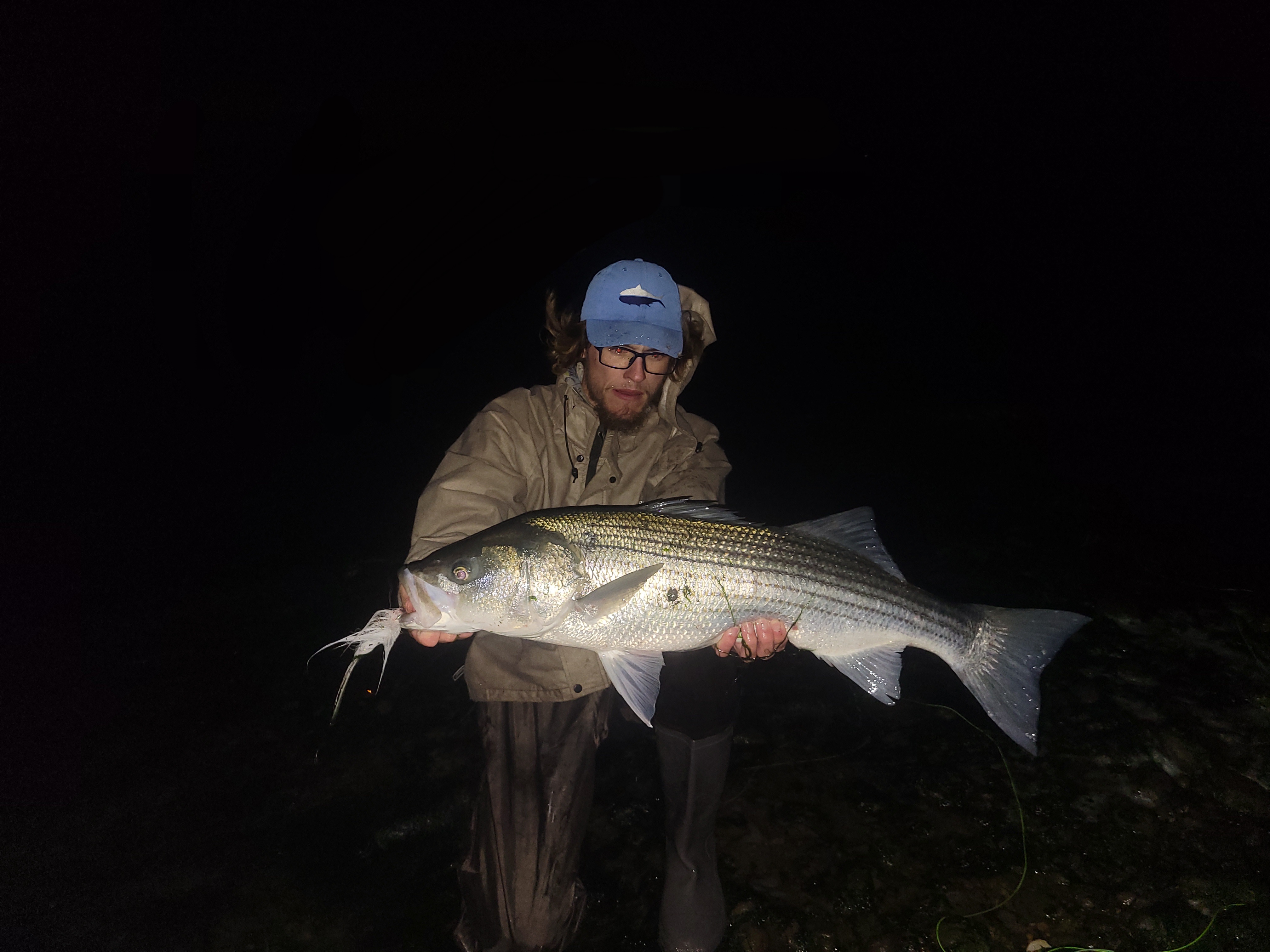
Well, there's a caveat to the "it was easy" thing. I'm a very stubborn fly caster, and I refuse to let wind dictate when or where I can cast. That has resulted in a lot of practice pounding hard casts into a strong wind, which is what I was doing that night. It also took a lot of time and effort to pattern bites enough to know that these fish might be where they were under those conditions. It was also the wee hours of the night and the weather was about to get a little dangerous. All of that to say, easy is relative. Catching big striped bass on the fly in the surf is never truly easy. It takes time, effort, and resolve. Through the entirety of this early October bite I fished until I no longer could, then slept in the car. I wasn't home much at all through most of the month actually. I took breaks to get work done and check other bites so I'd be prepared for clients. But any time I could be I had my boots in the salt, heavy fly rod in hand, and a large white or black fly tied onto the end of a short 40 pound leader. 


Unfortunately, some of the largest fish from this night were quite skinny, so a few fish that had the potential to exceed 30 pounds were pretty close to 20 pounds. It was, however, the first night I'd ever caught more than one 40 inch class fish on the fly. I could hem and haw over how much bigger these fish could have been had they been more bulked up, or about the one that did get away that sounded and felt huge. But the reality was that when that storm really closed and Alex and I decided to make our way back to the vehicles, we'd had spectacular fishing. I bid Alex a good night, of which there was very little left anyway, and sat in the car eating a snack while some of the loudest thunder I'd ever experienced rocked the ground. 

That night was not to be the last of the spectacular fishing this season. I'd put my hand in the mouth of the third 43" striper of the season, a truly epic year, but my sights were set on a larger target. They still are, though the biomass has now thinned dramatically as we creep into mid November. I'm hoping for one last shot at fly cow glory before the winter fishery sets in... of course, I won't be putting the striper flies away for the winter either. 

Of course, all this fantastic fishing has me very worried that some people will feel that the stock is going to recover with ease. It might, we currently have a fairly strong spawning stock. There have been good spawns coming from the Hudson as well, it seems. But the Chesapeake is going to continue to be a problem. A combination of climate change and human habitat degradation may eventually render the Chesapeake spawning stock incapable of maintaining its share of the fishery. I don't think anglers are remotely prepared for the level of advocacy it would require to slow that train, and it may not be stoppable at this point anyway. It has been hard enough to sway species management and we barely get anything done there. ASMFC is still not adequately dealing with conservation equivalency. Any measure that has been made in regards to striped bass management is little more than a half measure, and a poorly enforced one at that. A lot of anglers don't care. Snag-and-drop is still being done, guys are completely ignoring the circle hook law (which might be a problem as well, I may elaborate on that soon). When anglers that do care see poaching behavior, it seems they're either too lazy to call it in or just don't think anyone will come. Well... nobody comes if you don't call. 

We've got a long way to go. I've been over the moon with the quality of the fishing this fall. it was spectacular. I worry that this will be my good old days. This may not continue well into the future. There are too many problems that aren't being addressed. 

Thank you to my Patrons; Erin, David, John, Elizabeth, Brandon, Christopher, Shawn, Mike, Sara, Franky, Geof, Luke, Noah, Justin, Sean, Tom, Mark, Jake, Chris, and Oliver for making Connecticut Fly Angler possible. If you want to support this blog, look for the Patreon link at the top of the right side-bar in web version.


Tuesday, May 31, 2022

Convergence '22: Life

Another herring run has come and gone here in Connecticut. In April the alewives came in moderate numbers, danced their dance, drew in all the creatures that eat them, left their fertilized eggs and left. In May we had the worst blueback runs I've ever seen, there were hardly any herring. With June just a day away and temperatures hitting the 90's, it's just about over.

My fishing flows with the tides of my mental state. I'm almost always fishing, unless I'm even more depressed than is normal. The intent and discipline that I exercise on the water is what really changes, at least that's what I'm coming to learn. What apparently happens is I fish at my absolute best and hardest when I'm trying to hide from some festering thought. I'm both chasing a high and forcing myself to think about one thing. I don't stop and let introspection happen, I just role with the conditions and force myself to stay zoned into the task at hand. In the spring, my personal task is to get the largest striper I can, on the fly, one foot. My successes and failures are recorded in logs along with volumes of data, some perhaps irrelevant. The story those logs tell is that of a man possessed. The story ignores a whole myriad of existing problems, important issues, but it's the story I want to play out. For the first two thirds of the spring herring run season that story played out the way I wanted it too. Then it crumbled when the external plot could no longer be kept out. This is that story and its bitter end.

I started early this year. Having screwed up in the past starting much too late, I wanted to get a jump on it this year. There really weren't many herring around yet, but the bass were there. I started out tallying low numbers each night, one or two fish but no more. Those fish were all good though, I wasn't finding small bass. They were all 30 to 38 inch class. Then, a week in, I broke 40 inches. It was a solid confirmation that I was on the right track, as I typically hope to break that mark just once in a spring. Getting one so early on I was sure I'd have another shot, and I did. 

It was the night my partner and I broke up, something that had seemed imminent. I was also lost deeply in the weeds of cow madness, and wouldn't let myself out of that. Just a couple hours after we broke up, I was standing on the bank making that first short cast that I do while getting line out. I fished it out even though it was just a 25 foot shot because that's what you do if you actually mean to catch fish. Just seven feet off the rod tip, I came tight. The fish exploded to the surface ferociously, proving instantaneously that she was huge and a force to be reckoned with. That fish ended up being the first striper to get into my backing on my 12wt and the first large striped bass I've lost in three years. I'm not sure exactly how big she was, just that she was huge. I'm not exactly sure how I lost her, but it was a bruise to my ego for sure. My resolve hardened, though. If one big fish was around, surely I could find another. 

Many nights blended together, with work, guiding,  and scouting for guide trips occupying my days and fishing harder than is reasonable eating up the time I should have been spending asleep. I won't soon forget the night that I found the next big bass of the spring convergence. Oddly it was so memorable because it wasn't remarkable compared to many of the other nights that have yielded cows. Conditionally, it sat squarely mid playing field. It was good enough but not remarkable in any capacity. There were big fish around though, I could hear them occasionally. I've fished with enough people for stripers to know that most are horrible at interpreting the size of bass making surface feeding sounds at night. These, though, were completely obvious to my ears. Massive swirls created by large bodies. They weren't holding though, I don't think at any point a fish topped in the same spot twice. That meant I'd need to stand in one spot and just hope a cow moved in front of me at the right moment. I made cast after cast for two hours, being patient. A few fish came up fairly close to me, yet no touches. I decided I may as well try something different. Moving would make no sense and I had confidence in my fly, so I changed my retrieve. I went fast. Fast is rarely how I turn a cow bass on the fly at night. Big bass are lazy, they like easily caught pray. Usually. My first retrieve I got hit hard, jammed the hook, and for a little while thought I might have stuck a mid sized bass somewhere other than the mouth. It was an odd fight, completely lacking the trademark sweeping head shakes, instead consisting of short-ish extremely fast runs. When I got the fish close I could see that it was, in fact, a really large bass hooked exactly where she should be. Soon I was wrestling my largest shore-caught striper in the margin of the river, letting her make me bleed a little. She was 43 inches and very heavy. In that moment, I was completely elated. I'd tapped the right vein, put in the right stuff. Damn did it feel good, right there and then. 


Unwilling to back down, I pushed on, continuing to fish that night and each one that followed. Though I managed a few more high 30 inch range fish in my typical spot, two things rapidly deteriorated the quality of the fishing. The first was simply the amount of water. We've had a fairly dry spring and fishing totally slack water isn't a good bet for big bass on the fly. Also, the morons started showing up. That started to deteriorate my mental stability.

 One night, Garth and I were out in a pretty solid tide window when a jeep load of evidently drunk college age guys rolled up, being obnoxiously loud, parked illegally, and basically fell down the banks of the river with their headlamps on, scanning the water. Unable to conceal my displeasure, I yelled across the river. "TURN THE F***** LIGHTS OFF". They ignored me. I went and found the largest rock I could carry and dropped it off the center of the bridge before we left. I'm not proud of that, but if you're going to be an asshole on my river, I'm going to retaliate. 

Another night, a car pulled up in the center of the bridge and two guys got out and lit up the whole river with spotlights. I again voiced my discontent and was ignored. I go out of my way to be respectful of the place, the fish, and the other regulars that fish there. I call in poachers when I see them, I avoid being in close proximity to other anglers if they arrived at the spot before I did, I respect the neighbors and their property, don't shine my headlights into their yards and windows when I park, so on and so fourth. The lack of respect I see from other anglers pisses me off to no end. I didn't feel like being around that, so I decided to move along and explore new water in the latter half of the convergence season. I'd hit the old faithful river when the conditions seemed ideal and venture elsewhere otherwise. 

Though I do most of my herring run fishing alone, I sometimes have Garth tag along as he tends to share values and has the right mindset. He was with me on one of these exploratory mission, one that got me particularly excited about the new water I'd found. We didn't catch anything extraordinary but I did move a fish that was about 40 inches and we each got some beautiful little bass. I felt invigorated... just in time for the universe to kick me in the ass.

I was back on the same river, this time fishing with Alex Peru. Alex is quickly becoming one of my favorite people to fish with. He's obsessive, detail oriented, and deeply intuitive. He's also really good at making things that solve problems. Alex is the brains behind Albie Snax and Super Snax, two of the most effective soft plastic lures on the market. Alex and I had both been grinding hard throughout the herring run in an effort to catch the largest bass possible. I was eager to have him deciphering this new water with me as there were some aspects of it that reminded me more of the herring runs he fishes than the ones I'm used to. Seeing another angler, especially one as intuitive as Alex, pick apart the water with a slightly different eye and different tackle is often hugely helpful. There's a reason I don't just fish with guys that are unilaterally fly focused. That would put me in too much of an echo chamber, there'd only be so much I could learn. Most fly anglers, I find, are too rigid and stuck to old concepts. There's been a shift away from that in streamer design, thankfully. Much of that has been driven forward by anglers that gear fish too, or at least have a background and knowledge in that realm. 

Alex and I hit a few spots and got a few fish to hand, nothing big but it was progress. It felt like we might be hitting a stride, and I was saving what I felt were the best couple spots for later in the night. We were actually fishing a run I hadn't tried at night yet when Alex picked up one smaller fish. I had waded out to the edge of a strong current tongue to try to cover the opposite seem, but had no success. I waded back in and got up on a flat, dry rock. Alex and I were discussing the dynamics of the water in front of us, where the fish seemed to be holding, and what the next course of action should be when I suddenly went down. I don't recall even adjusting my weight, my feet just went out from beneath me and I went down hard, slamming the right side of my head on the very rock I'd been standing on. 

That probably could have been it. Had I hit a slightly different part of the rock or a different part of my head, even just an inch or two of deviation, and that fall could have killed me. If not, it might have severely disabled me. But instead I wasn't even knocked unconscious. I immediately got back up. I can't remember exactly what Alex said or what I said, though I know that for a short time my ears were ringing and I couldn't really hear myself speak anyway. What I do distinctly remember is feeling the side of my head and my fingers dropping into an obvious and shockingly deep indentation that shouldn't have been there. In a state of complete shock, I grabbed a small tree growing out of the rocks next to me. My head was spinning. The ringing started to fade, but I wasn't sure I was going to remain conscious at that point. Alex suggested I sit down, and that did seem like a good idea. We both took stock of the situation, and it was pretty clear what needed to happen. We were able to walk back to the car fine. Alex drove me to a clinic that was a bit close to my house. I called my mother on the way, trying to remain as calm as I could. The car ride was an odd and blurry experience, as were the next few hours. I was realizing that whatever I'd broken had severely altered the range of motion of my jaw. Moving it put me in excruciating pain. 

The clinic checked my vitals then did a CT scan. I'd fractured my zygomatic arch in three places. They decided to transfer me to Hartford Hospital to see a specialist. Alex was still waiting in his car when I got out of the clinic. I gave him the lowdown of what was happening, thanked him profusely, and he headed out to fish the morning tide, as any real angler would. I cannot emphasize enough how thankful I was to be with Alex when I fell. He handled it about as well as anyone could, really. I don't know what I'd have done were I alone. That would have been utterly terrifying. It was scary enough as is. Thank you Alex. You're a good friend. 

I was in the hospital for a while. The specialist came and took a look at the situation. She explained the surgery I'd need and how it would be done. I wasn't really all there at the time so I digested what information I could and forgot the rest. I had never broken a bone or even sprained an ankle or wrist before and I'd just skipped right ahead and broken part of my skull. I was just trying to remain calm. Exhaustion was also catching up. It was time to sleep. 

Having been given sort of an all clear from the doctors to go about life with only minor alterations, I pushed my limits. I knew if I stopped and thought for too long it would all come to a breaking point. There was a notable severe weather setup forecast the day after I was let out of the hospital, one Garth and I had planned to chase. You can bet your I wasn't going to sit it out. There was a different convergence about to happen, the meteorological sort, and when mother nature puts on a show I want to be there to see it, whether my skull is fractured or not.

Our target area was the Hudson Valley, my specific initial pinpoint was Poughkeepsie. We left early to get in a good position to watch things develop, stopping for bagels near Brewster. I must have looked like a complete moron, struggling to eat my bagel in exceptional pain yet still enjoying it. Behind the bagel joint there happened to be a trout stream. We had some time, so we walked over to take a look at it from a bridge. On the downstream side there were quite a few rising and nymphing fish. All browns, it looked like. We fiddled around there for a short time. All the while I was glancing at the radar. I small renegade cell had fired to our west, and it was tracking nearly straight north. These renegades were going to be the best bet for photogenic structure and tornadoes. It was time for us to make a move. 


We headed north, stopping near Milan, and let the storm progress. It underwent a split, weakening as it did so. The left split rapidly fizzled, but the right split seemed to be growing a bit. From our vantage, we could see a defined anvil and some inflow streaming in. "I think its turning right" I said, and a distant rumble of thunder punctuated my sentence. Turning right is a sign that a storm's updraft is beginning to rotate. This one had started to veer from a nearly straight north course to a Northeasterly one. It might be happening. My heartbeat quickened. 
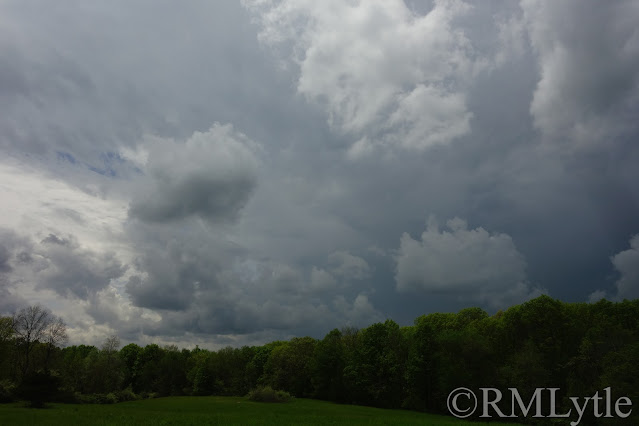


We blasted west then a bit south to get into a good position to observe the developing storm, and when we reached a cleared hilltop it already had a compact little updraft base, complete with rear flank downdraft cutting through the cloud base (this is called the "clear slot) and a  low wall cloud. The rapid rising motion on the right side of the wall cloud was incredible. This little cell wasn't even severe warned yet, but it was trying to do something.


We watched the storm evolve, breathing in from warm moist environment it was moving into and exhaling cold air and rain. The updraft was indeed rotating, and it was pulling rain around itself and lightly cloaking its inner workings in translucent curtains. As it did so, a laminar funnel appeared from the wall cloud and a couple of vorticies danced up from the ground. This was what we'd driven out here to see. This brief tornado lasted no more than two minutes and did no reported damage in the vicinity of Ulster Park, New York. Indeed the storm that spawned it still wasn't even severe warned, though nickel sized hail was reported. It quickly lost tornadic potential for a little while, perhaps interacting with the Hudson River Valley. Garth and I bailed from our position on the hill top with positive cloud to ground lightning raining down around us. I ran down that hill laughing like a mad man, the earth shaking around us from the thunder claps and fat rain drops starting to beat the grass. I was truly alive in that moment, happier than I know how to describe. Sitting in the car catching my breath, I think I may have said something to the effect of "That was the shit right there. That's what it's about".


We briefly left the storm, which may have been a mistake as it went severe warned just a short time thereafter. In a desperate bid to catch back up, we ventured into the hills near the New York/Massachusetts Border. We struggled to get a good position on those winding roads and in heavily wooded terrain. Near West Stockbridge, we gave up. 


While we were diving back south into Connecticut the linear mode was taking shape. That resulted in one tornado-warned northern tip echo and some straight line wind damage along the leading edge of the line. We were on the tornado warned area, it did not produce but exhibited a classic rain wrapped QLCS circulation.


When it became clear we could no longer keep up with the line it was time to head home. I was exhausted by that point anyway. 

The next few days, I was forced to stop. I couldn't keep chasing the highs in my injured state. I tried to get out after the big stripers here and there, and I did have some opportunities. Alex got a 44 incher the one night I didn't go at all. I had a few decent little fish to 30 inches but no monsters. Mostly, I couldn't find the energy to get excited. Staying at home and trying to focus on work suddenly devolved into a deep depression. Unable to get enthused by the little things and physically prevented from doing anything grander, all the thoughts and problems I'd been trying to keep out for the previous months came rushing in. Struggling to grasp at something, I began trying to make progress on my business plans. I found I couldn't. The energy wasn't there. Every bump in the road began to feel like an impasse. Just filling out or printing paperwork felt like it would be as difficult as lifting a boulder with one hand, so I didn't even bother. The fact that my truck was still, three months later, in the shop from the Florida debacle was grating on me. I worried if I'd be able to afford the bill. The loss of a good friend suddenly felt real when I got what should have been a brief moment of respite and caught an incredible brook trout in a new spot. I thought to myself "Alan will love this", then remembered that he's gone. The date of my surgery came and the procedure seemed to go well, though I was and still am in a constant odd state of discomfort or pain afterward. It all came to head when I found myself lying in bed one morning, shaking, tears soaking my pillow, cold, and feeling completely alone. An intrusive, awful thought that has made its way into my mind in the past was back again. I've struggled on and off for years with mental health. There have been times when I just didn't want to continue. I wished, that morning, that my fall had killed me. I had had enough.

Why am I telling you this, you are probably wondering? It's an incredibly vulnerable story to tell in a blog post. I honestly don't want to put a spotlight on myself. I've hemmed and hawed over how I should tell this story or if I should tell it all, but I keep coming to the same thought. I alone am far from important, but I'm also far from the only person that has wanted to end their lives. Many of us have lost loved ones to suicide. It's horribly common. I just want those who may feel similar to the way I do to know that you aren't alone. I'm sure plenty of people are putting off a public facade of happiness and deeply wishing you didn't exist as I have done many times. Someone may look to be leading a privileged and joy-filled life but be dying inside. I'll tell you, it fucking sucks. I don't wish this on anyone. Nobody deserves to feel this way. Like me, you may be chasing highs, hoping to forget the things that are hurting. It may be working for now, but if one thing is becoming clear to me its that chasing the highs is a temporary solution. Fishing is as much a symptom of  my problems as it is a cure. The chemical releases in my brain give me a buzz when it's good and the hard-headed focus required to be the best angler I can be keep my mind off other problems, but it can't be sustained. Please, if you're suffering similar feelings, don't let them go unchecked. I'm not remotely qualified to therapize anyone and I'm not going to try, but there are options out there. Don't put it off. It's easy to, I know. I have done and actively am doing so. But if you are hurting, please know that people do love you. You've got someone, even if you don't feel like it. I promise you do. I'm here still, and I care about you. 

I often struggle to find a direction in life. Other people try to sway you, to direct your course. That's not something that's really up to them, even if your course isn't ideal from their vantage point. I don't know if what I'm doing now is the right course of action. Sometimes it feels like I will never get ahead. With the economy spiraling, a service job like guiding may well become difficult or impossible to hold. It is, after all, a luxury. Some have pushed me towards this line of work while others try to drive me away, and in each case the reasoning isn't unsound. I can only base my decision on one thing, though, and that's the way I feel when I'm standing on the poling platform or in the river next to a client when they hook a good fish. In that moment, I'm often happier than I'd be had I hooked that fish myself. The joy I get from showing other people, wonderful people, a slice of my world is one of the few things that has kept me here. It's hard to describe, really. I had a client out for carp not long ago, and he had numerous shots at feeding and sunning fish and landed a few. There was a moment of deep clarity for me when he was casting at one particular fish, a tailer in just 7 inches of water. I realized that my legs were shaking more than they would were I casting at that fish myself. My client's excitement and my own were so palpable I could almost hear it, like the low buzz of high tension power lines. Flip Pallot said something on the Millhouse podcast how "life is focused like a laser beam into (a) skiff". That applies to more than just flats skiffs. When I'm with a client, I'm doing what I feel I was meant to do with my life. I have meaning, then. I'm on the water, I'm teaching, and I'm giving people unforgettable experiences. It is one of a small handful of things that continue to give me meaning. That meaning is there when I'm on the ground in rattlesnake country, taking down data or even just observing for the sake of seeing something incredible. 

I wish I could hold onto that feeling when everything comes crashing down around me. Some moments its there, others it blinks out.  

I'm trying. I don't really want this to be over, at least not at this moment. I may be running headlong down an impossible path, but it's all I seem to be able to do so I may as well. You may very well feel the same. Well, friend, we'll let's enjoy it while we can. It is, after all, as fleeting as the sound of a cow striper eating a herring. I'll see you at the end of the path, beaten down and broken I'm sure. We'll look like we just ran down a big hill trying to escape the lightning, splattered with rain and sweating profusely. Or perhaps like we just lost that cow striper, sore, exhausted, cold, and smelling a bit ripe from not showering and sleeping in vehicles for multiple nights. But I think, maybe, there'll be a smile on our faces. I'll look at you and say "That was the shit right there. That's what its about." We'll feel alive for a moment. Then it'll be over. Our stories will come to an end when they're supposed to, as does everything else in the universe. Let's not force that along. What would be the sense in that? Life will kick our asses, that much is true. Maybe we can still have fun in the process. 


 Thank you to my Patrons; Erin, David, John, Elizabeth, Brandon, Christopher, Shawn, Mike, Sara, Leo, C, Franky, Geof, Luke, Noah, Justin, Sean, Tom, Mark, and Jake for making Connecticut Fly Angler possible. If you want to support this blog, look for the Patreon link at the top of the right side-bar in web version.

Friday, December 17, 2021

Historic December Weather and How You Can Help

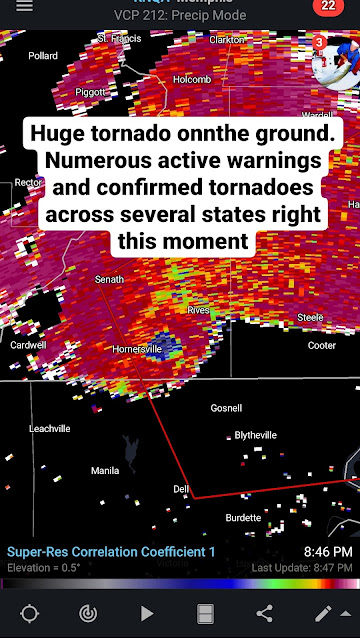
 On the night of December 10th, I needed to get sleep. I had an early trip the next morning. I couldn't sleep though. I was glued to my phone and laptop for hours, because something remarkable and devastating was taking place across several Midwestern and Southern States. My Instagram stories follow the events. 


The warned cell southwest of Jonesboro, Arkansas in te above screenshot was the early stages of a monster supercell that produced two long-tracked preliminary rated EF4 tornadoes. The first tornado formed near Bowman, Arkansas, and remained on the ground, getting violent near Monette Arkansas, before the supercell performed a rapid cycle after the tornado crossed the Mississippi.


A new violent, long tracked tornado then rapidly formed while the old tornado dissipated. The new tornado remained on the ground for hours, inflicting damage and upending lives on it's way through Kentucky. 


Though many seem to be suggesting, in the days that have followed, that December tornadoes are rare, this is certainly not the case. There is more precedent for this event than one might think, with a history of significant December tornadoes dating back as long as records have been kept. This year, La Niña conditions are driving volatile late season severe weather. Though it was clear to many of us that there would be a severe weather event on Dec. 10, and the tornado was reasonably well covered by the NWS and local stations, it still took lives. This was one of the deadliest tornado events in recent memory. 

I had multiple breakdowns as the events of that night unfolded and as images and videos came out over the following days. I love meteorology and have an obsessive need to forecast, chase, and photograph tornadoes, but I have a really hard time watching people's lives ending, and I knew that was what I was watching that night. It's time for us to help. If you can give, please do. The following is a list of ways to donate towards relief for the victims of the Decemember 10, 2021 tornado outbreak:


Thank You.

All imagery used in this post is owned by RadarScope

Monday, November 29, 2021

Surprise Rhode Island Northern Pike

 November 12th was one of those horribly unpleasant weather days to fish in, featuring high wind and very heavy rain over most of Connecticut and Rhode Island. It was at least vaguely warm though, and it was the sort of weather that gets predatory fish fired up. Subsequently, I was going to fish. I didn't want to fish for very long or far from my partner's apartment, so I drove less than five minutes away to a spot that I knew had potential but hadn't fished before. I didn't really know what to expect but it was exactly the sort of spot fish will stack up at in late fall during high water: a big slack water with reasonable depth, just off the main river. Most of the food chain utilizes these spots, from macroinvertebrates, to small shiners and dace, to panfish, bass and larger predator fish. 

The water was high and cold; I struggled a lot last season to get fish in this same river around this time of year. I'd not yet dialed in many areas though, and I'm still doing a lot of exploring and learning here. It was a crap-shoot, this spot, and though it appeared textbook, I wasn't sure I'd catch anything. I started out simple, hopping very small jig streamers along the bottom. This served two purposes. Flies like this catch everything from suckers and panfish to trout and bass, so it would give me a good idea off what was present (if anything). It also served as a way to feel out the bottom contours and find snags or hidden structure. That inevitably meant flies were lost, but that's just part of the game. I did start picking up fish. First, some pretty yellow perch. Nothing huge but nice to see and great to get the skunk off with. Then, a few good bluegills, and a roughly 2 pound smallmouth that I lost. That stung a little as larger smallmouth are pretty rare in this river and that was the largest I'd hooked here. 

I eventually decided to tie on a larger streamer, namely a conehead Marabou Muddler, and try to tempt a larger predator. This did not go the way I expected it to when, merely three casts later, the fly was smashed to rod lengths from me by a northern pike, and not a small one either. I didn't know there were even pike in the watershed so I was taken completely by surprise. I hooked it, but immediately was sure I'd lose the fish. I was using 10lb tippet and I'd seen the take; there seemed little hope my fly was pinned at the tip of the snout or somewhere else that would make a landing possible. I felt a bite-off was inevitable. Miraculously that never happened. I actually landed the fish. I was giddy. I hadn't targeted pike much at all this season, and with the exception of the one lone big one I got early in the season, hadn't encountered many of this species in 2021. To get one five minutes from the apartment in a watershed I didn't know had them during just atrocious weather was awesome- let alone on a 5wt and 10lb tippet. The fish was snub-nosed, which was a big factor in why I was able to land it. It was very healthy in terms of bulk and energy though. 


I stuck it out for a little while longer with only a few more perch, but I was sure the fight with the pike had disturbed the spot a lot. I left soaked to the bone and happy as can be, with a new task to latch onto- find even more pike in Rhode Island. Up until then I'd only heard about one body of water within the state that had any. Since then I've done quite a bit of research and scouting though and have half a mind to put in a solid effort to dial in some bites over here. It's funny how much one fish can change your mindset sometimes. 


Until next time, 

Fish for the love of fish.
Fish for the love of places fish live.
Fish for you.
And stay safe and healthy.


Thank you to my Patrons; Erin, David, John, Elizabeth, Brandon, Christopher, Shawn, Mike, Sara, Leo, C, Franky, Geof, Luke, Streamer Swinger, and Noah for making Connecticut Fly Angler possible. If you want to support this blog, look for the Patreon link at the top of the right side-bar in web version.

Edited By Cheyenne Terrien