Showing posts with label Jacks. Show all posts

Wednesday, September 7, 2022

Banded Rudderfish From The Rocks

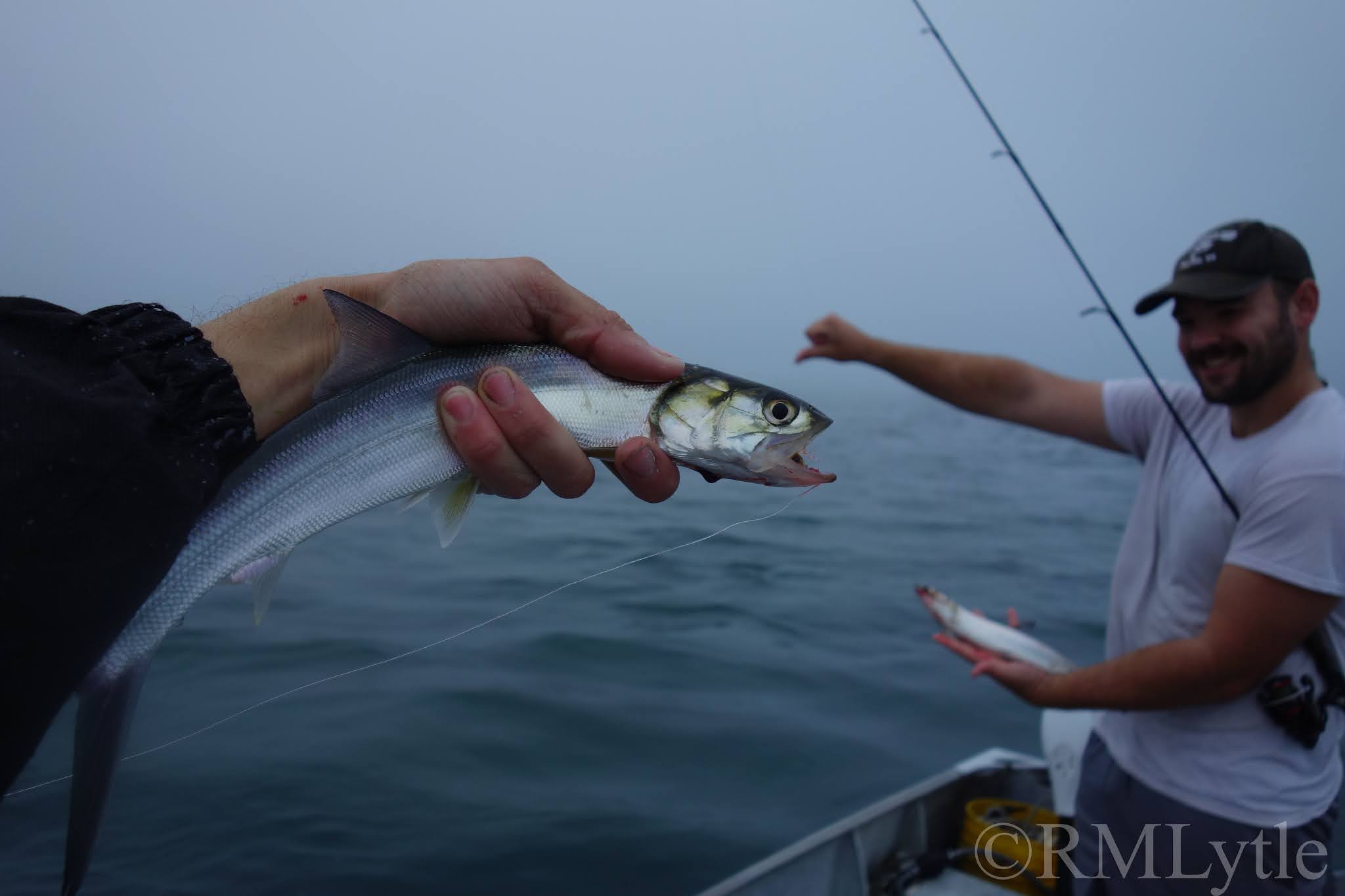
Over the years I've caught a decent number of banded rudderfish in southern New England. Banded rudderfish, Seriola zonata, area carangid fish similar to almaco jacks. They're highly pelagic, and in their younger years largely associate to floating structure like weeds mats, buoys, or driftwood. They're also known to follow sharks. When I've caught them in local waters its generally when they pile up under navigation buoys. I'd never caught them from the rocks until quite recently. 

Banded rudderfish follow warm water eddies off the gulf stream and wander into our waters in August and September when temperatures are near their peak. Not every season provides particularly good fishing for them and the windows are often short. of course, most anglers don't know or care about these little oddballs anyway. That's where I come in: the weird, the underappreciated, the obscure... that's my niche. I always spend at least a little bit of time each season looking for these oddballs. Sometimes with oddballs it's best to let them find you, though. In the final days of August I headed east in search of scombrids, and instead of catching those- though they were indeed around -I got a nice surprise in the form of a big school of rudders.

In the water, they looked like a fleet of white torpedoes running up and down the rocks harassing the silversides. Their attacks were quite coordinated, reminding me of similar patterns I've seen in scombrid species. Indeed both cargangids and scombrids school and coordinate in similar fashion, both being evolved for high speed attacks on schools of bait. Unlike scombridae the rudderfish moved up and down the rocks at a slower pace, affording far more shots than would little tunny or bonito. All I had to do was get a flash peanut in their midst. 

One of the interesting thinks about banded rudderfish is that as they grow, they actually lose those name-sake bands. In fact they can alter pigmentation at a moments notice even as juveniles, becoming patternless or heavily banded at the drop of a dime. This sometimes leads to confusion when people are trying to identify them. There are similarly shaped and patterned fish in the same genus, including lesser amberjacks, and distinguishing them can be difficult at times. But most are exceedingly rare inshore anyway.


What banded rudders do, other than look cool, change color, and feed in interesting ways, is fight like hell. For their size and even on a rod as heavy as an 8wt, these little buggers pullllll. What I really want to do, if they linger around, is bring the 1wt out there with me and get some to really scream some drag. 

Hopefully these little buggers will linger for a while. Their presence in our waters is so fleeting, as with the other exotics, I want to get it while it lasts.

Thank you to my Patrons; Erin, David, John, Elizabeth, Brandon, Christopher, Shawn, Mike, Sara, Leo, Franky, Geof, Luke, Noah, Justin, Sean, Tom, Mark, and Jake for making Connecticut Fly Angler possible. If you want to support this blog, look for the Patreon link at the top of the right side-bar in web version.

Monday, November 15, 2021

Late Season Jack Crevalles and Blue Runners in CT

 I particularly enjoy catching wandering pelagic and semi pelagic species in Connecticut waters. Each year a lot of fish that are ubiquitous in southern waters end up in Long Island Sound, and though they are often smaller than those I could catch elsewhere it is cool to encounter these species close to home. After all, they can often be caught in relative proximity to species we are much more used to seeing around here. Catching a crevalle jack and a striped bass within a half hour of each other is perfectly possible at some times of year in Connecticut and Rhode Island. November is one of those times, and perhaps the easiest time to make it happen at will. The warm water species get concentrated in, well, warm water as the environment around them cools off. Noah and I visited one of these concentrated warm water environments a little while ago. There were indeed loads and loads of jacks and blue runners present, and they were very willing and these species generally are. 


Though small in stature, these fish actually fight stupid hard. They're built for chasing down prey and swimming like hell away from predators. In the pelagic world, the predators really haul ass, so it pays to be really fast if you need to run away from those critters. That translates to a pretty sweet bend in the rod when you hook these guys. I was lucky to get the largest crevalle I've caught locally, and in heavy current that fish gave a phenomenal fight- even with a bit of its tail being missing.

The blue runners actually pull a bit harder, and we got some nice little football shaped runners that made our drags sing. 

I ended up keeping one of the blue runners; I pan fried it with olive oil and a little salt and pepper, the flavor and texture were fantastic. I'll certainly be eating more of these little buggers going forward. I haven't tried a crevalle yet, in part because I've seen videos of them being cleaned. It seems if they're of any size at all, they're loaded with parasites. Of course these are Florida-caught ones we're talking about, and I don't know if that would be true of the ones we get in CT. I should try and see at some point. 

The fishing was very fast paced. At times blitzes broke out and there were dozens of fish breaking around us. Mixed in were a few of the expected bluefish, but they were far outnumbered by the jacks and blue runners. It would have been particularly nice to encounter some other species mixed in, perhaps lesser amber jacks or banded rudderfish. Banded rudders are notable common in Connecticut some years but this wasn't one of them.


Eventually a flock of gulls to our east drew our attention, and we went off to get the sort of fish anglers actually expect to get in CT in November: the sort with stripey sides and an affinity for peanut bunker.


It's kind of cool when worlds collide. Of course, there was historically a strong Gulf Coast striped bass population. The extirpation of that population was driven by human action, no surprise. Were it not for that course of events it would be possible not only to catch jacks and stripers on the gulf coast but to catch a particularly large jack and good sized stripers in the same day. That certainly isn't a likely scenario any more. It's a cool oddity to be able to catch great numbers of both fish in Connecticut, but the jack schools Noah and I encountered were present as a result of humans altering the environment. Sure, jack crevalles and blue runners have naturally made it into CT waters for years, but they wouldn't linger into November were it not for artificially warm water. So, in essence, this is a novelty fishery. 

That doesn't stop it from being pretty damn fun though.

Until next time, 

Fish for the love of fish.
Fish for the love of places fish live.
Fish for you.
And stay safe and healthy.


Thank you to my Patrons; Erin, David, John, Elizabeth, Brandon, Christopher, Shawn, Mike, Sara, Leo, C, Franky, Geof, Luke, Streamer Swinger, and Noah for making Connecticut Fly Angler possible. If you want to support this blog, look for the Patreon link at the top of the right side-bar in web version.

Monday, December 7, 2020

Catching Ladyfish and Jacks in Connecticut

 Over the last few years I've encountered a number of generally considered southern species that find their way into Connecticut waters in late summer and early fall as ocean temperatures peak. I've caught blue runners, banded rudderfish, and Spanish mackerel, and seen cobia and mangrove snappers. This year was an exceptional one for such vagrants locally: abundant cownose rays and Spanish macks in the western sound, frigate mackerel in RI and and even Eastern CT, and plenty of other anomalies. I lucked out with one frigate mackerel and saw some banded rudderfish but didn't really get in on the action until October, when the cooling temperatures lead the less tolerant fish to either leave or seek what warm water they could find. It was a day like many other October days, except instead of finding stripers blitzing Noah and I found jacks and ladyfish along with uncountable Atlantic needlefish and the odd Spanish mackerel.

At first it was all needlefish. There were hundreds if not thousands of them. Any cast got followed by a squadron of these odd shaped monsters, all snapping at any lure or fly we ripped past them. They'd even blast a spook. It was nuts.

Strongylura marina


Then came the ladyfish. I'd caught my first ladyfish a few years ago in Florida, where they are a year-round resident and often considered irritating, sometimes even trash fish. Of course I quickly fell in love with these acrobatic silvery fish. Catching them locally is something I've long known was possible and has been a goal of mine, I was very pleased to see it come to fruition. Soon ladyfish were making their way into the little Lone Star Skiff with regularity, including at least one that jumped into the boat still green. Noah and I were having a hysterical time catching these high flying fish, in greater numbers than we ever got in Florida. We'd never really gotten to savor the experience there, so it was exceptionally unique to catch enough locally to really get a good feel for it... and these fish are seriously fun. There's nothing in New England waters that fights quite the same. Bluefish and hickory shad don't jump as much or as high, and landlocked salmon don't zip away quite so fast, though they're probably the closest in fighting style.


Noah with the first large one.

If you look at the tail on a ladyfish, it's not dissimilar from that of some of the fastest running saltwater species like bonefish and milkfish. It's not surprising that they fight as hard as they do. It is a little surprising that people don't enjoy catching them more. Sure, they are aggressive and easily duped; and yes their maxillary has a sandpaper texture and can snarl too light a leader, but damn is it a riot when they take off. 


It wasn't long before we became aware of another southerner in our midst when the aquatic equivalent of a swarm of bees followed my fly in... a school of tiny crevalle jacks, and one of them did find steel.

Caranx hippos. On a Woolly Bugger. In CT. 

Yet another member of the Caranx genus turned up just a few casts later, the blue runner. Unlike ladyfish and crevalle jacks this is a species I'd caught locally, and New England is actually where I got my lifer. 

Caranx crysos, blue runner, this one took a gurgler.

The slay fest continued as fish suddenly began to blitz. There were clearly bluefish and ladyfish there but I also saw some scombrid like slashes and jumps. Though I managed to maintain my season long skunking of  larger scombridae and only piked up a few bluefish, Noah managed a nice Spanish mackerel. By now it really felt like we were actually fishing in Florida.


When the blitzes subsided we resumed the ladyfish and jack beat-down along the rocky shoreline. For someone who likes variety, getting these species mixed in with more locally and seasonally ubiquitous ones like needlefish and bluefish was awesome. We were doubling up on ladyfish constantly and laughing hysterically for hours. It was just visually spectacular uncomplicated fun. 


I've been playing around a lot with flies tied on lead and tungsten jigs this year. Their applications for trout, bass and panfish were already well explored but they definitely have application in the salt too.


As darkness fell we weren't sure what would happen, whether the bite would slow or stop, or change at all. It actually improved because the needlefish seemed to stop feeding, and because they are so difficult to hook we were getting a higher percentage of fish hooked and boated once the needlefish stopped biting. They were still so balled up though that I was regularly foul hooking them. I received a few bites from needlefish, they are unpleasant to say the least. I'll lump needlefish in with bluefish, mangrove snapper, and skates as fish that seem to very intentionally try to bite you, and needlefish are very good at it. 

As darkness fell I hooked the biggest of the ladyfish I'd gotten. The initial run was so hard and fast I thought it must be a Spanish mackerel, but when it came up that silver slender form was a nice surprise. This was one of my favorite fish fights this year, actually. And there have been some memorable ones.


The night proceeded with loads more ladyfish and one especially memorable visitation from a huge predator. We left genuinely shaken, but so excited we came back the next day for more.


Those two evenings will surely remain some of my most memorable saltwater days in the northeast. 
I love what I get to do.  
Fish for the love of fish.
Fish for the love of places fish live.
Fish for you.
And stay safe and healthy.


Thank you to my Patrons; Erin, David, John, Elizabeth, Brandon, Christopher, Shawn, Mike, Sara, Leo, C, and Franky for supporting this blog on Patreon

Monday, March 30, 2020

Snook on Dock Lights

Snook worked their way into my soul in a unique fashion. They were one of those fish that I really wasn't extremely excited about before I'd ever caught one. I'd watched videos, and snook fishing looked fun. They seemed like a beautiful, hard fighting fish that wasn't easy to fool... but that describes a lot of species. When Noah and I first went to Florida, I caught my first two snook in the final day of fishing and my opinion changed quite a bit. They got to me, I have to say. The habitats they use, their behavior, their attitude... I quickly became infatuated with these fish. Andy Mill interviewed Steve Huff and Chico Fernandez recently on his podcast and both talked about their love of nook. They put it into words far better than I could, and naturally so as my love affair with these fish is still young. Look for the Mill House Podcast on Youtube, it is very much worth your time. The way Chico talked about snook especially spoke to my soul and made me reflect on my times going after these marvelous creatures. Three years and two trips with a lot of time dedicated to targeting snook after I'd caught my first, I was going to get a chance to target them in another different scenario: dock lights.

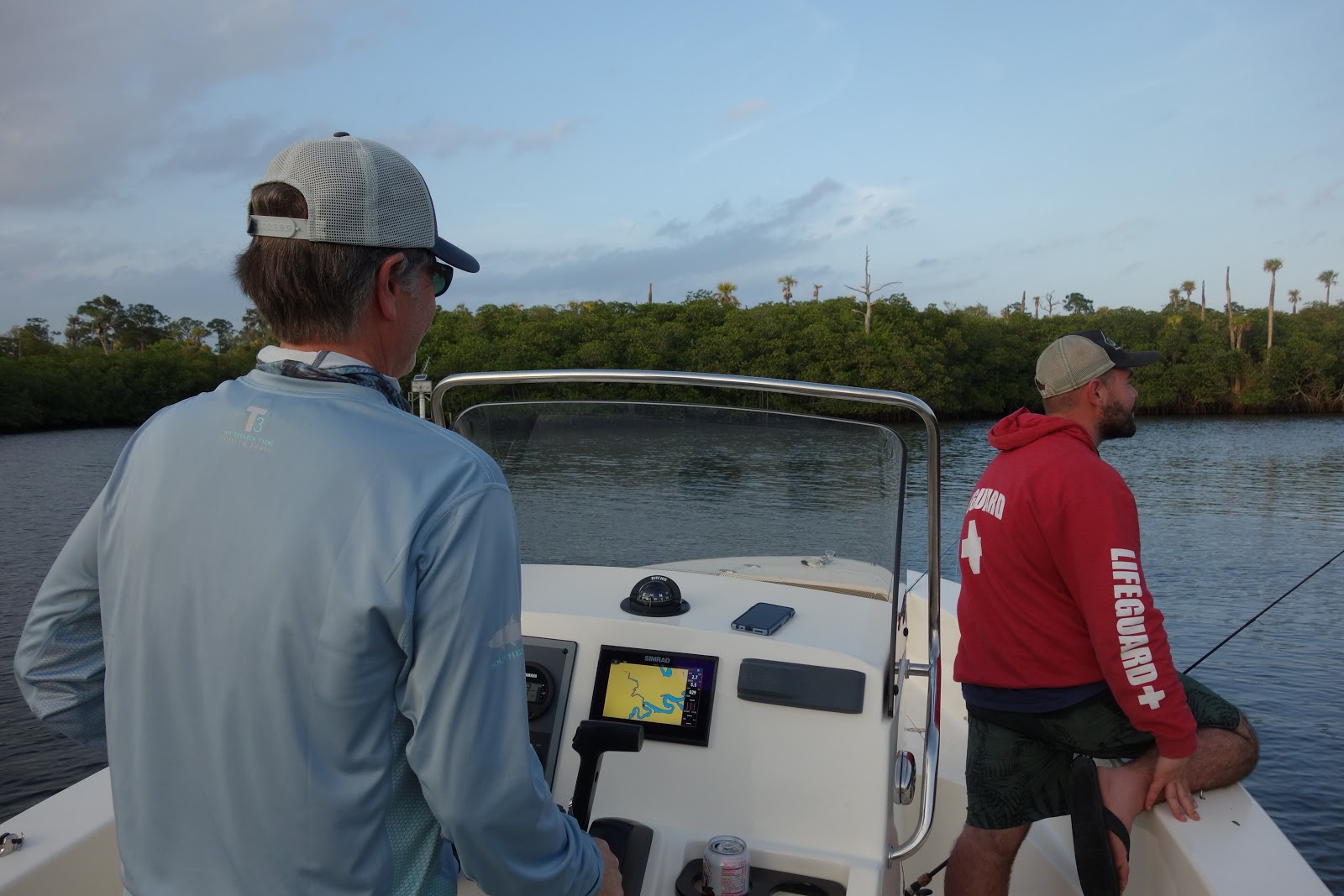
My friend and fellow fish-head, Kirk, has a place and a boat down in Florida now. He invited Noah and I out but promised nothing spectacular. Between Kirk and I, I'm the optimist. I felt confident we'd find something cool with three very fishy people on the same boat. The plan was to head up into the wild waters and see if we could find some rolling tarpon before the sun set, then head into the intracoastal to fish lighted docks for snook and lookdowns after dark.

As we headed into the mangrove lined dark waters that I'd spent hours looking at maps of and trying to decipher spots within, I couldn't help but feel a sense of excitement. Something I'd planned to do and though about for a while was coming to fruition.


We wandered our way around the bends and oxbows, looking for a non-windy corner and rolling fish. Eventually, we did find it. The head of an adult tarpon, looking like a carved piece of chrome, broke the surface, audibly indicated by a sucking sound and followed by the shape of its incredible forked tail. Tarpon are air breathers. They routinely surface to breath, especially in water with low oxygen content. They weren't rolling that frequently here, but enough to give us hope. I watched for rolls and the bubbles that followed as the fish expelled air behind its operculums to get some idea of what direction and speed the fish was traveling so as to cast to it. We were each using different methods, Noah a paddletail soft plastic, Kirk a jerkbait, and I a Gartside Gurgler. This is always a good idea until a pattern is established. We almost didn't catch anything up there in the back country though. I managed a single snook, my first of the trip and my first in more than a year, and that was reason enough for celebration. But we were soon heading back out of the river tarponless, which is about what you can reasonably expect anyway. 


Switching modes and surrounding, we prepared to hop docks late into the night, searching for those with the most active fish. We actually found fish breaking on a dock light very quickly but they weren't obliging. It took a little while to find some fish that were in a good mood and weren't actually just big mullet. Noah struck first. 


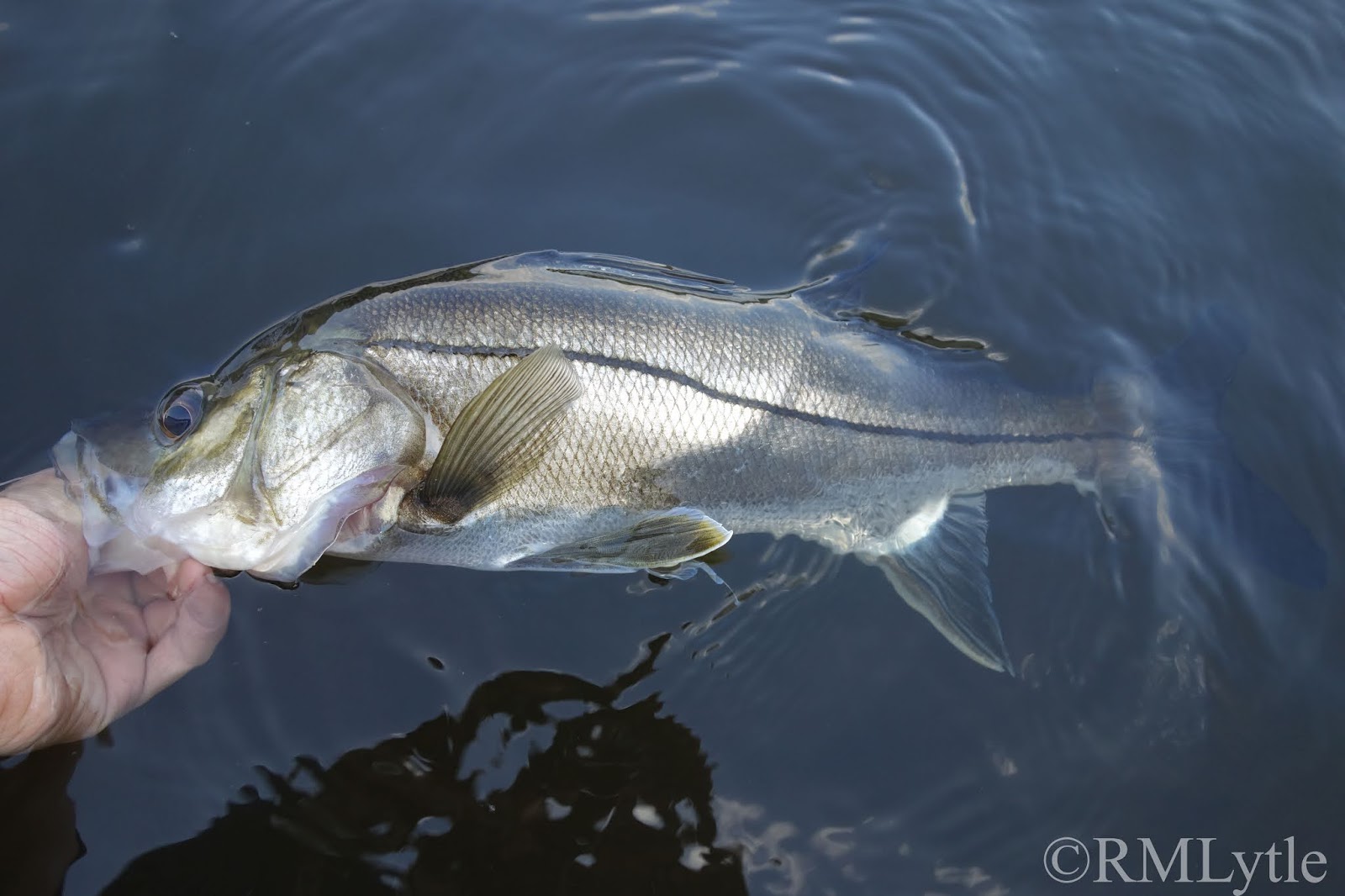
I didn't lag that far behind though. My Popovics Jiggy variation (bead instead of cone) got slammed as I pulled it into the darkness outside the dock light and I strip set into a pissed off, high flying snook. It pains me to say it, striped bass are my fish. I could never say a bad thing about stripers. But snook just fight harder. Their initial run is much faster than you can rightfully expect to get out of a striped bass and they will nearly always jump. Less so in deeper water, but a small to mid-sized snook is almost always going to go airborne at least once. Then, once you're done with a heck of a fight, you get to look at quite a unique and lovely looking fish. 

Centropomus undecimalis


The next dock produced a small crevalle jack, and a short time later another snook, again it took away from the light well into the darkness. We weren't seeing any spectacular numbers but the fish were more than abundant enough to keep the energy level up on the boat, and we all hoped that we'd happen upon a dock loaded up with lookdowns, a very unique jack neither Noah nor I had ever caught.


A few docks later, I got a take that wasn't at all snook like, and an extremely odd feeling fight. I could tell it was a very broad sided fish, as it would turn against me and I'd feel the vibrations of its tail pulses transmitting through my fly line. I was pretty sure I had a lookdown, and indeed I did. This was on of the strangest fish I'd ever caught, without question. It was so strikingly alien looking that it didn't matter that I'd seen many photos of them, holding one in my hands was a bit of a shock. Just look at this freak of nature:


Lookdown/moonfish, Selene vomer. Life List Fish #149. Rank: Species

We bounced docks for about an hour before we found another that was loaded up with fish. From a distance we could see the activity; fish breaking and bait spraying. On closer inspection it became clear we'd not catch any fish on this particular dock. There was far too much bait and probably only a few snook or lookdowns feeding. For here in the northeast Noah and I had come up with the "Triple P" or "Peanut to Predator Proportion" to describe the all too common scenario brought about by the presence of far too many peanut bunker and not nearly enough predator fish. Such a high proportion of baitfish makes for a visually spectacular blitz but often very poor catching. This, I guess we could say, was an undesirable "SSP" or "Silverside to Snook Proportion". We moved on and found the motherload.


Two docks, not 30 yards apart, held more snook between the two of them then we'd seen all night. They popped and boiled on bait and sat like ominous shadows in the green light of the docks. Kirk had been playing the dock light game a while now but he'd not seen anything like this. It was pretty stunning, and the action wasn't slow. 


We each hooked fish off of one or both of those two docks, and the fish never seemed to get completely tired of our intrusion. We actually had to leave them chewing there as it was no longer that same day we'd started fishing on, and we couldn't really ask for much more anyway. Right before we left, I snagged one of the docks and we had to go in to retrieve my fly. I learned two important things from this: first, and Kirk had already talked about this, use an anti-shock tippet above your heavy fluoro so you can break off when you inevitably snag (we typically use 30lb fluoro on snook because their rasp and sharp gill plate make quick work of lighter less abrasion resistant leader material). And second, though the fish looked like they were milling around within two feet of the surface the whole time, they were actually substantially deeper. I suspect, had I not switched to smaller but unweighted flies and simply trimmed down a Clouser or Jiggy that I could have actually caught even more fish. That's definitely an optical illusion to take into consideration if you fish lighted docks for any fish species. All told, it was a pretty spectacular experience. I thank Kirk for his time and sharing his new home waters with us, and it was really an exciting learning experience. Noah and I both left the boat launch that night feeling we'd learned a lot, and that our fishing resumes had been added to in a not insubstantial way. To me, that's what it is all about. 
Until next time,
Fish for the love of fish.
Fish for the love of places fish live.
Fish for you.
And stay safe and healthy.


Thank you to my Patrons; Erin, David, John, Elizabeth, Brandon, Christopher, Shawn, Mike, Sara, Leo, and Franky for supporting this blog on Patreon.

Saturday, March 14, 2020

Snapper, Puffers, and Snook in Small Canals

What do you do in Florida when it's cold and windy and you aren't in a good trout and redfish spot?


Snook and tarpon aren't fans of the cold. The area we'd elected to spend our first week is an area we'd chosen specifically for it's tarpon and snook potential. Left with wind that made fishing even moderately open water next to impossible and cold that meant fish there probably wouldn't eat anyway, we were left with limited options. The bass freshwater fishing was pretty mediocre in places we'd fished the prior year, when low water had concentrated large numbers of fish in small, isolated pockets. Now the wetlands were flooded and most of the fish were tucked away, spread out in the grass. The best viable option close to camp seemed to be residential saltwater canals, where we could get away from the wind and potentially find some pockets of sheltering snook while also getting shots at new species.


The canal we spent much of our time in alternated between natural mangrove banks and houses with docks, also a seawall or two. There were a few healthy oyster beds here and there which was great to see, and there were fish hanging out around them. I'd rigged my five weight with a size 12 BHHESH, not a bad small shrimp imitation, for these sorts of fish. Small mangrove snappers as it turns out are quite fun on a 5wt. Pound for pound, they've got even wild brown trout beat in the hit and run department. They'd come out and absolutely slam the fly, then dig like hell and sometimes even jump a bit if they were in very shallow water.

Lutjanus griseus

The only predator species that seemed to be working the abundant the abundant school of extremely small baitfish were small crevalle jack.. What species the bait was I have no clue, but the jack eating them were puny. In the main river, we saw big jacks blasting adult mullet. That was spectacular to behold. Loud, fast,and violent are applicable descriptors. I want one of those jacks. THAT would be a blast.
Caranx hippos
What I most wanted, other then for some sign of large predators getting frenzied enough to catch, was a puffer to show up on my nymph. And eventually one did! A checkered puffer, lifer #145.

Sphoeroides testudineus
 Later a frillfin goby found the same fly, the first goby I'd caught in more than a year. I'd caught this species before but I knew crested gobies, a species I hadn't caught, weren't at all unlikely to be in the same area. I hoped one of them would show itself. Gobies are adorable little monsters, popping out from their holes to make quick attacks at intruders and potential food then darting back inside. Often it's a one and done proposition with them. Hook them briefly an lose them, they don't seem likely to come back for seconds.

Bathygobius soporator


The next day, spurred on by warmer weather, somewhat manageable wind, and the crazy big jack blowups we'd seen the day prior, we returned to the same area. The wind was still pretty bad, but the mangrove snappers were, if anything, even more fired up.


Then, it happened. Noah FINALLY caught a snook and got it to hand for long enough to photograph it. I've personally watched him catch a snook larger the most non-Floridian fisherman I know have ever caught, but that was a disaster. I was battling a pelican that had flown into my line while Noah's big snook flopped off his board. He lunged trying to grab it and sliced a chunk out of the tip of his finger on it sharp gill plate. So, unfortunately, Noah can't say his first photographed snook was that monster... but you know what? We love the little ones. Tiny or big, snook remain one of my favorite species of fish to present a fly to. Give me a choice between catching a brown trout or a snook... I'm choosing snook, no further questions.


I blew it with snook that morning. I spooked some big ones and I broke off a small one. Even a small snook can rasp through light mono very quickly, I'm primarily using 30lb fluoro for all my snook fishing. I wasn't using fluoro for the one I broke off, of course. I didn't get a snook that day. That was fine though, the next would prove to be fruitful. More snappers and puffers though? I'll take them. There's nothing like the sort of fishing I was doing in CT. It was a lot of fun on my 5wt.


Though the forecast didn't look to be getting any better in term of wind for days and days and day, Noah and I both had some tricks under our sleeves. I may not be a local, this may have only been my fourth trip fishing in Florida ever, but Noah and I been known to accomplish things with exceptionally limited time and first hand experience before and this trip was not going to be an exception. When you live and breath fish and fishing, it doesn't matter where you go. Patterns reveal themselves and so do paths to success.
Until next time,
Fish for the love of fish.
Fish for the love of places fish live.
Fish for you.

Thank you to my Patrons; Erin, David, John, Elizabeth, Brandon, Christopher, Shawn, Mike, Sara, Leo, and Franky for supporting this blog on Patreon.