Showing posts with label False Albacore. Show all posts

Friday, November 17, 2023

Albie Season

 I'm not hardtail obsessed. I have been from time to time over the last six years, but I've found that I actually fish them better if they're more of an aside to my late summer and fall season rather than the main course. I'm a striped bass guy. They appeal to me more. I like large flies, large baitfish, and huge brutish stage fish that will hold a spot and work it. I also like night fishing. I feel as comfortable wading into a boulder field at night as I do sitting at my desk typing this chronicle out. That's my fish. Morone saxatilis and I were made for each other. Little tunny can honestly get a little boring to me. For many seasons, they've meant standing on the same five or six rocks across southern Connecticut and Rhode Island for hours at a time casting my arm off for fish that all ate more or less the same way, all on quite small flies, looked the same, and were only a few pounds larger or smaller than each other. There's no way to get an edge over other hardtail chasers to catch bigger ones, just more of them... and I'm just not a numbers guy. But there's undeniable thrills there too. I find immense satisfaction in the take and hookup. I fish near and on-surface flies and floating lines a lot unless conditions force my hand in using an intermediate or full sink. That means nine times out of ten an albie is breaking the surface to eat my fly. Gurglers are by far my favorite method, and damned deadly too. I'm far from the first to throw these flies at hardtails. In fact Jack Gartside had a gurgler variation tailored specifically to them, and Alan Caolo has talked up their effectiveness as well. It may be one of the best albie flies there is. When a little tunny pile drives a Gurgler and the line tightens in my hands, it feels like everything is right in the world. 

Early in the 2023 season I found myself on the bow of my good friend Mark Alpert's Amesbury Dory watching acres of crazed albies mowing down anchovies under the shadow of an iconic Southern New England lighthouse. It was the perfect day. The weather was gorgeous, and though a fair number of other anglers and boaters were out there were ample fish for everyone and in rare form, I didn't see anyone acting like a complete buffoon, plowing into fish, or cutting off other boats. It bordered on miraculous, with visual spectacle to match. Bright green and chrome reflections cut through the light chop, with rust colored anchovies spraying in their desperate attempts to evade the lightning fast predators. Frantic gulls added another auditory element beyond the impact like sounds of feeding fish and the excited voices of other anglers. Mark and I were privy to quite a show that day. And though the fish weren't the easiest, I was able to get them to eat the gurgler with exceptional regularity, even blind casting along travel routes when they weren't actually showing. 


It was my first day putting my Orvis Helios 3D 8wt that Shawn Combs extremely generously passed along to me to a really solid test on hardtails. One summertime bonito and a few chub mackerel didn't really give it the complete range of necessary tasks. It was a wonderfully precise bit of weaponry for little tunny sniping and very enjoyable to battle these late summer speed demons with. 


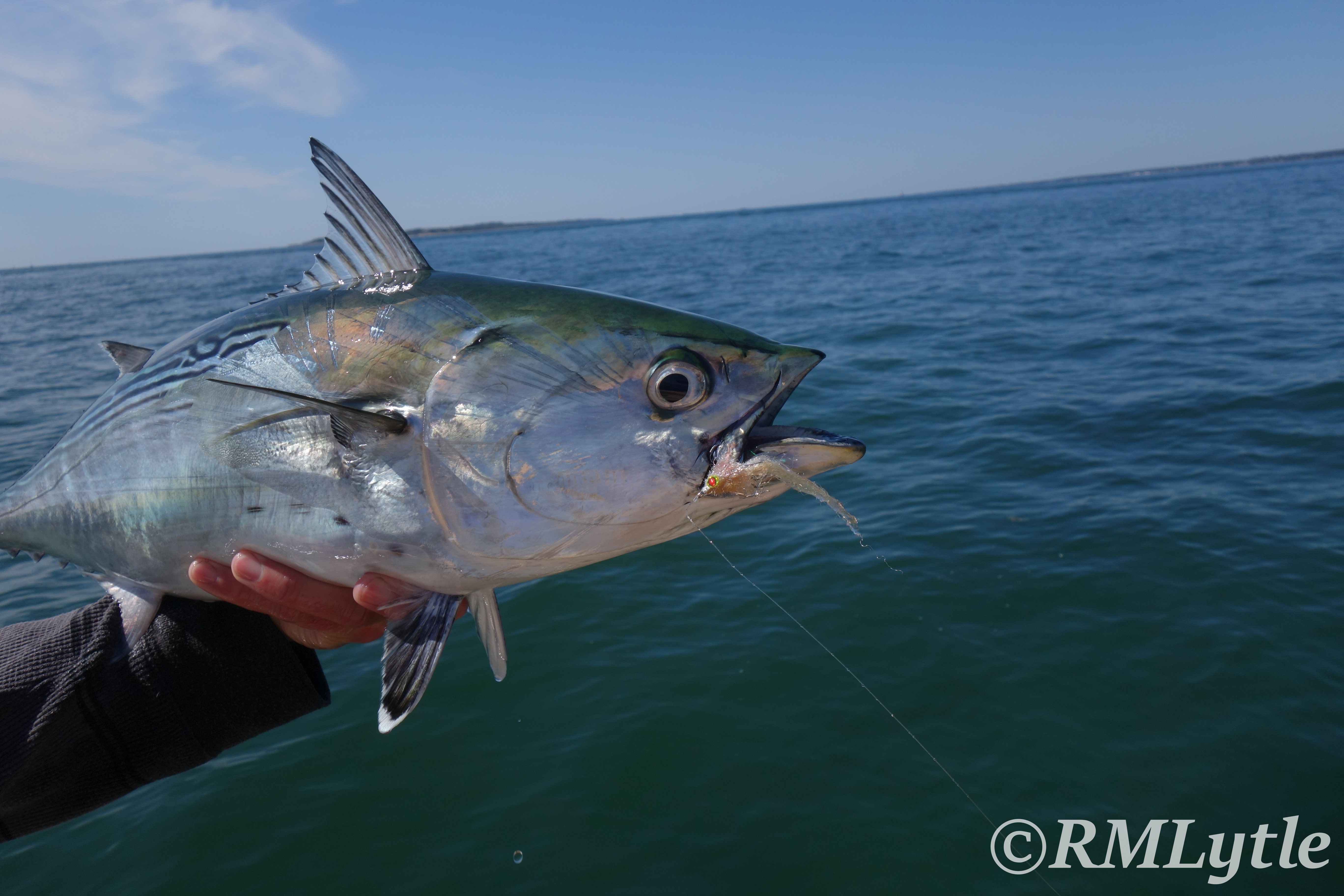
After the gurgler party east of the point began to fizzle, we ranged out looking to find more concentrated action. The reward was a mix of bass and albies feeding in a more delicate manner, less interested on the smaller bay anchovies. I took the opportunity to fiddle with a fly I'd been developing over the past two seasons, a sort of hybrid derivation of Dave Skok's White bait Mushy but with a stiff spine rather than Softex, and a body form and tying method inspired by Jonny King's Kinky Muddler. The fly rarely ever fouls (never at all if tied right), has an extremely natural profile from all sides, and has a great action in the water. I'd put it to the test on small bait blitzes of striper earlier in the year and found myself tight to fish any time I landed the fly close to breaking fish while other boats struggled, but given the fly's intent being tunoids it needed to work this time too. And it did. A memory that will forever be burned in my brain from that day was watching an albie race a group of striped bass to the fly and inhale it boat-side. I was forced to trout set at close range but got a great corner hookup and was treated to yet another quick ride into the backing. 


Outside of enjoying days on friends' boats, I only had a couple other goals for the 2023 albie season, those being to catch little tunny with my feet on sand, avoid fishing popular and ever more crowded spots, and catch more fish in new places or old places I'd been snubbed at in previous seasons. My motivation was driven by the growing popularity and changing culture around this fishery along with my own conviction to learn new things in new places. I've only been shore-based albie fishing for a short 5 years, but somehow that half a decade is enough to see changes in the game. My first season, I was being dropped off and could only get to locations I could walk to from a centralized relatively well known spot. On multiple occasions I had that place to myself for prime windows, and even when I didn't the etiquette was a bit different from what it has shifted toward. One day, I was struggling on a less than ideally positioned rock when one of the OG's, after getting three fish in fairly short order, reeled up and said "You're up, kid". That set a bit of a precedent and was a good lesson. Admittedly I've had my moments of greed, but I try my best to not be a camper and yield a hot rock if the next guy down the line isn't catching just because he isn't standing in the right spot that day. I also recognize that as a younger and more physically able angler, I could easily take up easy standing space from less able bodied folks in popular accesses, and don't feel that doing so is respectful or fair. A twenty or thirty something with good balance doesn't need to have the flattest, driest rock with the easiest cast into the travel lane. So this year I set out to fish other places and probably caught fewer fish than I otherwise would have as a result. That's okay. I fished with the people I wanted to fish with and had a better overall experience. I don't say any of this to denigrate those that fish the well known places, but I do want some anglers to rethink the way they go about this fishery and frankly fishing in general. More respect needs to be shown toward the locations, the fish, and the people that were out on those same rocks before us young guys even knew what a false albacore was. 

It all come together one morning when John Kelly and I met before sunup on a lonely beach that some schools of little tunny had been visiting with some consistency. The day before John had a couple fish to hand, and even with a late day arrival I had a couple shots. We knew there'd be fish, it was just a matter of being patient and making the shots. Sure enough, as the sun crested the horizon some splashed began to disrupt the otherwise only gently wind rippled surface. And then they were in front of us. John hooked up first. 

I've become more and more of a beach fishing addict over the years. Walking the open sand with a fly rod in hand is inherently contradictory; taking on the ocean and its predatory species with what is generally considered very light tackle (whether that actually portrays the real power a fly rod can have as a fish fighting tool is another story) feels at times like a David and Goliath situation. Though little tunny are far from goliath both in name and stature, they are quite a fish to tackle with light fly gear. The gentler slope of a beach adds even more to the fight. Unlike fish hooked from boats, jetties, or rock ledges, there's less opportunity for the fish to dive, making their runs a bit longer and faster than they otherwise would be. Add to that the mystique of catching a truly pelagic species- a tuna -just yards from the beach in a few feet of water and the pursuit of beach tunny becomes very appealing. John's fish came to hand after the predictable battle, and we took a quick moment to photograph it in the grey morning light. 

Not long thereafter, a group of fish came in toward me at an angle. I waited as they breached closer and closer, then fired a shot that I felt should lead them perfectly and began slowly two hand retrieving. The lead fish ate my pink minnow and tore off. A big gob of tangled line came out of the stripping basket and caught up in the first guide which resulted in a breakoff. I re-rigged, frustrated but not dejected, and looked in my fly wallet for the next soldier. A Gummy Minnow, incidentally given to me by John months prior, jumped out. The next time a pod of albies broke in range I got that Gummy in the right spot and one ate. 

Photo Courtesy John Kelly

That was a special fish for me for a number of reasons, very high on the list being that it was the first I'd managed to get to hand on the very first strip of sand I'd ever fished little tunny from. Back in 2017, after being dropped off to go about my own devices one September day, I opened my phone to look for new options after an unproductive few hours on ledges. I saw an appealing looking spot and I walked there. It was quite a long walk on a very hot day, though over that season I'd end up learning miles of shoreline on foot. I knew getting albies from sand beaches with a fly rod was a tall order, but within my first 15 minutes I had one boil on and refuse my fly. To redeem myself six years late was a huge sigh of relief. 

As the season rolled on, it continued to be productive. I went at my leisure, focusing on other fisheries most days. A few more good boat trips were had: most notably, one with my good friend Mark Phillipe. We were surrounded by feeding little tunny most of the day. The bait was absolutely miniscule, like metal shavings in the water, and the formation feeding fish demanded exceptional patience, numerous presentations, and the understanding that imitating the bait was not possible nor beneficial in order to catch. The task was much easier with a camera. The slow, deliberate feeding method these fish we performing in the slicks made for incredible visuals all day. 


   I did manage one fish that day, early of out of a large formation feed. I'd made a quick reaction cast at the right angle to their path of travel and once again my pink minnow fly drew a strike. Later it got taken a second time, putting me and 1 for 2 and Mark at 0 for 1 that day. It was tough, but certainly worthwhile. 


Not more than a couple days later I found myself on the beach again, this time with Garth. The feeding patterns were very similar to what Mark and I had experiences, but right in tight to shore. The bait the albies were feeding on was so small that adult silversides were actually eating it as well. I managed to lead a small pod of fish that came down the beach from my left, a perfect cast, and sure enough one ate the fly but I turned my body as I strip set and pulled the fly out of its mouth. A bit frustrated with that missed opportunity and the progressively smaller number of fish showing themselves, I made my way to a jetty. One the slack side, one decent pod was periodically coming in a feeding ravenously on snapper blues. It would have been a perfect opportunity at a very easy bite and they were clearly larger fish as well, but they stayed out of range save for one brief moment. On the opposite side, fish occasionally rolled as they swam past on their travel lane. These would be much harder to feed. Eventually I saw one rolling at 50 foot intervals and on course to get within range. I carefully times my cast, timing the rolls and realizing it would stay down went it got perpendicular to me. I waited for the closest roll I expected it to make then fired a 90 foot cast just beyond its track and began slowly twitching the fly. Sure enough, right when I expected their paths to cross the fish came to my fly. Though it was a very small fish, that one ranks amongst some of my most satisfying presentations and catches. 


As the day continued we'd find more fish and other locations, but a combination of exhaustion from a full night of cow hunting prior and a plethora of tautog fisherman in inconvenient location prevented us from fully taking advantage. Still, after quite a few years of poor albie fish close to home, fits and starts, fish arriving in mass then leaving just a couple weeks later, and getting frustrated with ever increasing crowds, it was just nice to have fish in front of me at a favorite location that doesn't fish well all the time but well enough to make it worth staying away from the hungry masses for. 


As the season continued to progress toward its end, I'd make it out a few more times here and there. Each trip presented interesting challenges and spectacular small bait ram-feeds. One particular day with Mark Alpert features some of the most spectacular and long lived feeds I've ever had the privilege to watch. Not only were the fish hard to feed though, but boat motion almost always made it tougher. We'd position upwind of the fish, and given  their uni-directional feeding you needed to lead them head on and pull the fly in the same direction they were going. I ended up going 0 for 3, because by the very nature of that presentation managing slack was absurdly difficult. Both boat and fish were traveling quickly towards each other each time I got bit and coming tight in that situation, with added heavy chop rocking the boat, isn't easy. Given how much everyone was struggling to catch during that time frame though I was just happy to convince those fish to eat. Can you guess which fly? Oh man, and was the photography ever special. 


Ya know, I really do love those stupid little fish. 2023 was a good season for them, from my perspective. I fished for them about as much as I wanted to, which wasn't much compared to some years (42 days in 2021, 12 days this year). I avoided crowds entirely and only fished with the small handful of people I really wanted to, sharing great memories with some of the best friends this obsessive passtime has allowed me to make over the years. I didn't have to see the scourge of insta heroes horribly mishandling albies just for a photo op. I only kept one fish that John had bleed out on him and it was one of the best tasting little tunny I've ever had.  I finished development on a new fly that seems to work really darned well. I captured both beautiful fish and compelling imagery. When all is said and done I feel very content with the 2023 albie season. 


Thank you to my Patrons; Erin, David, John, Elizabeth, Brandon, Christopher, Shawn, Mike, Sara, Franky, Geof, Luke, Noah, Justin, Sean, Tom, Mark, Jake, Chris, Oliver, oddity on Display, and Sammy for making Connecticut Fly Angler possible. If you want to support this blog, look for the Patreon link at the top of the right side-bar in web version.

Friday, September 22, 2023

Flashback: My First Albie

 It's worth looking back from time to time.

In 2016, a fresh-faced and wide-eyed former version of myself was early into the saltwater fly fishing rabbit hole. Now 8 years into that journey (or fall?) I can look back on it with very new perspectives and a more refined sensibility. So, though I've told this story on this blog before, I think it could be worth telling again. 

One of my enablers in those early days was my friend Mark Alpert. I met Mark at a small pond just a short walk from my house, a very secluded and hard to access spot that neither of us had ever expected to see another angler in. We talked carp. Mark was just getting into targeting the species- quite obsessively, in fact. We exchanged numbers and started fishing together fairly regularly- at first for carp, then saltwater. Mark has a beautiful and very well kept Amesbury dory, a classic New England boat. The original was built by C. H. Lancaster in Amesbury, Massachusetts. Similar to the Chamberlain dory, the Amesbury trades some row-ability for somewhat better stability. Mark's Amesbury is a 16ft version, very seaworthy and an extremely fishy boat, and the platform on which many memorable experiences I've had occurred; not least of which was catching my first ever little tunny. 

It was October 3rd. 2016 year that featured excellent false albacore fishing to the anglers plying the waters East of the Connecticut River close to shore. At the time I could probably fit everything I knew about the species and catching them on one side of a notecard. I'd never even fished with them around. There were a few slots in one of my fly boxes dedicated to albie flies... at the time, very crude and poorly tied attempts at imitating flies I'd seen online. Mark was going to put me on the fish though, and when we launched that morning my anticipation was high. It was a place I'd never been, though I now know it well. We were towards the eastern end of what had formerly been called by some local fly anglers "bonito alley". It had been some years since large numbers of bonito had frequented the area, but little tunny had filled their place quite nicely. Before the dory was even in the water I was looking for targets. Standing on a wood bulkhead, I watched a 30-something inch striped bass cruise by. This sort of thing became a staple of launching with Mark. I'd either see or catch a fish at the launch before the boat was in the water. My eagerness to get fishing was largely to blame. I couldn't stand to be near that water without casting into it. Though that need eventually faded, for a little while boat launch fish were sort of a hallmark of incoming good luck. October 3rd was one of the days that cemented that trend. 

We motored out through a no-wake zone toward blitzes that were already visible. Small flocks of gulls franticly called and swirled over equally small pods of little tunny slashing through small silversides. These sparse schools presented a few mediocre shots for a giddy angler without fully developed casting accuracy and distance. Eventually the fish dispersed a bit and Mark moved us further east. Soon we had some bigger pods here and there. It's hard for me to recall every detail of the moments right before my first albie, but here's what I do recall: I had one an extremely grungy fly, a no-name creation that was sort of like a backward Clouser. It had brass dumbbell eyes tied on the bend side of the shank rather than the top, so it didn't ride hook point up, and it had while bucktail for the belly and olive for the back with a little bit of flash in between. I still have that fly actually, and it is darned ugly. Very little thought or knowledge went into its design, but it was about to get eaten by a little tunny. The cast was a blind one, they hadn't broken in a little while. I came tight very close to the end of the cast, maybe only four or five feet into the retrieve. The fish then thrashed violently at the surface, making both Mark and I think it was a bluefish. I've never seen an albie behave like this since, it was completely uncharacteristic of the species. After a few moments, it remembered who it was and treated me to the classic long, hard and fast little tunny run. I was floored. The energy in that moment is still palpable years later. Your first albie on a fly isn't something you forget easily. It wasn't done with surprises though, as it soon charged the boat. Perhaps more memorable than that initial run, I vividly remember looking down in that clear Eastern Long Island Sound water and seeing my orange running line maybe ten to twelve feet down. The fish had already gone beneath us and kept going. I swept the rod around the bow, cleared the line, and came tight for the fish to scream into the backing yet again. The final challenge was a backing overlap that I had to clear by hand while Mark motored to keep the fish from running too hard while I had the line fouled. There were plenty of moments where that fish could have come off, but it didn't. Landing the fish was even more of a blur than the moments leading up to the hookup, but my first look at the fish was another standout. Those vibrant greens and blues and wild pattern rival the beauty of many of our prettiest fish. I had caught my first albie.


In the time since, Mark and I have had many a phenomenal day chasing hardtails on that boat and a few on foot as well. Of course, that one will always stand out, and I'll forever owe Mark for breaking me into the world of flash fishing for New England's miniature tuna. 

Thank you to my Patrons; Erin, David, John, Elizabeth, Brandon, Christopher, Shawn, Mike, Sara, Franky, Geof, Luke, Noah, Justin, Sean, Tom, Mark, Jake, Chris, Oliver, oddity on Display, and Sammy for making Connecticut Fly Angler possible. If you want to support this blog, look for the Patreon link at the top of the right side-bar in web version.

Tuesday, February 14, 2023

Drug

One of many spell in the fall of 2022 that I spent living out of my vehicle started with eating tortilla chips and queso in a park and ride. The tide wasn't what I wanted just yet for the one spot I'd intended to fish in the dark that night, so time needed to be killed. I threw on a podcast, got comfortable, and put calories in my body. The inside of my 4Runner probably didn't smell especially savory that night; with multiple saltwater soaked items of clothing drying in the back and my own sweaty, haggered self in the driver's seat. My overall mental state at the time reflected that of a fish obsessed hippy. I was nominally single, still occasionally hooking up with my ex but not bound into a time consuming relationship. I was guiding sporadically. My rig was finally behaving itself after half a year of mechanical problems. This was subsequently be my first fall run with my own vehicle, no partner, and no job. This was the first fall run during which I could do what I'd always wanted to do for years- live at the whims of the fish, tide, and wind alone. The conditions controlled what I did, not anything else. I had grown a tight little network of other anglers of the same mind and similar situational freedom. Our focus was honed on one of the most spectacular natural events on the east coast. The mass migration of baitfish was already underway and the predatory fish and birds were snapping at their heals. Those of us who simply couldn't resist the call of such spectacular biological occurrences came from all corners of the northeast and convened at our chosen churches, a fishing pilgrimage, if you will. Some worshipped on the sand beaches and long jetties of Rhode Island. Others boarded boats to pray from within the melee. I myself would be headed to my place of prayer in a short time, a rocky bit of shoreline in Eastern Connecticut where an estuary emptied into the sound. As I polished off my bag of chips, I saw that it was around midnight- almost time for the mass to begin -and dawned my ceremonial garb. I slipped neoprene socks onto my feet, and a beaten pair of sneakers over them. I tightened the belt of my khaki shorts and threw on a salt stained navy blue hoody. Into a sling pack went a few wallets of flies and some spools of heavy tippet. 

I parked a fair distance from the spot and outside of an open gate. Despite the fact that it was already late, I knew there was a fair chance this gate would be closed by the time I got back to the parking lot. A police officer had already had already warned me of this likelihood a few weeks prior when the tide timing was similar. I didn't at all mind adding to the walk anyway. The darkness enveloped me as the street lights began to disappear behind the trees and a sense of calm arose. In time, the pavement under my feet gave way to sand, then the sand to rock, then the rock to slat water. Wading into the inlet, I could hear the occasional pop and swirl of schoolie striped bass feeding on silversides. Affixed to the tippet at that time was a white Tabory Snake fly, a scraggly looking offering that I'd swing in hopes of drawing attention from a larger, more opportunistic predator. Bypassing the shallow feeding schoolies, I maneuvered the edge of the rocks out to the very mouth of the inlet. There, the estuary emptied out over a sandy delta into a deep area. Behind my lay a large bar on which stripers often roamed. In theory, the outgoing tide and baitfish in the estuary mouth might draw bass either from deep water of the rock bar to feed in the current plume. My second cast was greeted by a jarring strike. Not a bass though. The fish went airborne shortly after the hook-set. It jumped repeatedly and made spastic, energetic runs. This was certainly a bluefish. That poor Tabory snake fly stood no chance. 

After encountering that toothy critter, the destroyed Snake Fly was replaced by something more durable and I was treated to a pick of modestly sized bluefish for the rest of the tide. Though the bite was nothing to write home about, a few fish got the Tibor to sing nicely and the rod stayed bent for an hour or so. Who could complain about that? I made my way back to the parking spot exhausted and satisfied. Sleep would be minimal, though, as the sun still rises early in September and I had no intention of missing what would likely be a fiery false albacore feed right after dawn. 

I caught a couple hours right there in the parking lot, moderately comfortable in my fully reclined car seat with a pillow supporting my back and a blanket hiding my face from the one glaring streetlight. I moved an hour before sunrise just to be close to where I'd fish and got one more hour of rest before the light of the new day filtered through the fogged up windshield. Cracking a can of peanuts, I stretched and yawned. Almost reluctantly I climbed out into the morning air, binoculars in one hand and breakfast in the other. From the roof of my truck I'd eat my "meal" and watch for the first signs of fast fish. Before the first rays of sun even graced the Sound's lightly choppy surface the tunny were sending spray and piercing the waves out in the deeper water. I hurried my pace and called my friend Alex. There's a stretch in there that my tired mind did not commit to memory, but I cannot possibly forget the highlight of the morning. I know Alex had caught a rather nice striped bass on an Albie Snax and I'd lost one of his creative popper flies to a substantial blue, the I looked a point over and saw birds working in tight. Reluctant to make immediate moves, I let the situation fold out a bit longer. In time though it seemed there was no reason to stay where I was. I waved to Alex, who was further way and likely couldn't see the action from his position and began scampering across the rocks towards the unfolding blitz. I got out in front of the mayhem, tunny still blasting through the silversides just off the rocks, and fired a gurgler out into the fray. A mere few casts later I was treated to the sight of a tunny, shimmering like something carved out of a block of chrome with blue and green reflecting off of it's surface, blasted through the surface and engulfed the skittering fly. I was tight, and soon Alex was too. Any sense of exhaustion or lingering effects of car sleep melted away as though it were the backing leaving the reel as the tunny ran, taking every other problem in my life with it. There are a lot of different kinds of drugs out there and this, well this is mine. It's cliche, it's overused. But some of us sleep in parking lots, ruin relationships, and risk mental and physical health to pull on fish. Our brains crave the chemical stimulation enforced by evolving to predate, to acquire sustenance, and we take advantage of it to feel good, to get high for a moment in time. Some of us get addicted to it. It's not as dangerous as some other drugs, but it can still effect our well being. I must say, sometimes I just don't care. I'd rather look for that next high, and I feel I get so much enrichment through the process of hunting it. Moderation is good though. Sometimes you have to go home and sleep in a real bed.. Eat real meals. Foster healthy relationships. Like many drugs, you can have a moderately healthy balance if you try. Do I?


Nope.


Thank you to my Patrons; Erin, David, John, Elizabeth, Brandon, Christopher, Shawn, Mike, Sara, Franky, Geof, Luke, Noah, Justin, Sean, Tom, Mark, Jake, Chris, Oliver, and oddity on Display for making Connecticut Fly Angler possible. If you want to support this blog, look for the Patreon link at the top of the right side-bar in web version.

Monday, October 31, 2022

Stellar False Albacore Fly Fishing

 This year the tunny came in with a bang. Eastern CT saw a fantastic early showing, with fish available from shore in good numbers for a couple weeks steady. They were also showing in various locations, which I like a lot. Tunny draw a crowd of eccentrics, many of which are people I do enjoy standing next to on the rocks. It's an almost integral part of the fishery; all the familiar faces. I do enjoy that aspect, but I also enjoy solitude, or sometimes just one on one time with a friend. The widespread nature of that initial push of little tunny made it easier to pick and choose which experience I wanted to have and that was nice. It also meant I could try to catch some from places I'd not had the opportunity to in lower abundance years, and I'd often rather catch one somewhere new than five somewhere I've caught them before. 

I found myself standing on a familiar rock one day during that early season action, one I'd had shot at tunny from, hooked one once even, but I'd never caught one there before. Last year I'd made a beautiful cast into a breaking school and one ate my fly, peeled off on a run, then threw the hook. It was a disappointment in a season of disappointments. I stood on that same rock feeling a lot more at ease than I ever was during the previous season. Confidence plays a huge roll in this game, and knowing you can catch if you are patient, persistent, and most importantly relaxed can make or break a day- or, as it turns out, a whole season -of fishing for albies. This season I'd committed to fishing for them less, staying closer to home more, and just being satisfied with whatever was going to happen. It was a recipe for better success. This it just felt like it was going to happen. I had on a floating line. Most anglers fly casting for little tunny elect to fish lines that sink to some degree or another. Intermediates, sink tips, and full sinks are common fair. I've always liked floating lines. Though one argument, that thinner full sinking liens cut through the wind, is perfectly valid, I have not problem punching casts into wind if I have to regardless of the line I choose. I also like explosive surface strikes, and having my fly at or near the surface not only allows me to see that happen but also shows me whether fish are refusing my fly, building my confidence or allowing me to make changes in my presentation. last year I didn't fish the floater much. Ironically, when I did I caught fish. 

Adding to my ability to enjoy the day, I had paired a floating fly with my floating line. The Gartside Gurgler has been one of my favorite flies for the species. The skittering action of the gurgler draws explosive takes, even when more typical subsurface presentations are spurned. On this sunny early season day the floating line and gurgler combination would prove deadly. 

The tide window at this spot often presented a short window of opportunity, so I knew I wouldn't be there all day. It was beautiful though, and when the tunny came around I'd have a spectacular view. Initially the fish weren't playing within range, though that's not unusual. Gradually they drew nearer. I stayed patient, waiting through short lulls, and soon they were at my feet. The first good shot drew a strike, thought the fly came out of the fish's mouth a moment later. Back in hand I felt that the hook point wasn't quite as sharp as it should be. A few strokes on the file and it was back to fishing. The next break of fish came in over shallow sand and I landed the gurgler right in them. The great cast was rewarded with a spectacular eat and the first tunny of the year was on. 

I confess, though the initial run of a tunny is a spectacular thing, fighting these fish is a little dull to me. It lacks some of the challenges presented by other fish. If you can clear your line quickly and steer the fish well, which is particularly easy with a long rod, you are likely to land the fish. If you lose the fish in structure, it's not because that fish tried to get the line through said structure, it's merely because you put yourself in a situation where the structure is likely to end up between you and the fish anyway. I'd rather fight a fish that is headed for structure knowing that it can use it to free itself, or that is can find safe refuge. That's much more interesting. Subsequently, it's the fights where something goes wrong that actually get me excited when I'm hooked into a little tunny. That's exactly what happened this time. A tangle caught up at the end of the rod and the tip pulled off. I had to navigate that issue with a very strong fish still on the end of my line... now that was a challenge. I managed to deal with the issue and land the fish. What a good feeling that was. My first tunny in a new spot landed the hard way.


That was the beginning of an excellent streak. After the tide slacked out there, I made a moved to a reliable location. There, the wind was throwing a good chop. It was the ideal setup for fired up tunny. Indeed they were chewing, and I intercepted the procession of fish repeatedly that afternoon. The gurgler remained the ideal fly, and the takes were visually spectacular. 


That will likely end up being my favorite day of the season, even if I have another great numbers day. Everything felt like it went the way I wanted it to that way. If there was a hicup, like the tangle on the first fish, I navigated it successfully. The fish were numerous and willing. The conditions were comfortable and conducive to good bites. I caught in more than one location and even in a new location. It was ideal. The frustrations I'd had with this fish over the prior year melted away and I was able to enjoy the albie high. They are quite magnificent fish. That the opportunity to catch these small tunas comes within the sights of those who would as soon stand on rocks or sand than the deck of a boat is a minor miracle. Though I don't obsess over them like I do large striped bass, carp, or pursuing new species, chasing tunny is an integral part of the fall season. 


I'm still hopeful for one last blast in November. I've caught November tunny before, but it has been quite a few years. It would be nice to bookend this season with a large one. 

Thank you to my Patrons; Erin, David, John, Elizabeth, Brandon, Christopher, Shawn, Mike, Sara, Franky, Geof, Luke, Noah, Justin, Sean, Tom, Mark, Jake, and Chris for making Connecticut Fly Angler possible. If you want to support this blog, look for the Patreon link at the top of the right side-bar in web version.

Sunday, September 25, 2022

Albies & Updates

 You know what sucked? Last year's tunny season. You know what doesn't? This year's. It feels like this year you can play your cards right and have a good shot at landing a fish every time you go out. That very much wasn't how it played out last year, especially in CT. Last year was incredibly sporadic, with fish being isolated to certain areas and frequently hanging a few miles off shore rather than running the structure. 


There are plenty of slower days and the fish have been pressured enough to get picky, but this year's volume and spread are exponentially better than the previous three combined. It has also allowed for more confidence in experimentation, both with new spots and new methods. I, personally, have been streamlining my fly arsenal as well as getting back to frequently using floating line. Other high abundance years back when I first began targeting these fish, notably 2017, allowed for similar exploration and experimentation, but I didn't yet have the experience to draw conclusions yet. I got quite a lot of opportunities to fish despite not yet even having my own vehicle. During the 2017 season I'd often have my step-dad drop me off on his way to work, walking sometimes miles between spots throughout the day and slugging it out with nowhere to go on the slow days. Those were the good old days, I learned a lot entirely on my own. when I fished with friends that year, they often new as much or less about little tunny than I did, so it was very much a time of trial and error and learning from experience. 

On the note of  coming to conclusions, just what is it that has made this a good year? One factor seems to be the drought. Inshore salinity is higher due to a lack of rain. Other banner years happened in concurrence with droughts. 2016 was a severe drought year, 2017 likely piggy-backed off of that. Other drought years in the intervening time haven't hosted large numbers, so there is certainly more to it than that. it was an offshore storm that pushed the fish to us this year, which is exactly what happened in 2017. Last year it was the onshore impact of Henri that seemed to push in the first fish. There are still plenty off questions about what brings them in, why some years are so poor, and so on. Many won't likely ever be answered even with the startup of tagging projects like ASGA's "The Albie Project". I'm excited to see what results this project has, if anything at all. Frankly it will be noteworthy if any tagged fish get recaptured just as some tentative catch and release data.

In other news, I've updated my Patreon benefits, my to two tiers now get 50% off any guided trips! I've also increased my post rate over there, It's basically become the old style Connecticut Fly Angler- shorter, punchier posts, though I think more incisive. The incisiveness comes with age...  growth comes with time and I'm always growing as an angler and as a writer. I've started to feel a lot older lately when I think back to memorable bites and good fishing I've had and realize that some of it was more than a decade ago. 

I've got some availability for land-based tunny trips going into October, as well as some canoe based striped bass sight fishing as well. The fall sight fishing is very different from the more typical June-July crab season, the fish are often feeding on mullet and peanut bunker rather than crabs and shrimp. This often results in epic shallow water blitzes as well as less picky fish than spring. It's a cool option if you are looking for a unique guided fly fishing trip. Send me a message through any of the platforms I'm on to book. 

I really can't believe I've been doing this as long as I have. I must say again, thanks to every single one of you that has offered their support in one way or another over the years. You are all appreciated.

 Thank you to my Patrons; Erin, David, John, Elizabeth, Brandon, Christopher, Shawn, Mike, Sara, Leo, Franky, Geof, Luke, Noah, Justin, Sean, Tom, Mark, Jake, and Chris for making Connecticut Fly Angler possible. If you want to support this blog, look for the Patreon link at the top of the right side-bar in web version.

Wednesday, November 17, 2021

Eating An Albie

 I've heard all manor of descriptions of what little tunny taste like, and very little of it good. Something I've learned throughout the years, though, is that most fish are very palatable and usually better than that. Being adept at handling the fish after you've harvested it, cleaning it properly, and cooking it appropriately make all the difference. Of course there are some fish that some people just won't like- everyone has different tastes. I used to be incredibly picky about fish. Now I think it's all about how they're done, though. I've eaten quite a few fish species that I've seen anglers turn their noses up to- walking catfish and sea robin to name two of the oddest. The only fish that was genuinely unappealing was chub mackerel, and that's just because we didn't get it on ice fast enough. So, naturally, it was only a matter of time before I brought home an albie.

The opportunity arose the morning of a gnarly storm that brought heavy rain and wind to southern CT. It was absolutely pouring just minutes after I arrived and there was very little sign of activity, but I wasn't there to sit in the dry car and wish I were home. I cast, and I cast some more. Then suddenly one of my retrieves was stopped by the abrupt take of the fastest fish a fly angler can tie into with their feet on the New England shoreline. And here I was, ready to fight it with a cheap Bass Pro Shops brand fly rod. The 9wt Heat did the job admirably, and soon I had a beautiful and hopefully delicious fish at hand. I'll say it one more time: expensive gear isn't pivotal to success. I'm having a lot of fun with that silly rod. 


That was my only fish of the day, but that's all I really needed. I quickly bled it and left it out- no need to get it on ice, it was being pelted by cold rain. After being drenched to the bone and beaten up I went home with my little tunny in a bag in the trunk. I filleted it like one would any small tuna, and trimmed off the darkest bits of meat. That left rather a lot, about four meals worth if paired with another dish. 

There are quite a few ways to prepare little tunny. If you're already used to cleaning and cooking tuna, I recommend treating a little tunny the way you like to prepare a bluefin, yellowfin, or blackfin tuna. Expect it to have a little less shelf-life than those species, but the same cooking or sushi preparation techniques are applicable. It'll also allow you to compare the quality of the meat to the fish you're already familiar with.

I cook mine essentially the same way I cook myself a burger. I put a splash of olive oil in a pan, sprinkle some salt and pepper on the piece of meat, and cook it until it's just a bit pink in the middle. 


The texture and flavor is great. I loved it, and my partner really enjoyed it as well when she tried it. As long as you treat it right and eat it soon after it's caught, there's no reason not to eat an albie if you want to. And, frankly, lots and lots of dead ones are being thrown back in the water. Being an extremely fine-tuned, warm-blooded fish, little tunny have a very short shelf life when removed from the water. A lot of released ones die, that is very clear. I reckon the number could be as high as 45 to 50%. Grip n' grins are probably very close to a death sentence for these fish. 

I know I've thrown back tunny that didn't survive, and though I don't subscribe to the idea that a fish that died after release has been completely wasted (nothing organic goes to waste in the ocean), I don't think it's a good look to be killing large numbers of a species for the sake of of sport and believing you're doing right by the species. Little tunny are one of the most abundant predator fish species in the Atlantic Ocean, if they're going to be killed by even fairly careful catch and release methods, we may as well eat them. Since they aren't, in fact, horribly disgusting as many people make them out to be, I'll likely be keeping every one I decide to photograph from now on, knowing full well there are some fly caster that will dislike me for doing so. That's a lot better than such a magnificent animal being eaten by invasive green crabs. 

Until next time, 

Fish for the love of fish.
Fish for the love of places fish live.
Fish for you.
And stay safe and healthy.


Thank you to my Patrons; Erin, David, John, Elizabeth, Brandon, Christopher, Shawn, Mike, Sara, Leo, C, Franky, Geof, Luke, Streamer Swinger, and Noah for making Connecticut Fly Angler possible. If you want to support this blog, look for the Patreon link at the top of the right side-bar in web version.
Edited by Cheyenne Terrien

Wednesday, November 3, 2021

Sight Fishing False Albacore

Little tunny seem to move so rapidly most of the time that sight fishing for them would be next to impossible. However, when their behavior lines up with the right conditions it is in fact possible. Slower cruising fish and the right lighting and it is possible to snipe cruising tunny. I've only hit the right conditions once, and it was this season. It was one of the coolest days I've had fishing for scombrids, though the bite window lasted a mere 20 minutes. For that short time, there were dark clouds in front of me and clear skies behind with the sun right at my back, lighting up the water with exceptional contrast. The tunny were running predictable routes and would break sporadically, but the best shot happened when I could see the fish coming in the water, big pods of 20-30 fish, lit up green and blue in the water. 

I was fishing a white and pink Tabory Snake Fly, hoping I could continue to experiment with that the big, erratic fly strategy. I'd see the fish coming, lay the fly out, and strip it quickly as they approached. I got positive reactions each time, but the fish seemed to have a difficult time engulfing that big deer hair headed fly. The first two that grabbed did so abruptly, peeling away from their pods and side swiping the fly. Neither got steel. The third one did though, and it was such a spectacular and visible take- the best tunny take I've ever had. 

Unlike the previous fish I'd had this one actually was exciting. It felt good in some way other than just exhausted relief. Even better, that joy wasn't taken away by the fish breaking off or coming unbuttoned. Instead it very politely came to hand. 


When I got the fish in I could see that it was light up blue, which made for beautiful photography. However it also had severe abrasions from getting stuck in a net, which didn't. The abrasions were interesting because I've often worried about line burns on released tunny. They don't have thick scales or protective slime the way a lot of fish do and this leaves them vulnerable to infections. Very simply, little tunny evolved to be pelagic and fast, and fast pelagic fish don't naturally get abrasions very often. There's no reason for them to have a mechanism for fighting off the side effects of abrasions. This fish made me a little less concerned about it outright killing them. 


Regrettably I didn't manage to make good on any more shots that day but that fish was worth the price of admission. As tunny season wore on, I'd have some more shots in very different circumstances. It kept me entertained despite the overall slow nature of this year's fishing. There have been some big showing but overall it has been very sparse aside from a handful of windows and pockets of concentrated activity. It has been a long season. It's November and they're still here. And I'm still after the damn things.

Until next time, 

Fish for the love of fish.
Fish for the love of places fish live.
Fish for you.
And stay safe and healthy.


Thank you to my Patrons; Erin, David, John, Elizabeth, Brandon, Christopher, Shawn, Mike, Sara, Leo, C, Franky, Geof, Luke, Streamer Swinger, and Noah for making Connecticut Fly Angler possible. If you want to support this blog, look for the Patreon link at the top of the right side-bar in web version.

Monday, October 25, 2021

Incredible Ram Induction False Albacore Feeds

 I first heard the term 'ram induction feeding' from my friend Ian Devlin to describe how scombrid species eat small baitfish. Basically, they just slam trough tightly packed schools of bait and it gets funneled into their mouths. This feeding strategy can take on a few different looks, and when the fish are on very tiny "snot" bait it is a particularly remarkable thing to watch. The best example of this is chub mackerel, which routinely organize in compact (though large) schools and coordinate attacks on schools of tiny baitfish. We've had quite a lot of that in these parts over the last few years. Less frequently, little tunny feed in the same manor. A large school of them will bunch tightly together and propel themselves through the bait clouds, taking in the minuscule fish as they move. At times, in rough conditions, it can look like a huge pod of tunny is surfing a swell. Its a wild thing, and something I finally got to see and document this year. 


Catching fish from these types of feeds can be very difficult at times, and there are two strategies that can be employed: One is sniping smaller pods moving along with large impressionistic lures, something I watched one well known angler do on the day these photos were taken. The same can be done with flies, but it's harder to make a quick shot if you aren't prepared. I'll cover this a bit more in a future post. Another strategy is to cast very tiny bay anchovy patterns into the bigger feeds. There's a level of luck to this since the fish are in such a large cloud of bait and aren't actually singling something out then chasing it down and eating it, but if the school is tightly packed enough and up and feeding when you get your fly in them, the odds certainly aren't bad that the fly ends up in one of their mouths.


It was during the days that this was going on that I got some of my only hookups this season, which isn't typically how it works. I usually like it better when there are roving pods, maybe boiling occasionally but mostly not visible. These are hunting fish, and they are often much easier to catch. Of course the fish I did catch on the day I took these photos was roving, I hadn't cast at breaking fish. But it was clear that the bulk of the fish were very keyed on something specific. It was very cool to see but didn't result in the best fishing. The same can't be said for the situation I was met with in the next tunny post. 

Until next time, 

Fish for the love of fish.
Fish for the love of places fish live.
Fish for you.
And stay safe and healthy.


Thank you to my Patrons; Erin, David, John, Elizabeth, Brandon, Christopher, Shawn, Mike, Sara, Leo, C, Franky, Geof, Luke, Streamer Swinger, and Noah for making Connecticut Fly Angler possible. If you want to support this blog, look for the Patreon link at the top of the right side-bar in web version.

Saturday, October 23, 2021

Big Fly, Small False Albacore

 With the season dragging on and a few good weather windows missed, I was starting to get awfully irritated with the tunny. It had long since ceased being fun and I was now just slugging it out hoping to save my dignity. Turns out there really is no dignity in fly fishing for little tunny and I should probably just fish for striped bass unless it's clearly going to be a good year for the latter. It would be pretty easy for me to go get the appropriate spinning gear and drastically improve my catch rate, filling in those days where a fly rod just isn't the right tool for the job, but I've caught tunny on spinning gear already. It just didn't do it for me. It wasn't fun. So the question is, how do you turn it around during a depressing and obnoxious season when people around you are catching on spinning gear and soft plastics and you aren't able to get the fish to eat normal flies? 

I'd had a few big and brightly colored Tabory Snake Flies in my box the whole season, and more than once I'd thought to myself, "boy I could really get that to act like an Albie Snax if I fish it right." Twelve trips into my season I finally tied it on. Within five casts I was tight. Honestly it wasn't even exciting, it was just a relief. The previous afternoon I'd briefly had one on that broke off due to a nicked leader. Luckily this little fish stayed on for me. The fight was fairly run of the mill. The fish careened into the backing like only a little tunny can, and I then brought it back to me and scrambled down the rocks to get the fish in hand. It was a very small one, but it had eaten the largest fly I'd ever thrown for this species.


Of course I figured I'd had it solved and that I'd be able to get a couple more fish before the day was over. I did, but not little tunny. Some bluefish had come around, and they weren't the tiniest bluefish either so they provided some enjoyment. I like bluefish any time they aren't ruining flies and leaders.


As the afternoon wore on, the tunny started exhibiting some very interesting feeding behavior, which we'll delve into next time. 

Until next time, 

Fish for the love of fish.
Fish for the love of places fish live.
Fish for you.
And stay safe and healthy.


Thank you to my Patrons; Erin, David, John, Elizabeth, Brandon, Christopher, Shawn, Mike, Sara, Leo, C, Franky, Geof, Luke, Streamer Swinger, and Noah for making Connecticut Fly Angler possible. If you want to support this blog, look for the Patreon link at the top of the right side-bar in web version.

Edited By Cheyenne Terrien