Showing posts with label Trout. Show all posts

Tuesday, June 9, 2026

June Guiding Updates & Patreon Setlist

 May was a productive month with clients with a decent array of variety and some big fish here and there! Of course, it always is, May is one of those months in Connecticut when it is pretty hard to pick what exactly to do any given day, for my own personal fishing. I did no trout trips at all in April but had a few in May, starting with Frank and Brandon. It was a mixed bag day, mostly nymphing, one cool spot and stalk with a dry, and a nice tiger trout on a mouse. Then David and Kalil came down from Massachusetts for a great day with a lot of catching shotgun nymphing the riffles of one of Connecticut's more underrated trout rivers. 


Kalil Boghban Photo

Kalil Boghban Photo

The carp spawned in bursts throughout the month, not always in the same places on the same days. The only time it pretty much screwed me was when I had Tom Cole out, and in unusual form two fish were hooked and lost out of the only feeders we found. Carp don't often come unpinned after they're suck, and I saw that both weren't fouled very early on. At least the fish viewing that day was spectacular, with hundreds upon hundreds of carp of all shapes around us, under us, even splashing us at almost all times.


The next day I had Blake, who coincidentally had a similar situation when he booked me last year, where every hooked fish managed to slip away un-netted. This time was different with multiple large carp and plenty of channel catfish caught. Most exciting, though, was this gorgeous little mirror carp!


Also getting in on the carp success in May was Michael, with his largest freshwater fish on the fly....


... and Dar, with some excellent big lake action.


To keep the variety up, shad were also heavily in the program this May. I love American shad, but for my own devices I'd gladly go make one annual pilgrimage a year for the species. Sometimes clients pull me out for them though, as Jeff and Tony did this year. For two days we slugged it out with rain and cooling temperatures. It was harder work than I like shad fishing to be but fish were caught regardless.


I'm skipping a fair bit, here, so as not to crowd out this post too much, but it was a great month with great clients and lot of good fishing. On to June, which we are now almost halfway into. I'm going to get a little bit personal, now. The start of this month has been a disaster for me. With some very expensive and necessary repair investments done on my generally trusty set of wheels, I promptly got into a car wreck that has left me with both light physical strain, significant mental trauma and stress, and a financial burden that is turning out to be far worse than it even seemed it might be initially. This has left me in a tough place for June. If you are looking to book a trip, please understand that it my take me some effort in scheduling. Walk and wade trips will be much, much easier to accomplish than canoe or raft trips, though I can at least do canoe trips here and there, it'll just take some scheduling and working things around to make sure I can borrow appropriate wheels. Because I am in such a sticky financial situation I very much would appreciate any trips I can get on the books at all, as this is setting me back on a few things I'd intended to do this year, including getting a second raft which would have hugely boosted my ability to furnish fun and exciting float trips. If you can find room in your schedule and any of my normal early summer warmwater fare- (bass, carp, bowfin, catfish) or saltwater species (scup, fluke, blackfish, stripers), as well as wade trips on the Farmington and a handful of other rivers remaining cool enough for trout -appeals to you, I'd be massively appreciative of your booking. I can't promise the easiest scheduling process but will do my absolute best. Thank you for your understanding while I work this out. 

So far this month the fishing has been good and promises to continue being. Some bowfin, catfish, and carp have found their way to the net. I did something I don't usually do much anymore and made some casts at carp one day, resulting in the largest fantail I've ever personally set eyes on. It ate the fly before it made it to the bottom on a fast cruise in clear water. It was a spectacular eat and in many respects on of the best carp I'd ever caught... so no complaints there.

Levi Opsatnic Photo


As for Patreon, we're already on a nice roll this month. Here's the setlist: 

Cow+ Posts: 

Get In Loser, We're Going Gar-ing


Videos: 

Multidisciplinary Smallmouth Nymphing

Casting Under & Into Brush

Weekly Posts:

Surface Analysis

Thing Carp Eat Sometimes

Using Soft Glass to Set Hard

Stand In Cold Water

Quick Tips:

TBD

Walt's Durability

Walt's Profile


Thank you to my Patrons; Erin, David, John, Elizabeth, Brandon, Christopher, Shawn, Mike, Sara, Franky, Geof, Luke, Noah, Justin, Sean, Tom, Mark, Jake, Chris, Oliver, oddity on Display, Sammy, and Cris & Jennifer, Hunter, Gordon, Thomas, Trevor, Eric, Evan, Javier, Ryan, Dar, Eric, and Collin for making Connecticut Fly Angler possible. If you want to support this blog and access more informative content, look for the Patreon link at the top of the right side-bar in web version!

Saturday, January 31, 2026

Ghosts of Winters Past

2025 was a pretty good ice fishing season in Connecticut. 2026, so far, is even better.... the best in recent memory, in fact. Noah, who doesn't work in the winter anymore, has gotten fully ice obsessed, and that has carried along to me. Going from very casually stepping onto local lakes with a spud bar and one jigging rod to fully shanty-d up with heaters, vexilars, specialized rods and even more specialized jigs, and making spring bobbers at home is a bit of a leap. It was any easy leap for me to take. I'm a fly guy in open water virtually everywhere and every time I can be. With almost no exceptions, if I'm making casts with an artificial offering, I'm going to do so with a fly rod and don't care at all to use anything else. That doesn't operate well when the water is frozen. Walking on water is pretty darn fun. Trotting out on the ice nearly daily and even sleeping out on it has got me thinking about the winters that have passed, though. 

I caught my first fish through the ice not that long ago, in early January of 2018. It was a striped bass. Noah and I both got our first that day, actually. They were on handlines. They fought... poorly. 


That winter of 2017-18 was the first time I ever put even a measurable effort into ice fishing, and it wasn't a huge effort. I did give it a go with jigging panfish and bass and started to at least catch fish. That wasn't an exceptional ice winter, but it was good enough. My most significant memories on the ice that involved attempting to get carp through the ice and even losing a set rod to one, and dropping my phone down a hole and managing to grab it as it sank. The open water opportunities were probably markedly better that winter than the ice opportunities, at least given our lack of skill. That skill lack extended beyond just ice fishing though, Noah and I were both very much still in a developing age in our angling careers- not unskilled, per-se, probably better than average, but growing rapidly. We'd just gotten back from our first Florida trip, which opened our eyes in significant ways. 

I'd ice fished prior to 2018, of course, but in an even more disorganized fashion. In 2017 we had a very mild winter that gave no ice. January and February both presented more opportunities at open water bass, sunfish, and carp than they did at ice fishing. 2016 was much the same. In fact, winters like these have been more abundant in the last two decades than winters like the one we're having now. I can recall falling into a pond in early February of 2010 and it being a complete non-issue. 

My friend Rik and I poked around this snowy but open pond one January day in 2017


2014 was a late winter but cold enough and snowy enough to keep me off a lot of water. I don't know that I ice fished at all, my friend Dalton and I may have half-assedly attempted it. I did more snow-shoeing than fishing that winter, especially from February into early March. What I keenly remember was that shelf ice built up significantly. In combination with deep snowpack and the fact that we still had a short closed trout season back then and it made for a very good spring trout season. Fish were hungry, had been unpressured, and flows were fantastic. The hatches were better back then too. 

I believe it was 2013 that I recall struggling to cut through the thick ice on a local lake with a hatchet, and when I finally did it shot through and I lost it.  

In 2020 and 2021, I did a little bit of ice fishing, but not much. In 22 and 23, hardly any at all. I devoted some days in 24 but the window was short. Ice was largely absent each of those years but so was snow, with little in the way of prolonged snow coverage. So far 2025-26 has provided the longest duration of snow coverage locally that I can remember in a long time. What does that all mean, though? I hope this produces a spring trout fishing boom equivalent to 2013 and 14, but the reality is the streams are open to fish the moment they thaw now, and that closed March really was advantageous back when we still had that. Combined with the boom in popularity of two high impact trout methods- Euro nymphing and especially center pinning, now -the fish won't see the benefit of a deep freeze that they used to in conjunction with a chance to settle into early spring without heavy molestation. At the very least, snowpack melting into the ground a steady pace has significant groundwater benefits. We have a lot on the ground all over the northeast at this point, and all of February to accrue even more. That leaves another question: with snow on the ground all over the Mid Atlantic region, will there be a significantly better striped bass spawn this spring? My suspicion is, no, there will not, at least not enough to make up for the collapse we've seen thus far, but I could be mistaken. Colder winters with more precipitation are indeed tied to improved recruitment. We'll just need to wait and see.

What I'm most excited about, personally, is this: 

https://www.nohrsc.noaa.gov/nsa/index.html?year=2026&month=1&day=31&units=e&region=Northeast


I anticipate a pretty good spring floodplain season for me... if you've done that fishery with me, you know why that brings a smile to my face. It's the coolest. And with snowpack like we have throughout the watershed, it should be very reliable this spring. Book soon, because late March, April, and May do fill right in! 


Thank you to my Patrons; Erin, David, John, Elizabeth, Brandon, Christopher, Shawn, Mike, Sara, Franky, Geof, Luke, Noah, Justin, Sean, Tom, Mark, Jake, Chris, Oliver, oddity on Display, Sammy, and Cris & Jennifer, Hunter, Gordon, Thomas, Trevor, Eric, Evan, Javier, Ryan, Dar, Eric, Truman, and Collin for making Connecticut Fly Angler possible. If you want to support this blog, look for the Patreon link at the top of the right side-bar in web version.

Saturday, April 18, 2020

Why I Temporarily Quit Trout Fishing

Wild trout are entwined with my soul. I need them, at least every now and then, in order to feel comfortable. I need to see them, I need to fool them, I need to hold them in my hands and try my best to capture their beauty in a digital format. But right now, I am taking a break from fishing for wild trout. It won't be a long break, but in my opinion I owe it to the fish., and I'm going to try to make the case that you should do the same.


On a fairly recent trip, I fished an unlisted, un-stocked, polluted, hard to access small stream. I had only ever seen one other person fish it in the past and I shared it with a small handful of my inner circle of small water wild trout junkies. I've also made sure to mask its possible identity the handful of times I've written about it, maybe employed a bit of "smoke and mirrors" even, and flat out lied about where fish were caught to certain people. But on this trip, the first day I'd been there this year, there were foot prints on just about every sandbar but the hardest to get to, very clearly fisherman, and very clearly fisherman that had no idea what the hell they were doing. There was no cautious approach, no respect for the banks. New trails were worn, bank erosion was obvious. There was trash. More than normal. Fishing trash: line, worm containers, snagged rigs. The number of people not at work or school, want for things to do, venturing to places they wouldn't have otherwise is huge.


I fish 250-320 days a year, right now a no insignificant amount of my income is tied to fishing. So this might sound selfish, like I just don't want other people on what I kinda consider to be my water. It isn't mine, though I have put a lot of work into finding much of it, and I'll be damned if I just sit by and watch a bunch of goons do serious and lasting damage to these places. Thing is, I don't think many of the people who are doing the damage are reading this blog. I think you all reading this are probably mostly very respectful and responsible. So it might be time for those of us that do really care to lay off a little bit. It might be time to give trout a break, because as far as freshwater fish go they are likely the most highly targeted in the country behind black bass, especially in places like the Northeast. There is "trout culture" here. I hate what that culture represents, as it has put fish in an arbitrary hierarchy and lead to a massively skewed idea of what the word conservation means, but for better or worse (it's worse for sure. A few billion times over) that odd trout culture exists here an a LOT of people want to go out and catch trout and don't really care to fish for other species. That's a problem. Increased fishing pressure is focused on a handful of fish species in a more limited number of waters rather than being distributed across all available species and waters. Trout are sensitive fish, very sensitive, and the habitats that can support them are also sensitive. Merely being present on a trout stream, wading in it, walking the banks, has small negative impacts. Catching the trout themselves increases the negative impacts. I generally try to be a non-interventionist naturalist, and that flies completely in the face of also being a fisherman. To catch a fish I need to intervene, and my intervention will always be a negative impact on that fish's life. I've accepted that. And I think there are times when we need to chose, individually, whether we are willing to have that negative impact on the fish, the riparian zone, and everything we interact with on the stream.


This, ladies and gentlemen, is such a time. This won't last forever, this pandemic. But the negative impacts of dramatically increased pressure on sensitive waterways might. Please consider fishing for something other than trout. Spread the fishing pressure out. And, of course, if you do fish a trout stream, report any law infractions to CT DEEP. Oh, and keep a stocked trout here and there if legal. Because those are pollution too, the worst outcome or perhaps the cause of "trout culture". Turn the tide. Fish for something else, maybe even something different each time you go out. Even if it's still in a stream. Do it for the fish.

Wild trout are entwined with my soul... but trout also aren't everything. Accepting that and fishing for other species instead just may save one or two special trout spots from short term destruction.
Until next time,
Fish for the love of fish.
Fish for the love of places fish live.
Fish for you.
And stay safe and healthy.


Thank you to my Patrons; Erin, David, John, Elizabeth, Brandon, Christopher, Shawn, Mike, Sara, Leo, and Franky for supporting this blog on Patreon.

Sunday, March 8, 2020

Ending Winter Night Trouting Big and Ugly

I kind of expected my winter night fishing to improve when the state began stocking. At least in terms of numbers, not quality, I'll take holdovers over freshies any day regardless of size. Last year, in March, I able to catch stockers at night more or less as soon as they were dumped into the TMA's, so I had no reason to think anything would be any different with fresh stockers going into the river in February. I was wrong, I've continued to catch fish but not as many as I was when there were literally hundreds fewer fish in the river. Is it odd that the freshies wouldn't be into night feeding? Only a little, given that they were in fairly similar conditions in March last year. Is it odd that the holdovers became harder to catch? I'd say no to that. If it was just you and 3 other family members living in your house and suddenly somebody dumped 25 idiots in through the roof, you'd probably freak out too. The only improvement was with mousing, but that wasn't happening after dark. It's been a strictly daytime method thus far this winter.


I slogged through hours of no takes on the night of the 24th, just hoping for something. It wasn't happening. I fished spots that have been productive at night this winter and spots that I hadn't fished at nigh but had done well in during the day. I fished places I knew trout had been dumped in just days before. I hooked and lost one fish that, because it spent a lot of time airborne and though was clearly not more than 15 inches took me on a downstream shuffle, I'm convinced was a fall holdover. But I went a good two hours without so much as a nudge that wasn't definitely the bottom. Then I hooked up. At first it was just heavy, then it was on the surface rolling around all lazy like. Before I even turned a light on it I knew it was just an ugly breeder and almost certainly one I'd caught already, possibly more than once. That was exactly what it was. 


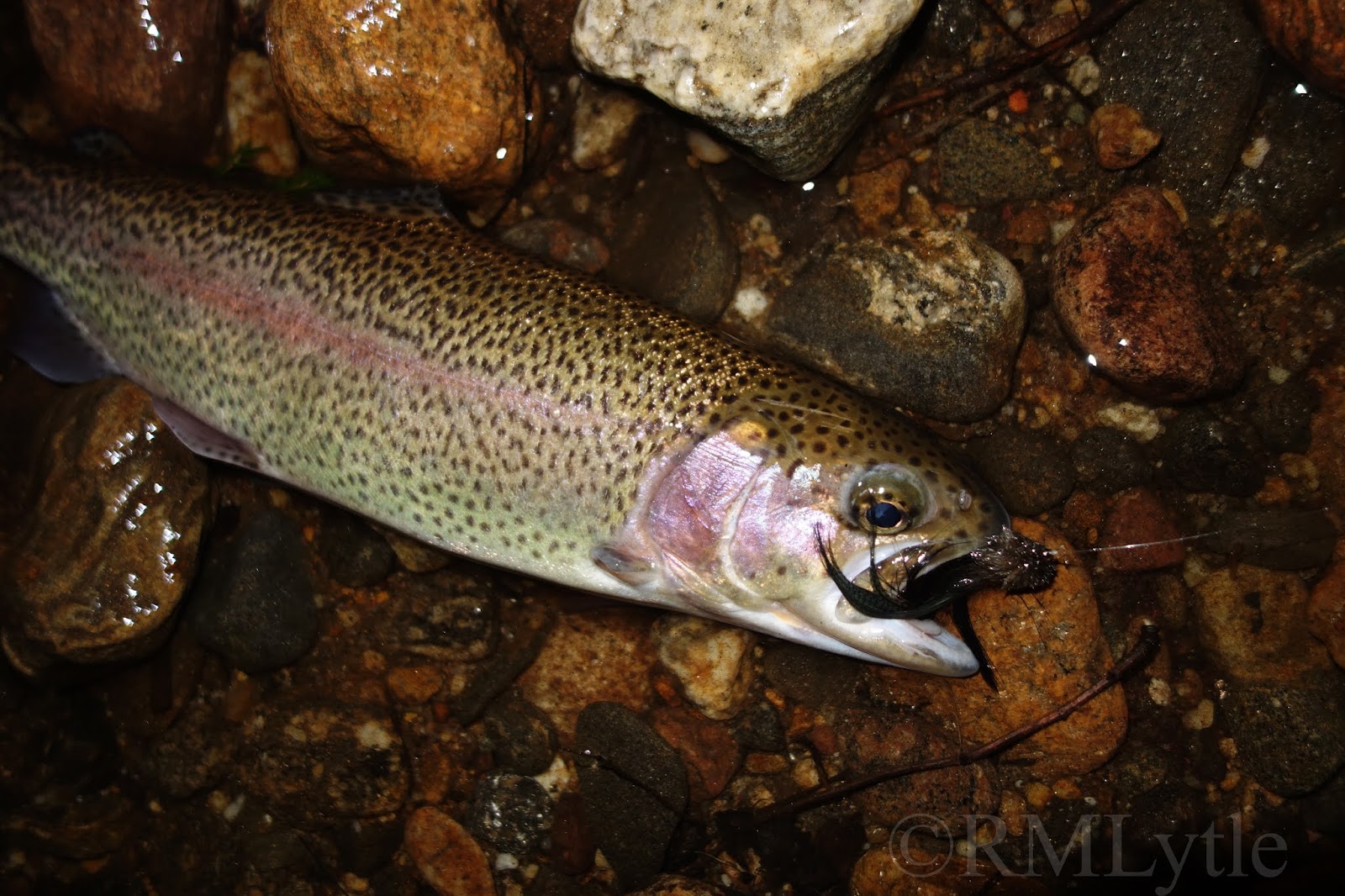
Unfortunately, that's how my winter night trout season is going to end. With a big, ugly, 3rd time recapture broodstock rainbow. I wish I could have devoted more time to night fishing wild trout water this winter, but what little is close enough for me to visit regularly doesn't lend itself to safe or productive winter night fishing. It's all small, fast flowing, bouldery freestones. Next winter I'm committed to catching some wild browns at night, I don't care what size they are. 
Until next time,
Fish for the love of fish.
Fish for the love of places fish live.
Fish for you.

Thank you to my Patrons; Erin, David, John, Elizabeth, Brandon, Christopher, Shawn, Mike, Sara, Leo, and Franky for supporting this blog on Patreon.

Thursday, February 20, 2020

In the Dark Again

Clouds and cold fog obscure any light that may otherwise reach the river at 11:00pm in February. Some things can still be seen, especially in my peripheral vision. But this is probably the darkest night I've ever fished in the when there weren't leaves on the trees and over my head. Being under the forest canopy on a clear, moonless summer night can be unnerving, so dark you could literally walk into a tree without any visual cue that it was there at all. In winter though even the darkest night is only so dark. And typically clouds reflect the artificial light and brighten things up substantially, so it was the fog that made this night so special. The perfectly dark winter night. 

On paper, it could potentially have been the best winter nigh fishing session I'd had yet. Dark is normally good in night fishing. But in retrospect, it was never going to be that good. The air was warm but the water was the coldest I'd fished all winter, and the river wasn't high but it was high enough to be a pain. And it just didn't feel right, perhaps the most important factor of the least important factors. 

But I didn't skunk. Working a deep bucket that has been a reliable spot this winter, and was previously reliable in early spring other years, I got more than one take. I was fishing a Bad Mother and a black leach. I wasn't sure which was getting taken, but more than once, after I'd dropped the flies into the top of the bucket and slowly lead them through it with the rod raised high, I felt a distinct thump. Eventually I managed to set the hook, sending a tiny stocker rainbow into the air. 


This wasn't going to be "the night". I'm still waiting for "the night". But I was fishing for trout in the dark again in February, and had continued my winter night skunk-free trend. That's not something many people can lay claim to.
Until next time,
Fish for the love of fish.
Fish for the love of places fish live.
Fish for you.

Thank you to my Patrons; Erin, David, John, Elizabeth, Brandon, Christopher, Shawn, Mike, Sara, Leo, and Franky for supporting this blog on Patreon.

Wednesday, February 5, 2020

February Nights

This is the winter that wasn't. I made the commitment before it started that I'd night fish for trout at least once each month. I feel I was given an unfair advantage. I was expecting to have to deal with ice in the guides and completely unwilling fish, instead I've been ale to find nights that have been almost comfortable to fish in and trout that were willing to feed in the dark.


These are fall stocked rainbows I'm fishing over primarily, so in terms of learning things that I can transpose to wild trout fisheries I'm not sure I've got anything. But night fishing for trout is notably erratic anyway, with differences river to river and sometimes pool to pool that don't seem to correlate to anything in particular. For example, I've found that pools that fish well in the summer don't always fish well in the summer, but not for any good reason so far as I can tell. One deep bend pool I've fished in both seasons now never fished well in summer but has produced a fish or two each visit this winter. Another bend pool that is almost identical in size, depth, and structure though fishes really well in the spring and summer, and has had fish in all winter, but I haven't caught a one on any of my night visits. Why? All factors taken into consideration, I see nothing different enough to stand out as a cause. 


So basically, what I'm learning about winter night fishing is most applicable to this river system, these trout, this year, and may not extend that well into many areas. But I don't think it's completely useless, because at least some of it is corroborated by the observations other skilled night fisherman I know fishing for wild trout in other parts of the country. So, I'll lay it out point by point. 

1: Insect imitations, be the stonefly nymphs or wetflies, have come up short, while streamers have taken the lion's share of the fish. This may be because even in the winter, small baitfish are more apt to be out and about at night than during the day. Equally possible, it may be that a larger profile fly like a size 2 black Muddler draws an opportunistic strike while a size 6 Professor or Leadwing Coachman doesn't even get noticed.

Not for lack of trying. 
2: Fish don't push up shallow in the winter. During the summer, with the exception of stretches of river that are bathed in artificial light or on full moon nights, trout typically move into shallow water to feed after dark rather than staying in the deeper, faster water they were feeding or resting in during the day. This seems very much not the case during the winter, everywhere I've caught fish they've been exactly where they were in daylight. I'm having to present my flies differently because of this, and the obvious sluggishness of the fish has forced me to include two and sometimes three split shot in my rig, along with weighted flies. More than a few fishing have taken the fly skittering on the bottom in more than five feet of water. During "normal" night fishing season, I do fish this way sometimes, but it is usually a last resort strategy. 


3: I do a hand-twist or figure eight retrieve in a lot of situations year round night fishing, and that SUCKS in the winter. It soaks your hand, you can't avoid it. Bring a towel to dry off, always. 

4: Zero surface activity of any kind. Throwing mice is pointless. This isn't at all surprising, mice are in their nests staying warm, frogs are in hibernation, and there aren't any big insects around. Though I've caught stocked trout on mice at night in March before, they were fresh stockers that were willing to eat mice during the day as well. If it isn't a time of year when there are small swimming animals and big insect for your trout to key on and you can't get them to eat a mouse during the day don't bother trying after dark. 

That's that. February trout at night in Connecticut. Is anybody else out there doing it? Honestly, even during the traditional night season, the only river I've seen other night fisherman out is the Farmington. For all the press and social media buzz mousing has gotten in recent years there really aren't that many anglers out there night fishing for trout. I know why: night trout fishing is crazy. You have to be totally obsessive to actually get remotely good at night fishing for trout. You have to have your priorities and expectations in line, your whits about you, no fear of the things that lurk in the dark, and more then a dash of insanity. How insane am I? The most exiting thing to me in the three nights I've fished already this month was having a white sucker slam my fly and fight like an absolute madman, running upstream past me in shallow water making a roostertail as it went. That was really cool to me. But maybe I'm the sane one, the prejudice against suckers makes no sense.


Until next time.
Fish for the love of fish.
Fish for the love of places fish live.
Fish for you.

Thank you to my Patrons; Erin, David, John, Elizabeth, Brandon, Christopher, Shawn, Mike, Sara, Leo, and Franky for supporting this blog on Patreon.

Monday, February 3, 2020

Resolving

If you didn't read my New Year's resolution post, here it is: Fishing Resolutions. Read that before you continue on.

I think I've been doing pretty well following up on my resolutions. I've been regularly fishing a lot of home waters I hadn't been for a while, and I've been find that there are plenty of fish to be had in them, be they trout or other species. I'm also honing my skills with methods I wasn't as adept at. I may not have been able to make good on my resolution so early in the year if this weren't such a mild winter, a lot of these streams lock up to an extreme extent under the influences of the normal New England cold blast. But I'll take what I'm given, I've fished more hours this winter so far than any other.


Aside from finding fall-stocked rainbows in unexpected places them, I've also found a fair number of browns that have held over from the spring stocking. The hope exists to find a wild brown or brook trout, but the truth is the last time I caught a wild brown trout in any of these streams was 2013 and the last time I caught a wild brook trout was 2017. But I'll keep hunting and hoping.


The lack of brookies doesn't mean I'm not catching native species though. I've been locating the wintering holes where fallfish, common shiners, and white suckers are residing. These are fish I've had an exceptionally hard time locating in these rivers from late fall through mid spring, so it's a good thing I'm on this mission. Though I haven't caught the white suckers yet, at least not during the day (to be further explained soon), I'm hoping my dedication to nymphing will get me some. I have a lot of friends that nymph far more than I do and they catch suckers incidentally more than I as well. I catch them on purpose during the spawning run and in specific spots I can sight fish to them, but I don't get them incidentally as much as I'd like. Here's hoping this endeavor changes that.


The fish of the day was a native species, actually. I was fishing one of those deep, dark holes where legend has it the biggest trout in the river lives when instead of a beastly salmonid following my jig streamer, I saw something decidedly skinny but infinitely more menacing in attitude hot on its tail. Soon I had the first pickerel of the year at hand. I was all smiles after that.


How are your fishing resolutions coming along? 

Until next time.
Fish for the love of fish.
Fish for the love of places fish live.
Fish for you.

Thank you to my Patrons; Erin, David, John, Elizabeth, Brandon, Christopher, Shawn, Mike, Sara, and Leo for supporting this blog on Patreon.

Saturday, January 18, 2020

Night Fisherman of All Seasons

For most, night fishing for trout is a seasonal pursuit. During the months of July and August especially, fly fisherman set out after dark convinced any given night could produce the biggest fish of their life. A smaller number of anglers though see night fishing differently. Regardless of season, if the conditions look even half decent, if there's any chance of catching even one trout of any size, we feel the pull. I have to go. A front approaches in January. On the night of the 11th, conditions align. At the ground, the air is still. Thousands of feet overhead, the clouds fly over at a blistering pace, lit up by a big bright moon. Up there it is not calm at all. A finger of unseasonably warm air reaches the northeast. The rivers are low enough, and though the water temperatures have not yet climbed out of the 30's, the low this night is in the mid 40's. I feel the pull.


I'd fished colder nights and come out on top, but this was slightly uncharted territory. I'd night fished for trout in January but never where I would be this night. My plan was clear none the less. There would be no fishing mice or poppers, or big streamers. Tightlining small streamers and nymphs was the plan. The fly I chose to start with, my all time favorite for nocturnal trout: a black bunny leech. Mousing may be all the rage, but give me a black leach any night and I will make something good happen. The black leech accounts for the largest trout of my life and hundreds more fish than I've caught on top. Tightlining at night poses its own challenges, but the rewards are high. Odd though it may seem, I've had far more violent and heart stopping takes on a tightlined leech than on a big rodent, which is typically pretty nonchalant. If you've ever seen a 20 inch brown take a hendrickson dun, you get the idea. It's often just like that when a brown eats a mouse.

When that heart stopping massive thump that buckles the rod comes in at 9:30 pm on January 11th in CT... well that's just awesome. Three hours and only the one take. I made the connection though.


You see, for me night fishing isn't about catching the biggest trout of my life. Perhaps it's too easy to say that seeing that it has already come to fruition, but I would have said the same thing before. Night fishing for trout is about challenging these fish on a different front. I want to know enough about their behavior and how conditions effect their feeding to be able to go out and catch a trout at any time of day or night any day of the year, or at least rule out the times when it isn't possible. That might mean I'm out there many nights getting cold and catching nothing. I'm okay with that. This is a game I adore.
Until next time.
Fish for the love of fish.
Fish for the love of places fish live.
Fish for you.


Thank you to my Patrons; Erin, David, John, Elizabeth, Brandon, Christopher, Shawn, Mike, Sara, an Leo for supporting this blog on Patreon.

Friday, January 10, 2020

The Mystery Fish


Swinging streamers has never been much my style. Part of that is to do with the species I have easy access to. I suspect if I were very frequently fishing for salmon and steelhead I'd be swinging flies much more often, but it is my opinion an experience that a down and across swinging streamer for the trout in the waters I fish is one of the least effective methods of presenting a meaty fly an getting trout to pounce on it. I'm far more inclined to present a streamer up and across with a fast retrieve when fish are aggressive, or straight up with a slow retrieve for less active fish, even dead drifting tight lined or under an indicator for the most lethargic trout. But I've realized that whether swinging is the most effective method of presenting a streamer to my trout around here or not, by not practicing on them I'm setting myself up for failure when I actually do get to go swing flies for Atlantic or Pacific salmon or steelhead. I do practice with my spey rod, here an there, very infrequently, but not enough to have a rhythm, for my cast to be automatic, or for me to know exactly what my fly is doing in the water on each swing. So practice I must, and I'm taking every opportunity to fish big water I can to do so. When my good friend Joe asked if I wanted to join him an our mutual friend Dan and suggested the Farmington, I said yes quickly. Mostly because I hadn't fished with them for far too long, but also because it would be an excellent chance to swing flies on water I've fished a lot but never applied the technique to. It was a brutally windy day, and the fishing was slow. But it was great to be out there with those guys on the river, feeling manly because we were some of the only people tough or crazy enough to be there in those conditions (Here's to Dave Machowski and the handful of other nuts that were out there in that shit with us, cheers! *clink*).


Though the fish weren't on fire, Dan an I pulled on a few. I missed some really solid grabs and caught two small fish, one a survivor strain with a red elastomer. Dan got the best fish of the day, one right about 20 inches, and lost a slob. Joe skunked out, which is surprising because typically in the winter I'm the one skunking when I fish the Farmington in the winter.

Photo Courtesy Joseph Apanowith, taken by Dan Allegue
The highlight of the day for me was seeing a trio of otters, who seemed just as surprised to see me out fishing on such a day as I was them. All three would dive and pop back up staring at me in tandem. It was really amusing and had me laughing aloud. 


In more comfortable conditions the next day I was out swinging again closer to home. On the Farmington I'd been fishing quite large intruder style flies, but I switched to smaller stuff to fish near home and it proved to be effective enough on the dumb ones.


After covering water I knew had fish, I moved upriver to water I was fairly confident wouldn't have anything but was a classic run to swing. I started at the top, made two swing, took a step, and continued that rhythm until I reached the bottom. I never felt a thing to make me think I'd touched a fish during that work through.


When I got to the end of the tailout I retrieved, grabbed my leader, an then noticed something on my fly. On closer inspection, it turned out to be two somethings. Two scales, actually. At some point while I fished that stretch of water, I had indeed made contact with some sort of mystery fish without ever noticing it. In a run I'd typically write off as a likely spot to catch a winter fish, something as simple as two scales on a hook changed my understanding of how this river I'd fished for more than 10 years could fish in the winter. I will be back for that mystery fish. I have to catch it, whatever it is.


Until next time.
Fish for the love of fish.
Fish for the love of places fish live.
Fish for you.


Thank you to my Patrons; Erin, David, John, Elizabeth, Brandon, Christopher, Shawn, Mike, and Sara for supporting this blog on Patreon.

Tuesday, January 7, 2020

Fishing Resolutions

I'm not really one for New Years' resolutions in general, but I am a very goal-oriented fisherman so I always set my sights high for what I want to achieve each year. I don't always reach my goals in time, which is fine; if you set your sights low enough that every goal gets achieved in short order you aren't really gaining much. I wanted to reach fish #150 on my lifelist in 2019, I was 7 short. I'm not setting a lifelist goal this year, though there are a bunch of species I am bound and determined to finally catch this year that have been evading me. Banded sunfish, goldfish, and lake trout are at the top of that list. I have plans for each. A non-fly centric goal I have for 2020 is to catch a big shark or ray from the beach in CT. It doesn't matter what species, it just has to be over 100lbs; more ideally something bigger than me. I'd like another shark on the fly as well, and I don't care where that occurs. It's been bugging me that the only shark I ever caught on the fly I was too much of a chicken to handle and photograph.

Perhaps my biggest fishing resolution for 2020 though is a multi-parter and something I've already been doing. I'm going to fish some of my home fisheries that I have lost touch with over the years. My local smallmouth and largemouth bass really haven't seen a whole lot of me lately, especially at certain times of year. Some of the stocked trout rivers I used to fish regularly have fallen out of favor. There are also places I've just never put time into at certain times of year. I know I've been missing out on some things, and I've fallen into a bit of a boring rhythm. I need to explore more, even the places I've already been too. That ties well into the second part and that is using methods on these waters that I never really have to any significant extent. That means mono rigging streamers, mono rigging inline spinners (not a joke), indicator nymphing, swinging a team of wets, spey casting, float and fly for bass and panfish, deep lake structure with small streamers on sinking line... I've chosen these methods because I know they represent significant gaps in my skill set, and because they are likely to teach me new things and catch me new fish on the waters I've been fishing for years. Like I already said, I've gotten a head starter on this multi-faceted resolution this year. It may not have worked out as well as it has were this not an abnormal winter in Southern New England. Many winters some of these local waters wouldn't even be fishable this time of year. But I'm also quickly learning that I was definitely missing out on some fast fishing some of the other warm winter spells. I've mostly ignored most of the larger local trout rivers from mid December until April. I never really put in the time to find the good wintering holes, or just explore likely water well away from the stocking locations where some fish could have wandered away to after being stocked in the fall. More so, I've always known there were places that had potential to have holdovers from the spring stocking and even possibly some big rogue wild or multi-year holdover fish. Not to mention big white suckers, fallfish, and smallmouth that I've always had a hard time finding in the winter. Those are the real end game this winter, the fall stockies I've already got down pat, though I am finding them in some cool spots I wouldn't have expected well away from where they get stocked.


Indicator nymphing and spey casting had been the primary methods thus far, and I actually did some nymphing on my 11ft 8wt two hander for the sake of practice for a trip to Pulaski that ended up getting canceled. I am confident though that I will get up there this winter and hopefully catch my first steelhead. But for now, I've tormented plenty of dumb planter rainbows  this winter (like, a couple hundred already) and odds are I'm going to torment plenty more. Indicator nymphing has been the productive method, I've yet to pull of a fish on the swing this winter locally, though I've ha some grabs.


But I have also found some of the more interesting things I've been seeking, including a fallfish an common shiner hole. I've always had a little bit of trouble finding viable winter spots for these species really close to home. I don't have to go that far to find them really, but I'd never found a winter fallfish spot I can just walk or bike to until now. This is good, I have a viable bait catching spot in case we ever have fishable ice in these parts again.

Semotilus corporalis

Luxilus cornutus
I found holdovers as well, and its all the easier to tell in these water because DEEP only stocks rainbows in the fall and not only did I catch rainbows that very clearly had been in the river a long time (skinny body, big head), but I also caught brown trout. Some of these waters used to produce the odd wild fish, but that's going back to my very early days in fly fishing an I haven't caught a wild brown trout in them in years. Part of that may well just be because I haven't been fishing them that hard but I would say there are definitely fewer than there once were. That is a sad thing.


I wish all of you the grit and determination to accomplish your own resolutions. Fish long, fish hard, fish smart. We're only six days into 2020, but I've fished all of them. Will tomorrow be the first skunking? It has the working of possibly being one, but it going to be a fun day regardless. But that's a story for another day. 
Until next time.
Fish for the love of fish.
Fish for the love of places fish live.
Fish for you.


Thank you to my Patrons; Erin, David, John, Elizabeth, Brandon, Christopher, Shawn, Mike, and Sara for supporting this blog on Patreon.