Monday, December 21, 2020

A Hike Through Rattlesnake Country

This is an entirely fishless post, but I hope you will all enjoy it. 

Back in September, my friend and mentor Bruce and I took a strenuous hike through an important piece of Northeast timber rattlesnake habitat. 

I've been observing timer rattlesnakes in Connecticut since either 2012 or 2013; I can't remember which year I saw my first, but I can remember the moment like it was yesterday. I was with my Dad and my brother, out doing photography in the woods, and my dad saw it first. It was, as I now understand, a large gravid female yellow phase. She was half tucked under a rock, but we could see enough to get a more than strong enough impression of her magnificence. I can't put into words what it's like to see your first timber rattlesnake -especially if you are keenly intrigued by the natural world- it's shocking. Jaw dropping. Eye widening. 

I needed to see more. And upon next returning to that exact spot, I did. I had no idea at the time but that little outcropping happened to be an important summer brooding area, and my next visit, a year later, was at exactly the right time. I walked up to the spot to see not just one or two snakes, but seven adult timber rattlesnakes distributed around the place. My prior awe was taken to a new level and I was hooked. I kept going back to that spot over the years and usually saw a timber or two. Then, last year, on my first visit to that spot, I met Bruce. I think we were both a little suspicious of each other at first, certainly him more so of me. But we hit it off pretty quickly. We are cut from a very similar cloth, Bruce and I. We go about observing wildlife with the same intent, drive, and care. And I think we both care more about these snakes than we do ourselves. I measure my own worth in my ability to preserve and protect these animals. If I leave the world without having done everything possible to make sure timber rattlesnakes are still in the CT hills, I've gone wrong somewhere along the line. Bruce and I are both very protective of these snakes and their habitat, suspicious of any human activity around them, and weary of our own impacts. We are also driven to see them and learn as much as we can, and that was our intent on that calm, warm September day. Neither of us had hiked the habitat before. We sought to add to our body of knowledge and experience.

We weren't there specifically for rattlesnakes, actually. Our goals were more broad. This same habitat was shared by a number of other species we were interested in seeing. However, the first snake found more than an hour in to the trip, was something neither of us expected. I walked int a clearing to see Bruce looking down into a blueberry bush, saying "that is not what I expected to see up here". I walked over and looked into the same bush. There coiled off the ground in the branches was a beautiful ribbon snake. Ribbon snakes are a very wetland oriented species. Up here; at least a mile from the nearest large vernal pool on a high dry mountaintop ledge; this species was a very surprising sight. 

It's things like this that keep me obsessed. I may never know what exactly had drawn that snake to that spot. But it was there, coiled in the branches, suspended off the ground, doing what I'd seen ribbon snakes do before. Just over a ledge instead of over the edge of a wetland. 


We continued our search, hoping from ledge to ledge, looking around rocks and logs, in blueberry bushes, next to stumps... it was tiresome and not as fruitful as we might have hoped, but eventually I heard Bruce call out, headed over to where he was and he'd found a beautiful adult timber. It was nestled next to a cover rock with a load of fallen limbs making photography very difficult, but no encounter with a healthy timber rattlesnake ends without me smiling. 


Seeing that snake really got our hopes up, we thought we'd soon find some others. This was new land to us though, and even on our home territories we'd both had a very difficult time this year. The harsh, dry, often very hot conditions had made snakes shyer than they may otherwise have been. It's hard to see a rattlesnake that's hiding under a 500lb rock, and that is very often what they were doing. So the situation was against us. We again went a while without seeing a thing when I just happened to glance down at a hanging slab of granite below me and saw a small rattlesnake perched in the leaf litter next to it. Not only was it one of the cleanest, most stunningly patterned and colored timbers I've ever seen but it was completely relaxed and perched fabulously. It was the perfect photography snake. The pictures I took of this young timber are among my favorite photos I've ever taken. 


That was the last rattlesnake we saw on that mountain that day. It wasn't one of those incredible but very possible days where we could see fifteen or more adult rattlesnakes on just one hill, we've both had days like that. But it was exceptionally thrilling to see the snakes we did see, especially being that it was a population we'd not been to before. 

With snow now on the ground, by mind drifts to days past and days future, but even with the snakes all now in their wintering dens I can't help it. I've been spotting ledges through the woods from the road, planning trips for next year, and even walking habitat to get the lay of the land. I'm obsessed with snakes. I have been since before I can remember. I'm just so thrilled now to have the chance to go see wild snakes on the regular. 


*Timber rattlesnakes are a protected species in every Northeast state, and are endangered in CT. Killing or harming one is illegal. Possessing one is illegal. Even trespassing on some den locations is illegal. If you are so lucky as to observe a timber rattlesnake in the wild, maintain a distance of about 10 feet, try to disturb the snake as little as possible, and do not share the location of the sighting with anyone except CT DEEP. Poaching and black market pet trade are one of if not the largest threats to CT's rattlesnakes today. The fewer people know where these animals are the better. 

 Fish for the love of fish.
Fish for the love of places fish live.
Fish for you.
And stay safe and healthy.


Thank you to my Patrons; Erin, David, John, Elizabeth, Brandon, Christopher, Shawn, Mike, Sara, Leo, C, Franky, and Geof for making Connecticut Fly Angler possible. If you want to support this blog, look for the Patreon link at the top of the right side-bar in web version. 

Thursday, December 17, 2020

More Salmon on the Mickey Finn

 My mission to get a CT Atlantic salmon on a dry this season fell quite short of the goal. On my second outing targeting broodstock salmon and unfortunately the last day I had good conditions for fishing dries, I put in a solid effort for about an hour and only moved one fish that I'm not sure was even a salmon before I gave up and tied on a Cascade. Sometimes I like dictating the day's fishing style; but I know I can't impose my will on the fish; and I do still like to catch. After all I could count on my finger the number of broodstock salmon I'd ever caught. I was determined not to have this be a season where I only caught fish on one day, as every year prior that had been the case. One and done. Eventually I moved a fish with the Cascade. It was a great surface strike but I was sure the fish felt something and I missed it. I gave the fish a rest and switched to the ever productive early season fly, the Mickey Finn. It chased on the next cast. I rested it again. The next time it hammered the fly in a spectacularly visual surface eat and I hooked it solidly. The ensuing fight was pretty damn good. A couple substantial runs, a bunch of jumps... even these hatchery fish can put on a heck of a show.


I continued down the pool and through the next run, moved one more fish that just wouldn't commit, then headed back upriver to hit a tight little spot I'd skipped over before I headed out. Just in case. Sure enough there was a salmon there and she took the Mickey Finn. This one was quite lovely, a lot more chrome compared to those I'd caught before and had better condition fins. It took out all it's energy jumping and it was a very short fight. 


I can't tell you how badly I wish we had wild sea run Atlantics in CT or even just a fishable run in Maine still. At least there are wild landlocked salmon there, but I want big, chrome fish that still have a couple sea lice on them, that make it into backing and sound like a small child landing in the water when the splash down from their high jumps. It is so frustrating to watch as wild salmon stocks world-wide plummet while I haven't the financial means to get to them while some are still good. 

Wait for me, salmon. Please.

 Fish for the love of fish.
Fish for the love of places fish live.
Fish for you.
And stay safe and healthy.


Thank you to my Patrons; Erin, David, John, Elizabeth, Brandon, Christopher, Shawn, Mike, Sara, Leo, C, Franky, and Geof for making Connecticut Fly Angler possible. If you want to support this blog, look for the Patreon link at the top of the right side-bar in web version. 

Tuesday, December 15, 2020

Big Bait, Big Flies, Small Stripers

 This November and December have been highlighted by the largest biomass of adult menhaden I've ever seen locally. They were everywhere: tidal creeks were packed bank to bank, flats had roving schools, and there seemed to be a continuous unbroken line of menhaden from the Connecticut River to City Island. 

One would think that with so much big bait around there'd be loads of predator fish on it.               Nope.                                                                                                                                                       We don't have big stripers and big bluefish anymore, not enough to make something spectacular happen with so much adult bunker. There is definitely such a thing as too much bunkah. Now, if there'd been an equivalent mass of juvenile bunker around that long, there'd have never been no end to the schoolie blitzes. Those bunker are still here, actually, at least those the cold snaps haven't yet killed. I was out this Sunday and had thousands in front of me. There were also many that were dead and dying. It's unfortunate that so many menhaden seem to have gotten stuck in many of the warmer backwaters to die as it just gets colder and colder. The repetitive record breaking warm spells encouraged so many of them to overstay, the ocean temperatures are now colder than the mud flats so there is no escape. 


Oh how I wish those were bluefish tails.

On only two days was I so lucky as to find anything eating the bunker. One day, they were out of range, bass and maybe blues pushing them. I stopped and parked just to watch, I'd seen the blitz from the road. Little did I know I was missing a better show to my East: a couple humpback whales had found a school of bunker and were getting their fill. 

A few days later I returned to the same area and this time found nervous bunker in tighter to the shore. I ran back to the car to gear up, heart pounding. Menhaden are huge baitfish and and usually if bass are on them, they aren't little schoolies. I tied on a long Slammer, but even that wasn't as at all as large as many of these menhaden. 


With the bait so nervous, I was sure I'd soon see some large splashes or boils. Indeed I did, and there were clearly a number of large stripers visibly working the school.


I wanted my fly to stand out and look easy to catch, so I worked it with a very slow steady two hand retrieve and the occasional quick short burst. This drew strikes, but not from the 45 inch bunker filled cows I was hoping for. How sub-20 inch striper thinks a 10 inch long Slammer is small enough to snack on I do not know. I caught a number of them. It was certainly better than nothing, but my hopes for just on big surf bass in the 2020 season were crushed as they had already been many times. 


Regardless, it was very nice to see some stripers on the adult bunker even though it should have been happening much more often this season. Big bait and big predators is a very exciting dynamic for obvious reasons. Hopefully the fishery will return to it's former glory so more anglers can experience such things, myself included. It's up to us to be good stewards of the species as well as the habitat and food sources they require. Stop eating stripers if you still do, don't use fish oil products mad from menhaden oil, and limit your impact by using barbless single hooks and intentionally catching fewer fish than you could.


 Fish for the love of fish.
Fish for the love of places fish live.
Fish for you.
And stay safe and healthy.


Thank you to my Patrons; Erin, David, John, Elizabeth, Brandon, Christopher, Shawn, Mike, Sara, Leo, C, Franky, and Geof for making Connecticut Fly Angler possible. 

Monday, December 14, 2020

The Great Hickory Shad Blitz of 2020

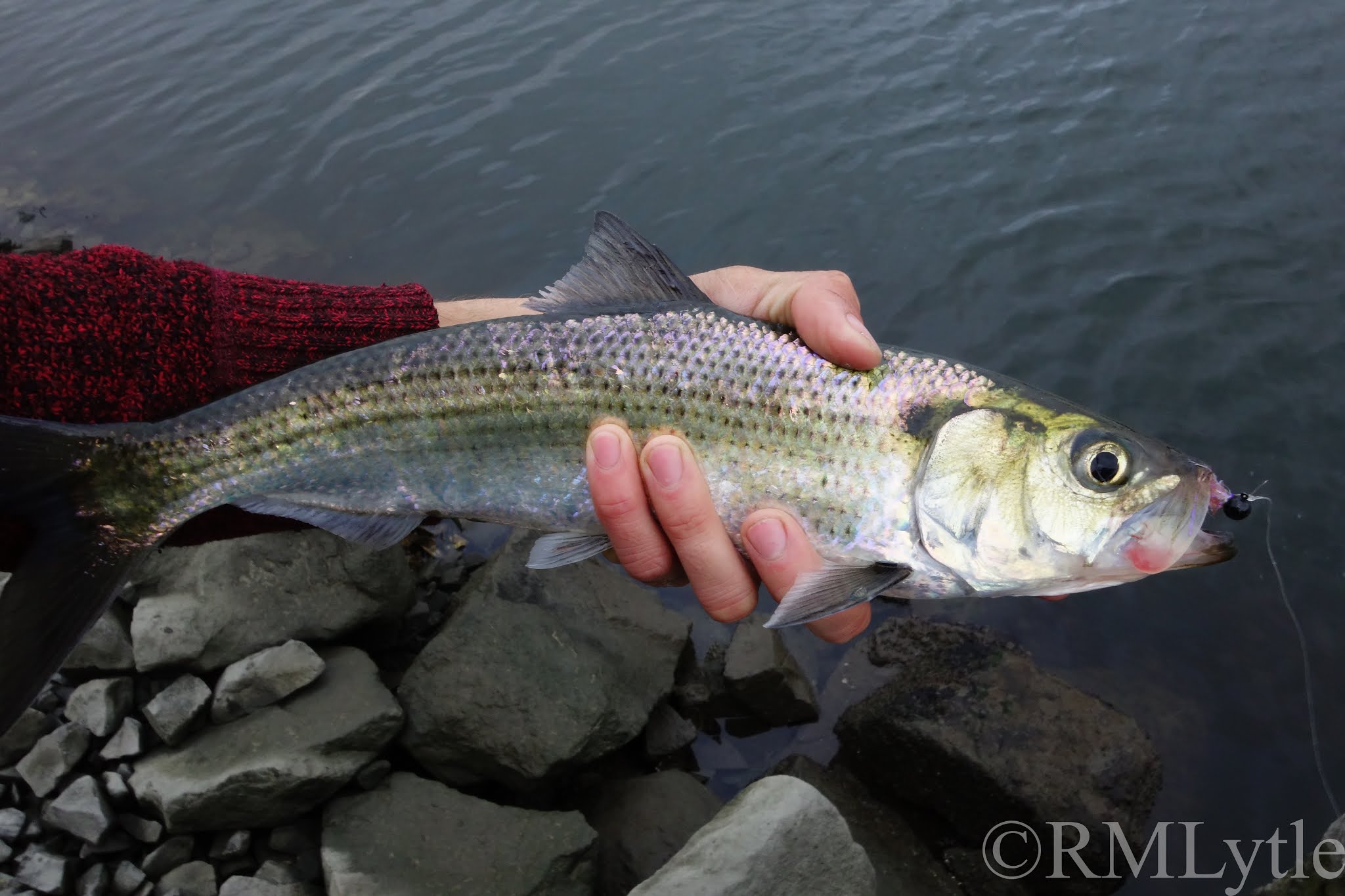
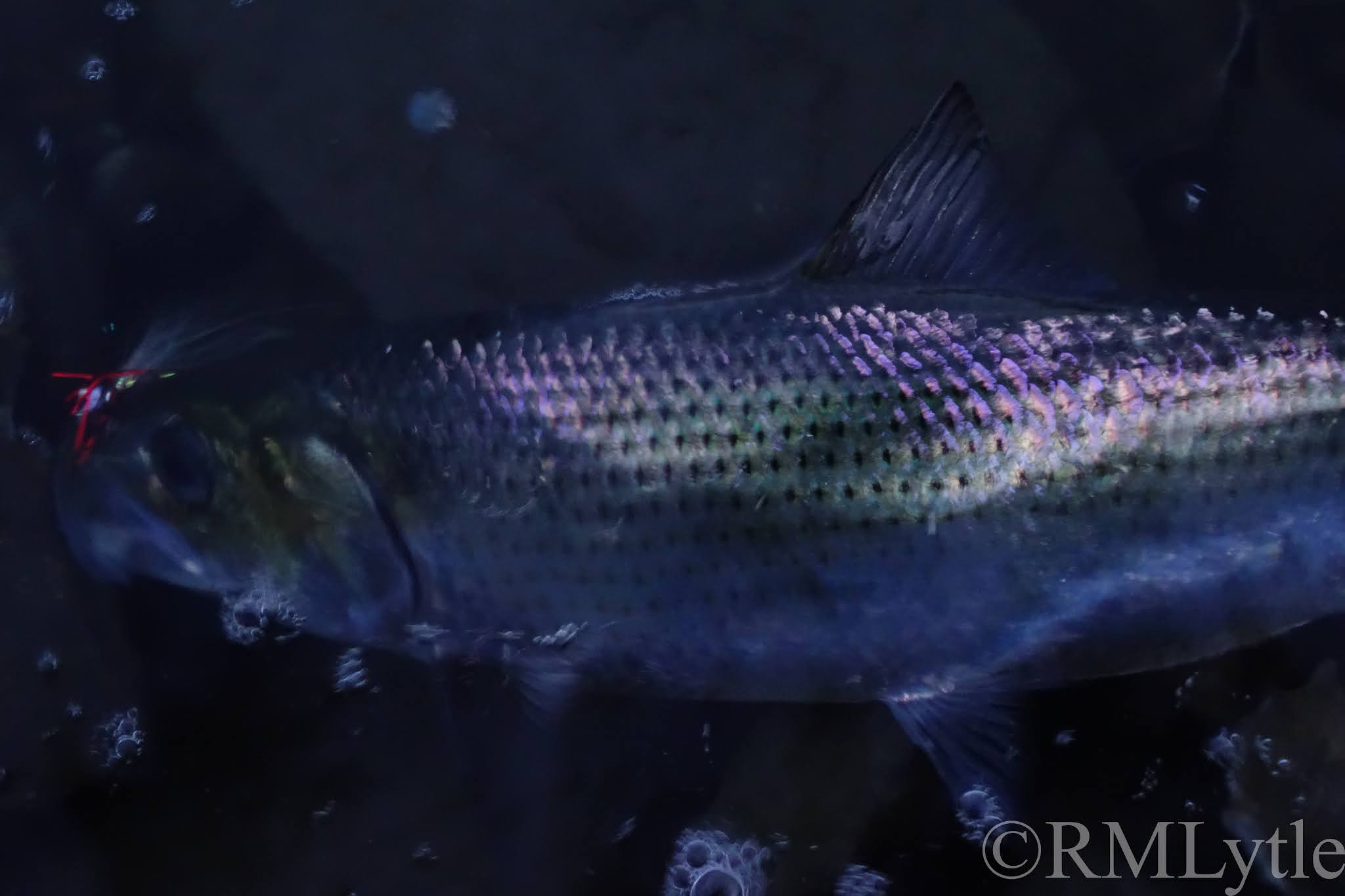
 There are many things the year 2020 could be known for. Many, many things. But in my mind, 2020 will forever be the year of the greatest hickory shad blitz in the history of Southern New England. If you are a surfcaster or saltwater fly angler and fished in the fall season of this year, you probably didn't miss it. It wasn't a one location blitz, or a single day event, but a near coast-wide event that has spanned weeks. From what I'm hearing it may still be in progress down south in New Jersey and even as far as South Carolina. It isn't really a singular event, but this year without question gave up the most stellar hickory shad fishing I've ever experienced. 

I intercepted the blitz in the final days of October on my home turf. I was fishing water I knew well, water I'd seen so much action in over the years -plenty of hickory blitzes included- but nothing like this. On the 28th I was on my own, and hickories were my first priority. That said, I started out taking quick looks at a few places that used to routinely hold big stripers in the fall. They are no longer as productive and I subsequently found little in the way of fish. I was then fully focused on shad. 

It was slow at first, not a notable blitz at all, but I was picking off some fish. Hickories battle magnificently, often being compared to baby tarpon because of their acrobatics. I've caught both, that's really not as accurate a comparison as one might think. Frankly I think fisherman are far too caught up in the idea of comparing species ("poor man's tarpon," "poor man's bonefish," "poor man's salmon") instead of just taking a fish species with it's own merits. Hickories are awesome fish and a hell of a lot of fun, that's all that matters. And though I definitely wasn't hammering them, I'd gotten 10 of them before the sun set and was pretty pleased with that.


With the sky now darkening and the little school under the bridge I'd been fishing pretty disturbed because I was catching them, I decided to make a move. I didn't go far but oftentimes a mile or two makes a huge difference. My first five casts at this new spot made it clear that something special was going on as each got at least one take and resulted in a large hickory shad to hand. That didn't change for the next hour and a half. I was catching fish continuously for the rest of my time fishing that night. It just never stopped. A swung grizzly Homer Rhode Seaducer was my the best method, though I'd started out with a Dave Bitters Baymen Clouser which was just a bit too big.


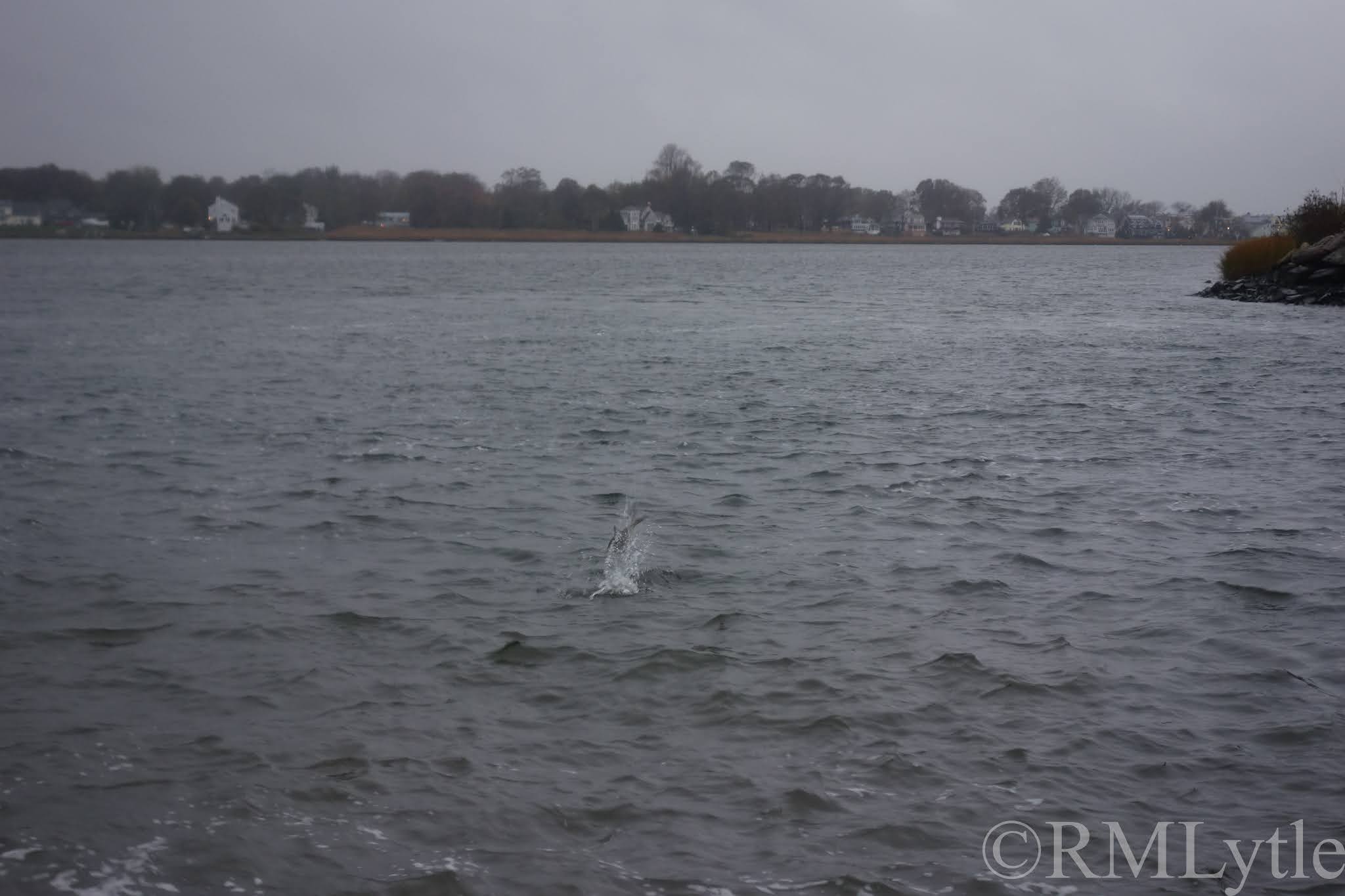
I left with the front of my waders slime and scale caked, but I wasn't satisfied. I wanted to see what I could feel and hear occurring in the darkness. The next day the conditions were different, it was warm but very rainy and windy. This time it was Noah and I. We went straight to the spot, and it was immediately clear that chaos was underway. There were hickories, there were stripers, there was bait spraying and predators swirling in the wind disturbed muddy water. We were into fish right away. The hickories were often leaping on the take, which lead to plenty of missed strikes but was so spectacular it was hard to care. They were doing this to the natural bait too, and at times you could look out over the channel and see dozens of iridescent fish leaping into the air. This was without a doubt one of the coolest things I'd seen all season. 


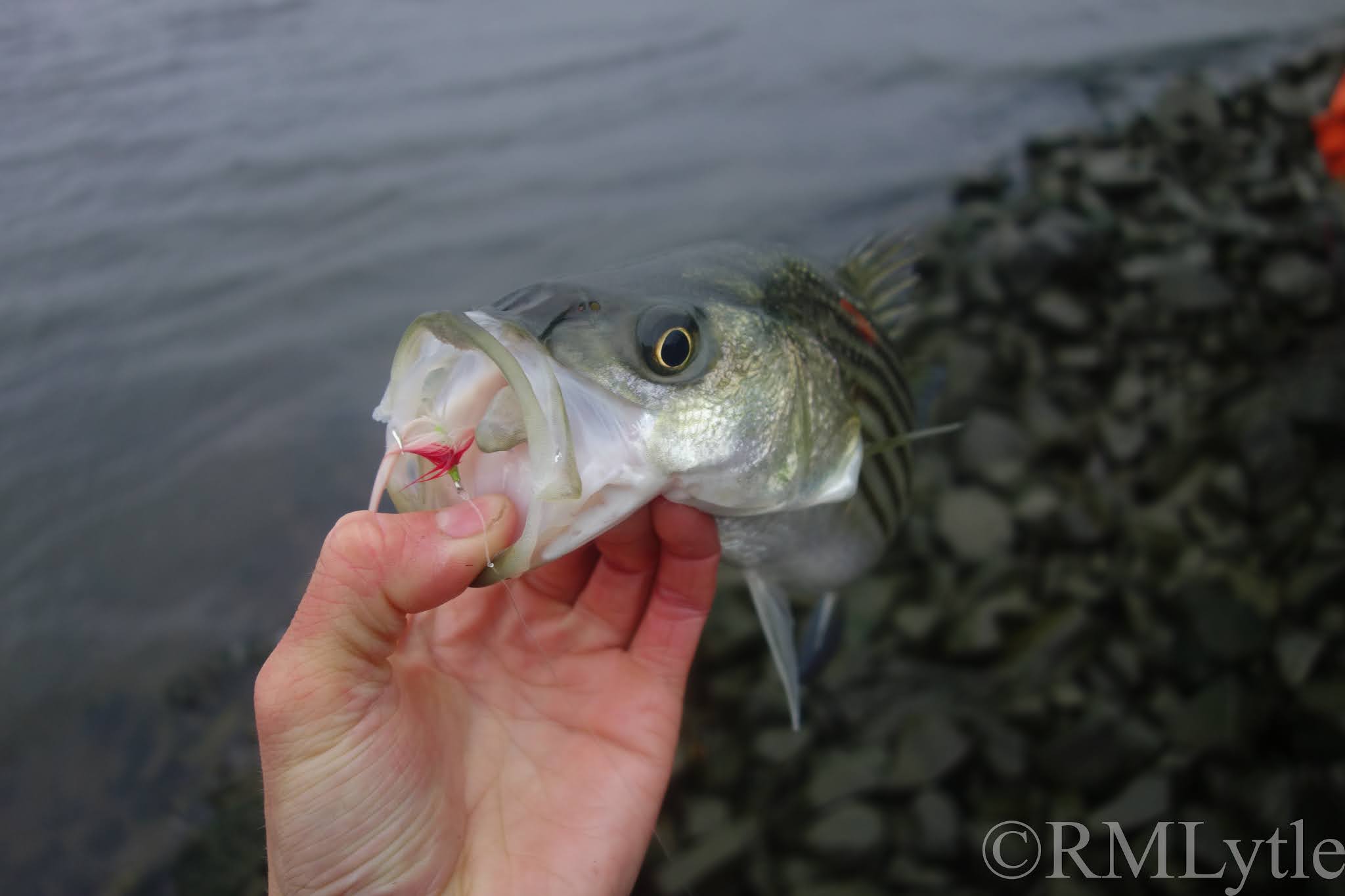
The stripers were mostly working in a pocket where wind was blowing white bait into shallow water and along a rip rap bank where some schoolies of peanut bunker were. At times they drew my attention away from the shad, and I did catch plenty of bass as well.

Seaducer in traditional colors. This simple old saltwater fly has become such a key fly in my arsenal.


I often break into my stash of black and purple redfish flies when fishing for stripers in murky water, the same sorts of flies I'd fish somewhere like Mosquito Lagoon.

Though the stripers blowing up the in the pocket were exiting, the shad were still the headliners. I had never seen so many of them. 


I rarely seek anything resembling peace in fishing but saltwater fishing especially. Even in the long, quiet nights of spring that sooth my soul after an icy winter, my greatest hope is to have a large striped bass shatter the peace completely and give me an adrenaline rush that will last days. It's days like the second of this great shad blitz that stand out. Wind and rain made simply being outside for an extended period of time uncomfortable and there was so much going on it was almost overstimulating. Noah and I were riding high on the phenomenal fishing. It was gloriously exciting chaos. Peace isn't what I seek when I'm fishing, and though I do often find it, it's the chaos that keeps me wanting more. Because damn, was that ever fun. We caught dozens of big hickories that hit and jumped like madmen and we were the only ones there experiencing that mayhem. I'd like to do that again some day. 

Fish for the love of fish.
Fish for the love of places fish live.
Fish for you.
And stay safe and healthy.


Thank you to my Patrons; Erin, David, John, Elizabeth, Brandon, Christopher, Shawn, Mike, Sara, Leo, C, Franky, and Geof for making Connecticut Fly Angler possible. 

Friday, December 11, 2020

Small Flies and Double-Handing for CT Broodstock Salmon

 The early season for CT broodstock Atlantic salmon the last few years has come with very low warm water. These conditions are less than enjoyable and prevent me from fishing for these salmon the way I really want to: traditional flies, swinging, spey casting. Though this isn't a real salmon fishery, I like to fish it like it is. About the only upside of the early season low water and warmth is the opportunity to get the fish to take a dry fly or riffle hitched wet, witch of course still falls in the bounds of classic Atlantic salmon tactics and is also very exciting. This year I was finally able to actually put time into this fishery and go at it on my own, and I badly wanted to get one on a dry. That said I also wanted to catch fish. So when I moved a small salmon twice with a Bomber, then couldn't get it to rise again even after a ten minute rest, I did what I knew would work and two hand retrieved a tiny Mickey Finn over it and the fish quickly obliged. 

Pinkie out for Salmo salar


 The fish was small but a firecracker. It spent a lot of time in the air and tried to make some runs, though it wasn't even close to heavy enough that I couldn't turn it without any fear of my 8lb tippet failing. The take was the highlight, I love when an Atlantic wakes up on a fly that on or just under the surface, and it always feels nice to come tight when two hand retrieving saltwater style. This is an underutilized method on freshwater rivers. I'd picked it's use up for broodstock salmon from my friend and experienced salmon fisherman Ben Bilello (actually my use of basically every tactic in the post should be credited to Ben) some year back and have applied it effectively on both salmon and trout since. Sometimes keeping the fly moving more or less continuously is very important. In this sort of fishing, down and across swinging for fish willing to move for the fly, it means the angler isn't relying on the pace of the current to set the speed of the swing. I can get the fly swinging fast in water it would otherwise be moving uncomfortably sluggish.

The next run down yielded no moved fish to a hitched wet, so I made another pass at it with the same little Mickey Finn. I sent another small salmon airborne there that didn't stay pinned. Later on, I moved another with the bomber before it went silent until, again, a two handed Mickey got it up and stuck. Once more it was a fantastic fighter though not at all a big fish. 


Always pinkie out.

My confidence with fine wire hook size 10-14 Mickey Finns for early season broodstock salmon is three fold. First off, red and yellow can do no wrong with these fish for the first month and a half of the short season. Second, small fine hooks are much easier to bury in a fish's mouth. Third, once they're in the fish they're more inclined to stay there. Perhaps some of this confidence originates in the first adult salmon I caught, my only true sea-run Atlantic, which was taken on a size 14 Sedgehammer. In low water the salmon are more inclined to notice and strike such a small fly, so it is a good move to take advantage of this and set your presentation apart from the crowd of big flies, spoons, and spinners these fish are being bombarded with as well as something more likely to get a good solid hookup. 

Fish for the love of fish.
Fish for the love of places fish live.
Fish for you.
And stay safe and healthy.


Thank you to my Patrons; Erin, David, John, Elizabeth, Brandon, Christopher, Shawn, Mike, Sara, Leo, C, Franky, and Geof for making Connecticut Fly Angler possible.