Saturday, April 10, 2021

High And Dirty Multispecies Nymphing

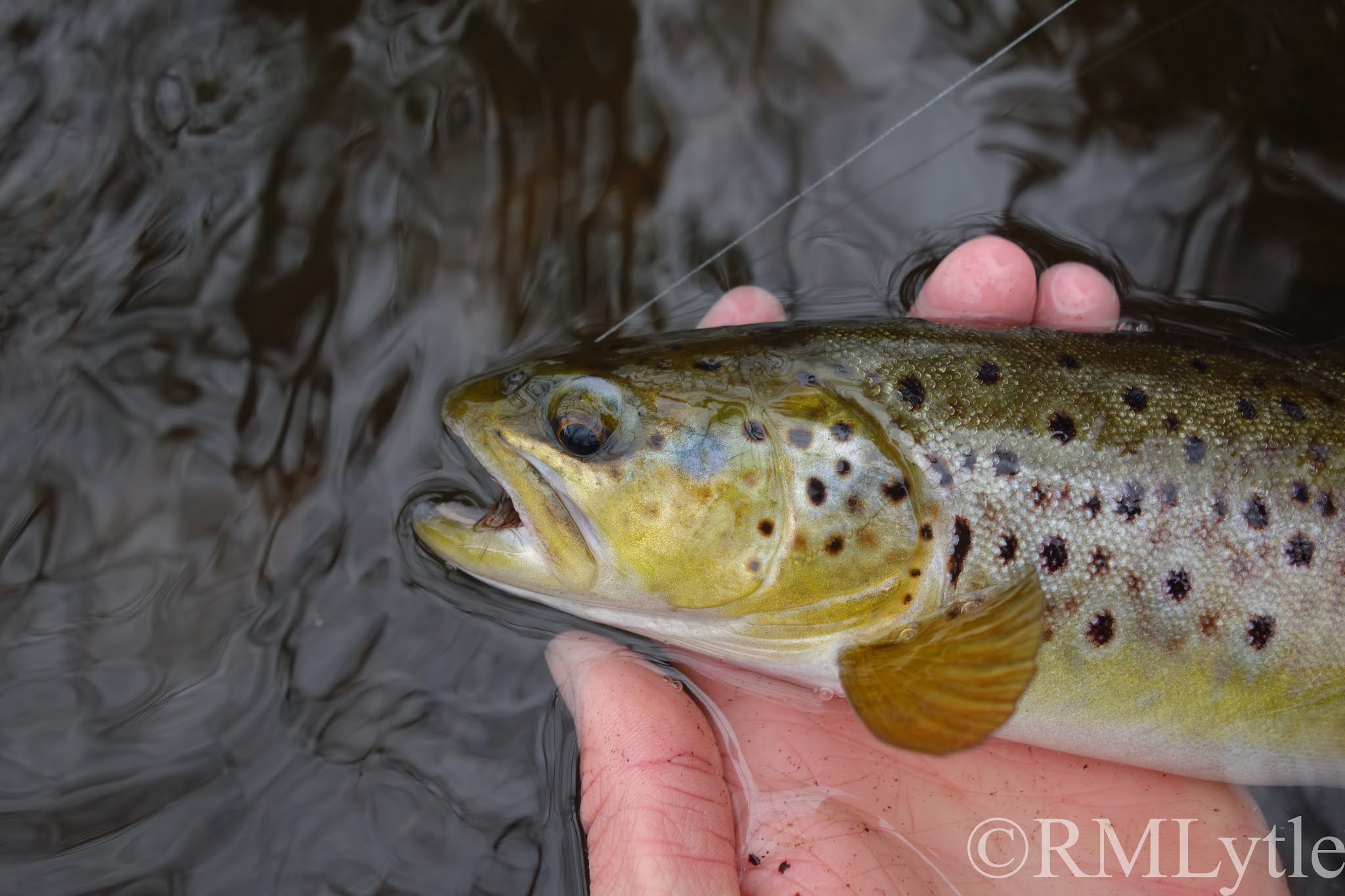
 One day this March, I bounced spot to spot on my way home from Rhode Island. I was mostly hitting new streams and looking for wild trout, but I was having a pretty tough day. I got some stocked trout at one spot, and a couple brookies in one stream I'd fished once before, but it was a struggle to get anything substantial. Then it started raining and I headed to what would be my final stop of the day. It was an upriver portion of a stream I fish a lot, but a part of it I'd never once made a cast in. Before Neil Hagstrom retired from DEEP he had recommended it to me, saying it had a good number of wild browns. 

The day had started out cloudy but by the time I got to this stream it was raining and had been for a little while. The water was severely discolored; I was going to try anyway. I tied on a heavy size 10 Ausable Ugly and began to fish. For a while, I was unsuccessful. Then I thought I had a grab but wasn't quite sure. It definitely felt like one. A few runs down I caught a fish, a wild brown. That bolstered my confidence massively. I suddenly felt this might become a productive evening. 


That fish was right along a seam where the main current of the stream met some chocolate milk colored water coming out of a drain. This is classic brown trout behavior during this sort of storm runoff. Mud lines are a key focus to a lot of my rainy day river fishing, regardless of species. Brown trout in particular though gravitate to them. As I continued downriver and the muddy water from the pipe mixed with the ever muddier water of the stream (it was still raining), it began to look un-fishable. But I don't shy away from stained water as easily as some anglers might. I was fully ready to keep fishing knowing I could well get some high caliber fish in conditions like this. 


It took a little while to get another, but that ended up being a decent fallfish. I then proceeded to catch 8 more fallfish and a brown out of the same seam before continuing downstream. I got a couple more fallfish downriver but didn't find another spot at all that productive so I hit it again on the way back up and got two more fallfish and a large white sucker. 


Those fish alone made it a pretty good bite. That whole pile of fish was stacked up towards the tailout of a very nice, defined bend run. They were in a slack behind a log. It was a classic setup. But to sweeten the pot even more, when I got back to the first spot I'd fished when I had arrived, I got a very hot 14 inch brown there. This fish was gorgeous and spent an awful lot of the fight airborne. 


This was the perfect example of a day that could have ended up being very unproductive, but wasn't entirely because it started to rain. I got soaked, smelled musty for the rest of the evening, and definitely wished I had put all of my electronics in a plastic bag, but it seemed like a pretty good use of my time. I never ignore nasty weather. 

Until next time, 

Fish for the love of fish.
Fish for the love of places fish live.
Fish for you.
And stay safe and healthy.


Thank you to my Patrons; Erin, David, John, Elizabeth, Brandon, Christopher, Shawn, Mike, Sara, Leo, C, Franky, Geof, Luke, and Noah for making Connecticut Fly Angler possible. If you want to support this blog, look for the Patreon link at the top of the right side-bar in web version. 

Edited by Cheyenne Terrien

Thursday, April 8, 2021

Salter Brook Trout: What Is, What Was, And What Still Could Be. Pt. 3

Economics

I don’t like this part, honestly. I don’t like this part because I think it loses sight of the main reason this re-zoning and development shouldn’t happen. Unfortunately, the economic side is what would most likely change the average Wareham resident’s mind about NOTOS’ rezoning proposal. As it turns out, there are a number of reasons why it would be economically smart to develop the land as it is presently zoned for single-family homes, rather than rezoning it for something that would demand much more water use and create more polluted runnoff.

First of all, any sort of large hospitality, recreation and entertainment district as NOTOS is proposing would cause increased traffic to an area currently not prepared for it. This would almost certainly demand costly infrastructural changes and improvements. One of the Wareham town board members expressed hope that the current presidential administration would be supportive of infrastructure grants, but hedging on this seems like too much of a risk.

The economic viability of developing the land as currently zoned was examined in a report by FXM Associates, and this report is what has been used as the primary determination of the economic viability of re-zoning and development. It determined substantial losses if the land were developed for single-family housing. This was re-examined in a report by Dr. Frederic Jennings, and the findings differed hugely. The FXM Associates evaluation seems to have been very flawed. 

Directly from the report by Dr. Jennings: 

“First, the number of new homes is overstated; 90 homes cannot be placed on a 275-acre parcel zoned for 3-acre lots and still leave room for roads and other facilities. Second, taking the average value of existing homes as a benchmark for the taxable value of new homes understates their tax revenue impacts. Third, the FXM analysis also exaggerated people per household to overstate their cost effects. Fourth, the scaling up of average cost per student to determine the cost impact of new enrollments is only valid were there no fixed costs in education! Fifth, excess capacity (from falling enrollments in Wareham’s schools) has inflated the average cost per student (due to significant fixed costs and COVID-19), which has further biased these cost effects upward. Sixth, the FXM measure of non-school costs, by scaling average residential use costs for municipal services upward, suffers from the same mistake of assuming no fixed costs in the provision of town services, so biases these costs upward as well.” 

Frederic B. Jennings Jr., Econologics, Ph.D 

Final Economic Analysis of

The Wareham Re-Zoning Plan

Proposed By The NOTOS Group

30 March 2021

Page 3

I certainly am not an expert in anything economic, but it looks to me like there are issues with this re-zoning outside of its ecological impacts. 

My opinion, though, is that I shouldn’t have to leverage these economic values to get my point across. No matter how this land in Wareham gets developed, it will have negative impacts on sensitive ecosystems. That should be enough, but alas it is not. The general public thinks of themselves first- and they aren’t completely wrong to do so. People are desperate. They were desperate before this pandemic and they are certainly more desperate now. This makes it far too easy for people with a little bit of power and money to leverage the public away from their own intentions.  All too often this ends up hurting both people and the natural world. Short term gain dominates the political and economic atmosphere in this country now. The economic viability of the sort of development NOTOS is proposing is questionable at best and could very likely end up being costly for Wareham. This sort of thing just hurts the working class and frankly everyone that isn’t obscenely wealthy. 

Wareham has a pretty simple choice. Save a beautiful, unique, and rare piece of land, or take a risk on something data suggests won’t benefit the town in the way NOTOS is selling it. With just one day on the clock, I hope they make the right decision. 


Comment from Dr. Fred Jennings: A lot of my work over the past 40 years has involved exploring the economic implications of the important difference between short-term myopic thinking and long-term broader perspectives. The reason that I got interested in ecological economics is because ecological issues are mostly based on very long-term and enduring consequences, while economic concerns are mostly short-term in character, involving immediate profit incentives, current impacts, and short-term effects. As Lord John Maynard Keynes famously said: “In the long run, we are dead.” And economists – even when they deal with long-term effects (usually in the context of capital accumulation and investment opportunities) – routinely discount future returns so they don’t count their full weight in the future once collapsed back down into “present value” terms. Some ecological economists have advocated a zero discount rate for this reason, though the implication of doing that is that if a natural resource has ANY durably positive value at all, then its non-discounted present value will be infinite, which also does not make a lot of sense unless you are arguing that Nature is sacred and so we shouldn’t disturb it at all (which I wouldn’t totally dismiss as an unreasonable argument, actually). But my point is a less dramatic one: that we should use very low discount rates for ecological services, while economists tend to use much higher discount rates for future returns and/or ecological impacts. So economists’ planning horizons and foresight tend to be much shorter and narrower than the ecologists’ planning horizons need to be. Your point, therefore, is a good one with which I wholly agree: the NOTOS Group proposal is focused on immediate financial benefits at the expense of very long-term ecological losses (that probably far outweigh those quick gains, if counted)…

Until next time, 

Fish for the love of fish.
Fish for the love of places fish live.
Fish for you.
And stay safe and healthy.


Thank you to my Patrons; Erin, David, John, Elizabeth, Brandon, Christopher, Shawn, Mike, Sara, Leo, C, Franky, Geof, Luke, and Noah for making Connecticut Fly Angler possible. If you want to support this blog, look for the Patreon link at the top of the right side-bar in web version. 

Edited by Dr. Frederic B. Jennings and Cheyenne Terrien 

Wednesday, April 7, 2021

The Agony of Swinging Steelhead

I picked Noah (Garth) up well before the sun rose and we started the drive to western New York. Our destination was the famous Salmon River and our target was steelhead. Perhaps more precisely, our target was lake run rainbows whose ancestors were steelhead. I’d fished the Salmon River twice already and caught steelhead on both trips, but this time it was my trip. Noah had never been, he had never fished for steelhead at all. This trip would put him closer to a salmonid over 30 inches than he’d ever been. Even though I’d been already, I had very little experience. This trip would test me. It would be my first real foray into Great Lakes steelheading. 

We got on the water around 9:00am, leaving us with most of the day to explore water that would mostly be new to both of us. We didn’t know exactly what to expect, other than a struggle. Winter steelheading pretty much always is. It would be especially so for me because I decided to dedicate myself to swinging. I faltered only a couple of times and fished with an indicator or sight cast with small streamers, but for the most part it was just big flies and spey casts. My other goal was to fish away from the crowds, outside of Altmar, and we managed to accomplish that. We walked a lot, though we didn’t actually need to. At times we found water devoid of fisherman right around the bridges. 

The weather was pleasant. It was only cold in the morning, and we took wading breaks because the water certainly wasn’t warm. The sky was clear though, and I didn’t think that helped the fishing. Yes, the fishing was slow. Very slow. We saw two other anglers hook fish and we saw steelhead, most of them tucked into log jams. We were struggling though, and by the evening of that first day I was expecting to skunk. 

Then, in the most promising run we found that day, I abruptly came tight. The fly was an olive and purple marabou pattern, a swing fly I’d had a steelhead take and caught a couple kings on back in the fall. The fish grabbed at the tail of the run, in a classic spot. I registered the take with astonishment, set the hook hard, and my spey rod doubled under the weight of a grumpy steelhead. Then I f’d up. The fish came to the surface and began violently head shaking, but I kept the rod high. The fly came out, and my heart plummeted.


It’s hard to express that feeling. Most people who don’t fish would just think it’s silly. But it was pure agony. I felt this deep sense of loss for the rest of the trip. We never came close to getting another steelhead. But that’s the game, and I’m proud that I managed a grab on a big fly when nobody was doing all that well, regardless of tactics. That certainly is a very bitter consolation though. I need to do more of this steelheading thing. 

Until next time, 

Fish for the love of fish.
Fish for the love of places fish live.
Fish for you.
And stay safe and healthy.


Thank you to my Patrons; Erin, David, John, Elizabeth, Brandon, Christopher, Shawn, Mike, Sara, Leo, C, Franky, Geof, Luke, and Noah for making Connecticut Fly Angler possible. If you want to support this blog, look for the Patreon link at the top of the right side-bar in web version. 

Monday, April 5, 2021

Salter Brook Trout: What Is, What Was, And What Still Could Be. Pt. 2

 "Progress"

Human "progress" has been the largest driver of ecological and biodiversity changes on this planet for a long time. Consider the simple act of building a new road through a wooded area with, say, a few vernal pools, a permanent wetland, a couple high dry ledges, and a small coldwater stream. The process of building the road immediately disrupts the plant life and many animals using the land where the road is being constructed. A ledge is blasted out and that action destroys the only copperhead den on that parcel of land. Runoff from the road grade carries silt into the stream and chokes out spawning habitat for dace, fallfish, common shiners, and brook trout for at least a few seasons. When the road crossing is complete, it hasn't taken fish passage into account so only American eels can make safe passage into and through a small culvert. In the years after the road's completion, reptile and amphibian populations that needed to cross the highway to reach habitat necessary for their survival slowly get knocked back as roadkill claims individuals. Mammal and bird populations suffer similar declines for a variety of reasons. One seemingly simple and nondestructive act of human progress suddenly looks a lot more egregious when all of it's impacts are taken into account.

"Any development is going to have a negative effect," cautioned Wayne Castonguay, Executive Director of Ipswich River Watershed Association, in a phone conversation I had with him about Massachusetts water regulations. The Ipswich and its tributaries have already been assailed by water removal, and some of of the headwater streams literally run dry in August. Brook trout seem to have been extirpated from the area. With eDNA evidence to support this and only anecdotal evidence that they could still be present, hope is slim there for salters. What Wayne told me improved my outlook in one sense, as he assured me that Massachusetts actually has very good water management laws now, even in regards to withdrawals. Coldwater fisheries resources also get special protections. I was pleased to see, looking at the map on MassDEP, that Red Brook was indeed marked as a coldwater stream. Of course Massachusetts wasn't always so protective of groundwater, and even when regulations were changed in 1986 they at first didn't mandate regulation of already existing withdrawals. But the question is whether the regulations, good though they may be comparatively, are good enough that they'd prevent significant impacts to a small stream when a new large development goes in. More specifically, would these regulations save Red Brook, one of only three remaining healthy salter streams on or near Cape Cod? 

Photo Courtesy Geoff Klane


Though Wayne's information gave me more confidence in the water regulations than I'd had prior to talking to him, the fact that essentially any development is bad development remained my biggest takeaway. This leads us to the most visible issue facing salter brook trout in the Northeast currently. The Notos Group, a real estate and development partnership, initially proposed a multi-use gaming complex in Wareham in August, 2019. This didn't make its way onto my radar until a few months ago, and had already changed drastically by that time. Having scrapped the original proposal, Notos is still intent on rezoning land right on top of the aquifer that feeds the upper reaches of Red Brook. Even as presently zoned, development on this land could pose a problem to Red Brook and its salters, but the battle currently is all in stopping this re-zoning. 

I first talked about this re-zoning with Geoffrey Day, Executive Director of Sea Run Brook Trout Coalition back in mid March. Geof emphasized, "After 3.5 million dollars, tens of thousands of volunteer hours by Trout Unlimited, all the effort, all the land acquisition... all that work runs the risk of being reversed." The Trustees, Trout Unlimited, Sea Run Brook Trout Coalition, the Lyman family, and the state of Massachusetts have put so much into restoring Red Brook to a healthy state. It is a miraculous story, one of the few cases where a stream can truly be said to be nearly as good as it was more than a century ago. Catch rates documented by Theodore Lyman can be compared directly to data from the present. The thought of losing this... horrible. Geof stated, "The Notos Group have made no commitments about what they are going to build and when." 

Photo Courtesy Geoff Klane


The fear is that the land, precariously situated in a critical area of the Red Brook watershed where much of the springs feeding it originate, could soon be home to a heavy duty water using development, and that those ever important water use laws won't be enough to prevent severe de-watering during critical drought periods. This could at worst eliminate the brook trout rapidly and at best start a war of attrition that knocks back the population bit by bit and year by year. We just don't know what will happen, and in the case of a stream as special as Red Brook, taking a chance is unacceptable. 

Wetlands adjacent to the land set to be re-zoned. Photo Courtesy Geof Day.

Geof and I discussed the ways in which this re-zoning- or any development thereafter- could be stopped. Since brook trout, even rare salters, aren't afforded all that much protection as a species, about the only animal that would stall development would be a federally listed endangered species on the land. That seems highly unlikely, though the presence of the federally protected Plymouth red bellied cooter is at least possible. State listed species aren't as much of a silver bullet, but lend support towards protecting the land. The property (from my analysis as a self trained field herpetologist) can support Eastern hognose, Eastern box turtles, and Eastern spadefoot toads, all of which are species of special concern in Massachusetts. Unfortunately, none of these would outright stop development. The land being bought by a conservation organization would also, of course, prevent development. However the Notos Group has substantially more capital than the state or any independent conservation organization that would consider acquiring the land. 

Photo Courtesy Geoff Klane

Without any way to stop development through those avenues, we are left basically with two options: advocacy and convincing Notos that the land isn't worth re-zoning and developing. "We live in a pro-development paradigm..." said Geof, "we as anglers have a voice, and we need to amplify that voice." Red Brook, special as it is, has more supportive voices than most small brook trout streams. Groups like TU, NFC, and SRBTC have amplified those voices. However it is Wareham residents that are going to have the most say in the re-zoning proposal, which will be voted on this April 10th. It is really hard to convince residents of a depressed southern New England town that new development, which seems like it should stimulate the local economy, is a bad idea because it might hurt some little speckled fish. That doesn't mean we shouldn't try, though. Fishing and conservation organizations throughout the Northeast have turned focus towards the matter. Trout Unlimited took commendable action, both in raising funds and organizing events in Wareham. TU President and CEO Chris Wood wrote an article on the issue, and Director of Volunteer Operations Jeff Yates helped organize two events that took place in Wareham to protest the re-zoning. Time will tell if these efforts have saved the stream. Its difficult but necessary to educate the voting public about the natural resources that could be put in danger by development. Every wild thing present in and around Red Brook has incalculable value, and to lose it would be deeply saddening. Red Brook is frankly the only reason I ever have or ever will spent a dime in Wareham. 

In the next post in this series, we will look at the economic angle and further dive into the complexities of public awareness and opinion. 

Until next time, 

Fish for the love of fish.
Fish for the love of places fish live.
Fish for you.
And stay safe and healthy.


Thank you to my Patrons; Erin, David, John, Elizabeth, Brandon, Christopher, Shawn, Mike, Sara, Leo, C, Franky, Geof, Luke, and Noah for making Connecticut Fly Angler possible. If you want to support this blog, look for the Patreon link at the top of the right side-bar in web version. 

Edited by Cheyenne Terrien

Thursday, April 1, 2021

I Didn't Take You For a Sucker(fisherman)

White suckers are the most ubiquitous fish in moving water here in Connecticut. They are vastly more numerous than trout, and because of their size they make up a larger biomass than sunfish species. Blacknose dace are certainly more abundant but are so small anglers rarely ever catch them, accidentally or intentionally. Anglers targeting trout periodically catch white suckers, especially in lake winter and early spring. Unfortunately, they are often disregarded, disrespected, or in some cases treated with outright contempt. I once listened to two anglers, (both in Trout Unlimited hats, go figure) on the Beaverkill speaking about a dead sucker they’d found… the words “better dead than alive’” were said. I duly explained to them that white suckers are a native species and play a vital role in the health of the river. They are an important food source for birds of prey, mammals, and large predator fish. They spawn in a fashion not dissimilar to trout but far more communal, and they clean large swaths of gravel that are later used by other fish species to spawn as well. Not to mention; there is a reason the sucker spawn fly pattern is so popular… trout eat sucker eggs. Non-native brown and rainbow trout, I might add….

Anyway, not only are white suckers an important native fish, they are also very sporting. This is something I’ve never really understood: white suckers are more selective than trout, fight really hard, run much larger on average, and are edible and apparently quite tasty when prepared correctly. Why is it that they are one of the species most often referred to as a “trash fish”? I adore white suckers. They are very hard to catch most of the year, so when the spring spawning run concentrates fish and gets them more aggressive I am usually antsy to get out and try to catch some. This year, I devoted some extra focus to pursuing these tricky omnivores. On March 15th I followed up on a report from my friend Joe, who had caught a bunch of suckers the evening prior. I went to the same spot intent on indicator nymphing it until I could no longer feel my extremities. It was a cold evening and cloudy, and I was sure the conditions weren’t all that poor. It took picking through a couple stocked trout before my indicator dropped and I set the hook into the real thing. 


Targeting white suckers on the fly is a bit less straightforward than some would think. In the summer I sight fish for them, and it is a very engaging yet frustrating game of watching most fish run away from or just completely ignore your fly. During the spawning run there are usually more targets, but you often can’t see them and it feels just as difficult to get them to eat as it does while sight fishing. Almost like nymphing steelhead, if white suckers aren’t really on fire and biting like crazy you just have to pound water until your fly gets in front of a willing one’s face. I was certainly accomplishing that, there were tons of fish in front of me. It just took patience. I fished two pools and was on the river for three hours. I landed half a dozen white suckers though, not including three that were hooked outside the mouth. Each was bigger than any of the 8 stocked trout I also caught, and way, way cooler.They all fought like demons too. Two even jumped. 


A green weenie took four fish, a mop fly took two. Eggs are often recommended as a good sucker fly and I did fish egg patterns, however I came up empty handed with them. I’ve had good success in the past with a variety of patterns including the Carp Carrot, Black-ops, Hare’s Ear, Ausable Ugly, and San Juan Worm. I’m not sure there is a “best sucker fly”, you sort of just have to throw a buggy or meaty nymph until your arm is about to fall off. 


I left pretty satisfied, that was my best spring sucker outing in a long time. But I wasn’t so satisfied that I was ready to give up. Oh no, I had decided that I was going to nymph good white sucker water until I couldn’t take catching another. Big fallfish, big wild trout, and untold other fish would also likely get caught in the process. Stay tuned. 

Until next time, 

Fish for the love of fish.
Fish for the love of places fish live.
Fish for you.
And stay safe and healthy.


Thank you to my Patrons; Erin, David, John, Elizabeth, Brandon, Christopher, Shawn, Mike, Sara, Leo, C, Franky, Geof, Luke, and Noah for making Connecticut Fly Angler possible. If you want to support this blog, look for the Patreon link at the top of the right side-bar in web version.