Thursday, November 10, 2022

Thunderstorms & Cows: Big Striped Bass on the Fly

 Early October featured some of the most consistent striped bass fishing I've ever experienced, offering regular opportunities at 20 pound class fish on the fly from shore. One of the major factors at play for me was a storm named Ian. Hurricane Ian hammered Florida's west coast, severely impacting thousands of people, destroying homes and businesses, and inundating an area I fell in love with on my very first trip to Florida in 2017. Ian would go on to continue up the coast as it dissipated. By the time it's effects were being felt in southern New England, it was a wide but weak storm. Ian's dying remnants brought some moderate rain and wind to the Connecticut shoreline, and during the inaugural Eastern LIS Tightlined Slam Alex, Noah and I battled rough conditions to find some spectacular bites. Despite, or rather in some ways because of the horrible weather, some truly incredible things transpired during that tournament. We found exceptional adult bunker feeds, including some all out raging blitzes of 20 pound class striped bass. It was difficult, tiring, and very, very wet, but also two of the most exciting days of fishing I've ever had. 


Though we caught a lot of fish, including some large ones, I don't think any of us were satisfied. I certainly wasn't. Ian's death was a slow, labored one, and it continued to throw wind and rain at the Connecticut shoreline for days on end. I took full advantage of the poor weather and low pressure, fishing every night and most days I could. It wasn't exactly easy, especially for a fly rodder. I needed to pick my spots, often walking and wading huge distances to where I could reach fish with fairly short casts. Large flies that imitate menhaden don't exactly cut the wind, not do floating fly lines. I was often casting into or perpendicular to a 20-30 mile per hour wind. The water was churned up and murky. If I didn't have completely that there'd be fish in front of me, and likely big fish, I might not have stuck it out the way I did some of those nights. It felt ridiculous at times. One night, Garth and I slogged it out for a few hours of tide in a ridiculous headwind at a spot I'd never wade fished before, but felt positive would be holding fish. It was, and we caught some good ones, though not as big as I was really hoping for. 


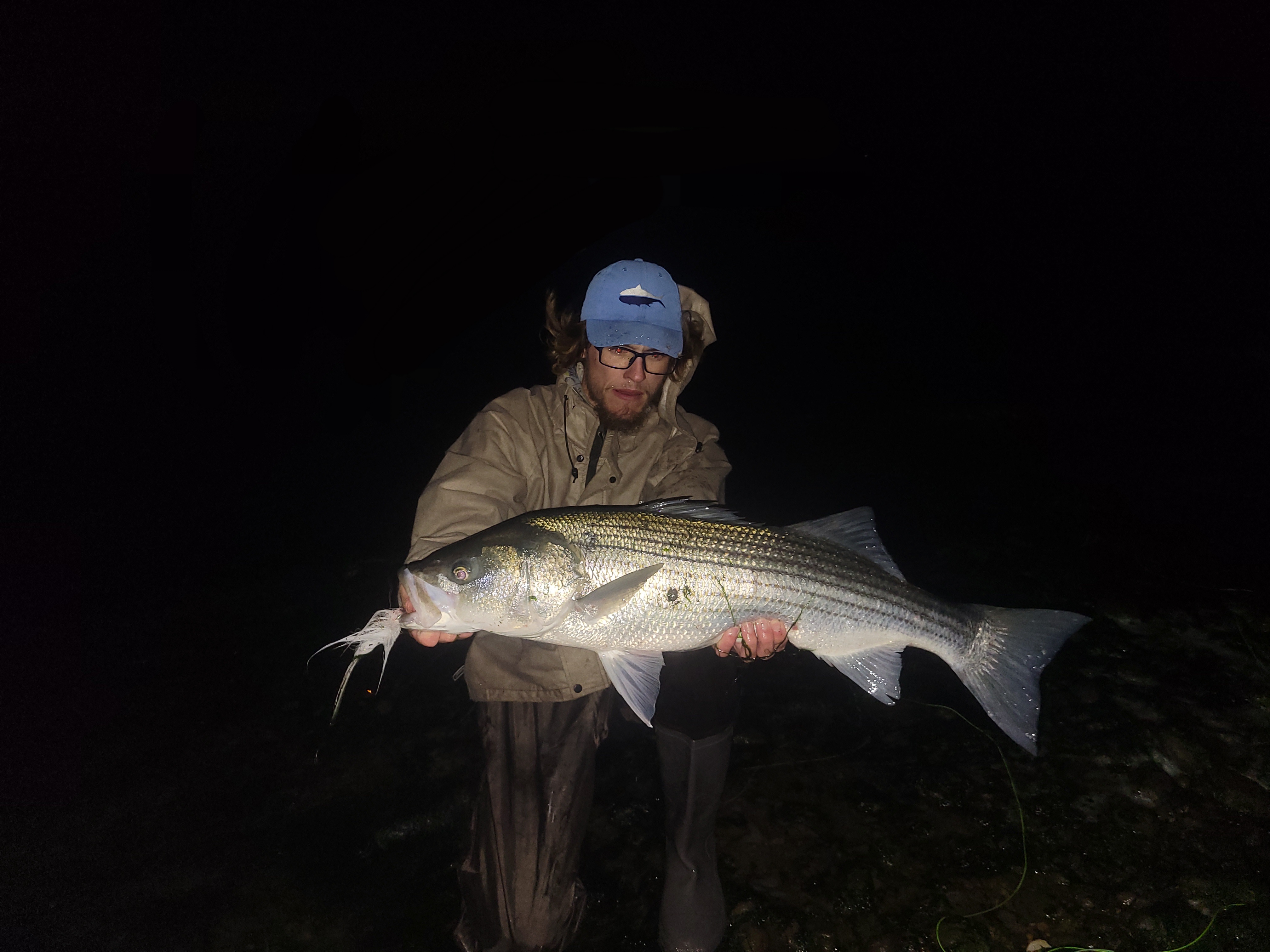
The next night, I revisited the same tide and location with Alex. We started catching a few fish, again good sized but not quite what we were really hoping for. The wind was a little harsher still this night and it had the water seriously churned up at that location. Alex convinced me that we should try to fish another spot to see if the bass had pushed deeper into sheltered water, and I agreed. We'd still have enough tide to come back if we decided we wanted to. It turned out that we'd not be returning. The secondary spot was absolutely stacked with good sized bass. Alex and I slugged it out with 20 pound fish after 20 pound fish while the wind howled and distant lightning gradually came closer and got brighter. The fish ranged mostly from 36 to 44 inches, though we're sure some larger ones were present.  They were stupidly easy. Big flies, big plastics both worked incredibly well. I fished white and black, it didn't seem to make any difference. These fish were just chewing in a way that I'd not encountered before. It was a rare window in which getting sizable striped bass on the fly was just easy.


Well, there's a caveat to the "it was easy" thing. I'm a very stubborn fly caster, and I refuse to let wind dictate when or where I can cast. That has resulted in a lot of practice pounding hard casts into a strong wind, which is what I was doing that night. It also took a lot of time and effort to pattern bites enough to know that these fish might be where they were under those conditions. It was also the wee hours of the night and the weather was about to get a little dangerous. All of that to say, easy is relative. Catching big striped bass on the fly in the surf is never truly easy. It takes time, effort, and resolve. Through the entirety of this early October bite I fished until I no longer could, then slept in the car. I wasn't home much at all through most of the month actually. I took breaks to get work done and check other bites so I'd be prepared for clients. But any time I could be I had my boots in the salt, heavy fly rod in hand, and a large white or black fly tied onto the end of a short 40 pound leader. 


Unfortunately, some of the largest fish from this night were quite skinny, so a few fish that had the potential to exceed 30 pounds were pretty close to 20 pounds. It was, however, the first night I'd ever caught more than one 40 inch class fish on the fly. I could hem and haw over how much bigger these fish could have been had they been more bulked up, or about the one that did get away that sounded and felt huge. But the reality was that when that storm really closed and Alex and I decided to make our way back to the vehicles, we'd had spectacular fishing. I bid Alex a good night, of which there was very little left anyway, and sat in the car eating a snack while some of the loudest thunder I'd ever experienced rocked the ground. 

That night was not to be the last of the spectacular fishing this season. I'd put my hand in the mouth of the third 43" striper of the season, a truly epic year, but my sights were set on a larger target. They still are, though the biomass has now thinned dramatically as we creep into mid November. I'm hoping for one last shot at fly cow glory before the winter fishery sets in... of course, I won't be putting the striper flies away for the winter either. 

Of course, all this fantastic fishing has me very worried that some people will feel that the stock is going to recover with ease. It might, we currently have a fairly strong spawning stock. There have been good spawns coming from the Hudson as well, it seems. But the Chesapeake is going to continue to be a problem. A combination of climate change and human habitat degradation may eventually render the Chesapeake spawning stock incapable of maintaining its share of the fishery. I don't think anglers are remotely prepared for the level of advocacy it would require to slow that train, and it may not be stoppable at this point anyway. It has been hard enough to sway species management and we barely get anything done there. ASMFC is still not adequately dealing with conservation equivalency. Any measure that has been made in regards to striped bass management is little more than a half measure, and a poorly enforced one at that. A lot of anglers don't care. Snag-and-drop is still being done, guys are completely ignoring the circle hook law (which might be a problem as well, I may elaborate on that soon). When anglers that do care see poaching behavior, it seems they're either too lazy to call it in or just don't think anyone will come. Well... nobody comes if you don't call. 

We've got a long way to go. I've been over the moon with the quality of the fishing this fall. it was spectacular. I worry that this will be my good old days. This may not continue well into the future. There are too many problems that aren't being addressed. 

Thank you to my Patrons; Erin, David, John, Elizabeth, Brandon, Christopher, Shawn, Mike, Sara, Franky, Geof, Luke, Noah, Justin, Sean, Tom, Mark, Jake, Chris, and Oliver for making Connecticut Fly Angler possible. If you want to support this blog, look for the Patreon link at the top of the right side-bar in web version.


Monday, October 31, 2022

Stellar False Albacore Fly Fishing

 This year the tunny came in with a bang. Eastern CT saw a fantastic early showing, with fish available from shore in good numbers for a couple weeks steady. They were also showing in various locations, which I like a lot. Tunny draw a crowd of eccentrics, many of which are people I do enjoy standing next to on the rocks. It's an almost integral part of the fishery; all the familiar faces. I do enjoy that aspect, but I also enjoy solitude, or sometimes just one on one time with a friend. The widespread nature of that initial push of little tunny made it easier to pick and choose which experience I wanted to have and that was nice. It also meant I could try to catch some from places I'd not had the opportunity to in lower abundance years, and I'd often rather catch one somewhere new than five somewhere I've caught them before. 

I found myself standing on a familiar rock one day during that early season action, one I'd had shot at tunny from, hooked one once even, but I'd never caught one there before. Last year I'd made a beautiful cast into a breaking school and one ate my fly, peeled off on a run, then threw the hook. It was a disappointment in a season of disappointments. I stood on that same rock feeling a lot more at ease than I ever was during the previous season. Confidence plays a huge roll in this game, and knowing you can catch if you are patient, persistent, and most importantly relaxed can make or break a day- or, as it turns out, a whole season -of fishing for albies. This season I'd committed to fishing for them less, staying closer to home more, and just being satisfied with whatever was going to happen. It was a recipe for better success. This it just felt like it was going to happen. I had on a floating line. Most anglers fly casting for little tunny elect to fish lines that sink to some degree or another. Intermediates, sink tips, and full sinks are common fair. I've always liked floating lines. Though one argument, that thinner full sinking liens cut through the wind, is perfectly valid, I have not problem punching casts into wind if I have to regardless of the line I choose. I also like explosive surface strikes, and having my fly at or near the surface not only allows me to see that happen but also shows me whether fish are refusing my fly, building my confidence or allowing me to make changes in my presentation. last year I didn't fish the floater much. Ironically, when I did I caught fish. 

Adding to my ability to enjoy the day, I had paired a floating fly with my floating line. The Gartside Gurgler has been one of my favorite flies for the species. The skittering action of the gurgler draws explosive takes, even when more typical subsurface presentations are spurned. On this sunny early season day the floating line and gurgler combination would prove deadly. 

The tide window at this spot often presented a short window of opportunity, so I knew I wouldn't be there all day. It was beautiful though, and when the tunny came around I'd have a spectacular view. Initially the fish weren't playing within range, though that's not unusual. Gradually they drew nearer. I stayed patient, waiting through short lulls, and soon they were at my feet. The first good shot drew a strike, thought the fly came out of the fish's mouth a moment later. Back in hand I felt that the hook point wasn't quite as sharp as it should be. A few strokes on the file and it was back to fishing. The next break of fish came in over shallow sand and I landed the gurgler right in them. The great cast was rewarded with a spectacular eat and the first tunny of the year was on. 

I confess, though the initial run of a tunny is a spectacular thing, fighting these fish is a little dull to me. It lacks some of the challenges presented by other fish. If you can clear your line quickly and steer the fish well, which is particularly easy with a long rod, you are likely to land the fish. If you lose the fish in structure, it's not because that fish tried to get the line through said structure, it's merely because you put yourself in a situation where the structure is likely to end up between you and the fish anyway. I'd rather fight a fish that is headed for structure knowing that it can use it to free itself, or that is can find safe refuge. That's much more interesting. Subsequently, it's the fights where something goes wrong that actually get me excited when I'm hooked into a little tunny. That's exactly what happened this time. A tangle caught up at the end of the rod and the tip pulled off. I had to navigate that issue with a very strong fish still on the end of my line... now that was a challenge. I managed to deal with the issue and land the fish. What a good feeling that was. My first tunny in a new spot landed the hard way.


That was the beginning of an excellent streak. After the tide slacked out there, I made a moved to a reliable location. There, the wind was throwing a good chop. It was the ideal setup for fired up tunny. Indeed they were chewing, and I intercepted the procession of fish repeatedly that afternoon. The gurgler remained the ideal fly, and the takes were visually spectacular. 


That will likely end up being my favorite day of the season, even if I have another great numbers day. Everything felt like it went the way I wanted it to that way. If there was a hicup, like the tangle on the first fish, I navigated it successfully. The fish were numerous and willing. The conditions were comfortable and conducive to good bites. I caught in more than one location and even in a new location. It was ideal. The frustrations I'd had with this fish over the prior year melted away and I was able to enjoy the albie high. They are quite magnificent fish. That the opportunity to catch these small tunas comes within the sights of those who would as soon stand on rocks or sand than the deck of a boat is a minor miracle. Though I don't obsess over them like I do large striped bass, carp, or pursuing new species, chasing tunny is an integral part of the fall season. 


I'm still hopeful for one last blast in November. I've caught November tunny before, but it has been quite a few years. It would be nice to bookend this season with a large one. 

Thank you to my Patrons; Erin, David, John, Elizabeth, Brandon, Christopher, Shawn, Mike, Sara, Franky, Geof, Luke, Noah, Justin, Sean, Tom, Mark, Jake, and Chris for making Connecticut Fly Angler possible. If you want to support this blog, look for the Patreon link at the top of the right side-bar in web version.

Wednesday, October 19, 2022

Kokanee (& Trout) In The Dark

As an obsessive nighttime angler, I'm constantly looking to d to my repertoire. One thing I've done very little of is target trout in stillwaters at night. Here in CT, many of our stillwater fisheries are composed of stocked trout with very poor holdover rates, so that makes them generally uninteresting to me. There are some lakes with a half decent holdover rate but most take some travel. There's also some lakes with other species of interest. It was kokanee that got me fairly intrigued to try one particular stillwater.

Kokanee are landlocked sockeye salmon. They were brought top CT in the 1940's to build a recreational fishery. Why the state of CT is expending resources on this only lightly fished species that isn't native is beyond me, but at least kokanee aren't going to spread far and wide. In fact, landloacked alewives, also a non-native, have almost completely wiped out kokanee fisheries in Ct in the past. Kokanee have an affinity for nocturnal activity, though kokanee feeding is focused on zooplankton. They're essentially a salmonid that filter feeds... not quite like menhaden or American shad, but they focus on such tiny food items when foraging. Transferring their nocturnal feeding habits over to the spawning run- when the strike mainly out of aggression -doesn't necessarily follow. But at least in my mind, nocturnal is nocturnal and I should be able to get some to strike. If not, rainbows would be around the same areas. 

I set out on a brightly moonlit night with a plan in mind. I'd fish two methods, both with relatively small and bright colored flies as that's what has worked for kokanee in the past. I'd start out fishing them under indicators. With the aid of the moon, as well as nearby artificial light, I'd be able to see the indicator drop if I was getting takes. If that failed, I'd slow pull the same flies as well as some streamers with a figure eight retrieve

Upon arrival to the spot, I could actually see the schools of fish. There were huge numbers of kokanee out there, as well as loads of trout. It soon proved very easy to get the trout to take. Me indicator dropped time and time again.


The trout seemed to have very little preference in the way of flies. I caught them on Green Weenies, eggs, Walt's Worm with pink collar, Sawyer's Pheasant Tail, and small buggers. I kept switching mostly to try to pull out a kokanee, but it wasn't proving to be especially easy. Even on the best of days they test a good angler's resolve. Each Pacific salmon has a different attitude during their spawning run., and it differs place to place as well. Kings in New York are heavily pressured and often hard to convince to snap at something, which is why many anglers fish eggs, bits of foam, and smaller flies with immense amounts of weight. This differs from large and less pressured river chinooks in Alaska, which are caught on large flies and lures. It also differs from less pressured water elsewhere in the great lakes. Coho, wherever they are, seem to be on the aggressive side of the spectrum, as do pinks. Chum salmon are definitely quite inclined to take large streamers and lures. Kokanee seem to be one of the finickiest. This results in a lot of people intentionally snagging them, which is just ridiculous. Its also illegal, and I call the TIP hotline any time I see it happening. As should you. Anglers often complain about poachers in CT, and yes ENCON is understaffed and won't always respond, but you should still call. The more calls get made the more poachers will get caught. Please do your part. 

I, of course, was just patiently waiting for a kokanee to actually grab a fly. It took a couple hours before one finally did, but it was a wonderful proof of concept. I could, in fact, catch a kokanee at night. The first one sunk the indicator just like the trout had been doing. The fly of choice? The good old Green Weenie.


That wasn't really the start of a pattern though. Kokanee are moody and erratic, and I often get them seemingly at random. Indeed I ended up with three that night in five hours of fishing, and each was on a different fly. The first was the only one to take under the indicator. The second took on a slow retrieve and the third took and egg on the fall. 


I lost a couple couple kokanee that I clearly saw as well, and a few that may have been. largely though the night was a very trouty one. I must have caught between 35 and 40 of them, and I even specifically tried to avoid them at times in hopes of picking up more salmon. As it turns out, that nighttime indicator strategy in particular is wildly effective. I've considered fishing indicators at night in rivers as well and this really did some convincing. I've lightly fiddled with the idea in the past, putting glow in the dark tape on indicators, but it never really got me anywhere I think its time to in some glowing thingamabobbers. 


The night game is such a fascinating one. I've always felt that it builds on an anglers understanding of the water they're fishing. If the right casts and presentations can be made or even things as simple as getting to the productive locations can be accomplished without aid of the light of day, it builds your understanding of the water. But something I sometimes forget, and likely equally important: fish behave differently at night. Fishing in the dark builds your understanding of your query as well. I feel I have a better understanding of landloacked sockeye now having caught them at night. 

Thank you to my Patrons; Erin, David, John, Elizabeth, Brandon, Christopher, Shawn, Mike, Sara, Franky, Geof, Luke, Noah, Justin, Sean, Tom, Mark, Jake, and Chris for making Connecticut Fly Angler possible. If you want to support this blog, look for the Patreon link at the top of the right side-bar in web version.

Saturday, October 15, 2022

The Value of Walking

 On a sweltering late summer day, I trod carefully along the banks of a heavily impacted New England river. This was a river I'd fished before, but a stretch I was unfamiliar with. I was on the hunt for carp. In rivers, I've often found that carp are not sparsely and evenly distributed. There'll be extremely long stretches with none at all, the short stretches occupied by substantial schools. I'd say I'm slowly piecing together together the factors that make a stretch of river appealing to carp, or at least appropriate for spotting them, but after a number of years of experience I've come to learn that at least on some rivers, the carp aren't necessarily in the same stretches year to year. 

Illustrative of this is a different, narrower, impacted New England river, one I fish and guide on regularly. There's a series of separated deep pools, each with fish. Year to year thought the abundance changes in each pool, and it is clear that though there are at points hundreds of yards of extremely shallow water in between the fish move pool to pool. Last year, a small orange koi started his year in what I call Pool 1. A few months later he dropped down into Pool 2. This year Pool 2 is the only place I've seen him. Additionally, Pool 1 and Pool 2 both have more fish showing than they did last year, whereas Pool 3, the longtime over-performer, seems to have about half as many fish.

Perhaps even more illustrative is a medium sized tributary stream. Last year it was full of carp. I found schools in four different sections. Some were huge. In fact, a client of mine hooked and subsequently broke off a fish that was easily 30 pounds. This season, there simply weren't carp in that stream. They'd all apparently dropped back for the winter and decided not to return. 

So that leaves some mystery in rivers like the one I was walking. Even if I found good looking water, there may not be fish. Indeed I carefully observed multiple pools- even going so far as climbing trees and watching for extended time periods from perfect vantage points -that clearly had no carp. They had the features of pools I'd found carp in on other rivers, so I can't rule them out for future seasons. the fish just aren't there now. Not to be deterred, I kept covering ground. I knew I'd find them eventually. I moved slowly and methodically, stop[ping and watching. I wasn't pausing and making casts, unless I saw a good sized smallmouth or a pod of rising fallfish, I was just looking. 

Eventually I did find what I was looking for, a substantial school of carp in a short stretch of river that really didn't look extremely special. It featured a couple deadfalls, mud bottom, slow and even current, and a steep far bank shaded by trees. It certainly looked good, but so had many other areas I'd already walked by. Perhaps it was the sum total of those aspects and perhaps a couple I didn't list that made this the carp's preferred stretch. Or maybe next year they will be somewhere else in the river. Regardless, they were there now. These fish were sizable for the area, most looking to be in the high teens in weight. All were mirrors. Their behavior didn't lend itself to feeding, however. They moved about in groups of three to six, moving much too quickly. I'd need to return at a more appropriate feeding time.

A week or so later, I got another opportunity to visit the river under better conditions. I carefully made my way to the spot, keeping my eyes out for fish that may have moved into any of the spots in the mile and a half between where I parked and where I'd found the carp on the previous trip. I didn't locate any new fish, but with near-ideal conditions, the fish at "the spot" seemed much more numerous and were clearly in a feeding mode. I tied on one of my black body squirmy hybrids and crept into position. The  first fish I presented to took. I had my work cut out for me on six pound but eventually got the fish to hand. 


I'd made one cast and caught one fish. Such events underscore the value of walking. If you sight fish, whether its to rising trout, carp, striped bass, bonefish, or whatever else it may be, there is immense benefit in simply covering ground slowly and methodically. Not casting, just observing. It allows you to see the lay of the land and grow your understanding of the location as well as the structures within it that the fish like or don't like. It also highlights the value of getting distance under your feet. This school of carp was residing at least a mile from anywhere I could park.I learned long ago that the way to fish fish was to search. I was relentless, and still am. Covering ground, covering water... there is huge value in walking. 

Thank you to my Patrons; Erin, David, John, Elizabeth, Brandon, Christopher, Shawn, Mike, Sara, Franky, Geof, Luke, Noah, Justin, Sean, Tom, Mark, Jake, and Chris for making Connecticut Fly Angler possible. If you want to support this blog, look for the Patreon link at the top of the right side-bar in web version.
Tuesday, October 4, 2022

The Prettiest Brook Trout in Connecticut

 I first met Alan Petrucci at the Comstock Covered Bridge. If you live outside of central Ct you likely don't know what that is, but it's well known here. The Comstock Bridge is lovely restored relic of a by-gone era, crossing Connecticut's Salmon River. I stood near it's west entrance, having just walked there from my home, at the time about four miles away. Connecticut Fly Angler was in its infancy then, being written by a kid trying to sound like he wasn't a kid. I didn't even have a drivers license yet. I was finding fishing spots by shear physical effort in those days, looking at maps and walking or biking as far as I could. I didn't know many other anglers. But there was this guy writing this blog called Small Stream Reflections. 

I almost idolized Alan. In those I was completely obsessed with small stream and wild brook trout. I think it was because such pursuits felt almost childish to me. I believe that play is intrinsically important to humans well beyond childhood though society today may try to beat it out of us. And brook trout fishing felt so much like play. It reminded me of my formative years, when my mother would bring me and later my brother too to state parks around my first home; Franklin, Pennsylvania. Playing in creeks was an integral part of my upbringing. Flipping rocks and looking for salamanders, catching crayfish, and watching fish were the most important tasks. Small stream fly fishing felt more like that than other hobbies, and it seemed to me that this Alan Petrucci had held onto that simple, childlike joy. I wanted to fish with him. 

I recognized Alan's vehicle immediately, that little black hatch-back with the BRK TRT license plate will live in my memory forever. He parked and walked over to introduce himself. I was an awkward teenager then, and I recall acting like it. I was bad at talking to new people then. I'm not sure what Alan's immediate impression was though hist struck me. Alan was a quiet man. No word he spoke was unnecessary. If he wanted to be funny, he was funny. If he wanted to be serious, he was serious. But generally he was a quiet man and that aptly carried over to his pursuit of small stream trout. We got along well, possibly because I was old for my age. Or perhaps he was young for his. Our appreciation for the environment where brook trout live, which Alan called "Brook Trout Forest" was really what brought us together. It was a simple, un-fancy appreciation of the natural and small. Brook trout in CT are not big, and indeed Alan always found the smaller char far prettier. He'd caught large ones, stories of which he told me while we drove to a new stream. "Those are ugly," he'd say, "those big males... big and ugly."

Alan seemed to know every stream. As he drove me to a place I'd never been he'd point out road crossings of other streams and ask "Ever fish down there?", and he'd always have a few words about each one. He'd describe a wild brown trout he'd caught, gesturing with his fingers to show the size, or describe the colors of the brook trout. I realize, now, that that's what I've become since. I already covered water beyond my reasonable means then. Spurred on by Alan and his apparent ability to find a brook trout anywhere, though, I began scouring with a fine toothed comb, and now much like Alan I have quiet anecdotes to fill in what had been holes on my personal map. He and I always talked about new streams. He was an old man then but he was not done exploring. He wanted to know what places held these wonderful fish and what didn't, as did I. 

We were winding through a hemlock forest on one of the prettiest roads in CT when Alan looked over and said "I'm taking you to a stream that has the most beautiful brook trout in CT". Soon we arrived at a tumbling brook full of plunge pools. Alan was right. The brook trout there were some of the most colorful I'd seen anywhere.