Wednesday, May 24, 2023

Miles on Foot

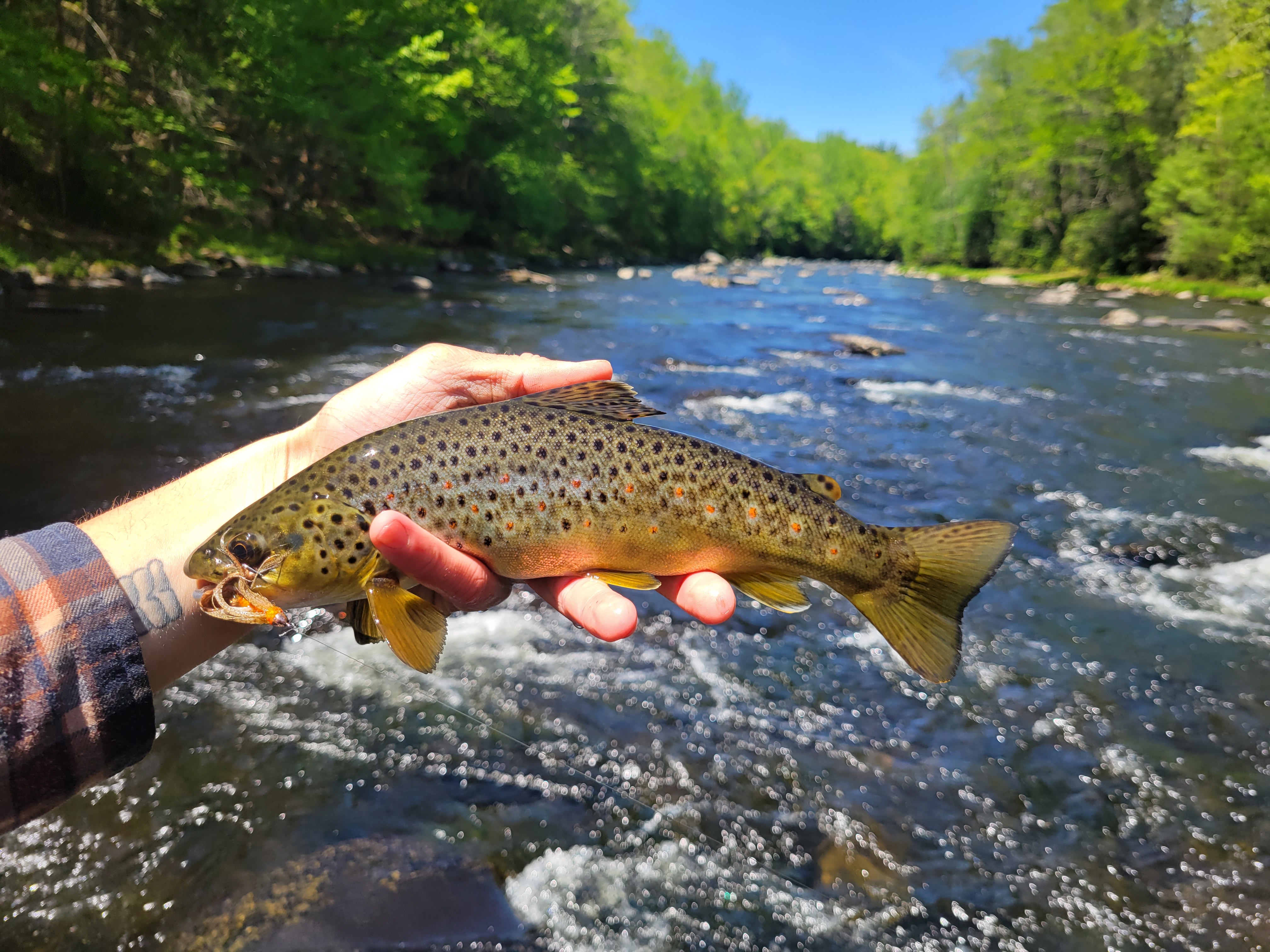
 Covering miles of freestone trout stream on foot isn't an easy physical endeavor. Waders are clunky and heavy, limiting mobility, and though wading shoes or boots with neoprene socks are less restrictive they leave an angler open to cold water, insects, and still usually carry some water weight. Some rivers aren't too hard to navigate, with sand and gravel substrate and trails along their edges. But some are strewn with large boulders, slipper algae, cliffs, waterfalls, and generally lack easy trail access. And whether there is good trail or road access or not, sometimes it doesn't go where I want to go. When I was younger and didn't have a vehicle, my obsession with trout drove me to what many might consider absurd lengths. My mode of getting to the water was a bike, and once I was there I invariably wanted to fish as much water as possible, and to do so I needed to walk. It wasn't unusual that I'd bike to a river anywhere from 6 to 25 miles away, then fish 4 to 8 miles of it on foot. When I could be dropped off by a parent, I would do the same thing further from home. Not all that many years back I was left to my own devices for two days on the Beaverkill and covered 3 miles of water downstream one morning, then turned around and fished back up, passing the campground and going another two miles up river. That was nothing for me at the time. I fished trout streams a lot and that's how I did it. Once I got a vehicle I both shifted away from trout and had less incentive to cover huge lengths of water. I lost touch a little bit- stopped exercising certain muscles -and didn't think much of it. Then I recently went to fish one of my favorite northeast trout rivers and got chewed up and spit own like a piece of gum. 

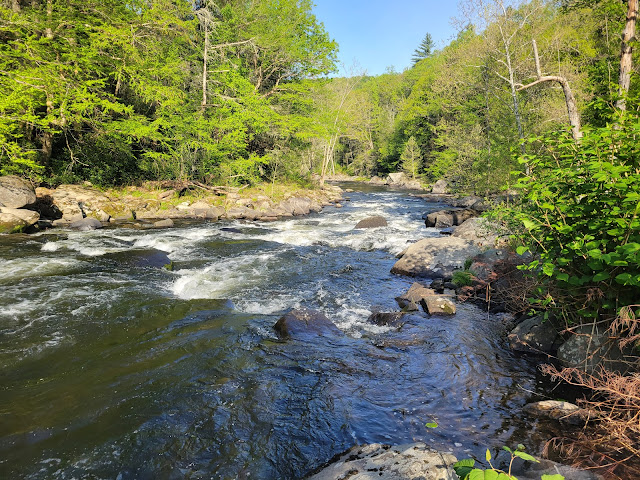
Large, road-less areas along sizable trout rivers aren't especially common in this part of the world anymore. Drawn toward solitude, wilderness, and exploration, I'm pulled to these places whether they have big fish reputations or not. And this one river, though known and fished through some stretches, has a very large un-developed area. Limited to non-existent cell service, treacherous terrain, and a high likelihood of seeing very few other anglers are almost as appealing as the abundant wild trout. Two years back I fished it from one access going upriver a modest distance to break up a drive home from fishing the periodical cicadas. I was entranced by the river itself as well as the surrounding landscape and vowed to come back. When a day opened up recently, I made the drive out early in the morning. I arrived at a new access right before sunrise, determined to fish down to where I'd ended the previous trip. The result would be roughly 10 miles of fishing and some added out of river walking. 

The day dawn crisp and clear with air temperatures in the low 40's. I packed as much food, water, and safety stuff as I could fit in a sling pack and hoofed down to the river. Tendrils of steam rose from the boulder strewn pocket water, signifying that the water was a bit warmer than the air. The sun wouldn't reach into the gorge for a while, and I'd need to keep moving to stay warm. My plan, fishing wise, was to prospect with streamers until I saw heads. I needed to cover a lot of ground and to get where I wanted to go, so I'd have to fish faster than effective nymphing would allow. 

For a while the quality of the fishing wasn't great. Limited bumps and swipes, some good water not producing any signs of life... I switched flies, retrieves, and approaches a few times but I eventually assessed that the fish weren't all that active yet. Eventually I did pull on a gorgeous and very dark brookie, but it wasn't until the sun got on the water that things got going a little bit better. 


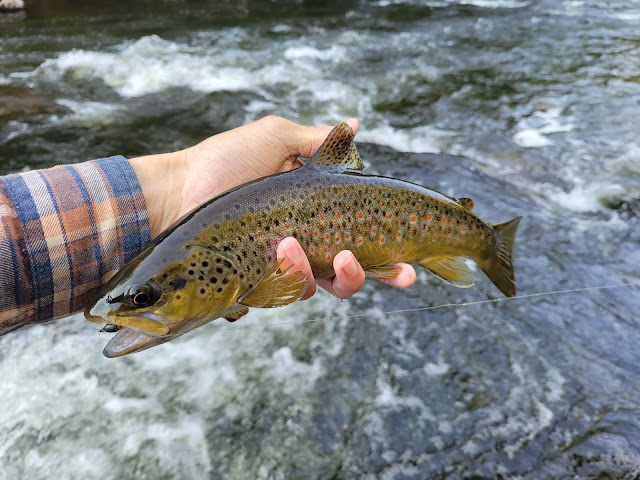
When the hits did come it was like a freight train. This fits my previous experience on this river, though I was fishing the Ausable Ugly then. The fish dart out fast, grab, and vacate fast. If they try to leave with the fly still in their mouth they pretty much set the hook on themselves. If not, they leave you questioning what you could have done to hook them. It really is a hit and run. Fight wise, some of the fish were very hot. Others seemed to be a bit less interested in winning the battle. They were all elegantly beautiful wild trout regardless. 


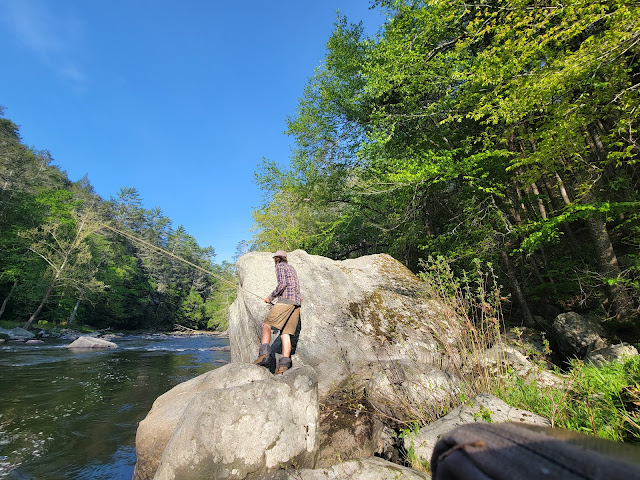
After a little while, the last vestiges of angler's foot prints faded as the terrain became more rough. I knew some people had almost certainly been through recently but at least not since the previous rain. Travel, atleast via the side of the river I was on, became complex when I reached a very deep pool flanked by a cliff. Most of the passage wasn't difficult until the little shale shelf I was skirting pinched off. With water over my head behind me, I hugged the ledge and pulled from a very modest understanding of handholds and footholds from rock climbing to negotiate the impass. It's this sort of stuff that makes me feel like I'm really trout fishing.  


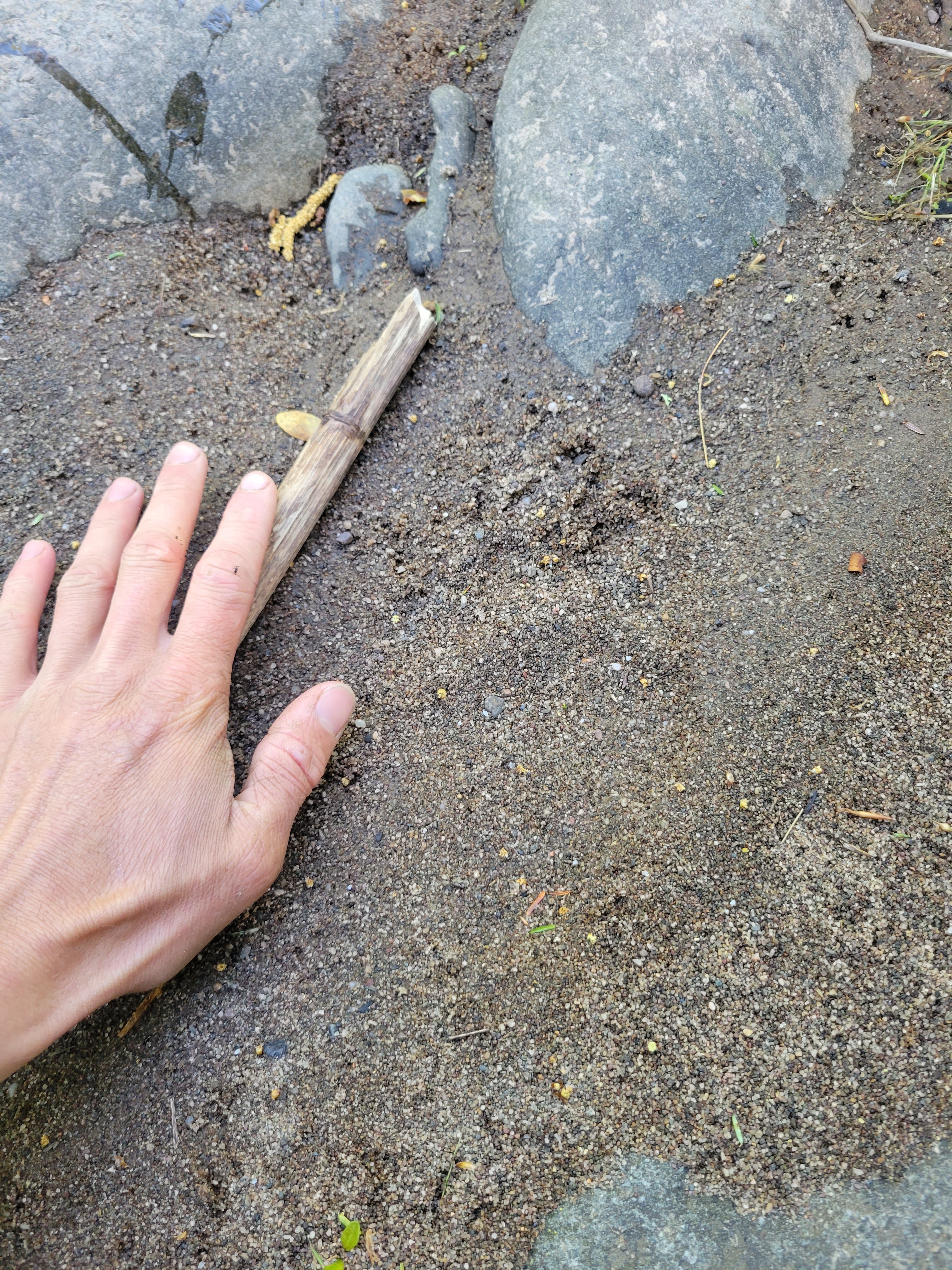
The biodiversity as I pushed ahead became more and more obvious. Lush plants sprouted were springs seeped from the cliff face. American toads called everywhere. They were in the heat of their breeding period and I had to take extra care of the strings of eggs laced through the shallows. Northern watersnakes basked on midstream rocks, seemingly unbothered by my presence. There were larger terrestrial fauna too, though it was a while before I saw any. Their tracks, though, dotted the sand bars and muddy spots. Some of the more significant trails through the woods were game trails rather than human trails. I found racoon, possum, fox, dear, mink, bear, coyote, and bobcat prints along the river. 


Eventually I did pass a couple other anglers that had come in from the other access. They reported spotty action as well. I soldiered on, catching sporadically as I went. Finally I did reach my intended destination. The pool I'd seen a few big fish in a couple years ago gave up the largest I'd catch on this trip. Ironically I didn't realize it, being on the opposite side of the river and approaching from above and with different flow conditions. I ended up passing it by quite a bit until I hit and unmistakable bend. That added distance would compound and already building problem. I knew I was going to be hurting when I got back to the car. Short breaks to rest and stretch became as mandatory as eating and drinking.


It wasn't until I re-fished a stretch almost middways back that I experienced legitimately fast paced fished. There seemed to be trout in every pocket and run, often multiple, and they were very interested in a half pint. I missed a lot and lost quite a few as well, but had a stretch where I was catching very regularly. None of the fish I ran into were all that large. I flashed two that I thought may have been over 20 inches but I couldn't be sure. It was abundantly clear that there were loads of healthy wild trout though, so I was in paradise. 


The one thing that I'd hoped would materialize was a strong hatch, and it never did. There were a few caddis, a Yellow Sally here and there, one or two March Browns, and a few Light Cahills. It was never enough to get any heads poking though. When I first started fishing the Catskills I wouldn't have cared, I was streamer obsessed. Now that's just amusing to me, I relished the idea of getting a break from the constant motion to rebuild my leader, tie on a dry fly, and target a specific fish. At one point it seemed like the opportunity might arise as a few fish began sporadically taking along the far bank of the same cliff edged pool I'd traversed on the way down, but they never increased the frequency as there was hardly a trickle of mayflies coming off. I tried for a little while but gave up. They weren't especially large fish anyway.


It was after fishing that pool for a while that I chose to peel away from the river and shorten the walk back. The game trail that lead me across the steep hillside over the river had some notably careless tracks on it that I couldn't identify for a while. The wet leaves didn't give a good read but they weren't deerlike at all. A pile of scat soon told the story. A mother bear and cubs. The mothers prints were far from obvious, in fact I only found one indentation that I think was hers. The cubs, young and naive as they are, left obvious and meandering prints. They were fresh. I realized I ought to get off that path. No sooner had that thought entered my mind then I looked down the slope and saw the cubs maybe 130 yards out in a stand of mature hardwoods. Two scrambled down from the tree they were in while the third waited on the ground before they departed hastily. Mama wasn't visible amd I didn't particularly want to see her. I gave them a wide berth.


On the way out I passed through a bizarre grassy clearing. It was totally isolated and full of deep rock piles. I took a break to flip some rocks as it looked like excellent milksnake habitat, though none were found. 

Eventually, haggered, hungry, and with the beginnings of what would prove to be some absolutely horrendous leg cramps, I made it out. If there's a lesson here, it's to be as prepared in training and warming up as in provisions. I'd brought as much food and water as I'd needed, had drinks with electrolytes and bananas for potassium... but I pushed way, way harder than I've pushed in years and payed the price. Know your limits. Push them if you'd like, but not so far that it compromises your safety. 

Thank you to my Patrons; Erin, David, John, Elizabeth, Brandon, Christopher, Shawn, Mike, Sara, Franky, Geof, Luke, Noah, Justin, Sean, Tom, Mark, Jake, Chris, Oliver, oddity on Display, and Sammy for making Connecticut Fly Angler possible. If you want to support this blog, look for the Patreon link at the top of the right side-bar in web version

Tuesday, May 2, 2023

Close Encounters

 Every serious angler has had one or two of those moments- a time span that could be as little as a glimpse or extend to a long duration sighting -in their time on the water. There are some fish out there, mythical ones. Legendary in proportion.  If you angle long enough, you'll run into them. Today the Noahs and I had an encounter with such a fish. 

The lake we were fishing is one loaded with chain pickerel. These native Esox are the dominant fish in that body of water, which we three love. There are certainly bass, the beloved non-native, but the habitat here favors the pickerel. The water is more acidic and carries a dark natural stain. Its classic pickerel water. Most are small though, maybe 14 inches. 20 inchers aren't especially uncommon though, so we've put some time in after larger pickerel on this lake. The goal today wasn't specific though. There are plenty of crappie, bluegill and yellow perch to be had as well, and that was loosely my focus. Noah and Garth switched back and forth between panfish and pickerel presentations. The weather played just as fast and loose. Clouds came and went, as did wind. One moment it felt like it was in the 40's, the next the sun beating on my back made me want to shed a layer. A passing shower's cold wind hit us for a few minutes as the clouds denoting the outflow boundary darkened the sky over our heads, making us fight to hold our drift with the trolling motor. 


It was shortly after that shower passed off to our north that the encounter happened. We'd been working our way up a dock line. The Noahs were casting shore-ward while I fish behind our drift, taking advantage of our slow speed to essentially troll for perch. I'd switched, though, when it happened. Noah had hooked a very small pickerel, maybe 10 inches if I saw things correctly. When he got it boat side what could only have been one of the largest pickerel in the world tried to eat the small one. It didn't even register as a pickerel to me. What I saw was it's diameter, which could best be described as leg-like. This was a pickerel that was honestly about as big around as my lanky thigh.The other two had a better look, and neither would argue that it was less than 30 inches. In fact we think it was quite a bit bigger. How believable is that? Not. I wouldn't believe you if you were telling me. Should you believe me? Shit, I don't know why you would. But we all know what we saw. It was a truly monumental chain pickerel. Record status. A fish of mythical status. A bit later Noah said "I feel strange now" and "I'll be thinking about that fish for a decade"... and I get it. I saw that fish, I know what that was. I've had a few similar  encounters as well, mostly while fishing alone with nobody to confirm the validity of the story.

I compared it to seeing a gray alien out your window. Fish like this aren't real, you don't really see them. And yet for a moment you may find yourself in the very position we were in today. Try to absorb it. It's one of the most thrilling things in fishing. 

We never saw that fish again. Garth got a pretty good one of about 24 inches later, Noah and I both got plenty to 20 inches. They felt extraordinarily insignificant. 

Thank you to my Patrons; Erin, David, John, Elizabeth, Brandon, Christopher, Shawn, Mike, Sara, Franky, Geof, Luke, Noah, Justin, Sean, Tom, Mark, Jake, Chris, Oliver, oddity on Display, and Sammy for making Connecticut Fly Angler possible. If you want to support this blog, look for the Patreon link at the top of the right side-bar in web version.

Thursday, April 20, 2023

Moments on the Fly: Iguanarama

 green iguanas first turned up in Florida in the 1960's, one of many invasive fauna that took to the warm and wet subtropical  climate. You may know of Florida's iguanas from famously falling out of trees during cold weather. Though they can tolerate the state's climate and indeed do well in it, they're limited in northern expansion even within the state. Like the many cichlid species present in the canals and ditches, northern extent is dictated by the animals intolerance of the cold. So there weren't many, or really any, in the first parts of Florida Noah and I saw while making our way south. But by the time we got to Boca Raton they were ubiquitous, scattered throughout the landscape right within the city. These big lizards had an almost stray dog like character. They were timid, not especially inclined to come near us if they had any choice, but carried a visible indignance if we had the audacity to interrupt their sun bathing. They were grungy and a little dopey but acted as though they were trying to carry themselves with some standard of dignity. 

I of course really wanted to catch one. The little kid in me that had pocketed June beetles and lady bugs and caught every frog he could get near would not let these lizards rest. So I crept up on them, trying to get as close as I could before attempting to pounce on them. This had largely unsuccessful results but was a needed distraction from staring into the clear blue water trying to pick out rarer fish species among the swarms of sergeant majors, spottail pinfish, and tomtates. Though I never managed to catch one there my actions did result in a memory that will stick with me forever. One particular dull looking iguana was sunning on a rock right along the inlet. When I inevitably startled it in my attempt to get my hands on it, the animal saw its best escape into the water. There are semi aquatic iguanas throughout the world, notably in the Gallapagos, but green iguanas seem extremely inept at water-based activities. After plunging into the rushing inlet water. this ine thrashed and spun violently, seemingly completely unable to right itself at all. It was a blur for legs, belly and tail for a few moments until it found purchase and made its way out onto another rock. There, it exhaled seawater out of its nose and blinked, looking almost embarrassed. Perhaps my fondness of reptiles as well as my confidence in their understanding of the world around them is causing me to anthropomorphize, but I swear that iguana looked right at me. The look it gave me was one of clear irritation. 

Thank you to my Patrons; Erin, David, John, Elizabeth, Brandon, Christopher, Shawn, Mike, Sara, Franky, Geof, Luke, Noah, Justin, Sean, Tom, Mark, Jake, Chris, Oliver, oddity on Display, and Sammy for making Connecticut Fly Angler possible. If you want to support this blog, look for the Patreon link at the top of the right side-bar in web version.


Wednesday, April 5, 2023

Go Back

Trucks roared by one the highway as I traversed the brushy riparian zone of a small wild trout stream. The landscape I was in was heavily altered, to my eye. But if it weren't for that road perpetual road noise someone else may not recognize the signs of human interruption. Many haven't trained themselves to understand the unnatural landscape, and some signs are more subtle than others. I wasn't in a city or even a suburb, I was in the woods. A place many might call "out in nature". But there was actually very little in front of me that was indeed natural. 

Dropping down a steep bank, I looked up and down a straight course of the stream. Along one bank was broken rock, rock which didn't match the native granite and gneiss. This black and fine grained basalt, a volcanic remnant that looks the part, had likely been quarried from one of the ridges in Central or Western Connecticut or possibly even Massachusetts. It was broken free with the help of explosives then trucked to this place and used to try to make a stream do what some people had decided they needed it to do. This stretch had been channelized, making it a straight shot of underwhelming water. Without natural bending and meandering the stream couldn't create deep pools, undercuts, or slowly fell trees into itself. This is all necessary habitat for fish, macroinvertebrates and more. Without it the stream was not only unnatural but much less full of life. I wouldn't catch fish in this section, they weren't there. They weren't there because people had made it unlivable. 

The irony is the fish I was there for was a fish that didn't belong either. Salmo trutta, not in spite of but in fact because of out love for them, are a broadly introduced invasive species that has brought disruption and damage throughout the world. I harbor a similar deep appreciation for brown trout, but unlike others who allow their adoration to cloud their view, I can see the problem at hand. This very stream should be and could be teaming with the native salmonid, Salvelinus fontinalis. But brown trout sometimes have advantage outside of home court and they outnumbered brook trout here. When I reached stretches where the stream took its own course and formed deep cuts and pools I ran into brown trout. These lovely fish had genetic lineage dating back to near their initial introduction. They'd adopted and adapted characteristics that allowed them to survive in this foreign land, and to me they were indeed beautiful creatures.


 As if they weren't there, in just a couple months a truck would pull up to a bridge not far from here and offload a couple hundred horrible facsimiles of these fish. Farm raised and bread, these trout would be ill adept and equipped to survive where they'd be put and in all likelihood none would even survive a whole season. But while they were there they'd do nothing but damage to the wild fish present in the stream, be they native or non-native. Human's had demanded the stream travel a certain course and they demanded not only what sort of fish lived in the stream but how many as well.

I dropped below the channelized stretch a ways, navigating between beech trees and maples, none of them very big or old, and occasionally deviating around a mess of green brier or bittersweet. Even these aspects of the landscape hinted at the anthropogenic alterations. Invasive plants, stunted trees, and unnatural abundances of species denote the post-European New England forest. Old growth is all but non-existent today, as are many of the huge native trees that once characterized and cast wilderness. Of course, the native peoples were making changes too before the white man ever stepped foot here. The natives managed land for their survival, maintaining habitats that favored species they relied on. Europeans had a different outlook: domination. And we did indeed dominate. We used, abused, and replaced. We left a landscape that is lesser, even when we've tried to protect it for the future. It's hard to feel something other than cynicism and apathy once you know just how... wrong, how unfathomably incorrect our people have made all of this landscape. If I could snap my fingers and turn it all back, I would. But I can't. So that leaves those of us who know to take responsibility. It will never be what it was; but those with the eye for human change and alteration, who know the subtle signs of damage, should use their understanding to turn back the clock where possible and preserve with extreme prejudice anywhere that remains somewhat natural. So the next time you go for a walk in the woods or along a stream, try to look at it with a new eye. Ask what's natural and what isn't and consider what could be put back. 


Thank you to my Patrons; Erin, David, John, Elizabeth, Brandon, Christopher, Shawn, Mike, Sara, Franky, Geof, Luke, Noah, Justin, Sean, Tom, Mark, Jake, Chris, Oliver, and oddity on Display for making Connecticut Fly Angler possible. If you want to support this blog, look for the Patreon link at the top of the right side-bar in web version.


Thursday, March 16, 2023

The Hike In

 Scraggly, low hanging clouds concealed the higher hills on one late September day in the Green mountains. Moisture clung to every surface as dainty glass like droplets, slowly gathering and gaining size as they combined with others before splattering to the forest floor. The sound of the drops permeated the forest. Indeed it was just about the only noise, though a soft and calming one. At the time, Garth and I may not have been able to enjoy it much at all. It reflected our own damp state in the moment. Both of us possessed waders with inconsiderate holes in them that slowly turned any dry pants or socks we layered underneath them into soggy, unpleasant garments. We both complained vocally as we inserted a leg at a time into our damp waders one last time for this trip. We had a walk ahead of us though, and we'd need to suck it up and bear it. 

The woods still very much gave these hills their name, and it was made all the more fresh by the dew... green was everywhere. Moss, ferns, hemlock, maple, birch... the forest couldn't have felt more alive. It was early fall though and little touches of other color were scattered throughout our view. Some trees were beginning to turn;l branches here and there adorned with yellow, orange, or red. Taking advantage of the misty rain, the terrestrial form of the eastern newt moved about on the forest floor. These vibrant little creatures stand starkly against their other amphibian relatives in the same environment, bright orange and red rather than brown, grey, green, or black. They moved with purpose. Each seemed to have a place to be, and though even something as minimal as an oak leaf acted as a massive impasse to these little animals they traversed them with unwavering determination.  

Our walk was significant too, though our purpose was certainly different from the efts. This was our twisted form of leisure... not really relaxing or even comfortable by the standards of the modern middle class vacation. We were wet, tired, and mentally drained, but adamant on making the most of our last hours in Vermont. We treated our pleasure more like business. And in many ways it was... work like, that is. We were certainly not hear to earn a wage. But we had goals and effort must be expended to reach those goals. The first and not least of which was simply getting to our stream of choice. 

As we began our walk, the sound of dripping water gave way to rushing and tumbling as we approached the first of two foot bridges. The river below tumbled over pale granite boulders creating a long stretch of pocket water. We already knew there wasn't much to off in that lightly tannic water, though in my younger days I'd have wasted time fishing that very sterile water. We were going elsewhere, a tributary with colder and more consistent flows and a series of old beaver meadows that lent nutrients to the stream in a way that bare granite never could. 

Days before I'd been sitting in front of a screen, looking at this same landscape in a disconnected fashion. In the blue light before me, an array of pixels depicted imagery gathered by a satellite. I studied the course of the river from above, trying to read its bends and contours, to get an idea of what it might look like in person. I'd grown good at this over the years; learning to read satellite imagery and topographic maps and what they had to tell me about where fish might be. A particular stretch of river, sinuous and coming in and out of a number of meadows, stuck out to me. It was well away from any road in an area I had little knowledge of. In my lap lay an open atlas, a forgotten tool for many a young angler. It was already dotted with marker and pencil, denoting places I'd been, places I wanted to go, and notes. My gaze shifted between my laptop and my Atlas, and I jotted down notes and added new pinpoints. I wasn't sure how cell service would be where we were going, so I wanted an analogue backup. Though it didn't end up being necessary this part of the process still had its benefits. It forced me to take a closer look. When we ended up there, on the ground, though my phone would have and did function as a source for direction and information, I had in the back of my head a picture of where we were and what we should do. 

Leaving the bridge, out path jogged to the east and up hill. The hemlock darkened this area and gave it a primordial feel which was further exaggerated by the return of the dripping noise as the river's loud sound faded behind us. The trail was crossed by uneven, moss covered roots. It was the kind of woods that smell fresh and alive and where one can picture some long though extinct animal traipsing out of the shadows and into reality. In fact, other than the little efts and the odd bird and red squirrel, we saw very little in the way of animals at all. Certainly nothing large or unusual. But it sure did feel like we could. We moved swiftly through down the trail, the sense of passing time pushing us forward. In a short time we came to the bridge crossing our stream. I knew we'd need to follow its course upstream to reach the stretch I really wanted to fish, but I wasn't sure there'd actually be a trail. There was. We followed it for about a mile, it's tunnel-like passage through the undergrowth taking us closer and closer to our goal. Though our hike from the gravel road had not been a particularly long one, we were pretty far from anything. There was no road noise, no other cars in the pull-off, nobody already in the river, and nobody hiking on that trail. Our intrusion was the only human one this day in this place. 

I paused eventually, noting that the sound of tumbling water had calmed and dense forest had been replaced with open, grassy areas to our left. This was our cue to leave the beaten path. We dropped into the river's narrow valley, where little braids coursed like veins through the thick tufts of grass, and made our way to the main artery. The river itself flowed dark and cold, and we didn't know for sure what we'd find as we worked its runs and pools. Garth went down, I went up. Both of us were keen to find out what we'd made that walk for. 


Thank you to my Patrons; Erin, David, John, Elizabeth, Brandon, Christopher, Shawn, Mike, Sara, Franky, Geof, Luke, Noah, Justin, Sean, Tom, Mark, Jake, Chris, Oliver, and oddity on Display for making Connecticut Fly Angler possible. If you want to support this blog, look for the Patreon link at the top of the right side-bar in web version.