Showing posts with label Autumn. Show all posts

Saturday, October 3, 2026

Fall Guiding & Updates

 It's been a hot minute since I rolled out one of these. The last one I did was in June? Woooh boy, I'm a mess. But the fishing is pretty good. I guess I'll go over the summer's worth of work. 

Carp, carp, and more carp. Then some more carp. I put a lot of people on carp. Some regulars, some new guys... so many carp. Here's a small selection for you:

Dar's RI fully

Joey's not-a-bowfin

Connor's mop eater

Johny's 22 pounder

JK's dock demon

Hayden's first bubbler

Speaking of carp, if you're a freak for the Cyprinus like I am, it's going to be worth your while to check out United State of Carp. The first issue is soon to come, with an article by yours truly. It'll be a photo heavy publication, well styled as far as I can tell, and I'm looking forward to it and to working with Joel more in the future!

The carp are far from done for the year, of course. If you'd still like to get on some, especially if you'd like to learn late season tactics, there is time... basically until the waters freeze over, there's always a shot. But I'm ecxited for the change of season and the change of target that comes with it. CT's niche stocked salmon season is rapidly approaching. I anticipate DEEP to put the first of the season in very soon, I'd say any dat after October 15 is a guaranteed shot if you'd like to get a day on the calendar now. It'll be walk and wade only for a little while, until the water is up. 

This fall I'm also very keen on stillwater trout trips. This is something I've been doing more and more of myself and with friends, but its hard to convince clients to fish anything but rivers for trout. I find that crazy, honestly. Some of the best big trout fishing in the state currently is on lakes, not rivers. It just takes a fly angler leaving their moving water comfort zone a little bit. The rivers are there too, of course, and the Housatonic, Farmington, and Salmon will all offer great opportunities over the coming months. I've been on a dry fly bender as well, with no intention of letting up. 

As for the salt, at least for me, it's been a hot mess. My fall weakfish bite either didn't happen or just not when I was there. My clients have boated some fluke and had some shots at blitzing bass, some tailing dogfish, and a couple short opportunities at hard tails, but it has been really kicking my teeth in the few chances there've been to get out, for me. 


So, the freshwater fall agenda persists: there is still great carp fishing ahead, there is still great smallmouth bass fishing ahead, and the pike, salmon, and trout offer a plethora of opportunities I am thrilled to offer to my clients! 

Thank you to my Patrons; Erin, David, John, Elizabeth, Brandon, Christopher, Shawn, Mike, Sara, Franky, Geof, Luke, Noah, Justin, Sean, Tom, Mark, Jake, Chris, Oliver, oddity on Display, Sammy, and Cris & Jennifer, Hunter, Thomas, Trevor, Eric, Evan, Javier, Ryan, Dar, Eric, Collin, and James for making Connecticut Fly Angler possible. If you want to support this blog and access more informative content, look for the Patreon link at the top of the right side-bar in web version!


Saturday, November 15, 2025

Yooper Wolves

 The hour or two I spent on the Two Hearted River was tantalizing, not satiating. The Lake Superior don't have the steelhead reputation that the other lakes do, but this river's reputation proceeds itself through the writings of Hemingway. I confess, though I have read The Old Man and The Sea and Big Two Hearted River, if Hemingway had never fished the Two Hearted and written about it I'm not sure it would have changed my opinion of it for the worse at all. I mostly mention it because that's how others know of it. The Two Hearted is a low gradient, winding, tannic river whose predominant year round salmonid is the native brook trout. The lake run rainbows reportedly average about six pounds here, though my first hand experience cannot corroborate that claim as I saw no evidence of any such fish in my time there, aside from a very small number of other anglers fishing for them. Spoons seemed to be the method of choice up there, which is a departure from the float-based or bottom bouncing approach I've seen in most other places I'd fished on the Great Lakes. There were also far fewer people here. By leaps and bounds, in fact. I made for five in total on a few hundred yards of water. This certainly owes to the remoteness of the location as much as anything. Michigan's Upper Peninsula is a sparsely populated place that reminds me of Northern Maine superficially. Resource extraction is the primary industries up here. Logging and mining lead the tables. Iron and copper both come from ground here. Later in the trip we'd meet a rock shop owner on the lower peninsula who's family were Yoopers, and she talked about inheriting large pieces of float copper that were found on her family's farm. Indirectly, it was the extraction industry the got me there. On November 10th, 1975, the jewel of the Great Lakes big iron boats, the Edmund Fitzgerald, sank during a monstrous storm. Losing big boats was not a particularly rare occurrence on the lakes up until that point, but none had quite the impact on popular culture that the Fitz did, and her end was a wakeup call that essentially ended a long string of lost vessels and crew. This November 10th was the 50th anniversary of the wreck of the Edmund Fitzgerald and that was why we were on the Upper Peninsula, and how I ended up stripping streamers in the languid, black runs at the very end of the Two Hearted River.


The river almost parallels the shore of Superior at it's lower end, though it would be hard to call such a winding path parallel to anything. The very last leg almost is straight before it juts sharply north and into the lake. Before that, though, her course is a very sinuous one through the stark landscape of dunes; all sand with scattered pines, many dead. The weather on November 10th 2025 was much, much better than the weather on the same date in 1975, but a stiff breeze out of the northeast made standing facing the lake a fairly unpleasant experience. It was easy enough to avoid that, thankfully, tucking in behind the dunes. Tolerable though it may have been, and as much water as I was able to cover without impedance, no chrome flashes lit up the darkly stained water. No grabs met my slowly pulled swings either. Hours spent casting were limited, though, and perhaps a future visit will go differently. There are other animals to encounter on the Upper Peninsula, though. One is certainly rarer but less out of place than the introduced rainbows. 

Across much of the Eastern half of country, wolves are a thing of the past. They eat our cattle and sometimes us, so settlers pushed them back hard. Though rumored sightings circle, the claimed last wolf in Connecticut was killed by Isreal Putnam in the town of Pomfret. Wolves held their grasp in Michigan longer. It wouldn't be until the 1910 that wolves would be beaten down from the Lower Peninsula. Even when they were gone there, the declining UP population was faced with bounties that remained instated until 1965¹. Though granted full protection not long after, it would take Wisconsin's population rebounding for animals to filter back onto the UP and repopulated. They've grown in number since, exceeding 762 in 2024 according to Michigan DNR. Isle Royale has the most significant density, but wolves are seen in other wild parts of the peninsula. 


As I've written about before, I adore large animals, predatory animals, and dangerous animals. Though I had no delusions of getting a chance to actually lay eyes on a wild wolf- they are very good at not being seen when they don't want to be -maybe, just maybe, I might be able to hear one. 

Being some sort of strange freak, I've spent countless hours standing in the woods in the dark listening to the sounds of wildlife. From endangered frogs to owls to coyotes, to even cryptids, I've put a lot of time in "with my ears on". A cackling pack of coyotes, barking fox, or overhead barred owl alarm call stopped fazing me years ago. Hours of annotated and carefully sorted sound recordings going back to when I was just 14 of woodland noise lace multiple hard drives. To say my comfort level in the dark is high would be an understatement. That, and my cursory understanding of topography, predator habits, seasonal prey movements, and modern satellite imagery gave me the confidence to go see if I might hear the wild wolves howl. I picked a spot where a wetland river corridor abutted rolling hills with hardwoods and patchy logging cuts. It was well out of town and closer to an area with reported sightings than some other decent looking habitat. Three of us- my partner Emily, our friend Ian, and myself -split from the group at our little cabin, hopped in the rental van, and went on a little adventure. 

The woods in southern New England don't feel wild at night. It's impossible to get away from anthropogenic noise or sound, so you always know you're near dense settlement and civilization. There's always a plane going by overhead and low enough to hear. Even in the most remote place in Connecticut, on a dry night you'll hear someone's broken muffler in the distance. Light from towns illuminates the bottom of the cloud deck and reflects everywhere. The only time you can really get away from that is during a heavy snow storm. But there, down a long dirt road and away from town, the Upper Peninsula had that feel... that silence. The air wasn't moving. We heard no car, no plane. Any crunch or scrape of gravel from our feet was deafening.  Those who appreciate such desolation seem automatically inclined to speak only in hushed tones. And that we did, remarking in amazement at just how silent it really was. I just hoped, maybe, that silence would be broken by a sound that has sent shivers down the backs of our species for millennia. 

It was almost funny how long it didn't take. The three of us were all whispering when something low and distant caught my attention and I made an abrupt "Shhh, SHHH!". Ian and Emily went silent, and we all heard them. They were far away, but it was hard for me to mistake what we were hearing. Those were not coyotes. There were only a few voices, no yips and barks... just long, low, mournful howls. I stood in awe for just a moment before being overtaken by the need to get closer. "Let's go, we can get closer to them", I urged, and we hopped back in the van. The howls had come from our north, so we followed the road that direction, up into the hardwood forest. We stopped again, and after a little while, heard another- this time apparently individual -caller. It seemed just as far off as the first howls. Once again, we hopped in the van and drove north. This time, our wolves wouldn't talk again. Instead, a single truck, tooling around the dirt roads on a joy ride, interrupted the silence and darkness. It made me realize just how load and obvious our vehicle certainly was, and how unlikely it was that we'd be able to gain ground on animals that had a vested interest in not being seen. We decided to call it a night, the echo of those distant howls still reverberating in my head, another voice that would surely call me back to this place some day down the road. 

¹ James H Hammill,  2013. "Wolf Recovery in Michigan" https://wolf.org/wolf-recovery-in-michigan/

Thank you to my Patrons; Erin, David, John, Elizabeth, Brandon, Christopher, Shawn, Mike, Sara, Franky, Geof, Luke, Noah, Justin, Sean, Tom, Mark, Jake, Chris, Oliver, oddity on Display, Sammy, and Cris & Jennifer, Hunter, Gordon, Thomas, Trevor, Eric, Evan, Javier, Ryan, Dar, Eric, and Truman for making Connecticut Fly Angler possible. If you want to support this blog, look for the Patreon link at the top of the right side-bar in web version. 

Friday, October 3, 2025

October-November Guiding Updates

 Hey folks! It's fall, right? Spastic weather aside, it is, I guess. We're in drought conditions, streams are very low, and the leaf hatch has commenced. So despite the temperature aggressively flip-flopping and the disappointing lack of good storms, it is indeed fall here in southern New England, and that brings a few changes to my guiding program. This late summer/fall transition period certainly wasn't unproductive though, with a few really cool highlights. I did as many big river floats as I could, and they all had their moments even on the slower days. Though smallmouth were the primary headliner, pike and stripers made plenty of showings as well. 

Greg with a nice one on a soft plastic

Barred up aggressor for Andrew


Schoolie for Dar... we were seeing a few much bigger than this!


Javier's pike put on a good show waking off the bank.

And of course there were plenty of good carp too. Late summer often gives up a few really good ones and this year was no exception. Winner goes to JK with this record breaker:


The carp are, of course, still going. It isn't as predictable at this point in the year, so I wouldn't recommend trying to book for them unless you have some flexibility with your schedule. Warmer days, especially after warmer nights, will be much better. 

In the salt, I'm still plugging away at the multispecies trips. They've got a heavier weakfish bend this year than last, they're becoming even more widespread and abundant. We're getting them both in daylight hours and at night, and some pretty nice ones are showing this year too. That's keeping me around the creeks and rockpiles. There are bonito and albies around as well, and when on anchor at rockpiles it's not at all out of the question to get shots at them from the canoe. Tautog season opens October 10th and I'm more than equipped to put you on your first fly rod blackfish! I do light tackle jigging for them as well, both shore and canoe based in shallow waters taking an approach very few others are. It's an interesting game, if you care to try it!

Jason with a good fly rod tautog


Jonathan's lifer weakfish.

And its salmon season again. Just like last year we're in drought conditions and the Shetucket is quite low, so it will be walk and wade trips only for the foreseeable future. This low water does provide shots to catch them on dries though, and that's always fun. If you have a flexible schedule, it's always best to try to hit an evening window or a cloudy or even rainy day, that's when we do our best, but conditions aside I can always put you in front of a salmon with the best flies to get the job done. I'll be taking Salmon bookings right into winter, and if we do start getting water enough to float I'll be doing float trips in the NRS, so look forward to that! 

Mark with a late season salmon from a productive float.

Aside from those saltwater and salmon targeted trips, there are other options coming up as well including kokanee, stillwater trout, and a continuation of the warm-water floats for bass and pike. I love this season, it's one of those times when there's just so much that can be really good it can be hard to decide what to do any given day. I love the fall but it does go fast. Don't let it slip you by!

Thank you to my Patrons; Erin, David, John, Elizabeth, Brandon, Christopher, Shawn, Mike, Sara, Franky, Geof, Luke, Noah, Justin, Sean, Tom, Mark, Jake, Chris, Oliver, oddity on Display, Sammy, and Cris & Jennifer, Hunter, Gordon, Thomas, Trevor, Eric, Evan, Javier, Ryan, Dar, Eric, and Truman for making Connecticut Fly Angler possible. If you want to support this blog, look for the Patreon link at the top of the right side-bar in web version. 

Saturday, April 27, 2024

Morning Blitz

 Fall 2023 was a struggle in most of my normal striped bass haunts, and I stubbornly stuck to my guns in those places working under the incorrect assessment that if I kept going, eventually the fish had to show up. Meanwhile, friends were having much better fishing just a short bit further away from home. Not only were the encountering good stripers but big bluefish as well. I stuck to my guns on my home turf for a while before finally seeing reason and venturing out further. It was desperately necessary at that point, as I the season looked to be about to wind down.

Fall is when I basically live out of my car. Really, that could happen any time of year. But it's definitely more likely from September through November. The same clothes may not come off for days on end, the interior of the vehicle starts to smell dank and musty, and I consistently look both manic and tired. Loved ones say "you should get some rest", I say "when I'm dead". Pushing even just a little further from home and learning a relatively new to me area demands even more than the usual effort, and when a bite is in progress that means methodically fishing different structure in the new area, drawing knowledge of how similar spots in areas I already know fish at different tides, winds, and times of day. Some may require a significant number of visits at different times and tides to really dial in. I look or bait and make educated guesses as to where it may go next if it is liable to leave- always a factor in the fall -and watch for concentrations of fish eating birds or even seals. This often mean spending the majority of a week in the same general area, catching naps here and there and eating when I can and what I can between tides. But I always feel the pressure of the approaching cold season and the inevitable departure of the fish. 

On the first day of my exploratory I found a spot in daylight with very promising structure and bait activity. I made careful note of the tide level and current speed at the time of that visit and came back later that night on a different tide. There were fish feeding heavily and some very large ones in the mix. The next night, same thing but on the opposite tide. This was an ideal setup, and a spot I'd throw into the rotation for a while. Unfortunately it ended up serving up absurdly fickle fish. Though there was near constant and hellacious surface action I struggled to get bit. I tricked just a couple into taking very large Hollow Fleyes, but nothing else seemed to draw any attention and that just barely worked as it was. I fell asleep in my waders in a park and ride that night a bit dejected and frustrated but with intrigue as to the following morning. I hoped that bait might dump out into the adjacent bay and start a blitz.

The next morning, a huge blitz was in progress in a spot I couldn't get to as I drove to where the fish had been the night before. I pulled off for a bit to watch the birds dipping down to catch juvenile menhaden as stripers and blues churned the water underneath them. It was a fun show for a bit, but I wanted to feel a tight line. Things were quiet over by the mouth of the creek that had been loaded with bass the previous few nights. There were a bunch of cormorants hanging out up the beach though, and they seemed expectant. I decided to take their lead. I made some blind casts while I waited and picked up a few errant schoolies. 

It was more than an hour without much change before some of the cormorants began to take off confidently, fly across the bay, then land and swim around a point that was obscuring another small cove. Soon the whole flock- perhaps more than a hundred birds -were following their lead. I did the same. Rounding the corner, diving gulls and a few swirls marked the school. Eagerly I hopped out, dropping a camera in my waders pocket and grabbing the rod. I doubted tis would last very long and didn't expect I'd need to perform any fly changes. Twenty minutes, a dozen fish up to about 20 pounds, and a bit of sitting and basking in the chaos later the action departed and so did I. 


Short though that may have been, and utterly underwhelming compared to the blitzes the previous fall, that was the peak of my fall daytime fishing for bass. Had I adapted earlier and looked for greener grass further afield, it may have looked quite a bit different. That's how the game works sometimes though. You can get rewarded handsomely for sticking to your guns or you could miss out on the bite happening where you aren't.  

Thank you to my Patrons; Erin, David, John, Elizabeth, Brandon, Christopher, Shawn, Mike, Sara, Franky, Geof, Luke, Noah, Justin, Sean, Tom, Mark, Jake, Chris, Oliver, oddity on Display, Sammy, and Cris & Jennifer for making Connecticut Fly Angler possible. If you want to support this blog, look for the Patreon link at the top of the right side-bar in web version. 

Wednesday, April 3, 2024

Moments on The Fly- Log Common

 On a winding Ohio creek shaded by lush trees just beginning to get touches of fall color, I found a school of perhaps 20 carp relating to a tree that had fallen in the river. I'd walked quite a lot of this creek already, finding some redhorse here an there, catching striped shiners and smallmouth bass. This was the only place I'd see carp, and there were a lot of them there. This wasn't an atypical thing in my experience- I fairly regularly encounter isolated schools of carp in a pool or perhaps two consecutive pools on a small river in low flows with none whatsoever to be seen above or below. Sometimes these schools have just temporarily taken up shop in a spot and will only be seen there for a season, perhaps having made there way there during high water conditions. Sometimes these locations prove to consistently hold fish at all times of year. Which of the two cases this was is not known to me, as it remains the only time I'd ever fished this river. I do hope to return of course.

When I spotted the carp it was because I disturbed them a little bit. Two of the fish noticed my movements and left the log. Their retreat to deeper water wasn't especially hastily and it didn't seem to disturb the other carp there much though they did begin to move around a bit. The moment I'd noticed these fish I stopped in my tracks, very literally. Once the pair that left were out of sight I slowly adjusted from my mid-stride position to a more comfortable stance and just waited and watched as the carp that had decided to shifted and adjusted into new positions as well, taking advantage of the new room. Even if some fish are spooked or disturb in a school, an immediate shift to being a still and quiet as possible can keep the ones that weren't from taking notice. Common carp are a particularly aware and weary species and it won't always work on them. This time everything went according to plan. The fish went about their business as though I wasn't there and in time I felt comfortable enough with their behavior to try to present a fly to them. The choice of target wasn't difficult when one fish sidled out of the shadow of the log and worked its way toward me parallel to it, shopping the river bottom for morsals. It wasn't the biggest fish there but none were that big nor were there any mirrors, ghosts or any other interesting morphs I might rather catch. I'm not one to look a gift horse in the mouth so I fed that little fish a green weenie. I'll often take a smaller feeding target over a non-feeding but bigger one so long as neither is actually that big, and none of these fish looked over 10 pounds to me. That active little common ate the weenie in textbook fashion and I lifted the rod to set the hook. Within the next few seconds there wasn't a carp in the lot that was left undisturbed. 


Though it wasn't an especially big fish, the circumstances made is a standout catch from that trip. Carp will always be a favorite of mine, big or small, and small midwestern creeks provide a backdrop to the pursuit of this species that I'm not as familiar with. Though I was looking for new species out there, the novelty of catching an old stand-by in a different setting withstood. 

Thank you to my Patrons; Erin, David, John, Elizabeth, Brandon, Christopher, Shawn, Mike, Sara, Franky, Geof, Luke, Noah, Justin, Sean, Tom, Mark, Jake, Chris, Oliver, oddity on Display, Sammy, and Cris & Jennifer for making Connecticut Fly Angler possible. If you want to support this blog, look for the Patreon link at the top of the right side-bar in web version. 

Monday, March 18, 2024

The Rainbow Darter, #200 On The Fly

 Darters are interesting little fish that go ignored by most anglers. Members of the family Percidae, darters share lineage with yellow perch and walleye. If you look at their morphology this isn't terribly shocking, their fin arrangement and build aren't at all dissimilar from perch, with a spikey forward dorsal and big, rounded rear dorsal. Their patterning often matches up pretty similarly too, though it is incredibly varied. Darters are extremally diverse in fact, comprising a subfamily (Etheostomatinae) made up of five genera ( Ammocrypta, Crystallaria, Etheostoma, Nothonotus, and Percina). Of these, I've caught species in two genera: Etheostoma and Percina. Though I live in an area with a notable lack of darters- Connecticut only has two species -I am a big fan of them and when the opportunity arises to target them in areas with more diversity I like to. Of course, they're often very tiny, so it can be a real challenge to get them on the fly. Percina weren't terribly hard as they're larger and a bit aggressive, so longhead darter and logperch were quite easily acquired once I fished around an abundance of each. But the Etheostoma are little bit tricky. And oh boy can that ever be both appealing and irritating. Combine their difficulty with their exceptional diversity and you've got a recipe for a hunched over, frustrated CT Fly Angler with a very sore back sneaking around shallow streams. 

And such was the position I found myself in on a clear, clean flowing mid-sized river in central Ohio this past fall. I knew this area had a number of darters that I'd not yet added to my life list, and I was having no trouble finding a bunch of different ones in the shallows. And some of them were quite ornately colored. In fact, I could already tell that one of the species represented in this spot was the rainbow darter, one of a number of species that are graced with extravagant blue, red, and orange coloration. Their name portrays their beauty, and though they are quite widespread and can be fairly numerous a lot of anglers totally skip over their existence. Brook trout, eat your heart out... if colorful, nearly gaudy elegance is your type, rainbow darters give fontinalis a serious run for their money. Fly fisherman may quickly jump to a salmonid as the prettiest freshwater fish but I struggle to pick between darters and sunfish in terms of the colorful species. 

As I slowly wandered the tail out of a run, examining the bottom carefully, I noted small aggregations of darters around clusters of rocks with vegetation growing on them there were a few species represented though I couldn't identify each. I rigged up carefully: a size 22 hair big with a tiny piece of squirmy worm material affixed to the bend of the hook (darters like something to chew on, I've noticed) and one small shot just a couple inches ahead of it on 6x tippet. Finessing a fly down in front of a tiny darter in this current would be almost akin to dropping a nymph in front of a trout in 10 feet of water in a raging, turbulent flood. It's a very tricky dance that requires precision and patience, one I was already well familiar with. 

The shot placement is a key. If you place a split shot immediately ahead of a fly, it can drop right down to the bottom nd you don't have to control two separate entities down there; the split shot and fly act as one. But some darters like attacking the shot. For some this can almost work in your favor when the fly is right at the shot, eventually they get it in the process of trying to kill the lead ball (it comical, I'm not quite sure where their infatuation with them lies). But some of the really small ones, like the ones I was seeing, my attack the shot once and be done. So I had to play an odd game of keeping the shot far enough away from the fly as not to distract the darter but close enough to have control over where on the bottom the fly settles. Closer means more control, further means less chance the darter just attacks the shot and never cares about the fly. This is, obviously, not an exact science. It requires an immense amount of trial and error. In this case about an hour of it. I had darters attack the shot, run and hide, or hit the fly but not get it in their mouths just right. Persistence pays off though and eventually I did manage to hook one. It was a diminutive but colorful little creature, my first rainbow darter. 


Lifelist fish #200: Etheostoma caeruleum, Rainbow darter. Rank: Species

Though this certainly wasn't the most impressive example to the species, it was exciting to get my first of one of the more well known colorful Etheostoma. When they spawn in the spring the mature males really color up something fierce and I'd very much like to catch one of those. But there's always another fish, isn't there? Darters are just one of a large number of whole families and genera that go largely ignored by the angling world as a while. They flee from the path of completely unaware wading anglers and scuttle for cover as our drift boats shadow the riffle bottom. I don't expect everyone to want to catch two inch long fish on hook and line, but it still surprises me that many just have no interest in learning about them at all. 

Thank you to my Patrons; Erin, David, John, Elizabeth, Brandon, Christopher, Shawn, Mike, Sara, Franky, Geof, Luke, Noah, Justin, Sean, Tom, Mark, Jake, Chris, Oliver, oddity on Display, Sammy, and Cris & Jennifer for making Connecticut Fly Angler possible. If you want to support this blog, look for the Patreon link at the top of the right side-bar in web version. 

Saturday, January 27, 2024

Fly Fishing for Quillbacks in Ohio

 My now-partner-then-friend Emily dropped me off next to an unfamiliar river in an unfamiliar town in the middle of Ohio. Unfamiliar to me, that is. Emily had grown up around there, but I'd actually never fished in Ohio before this trip. Now I had about an hour to figure out a short stretch of river full of unknown-to-me species, and there is nothing more exciting to me that literally just that- getting dumped next to a random river full of fish species I'd never caught with a fly rod in hand. A low-head dam below a bridge immediately called to me... these sorts of things are a fish magnets by default, being that they are choke points at best an migration barriers at worst. I had an Ausable Ugly on... what else... and went about tight-lining the spill over. The first fish was a smallmouth bass. Leave it to the aggressive and ever-present Micropterus to beat all else to the fly in such a situation. Unlike home, though, smallmouth were native to this place. These creeks and drainages in Ohio had been teaming with smallmouth for ages before they were dumped in Connecticut. I do love a native fish. 


A couple more smallmouth later I decided to move down into the slower water and look for some suckers. Though they'll often sidle right up to the base of a dam in the faster water in the spring, many of the sucker species will settle back into the deep, slow pools for the summer and fall. That's exactly what I found. In a lovely deep hole bellow a bridge were various redhorse, quillback, and some white suckers. The quillback immediately became my primary target. Quillback carpsuckers (Carpiodes cyprinus) are so named for their similarity in appearance with carp. They aren't carp, but unfortunately the unearned poor reputation carp have long held in this country also carries over to species like carpsuckers and buffalo. Given my exceptional reverence for these species it seriously hurts to see photos of them dead on the bank with holes in them... I won't apologize, bow fishing is a scourge and the bad characters in that community FAR out-weigh the good ones. Every time I see a "carp" being foisted on a spear that is actually a native sucker, quillback or buffalo it gives me both mental and physical discomfort. But these ones were safe, save for a little prick in the lip. At least that was my hope. Quilbacks are notoriously fickle and even more so on an artificial fly. I know a small number of people that have caught them and there are no defined tactics. Unlike bass or trout you can't pick up dozens upon dozens of books, watch hundreds of videos or find magazine articles galore about how to convince a carpsucker to eat a fly... this was something I'd have to find out on my own with whatever time I had left to fish this spot that day. I do love a challenge. 

I stood pretty much on the same rock for the rest of my time there, studying the behavior of the quillback. They were fairly active foragers, moving around and feeding methodically. I noticed that the focused most of their effort is spots that had a little bit of vegetation or small collections of detritus. They sifted through this stuff, presumably looking for tiny insect larvae and nymphs, their small mouths working much the same way a sucker's or carp's does. I estimated that I'd need quite a small fly to dupe one of them, and tied a size 20 Pheasant Tail onto 6x tipped, with two shot just above it. For a while I tried to present to specific fish, and this didn't work at all. Either they ignored the presentation or I lined them and they spooked. Eventually I got smart and realized that they were so methodical with their feeding pattern that if I dropped the nymph stationary on an algae covered rock or in a pile of detritus, one would eventually make its way to the fly. They weren't feeding in the drift anyway, but on stationary things. So I found a suitable spot near where two were feeding and settled my nymph in a clump of moss green algae and waited. It was probably only three minute before a quillback started rooting around in that clump of algae. I payed close attention to my shot- I couldn't see my fly but I could see the weights -and hoped that if the fish picked up my fly they might move. 

My anxiety was high as I watched the fish feed and my shot sit stationary on the bottom. This was one of my most coveted North American fishes; I really, really wanted to catch one of these. My shot never moved though and that individual moved on. I stood there for another five minutes trying not to move my rod too much and dislodge my fly before another moved in. This one seemed to notice the fly and move directly to it. The shot twitched on the bottom and I struck. In retrospect, I hit that fish way too hard. The anticipation had been killing me. The was a bright flash of a brassy color and a momentary sensation of tension, then the fish hurried off and my fly and shot landed in the water behind me with a plop. I slumped my shoulders and groaned. I didn't know if I'd get a better shot than that. 

For a while the quillbacks went quiet. They clearly didn't appreciate that disruption. So I decided to present to some redhorse. These fish were in slack water and up in the column. Bad targets, really, I can't recall ever getting suckers that were resting high in the column to eat. But I'll be darned if the first one I sunk a Walt's Worm past didn't immediately move to it and take! As interested in the quillback as I'd been, I'm an absolute redhorse freak. I adore this diverse genus and the crazy challenge of catching them on flies. 

Lifelist fish #199, Moxostoma erythrurum, golden redhorse. 


Though my time at this spot was about to wind down and I'd failed to catch a quillback, just getting to stand in the midst of an unfamiliar community of fishes and catch a new species was full filling enough. Even better, I had come up with a methodology for targeting quillback with the fly that should be sound and, if I ever encounter them feeding in the same manner again, should produce one. I will target them again, that much is a guarantee. 

Thank you to my Patrons; Erin, David, John, Elizabeth, Brandon, Christopher, Shawn, Mike, Sara, Franky, Geof, Luke, Noah, Justin, Sean, Tom, Mark, Jake, Chris, Oliver, oddity on Display, and Sammy for making Connecticut Fly Angler possible. If you want to support this blog, look for the Patreon link at the top of the right side-bar in web version.


Thursday, January 18, 2024

Giant Brook Trout

 I can catch oodles of eight inch brook trout in Connecticut. Those are wonderful, special little fish, and I never take them for granted, but I try to make a point not to travel for a fish I can catch at home. Maine has big brook trout, still. Certainly not as many as it once did, but they are there. When I go to Maine, that's what I want to catch: brook trout that thoroughly dwarf those I could catch back at home. That hasn't always happened, but I've gotten better and better at manufacturing it with each trip. 

Back in Late September with Noah, I'd already gotten some fantastic and healthy fish to hand (read here), but was very much hoping for something even a little bit larger than those. It had become fairly clear from that experience that fairly thoroughly covering quite a lot of water would be necessary in order to find larger fish in these small creeks with lake runners, as they were clearly not evenly distributed and even some of the nicest looking water may not be holding. 


Though we were only about six hours from home, this was very different territory. I traversed high grassy banks along shallow, gravely runs before dropping onto sand bars pocked with moose tracks, staying low and moving swiftly but with intent so as not to spook any fish that might be in shallow, visible lies. I didn't really see fish for a long time, it was clear that most were holding in the very deep, slow pools. That made sense, it wasn't spawning time yet so there was little need for the fish to put themselves at risk in the shallow tailouts and pockets just yet. They were likely hopping from deep spot to deep spot on their way up, with some time in the faster runs with lots of cover as well like where I'd caught them the day before. 

But even those didn't always seem to provide the pull I was looking for. Then I came to one dark, deep bend pool with an overhanging tree and loads of wood in the water. This one had to be harboring something large. The head looked extremely juicy, with the main current dumping over a beautiful gravel shelf into the depths of the pool and a foam covered eddy on the other side with branches sticking through. I dangled and tightlined the big, heavy Ausable Ugly through the faster current, then pulsed and retrieved it through the eddy. Not believing there wasn't a fish there to be caught, I then went back through it again making extra certain the fly got down deep. As small one obliged, maybe 10 inches... that wasn't it. I moved on to the heart of the pool, counting the fly down and retrieving gradually, forming figure eights with the line in the palm of my hand then raising the rod tip in little jumps as the leader neared the tip. Still no satisfying thump. I had moved down to the tail when Noah rounded the corner. We both remarked how incredible this pool looked and that there must be a large fish in it. Looking back to what I was doing I saw a large dark shadow streak out from one of the many logs. I struck, my rod flexing as the hook point found purchase, and said "Oh there she is!"

Large brook trout often don't have the piss and vinegar of other salmonid species, and though this was one of the heavier trout I'd stuck in a while it wasn't terribly hard to control. We had it in the net in just a short time. The fish of the trip was indeed a hefty one, and dressed up in proper brook trout finery. 


It had been a number of years since I'd tied into a Maine brook trout this size, and to do so in a lesser known fishery made it all the more satisfying. It was yet another reminder of the magic these fish I've long adored hold. Brook trout were one of the fish that brought me to fly fishing and made me obsess over it, hiking and biking sometimes 60 miles in a day to try to find new streams before I could drive. I'm less brook trout obsessed than I was back then, but they do remain a driving force in my angling- the hard headed, gaudy, and aggressive native that they are. It is hard to deny the appeal. They stand both for wilderness and the fact that we haven't quite snuffed out wild things yet, even when we've done our damnedest to do so. In Connecticut, there are still wild brook trout swimming behind shopping centers and through neighborhoods. In Maine, there are still big, darkly colored brookies residing in lakes and ponds and a few rivers. They are a stubborn relic of what this land once was. 

Thank you to my Patrons; Erin, David, John, Elizabeth, Brandon, Christopher, Shawn, Mike, Sara, Franky, Geof, Luke, Noah, Justin, Sean, Tom, Mark, Jake, Chris, Oliver, oddity on Display, and Sammy for making Connecticut Fly Angler possible. If you want to support this blog, look for the Patreon link at the top of the right side-bar in web version.

Wednesday, December 13, 2023

Wet T-Shirk Muskie Contest

 Muskellunge are a critter often associated with massive amounts of time, effort, and dedication to catch. Especially on the fly. I hadn't put in anywhere near the amount of effort typically associated when I trudged through the early fall woods on my way to a pool in a river in which I might possibly be able to find a muskie. The day prior my good friend Drew Price and I had floated a different stretch of the same river and I'd stuck a hook in my first muskie (the short story about that has been on Patreon for a while), And I'd increased the number of muskies I'd moved with a fly from one to... frankly I've forgotten the number, but it was a lot. We saw a tremendous number of fish that day. That bumped my experience a bit but not much. And now I was in unfamiliar territory again. Drew had told me there were muskies there, but other than that I was pretty much left of my own devices to try to catch one on foot. It was very much the sort of mission this angler is comfortable with. If you've read these chronicles long enough, you've read of many a grueling, ill-advised DIY effort that resulted in netter fish than I had any right to be able to catch. So, although I had no expectations, I felt very comfortable setting out with just my wading boots, shorts, a sling pack, and a couple rods to pursue one of the most notoriously difficult to catch predator fish in the country. 

Shallow riffles and pocket water weaving through the trees gave way to a wide open pool, slow and dark and flanked by steep grass-covered banks. The bottom turned from rock and gravel to mud, and parts of the pool were lined with spare weed beds. This pool looked like a place some Esocids would inhabit, and in this case the top predator wasn't the pickerel and pike one would find back in Connecticut. I decided to work my way around the pool clockwise, starting at one side of the the head of the pool and working around the edge to the tailout, cross, then coming back up the other side. Though the head of the pool didn't show anything, I barely made more than 10 feet down the bank before I moved the first muskie of the day. It came slowly behind the fly, a small male of maybe 30 inches, shadowing with interest but not about to commit to eating.  Working my way around the pool I'd move three more small muskies and one larger one. The small fish emerged from the weed bed, while the largest one materialized from the gloom of the middle of the pool. I'd noticed the day before that the largest three we saw weren't on the edge or in the structure, but rather out in the middle of the river. I found this odd, but many of the fish I target have larger predators to be worried about. A muskellunge doesn't really have that. A big old adult muskie isn't getting eaten by too many things. They can afford to hang out pretty much anywhere they want to that offers them the hydraulic needs to maintain their metabolism. As I ran out of pool to fish, I paused to take a break. I sat down in the tall grass, trying to avoid putting any exposed skin in the abundant stinging nettle, and grabbed a granola bar out of my pack. By that point it had become fairly clear that I was going to get clipped by the southern end of a line of thundershowers. 

I sat and enjoyed my granola bar and assessed that there was very little point in trying to rush back to get a rain jacket. I'd be in a fairly safe spot as far as lightning, I'd just get a bit wet. That's okay, my bottom half already was anyway. I made my way to the tree line, looked at the canopy and tried to pick a place that might be fairly dry. The rain came loud and heavy, big droplets slapping the leaves and bubbling the surface of the river. My little spot was barely enough to keep my bag dry, and mostly because I hunched over it. The rain lasted probably 15 minutes, leaving a soaked angler trying to shake off and wring out his t-shirt while looking downriver at the next pool and wondering if the passage of that shower might have changed the mood of the fish. The day before, a big storm rolling through had seemed to turn the bite off. I worried that those listless follows might be as much as I'd see of a muskie on this trip. But the next pool down looked promising anyway. It was bigger and round, and looked like it could be harder to fish effectively on foot compared to the one above it. I was pretty much stuck with the head of the pool, which was the only chunk of the one above that didn't seem to be holding a fish. Not knowing if that really mattered, I set about working the head of it as thoroughly and consciously as I possibly could. I mixed and matched retrieves, but favored keeping the sink tip of the bottom with a steady two hand with occasional accelerations. I worked river right first, fanning twice, then crossed the stream to work the other side. The number of casts made on that side couldn't have been many when the line went tight. It wasn't a violent eat to feel, and I didn't see it, but the fish had to have eaten with some force because before coming tight there was actually quite a bit of slack. Then there was a moment of uncertainty where it wasn't fully clear to me that this was actually a fish. But it was. And not one of those little one either. The fight wasn't remarkable outside of the immediate urgency and fear I had of losing the fish. I don't experience it to the level I was in that moment very often. It would have hurt a lot if that fish came off. But it didn't. Everything somehow went to plan. The same angler than had stood under the trees with a slight frown just a short time prior now knelt in the water next to the river bank shaking with what must have been a look of sheer elation on his face. 


Muskellunge, Esox masquinongy. Lifelist Fish #198. Rank: Species

Muskie are a not insignificant fish in my personal history, despite my minimal time and effort targeting them. One of my first memories is seeing a muskie in the water at a lake in Northwestern Pennsylvania near where I was born. I'm not sure where on the timeline it fits exactly, nor is it the clearest memory I have, but it's the first fish memory I have. You might think that would make muskie fishing a somewhat bigger part of my agenda. I'm not really sure why it isn't outside of simply not having them around. With a fish so notorious for frustration, skunking, and heartbreak and an angler who frequently likes to have to work hard to catch the target, it would seem to be a match made in heaven. Maybe someday I will get totally muskie obsessed. It would seem to be a high likelihood. But for now, with a helping push from Drew and a bit of patience and persistence to get it done on foot in water I'd never seen before, I can be pretty satisfied with my first muskie on the fly. 

Thank you to my Patrons; Erin, David, John, Elizabeth, Brandon, Christopher, Shawn, Mike, Sara, Franky, Geof, Luke, Noah, Justin, Sean, Tom, Mark, Jake, Chris, Oliver, oddity on Display, and Sammy for making Connecticut Fly Angler possible. If you want to support this blog, look for the Patreon link at the top of the right side-bar in web version.

Friday, November 17, 2023

Albie Season

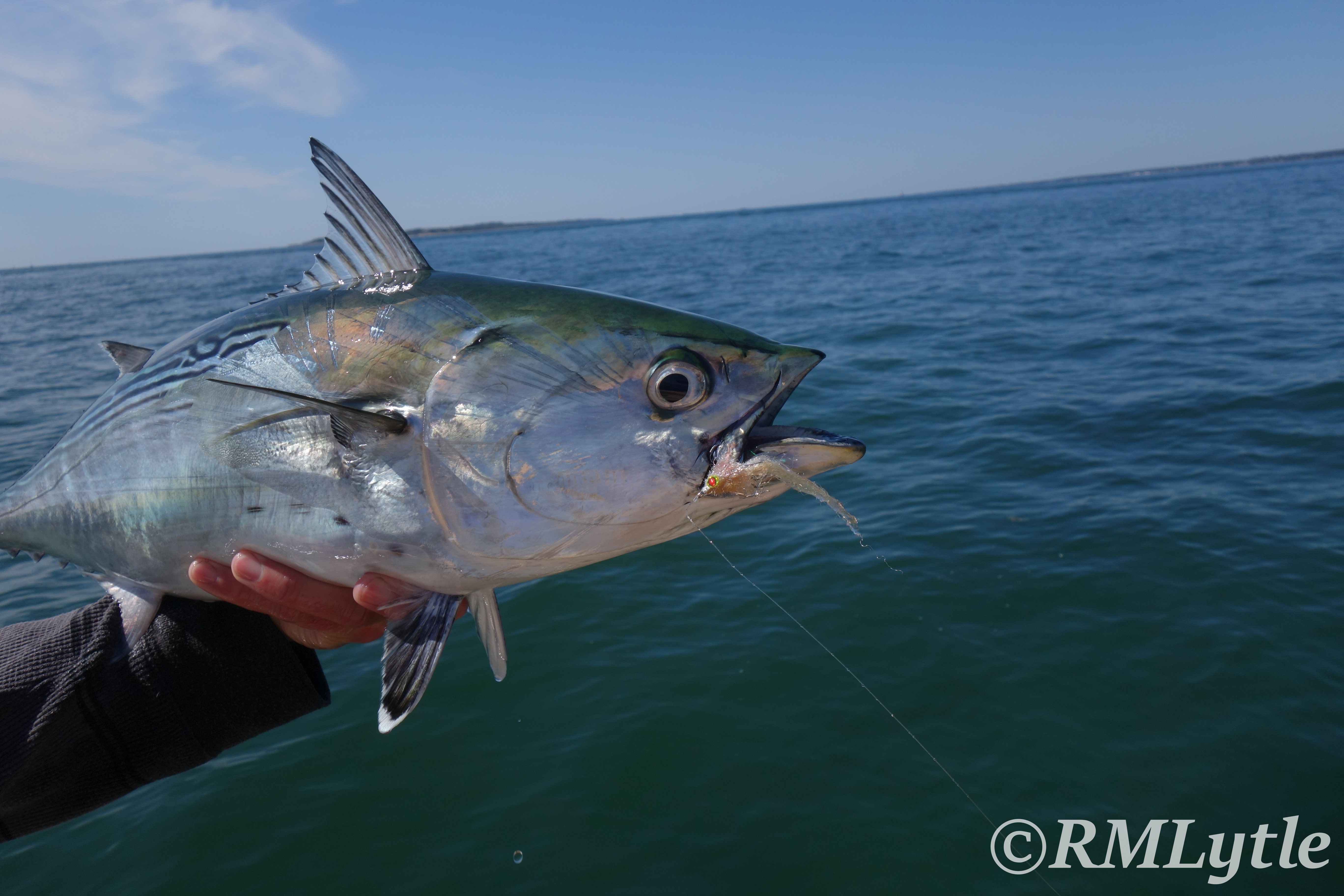
 I'm not hardtail obsessed. I have been from time to time over the last six years, but I've found that I actually fish them better if they're more of an aside to my late summer and fall season rather than the main course. I'm a striped bass guy. They appeal to me more. I like large flies, large baitfish, and huge brutish stage fish that will hold a spot and work it. I also like night fishing. I feel as comfortable wading into a boulder field at night as I do sitting at my desk typing this chronicle out. That's my fish. Morone saxatilis and I were made for each other. Little tunny can honestly get a little boring to me. For many seasons, they've meant standing on the same five or six rocks across southern Connecticut and Rhode Island for hours at a time casting my arm off for fish that all ate more or less the same way, all on quite small flies, looked the same, and were only a few pounds larger or smaller than each other. There's no way to get an edge over other hardtail chasers to catch bigger ones, just more of them... and I'm just not a numbers guy. But there's undeniable thrills there too. I find immense satisfaction in the take and hookup. I fish near and on-surface flies and floating lines a lot unless conditions force my hand in using an intermediate or full sink. That means nine times out of ten an albie is breaking the surface to eat my fly. Gurglers are by far my favorite method, and damned deadly too. I'm far from the first to throw these flies at hardtails. In fact Jack Gartside had a gurgler variation tailored specifically to them, and Alan Caolo has talked up their effectiveness as well. It may be one of the best albie flies there is. When a little tunny pile drives a Gurgler and the line tightens in my hands, it feels like everything is right in the world. 

Early in the 2023 season I found myself on the bow of my good friend Mark Alpert's Amesbury Dory watching acres of crazed albies mowing down anchovies under the shadow of an iconic Southern New England lighthouse. It was the perfect day. The weather was gorgeous, and though a fair number of other anglers and boaters were out there were ample fish for everyone and in rare form, I didn't see anyone acting like a complete buffoon, plowing into fish, or cutting off other boats. It bordered on miraculous, with visual spectacle to match. Bright green and chrome reflections cut through the light chop, with rust colored anchovies spraying in their desperate attempts to evade the lightning fast predators. Frantic gulls added another auditory element beyond the impact like sounds of feeding fish and the excited voices of other anglers. Mark and I were privy to quite a show that day. And though the fish weren't the easiest, I was able to get them to eat the gurgler with exceptional regularity, even blind casting along travel routes when they weren't actually showing. 


It was my first day putting my Orvis Helios 3D 8wt that Shawn Combs extremely generously passed along to me to a really solid test on hardtails. One summertime bonito and a few chub mackerel didn't really give it the complete range of necessary tasks. It was a wonderfully precise bit of weaponry for little tunny sniping and very enjoyable to battle these late summer speed demons with. 


After the gurgler party east of the point began to fizzle, we ranged out looking to find more concentrated action. The reward was a mix of bass and albies feeding in a more delicate manner, less interested on the smaller bay anchovies. I took the opportunity to fiddle with a fly I'd been developing over the past two seasons, a sort of hybrid derivation of Dave Skok's White bait Mushy but with a stiff spine rather than Softex, and a body form and tying method inspired by Jonny King's Kinky Muddler. The fly rarely ever fouls (never at all if tied right), has an extremely natural profile from all sides, and has a great action in the water. I'd put it to the test on small bait blitzes of striper earlier in the year and found myself tight to fish any time I landed the fly close to breaking fish while other boats struggled, but given the fly's intent being tunoids it needed to work this time too. And it did. A memory that will forever be burned in my brain from that day was watching an albie race a group of striped bass to the fly and inhale it boat-side. I was forced to trout set at close range but got a great corner hookup and was treated to yet another quick ride into the backing. 


Outside of enjoying days on friends' boats, I only had a couple other goals for the 2023 albie season, those being to catch little tunny with my feet on sand, avoid fishing popular and ever more crowded spots, and catch more fish in new places or old places I'd been snubbed at in previous seasons. My motivation was driven by the growing popularity and changing culture around this fishery along with my own conviction to learn new things in new places. I've only been shore-based albie fishing for a short 5 years, but somehow that half a decade is enough to see changes in the game. My first season, I was being dropped off and could only get to locations I could walk to from a centralized relatively well known spot. On multiple occasions I had that place to myself for prime windows, and even when I didn't the etiquette was a bit different from what it has shifted toward. One day, I was struggling on a less than ideally positioned rock when one of the OG's, after getting three fish in fairly short order, reeled up and said "You're up, kid". That set a bit of a precedent and was a good lesson. Admittedly I've had my moments of greed, but I try my best to not be a camper and yield a hot rock if the next guy down the line isn't catching just because he isn't standing in the right spot that day. I also recognize that as a younger and more physically able angler, I could easily take up easy standing space from less able bodied folks in popular accesses, and don't feel that doing so is respectful or fair. A twenty or thirty something with good balance doesn't need to have the flattest, driest rock with the easiest cast into the travel lane. So this year I set out to fish other places and probably caught fewer fish than I otherwise would have as a result. That's okay. I fished with the people I wanted to fish with and had a better overall experience. I don't say any of this to denigrate those that fish the well known places, but I do want some anglers to rethink the way they go about this fishery and frankly fishing in general. More respect needs to be shown toward the locations, the fish, and the people that were out on those same rocks before us young guys even knew what a false albacore was. 

It all come together one morning when John Kelly and I met before sunup on a lonely beach that some schools of little tunny had been visiting with some consistency. The day before John had a couple fish to hand, and even with a late day arrival I had a couple shots. We knew there'd be fish, it was just a matter of being patient and making the shots. Sure enough, as the sun crested the horizon some splashed began to disrupt the otherwise only gently wind rippled surface. And then they were in front of us. John hooked up first. 

I've become more and more of a beach fishing addict over the years. Walking the open sand with a fly rod in hand is inherently contradictory; taking on the ocean and its predatory species with what is generally considered very light tackle (whether that actually portrays the real power a fly rod can have as a fish fighting tool is another story) feels at times like a David and Goliath situation. Though little tunny are far from goliath both in name and stature, they are quite a fish to tackle with light fly gear. The gentler slope of a beach adds even more to the fight. Unlike fish hooked from boats, jetties, or rock ledges, there's less opportunity for the fish to dive, making their runs a bit longer and faster than they otherwise would be. Add to that the mystique of catching a truly pelagic species- a tuna -just yards from the beach in a few feet of water and the pursuit of beach tunny becomes very appealing. John's fish came to hand after the predictable battle, and we took a quick moment to photograph it in the grey morning light. 

Not long thereafter, a group of fish came in toward me at an angle. I waited as they breached closer and closer, then fired a shot that I felt should lead them perfectly and began slowly two hand retrieving. The lead fish ate my pink minnow and tore off. A big gob of tangled line came out of the stripping basket and caught up in the first guide which resulted in a breakoff. I re-rigged, frustrated but not dejected, and looked in my fly wallet for the next soldier. A Gummy Minnow, incidentally given to me by John months prior, jumped out. The next time a pod of albies broke in range I got that Gummy in the right spot and one ate. 

Photo Courtesy John Kelly

That was a special fish for me for a number of reasons, very high on the list being that it was the first I'd managed to get to hand on the very first strip of sand I'd ever fished little tunny from. Back in 2017, after being dropped off to go about my own devices one September day, I opened my phone to look for new options after an unproductive few hours on ledges. I saw an appealing looking spot and I walked there. It was quite a long walk on a very hot day, though over that season I'd end up learning miles of shoreline on foot. I knew getting albies from sand beaches with a fly rod was a tall order, but within my first 15 minutes I had one boil on and refuse my fly. To redeem myself six years late was a huge sigh of relief. 

As the season rolled on, it continued to be productive. I went at my leisure, focusing on other fisheries most days. A few more good boat trips were had: most notably, one with my good friend Mark Phillipe. We were surrounded by feeding little tunny most of the day. The bait was absolutely miniscule, like metal shavings in the water, and the formation feeding fish demanded exceptional patience, numerous presentations, and the understanding that imitating the bait was not possible nor beneficial in order to catch. The task was much easier with a camera. The slow, deliberate feeding method these fish we performing in the slicks made for incredible visuals all day. 


   I did manage one fish that day, early of out of a large formation feed. I'd made a quick reaction cast at the right angle to their path of travel and once again my pink minnow fly drew a strike. Later it got taken a second time, putting me and 1 for 2 and Mark at 0 for 1 that day. It was tough, but certainly worthwhile. 


Not more than a couple days later I found myself on the beach again, this time with Garth. The feeding patterns were very similar to what Mark and I had experiences, but right in tight to shore. The bait the albies were feeding on was so small that adult silversides were actually eating it as well. I managed to lead a small pod of fish that came down the beach from my left, a perfect cast, and sure enough one ate the fly but I turned my body as I strip set and pulled the fly out of its mouth. A bit frustrated with that missed opportunity and the progressively smaller number of fish showing themselves, I made my way to a jetty. One the slack side, one decent pod was periodically coming in a feeding ravenously on snapper blues. It would have been a perfect opportunity at a very easy bite and they were clearly larger fish as well, but they stayed out of range save for one brief moment. On the opposite side, fish occasionally rolled as they swam past on their travel lane. These would be much harder to feed. Eventually I saw one rolling at 50 foot intervals and on course to get within range. I carefully times my cast, timing the rolls and realizing it would stay down went it got perpendicular to me. I waited for the closest roll I expected it to make then fired a 90 foot cast just beyond its track and began slowly twitching the fly. Sure enough, right when I expected their paths to cross the fish came to my fly. Though it was a very small fish, that one ranks amongst some of my most satisfying presentations and catches. 


As the day continued we'd find more fish and other locations, but a combination of exhaustion from a full night of cow hunting prior and a plethora of tautog fisherman in inconvenient location prevented us from fully taking advantage. Still, after quite a few years of poor albie fish close to home, fits and starts, fish arriving in mass then leaving just a couple weeks later, and getting frustrated with ever increasing crowds, it was just nice to have fish in front of me at a favorite location that doesn't fish well all the time but well enough to make it worth staying away from the hungry masses for. 


As the season continued to progress toward its end, I'd make it out a few more times here and there. Each trip presented interesting challenges and spectacular small bait ram-feeds. One particular day with Mark Alpert features some of the most spectacular and long lived feeds I've ever had the privilege to watch. Not only were the fish hard to feed though, but boat motion almost always made it tougher. We'd position upwind of the fish, and given  their uni-directional feeding you needed to lead them head on and pull the fly in the same direction they were going. I ended up going 0 for 3, because by the very nature of that presentation managing slack was absurdly difficult. Both boat and fish were traveling quickly towards each other each time I got bit and coming tight in that situation, with added heavy chop rocking the boat, isn't easy. Given how much everyone was struggling to catch during that time frame though I was just happy to convince those fish to eat. Can you guess which fly? Oh man, and was the photography ever special. 


Ya know, I really do love those stupid little fish. 2023 was a good season for them, from my perspective. I fished for them about as much as I wanted to, which wasn't much compared to some years (42 days in 2021, 12 days this year). I avoided crowds entirely and only fished with the small handful of people I really wanted to, sharing great memories with some of the best friends this obsessive passtime has allowed me to make over the years. I didn't have to see the scourge of insta heroes horribly mishandling albies just for a photo op. I only kept one fish that John had bleed out on him and it was one of the best tasting little tunny I've ever had.  I finished development on a new fly that seems to work really darned well. I captured both beautiful fish and compelling imagery. When all is said and done I feel very content with the 2023 albie season. 


Thank you to my Patrons; Erin, David, John, Elizabeth, Brandon, Christopher, Shawn, Mike, Sara, Franky, Geof, Luke, Noah, Justin, Sean, Tom, Mark, Jake, Chris, Oliver, oddity on Display, and Sammy for making Connecticut Fly Angler possible. If you want to support this blog, look for the Patreon link at the top of the right side-bar in web version.