Showing posts with label Snakehead. Show all posts

Saturday, September 14, 2024

Gotta Be a Mango Tree Here Somewhere

 The rumble of the Honda 2.3 disturbed the cool, foggy south Jersey morning as Joe Cermele navigated his Clackacraft up a winding, murky river. In the front was Drew Price, wearing the weary, somewhat tired, but a little bit hopeful mask that anyone has on after three days of doing little other than fishing. I had the same mask on. We'd fished hard in my neighborhood for two days leading up to this. It had been pretty good, too, and I'd managed to get Drew on 11 new species and hybrids on the fly in all sorts of water, from mile long jetties to tiny cemetery ponds. There were some notable chunks of inactivity but there are pretty much any time you voluntarily fish for about 14 hours straight two days in a row. 

Fishing that hard can be a bit of an unfamiliar concept to many folk that call themselves fisherman. Even avid fisherman aren't frequently fishing that hard. There's probably the healthier way to fish anyway, here and there for a few hours throughout the week or some long hard trips scattered through the year. Drew and I beat ourselves up, this wasn't the first time. Last fall I drove up to Vermont to fish with Drew on a boiling hot day after he had a client, pounded big bowfin that afternoon, beat up drum the next day, floated for musky the day after that, I went out on my own and stuck a nice one on foot the day after that, drove to Saranac Lake the next day, I slept in my 4Runner next to the Ausable that night and fished in the Adirondacks all day the next day, then went back to Drew's area to microfish....

Fishing hard this way isn't great for the body or the mind, and I'm not quite sure we do it. A focused angler may not drink as much as they should, or will miss a meal here and there. When we do eat, it isn't infrequently absolute garbage. We may apply sunscreen at the start of the day, or wear good protective clothing, but there's always something exposed that gets singed. On this trip it was my lips. They felt and looked more or less like a desert watering hole in a drought. I was applying chapstick prodigiously but it wasn't saving it. As I type this some cracks and cuts are still there. 

All that hard fishing was the lead in to this river, and a highly intriguing target species. The catch that started it all happened in Crofton, Maryland in 2002, tipping of fisheries biologists to the start of an invasion. Soon the media was running with it, building a mythical reputation around the species, one that almost matches fear mongering in current events. No, Channa argus won't climb out of the Potomac and eat your pet Chihuahua. Invasive fish are certainly not joke, and the northern snakehead should never have ended up in the waters of the Mid Atlantic states. But the media ran with it and ran hard, while other arguably more impactful invasives didn't get nearly the amount of press. I wasn't hearing rumors about blue catfish climbing into people's lawns with evil intent.... 

Northern snakehead did spread, and certainly hurt native species, but along the way they've attracted quite an angling following. Joe Cermele is one such devote of the snake, as evidenced by his profile image image as Fishing Editor for Outdoor Life and in the many media forms he's presented over the years, from video to articles to podcasts. Cermele is ate up with the snakeheads. And he really wanted Drew and I to see just why it was he was so taken with these invasive fish.

We had completely unearned hope in the boat that morning. As anglers, if we can't be optimistic what do we have? The mist rose off the water in cool tendrils as the light of the new day shot across the sky in yellow and orange. Piscivorous birds lingered on the banks and dead trees until the rumble of the motor was too loud for them to abide. Gentle ripples and swirls emanated from surfacing gizzard shard. Carp bubbled, rolled and tailed along the banks. It was quiet but lively away from the main artery of the turnpike and the grime and garbage that lined it. This all felt very Apocalypse Now, though we cracked lines from a drift boat, not a PBR, and instead of Colonel Kurtz the foe we hunted with extreme prejudice was a fish with an elongate dorsal fin, narrow face, and ornate, python like patterning along its flanks. 


 I flexed my fingers as I watched a great blue heron take off from its morning hunting spot. My hands didn't quite feel all there after one day of making cast after bank pounding cast, and looking down I flexed each finger one at a time. I regretted fly line choices, as the floating line I'd brought wasn't quite short and punchy enough in the head for this sort of fishing. It had made me work harder and both my callouses and muscles felt it. I acknowledged this with some indifference and looked back up to the bank, eyeing bits of structure that could hold what we were looking for. Some edges held an almost clover like vegetation that stuck up from the water's surface on short one to four inch stems, bright green and tightly packed, looking like the perfect place for a notorious predator to lurk. The streaking, out-of-nowhere strike of an angry snake was hard to picture but easy to want in that moment. The day before we'd seen but two fish, and only one of them had bothered to move to a fly and had done so only tentatively. Their lack of interest in all of our offerings and seeming absence from most of the water that should have held was a source of frustrating bewilderment for Joe, and Drew and I just had to follow the lead given our lack of experience. Yet we were still optimistic as we started again... why? We always are, each fresh start makes a fisherman feel like things are new and fresh. And they are, to some extent. But if we'd really thought about it, this day wasn't so different. The night was about as cool, the forecast high was the same. The barometric changes were there but minimal and the wind would kick up from the same direction. The moon was only a day advanced and the flow and water clarity was the same. The only real change was an early start, which Joe admitted rarely factored into snakehead success. 

When he'd gotten where we needed to be, Joe cut the motor, got in the rowers seat and Dre and I began pounding banks with loud topwater flies once again. Signs of life were positive and it wasn't long before a few largemouth bass showed interest. 

But that was just a tease. This day would beat us into submission too. We torture ourselves sometimes. I'm not quite sure why. 

 Thank you to my Patrons; Erin, David, John, Elizabeth, Brandon, Christopher, Shawn, Mike, Sara, Franky, Geof, Luke, Noah, Justin, Sean, Tom, Mark, Jake, Chris, Oliver, oddity on Display, Sammy, and Cris & Jennifer, Courtney, and Hunter for making Connecticut Fly Angler possible. If you want to support this blog, look for the Patreon link at the top of the right side-bar in web version.

Monday, December 3, 2018

Sticking Hard-Mouthed Fish with the Fly Rod

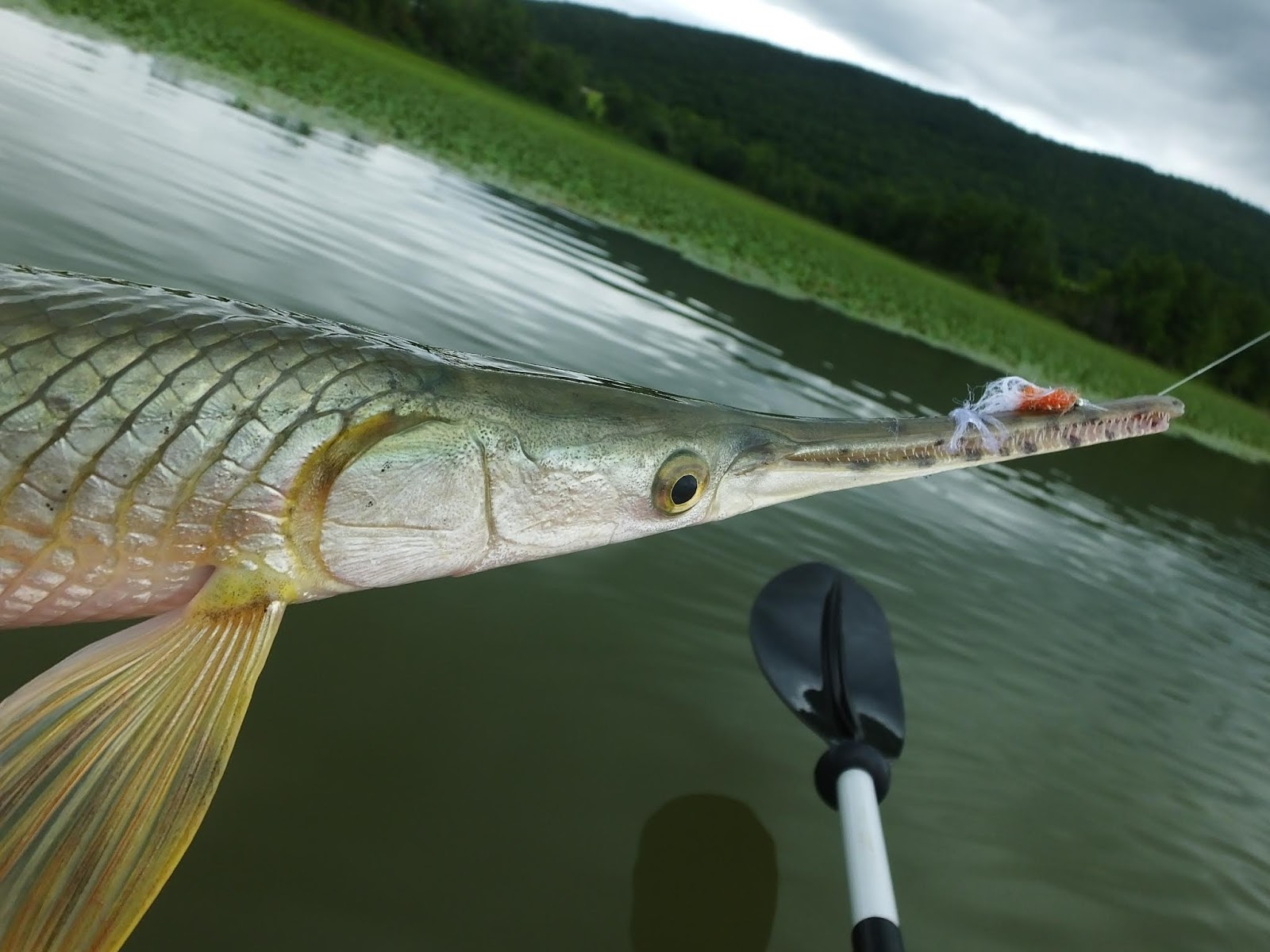
I have become a bit dinosaur obsessed in the last year. Not the extinct variety (though those are wicked cool), the fish variety. Gar. Bowfin. Snakeheads. There is very little in freshwater that I have become more interested in recently than these armor plated, bony mouthed, prehistoric fish. They fascinate me endlessly. I have a life goal revolving around these fish: catch at least one of every gar species and one of every snakehead species on the fly. I am much closer to my gar goal with both Florida and longnose gar under my belt; I haven't caught either northern or bullseye snakehead yet but I will. To get the rest of the snakehead species I will have to go to Southeast Asia. And I promise I will before I die. But bowfin are very similar in behavior and shape to snakeheads, so I can shed some light on hooking them even though I personally haven't yet.

This is not a guide to finding these species. It isn't a guide to specific fly patterns. It isn't about presentation either. This is a guide to how to make sure, if you are going to target these species, that you can do the single most important thing after the fish eats: Get them stuck and stuck good. Because driving a hook into these specie's rock hard mouths can be very difficult, sometimes even impossible. This is...

RM Lytle's Complete Guide to Stickin' Gar, Bowfin, and Snakeheads 


KEEP YOUR HOOKS SHARP

There are no excuses. If your hooks are dull you are going to blow that shot at the gar, 'fin, or 'snake of a lifetime. Buy sharp hooks and sharpen them after each use. You should already be carrying a hook hone with you. If you aren't, get one. Snagged in a log? Sharpen that hook. Hit a rock on the backcast? Sharpen that hook. Just caught a good fish? Sharpen that hook. It should be so sharp that it only takes minimal pressure on the point with your finger tip to make you bleed... but I don't recomend doing that on purpose, so test it on newspaper instead. It the barb doesn't bury in a rolled up newspaper with one sharp pull... sharpen that hook. 


KEEP YOUR HOOKS STOUT, BUT NOT TOO STOUT

This is not the scenario in which you want some sissy aberdeen hook. It's also not the scenario straight up shark hooks either. You need a hook that is thin enough in diameter to bury in cartilage with one big swing or a few strip-sets, and stout enough to put up with being chomped on by some of the toughest jaws of any freshwater fish all the while being pulled on really hard with heavy tippet and a heavy rod. One of my favorite hooks for this application is the Tiemco TMC811S. They come real sharp out of the package, maintain that sharpness well, and set into a bony fish's mouth with relative ease. 


ALL ABOUT THAT TREBLE

Flies with treble hooks are probably not a common product in your local shops, but you may want to consider tying some if you intend to target gar species other than longnose. Don't go really big, Just use a size 8 treble and a 28mm Chocklett's Articulated Big Game Shank to tie your fly. Once again, make sure you keep those points needle sharp. 


GO SMALL

So you aren't about trebles, that's okay too. Go small if you want a better chance to stick Florida or spotted gar. Use an articulated fly or topwater with two size 10's, 8's, or 6's. These small hooks will bury with less effort than a big hook, and these smaller gar species aren't going to bend them out. They'll eat almost anything anyway, I actually got a few to eat small nymphs in the Tamiami canal and they stayed stuck far longer than any that took a big streamer. In fact, had I not gone down to a very small fly I doubt I would have caught even one. 


SHORT LEADER, HEAVY TIPPET

There's no sense in trying to hide your leader from these fish, they're so tough and gnarly they don't even care. Instead, tie up a short very strong leader that will stand up to the strain of a really hard hook set. A five foot leader to 20lb tippet will do exactly that. Fluorocarbon is preferable for subsurface presentations, especially since all these fish are very toothy and will abrade your line, but I use Trilene big game any time I'm fishing topwater since it floats and is dirt cheep. I have not yet had a bowfin or gar bite off, but I have had to change tippets after landing them. 


RODS WITH BACKBONE

Don't screw around with light rods for these fish either. If you want to stick them well, use a rod with backbone. Rods in 8, 9, and 10 are appropriate, even though it would be possible to fight these fish effectively with a 6wt (hell, I got my first gar on a 5/6 glass rod). But at close range I've found a hard set up and to the side is optimal, and a noodle glass rod or super slow action graphite won't provide the brute force I want. An 8wt is ideal for small gar an bowfin. For larger gar, big bowfin, and snakeheads, a 10wt is not at all overkill. And for real monsters like alligator gar, a 12wt or even a 14 or bigger is ideal. Fast action graphite with a good comfortable fighting but and a lot of pulling power will help you drive that hook home. 


STRIP UNTIL YOU CAN STRIP NO MORE

All of these species hold onto the fly after they'v eaten it. Unlike a trout mouthing bits of organic matter, nymphs, and other junk in the drift and spitting half of it back out, a bowfin or snakehead or gar has already decided that your fly was food before it put it in its mouth, and it's going to keep it there for a little while. Give the fish a second to really suck it down. Then strip set like you're trying to bury that hook into a cinder block and don't stop until the fish forces you too. You may have to tape your fingers after four or five fish, so be it. This is just what you have to do. When sight-fishing bowfin or snakeheads in the weeds or on fry balls this won't really fly. Instead, got straight up Jimmy Houstan on that sucker, cross his eyes and cross them good. Sweep that rod back and to the side and strip hard at the same time. 


DON'T EVEN USE HOOKS

So, longose gar are a little bit special in this realm. You probably won't hook one, so don't try. Not only is their snout bony as hell, it's so skinny their's not much between the inside of  the mouth and the outside of the mouth for a hook to encounter. Instead of frustrating yourself trying to actually hook one, Use rope flies. Nylon rope and other fine-fiber materials tangle in a longnose gar's many needle-like teeth, acting almost like velcro. I would't forgo the hook entirely, but not because it might stick in a gar... you don't want to miss out on the bass of a lifetime because it came along and sucked down a hookless gar fly. When a gar eats a rope fly, just let it toy with it for a couple seconds to get the fibers all nice and tangled in its teeth, then lift the rod gently to begin the fight. You'll want both a jaw spreader and pliers to get a longnose gar unstuck, not only for your safety but because letting one swim off with a bunch of nylon stuck in his teeth is just rude.
For for big spotted, Florida, and alligator gar, rope flies won't work nearly as well though.


NO STRETCHING!

There's no room in this game for a stretchy fly line. Use a floating line with a strong core. Less than supple is not a problem fishing for these species as the water is rarely cold enough to make your coating even more stiff and prone to tangling. You want is little give as possible. I, personally, am still looking for the optimal line for this fishing, but I've gotten much closer with Airflo.  


LOST FISH ARE A PART OF THE GAME

When you fish for bowfin, gar, and snakeheads, you are going to miss and loose fish no matter how sharp your hooks are, no matter how hard you set, no matter how perfectly tuned your gear is. It is just a part of the deal. Get over it, get back to fishing, and put every ounce of available effort into sticking the next one. 

Stick them hard. 

If you enjoy what I'm doing here, please share and comment. It is increasingly difficult to maintain this blog under dwindling readership. What best keeps me going so is knowing that I am engaging people and getting them interested in different aspects of fly fishing, the natural world, and art. Follow, like on Facebook, share wherever, comment wherever. Also, consider supporting me on Patreon (link at the top of the bar to the right of your screen, on web version). Every little bit is appreciated! 
Thanks for joining the adventure, and tight lines.