I'm not hardtail obsessed. I have been from time to time over the last six years, but I've found that I actually fish them better if they're more of an aside to my late summer and fall season rather than the main course. I'm a striped bass guy. They appeal to me more. I like large flies, large baitfish, and huge brutish stage fish that will hold a spot and work it. I also like night fishing. I feel as comfortable wading into a boulder field at night as I do sitting at my desk typing this chronicle out. That's my fish. Morone saxatilis and I were made for each other. Little tunny can honestly get a little boring to me. For many seasons, they've meant standing on the same five or six rocks across southern Connecticut and Rhode Island for hours at a time casting my arm off for fish that all ate more or less the same way, all on quite small flies, looked the same, and were only a few pounds larger or smaller than each other. There's no way to get an edge over other hardtail chasers to catch bigger ones, just more of them... and I'm just not a numbers guy. But there's undeniable thrills there too. I find immense satisfaction in the take and hookup. I fish near and on-surface flies and floating lines a lot unless conditions force my hand in using an intermediate or full sink. That means nine times out of ten an albie is breaking the surface to eat my fly. Gurglers are by far my favorite method, and damned deadly too. I'm far from the first to throw these flies at hardtails. In fact Jack Gartside had a gurgler variation tailored specifically to them, and Alan Caolo has talked up their effectiveness as well. It may be one of the best albie flies there is. When a little tunny pile drives a Gurgler and the line tightens in my hands, it feels like everything is right in the world.
Early in the 2023 season I found myself on the bow of my good friend Mark Alpert's Amesbury Dory watching acres of crazed albies mowing down anchovies under the shadow of an iconic Southern New England lighthouse. It was the perfect day. The weather was gorgeous, and though a fair number of other anglers and boaters were out there were ample fish for everyone and in rare form, I didn't see anyone acting like a complete buffoon, plowing into fish, or cutting off other boats. It bordered on miraculous, with visual spectacle to match. Bright green and chrome reflections cut through the light chop, with rust colored anchovies spraying in their desperate attempts to evade the lightning fast predators. Frantic gulls added another auditory element beyond the impact like sounds of feeding fish and the excited voices of other anglers. Mark and I were privy to quite a show that day. And though the fish weren't the easiest, I was able to get them to eat the gurgler with exceptional regularity, even blind casting along travel routes when they weren't actually showing.


It was my first day putting my Orvis Helios 3D 8wt that Shawn Combs extremely generously passed along to me to a really solid test on hardtails. One summertime bonito and a few chub mackerel didn't really give it the complete range of necessary tasks. It was a wonderfully precise bit of weaponry for little tunny sniping and very enjoyable to battle these late summer speed demons with.


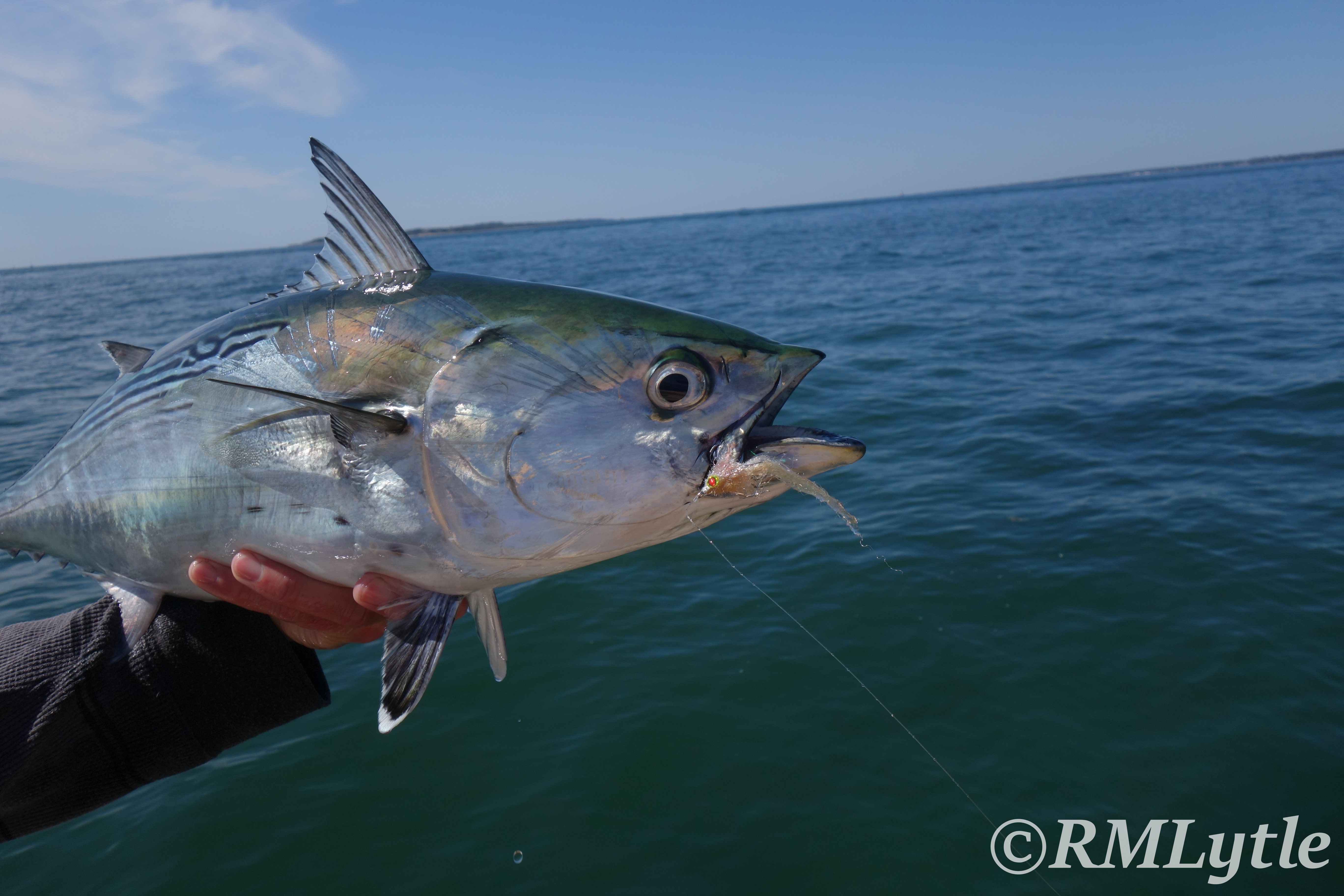
After the gurgler party east of the point began to fizzle, we ranged out looking to find more concentrated action. The reward was a mix of bass and albies feeding in a more delicate manner, less interested on the smaller bay anchovies. I took the opportunity to fiddle with a fly I'd been developing over the past two seasons, a sort of hybrid derivation of Dave Skok's White bait Mushy but with a stiff spine rather than Softex, and a body form and tying method inspired by Jonny King's Kinky Muddler. The fly rarely ever fouls (never at all if tied right), has an extremely natural profile from all sides, and has a great action in the water. I'd put it to the test on small bait blitzes of striper earlier in the year and found myself tight to fish any time I landed the fly close to breaking fish while other boats struggled, but given the fly's intent being tunoids it needed to work this time too. And it did. A memory that will forever be burned in my brain from that day was watching an albie race a group of striped bass to the fly and inhale it boat-side. I was forced to trout set at close range but got a great corner hookup and was treated to yet another quick ride into the backing.

Outside of enjoying days on friends' boats, I only had a couple other goals for the 2023 albie season, those being to catch little tunny with my feet on sand, avoid fishing popular and ever more crowded spots, and catch more fish in new places or old places I'd been snubbed at in previous seasons. My motivation was driven by the growing popularity and changing culture around this fishery along with my own conviction to learn new things in new places. I've only been shore-based albie fishing for a short 5 years, but somehow that half a decade is enough to see changes in the game. My first season, I was being dropped off and could only get to locations I could walk to from a centralized relatively well known spot. On multiple occasions I had that place to myself for prime windows, and even when I didn't the etiquette was a bit different from what it has shifted toward. One day, I was struggling on a less than ideally positioned rock when one of the OG's, after getting three fish in fairly short order, reeled up and said "You're up, kid". That set a bit of a precedent and was a good lesson. Admittedly I've had my moments of greed, but I try my best to not be a camper and yield a hot rock if the next guy down the line isn't catching just because he isn't standing in the right spot that day. I also recognize that as a younger and more physically able angler, I could easily take up easy standing space from less able bodied folks in popular accesses, and don't feel that doing so is respectful or fair. A twenty or thirty something with good balance doesn't need to have the flattest, driest rock with the easiest cast into the travel lane. So this year I set out to fish other places and probably caught fewer fish than I otherwise would have as a result. That's okay. I fished with the people I wanted to fish with and had a better overall experience. I don't say any of this to denigrate those that fish the well known places, but I do want some anglers to rethink the way they go about this fishery and frankly fishing in general. More respect needs to be shown toward the locations, the fish, and the people that were out on those same rocks before us young guys even knew what a false albacore was.
It all come together one morning when John Kelly and I met before sunup on a lonely beach that some schools of little tunny had been visiting with some consistency. The day before John had a couple fish to hand, and even with a late day arrival I had a couple shots. We knew there'd be fish, it was just a matter of being patient and making the shots. Sure enough, as the sun crested the horizon some splashed began to disrupt the otherwise only gently wind rippled surface. And then they were in front of us. John hooked up first.
I've become more and more of a beach fishing addict over the years. Walking the open sand with a fly rod in hand is inherently contradictory; taking on the ocean and its predatory species with what is generally considered very light tackle (whether that actually portrays the real power a fly rod can have as a fish fighting tool is another story) feels at times like a David and Goliath situation. Though little tunny are far from goliath both in name and stature, they are quite a fish to tackle with light fly gear. The gentler slope of a beach adds even more to the fight. Unlike fish hooked from boats, jetties, or rock ledges, there's less opportunity for the fish to dive, making their runs a bit longer and faster than they otherwise would be. Add to that the mystique of catching a truly pelagic species- a tuna -just yards from the beach in a few feet of water and the pursuit of beach tunny becomes very appealing. John's fish came to hand after the predictable battle, and we took a quick moment to photograph it in the grey morning light.

Not long thereafter, a group of fish came in toward me at an angle. I waited as they breached closer and closer, then fired a shot that I felt should lead them perfectly and began slowly two hand retrieving. The lead fish ate my pink minnow and tore off. A big gob of tangled line came out of the stripping basket and caught up in the first guide which resulted in a breakoff. I re-rigged, frustrated but not dejected, and looked in my fly wallet for the next soldier. A Gummy Minnow, incidentally given to me by John months prior, jumped out. The next time a pod of albies broke in range I got that Gummy in the right spot and one ate.
_1.jpg) |
| Photo Courtesy John Kelly |
That was a special fish for me for a number of reasons, very high on the list being that it was the first I'd managed to get to hand on the very first strip of sand I'd ever fished little tunny from. Back in 2017, after being dropped off to go about my own devices one September day, I opened my phone to look for new options after an unproductive few hours on ledges. I saw an appealing looking spot and I walked there. It was quite a long walk on a very hot day, though over that season I'd end up learning miles of shoreline on foot. I knew getting albies from sand beaches with a fly rod was a tall order, but within my first 15 minutes I had one boil on and refuse my fly. To redeem myself six years late was a huge sigh of relief.
As the season rolled on, it continued to be productive. I went at my leisure, focusing on other fisheries most days. A few more good boat trips were had: most notably, one with my good friend Mark Phillipe. We were surrounded by feeding little tunny most of the day. The bait was absolutely miniscule, like metal shavings in the water, and the formation feeding fish demanded exceptional patience, numerous presentations, and the understanding that imitating the bait was not possible nor beneficial in order to catch. The task was much easier with a camera. The slow, deliberate feeding method these fish we performing in the slicks made for incredible visuals all day.
I did manage one fish that day, early of out of a large formation feed. I'd made a quick reaction cast at the right angle to their path of travel and once again my pink minnow fly drew a strike. Later it got taken a second time, putting me and 1 for 2 and Mark at 0 for 1 that day. It was tough, but certainly worthwhile.


Not more than a couple days later I found myself on the beach again, this time with Garth. The feeding patterns were very similar to what Mark and I had experiences, but right in tight to shore. The bait the albies were feeding on was so small that adult silversides were actually eating it as well. I managed to lead a small pod of fish that came down the beach from my left, a perfect cast, and sure enough one ate the fly but I turned my body as I strip set and pulled the fly out of its mouth. A bit frustrated with that missed opportunity and the progressively smaller number of fish showing themselves, I made my way to a jetty. One the slack side, one decent pod was periodically coming in a feeding ravenously on snapper blues. It would have been a perfect opportunity at a very easy bite and they were clearly larger fish as well, but they stayed out of range save for one brief moment. On the opposite side, fish occasionally rolled as they swam past on their travel lane. These would be much harder to feed. Eventually I saw one rolling at 50 foot intervals and on course to get within range. I carefully times my cast, timing the rolls and realizing it would stay down went it got perpendicular to me. I waited for the closest roll I expected it to make then fired a 90 foot cast just beyond its track and began slowly twitching the fly. Sure enough, right when I expected their paths to cross the fish came to my fly. Though it was a very small fish, that one ranks amongst some of my most satisfying presentations and catches.

As the day continued we'd find more fish and other locations, but a combination of exhaustion from a full night of cow hunting prior and a plethora of tautog fisherman in inconvenient location prevented us from fully taking advantage. Still, after quite a few years of poor albie fish close to home, fits and starts, fish arriving in mass then leaving just a couple weeks later, and getting frustrated with ever increasing crowds, it was just nice to have fish in front of me at a favorite location that doesn't fish well all the time but well enough to make it worth staying away from the hungry masses for.

As the season continued to progress toward its end, I'd make it out a few more times here and there. Each trip presented interesting challenges and spectacular small bait ram-feeds. One particular day with Mark Alpert features some of the most spectacular and long lived feeds I've ever had the privilege to watch. Not only were the fish hard to feed though, but boat motion almost always made it tougher. We'd position upwind of the fish, and given their uni-directional feeding you needed to lead them head on and pull the fly in the same direction they were going. I ended up going 0 for 3, because by the very nature of that presentation managing slack was absurdly difficult. Both boat and fish were traveling quickly towards each other each time I got bit and coming tight in that situation, with added heavy chop rocking the boat, isn't easy. Given how much everyone was struggling to catch during that time frame though I was just happy to convince those fish to eat. Can you guess which fly? Oh man, and was the photography ever special.


Ya know, I really do love those stupid little fish. 2023 was a good season for them, from my perspective. I fished for them about as much as I wanted to, which wasn't much compared to some years (42 days in 2021, 12 days this year). I avoided crowds entirely and only fished with the small handful of people I really wanted to, sharing great memories with some of the best friends this obsessive passtime has allowed me to make over the years. I didn't have to see the scourge of insta heroes horribly mishandling albies just for a photo op. I only kept one fish that John had bleed out on him and it was one of the best tasting little tunny I've ever had. I finished development on a new fly that seems to work really darned well. I captured both beautiful fish and compelling imagery. When all is said and done I feel very content with the 2023 albie season.

Thank you to my Patrons; Erin, David, John, Elizabeth, Brandon, Christopher, Shawn, Mike, Sara, Franky, Geof, Luke, Noah, Justin, Sean, Tom, Mark, Jake, Chris, Oliver, oddity on Display, and Sammy for making Connecticut Fly Angler possible. If you want to support this blog, look for the Patreon link at the top of the right side-bar in web version.



_1.jpg)


