Showing posts with label Suckers. Show all posts

Wednesday, July 5, 2023

Impromptu Redhorse Hunt

 I was in Vermont for my younger brother's graduation, and only for a couple days. Fishing time was limited. My partner, Haley, was also with me. Options weren't as broad as they might otherwise be. Contingencies aside, when I'm somewhere I don't always get to be I'm going to fish at least a little. With finite time and a limited number of options within hitting distance, my friend Drew Price pulled through for me with a close to sure bet for shorthead redhorse. Having only caught one lone smallmouth redhorse in western Pennsylvania and being interested in the rest of the Moxostoma genus, this seemed as good an option as any. So I dragged my very tolerant girlfriend with me to a Lake Champlain tributary to look for a new species. 

Redhorse are a diverse genus of North American suckers that includes more than 20 distinct species. Moxostoma are spread across over a substantial chunk of the Eastern half of the continent. Like their other sucker relatives they are often underappreciated, poorly treated, and frequently badly managed by state fisheries agencies. As in all cases, I just don't get that- they're cool as hell. redhorse are native, they fight hard, live in beautiful rivers and creeks, are often hard to fool, and look darned cool. They don't taste half bad either. What isn't to love? Any time redhorse are an option I perk up. I adore targeting them on the fly and don't get to at all often enough. My confidence in success bordered on certainty given Drew's report and we jetted out the door the moment it looked like we might have time. The drive south to the tributary he suggested was about 45 minutes and we only had a few hours to work with so time was of the essence. 

The stream was a lightly-stained freestone over dark grey calcareous shale and blueish limestone from the Ordovician period. Where the stream cut to the bedrock, the step-like fractures allowed sand and gravel from different bedrock layers upstream to collect, and along with algae growth made the riverbed became a rainbow of pastel coloration. Some stretches meandered and featured deep pools with some mud bottom. I was keeping my eyes sharply peeled for any red tails waving in the riffles. The first fish I saw were big smallmouth bass on beds. I half heartedly presented a small Ausable Ugly to the first large one I saw and she ate. The fight was pretty intense as the fish tried to lodge under every large rock in the run. 

I continued upstream a little ways, catching a few more bass and a very large white sucker. It was nice to get a native species but I was getting a little worried that the redhorse had managed to make their way out of the system already since I wasn't seeing them. A text from Drew changed the trip... I'd gone the wrong way!

Counter to my instinct to walk upstream, we turned tail and headed down. It didn't take long to encounter a couple of pools absolutely packed full of redhorse. They stood out quite well in both the pools and the riffles, though I found the fish in the shallow fast water entirely too finicky. The pools were more comfortable territory though- I already know how to catch suckers holding in pools, that's pretty much my typical white sucker fishing scenario back at home. I rigged up with an indicator and left on the Ausable Ugly. The redhorse weren't exactly obliging, but after some time I did convince one to eat: another new species thanks to Drew. He's been responsible for two so far this year. 

Lifelist fish #190: Shorthead redhorse, Moxostoma macrolepidotum. Rank: Species

After bringing the lifelist up to 190, I relaxed a bit and went about enjoying the action. I caught three more shortheads; one with a couple hangers on in the form of sea lamprey. Unlike the ocean, where lamprey parasitize large fish that are capable of handling the the blood loss, in landlocked environments they can be a big problem to native species. I removed both lamprey from this redhorse accordingly. 


Presumably, as anadromous lamprey sometimes do, these guys had latched on to catch a ride up to spawning territory. If so it is remarkable how small they are to be of reproductive age. Of course the landlocked lamprey don't get anywhere near as big as their oceanic counterparts, which attain sizes in excess of 30 inches. 


After getting my fill of Moxostoma glory, we hustled back to get ready for graduation related events. Vermont has one other redhorse species to offer though, the greater redhorse. Perhaps next year I'll get to target them up there. Or, better yet, I get out to Pennsylvania again before then to target Moxostoma and a variety of other species again in the waters near where I was born. It's been a while since I had a dedicated lifelisting trip.


Thank you to my Patrons; Erin, David, John, Elizabeth, Brandon, Christopher, Shawn, Mike, Sara, Franky, Geof, Luke, Noah, Justin, Sean, Tom, Mark, Jake, Chris, Oliver, oddity on Display, and Sammy for making Connecticut Fly Angler possible. If you want to support this blog, look for the Patreon link at the top of the right side-bar in web version


Friday, March 3, 2023

Podded up Wintertime Suckers

 Suckers. Just the name alone has a complete lack of glamour. Who waxes poetic about the lowly sucker? Not enough people, if you ask me. White suckers are a fabulous and difficult fish, averaging larger than most trout in Southern New England. Plenty of times an angler will hook what they think is a large trout only to be disappointed by a modestly sized sucker. Why? That 16 inch sucker just fooled you into thinking you had a 22 inch brown trout! Imagine what the 22 inch sucker will feel like.... Well, if you're very experienced you know that a sucker fights a bit differently from a trout. They twist and death roll more, and stay deeper generally.  Fighting aside, a lot of people think suckers are ugly. I tend to think describing any living organism as ugly is a very archaic and perhaps even immoral prescription. There is beauty in survival, and when I think about the form and function of any living fish I feel the same deep feeling that life is beautiful. Suckers evolved in their environment to fill a nice, and their oft-thought unappealing head and mouth structure is a remarkable work of natural art, at least to me. Different species have very different shapes, be they longnose suckers, shorthead redhorse, river redhorse, or indeed our locally abundant white suckers. And then there's their coloration and scaling. White suckers look like they've adorned thousands of tiny pennies, shining copper under a late afternoon sun. They're a lovely fish, deserving of as much respect as any other. 

They're also infinitely more interesting to angle for than are hatchery trout. So it was that I dropped my plans completely one evening while doing some mono rig practice when I came across a large school of wintering suckers in a crystal clear deep pool. These fish would not be eating as readily as the holdover rainbows I'd been catching. I promptly made some rig alterations and tried to figure out how best to present to the school. The task was made difficult by a significant amount of ice and depth between myself and the fish. I opted to fish to them from below, though it was a little further away. I went through a quick rotation of flies before deciding that the fly wasn't as much of an issue as the presentation. I schlepped on an indicator and that problem was solved. it wasn't lock an load, despite the tightly packed school. It rarely is with suckers on artificials. But I started to pick off fish on a large Hare's Ear, their takes registering as gentle double and triple ticks on the indicator. 

A couple came up fouled, a regrettable but unavoidable aspect of fishing tightly packed sucker schools. Happily though, I managed a half dozen to hand hooked squarely in the upper lip. Funny enough I did rotate through some other flies, including a mop and some tiny pheasant tails, and the preference leaned decisively to the size 10 Hare's Ear. I tend to find that if suckers are being picky smaller in better, but it wasn't in this case this time. The key, especially in the winter, is having the fly roll right along the bottom. I was accomplishing that with ease with each fly by adding and removing small shot, though the hare's ear didn't need any. That may have been the difference maker. When I've been in position to closely observe the suckers I'm presenting to I've noticed that they'll move out of the way if they feel the tipped, and with a split shot rolling ahead of the fly they're far more likely to encounter the tippet before the fly makes it to them. This can be negated by utilizing the down and across technique often employed for Great Lakes salmon and steelhead, but I'd found this results in a higher percentage of snagged fish. 


I've fished intentionally for suckers for many years now, and on many a day found myself completely unable to convert opportunities even when there were large schools of them in front of me. Back in my formative years, we'd revert to snagging them. It was silly, but as kids there was this urge to see these weird, big-ish fish out of the water and hold them. When we found them much more picky and moody than the stocked trout, sunfish, and largemouth bass we were used to, we forced our will upon them  I feel bad for doing it now, of course. But I think it somewhat speaks to the intrinsic curiosity these fish resulted in. We'd see them plastered to the river bottom in so many of the places we fished, and just had to catch them. It wasn't until I started fly fishing that I had any thought of them being undesirable. The stupid, pointless hierarchy so common in fishing- that which sticks certain species on a pedestal while considering anything else as worthless trash -almost got to me. But the child-like curiosity won out, thankfully. Those odd, big fish plastered to the river bed still capture my imagination. All that really changed is that now I know how to properly catch them. 


Thank you to my Patrons; Erin, David, John, Elizabeth, Brandon, Christopher, Shawn, Mike, Sara, Franky, Geof, Luke, Noah, Justin, Sean, Tom, Mark, Jake, Chris, Oliver, and oddity on Display for making Connecticut Fly Angler possible. If you want to support this blog, look for the Patreon link at the top of the right side-bar in web version.

Tuesday, March 22, 2022

Spring Guide Season Update

 Everything is happening all at once at this time of year, really. I've been out here and there after whatever is most appealing to me that day. Today I was out salmon fishing, which has the biggest time limit as, at least in the Shetucket, the salmon seem to get weird right when the stocked trout go in. I had four grabs, one of which resulted in a break-off (don't let those wind knots go unchecked!). All took light colored flies: one a white bugger, the other three a white and black Sunray Shadow.  There's a big rain event coming so it'll likely be just this week and then done. If we're lucky and they hold off the trout stocking, maybe when it drops back down I'll open up a few days to clients. 
Suckers are on the move, and I've been targeting them when time avails. They're exceptionally easy at this time of year, very difficult in others. If you're interested in learning to target these tricky, hard fighting, and often large native fish, perhaps even looking to get a trophy fish pin or even beat a length record, the next three weeks are prime. Another often overlooked native is also exceptionally active right now. This is perhaps the best time of year to target very large chain pickerel, and I'll take clients for them as well. These are short windows for the big, big fish, so if you're looking for one don't wait.


Of course the truck trout are being dumped around the state now, much to my... eh, I'll leave the complaining for another day. You all know how I feel about hatchery trout as a fisheries management strategy and ecological problem anyway (if you don't you certainly will eventually). But they're here so we may as well stick some fur and feathers in their faces. The mouse bite is happening. Some years it starts in February. I'm talking about the daylight mouse bite, not the night bite... but that doesn't mean night fishing isn't going now too. It is, but it's focused on streamers and wet flies. However you're interested in targeting trout, be it at night, in daylight, on dries, on nymphs, on streamers, on mice, on wets... you name it, I'll do my best to put you on them. If I don't feel I'm the guy for what you're looking for I'm sure I know someone that is. 


On that note... Noah is now Captain Noah. He'll be starting to run trips on his new skiff very soon. If slamming perch, crappie, bass, carp, or bowfin on light spinning tackle or cane poles is more your thing, I can put you in touch with him. He and I were out last week after big panfish. He lost a monster yellow perch right at the dock, which was a bummer. Though we got some nice fish we didn't land any of the real monsters, but the numbers were certainly there. 


That leaves the two things that I guide for often that aren't really going that crazy yet: smallmouth bass and carp. We're on the cusp. It will get crazy, and it'll get crazy soon. I've already got guys waiting for smallmouth trips, so don't wait too long. I've gotten most of my really large smallmouth in April and May in recent years. With water temperatures approaching 50 in a lot of places already this promises to be an early season. Carp are moving shallow too, and like smallmouth early is better for the bigs.

Like I said, it all happens at once this time of year. Don't let the season pass you by!

Thank you to my Patrons; Erin, David, John, Elizabeth, Brandon, Christopher, Shawn, Mike, Sara, Leo, C, Franky, Geof, Luke, Streamer Swinger, Noah, Justin, Sean, Tom, and Mark for making Connecticut Fly Angler possible. If you want to support this blog, look for the Patreon link at the top of the right side-bar in web version.


Monday, November 1, 2021

Swinging New York Salmon

Spey casting for Great Lakes salmon and steelhead is kind of a fools errand. The fish aren't like native salmon, they leave a freshwater lake and enter a freshwater river... by the time they get in front of anglers they've mostly already gone though their transition into spawn-focused automatons. There's a reason you can find videos galore of Alaskan cohos smashing topwater flies and none of that from the Great Lakes. They're long done with that by the time they come in. There's also to many damn people. Even in the Douglaston Salmon Run. You can't really rotate when there's a dozen nymphers standing in the run, flogging the same water for hours. The fish also see more flies than any fish should ever have to see. If they were actually native, I'd have a huge problem with the ethics of it, but since they're introduced my problem with it is completely selfish- I want to fish for them the way I want to fish for them, and that just happens to be spey casting which requires room and the ability to cover water. 

So, all that said, there's no other way I'll fish for Great Lakes salmon and steelhead. Even if it's the hardest way. Hey, at least I know my fish ate when I hook one (yeah, I went there). There's very little better than that tight line grab, even if it only happens a few time in a whole day of fishing. 

Rick invited Charlie and I to go to Pulaski and fish the Douglaston Salmon Run again this fall. The weather was very different this go around. It was excessively warm for mid October, and that negatively impacted the fishing. We could easily have wet waded the water was so warm. The kings were around but a lot were entering the river less than fresh. Steelhead were far from numerous and mostly holding in very fast water. And there were of course lots of guys on the run as that week is often the peak, so space to swing was at a premium. I was lucky enough a few times to be able to rotate with a couple other spey casters or have enough water to myself to cover a bit of it before another angler slipped in in front of me, but I got a bit less lucky than last year. 

The fish I wanted most was an adult coho. I'd gotten my first swing steelie last fall and some juvenile cohos this winter. I really hoped for a big, chrome, fired up coho. I ended up getting just that. The fish ate a size 4 Ally's Shrimp and put on a fantastic fight. It was also properly chrome, more chrome I'd ever personally seen before. 


The next couple of fish were all ugly kings. One on an olive and black Intruder, one on a large grey Bugger, one on a Gartside Soft Hackle Streamer. They were in various states of decay. The freshest put up a ridiculous fight with loads of jumps before bolting downriver an forcing me to really reef on it to land it in a waste deep bank trough. 


The to most unusual and unexpected fish of the trip was a native species, a Northern hogsucker that grabbed a blue charm of all things. I love these goofy suckers and their odd black lip coloration. This was the first large one I've caught. My lifer was very small, caught in Western Pennsylvania last fall. This one was much more impressive.


For he next couple days, all I was able to get grabs from was kings, and not many kings at that. A couple of them were pretty seriously big at least. They weren't the best looking fish though. 


Rick and Charlie weren't spey casting and they weren't having fast fishing either. Charlie ended up being the hot hand though with unquestionably the best fish of the trip, and possibly a fish of a lifetime: a gorgeous chrome buck steelhead, a huge one, that took him on a hell of a ride. That's certainly the sort of fish I'd have loved to run into. Of course, I'll have more opportunities. I don't get out there much but I'm slowly figuring things out and refining my technique and fly selection. How many more times will I put up with all the nonsense? Probably way too many times. 


Until next time, 

Fish for the love of fish.
Fish for the love of places fish live.
Fish for you.
And stay safe and healthy.


Thank you to my Patrons; Erin, David, John, Elizabeth, Brandon, Christopher, Shawn, Mike, Sara, Leo, C, Franky, Geof, Luke, Streamer Swinger, and Noah for making Connecticut Fly Angler possible. If you want to support this blog, look for the Patreon link at the top of the right side-bar in web version.

Monday, April 19, 2021

White Sucker Insanity

 Every now and then I accomplish exactly what I want to. This is very, very rare, but it does happen. The spring sucker run had already been in progress for a little while when, on March 30th, I hit an absurdly good bite the likes of which I'd never seen before. My primary goal that day had actually been an abject failure: I'd been after fallfish, specifically large ones, and I'd not found anything remotely like what I was looking for in that regard. The day turned around the moment I came around one bend on the last stream I had on my hit list and found a run so full of suckers that I couldn't see the stream-bed at all. That wasn't even the only spot like that. Within about a hundred yards of creek, I may have seen over a thousand white suckers. And they weren't shy. I primarily indicator-nymphed, and that bobber dropped again and again. The bite was constant from the time I arrived until the time I left. There really were no lulls at all. It was the most insane white sucker fishing I've ever seen. 


Fat, egg laden females were followed by colored up, tubercle covered males. Each fish fought superbly: some jumped while others made mad dashes downstream. This was a small stream I was fishing, I could never hope to have an outing this action packed with any other species on water this size in CT. I was some of the most fun I've ever had with a fly rod in my hand, honestly. I was giddy. 


Most of the fish took a bead head Hare's Ear Soft Hackle. There was little need for me to bother changing as it never seemed to decrease in effectiveness at all. Maybe an egg would have worked better but I was hooking fish darn near every drift. I also discovered I had to set the hook very carefully to prevent repetitively snagging fish. The sort of quick, sharp set I use when trout fishing worked, but also snagged fish. A gentle lifting hook set stopped that entirely. It's essentially the same sort of hook set you'd use fishing for Great Lakes salmon with nymphs or eggs, for the same reason- snag prevention. 


By the time it was too dark to see, I'd caught more white suckers than I'd probably caught in my entire life prior. It had been exactly the sort of sucker fishing I'd hoped to experience this spring, and though I'll certainly be casting at some more before the run ends, I felt completely satisfied and was happy to move onto another major target species, a feeling I've gotten to enjoy only a handful of times over the years. Of course next spring I'll be checking back on logs to try hitting this sort of bite again, but until then, I'm on to the next fish. 

Until next time, 

Fish for the love of fish.
Fish for the love of places fish live.
Fish for you.
And stay safe and healthy.


Thank you to my Patrons; Erin, David, John, Elizabeth, Brandon, Christopher, Shawn, Mike, Sara, Leo, C, Franky, Geof, Luke, and Noah for making Connecticut Fly Angler possible. If you want to support this blog, look for the Patreon link at the top of the right side-bar in web version. 

Edited by Cheyenne Terrien

Saturday, April 10, 2021

High And Dirty Multispecies Nymphing

 One day this March, I bounced spot to spot on my way home from Rhode Island. I was mostly hitting new streams and looking for wild trout, but I was having a pretty tough day. I got some stocked trout at one spot, and a couple brookies in one stream I'd fished once before, but it was a struggle to get anything substantial. Then it started raining and I headed to what would be my final stop of the day. It was an upriver portion of a stream I fish a lot, but a part of it I'd never once made a cast in. Before Neil Hagstrom retired from DEEP he had recommended it to me, saying it had a good number of wild browns. 

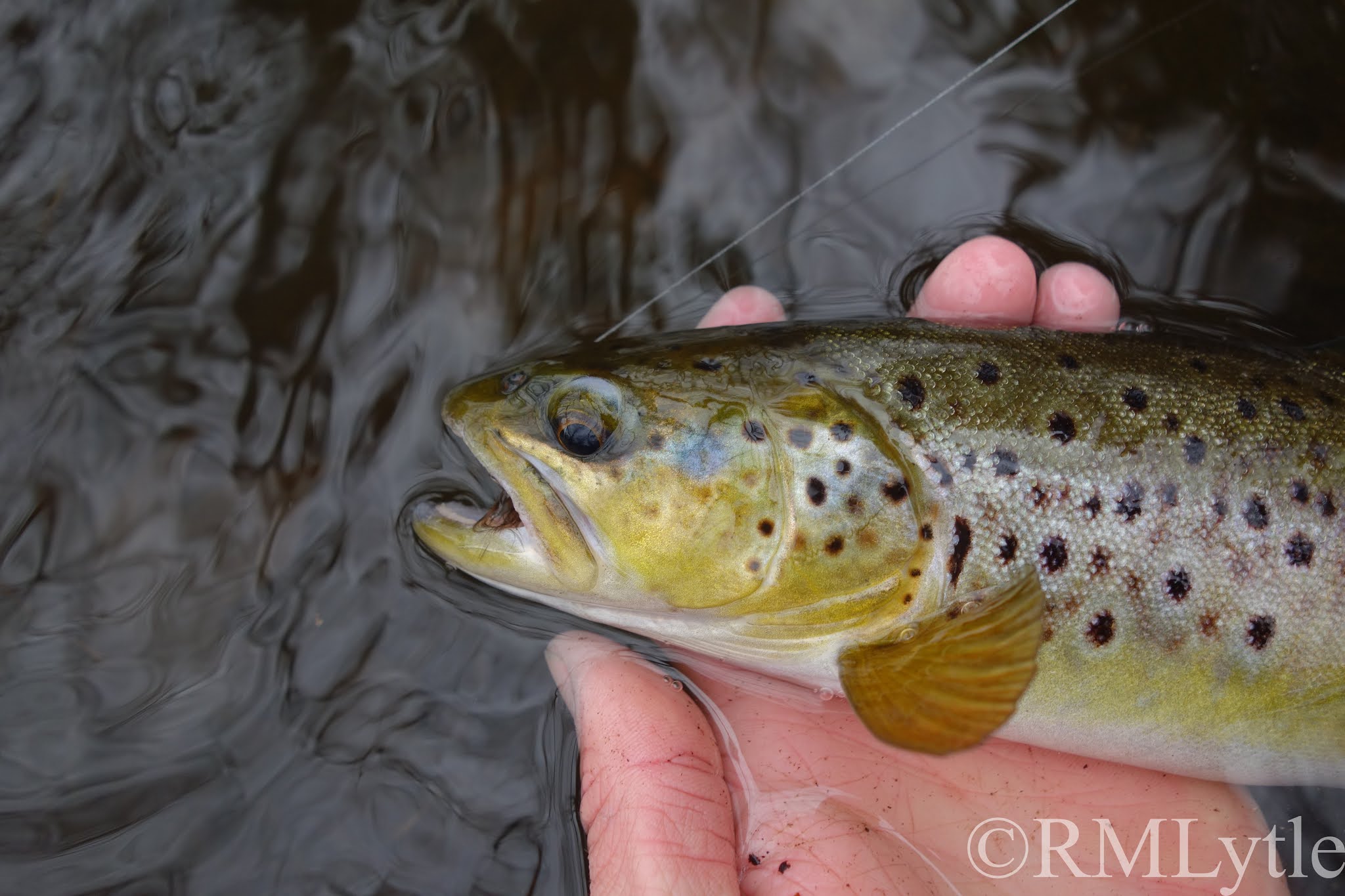
The day had started out cloudy but by the time I got to this stream it was raining and had been for a little while. The water was severely discolored; I was going to try anyway. I tied on a heavy size 10 Ausable Ugly and began to fish. For a while, I was unsuccessful. Then I thought I had a grab but wasn't quite sure. It definitely felt like one. A few runs down I caught a fish, a wild brown. That bolstered my confidence massively. I suddenly felt this might become a productive evening. 


That fish was right along a seam where the main current of the stream met some chocolate milk colored water coming out of a drain. This is classic brown trout behavior during this sort of storm runoff. Mud lines are a key focus to a lot of my rainy day river fishing, regardless of species. Brown trout in particular though gravitate to them. As I continued downriver and the muddy water from the pipe mixed with the ever muddier water of the stream (it was still raining), it began to look un-fishable. But I don't shy away from stained water as easily as some anglers might. I was fully ready to keep fishing knowing I could well get some high caliber fish in conditions like this. 


It took a little while to get another, but that ended up being a decent fallfish. I then proceeded to catch 8 more fallfish and a brown out of the same seam before continuing downstream. I got a couple more fallfish downriver but didn't find another spot at all that productive so I hit it again on the way back up and got two more fallfish and a large white sucker. 


Those fish alone made it a pretty good bite. That whole pile of fish was stacked up towards the tailout of a very nice, defined bend run. They were in a slack behind a log. It was a classic setup. But to sweeten the pot even more, when I got back to the first spot I'd fished when I had arrived, I got a very hot 14 inch brown there. This fish was gorgeous and spent an awful lot of the fight airborne. 


This was the perfect example of a day that could have ended up being very unproductive, but wasn't entirely because it started to rain. I got soaked, smelled musty for the rest of the evening, and definitely wished I had put all of my electronics in a plastic bag, but it seemed like a pretty good use of my time. I never ignore nasty weather. 

Until next time, 

Fish for the love of fish.
Fish for the love of places fish live.
Fish for you.
And stay safe and healthy.


Thank you to my Patrons; Erin, David, John, Elizabeth, Brandon, Christopher, Shawn, Mike, Sara, Leo, C, Franky, Geof, Luke, and Noah for making Connecticut Fly Angler possible. If you want to support this blog, look for the Patreon link at the top of the right side-bar in web version. 

Edited by Cheyenne Terrien

Thursday, April 1, 2021

I Didn't Take You For a Sucker(fisherman)

White suckers are the most ubiquitous fish in moving water here in Connecticut. They are vastly more numerous than trout, and because of their size they make up a larger biomass than sunfish species. Blacknose dace are certainly more abundant but are so small anglers rarely ever catch them, accidentally or intentionally. Anglers targeting trout periodically catch white suckers, especially in lake winter and early spring. Unfortunately, they are often disregarded, disrespected, or in some cases treated with outright contempt. I once listened to two anglers, (both in Trout Unlimited hats, go figure) on the Beaverkill speaking about a dead sucker they’d found… the words “better dead than alive’” were said. I duly explained to them that white suckers are a native species and play a vital role in the health of the river. They are an important food source for birds of prey, mammals, and large predator fish. They spawn in a fashion not dissimilar to trout but far more communal, and they clean large swaths of gravel that are later used by other fish species to spawn as well. Not to mention; there is a reason the sucker spawn fly pattern is so popular… trout eat sucker eggs. Non-native brown and rainbow trout, I might add….

Anyway, not only are white suckers an important native fish, they are also very sporting. This is something I’ve never really understood: white suckers are more selective than trout, fight really hard, run much larger on average, and are edible and apparently quite tasty when prepared correctly. Why is it that they are one of the species most often referred to as a “trash fish”? I adore white suckers. They are very hard to catch most of the year, so when the spring spawning run concentrates fish and gets them more aggressive I am usually antsy to get out and try to catch some. This year, I devoted some extra focus to pursuing these tricky omnivores. On March 15th I followed up on a report from my friend Joe, who had caught a bunch of suckers the evening prior. I went to the same spot intent on indicator nymphing it until I could no longer feel my extremities. It was a cold evening and cloudy, and I was sure the conditions weren’t all that poor. It took picking through a couple stocked trout before my indicator dropped and I set the hook into the real thing. 


Targeting white suckers on the fly is a bit less straightforward than some would think. In the summer I sight fish for them, and it is a very engaging yet frustrating game of watching most fish run away from or just completely ignore your fly. During the spawning run there are usually more targets, but you often can’t see them and it feels just as difficult to get them to eat as it does while sight fishing. Almost like nymphing steelhead, if white suckers aren’t really on fire and biting like crazy you just have to pound water until your fly gets in front of a willing one’s face. I was certainly accomplishing that, there were tons of fish in front of me. It just took patience. I fished two pools and was on the river for three hours. I landed half a dozen white suckers though, not including three that were hooked outside the mouth. Each was bigger than any of the 8 stocked trout I also caught, and way, way cooler.They all fought like demons too. Two even jumped. 


A green weenie took four fish, a mop fly took two. Eggs are often recommended as a good sucker fly and I did fish egg patterns, however I came up empty handed with them. I’ve had good success in the past with a variety of patterns including the Carp Carrot, Black-ops, Hare’s Ear, Ausable Ugly, and San Juan Worm. I’m not sure there is a “best sucker fly”, you sort of just have to throw a buggy or meaty nymph until your arm is about to fall off. 


I left pretty satisfied, that was my best spring sucker outing in a long time. But I wasn’t so satisfied that I was ready to give up. Oh no, I had decided that I was going to nymph good white sucker water until I couldn’t take catching another. Big fallfish, big wild trout, and untold other fish would also likely get caught in the process. Stay tuned. 

Until next time, 

Fish for the love of fish.
Fish for the love of places fish live.
Fish for you.
And stay safe and healthy.


Thank you to my Patrons; Erin, David, John, Elizabeth, Brandon, Christopher, Shawn, Mike, Sara, Leo, C, Franky, Geof, Luke, and Noah for making Connecticut Fly Angler possible. If you want to support this blog, look for the Patreon link at the top of the right side-bar in web version. 

Friday, October 30, 2020

Redhorse, Shiners, and Crayfish Eating Snakes (Western PA Pt. 6)

 As dawn broke on our second morning in Pennsylvania, it became abundantly clear to Jake, Noah and I that we needed to make a pretty drastic change. We'd struggled the whole day prior and well into the night to find larger fish that were willing to eat, and we just weren't successful. And now it was the coldest morning any of us had felt in months. Temperatures had dropped below 50 overnight. We hit the same creek where Noah and I had found wild trout the first day, and Jake quickly got his lifer, but we then dropped south. Even though we were inland and not even travelling an hour, we were going into slightly warmer weather. We were headed to another area I'd spent a lot of time around as a kid, but still hadn't fished much. 


We dropped further down the Allegheny watershed, towards a town called Vandergrift and the surrounding area. Vandergrift is where my mother grew up and where my grandparents still live, northeast of Pittsburgh. We'd spend the second half of our trip fishing this area, which is just as species rich though much more impacted industrial activity. It would be interesting to see how the native species were faring in these waters. 

The first spot we decided to check out was a spillway my grandfather has been telling me about for years. It was a spot he'd caught a number of muskellunge at over the years. That was certainly a big draw, but it was a spillway... from shiners to redhorse to huge catfish, spillways draw fish. They're both a barrier to upstream travel, a food delivery funnel, and a provider of deep holding water. We knew the likelihood of encountering things like drum, sauger, redhorse, and buffalo would be pretty high at such a place. And he first few minutes were not disappointing, as we saw multiple sized and species of redhorse. Some were just flashing, but others were actually tailing like carp. Or, frankly, like bonefish. Because if I were going to consider any North American freshwater fish a bonefish, it would be redhorse. They're sleeker than carp and I'm convinced they fight harder, pound for pound. 

As it turned out though they aren't as easy to catch. I was getting snubbed constantly no matter what I presented these fish. This surprised me a bit, I'd expected these fish to be about as difficult as carp and a little easier than white suckers, but at least in the conditions we'd been presented so far they were about as tricky as white suckers if not more. Even with bait they were far from pushovers. 

Incidentally, the first notable catch, by Jake, wasn't a fish, but a reptile. He'd actually caught one the night before as well, albeit a juvenile, and that one had been my lifer. It was a queen snake, an unassuming but beautiful semi-aquatic natricine that feeds primarily on crayfish. They're cool snakes but that's all I really knew about them, I hadn't even realized they lived in the area. 


These were very cool snakes, I saw them exhibit behavior more aquatic in nature than any snake species I'e observed besides actual water snakes (Nerodia). They'd poke out of crevices with everything but their heads under the surface, and spent extended periods of time completely submerged. They seemed especially abundant too, we saw lots of them. 

Eventually I finally caught something noteworthy while indicator nymphing, something very noteworthy. My indicator gave a little shudder, very bluegill like, but I set into something much larger than I'd hooked all day and when it started thrashing at the surface I could see that it was a redhorse, so no matter what it would be a new species. It turned out to be a smallmouth redhorse, endemic to the Ohio drainage and an especially good looking redhorse speceis. It had nibbled a beadhead Hare's Ear soft hackle. 

Lifelist fish #174, smallmouth redhorse, Moxostoma breviceps. Rank:species.


That was a gorgeous fish, a native species that is largely overlooked and an exceptional challenge to catch. I promptly fell in love and had a big goofy smile plastered on my face as I let the fish slip from my hands and back into the muddy river. 


I kept indicator nymphing for a while hoping that might be the effective method, and I did get a few more fish, but not anything exciting. 


By the time I gave up on that, Jake and Noah were hammering down on micros, including streamline chubs which I thought I needed (I'd not yet ID'd mine from the day before). Jake was also catching the odd logperch. So I rigged a tanago and got to it. Of course I could only seem to catch species I already had, but luckily I take photos of fish that may not be new but have some relatives that are similar enough... what I thought was a spottail shiner I'm now as sure as I an be is a rosyface shiner.

Lifelist Fish #175, rosyface shiner, Notropis rubellus. Rank: species.


With two new species on the fly under my belt, I ended the day's outing photographing another queen snake.


From the river we headed to my grandparents' house, where we'd get to say in relative luxury for two nights in their camper. It was great to see them, though strange due to the necessity of social distancing due to coronavirus. Living a few states away from my family leaves long gaps between visits, so though I'd been there and seen them all much more recently than I'd seen Franklin, a lot had changed. It held more of a familiarity though, it felt much less strange. Perhaps the presence of people I know and love is all there is to that.

Until next time,

Fish for the love of fish.
Fish for the love of places fish live.
Fish for you.
And stay safe and healthy.


Thank you to my Patrons; Erin, David, John, Elizabeth, Brandon, Christopher, Shawn, Mike, Sara, Leo, and Franky for supporting this blog on Patreon.