Showing posts with label Night Fishing. Show all posts

Saturday, July 6, 2024

Down in Brown Town

 The road to the Norfork Tailwater from Mountain Home was a sad one in June. Early in the morning on May 26th, 2024, at around 4:30am, a large tornado carved a six mile path, almost paralleling the main road. It was rated EF-3 and killed one woman, injured others, and destroyed multiple homes. Emily and I passed through the wreckage of people lives before dropping down into the valley where the tailwater was. Though it hadn't caused as much damage down there, word is the tornado and associated severe thunderstorms had blow the last of the Great Southern Brood periodical cicadas in this area away. Given that was the main reason for the visit, it was hard to feel confident about the daytime fishing. The sight of people's lives scattered around in the woods and fields like so much tissue paper by winds over 120 miles per hour was, much, much harder to stomach. So perhaps I ought not see much at all? Brown trout, especially big brown trout, are very nocturnal critters anyway. 

Northern Arkansas may not seem the most likely place for one of the best big brown trout fisheries in the world, but combination of factors, most of them unnatural, have resulted in just that. In 1944, construction was completed on Norfork Dam, which was originally designed to be a flood control dam but modified to include generators, and in 1949 stocking of brown began. Bull Shoals Dam was opened on the White River in 195, and Greers Ferry Dam created the Little Red River tailwater in 1962, and soon all three tailwaters would become robust trout fisheries as the massive and deep reservoirs created by these dams would keep each at a steady, cool temperature even in the stifling Ozarks summers. As time passed, aquatic insects would populate, stocking regimes would change, and instances of gigantic trout would grow more and more frequent. On May 9th, 1992, Howard Collins caught a 40 pound 4 ounce wild brown trout out of the Little Red, solidifying  Arkansas in the annals of brown trout angling history. Each of these tailwaters could at any moment kick out a brown trout as large as anyone has ever seen to some lucky angler. 


I'd first learned about the White River in the context of streamer fishing. When the big-streamer-trout craze hit its peak, there were essentially two epicenters- Michigan and Arkansas. The White River, with its size, heavy generation cycles, baitfish population, and monstrous trout became a big fly mecca. For a long time I thought that if I ever got to fish the White it would be in the winter to chuck big streamers and sinking lines. About a decade later and I first wet my waders in the White when they turned most of the generators off, when the water was low and manageable in the black of night. Instead of a high-octane, fast stripping, covering a lot of ground, I was in for a different experience, but one that is very much my style now- the subtle approach, covering water with careful deliberation, alone, with somewhat subtler tactics. I'm still very much after the same sort of fish though- big, predatory Salmo trutta. 

The specific allure of night fishing for me is its tactility. I read water by feel, a keen awareness of the tension on my line and what it means guiding me through seems, eddies, pockets... time taught me that I don't need to see to read water, even somewhere I've never been. The take, the feeling of the take, is the prize. A fly line is a glorified handline. We manipulate our flies primarily with our hands to achieve a specific action, then the take often registers through that line rather than feeling the rod bend holding the grip. The feeling of a grab in the dark, with all visual aspects removed, is an electric feeling. It isn't always jarring, aggressive, or violent. Oftentimes the larger the fish is the more subtle it is, which makes good sense to me. Even with a fairly large, buoyant fly, the take of a large brown trout may just be an increase in tension. There's often no loud blowup or surface hysterics. Think of how a 20 inch trout eats a mayfly dun. There's no need for it to race up and attack it violently. It can just gulp it down. That seems to be exactly how giant trout eat frogs, injured baitfish, mice, and other such things in the dark. Sometimes though it is explosive, and that is of course quite jarring and exciting. But if I'm honest, I like the subtler takes better. I feel they result in fish to hand more often. The subtle bite and subsequent hookup is an affirming bit of confirmation that technique and approach are on point.

I crept my way out into the low flows of the river blind in one sense but with the added confidence of useful intel from a friend. On such a big river, its more than a little intimidating. But I have a lot of good friends that have fished all over, and Mark Sedotti had given me all I really needed to know to be safe- what wading would be like and a list of places I could park. I'd have tackled the river without the intel anyway but my approach would have had to be more cautious and slow. Careful daytime examination was performed, though the flows were much higher than they'd end up being. 

My process was very simple- slowly work the available water with a large, neutrally buoyant confidence fly, altering my presentation periodically and moving only when I was sure I'd thoroughly covered the water I could reach and didn't believe it was worth waiting for more fish to move in. This was unlike anywhere else I'd night fished though. The maximum possibilities were outrageous, the number of fish were as well. The forage variety isn't what I'm used to either. But trout are trout no matter where you are in the world, so I was sure I'd be able to catch. Sure enough the river delivered in fairly short order. 


My first Arkansas trout ate on an upriver cast in nearly still water, the current was just trickling along. I'd pushed a couple fish out that were practically belly crawling in the shallows, each a decent trout, and it became clear I couldn't rule out this water. I pie cast, starting straight out then closing in on the bank. Short casts, in the sweet spot for a delicate landing and minimizing the chance of lining fish. Really, I want led to land my fly withing a leader length of one and have it eat in just a few strips. That's exactly how it worked: cast, slow strip, tight. Quite a good start too, I'd say. It was my largest wild river trout of the year. 

That first night provided a slow pick, with nearly every fish coming when I either moved a little or altered my presentation. I only caught two fish doing the same thing, in fact. Each fish was a good one though. 


My tally was seven fish by the time false dawn approached. It was like leaving with a good taste but a hunger for more... just an appetizer before the restaurant closed. It was time to leave the river for the daytime shift crew to come in, for the generators to turn on, the flows to rise, and the jet boats to take over. 

A second might really wasn't in the plans. The idea was originally to head north trying to get back into the thick of it with the magic cicadas. Emily would still need to sleep though and I struggled to justify driving away from what would likely be my best shot at a monster trout for the rest of the year without one more attempt. We got another night at the hotel and I took a bit of a pre-game nap after a day of day of hunting new species with my friend Hamilton Bell. An alarm jarred me awake again and midnight for another shift hunting the big one. 


Brown trout look a bit different everywhere, though maintaining certain consistent traits. In the White River a lot of the brown trout seem to have these incredible big fins. Some seem unreasonably large and fan-like, disproportionate on the body of the fish they belong to. Any number of things could drive this trait and not every individual has them but enough do that those big, webby fins can be somewhat of a visual clue that the brown trout you're looking at came from the White River. There are many places where fluvial brown trout grow old and long and their fins get quite large as they age despite the fish not getting much heavier. These old, big-finned trout look a bit different than these trout. A lot of 20 inch White River trout aren't old fish but still have these disproportionate fins. It's an interesting trait. 


The night two highlight ended up being a short window in a big eddy when a fairly quick two hand retrieve seemed to be favored. This is counter to most of the deathly slow presentations I make at night, but it works now and then so I use it. A gnarly 22" rainbow and a 19" brown fell first, neither take being particularly noteworthy despite the aggressive retrieve. The next fish to move, though, absolutely blasted out of the water for the fly and completely missed. That one was clearly a much larger fish, which I could see partially in the glair of a house's lights. I'd guess it was in the high 20's, though I really don't know for sure. It never made contact with the fly that I could feel and I couldn't get it to come back. Though 25 fish came to hand on that second night and plenty were 18-22", the real monster still alluded me. 

Once again there was a little light in the sky as I peeled my leaky, smelly waders off after that finale stand. I reflected on how exceptional the fishing I'd just had was. On a lot of the rivers back home I typically go a whole season without catching as many quality wild trout in the dark. It's pretty cool to step into a place where the standard is a little different, and the possibilities are almost hard to fathom. 

 Thank you to my Patrons; Erin, David, John, Elizabeth, Brandon, Christopher, Shawn, Mike, Sara, Franky, Geof, Luke, Noah, Justin, Sean, Tom, Mark, Jake, Chris, Oliver, oddity on Display, Sammy, and Cris & Jennifer, Courtney, and Hunter for making Connecticut Fly Angler possible. If you want to support this blog, look for the Patreon link at the top of the right side-bar in web version.


Monday, October 16, 2023

In Winter's Grip

 It was a damp, dark February night. Garth and I parked at a muddy pull off on a quiet New England back road and quickly geared up. I was going wader-less but warm, with long johns and sweat pants under a well weathered pair of khakis, thick wool socks under my leather work boots, and multiple layers on top as well. We both dawned nitrile gloves and pulled rods out of the car before disappearing silently into the woods. We wore no headlamps, as neither of us are inclined to pollute the darkness with artificial light during our nocturnal striped bass hunts. This particular outing was well into a long bender to decipher after dark feeding patterns of large holdover fish. The conditions, we thought, were ideal this time. We'd carefully put together puzzle pieces over the course of the winter: light, moon phase, barometric pressure, tide, frontal conditions... it was starting to fit together. It had been a long road to success, starting years prior for me with multiple failed after hours attempts. I'd eventually come to the conclusion that my holdover spots just weren't worth night fishing. Reinvigorated efforts came as a result of complete disbelief that that could actually be the case. These fish had to eat in the dark too. Holdovers in other places did. Eventually, with a push to be more patient and observant one night thanks to Garth. It would have taken longer to catch anything if one night he hadn't insisted that we sit for a while and let things settle. A condition change occurred as we bantered on the marsh bank and suddenly our discussion was interrupted by the sound of stripers gently swirling on bait. 

Those had been small fish though. I was adamant we could get something larger. We were hell bent on doing so. The appeal of putting up a 20 pound or bigger striped bass in the winter months and doing so on foot in the middle of the night with a fly rod was multifaceted for me. I've been an intensely devoted nighttime angler since I was a teenager and my comfort and confidence navigated all sorts of waters at night is very high. To do so for arguably my favorite target species in a time of year I hadn't figured out yet was very appealing. Add to that the difficulties of sub-freezing temperatures, ice, and even snow, and it gets more interesting still. There's also a patience and subtlety to targeting large holdovers in lower yield locations that demands focus and time. The fish eat delicately and infrequently, and though there isn't complexity to the flies required to catch them there is to the presentation. There's also a lot to be said for being able to blind cast as far as you can in the darkness with limited back-cast for hours on end for just a handful of subtle blink-and-you-miss-it bites. Throw in gobs of frost collecting in your guides and icicles forming in you beard on the worst of nights and you've got a recipe for a lot of guys staying home. And that's probably fair, it really isn't everyone's cup of tea. But f*** man, it sure is mine. I absolutely love it. 

This particular night we were on the cusp of a front and it really wasn't all that unpleasant out. The water was closing in on 40 degrees and the air temperature was a bit over that even after 1:00am. We covered ground briskly on our way to the river, almost but not quite capable of doing this walk with our eyes closed now. Eventually the trees gave way and the ethereal reflection of the clouds off the water's surface came into view. We quietly assumed or first casting positions and began to ply the dead still waters. 

Bites didn't come with any notable frequency that night, but my mind recorded the one that mattered like a bit of grainy super 8 footage. Some winter bass bites are barely a flutter. Others load up on it. This fish slammed the fly hard, as though it had come at it head on. My 6wt flexed under the weight and I uttered "big fish" and Garth hastily made his way over. The fight was a significant one, The fish had a fair bit of energy for being in that cold water. It was a little while before we did get a glimpse at her when we did, it was a moment of exceptional satisfaction. It was the sort of fish we'd come for. 


With new found confidence, we'd push ourselves to the limit the rest of the winter. In the end, we didn't best that fish though both of us just about matched it numerous times. Inevitably, we came out of that season with new questions. Chief among them being just what exactly out upper limit could be. Could we get a 30 pounder in January or February? How about a 40? There's really only one way to find that out. 

Thank you to my Patrons; Erin, David, John, Elizabeth, Brandon, Christopher, Shawn, Mike, Sara, Franky, Geof, Luke, Noah, Justin, Sean, Tom, Mark, Jake, Chris, Oliver, oddity on Display, and Sammy for making Connecticut Fly Angler possible. If you want to support this blog, look for the Patreon link at the top of the right side-bar in web version

Tuesday, February 14, 2023

Drug

One of many spell in the fall of 2022 that I spent living out of my vehicle started with eating tortilla chips and queso in a park and ride. The tide wasn't what I wanted just yet for the one spot I'd intended to fish in the dark that night, so time needed to be killed. I threw on a podcast, got comfortable, and put calories in my body. The inside of my 4Runner probably didn't smell especially savory that night; with multiple saltwater soaked items of clothing drying in the back and my own sweaty, haggered self in the driver's seat. My overall mental state at the time reflected that of a fish obsessed hippy. I was nominally single, still occasionally hooking up with my ex but not bound into a time consuming relationship. I was guiding sporadically. My rig was finally behaving itself after half a year of mechanical problems. This was subsequently be my first fall run with my own vehicle, no partner, and no job. This was the first fall run during which I could do what I'd always wanted to do for years- live at the whims of the fish, tide, and wind alone. The conditions controlled what I did, not anything else. I had grown a tight little network of other anglers of the same mind and similar situational freedom. Our focus was honed on one of the most spectacular natural events on the east coast. The mass migration of baitfish was already underway and the predatory fish and birds were snapping at their heals. Those of us who simply couldn't resist the call of such spectacular biological occurrences came from all corners of the northeast and convened at our chosen churches, a fishing pilgrimage, if you will. Some worshipped on the sand beaches and long jetties of Rhode Island. Others boarded boats to pray from within the melee. I myself would be headed to my place of prayer in a short time, a rocky bit of shoreline in Eastern Connecticut where an estuary emptied into the sound. As I polished off my bag of chips, I saw that it was around midnight- almost time for the mass to begin -and dawned my ceremonial garb. I slipped neoprene socks onto my feet, and a beaten pair of sneakers over them. I tightened the belt of my khaki shorts and threw on a salt stained navy blue hoody. Into a sling pack went a few wallets of flies and some spools of heavy tippet. 

I parked a fair distance from the spot and outside of an open gate. Despite the fact that it was already late, I knew there was a fair chance this gate would be closed by the time I got back to the parking lot. A police officer had already had already warned me of this likelihood a few weeks prior when the tide timing was similar. I didn't at all mind adding to the walk anyway. The darkness enveloped me as the street lights began to disappear behind the trees and a sense of calm arose. In time, the pavement under my feet gave way to sand, then the sand to rock, then the rock to slat water. Wading into the inlet, I could hear the occasional pop and swirl of schoolie striped bass feeding on silversides. Affixed to the tippet at that time was a white Tabory Snake fly, a scraggly looking offering that I'd swing in hopes of drawing attention from a larger, more opportunistic predator. Bypassing the shallow feeding schoolies, I maneuvered the edge of the rocks out to the very mouth of the inlet. There, the estuary emptied out over a sandy delta into a deep area. Behind my lay a large bar on which stripers often roamed. In theory, the outgoing tide and baitfish in the estuary mouth might draw bass either from deep water of the rock bar to feed in the current plume. My second cast was greeted by a jarring strike. Not a bass though. The fish went airborne shortly after the hook-set. It jumped repeatedly and made spastic, energetic runs. This was certainly a bluefish. That poor Tabory snake fly stood no chance. 

After encountering that toothy critter, the destroyed Snake Fly was replaced by something more durable and I was treated to a pick of modestly sized bluefish for the rest of the tide. Though the bite was nothing to write home about, a few fish got the Tibor to sing nicely and the rod stayed bent for an hour or so. Who could complain about that? I made my way back to the parking spot exhausted and satisfied. Sleep would be minimal, though, as the sun still rises early in September and I had no intention of missing what would likely be a fiery false albacore feed right after dawn. 

I caught a couple hours right there in the parking lot, moderately comfortable in my fully reclined car seat with a pillow supporting my back and a blanket hiding my face from the one glaring streetlight. I moved an hour before sunrise just to be close to where I'd fish and got one more hour of rest before the light of the new day filtered through the fogged up windshield. Cracking a can of peanuts, I stretched and yawned. Almost reluctantly I climbed out into the morning air, binoculars in one hand and breakfast in the other. From the roof of my truck I'd eat my "meal" and watch for the first signs of fast fish. Before the first rays of sun even graced the Sound's lightly choppy surface the tunny were sending spray and piercing the waves out in the deeper water. I hurried my pace and called my friend Alex. There's a stretch in there that my tired mind did not commit to memory, but I cannot possibly forget the highlight of the morning. I know Alex had caught a rather nice striped bass on an Albie Snax and I'd lost one of his creative popper flies to a substantial blue, the I looked a point over and saw birds working in tight. Reluctant to make immediate moves, I let the situation fold out a bit longer. In time though it seemed there was no reason to stay where I was. I waved to Alex, who was further way and likely couldn't see the action from his position and began scampering across the rocks towards the unfolding blitz. I got out in front of the mayhem, tunny still blasting through the silversides just off the rocks, and fired a gurgler out into the fray. A mere few casts later I was treated to the sight of a tunny, shimmering like something carved out of a block of chrome with blue and green reflecting off of it's surface, blasted through the surface and engulfed the skittering fly. I was tight, and soon Alex was too. Any sense of exhaustion or lingering effects of car sleep melted away as though it were the backing leaving the reel as the tunny ran, taking every other problem in my life with it. There are a lot of different kinds of drugs out there and this, well this is mine. It's cliche, it's overused. But some of us sleep in parking lots, ruin relationships, and risk mental and physical health to pull on fish. Our brains crave the chemical stimulation enforced by evolving to predate, to acquire sustenance, and we take advantage of it to feel good, to get high for a moment in time. Some of us get addicted to it. It's not as dangerous as some other drugs, but it can still effect our well being. I must say, sometimes I just don't care. I'd rather look for that next high, and I feel I get so much enrichment through the process of hunting it. Moderation is good though. Sometimes you have to go home and sleep in a real bed.. Eat real meals. Foster healthy relationships. Like many drugs, you can have a moderately healthy balance if you try. Do I?


Nope.


Thank you to my Patrons; Erin, David, John, Elizabeth, Brandon, Christopher, Shawn, Mike, Sara, Franky, Geof, Luke, Noah, Justin, Sean, Tom, Mark, Jake, Chris, Oliver, and oddity on Display for making Connecticut Fly Angler possible. If you want to support this blog, look for the Patreon link at the top of the right side-bar in web version.

Friday, December 9, 2022

In The First Minutes of November

 Garth and I dumped the canoe in last few hours of October. There'd been some large striped bass around and I'd been using personal watercraft to explore new territories. A couple days prior I'd caught my largest surf striper, a roughly 44 inch 30-plus pound fish. Minutes before that fish another 40 incher had come to hand. This was in daylight... I was a bit taken with that and felt the need to ply the same waters under the cover of darkness. Access was tricky but Garth and I found our way in.The canoe would be our ferry, the fishing itself would be land based. We just couldn't get where we planned to fish by wading outside of extreme low tides, and we'd inevitably not be able to do the fishing we wanted to in such a scenario. The canoe that Drew Price fished on the waters of Lake Champlain was now getting two young anglers onto the dark waters of Long Island Sound, where we thought we might just have a chance to run into a sea monster. 

There's often a deeply ominous feeling when I climb out onto the furthest rock I can reach to cast into a powerful rip. The water is rarely calm, certainly not on the most productive nights, nor is it clear. A headlamp provides some security but it mustn't be on long and I've learned to do nearly everything I possibly can without one. That darkness envelopes you, as does the sound of the incoming tide flushing around the boulders. All this rock was left as the glaciers receded and is now home to a plethora of baitfish, crabs both native and invasive, the odd lobster, oysters, muscles, and of course striped bass. My hope was that within this particular pile of current ravaged, life encrusted granite, there could be a truly huge striped bass. My mind created all sorts of other creatures though, and as I scrambled onto my rock of choice I looked back at the dry land behind me nervously. The point I was on formed a ridge extending out toward deep water. It's descent was quite gradual, meaning I'd needed to wade a long way through unfamiliar territory to get where I was. I knew the holes between some of these boulders could be surprisingly deep. I also knew that seals and brown sharks like to hunt this same water. Though I knew that rationally these large creatures posed no threat to me, the ingrained fear of that which I couldn't see crept up. The intent, really the necessity of pulling on a large striper prevailed though, and any unwarranted fear faded in the pursuit of a striped bass of a lifetime. Expectation overshadowed reality out on that point that night. One take from a bass of unknown stature was all that resulted.

I had other tricks up my sleeve though. Nearby a shallow muscle bar marked the passage between island and mainland. Despite being very shallow it was enticing structure with good current and multiple ambush points. We picked our way out into the rushing current. I was keenly aware that much of bottom I trod on there was a living mosaic of mollusks. I tried not to drag my feet or step too hard. When I could I walked on what sand I could find. The current here was perfect for swinging, and I worked the water by casting down and across with my large white Hollow Fleye and simply letting the tide carry it. Large stripers are lazy and bait often doesn't suspect pursuit under the cover of darkness. A slow and deliberate presentation will often beat out a fast retrieve.

It was just a few minutes into November when I felt a pull. I pulled back hard and buried the hook. The fish's actions were deliberate and slow. It didn't really define its size, though I knew it wasn't small. My size guess changed again and again as I waded into the shallows, walking the fish back to where I could land here. When I finally did get her on her side in about five inches of water where her silhouette was just visible, I could see that she was a good one. At 39.5 inches and 20 some pounds she was easily my largest November bass. It can be all too easy to ignore the bass in front of you when you feel confident that there are much, much larger ones within a mile of where you, and I'd had a such a good October that I'd started to tire of the smaller fish. I wanted a 40 pound striper on the fly, on foot. And this wasn't it. But I realized her significance... she was a reminder to stay on my toes, to expect the unexpected. I thought there was a chance big fish could occasionally slide onto that muscle bar, but if I'd had to pick one spot in that area to fish that night it would have been where we started and we would have gotten skunked. 


And we almost did. That was the only fish we laid hands on that night. It proved the importance of exploring all the possibilities of a spot, analyzing it critically, and fishing thoroughly and with intent at all times. Though I'd try again, that muscle bar never produced another striper this fall. The point nearby did give me some opportunities. It will take a few seasons at least to really grasp the dynamic of this new-to-me water. After fishing it an hour more that night we paddled the canoe back to our starting point. The whole way I was formulating approaches, considering conditions, and picturing the fish I knew was out there somewhere not far away. Scales as big as quarters. Mouth wide enough to swallow a fluke. I need to catch her. 

Thank you to my Patrons; Erin, David, John, Elizabeth, Brandon, Christopher, Shawn, Mike, Sara, Franky, Geof, Luke, Noah, Justin, Sean, Tom, Mark, Jake, Chris, and Oliver for making Connecticut Fly Angler possible. If you want to support this blog, look for the Patreon link at the top of the right side-bar in web version.

Wednesday, October 19, 2022

Kokanee (& Trout) In The Dark

As an obsessive nighttime angler, I'm constantly looking to d to my repertoire. One thing I've done very little of is target trout in stillwaters at night. Here in CT, many of our stillwater fisheries are composed of stocked trout with very poor holdover rates, so that makes them generally uninteresting to me. There are some lakes with a half decent holdover rate but most take some travel. There's also some lakes with other species of interest. It was kokanee that got me fairly intrigued to try one particular stillwater.

Kokanee are landlocked sockeye salmon. They were brought top CT in the 1940's to build a recreational fishery. Why the state of CT is expending resources on this only lightly fished species that isn't native is beyond me, but at least kokanee aren't going to spread far and wide. In fact, landloacked alewives, also a non-native, have almost completely wiped out kokanee fisheries in Ct in the past. Kokanee have an affinity for nocturnal activity, though kokanee feeding is focused on zooplankton. They're essentially a salmonid that filter feeds... not quite like menhaden or American shad, but they focus on such tiny food items when foraging. Transferring their nocturnal feeding habits over to the spawning run- when the strike mainly out of aggression -doesn't necessarily follow. But at least in my mind, nocturnal is nocturnal and I should be able to get some to strike. If not, rainbows would be around the same areas. 

I set out on a brightly moonlit night with a plan in mind. I'd fish two methods, both with relatively small and bright colored flies as that's what has worked for kokanee in the past. I'd start out fishing them under indicators. With the aid of the moon, as well as nearby artificial light, I'd be able to see the indicator drop if I was getting takes. If that failed, I'd slow pull the same flies as well as some streamers with a figure eight retrieve

Upon arrival to the spot, I could actually see the schools of fish. There were huge numbers of kokanee out there, as well as loads of trout. It soon proved very easy to get the trout to take. Me indicator dropped time and time again.


The trout seemed to have very little preference in the way of flies. I caught them on Green Weenies, eggs, Walt's Worm with pink collar, Sawyer's Pheasant Tail, and small buggers. I kept switching mostly to try to pull out a kokanee, but it wasn't proving to be especially easy. Even on the best of days they test a good angler's resolve. Each Pacific salmon has a different attitude during their spawning run., and it differs place to place as well. Kings in New York are heavily pressured and often hard to convince to snap at something, which is why many anglers fish eggs, bits of foam, and smaller flies with immense amounts of weight. This differs from large and less pressured river chinooks in Alaska, which are caught on large flies and lures. It also differs from less pressured water elsewhere in the great lakes. Coho, wherever they are, seem to be on the aggressive side of the spectrum, as do pinks. Chum salmon are definitely quite inclined to take large streamers and lures. Kokanee seem to be one of the finickiest. This results in a lot of people intentionally snagging them, which is just ridiculous. Its also illegal, and I call the TIP hotline any time I see it happening. As should you. Anglers often complain about poachers in CT, and yes ENCON is understaffed and won't always respond, but you should still call. The more calls get made the more poachers will get caught. Please do your part. 

I, of course, was just patiently waiting for a kokanee to actually grab a fly. It took a couple hours before one finally did, but it was a wonderful proof of concept. I could, in fact, catch a kokanee at night. The first one sunk the indicator just like the trout had been doing. The fly of choice? The good old Green Weenie.


That wasn't really the start of a pattern though. Kokanee are moody and erratic, and I often get them seemingly at random. Indeed I ended up with three that night in five hours of fishing, and each was on a different fly. The first was the only one to take under the indicator. The second took on a slow retrieve and the third took and egg on the fall. 


I lost a couple couple kokanee that I clearly saw as well, and a few that may have been. largely though the night was a very trouty one. I must have caught between 35 and 40 of them, and I even specifically tried to avoid them at times in hopes of picking up more salmon. As it turns out, that nighttime indicator strategy in particular is wildly effective. I've considered fishing indicators at night in rivers as well and this really did some convincing. I've lightly fiddled with the idea in the past, putting glow in the dark tape on indicators, but it never really got me anywhere I think its time to in some glowing thingamabobbers. 


The night game is such a fascinating one. I've always felt that it builds on an anglers understanding of the water they're fishing. If the right casts and presentations can be made or even things as simple as getting to the productive locations can be accomplished without aid of the light of day, it builds your understanding of the water. But something I sometimes forget, and likely equally important: fish behave differently at night. Fishing in the dark builds your understanding of your query as well. I feel I have a better understanding of landloacked sockeye now having caught them at night. 

Thank you to my Patrons; Erin, David, John, Elizabeth, Brandon, Christopher, Shawn, Mike, Sara, Franky, Geof, Luke, Noah, Justin, Sean, Tom, Mark, Jake, and Chris for making Connecticut Fly Angler possible. If you want to support this blog, look for the Patreon link at the top of the right side-bar in web version.

Wednesday, September 14, 2022

Squid Hounds

 One nickname given to striped bass is "squid hound". Perhaps you've heard it used, perhaps not, but if you've seen how striped bass act when squid are around you can probably make the connection. Squid are an interesting bait, being generally fairly sizable, soft, and swallow-able. They're a dense and easy caloric package. They don't always get themselves into places where a shore-bound fly caster can reach though. I'm used to squid bites on the reefs, casting poppers at dawn or large white or orange flies on sink tips. The bass coral the squid at the head of the rip, and they can often be seen jumping out of the water. This is a boat game in deep water. I'd not encountered a surf-based squid bite until more recently. It was a night bite, in a spot I'd been visiting for the difficult to fish but epic peanut bunker feeds. This night though something new was going on. The peanuts were there but the bass weren't on them, merely apparently passing through them. a few times I felt odd plucks on my fly... the sensation of something just touching it. Not a fish. Cephalopods, things with arms, tactile little creatures. 

It didn't take too long to put two and two together. This was a squid bite. The squid were here feasting on peanuts, and the bass were living up to their nickname. It wasn't hot and heavy, but there was good fish to be had in shallow water. 

The first hooked was a respectable fish of maybe 29 inches. A beautiful fish indeed. It hit close in, no more than 25 feet away. Soon another fish boiled nearby, and a quick reaction cast got the fly into it's vicinity. There was barely time to make a couple strips before the bass was on it. A sharp couple of strips buried the hook and the fish exploded at the surface. This one was very plainly a much bigger animal. It made a good account of itself, fighting me at ever step of the way in the bulldog sort of way that a good striped bass fights. When I got hands on it I could help but grin ear to ear. 

Any 20lb class striped bass on the fly is a victory; more, much more so when your feet aren't on the deck of a boat. Pursuing these fish is endlessly captivating to me, and one of the reasons is their versatility. This was such a perfect example of it, a spot that had been producing one type of bite, fish steadily on pattern eating peanuts. Then sudden;y the wild card- squid -they showed up and everything changes. Suddenly the fish's demeanor and behavior was completely renewed. They'd eat big flies right at my feet. 

My goal this fall striper season has been to narrow my focus. I often cover areas too haphazardly, though much of that has been in the name of finding new places. I know now though that there are a limit to the number of places that are likely to give me shits at larger bass from shore on fly, and instead of trying to fish everywhere, I'm focusing my effort on really just two spots, and the majority of that effort on one. I'm still keeping tabs on my Rhode Island shoreline for guiding purposes, but from a distance. Narrowing focus should in the end pay dividends in terms of larger stripers, I feel. My end goal? Well, I don't really have one. I'm just trying to see what is really possible with a fly rod and waders (or wading shoes) in today's over crowded, over-hyped boat fishery. The how large a squid hound can I pull on with my feet in the water? How many large ones can I tie into in a season? I'm not really sure, but whatever the answer I intend to find out through slow, well thought out pursuit. 

Thank you to my Patrons; Erin, David, John, Elizabeth, Brandon, Christopher, Shawn, Mike, Sara, Leo, Franky, Geof, Luke, Noah, Justin, Sean, Tom, Mark, and Jake for making Connecticut Fly Angler possible. If you want to support this blog, look for the Patreon link at the top of the right side-bar in web version.

Monday, August 8, 2022

Monster Carp on The Fly at Night

 Quick reminder: I'm doing a talk this coming Thursday, August 11th, at 7:00pm at the Middle Haddam Library on fly fishing for Connecticut River Carp. It should run about an hour, I hope to see some of you there!

The Hex hatch is a CT summer featurette. It's tough to pinpoint, devilishly so, and doesn't last. If the conditions aren't just so there often aren't even that many fish feeding on it. When it does come together though, wow is it ever magical. The water boils with a multitude of fish species frenzying on the huge mayflies. This year, so far as I do occasionally run into later August hatches, the fishing has been average, which is to say an exciting experience but not one that resulted in a significant number of notable catches. Last year was subpar but one night yielded giant crappies slurping spinners, which was just incredible. This year it was mostly average sized white perch and smallmouth bass making up my catch each night. With one exception. 

I always linger after the hatch, especially early in the event. If it's marginal, the nymphs will often swim for a little while after the ones that are going to emerge do so. It's slower, slightly less exciting fishing but It has produced some of the larger fish. One night, I was standing under a streetlight casting  Pat's Rubber Legs- an un-ideal but passable hex nymph imitation -when a shadowy form emerged from the depths into the lit area. It was a carp, a decent sized one at that. I let it approach then presented my fly to it. It moved forward and flaired its lips, so I set. I was into something solid. Too solid, I thought, it felt snagged. I started to attempt to detach the fly, knowing full well the carp was going to spook off. It left fairly passively, which was odd. Suddenly, line was coming out of my had. "Oh, she is on" I muttered aloud. The fish left with patient autority, buckling my 5wt but in no real rush. I knew it was big, though at that point I wasn't quite sure just how big. 


Yeah, uhhh... she was huge. She was actually tough to lift. I've only had that issue with a small handful of carp. I suppose the takeaway here isn't extremely clear, so in case that's true: keep fishing. You can't always predict when a trophy fish is going to present itself. Some are a result of fishing hard, planning, predicting... and then others just sorta happen. In either case, you can't be sitting at home. Fish when you can, always. 

Thank you to my Patrons; Erin, David, John, Elizabeth, Brandon, Christopher, Shawn, Mike, Sara, Leo, Franky, Geof, Luke, Noah, Justin, Sean, Tom, Mark, and Jake for making Connecticut Fly Angler possible. If you want to support this blog, look for the Patreon link at the top of the right side-bar in web version.

Tuesday, May 31, 2022

Convergence '22: Life

Another herring run has come and gone here in Connecticut. In April the alewives came in moderate numbers, danced their dance, drew in all the creatures that eat them, left their fertilized eggs and left. In May we had the worst blueback runs I've ever seen, there were hardly any herring. With June just a day away and temperatures hitting the 90's, it's just about over.

My fishing flows with the tides of my mental state. I'm almost always fishing, unless I'm even more depressed than is normal. The intent and discipline that I exercise on the water is what really changes, at least that's what I'm coming to learn. What apparently happens is I fish at my absolute best and hardest when I'm trying to hide from some festering thought. I'm both chasing a high and forcing myself to think about one thing. I don't stop and let introspection happen, I just role with the conditions and force myself to stay zoned into the task at hand. In the spring, my personal task is to get the largest striper I can, on the fly, one foot. My successes and failures are recorded in logs along with volumes of data, some perhaps irrelevant. The story those logs tell is that of a man possessed. The story ignores a whole myriad of existing problems, important issues, but it's the story I want to play out. For the first two thirds of the spring herring run season that story played out the way I wanted it too. Then it crumbled when the external plot could no longer be kept out. This is that story and its bitter end.

I started early this year. Having screwed up in the past starting much too late, I wanted to get a jump on it this year. There really weren't many herring around yet, but the bass were there. I started out tallying low numbers each night, one or two fish but no more. Those fish were all good though, I wasn't finding small bass. They were all 30 to 38 inch class. Then, a week in, I broke 40 inches. It was a solid confirmation that I was on the right track, as I typically hope to break that mark just once in a spring. Getting one so early on I was sure I'd have another shot, and I did. 

It was the night my partner and I broke up, something that had seemed imminent. I was also lost deeply in the weeds of cow madness, and wouldn't let myself out of that. Just a couple hours after we broke up, I was standing on the bank making that first short cast that I do while getting line out. I fished it out even though it was just a 25 foot shot because that's what you do if you actually mean to catch fish. Just seven feet off the rod tip, I came tight. The fish exploded to the surface ferociously, proving instantaneously that she was huge and a force to be reckoned with. That fish ended up being the first striper to get into my backing on my 12wt and the first large striped bass I've lost in three years. I'm not sure exactly how big she was, just that she was huge. I'm not exactly sure how I lost her, but it was a bruise to my ego for sure. My resolve hardened, though. If one big fish was around, surely I could find another. 

Many nights blended together, with work, guiding,  and scouting for guide trips occupying my days and fishing harder than is reasonable eating up the time I should have been spending asleep. I won't soon forget the night that I found the next big bass of the spring convergence. Oddly it was so memorable because it wasn't remarkable compared to many of the other nights that have yielded cows. Conditionally, it sat squarely mid playing field. It was good enough but not remarkable in any capacity. There were big fish around though, I could hear them occasionally. I've fished with enough people for stripers to know that most are horrible at interpreting the size of bass making surface feeding sounds at night. These, though, were completely obvious to my ears. Massive swirls created by large bodies. They weren't holding though, I don't think at any point a fish topped in the same spot twice. That meant I'd need to stand in one spot and just hope a cow moved in front of me at the right moment. I made cast after cast for two hours, being patient. A few fish came up fairly close to me, yet no touches. I decided I may as well try something different. Moving would make no sense and I had confidence in my fly, so I changed my retrieve. I went fast. Fast is rarely how I turn a cow bass on the fly at night. Big bass are lazy, they like easily caught pray. Usually. My first retrieve I got hit hard, jammed the hook, and for a little while thought I might have stuck a mid sized bass somewhere other than the mouth. It was an odd fight, completely lacking the trademark sweeping head shakes, instead consisting of short-ish extremely fast runs. When I got the fish close I could see that it was, in fact, a really large bass hooked exactly where she should be. Soon I was wrestling my largest shore-caught striper in the margin of the river, letting her make me bleed a little. She was 43 inches and very heavy. In that moment, I was completely elated. I'd tapped the right vein, put in the right stuff. Damn did it feel good, right there and then. 


Unwilling to back down, I pushed on, continuing to fish that night and each one that followed. Though I managed a few more high 30 inch range fish in my typical spot, two things rapidly deteriorated the quality of the fishing. The first was simply the amount of water. We've had a fairly dry spring and fishing totally slack water isn't a good bet for big bass on the fly. Also, the morons started showing up. That started to deteriorate my mental stability.

 One night, Garth and I were out in a pretty solid tide window when a jeep load of evidently drunk college age guys rolled up, being obnoxiously loud, parked illegally, and basically fell down the banks of the river with their headlamps on, scanning the water. Unable to conceal my displeasure, I yelled across the river. "TURN THE F***** LIGHTS OFF". They ignored me. I went and found the largest rock I could carry and dropped it off the center of the bridge before we left. I'm not proud of that, but if you're going to be an asshole on my river, I'm going to retaliate. 

Another night, a car pulled up in the center of the bridge and two guys got out and lit up the whole river with spotlights. I again voiced my discontent and was ignored. I go out of my way to be respectful of the place, the fish, and the other regulars that fish there. I call in poachers when I see them, I avoid being in close proximity to other anglers if they arrived at the spot before I did, I respect the neighbors and their property, don't shine my headlights into their yards and windows when I park, so on and so fourth. The lack of respect I see from other anglers pisses me off to no end. I didn't feel like being around that, so I decided to move along and explore new water in the latter half of the convergence season. I'd hit the old faithful river when the conditions seemed ideal and venture elsewhere otherwise. 

Though I do most of my herring run fishing alone, I sometimes have Garth tag along as he tends to share values and has the right mindset. He was with me on one of these exploratory mission, one that got me particularly excited about the new water I'd found. We didn't catch anything extraordinary but I did move a fish that was about 40 inches and we each got some beautiful little bass. I felt invigorated... just in time for the universe to kick me in the ass.

I was back on the same river, this time fishing with Alex Peru. Alex is quickly becoming one of my favorite people to fish with. He's obsessive, detail oriented, and deeply intuitive. He's also really good at making things that solve problems. Alex is the brains behind Albie Snax and Super Snax, two of the most effective soft plastic lures on the market. Alex and I had both been grinding hard throughout the herring run in an effort to catch the largest bass possible. I was eager to have him deciphering this new water with me as there were some aspects of it that reminded me more of the herring runs he fishes than the ones I'm used to. Seeing another angler, especially one as intuitive as Alex, pick apart the water with a slightly different eye and different tackle is often hugely helpful. There's a reason I don't just fish with guys that are unilaterally fly focused. That would put me in too much of an echo chamber, there'd only be so much I could learn. Most fly anglers, I find, are too rigid and stuck to old concepts. There's been a shift away from that in streamer design, thankfully. Much of that has been driven forward by anglers that gear fish too, or at least have a background and knowledge in that realm. 

Alex and I hit a few spots and got a few fish to hand, nothing big but it was progress. It felt like we might be hitting a stride, and I was saving what I felt were the best couple spots for later in the night. We were actually fishing a run I hadn't tried at night yet when Alex picked up one smaller fish. I had waded out to the edge of a strong current tongue to try to cover the opposite seem, but had no success. I waded back in and got up on a flat, dry rock. Alex and I were discussing the dynamics of the water in front of us, where the fish seemed to be holding, and what the next course of action should be when I suddenly went down. I don't recall even adjusting my weight, my feet just went out from beneath me and I went down hard, slamming the right side of my head on the very rock I'd been standing on. 

That probably could have been it. Had I hit a slightly different part of the rock or a different part of my head, even just an inch or two of deviation, and that fall could have killed me. If not, it might have severely disabled me. But instead I wasn't even knocked unconscious. I immediately got back up. I can't remember exactly what Alex said or what I said, though I know that for a short time my ears were ringing and I couldn't really hear myself speak anyway. What I do distinctly remember is feeling the side of my head and my fingers dropping into an obvious and shockingly deep indentation that shouldn't have been there. In a state of complete shock, I grabbed a small tree growing out of the rocks next to me. My head was spinning. The ringing started to fade, but I wasn't sure I was going to remain conscious at that point. Alex suggested I sit down, and that did seem like a good idea. We both took stock of the situation, and it was pretty clear what needed to happen. We were able to walk back to the car fine. Alex drove me to a clinic that was a bit close to my house. I called my mother on the way, trying to remain as calm as I could. The car ride was an odd and blurry experience, as were the next few hours. I was realizing that whatever I'd broken had severely altered the range of motion of my jaw. Moving it put me in excruciating pain. 

The clinic checked my vitals then did a CT scan. I'd fractured my zygomatic arch in three places. They decided to transfer me to Hartford Hospital to see a specialist. Alex was still waiting in his car when I got out of the clinic. I gave him the lowdown of what was happening, thanked him profusely, and he headed out to fish the morning tide, as any real angler would. I cannot emphasize enough how thankful I was to be with Alex when I fell. He handled it about as well as anyone could, really. I don't know what I'd have done were I alone. That would have been utterly terrifying. It was scary enough as is. Thank you Alex. You're a good friend. 

I was in the hospital for a while. The specialist came and took a look at the situation. She explained the surgery I'd need and how it would be done. I wasn't really all there at the time so I digested what information I could and forgot the rest. I had never broken a bone or even sprained an ankle or wrist before and I'd just skipped right ahead and broken part of my skull. I was just trying to remain calm. Exhaustion was also catching up. It was time to sleep. 

Having been given sort of an all clear from the doctors to go about life with only minor alterations, I pushed my limits. I knew if I stopped and thought for too long it would all come to a breaking point. There was a notable severe weather setup forecast the day after I was let out of the hospital, one Garth and I had planned to chase. You can bet your I wasn't going to sit it out. There was a different convergence about to happen, the meteorological sort, and when mother nature puts on a show I want to be there to see it, whether my skull is fractured or not.

Our target area was the Hudson Valley, my specific initial pinpoint was Poughkeepsie. We left early to get in a good position to watch things develop, stopping for bagels near Brewster. I must have looked like a complete moron, struggling to eat my bagel in exceptional pain yet still enjoying it. Behind the bagel joint there happened to be a trout stream. We had some time, so we walked over to take a look at it from a bridge. On the downstream side there were quite a few rising and nymphing fish. All browns, it looked like. We fiddled around there for a short time. All the while I was glancing at the radar. I small renegade cell had fired to our west, and it was tracking nearly straight north. These renegades were going to be the best bet for photogenic structure and tornadoes. It was time for us to make a move. 


We headed north, stopping near Milan, and let the storm progress. It underwent a split, weakening as it did so. The left split rapidly fizzled, but the right split seemed to be growing a bit. From our vantage, we could see a defined anvil and some inflow streaming in. "I think its turning right" I said, and a distant rumble of thunder punctuated my sentence. Turning right is a sign that a storm's updraft is beginning to rotate. This one had started to veer from a nearly straight north course to a Northeasterly one. It might be happening. My heartbeat quickened. 
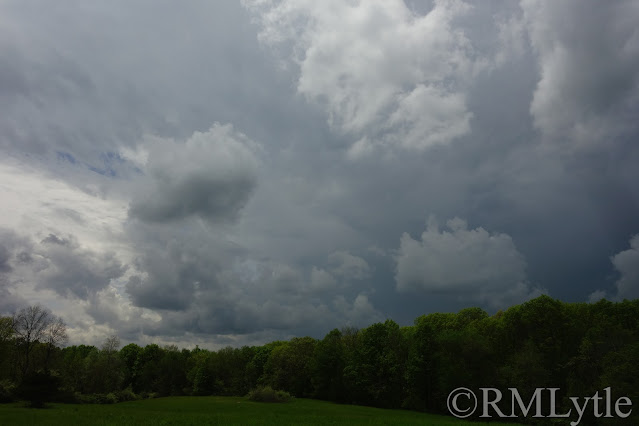


We blasted west then a bit south to get into a good position to observe the developing storm, and when we reached a cleared hilltop it already had a compact little updraft base, complete with rear flank downdraft cutting through the cloud base (this is called the "clear slot) and a  low wall cloud. The rapid rising motion on the right side of the wall cloud was incredible. This little cell wasn't even severe warned yet, but it was trying to do something.


We watched the storm evolve, breathing in from warm moist environment it was moving into and exhaling cold air and rain. The updraft was indeed rotating, and it was pulling rain around itself and lightly cloaking its inner workings in translucent curtains. As it did so, a laminar funnel appeared from the wall cloud and a couple of vorticies danced up from the ground. This was what we'd driven out here to see. This brief tornado lasted no more than two minutes and did no reported damage in the vicinity of Ulster Park, New York. Indeed the storm that spawned it still wasn't even severe warned, though nickel sized hail was reported. It quickly lost tornadic potential for a little while, perhaps interacting with the Hudson River Valley. Garth and I bailed from our position on the hill top with positive cloud to ground lightning raining down around us. I ran down that hill laughing like a mad man, the earth shaking around us from the thunder claps and fat rain drops starting to beat the grass. I was truly alive in that moment, happier than I know how to describe. Sitting in the car catching my breath, I think I may have said something to the effect of "That was the shit right there. That's what it's about".


We briefly left the storm, which may have been a mistake as it went severe warned just a short time thereafter. In a desperate bid to catch back up, we ventured into the hills near the New York/Massachusetts Border. We struggled to get a good position on those winding roads and in heavily wooded terrain. Near West Stockbridge, we gave up. 


While we were diving back south into Connecticut the linear mode was taking shape. That resulted in one tornado-warned northern tip echo and some straight line wind damage along the leading edge of the line. We were on the tornado warned area, it did not produce but exhibited a classic rain wrapped QLCS circulation.


When it became clear we could no longer keep up with the line it was time to head home. I was exhausted by that point anyway. 

The next few days, I was forced to stop. I couldn't keep chasing the highs in my injured state. I tried to get out after the big stripers here and there, and I did have some opportunities. Alex got a 44 incher the one night I didn't go at all. I had a few decent little fish to 30 inches but no monsters. Mostly, I couldn't find the energy to get excited. Staying at home and trying to focus on work suddenly devolved into a deep depression. Unable to get enthused by the little things and physically prevented from doing anything grander, all the thoughts and problems I'd been trying to keep out for the previous months came rushing in. Struggling to grasp at something, I began trying to make progress on my business plans. I found I couldn't. The energy wasn't there. Every bump in the road began to feel like an impasse. Just filling out or printing paperwork felt like it would be as difficult as lifting a boulder with one hand, so I didn't even bother. The fact that my truck was still, three months later, in the shop from the Florida debacle was grating on me. I worried if I'd be able to afford the bill. The loss of a good friend suddenly felt real when I got what should have been a brief moment of respite and caught an incredible brook trout in a new spot. I thought to myself "Alan will love this", then remembered that he's gone. The date of my surgery came and the procedure seemed to go well, though I was and still am in a constant odd state of discomfort or pain afterward. It all came to head when I found myself lying in bed one morning, shaking, tears soaking my pillow, cold, and feeling completely alone. An intrusive, awful thought that has made its way into my mind in the past was back again. I've struggled on and off for years with mental health. There have been times when I just didn't want to continue. I wished, that morning, that my fall had killed me. I had had enough.

Why am I telling you this, you are probably wondering? It's an incredibly vulnerable story to tell in a blog post. I honestly don't want to put a spotlight on myself. I've hemmed and hawed over how I should tell this story or if I should tell it all, but I keep coming to the same thought. I alone am far from important, but I'm also far from the only person that has wanted to end their lives. Many of us have lost loved ones to suicide. It's horribly common. I just want those who may feel similar to the way I do to know that you aren't alone. I'm sure plenty of people are putting off a public facade of happiness and deeply wishing you didn't exist as I have done many times. Someone may look to be leading a privileged and joy-filled life but be dying inside. I'll tell you, it fucking sucks. I don't wish this on anyone. Nobody deserves to feel this way. Like me, you may be chasing highs, hoping to forget the things that are hurting. It may be working for now, but if one thing is becoming clear to me its that chasing the highs is a temporary solution. Fishing is as much a symptom of  my problems as it is a cure. The chemical releases in my brain give me a buzz when it's good and the hard-headed focus required to be the best angler I can be keep my mind off other problems, but it can't be sustained. Please, if you're suffering similar feelings, don't let them go unchecked. I'm not remotely qualified to therapize anyone and I'm not going to try, but there are options out there. Don't put it off. It's easy to, I know. I have done and actively am doing so. But if you are hurting, please know that people do love you. You've got someone, even if you don't feel like it. I promise you do. I'm here still, and I care about you. 

I often struggle to find a direction in life. Other people try to sway you, to direct your course. That's not something that's really up to them, even if your course isn't ideal from their vantage point. I don't know if what I'm doing now is the right course of action. Sometimes it feels like I will never get ahead. With the economy spiraling, a service job like guiding may well become difficult or impossible to hold. It is, after all, a luxury. Some have pushed me towards this line of work while others try to drive me away, and in each case the reasoning isn't unsound. I can only base my decision on one thing, though, and that's the way I feel when I'm standing on the poling platform or in the river next to a client when they hook a good fish. In that moment, I'm often happier than I'd be had I hooked that fish myself. The joy I get from showing other people, wonderful people, a slice of my world is one of the few things that has kept me here. It's hard to describe, really. I had a client out for carp not long ago, and he had numerous shots at feeding and sunning fish and landed a few. There was a moment of deep clarity for me when he was casting at one particular fish, a tailer in just 7 inches of water. I realized that my legs were shaking more than they would were I casting at that fish myself. My client's excitement and my own were so palpable I could almost hear it, like the low buzz of high tension power lines. Flip Pallot said something on the Millhouse podcast how "life is focused like a laser beam into (a) skiff". That applies to more than just flats skiffs. When I'm with a client, I'm doing what I feel I was meant to do with my life. I have meaning, then. I'm on the water, I'm teaching, and I'm giving people unforgettable experiences. It is one of a small handful of things that continue to give me meaning. That meaning is there when I'm on the ground in rattlesnake country, taking down data or even just observing for the sake of seeing something incredible. 

I wish I could hold onto that feeling when everything comes crashing down around me. Some moments its there, others it blinks out.  

I'm trying. I don't really want this to be over, at least not at this moment. I may be running headlong down an impossible path, but it's all I seem to be able to do so I may as well. You may very well feel the same. Well, friend, we'll let's enjoy it while we can. It is, after all, as fleeting as the sound of a cow striper eating a herring. I'll see you at the end of the path, beaten down and broken I'm sure. We'll look like we just ran down a big hill trying to escape the lightning, splattered with rain and sweating profusely. Or perhaps like we just lost that cow striper, sore, exhausted, cold, and smelling a bit ripe from not showering and sleeping in vehicles for multiple nights. But I think, maybe, there'll be a smile on our faces. I'll look at you and say "That was the shit right there. That's what its about." We'll feel alive for a moment. Then it'll be over. Our stories will come to an end when they're supposed to, as does everything else in the universe. Let's not force that along. What would be the sense in that? Life will kick our asses, that much is true. Maybe we can still have fun in the process. 


 Thank you to my Patrons; Erin, David, John, Elizabeth, Brandon, Christopher, Shawn, Mike, Sara, Leo, C, Franky, Geof, Luke, Noah, Justin, Sean, Tom, Mark, and Jake for making Connecticut Fly Angler possible. If you want to support this blog, look for the Patreon link at the top of the right side-bar in web version.

Monday, April 18, 2022

Can't Stop

It's dark and cold. The spring peepers went quiet hours ago when the temperature crept down below freezing. Nobody is out, the water slides by at a slow and steady pace. The tide is as sluggish as everything else seems to be. There isn't any sign of bait. There's no sign of bass either. It's so cold, why would there be? I fish anyway, letting the hours slide by, allowing the pursuit to pull me forward and keep me on target. If I think about that target I don't need to think about anything else. 

A muskrat comes up the bank from below. I think I know where he's headed, but I'm surprised to see him at this time of night. Normally he makes his rounds earlier. Maybe he's just wondering why I'm there when I am too. I'm often late to the party, showing up after the bass have been around a while and lingering till after everyone else has given up. This year I felt the need to hit the target sooner. But tonight there's nothing, it seems. No bait. No bass. But I must not stop. At 3:30am I can hear the frost that's forming on my line scraping off onto my guides. Hmm. Very cold indeed. 

I make a minor spot adjustment, just to cast through the same water at a slightly different angle. Sometimes that makes a difference. Usually it doesn't. I think about these things that some anglers don't. Not merely does adjusting where you stand allow you to present your fly to different fish, but it might let you present it better to the same fish you've already showed it to. Maybe there was a bass in front of me and I just had to show it the same fly in a different way. Maybe it  If I keep thinking about these things I don't have to think about... well, I don't want to think about that. I force myself to think about the variables and the task at hand again. The line I'm using wasn't great. The head is much too long for the job. It's much too long for anything I would do with it, frankly. Feeling the taper as I strip it through my fingers, I ponder solutions. I could cut it down I bet, make it into something really useful. It would end up being a triangle taper, basically. As it was there was really nothing I could think to use it for. My mind drifts to things Ian Devlin has taught me about tapers, grain weights, and casting. 

My new angle suddenly seems to have been a good idea when I feel that ever distinct thump. Ramming the hook home, I could tell it was a fairly decent bass. Not huge, but big enough to make for a very solid first of the season. 

By that point I'm more than exhausted enough to fall asleep. I let the fish swim off and walk back to the car. That was that. But only for that night. Sleep keeps the thoughts away for the most part, especially when I'm so dog tired I don't have any dreams I can remember. The next day I'll work until I have no more will to work, then I'll go fishing again. And I'll fish harder and with more intent than I ever have before.

 I can't stop, and I barely have since. If I fish hard enough I'll break my goals. If I fish hard enough, I won't think about those things I don't want to. I can't stop now or it will hurt too much. I'm fishing the pain away. That's all I know how to do. 

Thank you to my Patrons; Erin, David, John, Elizabeth, Brandon, Christopher, Shawn, Mike, Sara, Leo, C, Franky, Geof, Luke, Streamer Swinger, Noah, Justin, Sean, Tom, and Mark for making Connecticut Fly Angler possible. If you want to support this blog, look for the Patreon link at the top of the right side-bar in web version.

Monday, April 4, 2022

Night Fishing Seminar (In Person)

 I'll be presenting one of my night fishing seminars starting at 6:00pm on April 10th, at the Middle Haddam Public Library (2 Knowles Rd, Middle Haddam, CT 06456). This will be the first in person presentation I've done since the pandemic! Admission is free.

This seminar will cover the necessities for anyone looking to start or expand their skill-set night fishing trout streams. It covers gear, safety, flies, reading water, and other strategies. It'll run about an hour long. I hope to see some of you there!

Monday, February 28, 2022

Following Trout and Char Through The Seasons

 Garth and I found ourselves wandering around CT late on New Years Day. It was a dreary, grey, and damp day, though exceptionally warm for the 1st of the year. The morning had featured that dangerous sort of pea-soup fog, fog so thick it soaked clothing. That had lifted but was only replaced by thick grey stratiform clouds. Front passage was not predicted until early morning, so I knew warmth would hold well into the night. We fished through the daylight without any notable success, but I was not done when the sun set. I had an idea, a spot I wanted to try. 

I'd started to rethink where wild trout might move throughout the season the year before. Brook trout have a long history of success even under extreme anthropogenic pressure. They managed to survive through the near complete deforestation of New England, and even now, though very notable declines have been documented, they persist in river systems that are often very impaired. One of a fish's methods for surviving a cataclysmic event is to run away from it. To persist, brook trout have to have moved around a lot. And they must still do so, right? This would explain why I was sometimes finding stretches of river that I knew with certainty held salmonid populations to be completely void of them during certain time periods. 

Winter is, in some ways, a potentially deadly time for a salmonid. Ice and food availability are the biggest threats. What makes those threats null? The presence of deep, food rich water. The previous winter I'd devoted some time to exploring a few streams that emptied into significant wetlands with unsatisfactory results. One stream produced fish, but not as many as I knew it should. Another dealt me more than one skunking. Though I was unable to revisit them in the spring, one observation gave me a hunch. Noah and I stopped briefly one day at a spot within one of the wetlands, where the braided swampy stream was briefly constricted and deepened. We saw a school of brook trout, surprisingly large brook trout, in this deep elongated pool.

This was a spot that had been surveyed via electrofishing before, and when I looked back at the data what I'd remembered had not been wrong. No brook trout had been present at the times it was sampled. Those surveys were performed in the summer. Brook trout, particularly large brook trout, are far more reliant on a varied habitat than we give them credit. A stretch of stream might provide ideal spawning gravel but minimal cover or food during low water. A swamp might be too warm in the summer but provide refuge and readily available food in the winter. A stretch of pocket water may remain well oxygenated in summer but be choked in with anchor ice in the winter. Many fish need an interconnected mosaic of habitat to be successful, and their movements throughout these zones are often fairly predictable. That doesn't always work for angling, though. I can't count the places I still ask myself "where the hell do these fish go?". Sometimes you just can't find them. That doesn't mean they are all dead or something, they're either just not where you're looking or their behavior is making them less than receptive to your angling strategies. Just down the road from the spot Noah and I saw the brookies was a near identical if not more impressive pool in and arm off the same system. I've still yet to encounter a fish in that one and I just don't know why. I may well never.

This time though, I'd cracked part of the code. Garth and I pulled into a parking spot near the swamp hole and then waited a while. We hadn't been able to avoid hitting the water with our headlights so I wanted to rest it to have the best shot. A while late, we quietly approached the water. I covered the same 10 square feet of the near-still hole, often retrieving the fly over the same water three times consecutively. There was, at one point, a barely perceptible swirl on the fly. Then, a few minutes later, one of the brook trout I knew must be there revealed itself. She wasn't as big as I know is possible, but at a foot long this is a great CT native char, and one caught in complete darkness, in January, on a mouse. 

Thinking I had it absolutely pinned I decided to take Garth to two nearly identical spots to try to repeat the success. It didn't work at all we found no more fish. I think I know why but I'll leave that for another day. 

There are two takeaways for this, in my opinion: fish catching survey methods, be it angling, netting, or electrofishing, provide tiny slices of the pie. They can be incredibly helpful in determining if fish are present, but are very unreliable for determining whether a fish species isn't present. They just may not be present exactly when and where the sampling took place. 

And of course, if you're not catching fish, they may legitimately not be there at the moment. No amount of fly changes, strategies, or approaches will change your success if all the fish you're targeting are two miles away. Sometimes you need to think outside the box, and by box I mean the "fishiest" looking water. Fly fisherman in particular aren't always the best judge of productive trout water, often because the gravitate to the "pretty" stuff. Not all trout water fits the classic, tumbling freestone or manicured, grassy spring creek stereotype. Some of it is really muddy, slow, and has brush around that is so thick you'd think no living creature could penetrate it and reach the water itself, and that shreds expensive waders with ease. Even if you manage to get to the water, conventional fly cast strategies simply will not do the job. But that might be where the fish are, depending on the season.

Until next time, 

Fish for the love of fish.
Fish for the love of places fish live.
Fish for you.
And stay safe and healthy.


Thank you to my Patrons; Erin, David, John, Elizabeth, Brandon, Christopher, Shawn, Mike, Sara, Leo, C, Franky, Geof, Luke, Streamer Swinger, Noah, Justin, and Sean for making Connecticut Fly Angler possible. If you want to support this blog, look for the Patreon link at the top of the right side-bar in web version.