Showing posts with label Snapper. Show all posts

Saturday, April 11, 2020

Indicator Fishing for Reef Fish: Failure and Redemption

Maybe this would more appropriately be called float fishing for reef fish, because for the most part that's exactly what it was. Whether indicator nymphing is fly fishing is neither here nor there, I contest that it is, but I was categorically not fly fishing.

After catching three remarkable new species at Boca Raton Inlet Park, Noah and I left to try a place nearby that we'd never fished before. Satisfied with how I'd already done, I wanted to just relax and catch a bunch of fish, so I decided to fish with bait the rest of the day. I tipped my fly with squid and affixed an indicator to my leader and promptly began catching a ton of fish. Noah followed suit and started using a float as well. It was wildly effective, didn't result in as many hangups, and produced  variety of species.

Slippery dick, Halichoeres bivittatus

Pinfish, Lagodon rhomboides

Spottail pinfish, Diplodus holbrookii 
Slippery dick, terminal phase.

 I spent a lot of the time just sitting on the wall, relaxing, enjoying a kind of fishing not comparable to anything I've done in the northeast. In the back of my mind though was the distinct and very likely possibility that I could at any point hook a species that I'd never caught before. I don't keep a hook and line lifelist, I'm not particularly interested in trying to catch every species possible on hook and line. I am really only interested in catching as many species as possible on the fly. So any species I caught doing this would represent, essentially, a failure on my part to take advantage of a possible opportunity to catch a new species on the fly.

Inevitably, I caught a species I'd not before: a lane snapper, probably the prettiest snapper species in Florida. That was a disappointment. I would have loved to have caught this fish on the fly, and maybe I could have.

Lane snapper,  Lutjanus synagris
I didn't change what I was doing though as I really wasn't that confident I'd be able to catch a lane snapper on the fly at this spot anyway. a short time later I caught a very cool looking scrawled cowfish. I was thankful I'd already caught one on the fly the same day.

Scrawled cowfish, Acanthostracion quadricornis

Mangrove snapper, Lutjanus griseus
About an hour later, another species I'd never caught before ate my squid. This time it was a grunt.

Smallmouth grunt, Haemulon chrysargyreum
With two species that would have been exciting editions to my life list caught on bait I started just fishing the fly under the indicator hoping to redeem myself, and I did catch fish on the fly... just tomtates and sergeant majors though. I left not really feeling frustrated, because what had transpired wasn't at all surprising. But I decided I'd like not to fish bit anymore that day. We headed back north but visited a place that Noah had found, a spot that definitely contained a lot of reef fish based on diving videos Noah had seen. Though it was now night, I kept with the indicator technique as I could still see it in the glare of the streetlights and it allowed me to keep the fly suspended on long drifts. I caught a new species on a small Clouser under the indicator almost immediately: a blue striped grunt. The the smallmouth grunt would remain one of only a tiny handful of fish species that I've caught but not caught on the fly, at least I'd add a fourth species of grunt to my life list. And it was a beautiful fish.

Blue striped grunt, Haemulon sciurus. Life list fish #154. Rank: Species

I then hooked and lost two fish on the same small clouser that fought in an incredibly strange fashion, completely unlike any fish I'd ever hooked before. They were both substantial, and the second broke off. In retrospect I think they could have been small morray eels but I'm not sure. The fight was closer to that of an eel than anything else I can think of. However I wasn't out of the count yet. Changing to a size 12 Hare's Ear, I then caught my lane snapper!

Lane snapper, Lutjanus synagris. Life list fish #155
I felt a bit redeemed by those two fish, and we'd be back at this same spot very soon to see what we could find there during the day. We had no idea what we were in for.
Until next time,
Fish for the love of fish.
Fish for the love of places fish live.
Fish for you.
And stay safe and healthy.


Thank you to my Patrons; Erin, David, John, Elizabeth, Brandon, Christopher, Shawn, Mike, Sara, Leo, and Franky for supporting this blog on Patreon.

Saturday, March 14, 2020

Snapper, Puffers, and Snook in Small Canals

What do you do in Florida when it's cold and windy and you aren't in a good trout and redfish spot?


Snook and tarpon aren't fans of the cold. The area we'd elected to spend our first week is an area we'd chosen specifically for it's tarpon and snook potential. Left with wind that made fishing even moderately open water next to impossible and cold that meant fish there probably wouldn't eat anyway, we were left with limited options. The bass freshwater fishing was pretty mediocre in places we'd fished the prior year, when low water had concentrated large numbers of fish in small, isolated pockets. Now the wetlands were flooded and most of the fish were tucked away, spread out in the grass. The best viable option close to camp seemed to be residential saltwater canals, where we could get away from the wind and potentially find some pockets of sheltering snook while also getting shots at new species.
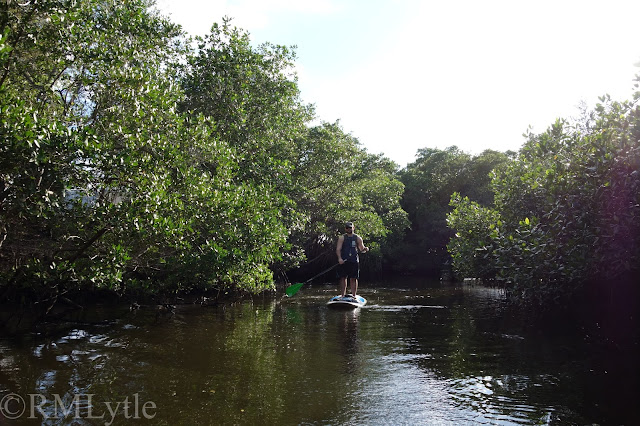

The canal we spent much of our time in alternated between natural mangrove banks and houses with docks, also a seawall or two. There were a few healthy oyster beds here and there which was great to see, and there were fish hanging out around them. I'd rigged my five weight with a size 12 BHHESH, not a bad small shrimp imitation, for these sorts of fish. Small mangrove snappers as it turns out are quite fun on a 5wt. Pound for pound, they've got even wild brown trout beat in the hit and run department. They'd come out and absolutely slam the fly, then dig like hell and sometimes even jump a bit if they were in very shallow water.

Lutjanus griseus

The only predator species that seemed to be working the abundant the abundant school of extremely small baitfish were small crevalle jack.. What species the bait was I have no clue, but the jack eating them were puny. In the main river, we saw big jacks blasting adult mullet. That was spectacular to behold. Loud, fast,and violent are applicable descriptors. I want one of those jacks. THAT would be a blast.
Caranx hippos
What I most wanted, other then for some sign of large predators getting frenzied enough to catch, was a puffer to show up on my nymph. And eventually one did! A checkered puffer, lifer #145.

Sphoeroides testudineus
 Later a frillfin goby found the same fly, the first goby I'd caught in more than a year. I'd caught this species before but I knew crested gobies, a species I hadn't caught, weren't at all unlikely to be in the same area. I hoped one of them would show itself. Gobies are adorable little monsters, popping out from their holes to make quick attacks at intruders and potential food then darting back inside. Often it's a one and done proposition with them. Hook them briefly an lose them, they don't seem likely to come back for seconds.

Bathygobius soporator


The next day, spurred on by warmer weather, somewhat manageable wind, and the crazy big jack blowups we'd seen the day prior, we returned to the same area. The wind was still pretty bad, but the mangrove snappers were, if anything, even more fired up.


Then, it happened. Noah FINALLY caught a snook and got it to hand for long enough to photograph it. I've personally watched him catch a snook larger the most non-Floridian fisherman I know have ever caught, but that was a disaster. I was battling a pelican that had flown into my line while Noah's big snook flopped off his board. He lunged trying to grab it and sliced a chunk out of the tip of his finger on it sharp gill plate. So, unfortunately, Noah can't say his first photographed snook was that monster... but you know what? We love the little ones. Tiny or big, snook remain one of my favorite species of fish to present a fly to. Give me a choice between catching a brown trout or a snook... I'm choosing snook, no further questions.


I blew it with snook that morning. I spooked some big ones and I broke off a small one. Even a small snook can rasp through light mono very quickly, I'm primarily using 30lb fluoro for all my snook fishing. I wasn't using fluoro for the one I broke off, of course. I didn't get a snook that day. That was fine though, the next would prove to be fruitful. More snappers and puffers though? I'll take them. There's nothing like the sort of fishing I was doing in CT. It was a lot of fun on my 5wt.


Though the forecast didn't look to be getting any better in term of wind for days and days and day, Noah and I both had some tricks under our sleeves. I may not be a local, this may have only been my fourth trip fishing in Florida ever, but Noah and I been known to accomplish things with exceptionally limited time and first hand experience before and this trip was not going to be an exception. When you live and breath fish and fishing, it doesn't matter where you go. Patterns reveal themselves and so do paths to success.
Until next time,
Fish for the love of fish.
Fish for the love of places fish live.
Fish for you.

Thank you to my Patrons; Erin, David, John, Elizabeth, Brandon, Christopher, Shawn, Mike, Sara, Leo, and Franky for supporting this blog on Patreon.

Saturday, February 2, 2019

Florida: A Plethora of Weird Fish

If you enjoy what I'm doing here, please share and comment. It is increasingly difficult to maintain this blog under dwindling readership. What best keeps me going so is knowing that I am engaging people and getting them interested in different aspects of fly fishing, the natural world, and art. Follow, like on Facebook, share wherever, comment wherever. Also, consider supporting me on Patreon (link at the top of the bar to the right of your screen, on web version). Every little bit is appreciated! 

"What the f*** is that thing" was the common theme for Noah and I on most of our visits to inlets south of where we were staying on the East Coast. We saw some weird stuff down there. Huge scrawled filefish... like, easily world record sized. All manor of species and color phases of parrotfish. Some very strange wrasse. I saw a huge lime green moray eel. Giant angelfish. There were things swimming in that water that I just could not identify.

This was a life-lister's wet dream. How many species down there would be new ones for me? The number could easily have been north of 50. And throughout the year I have no doubt at least 200 species I've never caught spend some time in this same water. Noah and I knew this before we even saw a South FL inlet, and it's why we fished them so much. We were down there to catch new species, and inlets and piers were going to put us very close to a lot of them.


I myself got 13 new species from one inlet that we fished three times. I'm not sure exactly how many Noah got but it was substantial as well. I should add that just because there were hundreds of fish and a lot of new species didn't make it easy to catch them. I had to work for new species. But the sheer biomass of the place meant I was assured to catch at least a few new ones. If you haven't already read it, this post covers the first trip and six species I got at this inlet: flyfishingcts.blogspot.com. Ideally you should read that one before finishing this one.

Our second visit to this particular inlet was great fun for me because it yielded a few species that I really wanted to get. Of course I started out catching the ever present sergeant majors. We need to find a time when those buggers aren't so prevalent. I do wonder if there even is such a time.

Abudefduf saxatilis
Noah saw a yellow thing in the mix. He dropped his shrimp in front of said yellow thing, then hooked said yellow thing. The yellow thing turned out to be a French grunt. Did I say yellow thing enough? Yellow thing. You'd get it if you had been there.

 Haemulon flavolineatum (yellow thing)
Noah then went up the wall, and I was left to catch one of two new wrasse species I would catch at this inlet. Both have very hilarious names. This one probably has the funnier of the two. On a pheasant tail nymph with a soft plastic tail, I caught two slippery dicks. No, I did not make that name up. They are slippery though, and they are dicks about letting you get your fly back from them. So, aptly named I guess. They are gorgeous little fish though, in contrast to the rather dull colored wrasse we see in New England, bergalls and tautog.

Halichoeres bivittatus


Not long after I caught the slippery dicks I got a couple of damselfish. Some of the damselfish in Florida are very tricky to identify, namely longfin, cocoa, and dusky damselfish. Sergeant majors are a damselfish as well but they stand out from the crowd. Cocoa and longfin damselfish havevery distinct color phases, unfortunately when inshore their color varies almost none from eachother and dusky damselfish. I am fairly confident though that both of the ones I caught were dusky damselfish, Stegastes adustus.


The blue on this one's fin threw me off. Thanks to Patrick Kerwin I learned that dusky may have some blue.
As time wore on I caught fewer and fewer fish, even fewer non-sergeant majors, and even fewer fish on the fly. But eventually I managed to get something interesting to take the artificial again. A bandtail puffer! I had seen a lot of puffers on this trip and I couldn't imagine leaving without at least one, but I thought it would have been either a checkered of southern. I will get those, but catching the less common bandtail was a wonderful compromise.

Bandtail puffer, Sphoeroides spengleri
I believe that was the last fish I caught there that day. But we came back the next for more. We thought there's be more potential for new species there at slack tide. That seemed to be validated. Quickly upon getting there I made casts out into deep water, which was not fishable with the fly rod when the tide was moving, and the first fish I caught was the second wrasse with a funny name. The puddingwife wrasse. In my opinion this was the prettiest fish I have ever caught. 

Puddingwife wrasse, Halichoeres radiatus


Then a yellow thing jumped on my little streamer and I had a French grunt of my own. Slack tide was working out well.

These guys' eyes are just mesmerizing. Haemulon flavolineatum
Then, another grunt species came to the fly, my third species of grunt of this trip: a sailor's choice grunt.  

Haemulon parra

And then, a new snapper species. Schoolmaster snapper. I think these are probably the most handsomely dressed of the snappers. I caught a mangrove snapper a while later, for comparison a photo of that fish follows the photo of the schoolmaster. Though many target snapper species as food fish, keeping a schoolmaster would be a poor decision. They often carry cigutera poisoning, something found in some reef-fish and fish that eat reef-fish. They are so frequently associated with cigutera that in some areas locals just label the species itself poisonous. Though that isn't true... don't eat one. Or any other species you have limited knowledge of, for that matter. 

 Lutjanus apodus

 Lutjanus griseus
Noah caught a couple fish that I was kind of jealous of. One of them was a big, gorgeous terminal phase slippery dick. Another was a juvenile gray triggerfish.

Halichoeres bivittatus, terminal phase (Photo courtesy Noah Johnson)

Balistes capriscus
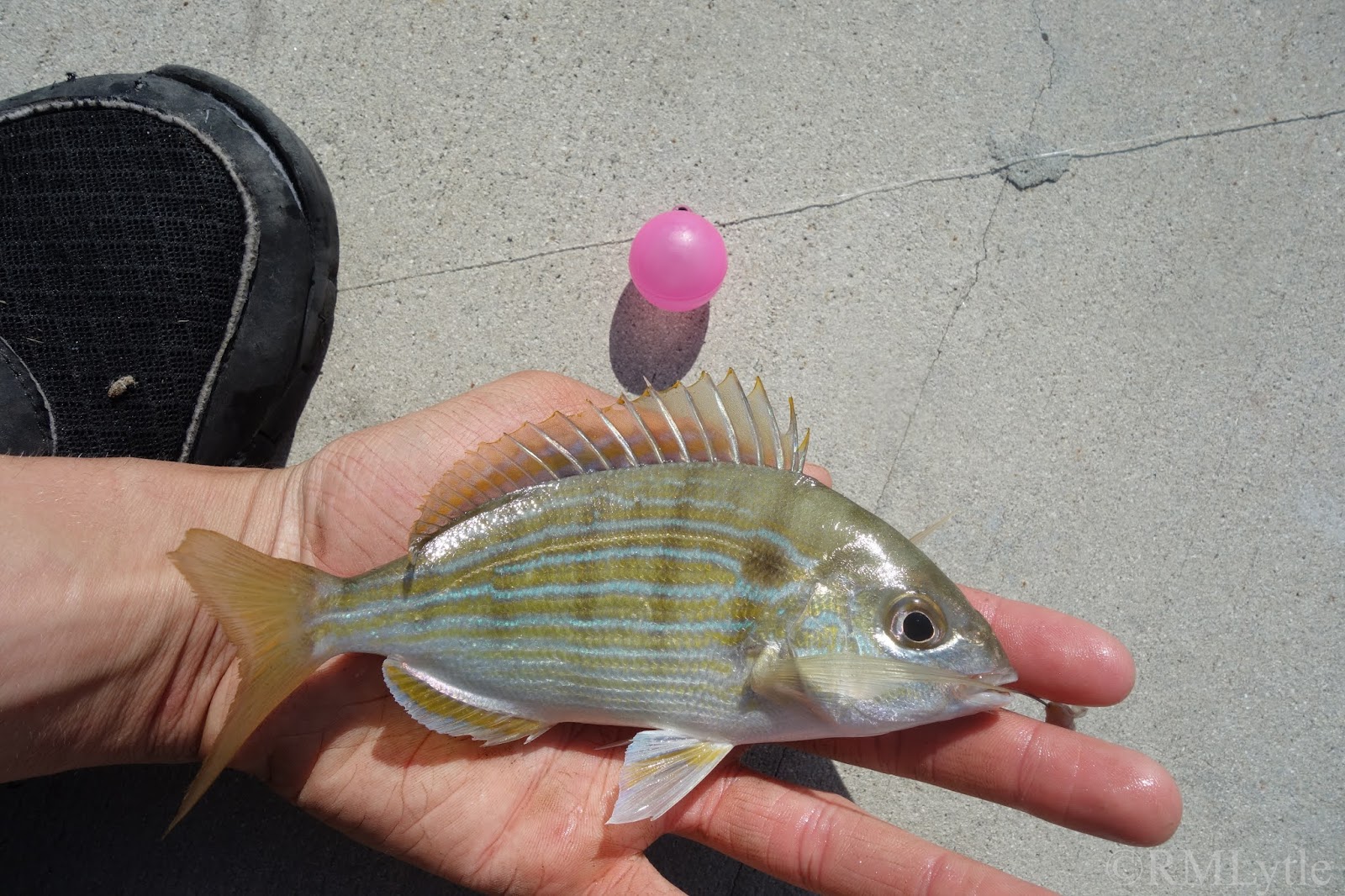
But the fish I was most jealous of was a really bizarre one. We had seen this thing swimming around for about an hour. We both got casts in front of the thing and both had interest from it. In fact, the second photo in this post shows this fish. At the time we didn't know exactly what it was, which is a shame because it was actually an all tackle world record. Eventually Noah got the fish to take a jig. We walked it down the wall, where I hopped down to help him land it (this is where things broke down if we had wanted to get this fish confirmed as a record). I leadered the fish and led it around the rocks. Touching it was questionable. There were a lot of spines to get poked by and we had no clue what kind of strange toxins this fish could be carrying around with it. 
As it turns out, this was a spotfin porcupinefish. The world record was just over 8lbs, caught by a rather legendary angler in the life-listing community,  Steve Wozniak (not the apple one). This one would have gone 12 easy. And we didn't even properly identify it until we were on our way back to camp. Oops. 


Diodon hystrix


Missed world record opportunity aside, we did really well there on our last visit and really well there in general. We caught a total of 18 species between us at this one inlet, most of them new.

Blue runner,
Horseye jack,
Yellow jack,
Leather jack,
Sergeant major,
Dusky damselfish,
Tomtate grunt,
French grunt,
Sailors choice grunt,
Spottail pinfish,
Pinfish,
Puddingwife wrasse,
Slippery dick,
Mangrove snapper,
Schoolmaster snapper,
Bandtail puffer,
Spotfin porcupinefish,
Gray Triggerfish

That's just wild. And I know we didn't even catch half the number of species we saw there. I can't wait to return to that place. It has so much potential. When we finished out there that evening we headed for our last night of the Florida trip. I wouldn't catch any new species before we left. I ended the trip with 29 new species and 1 new hybrid, bringing my life-list total to 130. My goal of reaching 150 by the end of 2019 seems very attainable if not surpassable. Time to put an inhuman amount of effort into catching fish people rarely think to target.

This Florida trip is not entirely complete though. Expect one more post, hopefully just as exciting as the rest have been. Unfortunately it seems you all haven't enjoyed these as much as I did as my readership has fallen even further over the last month, but I plan to do more trips like this in the near future whether or not they result in good numbers here on the blog.


Tuesday, January 22, 2019

Florida: Strange New Species

As Noah and I drove across peninsular Florida once again, I felt partly fulfilled and partly frustrated. In our time on the Gulf Coast, I had not gotten a single new species. I failed to get my redfish. But I had caught a lot of snook, a few good snook, and one quite big one. The end was in sight now. We had caught a lot of new species in Florida this time. I had already reached my goal of adding at least 15 to my life list. It was time to buckle down and really get a lot done in the time we had left. 

As we traveled, we passed lots of oranges. Some growing, some in transit. The growers seem not to mind loosing some product: The trucks are filled as much as they can be, providing an explanation for the piles of roadside oranges we saw in Arcadia. Noah and I joked that if we tailgated the a truck long enough with a catcher's mitt on one hand out the window, we could probably get a free snack.


We spent a night at my Grandparent's again before going back to our base camp. It gave us a good chance to just relax a little. We needed it badly. But in the morning, we were ready to go. On our way south towards Jupiter we decided to hit some familiar places and some new places, starting in Melbourne.


Our first spot was quite productive. I had found some funky species here in November and wanted to get some of them, and this time I did. We both got ourselves frillfin gobies, which were easy to find and fool but not as easy to bring to hand. Dropping my tiny flies into different cracks and holes produced many takes and I eventually did bring some to hand, but I found that, much like darters, the little turds liked to attack my split shot instead of the fly. That is an annoying trait of some of the more aggressive micros I target. These little gobies did have a big attitude. It makes them pretty adorable.

frillfin goby, Bathygobius soporator


Mangrove snapper were pretty abundant there this time, though they were genuinely difficult to get on artificials and bait. I got a fair number of takes and just two to hand. Also abundant were scaled sardines (pilchards) and some other kind of tiny baitfish, which were periodically getting trashed by either jacks or spanish mackerel. We didn't catch any of the blitzing fish, so we'll probably never know which.

mangrove snapper, Lutjanus griseus
Eventually Noah wandered elsewhere while I continued trying to get new species in the rocks. He found some hardhead catfish and was sight fishing them. He called me up and I made my way over. Sure enough there were some cats meandering around a weedy area. He had already caught more than one. I took a few shots before I hooked one. These were a pretty unique fish. Just seeing a catfish swimming around in salt water was weird enough, but these things jumped sometimes when hooked and had a funky metallic sheen to them. Though widely considered a trash fish throughout their range and being very difficult to handle, I found them pretty interesting. 


hardhead catfish, Ariopsis felis
As tricky and somewhat dangerous as hardhead catfish are to handle, not long after I managed to get something to eat my fly that was much, much more dangerous. I had seen a lot of stingrays already on this trip. I'd made casts to a couple. Spooked all of them. This time? That thing just swam over and planted right on top of the fly, taking it much the same way as the skates I've sight fished have. I set the hook, battled the fish for a little while, and found myself in a predicament. I was not going to get a good grip and grin with this thing... I let it sit in the shallows for a moment and called Noah to see if he could grab a towel. Eventually I got antsy and just snapped what mediocre photos I could get, broke the fish off, and ushered it out of the tide pool. This was my third cartilaginous fish species on the fly. 


common stingray, Dasyatis pastinaca
So, I had added 3 new species to my list at this spot today. Could I get one of the scaled sardines we were seeing? We certainly had small enough tackle. Noah and I both sat on a concrete culvert trying to hook a pilchard for a long time. He had the added advantage of being able to use bait. Though I could use bait, it would disqualify the catch from being added to my list. But what we found was that these fish wouldn't grab onto anything for long, bait or artificial. That is usually what makes getting a smaller fish hard on the fly: they just don't hold on long enough to set the hook. Well, in this case they were behaving the same way with the shrimp and the fly. We would occasionally have one on for a few seconds before it would flip off the hook and back into the water. Eventually, Noah got one. I found that when he quit regretting them the going got tougher for me: having bits of shrimp in the water was getting the fish into a frenzy. So I started just tossing pieces in and jigging my fly violently right under the surface. Noah was pretty much packed and ready to leave when I finally managed to hook one of those little buggers and get it to hand. This is a species I certainly hadn't expected to get on this trip, or ever honestly. 

scaled sardine, Harengula jaguana
From there we continued south, and found another very charismatic new fish species. But that will have to wait for another day.