Showing posts with label Big Rivers. Show all posts

Tuesday, May 6, 2025

A Single Sailboat

 I take significant strides to avoid the hendrickson crowds. It's a hatch I enjoy fishing, they're such a classic ephemera that can bring up some larger wild trout under the right conditions, but that means everyone and their mother is just as keen to fish them on the major rivers. And unfortunately the hatch just doesn't happen everywhere, even in places where it used to. The Housatonic doesn't seem to have a Hendrickson hatch to speak of anymore. Nobody quite knows why, and it may be a site by site problem, but aquatic insects are, on the whole, not doing so hot. In some places, nutrient deficiency means less bugs- ironically, septic tank leaks and farm runoff with manure in it isn't always the worst thing. In others, perhaps the runoff is the issue. Streams are more "flashy" now as areas develop with paved, impervious surfaces, so flows are more sporadic and less stable. And there's that pesky road salt. So wandering to places questionable has become the mantra, wondering if there will be bugs at all. Find a rock or log next to a pool or run, sit, ponder, don't make a cast unless a trout rises. And so I found myself standing next in a pool somewhere in Massachusetts after watching sleepily for a while. There'd been some duns flying by. I caught one, looked at it for a while and took some pictures. 


Eventually, looking into the reflective glare toward the top of the pool, one of the little sailboats appeared alone. In twirled through little eddies and rode down a seem, standing out like a sore thumb. Hapless little creatures they are in this state, its no wonder trout eat them with such abandon sometimes. Though this bug was by itself, I wondered if enough fish were looking upward to intercept it or if, by emerging in such sparsity the mayflies today were making it to the air freely without exception. It drew nearer, still drifting along. This is anthropomorphizing to an egregious degree, but that little bug looked happy to me. She bobbed along with her wings perked up skyward in the bright sunlight, seemingly carefree and safe as could be. My gaze followed it as it meandered down the seem. It then fluttered once, fluttered again, and in one fateful instant before it overcame the surface tension and took to the air, a foot long trout rose and she disappeared in a small splash. "Aww..." I uttered audibly though I was alone. That's when I stood, and decided that I'd seek vengeance for that little bug. The pool was wide and deep but I made it to a comfortable rock  above and across from where the trout had taken the bug and within reach of  a forty foot cast. It was a slow effort, as I didn't want to send ripples over the only fish I'd so far seen rise in a few trips of this sort. Once there, careful triangulations were performed to determine where that trout had been as the fly was dressed. Then I let fly a cast. I'd decided that this revenge would be swift but fair, it wouldn't take more than one cast. My fly and leader landed with slack to spare, and as the fly settled into that same seem the mayfly had taken her final ride down it looked much like that singular little sailboat had. And evidently I was not the only one that thought so as the trout came to it just as willingly as it had the natural. The battle was pretty one sided, admittedly. Modern fly tackle more than capable of subduing twelve inches of squirming brown trout. At hand, I scolded the trout, removed my fly, then sent it off with a smile. That had been enough for me, and I packed it in for the day. 

Thank you to my Patrons; Erin, David, John, Elizabeth, Brandon, Christopher, Shawn, Mike, Sara, Franky, Geof, Luke, Noah, Justin, Sean, Tom, Mark, Jake, Chris, Oliver, oddity on Display, Sammy, and Cris & Jennifer, Hunter, Gordon, Thomas, Trevor, Eric, Evan, and Javier for making Connecticut Fly Angler possible. If you want to support this blog, look for the Patreon link at the top of the right side-bar in web version. 

Wednesday, December 13, 2023

Wet T-Shirk Muskie Contest

 Muskellunge are a critter often associated with massive amounts of time, effort, and dedication to catch. Especially on the fly. I hadn't put in anywhere near the amount of effort typically associated when I trudged through the early fall woods on my way to a pool in a river in which I might possibly be able to find a muskie. The day prior my good friend Drew Price and I had floated a different stretch of the same river and I'd stuck a hook in my first muskie (the short story about that has been on Patreon for a while), And I'd increased the number of muskies I'd moved with a fly from one to... frankly I've forgotten the number, but it was a lot. We saw a tremendous number of fish that day. That bumped my experience a bit but not much. And now I was in unfamiliar territory again. Drew had told me there were muskies there, but other than that I was pretty much left of my own devices to try to catch one on foot. It was very much the sort of mission this angler is comfortable with. If you've read these chronicles long enough, you've read of many a grueling, ill-advised DIY effort that resulted in netter fish than I had any right to be able to catch. So, although I had no expectations, I felt very comfortable setting out with just my wading boots, shorts, a sling pack, and a couple rods to pursue one of the most notoriously difficult to catch predator fish in the country. 

Shallow riffles and pocket water weaving through the trees gave way to a wide open pool, slow and dark and flanked by steep grass-covered banks. The bottom turned from rock and gravel to mud, and parts of the pool were lined with spare weed beds. This pool looked like a place some Esocids would inhabit, and in this case the top predator wasn't the pickerel and pike one would find back in Connecticut. I decided to work my way around the pool clockwise, starting at one side of the the head of the pool and working around the edge to the tailout, cross, then coming back up the other side. Though the head of the pool didn't show anything, I barely made more than 10 feet down the bank before I moved the first muskie of the day. It came slowly behind the fly, a small male of maybe 30 inches, shadowing with interest but not about to commit to eating.  Working my way around the pool I'd move three more small muskies and one larger one. The small fish emerged from the weed bed, while the largest one materialized from the gloom of the middle of the pool. I'd noticed the day before that the largest three we saw weren't on the edge or in the structure, but rather out in the middle of the river. I found this odd, but many of the fish I target have larger predators to be worried about. A muskellunge doesn't really have that. A big old adult muskie isn't getting eaten by too many things. They can afford to hang out pretty much anywhere they want to that offers them the hydraulic needs to maintain their metabolism. As I ran out of pool to fish, I paused to take a break. I sat down in the tall grass, trying to avoid putting any exposed skin in the abundant stinging nettle, and grabbed a granola bar out of my pack. By that point it had become fairly clear that I was going to get clipped by the southern end of a line of thundershowers. 

I sat and enjoyed my granola bar and assessed that there was very little point in trying to rush back to get a rain jacket. I'd be in a fairly safe spot as far as lightning, I'd just get a bit wet. That's okay, my bottom half already was anyway. I made my way to the tree line, looked at the canopy and tried to pick a place that might be fairly dry. The rain came loud and heavy, big droplets slapping the leaves and bubbling the surface of the river. My little spot was barely enough to keep my bag dry, and mostly because I hunched over it. The rain lasted probably 15 minutes, leaving a soaked angler trying to shake off and wring out his t-shirt while looking downriver at the next pool and wondering if the passage of that shower might have changed the mood of the fish. The day before, a big storm rolling through had seemed to turn the bite off. I worried that those listless follows might be as much as I'd see of a muskie on this trip. But the next pool down looked promising anyway. It was bigger and round, and looked like it could be harder to fish effectively on foot compared to the one above it. I was pretty much stuck with the head of the pool, which was the only chunk of the one above that didn't seem to be holding a fish. Not knowing if that really mattered, I set about working the head of it as thoroughly and consciously as I possibly could. I mixed and matched retrieves, but favored keeping the sink tip of the bottom with a steady two hand with occasional accelerations. I worked river right first, fanning twice, then crossed the stream to work the other side. The number of casts made on that side couldn't have been many when the line went tight. It wasn't a violent eat to feel, and I didn't see it, but the fish had to have eaten with some force because before coming tight there was actually quite a bit of slack. Then there was a moment of uncertainty where it wasn't fully clear to me that this was actually a fish. But it was. And not one of those little one either. The fight wasn't remarkable outside of the immediate urgency and fear I had of losing the fish. I don't experience it to the level I was in that moment very often. It would have hurt a lot if that fish came off. But it didn't. Everything somehow went to plan. The same angler than had stood under the trees with a slight frown just a short time prior now knelt in the water next to the river bank shaking with what must have been a look of sheer elation on his face. 


Muskellunge, Esox masquinongy. Lifelist Fish #198. Rank: Species

Muskie are a not insignificant fish in my personal history, despite my minimal time and effort targeting them. One of my first memories is seeing a muskie in the water at a lake in Northwestern Pennsylvania near where I was born. I'm not sure where on the timeline it fits exactly, nor is it the clearest memory I have, but it's the first fish memory I have. You might think that would make muskie fishing a somewhat bigger part of my agenda. I'm not really sure why it isn't outside of simply not having them around. With a fish so notorious for frustration, skunking, and heartbreak and an angler who frequently likes to have to work hard to catch the target, it would seem to be a match made in heaven. Maybe someday I will get totally muskie obsessed. It would seem to be a high likelihood. But for now, with a helping push from Drew and a bit of patience and persistence to get it done on foot in water I'd never seen before, I can be pretty satisfied with my first muskie on the fly. 

Thank you to my Patrons; Erin, David, John, Elizabeth, Brandon, Christopher, Shawn, Mike, Sara, Franky, Geof, Luke, Noah, Justin, Sean, Tom, Mark, Jake, Chris, Oliver, oddity on Display, and Sammy for making Connecticut Fly Angler possible. If you want to support this blog, look for the Patreon link at the top of the right side-bar in web version.

Tuesday, August 22, 2023

Goliath

 It's rare that I take the canoe out on my own. It's big and bulky and blows around like crazy. There's little sense in sight fishing from it unless I can anchor. I'd actually never bothered to do a solo trip in it until a morning not all that long ago. After multiple client trips with loads of channel cats and carp blind fishing, I wanted my own little piece of the action in solitude. I set out in the early morning haze, groggy and slow but confident. I went about the methodical process of launching the boat without concern of anyone else showing up at the launch on weekday dawn. I undid straps, grunted under the strain of hoisting the yoke over my shoulders, and disrupted the calm by letting the hull slap down when I flipped the boat over onto the river's surface. I feel a little bad when I do that kind of thing and tried to make up for it by poling myself downriver in a manner that blended with the waking up world. Upon getting to the deep cut I'd fish, the push pole served as an anchor with a roped tied to it for easy adjustment. The glassy surface rippled from my activities as well as those of channel catfish and common carp that were just as excited about the warm, humid and calm conditions as I was. 

My strategies for blind fishing carp and catfish are simple, involving relatively small flies, slow presentations on floating or intermediate lines, and patience. As John put it: "Its exactly like bluefin tuna fishing, apart from every single detail". But however slow it may be it is also wildly productive. Though I hardly have any clients interested in it, those that are as well as myself have put a staggering number of fish in the boat this summer. I'm not sure another guide has netted so many fly caught channel cats for their clients in a single month. And the fish themselves are incredibly sporting, pulling like demons and demanding careful fighting and forethought of knot strength and line deterioration. They aren't objectively pretty- not the channels at least, I find carp scales strikingly pretty. But channel catfish, especially big ones, are gnarly looking monsters that are hard to make photogenic. I appreciate their form and function though, and hold the opinion that every living thing holds beauty. The little ones, now some of those are indeed pretty. They have almost a light glitter to their flanks, more like a silver or gold iridescence, and lovely little black spots. Despite all their lack of visual glamour, its still the biggest one that I really want. Garth, John and I have devoted a lot of hours to the species this summer. It's high time for a giant to show. We're after a record. 

The bite proved consistent as the day gradually brightened. I picked off channel catfish from one to eight pounds and a couple smaller carp at a steady rate. By the time the sun hit the tree tops way up above the bank I was fishing, I'd netted more than a dozen fish. 


It was around that time that the Helios registered a faint bite and I swung into shear mass and authority. The fish ran perpendicular and down current, making the line vibrate in the water as it went. I knew it was a carp, and though it would be quite a while before I saw it I knew it was large. It had been a while since a carp had got me into my backing, even on light tippet and rods. This one did so and then some, in the process pulling my makeshift anchor out of the mud and giving me what I'll call a Connecticut River Sleigh Ride. It was 50 yards before I actually saw the fish. and 50 more longer, shakier, heart pounding yards before I sunk it in the net. She was a huge fish, just short of the second stripping guide on the rod and substantially over 30 pounds. I can hoist 20's with two hands not problem but this fish needed to rest on my knee for the photo to work.


Some feeding windows are set up to be exceptional, and the fishy angler knows it. There's a feeling, a smell, something like that. Things aren't going wrong. There is an efficiency and a lack of anxiety to the world. Sure, spectacular things happen when its chaos too. Frequently. But there's something special to a relaxed slam fest culminating in a monster fish. It's more affirming than the rushed, panicked fishing. That's how carp fishing has become for me. I've got a founded confidence after a decade of aggressive and targeted fishing for the species in a huge variety of fisheries from North Carolina to Massachusetts. I'd like to think I'm fairly alright at it. Sure, I get some light jitters to this day when I'm casting at a huge one, and there will always be more learning to do an mysteries to solve. But I set out that morning certain I'd catch carp on the fly, and five years ago that never would have happened. I didn't know I'd catch a huge one- perhaps the biggest of the year -but I was completely certain that I'd catch. That's meaningful for me. That defines progress as an angler. The idea after a short spell of having that confidence is to intentionally throw a little monkey wrench in- change something in a way I'm not sure will work, but might and could even further improve my productivity. 

Thank you to my Patrons; Erin, David, John, Elizabeth, Brandon, Christopher, Shawn, Mike, Sara, Franky, Geof, Luke, Noah, Justin, Sean, Tom, Mark, Jake, Chris, Oliver, oddity on Display, and Sammy for making Connecticut Fly Angler possible. If you want to support this blog, look for the Patreon link at the top of the right side-bar in web version.

Wednesday, August 2, 2023

Bug Factory

 A lot of trout waters in Connecticut go pretty much unnoticed. Though the covid fishing boom brought new pressure to some of them, it didn't seem to have lasting affects for most. While the Farmington continues to see a perpetual parade of anglers, other river slink by in the shadows, known to locals and not much in the way of anyone else. One grabbed my attention a while back. At almost an hour away from me, it wasn't exactly convenient, but rumors of large wild fish from the few people I could find that knew anything at all about it encouraged my interest. Garth and I made a few wintertime trips, one of which produced a couple hatchery rainbows while another proved fruitless, but I had a feeling this stream might really pop come spring. Fast forward from February to late May, and I'd certainly missed most of the window when I happened to make a stop while on other business. A small town pull-off gave me immediate access to the river, and when I walked down to the waters edge it was a sight to behold. The rivers surface was coated with little blue-winged olives and March browns. 


Being a bit of a bug nerd and a lover of the dry fly, I couldn't rig fast enough. My habits have drifted me away from springtime hatch fishing in recent years, which is a shame as it is not only something I particularly enjoy but a style of fishing I had gotten quite good at. There is something special about observing a rising trout, gauging its size and attitude, making an approach, then landing the perfect cast and drift over its head and seeing that snout come up for the fly. It is cliché, but for a reason. That really is fly fishing. The cardinal sin was putting mass on the hook and pursuing the sort of fish that don't eat bugs. As Hank Patterson once said, "a fly doesn't have to be a fly fly to be a fly". But it is nice to fish a fly fly sometimes, and I probably should more often.

Now, I already knew this wasn't a high density river fish wise. It was classic marginal water. So though there was a blanket hatch in progress, heads were spread out. I found a few gulpers in the head of the first pool I looked at though. I lengthened and tapers down my leader as I watched them feed, then tied on a simple grey Comparadun. With a complex hatch and fish rising in fairly riffled water at the head of the pool, I could see individual fish eating more than one species of bug and lacking fly fishing pressure, I figured these trout would eat something impressionistic rather than an accurate representation of one of the handful of species of mayfly I was seeing. I also watched one fish eat a blue winged olive, a pale mayfly that looked like a vitreous, and a caddis in quick succession. 

Of the four fish consistently rising, none of which seemed especially large, called to me. He was rapid fire housing every bug that came down his lane. I positioned myself above and adjacent to the fish on the bank and laid the fly about two feet above it, making one mid air mend in the process. The drift was fast. The trout rose to the fly without concern and I lifted the rod. There is a simple rhythm to the dry fly game once an angler is attuned to it. The outcome is almost manufactured, is if dropping this gorgeous little wild brown in the net was always going to happen as long as I followed the rhythm. 


The fish had an interesting different look to it than I'd generally expect, but after seeing a couple of photos of wild fish from the watershed I knew they had a different look. It was nice to get one after a few trips of searching, and confirmation that hard effort might yield even greater results here. The hatch continued into dark, and I kept fishing and picking of risers when I found them. It wasn't incredible fishing, but satisfying. And a testament to the quality of a relatively unknown river. I'm pulled to these places more and more with the popularity of trout fishing ever growing on the well known rivers. I'd rather fish a bug factory of a stream completely alone for just a handful of trout than share a pool with three or four anglers I don't particularly care to know. 

Thank you to my Patrons; Erin, David, John, Elizabeth, Brandon, Christopher, Shawn, Mike, Sara, Franky, Geof, Luke, Noah, Justin, Sean, Tom, Mark, Jake, Chris, Oliver, oddity on Display, and Sammy for making Connecticut Fly Angler possible. If you want to support this blog, look for the Patreon link at the top of the right side-bar in web version

Saturday, October 15, 2022

The Value of Walking

 On a sweltering late summer day, I trod carefully along the banks of a heavily impacted New England river. This was a river I'd fished before, but a stretch I was unfamiliar with. I was on the hunt for carp. In rivers, I've often found that carp are not sparsely and evenly distributed. There'll be extremely long stretches with none at all, the short stretches occupied by substantial schools. I'd say I'm slowly piecing together together the factors that make a stretch of river appealing to carp, or at least appropriate for spotting them, but after a number of years of experience I've come to learn that at least on some rivers, the carp aren't necessarily in the same stretches year to year. 

Illustrative of this is a different, narrower, impacted New England river, one I fish and guide on regularly. There's a series of separated deep pools, each with fish. Year to year thought the abundance changes in each pool, and it is clear that though there are at points hundreds of yards of extremely shallow water in between the fish move pool to pool. Last year, a small orange koi started his year in what I call Pool 1. A few months later he dropped down into Pool 2. This year Pool 2 is the only place I've seen him. Additionally, Pool 1 and Pool 2 both have more fish showing than they did last year, whereas Pool 3, the longtime over-performer, seems to have about half as many fish.

Perhaps even more illustrative is a medium sized tributary stream. Last year it was full of carp. I found schools in four different sections. Some were huge. In fact, a client of mine hooked and subsequently broke off a fish that was easily 30 pounds. This season, there simply weren't carp in that stream. They'd all apparently dropped back for the winter and decided not to return. 

So that leaves some mystery in rivers like the one I was walking. Even if I found good looking water, there may not be fish. Indeed I carefully observed multiple pools- even going so far as climbing trees and watching for extended time periods from perfect vantage points -that clearly had no carp. They had the features of pools I'd found carp in on other rivers, so I can't rule them out for future seasons. the fish just aren't there now. Not to be deterred, I kept covering ground. I knew I'd find them eventually. I moved slowly and methodically, stop[ping and watching. I wasn't pausing and making casts, unless I saw a good sized smallmouth or a pod of rising fallfish, I was just looking. 

Eventually I did find what I was looking for, a substantial school of carp in a short stretch of river that really didn't look extremely special. It featured a couple deadfalls, mud bottom, slow and even current, and a steep far bank shaded by trees. It certainly looked good, but so had many other areas I'd already walked by. Perhaps it was the sum total of those aspects and perhaps a couple I didn't list that made this the carp's preferred stretch. Or maybe next year they will be somewhere else in the river. Regardless, they were there now. These fish were sizable for the area, most looking to be in the high teens in weight. All were mirrors. Their behavior didn't lend itself to feeding, however. They moved about in groups of three to six, moving much too quickly. I'd need to return at a more appropriate feeding time.

A week or so later, I got another opportunity to visit the river under better conditions. I carefully made my way to the spot, keeping my eyes out for fish that may have moved into any of the spots in the mile and a half between where I parked and where I'd found the carp on the previous trip. I didn't locate any new fish, but with near-ideal conditions, the fish at "the spot" seemed much more numerous and were clearly in a feeding mode. I tied on one of my black body squirmy hybrids and crept into position. The  first fish I presented to took. I had my work cut out for me on six pound but eventually got the fish to hand. 


I'd made one cast and caught one fish. Such events underscore the value of walking. If you sight fish, whether its to rising trout, carp, striped bass, bonefish, or whatever else it may be, there is immense benefit in simply covering ground slowly and methodically. Not casting, just observing. It allows you to see the lay of the land and grow your understanding of the location as well as the structures within it that the fish like or don't like. It also highlights the value of getting distance under your feet. This school of carp was residing at least a mile from anywhere I could park.I learned long ago that the way to fish fish was to search. I was relentless, and still am. Covering ground, covering water... there is huge value in walking. 

Thank you to my Patrons; Erin, David, John, Elizabeth, Brandon, Christopher, Shawn, Mike, Sara, Franky, Geof, Luke, Noah, Justin, Sean, Tom, Mark, Jake, and Chris for making Connecticut Fly Angler possible. If you want to support this blog, look for the Patreon link at the top of the right side-bar in web version.

Tuesday, January 4, 2022

Monster Rogue Brown Trout

 Trout wander. Some go upstream, some down. Some wander down a tributary, up the river it flows into, then into another tributary. This is how fish spread and proliferate, it's a necessary function of their evolution and survival. Sometimes this results in trout, be they stocked or wild, finding their way into water that isn't looked at by most fly anglers as trout water. I'm talking about the trout that go way down, as far as they can. Some go to big, slow, lower river channels, some end up in lakes or ponds, and some end up in estuarine waters and become sea run trout. These trout often get big on a greater abundance of bait fish, or they already are big and that's how they survive- usually the sort of places these fish end up have larger predators that happily chow down on small trout. Encountering these fish takes a lot of skill and even more luck if you intentionally try to catch one. Most of the time though these trout get caught by people casting lures for bass, stripers, walleye, and other species that are well known to inhabit the water they're fishing. 

I still remember my first encounter with a rogue trout. It was a wild brook trout caught out of my home lake, a place nobody would ever rightly expect to catch such a fish. I did not catch it, my friend Dalton did... on a wacky rigged senko of all things. The fish was near the mouth of the tributary it had undoubtedly come out of, feeding on corn that had been thrown into the lake to attract carp. It remains the most impressive wild brook trout I've personally seen caught in CT. 

My own history with actually catching these rogue trout in Connecticut, be they sea run, lake runs, or what I call "river runs" that drop from tributaries into large slow rivers, is filled mostly with disappointment. I've caught only one definitive sea run brown trout, a small but stunning wild fish that I landed back in 2014. River run and lake run fish have been just as scarce for me, though I've had my encounters. Then, just a couple weeks ago, Lady Luck smiled and I happened into a monster. 

I'd been putting a fair bit more effort into trout in general but particularly big, rogue trout this fall and early winter. With a summer of exceptional rainfall allowing- and in some cases forcing- trout to move around, I figured there'd be a better chance of running into big ones in what some might consider unlikely places. After a bunch of trips without the sort of success I was really hoping for, I set out one morning under cloudy skies and cold conditions to cover a piece of water that could hold some large trout. I fished thoroughly, starting at the uppermost point I thought I might encounter a trout and working down towards the mouth of the river. Not everywhere was reachable or fishable, some of it was too deep and swift and chunks of the bank were private or just too treacherous, but I felt I would be able to cover enough. 

The fish came at the tailout of a large pool, in slick gliding water like I'd expect an Atlantic salmon to roll in. In fact, the fish rolled my fly, a big white Drunk & Disorderly, very much like a salmon. The squared off tail that began slapping the water, though, said monster brown trout. That's exactly what it was, a huge rogue brown trout. The fish gave a pretty good fight on my 6wt, running a bit, thrashing on the surface, and dogging deep. Soon she was in the shallows and I had her. The still-worn fins signified that the fish was of hatchery origin, but proportionally she was shaped like she'd been around a while. She was miles from anywhere such trout are stocked, and had the wounds to show that she'd been around the block. Scars on one side of here head were clearly left when an angler removed the trebles of a large striper plug. This is a brown trout that has been cruising around striped bass and maybe even bluefish haunts. 


At the time, since I knew it wasn't a wild fish, I wasn't as excited as I probably could have been. It was an exceptional and in many ways unlikely fish. Considering how long I've known that catching these rogue fish was possible, I'm really glad it came to fruition. Now I just want to do it better. I want more, I want bigger, and I want wild. 

I'm obsessed. I probably need help. I'm in the salmonid mood again and I'm hell-bent on catching the biggest trout I've ever seen.

Until next time, 

Fish for the love of fish.
Fish for the love of places fish live.
Fish for you.
And stay safe and healthy.


Thank you to my Patrons; Erin, David, John, Elizabeth, Brandon, Christopher, Shawn, Mike, Sara, Leo, C, Franky, Geof, Luke, Streamer Swinger, and Noah for making Connecticut Fly Angler possible. If you want to support this blog, look for the Patreon link at the top of the right side-bar in web version.

Edited by Cheyenne Terrien

Monday, December 6, 2021

Late Season River Multi-species Fishing

 As water temperatures plummet in November, fish are both on the move and slowing down. They are on the move because the need to be in very different water for the winter than they were just in all summer, and slowing down because as cold blooded animals their metabolism slows when it gets cold. This results in some interesting challenges for an angler trying to catch these fish. It can also create some great fishing, because the fish's feeding drive may be just a bit slower but they often pile up in staging areas and then in their wintering holes. 

The fish species I'm really talking about here are fallfish, bass, sunfish, and perch. The late fall and early spring transitional period are, quite honestly, some of the best time windows I've found for loading up large numbers of these fish and often some trophy sized specimens. This year I was presented with the challenge of finding these fish in staging areas on new water, the same general area I've fished all summer in Rhode Island for carp. Because I'd been so focused on carp, I let a lot slide and missed chances to better figure out bites with some other species. Come November, catching would be more difficult simply because fish would be in fewer places and actively feeding less often. 

I knew the sorts of spots that should be holding fish though from past experience on other watersheds. I used google maps and pinned every spot that looked like it had potential, from in-flowing creeks and canals to backwaters and large eddies. Some would clearly be difficult to access, so I started out with the one closest to home that I knew would be publicly accessible. I fished it first in low pressure during a big storm, with a simple "float n' fly" tactic. My leader was 8 feet long, tapered to 0x, with a small Thingamabobber and a micro streamer. Often, when water temperatures are falling, any retrieve is too much retrieve. Think effective ice fishing tactics: you want a fly to be basically in place, maybe with a little bit of jigging action, but barely moving horizontally at all. 

I hit it right with the first spot, which was excellent. It wasn't crazy. The fish were neither huge nor especially numerous, but they were there and I could catch them; that's half the battle. 


Over the next week or two I poked around new spots and revisited the first with mixed results. For a while, that first place seemed incredibly consistent until in one 24 window it went from fantastic, with a three perch and ten bluegill outing being followed the very next afternoon by a complete skunking. All that changed in that time frame was a three inch river drop and a 2 degree temperature drop. That's often all it takes for fish to move on from a staging area to a wintering hole.


Some of the other spots that produced fish were more typical fallfish or sucker late fall holes, though I squeaked the odd yellow perch out of them too. That was cool, as I'm not especially used to catching yellow perch out of anything other than near-still or still water this late in the year. Pulling them up on an indicator rig from the sort of water that would be holding brown trout in a cold-water fishery was actually pretty cool. There were fallfish in all the right spots too. No monsters, but lovely specimens with typical late fall coloration. 


Inevitably these spots started to falter to as the temperature dropped even further. I've now shifted focus to other fisheries anyway, but when I get back to this river I'll need to learn another set of conditions entirely. It'll continue to be an interesting challenge. 

Until next time, 

Fish for the love of fish.
Fish for the love of places fish live.
Fish for you.
And stay safe and healthy.


Thank you to my Patrons; Erin, David, John, Elizabeth, Brandon, Christopher, Shawn, Mike, Sara, Leo, C, Franky, Geof, Luke, Streamer Swinger, and Noah for making Connecticut Fly Angler possible. If you want to support this blog, look for the Patreon link at the top of the right side-bar in web version.

Monday, November 29, 2021

Surprise Rhode Island Northern Pike

 November 12th was one of those horribly unpleasant weather days to fish in, featuring high wind and very heavy rain over most of Connecticut and Rhode Island. It was at least vaguely warm though, and it was the sort of weather that gets predatory fish fired up. Subsequently, I was going to fish. I didn't want to fish for very long or far from my partner's apartment, so I drove less than five minutes away to a spot that I knew had potential but hadn't fished before. I didn't really know what to expect but it was exactly the sort of spot fish will stack up at in late fall during high water: a big slack water with reasonable depth, just off the main river. Most of the food chain utilizes these spots, from macroinvertebrates, to small shiners and dace, to panfish, bass and larger predator fish. 

The water was high and cold; I struggled a lot last season to get fish in this same river around this time of year. I'd not yet dialed in many areas though, and I'm still doing a lot of exploring and learning here. It was a crap-shoot, this spot, and though it appeared textbook, I wasn't sure I'd catch anything. I started out simple, hopping very small jig streamers along the bottom. This served two purposes. Flies like this catch everything from suckers and panfish to trout and bass, so it would give me a good idea off what was present (if anything). It also served as a way to feel out the bottom contours and find snags or hidden structure. That inevitably meant flies were lost, but that's just part of the game. I did start picking up fish. First, some pretty yellow perch. Nothing huge but nice to see and great to get the skunk off with. Then, a few good bluegills, and a roughly 2 pound smallmouth that I lost. That stung a little as larger smallmouth are pretty rare in this river and that was the largest I'd hooked here. 

I eventually decided to tie on a larger streamer, namely a conehead Marabou Muddler, and try to tempt a larger predator. This did not go the way I expected it to when, merely three casts later, the fly was smashed to rod lengths from me by a northern pike, and not a small one either. I didn't know there were even pike in the watershed so I was taken completely by surprise. I hooked it, but immediately was sure I'd lose the fish. I was using 10lb tippet and I'd seen the take; there seemed little hope my fly was pinned at the tip of the snout or somewhere else that would make a landing possible. I felt a bite-off was inevitable. Miraculously that never happened. I actually landed the fish. I was giddy. I hadn't targeted pike much at all this season, and with the exception of the one lone big one I got early in the season, hadn't encountered many of this species in 2021. To get one five minutes from the apartment in a watershed I didn't know had them during just atrocious weather was awesome- let alone on a 5wt and 10lb tippet. The fish was snub-nosed, which was a big factor in why I was able to land it. It was very healthy in terms of bulk and energy though. 


I stuck it out for a little while longer with only a few more perch, but I was sure the fight with the pike had disturbed the spot a lot. I left soaked to the bone and happy as can be, with a new task to latch onto- find even more pike in Rhode Island. Up until then I'd only heard about one body of water within the state that had any. Since then I've done quite a bit of research and scouting though and have half a mind to put in a solid effort to dial in some bites over here. It's funny how much one fish can change your mindset sometimes. 


Until next time, 

Fish for the love of fish.
Fish for the love of places fish live.
Fish for you.
And stay safe and healthy.


Thank you to my Patrons; Erin, David, John, Elizabeth, Brandon, Christopher, Shawn, Mike, Sara, Leo, C, Franky, Geof, Luke, Streamer Swinger, and Noah for making Connecticut Fly Angler possible. If you want to support this blog, look for the Patreon link at the top of the right side-bar in web version.

Edited By Cheyenne Terrien

Wednesday, August 4, 2021

Using Crayfish for Trophy Smallmouth

 After a really good day of hammering smallmouth, Noah and I became about as tired of catching them the way we had been as is possible. At a point it was no longer that engaging. It was also slowly becoming less effective. After spending a while just swimming, I started catching crayfish and got an idea. I threaded one on a jig to see just how effective they were at getting finicky fish. I suspected very. Last fall Noah, Jake, and I watched three fisherman using live crayfish catch more smallmouth than we realized were present in a creek we were fishing in Western PA. I wasn't quite sure it would work as well here, as I'd be fishing water we'd just been swimming in moments prior. I was mistaken.


The crayfish worked best threaded on the hook tail first, and drifted along the bottom as slowly as possible. The takes weren't particularly violent, but the fish I caught on live crayfish were all big. One was the largest bass I caught all day.


We didn't even fish much longer, but the proof is in the pudding. I'd never fished for bass with bait much even when I primarily fished spinning gear. Its pretty ironic that I now that I only own fly gear, I'm far more interested in fishing live bluegills or live crayfish than I ever was before.

Until next time, 
Fish for the love of fish.
Fish for the love of places fish live.
Fish for you.
And stay safe and healthy.


Thank you to my Patrons; Erin, David, John, Elizabeth, Brandon, Christopher, Shawn, Mike, Sara, Leo, C, Franky, Geof, Luke, and Noah for making Connecticut Fly Angler possible. If you want to support this blog, look for the Patreon link at the top of the right side-bar in web version. 

Friday, July 30, 2021

Housatonic Smallmouth Bass Beatdown

 Back before all the rain brought the river up to atypical summer levels, Noah and I hit the Housatonic looking for as many smallmouth as we could catch. That is precisely what we encountered. 

The conditions were ideal for both numbers and size. It was hot and humid, and thunderstorms were predicted that afternoon. The water temperature was in the low 70's. The flow was down enough that we could wade just about anywhere we wanted. The fish were appropriately fired up. Actually, it was just downright crazy. It was the best day of smallmouth fishing I'd ever had.


We hooked fish after fish in each hole we plied. Noah fished small jigs with soft plastics, I fished streamers. The most productive fly, far and away, was the Half Pint. I think it does a decent job of looking like, well, food. It looks kind of like a crayfish, a lot like a darter, a bit like a bluntnose minnow, and quite a bit like a yearling smallmouth. Whatever it looks like, smallmouth like it.


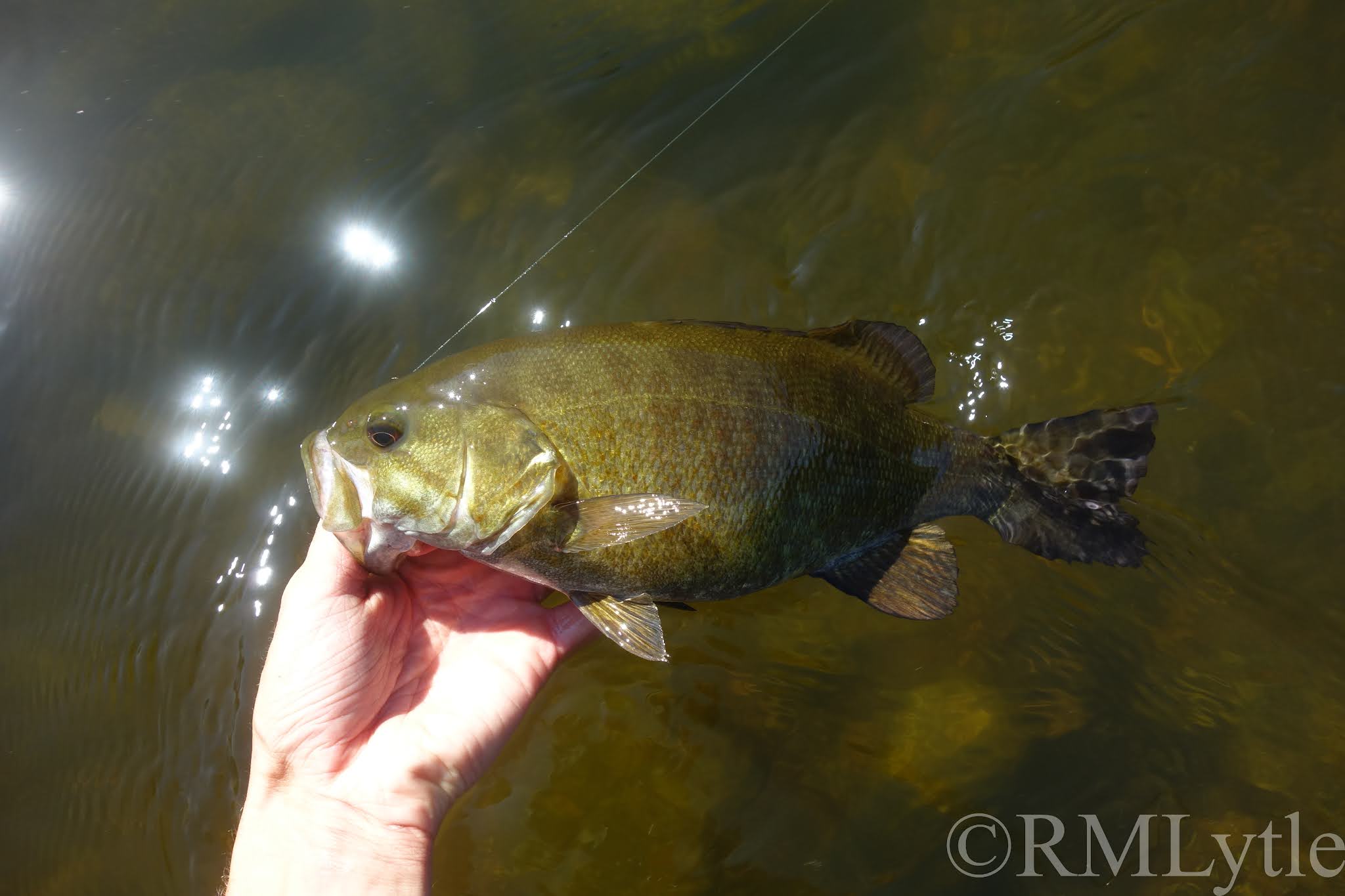
The average size was phenomenal. The fish above is typically the average- and sometimes a bit above average -on the 'tonic. On this day small fish, bass under 11", were a notable minority. Fish averaged about 13", with a noteworthy quantity well in excess of that number. 

Noah and I both managed to lose fish in excess of 18" though. That was painful, as many go a long, long time without seeing a true Housatonic 18". 


Noah's 18" ate in a deep, fast run. It performed a single jump then shook off. Mine ate in even faster water. It was an extremely visual eat. The fly had been riding deep in the slow crease beyond a very fast current tongue, and when I could no longer manage slack and the line came tight, it quickly rose towards the surface and began to swing. The fish followed it up and ate it in full view in a quite violent fashion. It was nuts. And of course she somehow managed to shake off well into the fight.


Aside from those two moments of heartbreak it was as good a day of bass fishing as one could hope to have on this water. Truly crazy, nonstop, absolute chaos. 


Eventually Noah actually started to get tired of it. We'd exceeded 45 smallmouth apiece by that point, so it was at least a bit understandable. We tried to shift gears a bit. What followed will be the subject of a different post. 

Until next time, 

Fish for the love of fish.
Fish for the love of places fish live.
Fish for you.
And stay safe and healthy.


Thank you to my Patrons; Erin, David, John, Elizabeth, Brandon, Christopher, Shawn, Mike, Sara, Leo, C, Franky, Geof, Luke, and Noah for making Connecticut Fly Angler possible. If you want to support this blog, look for the Patreon link at the top of the right side-bar in web version. 

Edited by Cheyenne Terrien