Over the last few years I've encountered a number of generally considered southern species that find their way into Connecticut waters in late summer and early fall as ocean temperatures peak. I've caught blue runners, banded rudderfish, and Spanish mackerel, and seen cobia and mangrove snappers. This year was an exceptional one for such vagrants locally: abundant cownose rays and Spanish macks in the western sound, frigate mackerel in RI and and even Eastern CT, and plenty of other anomalies. I lucked out with one frigate mackerel and saw some banded rudderfish but didn't really get in on the action until October, when the cooling temperatures lead the less tolerant fish to either leave or seek what warm water they could find. It was a day like many other October days, except instead of finding stripers blitzing Noah and I found jacks and ladyfish along with uncountable Atlantic needlefish and the odd Spanish mackerel.
At first it was all needlefish. There were hundreds if not thousands of them. Any cast got followed by a squadron of these odd shaped monsters, all snapping at any lure or fly we ripped past them. They'd even blast a spook. It was nuts.
 |
| Strongylura marina |


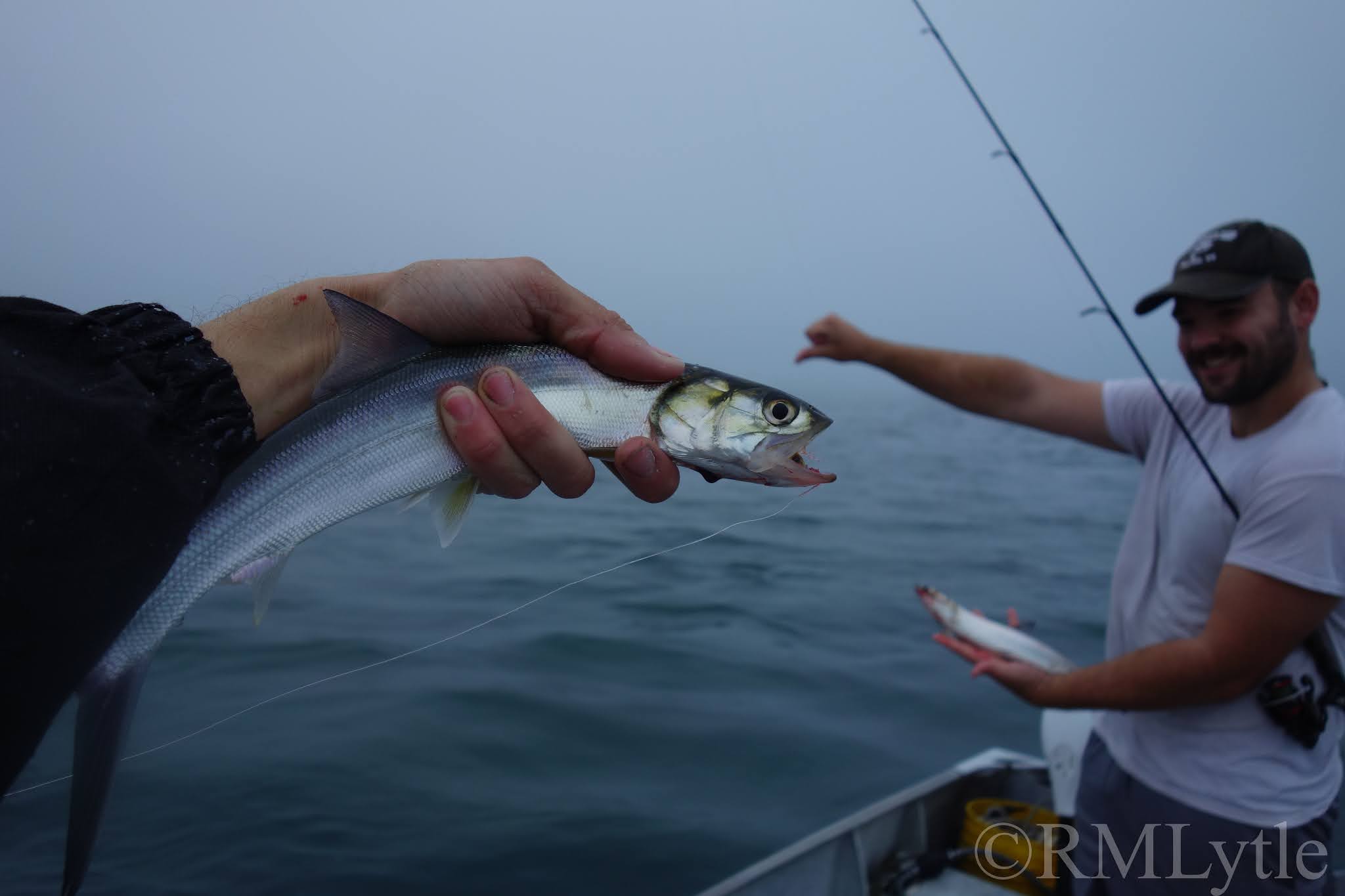
Then came the ladyfish. I'd caught my first ladyfish a few years ago in Florida, where they are a year-round resident and often considered irritating, sometimes even trash fish. Of course I quickly fell in love with these acrobatic silvery fish. Catching them locally is something I've long known was possible and has been a goal of mine, I was very pleased to see it come to fruition. Soon ladyfish were making their way into the little Lone Star Skiff with regularity, including at least one that jumped into the boat still green. Noah and I were having a hysterical time catching these high flying fish, in greater numbers than we ever got in Florida. We'd never really gotten to savor the experience there, so it was exceptionally unique to catch enough locally to really get a good feel for it... and these fish are seriously fun. There's nothing in New England waters that fights quite the same. Bluefish and hickory shad don't jump as much or as high, and landlocked salmon don't zip away quite so fast, though they're probably the closest in fighting style.


 |
| Noah with the first large one. |
If you look at the tail on a ladyfish, it's not dissimilar from that of some of the fastest running saltwater species like bonefish and milkfish. It's not surprising that they fight as hard as they do. It is a little surprising that people don't enjoy catching them more. Sure, they are aggressive and easily duped; and yes their maxillary has a sandpaper texture and can snarl too light a leader, but damn is it a riot when they take off.
It wasn't long before we became aware of another southerner in our midst when the aquatic equivalent of a swarm of bees followed my fly in... a school of tiny crevalle jacks, and one of them did find steel.
 |
| Caranx hippos. On a Woolly Bugger. In CT. |
Yet another member of the Caranx genus turned up just a few casts later, the blue runner. Unlike ladyfish and crevalle jacks this is a species I'd caught locally, and New England is actually where I got my lifer.
 |
| Caranx crysos, blue runner, this one took a gurgler. |
The slay fest continued as fish suddenly began to blitz. There were clearly bluefish and ladyfish there but I also saw some scombrid like slashes and jumps. Though I managed to maintain my season long skunking of larger scombridae and only piked up a few bluefish, Noah managed a nice Spanish mackerel. By now it really felt like we were actually fishing in Florida.
When the blitzes subsided we resumed the ladyfish and jack beat-down along the rocky shoreline. For someone who likes variety, getting these species mixed in with more locally and seasonally ubiquitous ones like needlefish and bluefish was awesome. We were doubling up on ladyfish constantly and laughing hysterically for hours. It was just visually spectacular uncomplicated fun.
 |
I've been playing around a lot with flies tied on lead and tungsten jigs this year. Their applications for trout, bass and panfish were already well explored but they definitely have application in the salt too. |
As darkness fell we weren't sure what would happen, whether the bite would slow or stop, or change at all. It actually improved because the needlefish seemed to stop feeding, and because they are so difficult to hook we were getting a higher percentage of fish hooked and boated once the needlefish stopped biting. They were still so balled up though that I was regularly foul hooking them. I received a few bites from needlefish, they are unpleasant to say the least. I'll lump needlefish in with bluefish, mangrove snapper, and skates as fish that seem to very intentionally try to bite you, and needlefish are very good at it.
As darkness fell I hooked the biggest of the ladyfish I'd gotten. The initial run was so hard and fast I thought it must be a Spanish mackerel, but when it came up that silver slender form was a nice surprise. This was one of my favorite fish fights this year, actually. And there have been some memorable ones.
The night proceeded with loads more ladyfish and one especially memorable visitation from a huge predator. We left genuinely shaken, but so excited we came back the next day for more.
Those two evenings will surely remain some of my most memorable saltwater days in the northeast.
I love what I get to do.
Fish for the love of fish.
Fish for the love of places fish live.
Fish for you.
And stay safe and healthy.
Thank you to my Patrons; Erin, David, John, Elizabeth, Brandon, Christopher, Shawn, Mike, Sara, Leo, C, and Franky for supporting this blog on Patreon