Showing posts with label Cyprinids. Show all posts

Saturday, March 11, 2023

Ploop

 A grey squirrel sits on the branch of a mulberry tree, stuffing its face with almost-ripe fruit. The oblong white berries are just starting to get the brushed-on red tint look that means they're ready for the taking. The squirrel haphazardly plucks them from the small clusters they grow in, losing some now and then. Each berry falls, bouncing off branches and tumbling as they go. The tree would have it that these berries land on dry ground where some other animal might find them and spread the seeds to areas not already thickly canopied. But this tree loses some of its potential offspring each season, because this tree happens to grow over water. Each mis-picked berry, dropped by a squirrel, grackle, sparrow, or starling, falls to the water below with a distinct "ploop". And there it is met by hungry fish. Cyprinus carpio, as foreign to the landscape as the starling above, gather en masse under each mulberry tree and greedily feed on the sweet fruits each berry season. They have grown so familiar to that "ploop" sound that, even when one is far way from one of the trees and the berry fall is long done, they still frequently come to inspect anything that lands in the water in such a manor. 

The well rounded and observant fly angler will learn to predict such events. Food drives fish and when such abundance of calories- one which exceeds normal standards but isn't so high as to drive down competition -the angler can have not only excellent fishing but striking opportunities to watch wildlife interact. On this day, the angler sat poised below the mulberry tree looking up into its branches rather than down into the water. The squirrel busily worked in the foliage, and eventually knocked another berry free. The angler's gaze followed its indirect path to the water. It bounced off of one twig, knocked a leaf, then fell to the water's calmly rolling surface. Two shadows rushed to the berry's sound, creating wakes in their rush to obtain sustenance. Neither one actually found the berry, which was then slowly sinking to be battered about by bluegills before resting on the bottom. One of the carp mouthed at a peice of flower peddle but found it lacking. 


The angler observed not because he didn't want to catch a fish yet, but simply because he felt no pressure to. He'd stood in this spot before, watching the same show. He knew what would happen when he pulled line from his reel, made his cast, and let his spun deer hair fly land with a "ploop". He was in no rush. That would only lessen the amount of activity he saw before him now and there was no need to disrupt it just yet. He'd watched this show, sure. But he was far from tired of it. He was content to remain a passive viewer for a few more moments. 

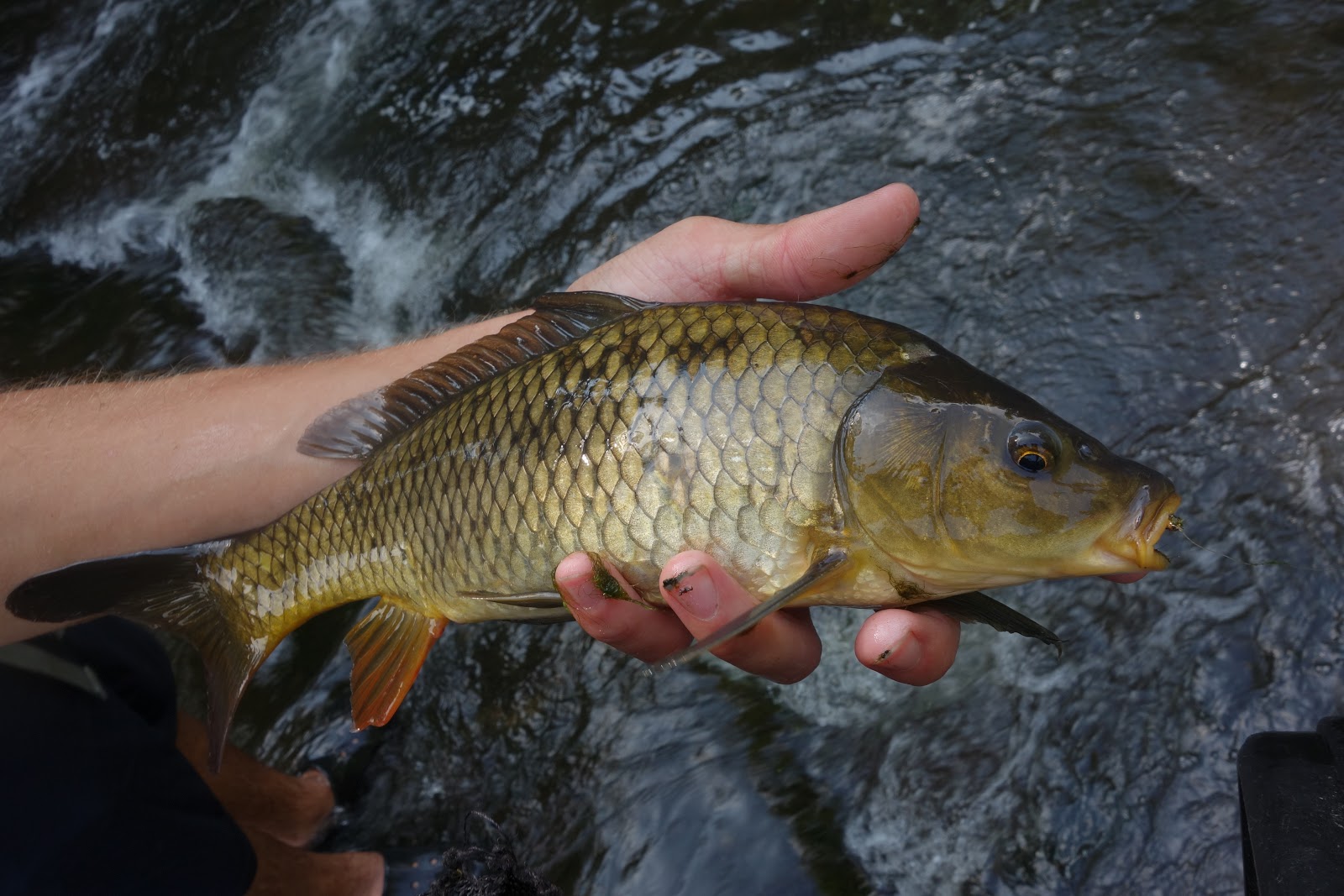
When the desire to interact with the carp in front of him finally overruled his enjoyment of their un-bothered feeding, he wet his fly in the water at his feet. This would give it the weight to convincingly approximate the sound of impact as well as the buoyancy of the natural berries. They don't float high and dry as a foam fly or completely dry deer hair fly would. Then, with a sharp flick, he delivered his artificial lure underneath the mulberry tree. A chestnut colored mirror carp rushed to it, needing to beat out the competitors lurking nearby. It was completely and utterly duped, slurping down the berry with no sign of apprehension. The angler raised the rod and in time made work of taming the specimen. It was a lovely creature. The fly was removed and the fish returned to its habitat a lot more weary than it had been before. Indeed the battle had made aware the other carp as well, and only two remained near the tree. Their actions were flighty and quick though, and the angler felt it prudent to call it a day. Though he'd enjoy catching another, he knew he could so elsewhere thereby allowing these fish to return to their natural rhythm. There was no sense in not only making the fishing harder for himself down the line by over-educating these already clever fish, nor did he feel making their capture harder for the next angler down the path was a kind thing to do to a fellow watcher of the interplay of berries and animals. Whistling as he went down the path, the angler thought about "ploop" sounds, clumsy squirrels, and hungry carp. 


Thank you to my Patrons; Erin, David, John, Elizabeth, Brandon, Christopher, Shawn, Mike, Sara, Franky, Geof, Luke, Noah, Justin, Sean, Tom, Mark, Jake, Chris, Oliver, and oddity on Display for making Connecticut Fly Angler possible. If you want to support this blog, look for the Patreon link at the top of the right side-bar in web version.

Monday, May 9, 2022

Fly Fishing For Invasive Goldfish

 Recently I took a quick ride south to a park pond. I was after an invasive species. I often fish for non-native and invasive fish, as there are plenty of them around (definitively, of course). I don't fish for this species that often though, as they haven't really taken hold here in Connecticut just yet. In other parts of the country, they've filled significant niches, displacing native species and causing ecological issues, as an invasive must do to be designated as such. As with other cyprinid species, goldfish in large numbers can cause increased water turbidity due to their bottom-based feeding strategy, diminishing plant life and degrading water quality. These negative impacts could well happen in Connecticut if they are allowed to spread. Concerningly, two of the places I know of that contain them drain indirectly into the Connecticut River. Fishing is not permitted in either and it seems the goldfish are welcomed by those managing those waters. In another case, a pond had a large number of big goldfish that were thankfully eradicated before they spread into the river below. On a couple of occasions I've seen individual goldfish in rivers where they were likely dumped as unwanted pets. This day, though, I was heading to an isolated pond where the goldfish couldn't leave. They still shouldn't be there, but it's less of a concern for spreading. 

This pond ecosystem itself is an odd one. It contains a single large common carp, western mosquitofish, and the goldfish as the non-native species. For natives, it contains pumpkinseed sunfish, golden shiners, and brown bullheads. Being a tiny, man-made pond it doesn't represent a great example of how these species would interact in a natural ecosystem, but the golden shiners seem to be quite stunted there and rarely attain the sizes I see in similarly sized waters that don't contain goldfish or mosquitofish, so maybe there is a negative impact at play. 

The goldfish themselves are finicky creatures and tough to fool with a fly. They often school up tightly at the surface in the spring and sit motionless, just sunning themselves. When they aren't doing that, if you don't chum you won't see them. At all. They may as well not be there. I wasn't prepared with chum so it was a good thing they were sunning. That didn't make it an easy task though. I spent the better part of an hour fishing to them with unweighted nymphs, soft hackles, and a few dry flies. I had them move to the fly numerous times but discerning the take is often the hardest part of the whole deal. I rarely feel it, and with goldfish the size of these at a distance more than 25 feet seeing the exact moment they nip the fly is a real trick, one I usually don't perform well. Eventually though I usually manage to make it work, and this time I did get a nice orange one. Only the one, but I'll always take one over none. 

Goldfish are tough to get a handle on once they do take over. As is often the case with similar species, angling can't really stop them, so even if you kill every one you catch you aren't doing any good. Because of the habitat they spend most of their time in, mechanical and chemical methods of removal often either don't get them all or are too indiscriminate. So the best strategy is actually curbing future infestations. Anglers should report seeing goldfish, especially in interconnected waterways, to their state environmental protection agencies. It's also important to pass on information and educate, since goldfish are a common pet that is all too often released into the wild. The ramifications of goldfish taking over a watershed are not insignificant and should be taken seriously. 

Thank you to my Patrons; Erin, David, John, Elizabeth, Brandon, Christopher, Shawn, Mike, Sara, Leo, C, Franky, Geof, Luke, Streamer Swinger, Noah, Justin, Sean, Tom, Mark, and Jake for making Connecticut Fly Angler possible. If you want to support this blog, look for the Patreon link at the top of the right side-bar in web version.

Monday, April 26, 2021

Goldfish On The Fly

 Goldfish are a notable and often problematic invasive species found throughout the world. They are native to East Asia, were selectively bred to create the vibrantly colored ornamental variations seen today, and spread around the world for hundreds of years. They are one of the most popular aquarium fish and one of the most widespread domesticated fish. In the wild, goldfish can cause significant problems where they are not native. They reproduce rapidly and despite often being orange and poorly suited to remaining hidden, they quickly overpopulate. Though goldfish are certainly not apex predators, their presence usually disrupts whatever ecosystem they are released in. 

I’ve encountered goldfish sporadically throughout the years in CT waters, but never any big enough to catch on the fly. Then, one day this spring, while looking for water snakes with my friend Bruce, we spotted a school of goldfish in a small public pond. I’ve since returned three times- once on my own and twice with Noah -specifically to fish for those goldfish. On the first visit I didn’t get any goldfish but I was able to determine what species were in the pond. Three that I saw were native fish: golden shiners, brown bullhead, and pumpkinseed sunfish. Two more, other than the goldfish, were invasive species: common carp and mosquitofish (whether they were eastern or western I am not sure, but western is more likely as westerns are the only of the two species so far confirmed in CT). There was only one common carp in the pond, an 18 pound or so fish likely introduced intentionally with the hopes it would do something to control weed growth. 


On the second trip, Noah and I were more strategized. We brought bread to chum in the goldfish. The golden shiners and bullheads got to it first, and we got a couple bullheads each. It took a long time for any goldfish to come around. Eventually some did. I had on a size 16 Walt’s Worm under an indicator, but interesting fish would lose interest in the fly as soon as it sank to depth and suspended. They seemed far more interested in a moving fly. This was interesting to me because I’d seen the same behavior from lake chubsucker, a North American native fish. Lake and creek chubsucker both share a nearly identical niche with goldfish and are visually, anatomically and ecologically similar; a clear example of convergent evolution. 

Eventually, I managed to get one of the two goldfish that were spending time in our baited area to take my little nymph, and after no fight at all I had lifer #178 at hand. It was certainly a pretty fish, ornately colored and lustrous. This fish was also completely unnatural: no undomesticated, uncultured, native goldfish would look anything like this, nor would such a fish be swimming in a pond in Connecticut were it not for human intervention. For some reason I really liked that little fish and felt compelled to catch more. When Noah wasn’t able to get his lifer on the first attempt, it was a good excuse for me to return for more. 

Lifelist fish #178, goldfish, Carassius auratus. Rank: Species.

On attempt two, we brought corn as well as bread. Our justification for that was how disinterested in the floating bits of bread the goldfish were and how hard it was for Noah to keep bread on the hook. Bread still helped draw in the hungry masses, and we had some goldfish come into the swim much sooner than we had the previous trip. This time I focused on golden shiners before the goldfish showed interest. I’ve become increasingly more obsessed with that species lately, as well. Unfortunately this pond seems not to hold any large ones. 


Noah got the first goldfish- a lovely wild-type. That was exactly the color expression I wanted to catch, as it would be a nice contrast with the cultured ornamental version I’d already caught. I ended up getting three goldfish on the fly: a bright orange one, another with orange and black patterning, and an almost wild looking but still fairly colorful individual. They were actually surprisingly willing to eat and even chase a nymph. If it stopped moving, they lost interest. This is of course what we’d already observed on the trip before, but it was nice to know that behavior wasn’t a fluke. 


Eventually I broke down, put on a piece of corn and caught a true wild-type. I’m not sure if these goldfish had simply been present and reproducing long enough for the more natural color genetics to arise or if some wild type individuals had been put in the pond originally. There wasn’t a notable variety of sizes, so I can’t be sure these fish are actually reproducing in that pond. 

Catching those goldfish coincided with a general urge to catch colorful cyprinids. I’ve got this strange, previously non-existent compulsion to fish for ornamental fish. Next on the list, something I’d been after for years: mirror carp. Another genetic variation cultivated for ornamental purposes. 

Until next time, 

Fish for the love of fish.
Fish for the love of places fish live.
Fish for you.
And stay safe and healthy.


Thank you to my Patrons; Erin, David, John, Elizabeth, Brandon, Christopher, Shawn, Mike, Sara, Leo, C, Franky, Geof, Luke, and Noah for making Connecticut Fly Angler possible. If you want to support this blog, look for the Patreon link at the top of the right side-bar in web version. 

Edited by Cheyenne Terrien

Wednesday, October 7, 2020

Allegheny Micros (Western Pennsylvania Pt. 2)

 I stood on a huge boulder looking out over the Allegheny River. The water was strikingly clear, but also held that classic blue-green color that I see all over in Pennsylvania, but rarely ever here in Connecticut. It comes from the sedimentary geology. Limestone, sandstone, shale... that's what makes up much of Pennsylvania's bedrock. In Connecticut, we have schist, gneiss, granite, traprock, and brownstone. Different rock, different minerals, different colored water. 

Swimming in this water were fishes I may well have seen as a child, but I was looking at them now with new eyes. I knew at least loosely what I was looking at. Moxostoma, Notropis, Semotilus, Micropterus... latin names came to mind, not simply "suckers" or "minnows" or "bass". I didn't know the exact species of every fish I was looking at, but I was equipped to find out, and that was just so damned exciting.

I'd lived in this place a nature-curious kid until I was 8, now at 23 I was here with the same excitement, joy, and curiosity, but with new eyes and new tools and a lot more experience. So I hopped down with fly rod in hand, ready to tackle whatever the Allegheny was going to throw my way. At the moment, targeting micros seemed the best way to learn what was in these waters. I could see redhorse, quillback, and gigantic smallmouth, but those fish were extremely unwilling. The smaller cyprinids were ready to attack, but still difficult to hook and then keep hooked. Inevitably, the first was a Cyprinella which are a royal pain to identify. Unfortunately, careful examination showed it to be a spotfin shiner, the only Cyprinella I've caught yet. 

Cyprinella spiloptera

The next fish was something very clearly new. It was a chub, one I didn't recognize. Noah got one as well. Some research on my phone resulted in the determination that these were river chubs. My 166th life list fish and my first lifer from these waters of my childhood.

Nocomis micropogon, river chub. Lifelist fish #166, Rank: Species 

A short time later I caught one of the many small Notropis in front of me. I wasn't certain, but I thought it was an emerald shiner. Fellow multispecies angler Tim Aldridge later confirmed suspicions I'd gotten after a little research, this was actually a silver shiner. My 167th lifer. 


Notropis photogenis, silver shiner. Lifelist fish #167. 

After seemingly exhausting our options at this spot at this time of day, we moved again. This time, we stopped at a spot I did remember a little bit. It was a small tributary of the Allegheny that flowed under a bike trail my mother often took me too. Again, this was a place I'd never fished. And again, I was quickly gratified with a species I have no doubt I'd seen as a kid, but knew very little about until recently. As it turns out, Northern hogsuckers are quite abundant in Western Pennsylvania, and we'd see them all over the Allegheny and other watersheds. My first was a juvenile that took a tanago midge after methodically presenting it to each fish in the school repeatedly. Some attacked the split shot, most either did nothing or spooked, but this one did eat the tanago. And what a beautiful little lifer this was! I'd love to catch a large adult so this certainly won't be the last time I target northern hogsuckers. 

Hypentelium nigricans, Northern hogsucker. Lifelist fish #168

In a short time the Allegheny had served up three new species, two were fish I'd noted, seen prior, researched a little, and knew I wanted to catch. One (the silver shiner) was a fish I new basically nothing about then but know a little about now. And look at all three new species and the spotfin shiner together... what a beautifully diverse little group! These are all fish that would be lumped under the heading "bait" by the hoards of online idiots, which remains the most annoying and stupid comment on posts asking for fish identification help. But to Noah, Jake and I, the diversity of these fishes makes them worthy of our time and respect. Fish are fascinating at any size or stage of life. Ironically we also happened to be in a part of the country were the understanding of fish diversity is especially lacking, and it shows in the fact that I, as a nature obsessed kid, new nothing of any of these species at all when I was living there. Nobody around could tell me exactly what I was looking at. Little did I know just how diverse these waters actually are. 

Until next time,

Fish for the love of fish.
Fish for the love of places fish live.
Fish for you.
And stay safe and healthy.


Thank you to my Patrons; Erin, David, John, Elizabeth, Brandon, Christopher, Shawn, Mike, Sara, Leo, and Franky for supporting this blog on Patreon.

Thursday, August 27, 2020

Not So Little Things

It was one of those full, heavy summer days. High humidity, some puffy cumulus, very little wind... I'd gone out mostly hoping to see a copperhead that day, but ended up not seeing a single snake of any kind. I had my 2wt though, and one box of flies. And there was a stream where I was herping. The water was low and this wasn't a wild trout stream but I wondered what sort of fish might be in this water, having to fished it. I assumed I'd be in for some small fallfish. But when I brought the first fish to hand I was almost a little surprised to see that it was not a fallfish at all, but creek chub. I've caught creek chubs everywhere from North Carolina to Deboullie in Maine. But I rarely ever catch them so close to home. Eastern CT has a very patchwork population of creek chubs. I caught one once in a small stream about 15 minutes from my house and was so thrown by it that I remember every detail of that capture to this day. I'd never before and have never since caught a creek chub in that watershed, an area I've fished most of my life. Most fisherman wouldn't bat an eye at catching a creek chub anywhere, but of course the average fisherman isn't ichthyologically literate. That's not necessarily a dig, but I wish more fisherman sought to really understand their local fish. But to most angler it seems "creek chub" applies to any silvery minnow species, and in Eastern CT that is fallfish, common shiners, and golden shiners far more often than it is Semotilus atromaculatus.
I certainly lack far more knowledge of ichthyology than I possess, I'm still way behind properly identifying the sea chubs on my life list. It's hard to keep up with updated classification in the study of fishes. But I know a creek chub when I see one, and I was delighted to see this one! The thick lips, the defined lead grey lateral line, the wonderful hatched pattern made by dark scale edges, the faint tints of lavender on the gill plate and face, the small black mark on the dorsal fin....


This may seem like such a "little thing", as in "the little things in life". But to me it isn't. To me this is all that matters, an appreciation of all things natural. That appreciation come from both academic understanding... studying the native range of the species, where it has been introduced what niche it fills, what it eats, how it spawns... as well as what some would call spiritual understanding... watching the species in it's habitat, or holding one it my hand, and thinking about how these things make me feel. Both feed into each other. I don't think you can have a full appreciation of a species without a healthy amount of both. I hope, above all else, that I can impart this on as many of my readers as I can. That's really all this is about. I want as many people as possible to care deeply about even seemingly insignificant, entirely stable fish species like creek chubs, because they're still important. A stream full of native dace, darters, and shiners deserves to be protected as much as any full of more at risk fish like brook trout and slimy sculpins (of these two, we're more likely to lose sculpins here in CT... food for thought). The latter may require more, time, effort, and money, and that's fine, we're closer to losing those. But letting a stream go dry or get poisoned because it lacks glamorous species like salmon or trout is no more acceptable.
Learn to love the little things. They really aren't so little.
Until next time,
Fish for the love of fish.
Fish for the love of places fish live.
Fish for you.
And stay safe and healthy.

Thank you to my Patrons; Erin, David, John, Elizabeth, Brandon, Christopher, Shawn, Mike, Sara, Leo, and Franky for supporting this blog on Patreon. 

Thursday, December 5, 2019

Species Profile: Cutlips Minnow

As most of you hopefully already know, I am a life-list angler. I target, document, and count the number of species, hybrids, and subspecies I catch, specifically on fly tackle. Because of that I spend a lot of time learning about and fishing for many different species of fish. This means I'm more adept at identifying and fishing for an extremely broad range of species than the average fly angler. This series will attempt to outline species identification, some life history, and methods for targeting with fly tackle. Maybe I'll get to every fish on my life list, but considering it is ever growing... it would take a while. Mostly, I hope this will get a few of you interested in going out and learning about or catching something new. 

Cutlips minnows are one of the most unique freshwater fish in North America. It may not appear to be anything out of the ordinary on first glance, as with most small freshwater fish of it's variety if the average angler caught one they'd just call it a minnow or a dace or a chub and call it a day. But if you get to know Exoglossum maxillingua, you realize how weird this little fish is.

The cutlips minnow has a relatively small range, From extreme northern North Carolina up north along the Atlantic Slope to the St. Lawrence, barely edging into western CT, MA, and VT. Introduced non-native populations exist in close proximity to their native range, where they were most likely released from bait buckets. The species prefers clean freestone streams and resides mostly in slow moving pools rather than riffles and fast water. They may also be found in some lakes. At a glance they don't differ that much from creek chubs in appearance, with an olive colored back, white belly, and frequently well defined lateral stripe, and an average size of about 5 inches. They spawn in the spring around the time most other North American cyprinids spawn. Males build small peddle mounds, similar to the spawning behavior of fallfish but on a smaller scale.


The clearest distinguishing trait of the cutlips minnow, and the one it gets its name from, is its lower lip. The lower jaw of the cutlips minnow consists of three lobes, with the middle one protruding out farther. This is an adaptation that has arisen through utilization of very small mollusks and insects as a food source. Cultlips minnows use their lower lip to scrape tiny snails and nymphs off of stream bed rocks. 


But that is not all cutlips utilize their uniquely evolved mouth for. Oh no. Far from it.

They also use it to pry the eyeballs off of other live fish.

That doesn't sound right, does it? How can that possibly be true? Well, it is. When times are tough, cutlips minnows scoop the eyes out of other fish species and sometimes each other and eat them. A such, they are probably not a great choice for a multi species aquarium. Interestingly, a study done by Antonios Pappantoniou of Fordham University found that "camouflage in the form of eyespots and eye lines did act to either confuse or misdirect the eye-picking attacks of the cutlips minnow." 
So, intriguingly, not only can eye like markings on various fish prevent large predator fish from successfully targeting the head of the prey in question, it can confuse the small, eye-eating cutlips minnow. 

"False eye" exemplified by an adult Cichlasoma urophthalmus
If you want to catch a cutlips minnow on the fly, first of all make sure you are fishing where they exist. The methods are pretty simple. Fish small nymphs in clear pools and look for schools of minnows to cast into. When you catch one, take a close look at its lips to verify that it is indeed a cutlips. Then, marvel at the fact that the little minnow you are holding has one of the most wild and bizarre eating habits of any fish. If you choose to admire fish not only for their size, their coloration, or their edibility, but for their incredible diversity of behavior and anatomy, it opens up a whole new world of fishing to you. Fish are a amazing. That, in the end, is what the "species profile" series is all about.


Until next time.
Fish for the love of fish.
Fish for the love of places fish live.
Fish for you.


Thank you to my Patrons; Erin, David, John, Elizabeth, Chris, Brandon, Christopher, and Shawn for supporting this blog on Patreon.

Sunday, August 4, 2019

Everything Else in Deboullie (PT. 2)

Ever wonder what a hailstorm is like in the mountains? Ever wonder what one sounds like? I'd heard hail roar from a long tracked hail and tornado producing supercell thunderstorm way back in 2009. But even that monster didn't prepare me for what a smaller storm in a big, echo making, anthropogenic noise free landscape would be like.

On our last day in the Deboullie area, Noah and I left our little base camp area to fish some new areas. I knew Togue Pond and the surrounding bodies of water had species neither of us had caught. Though lake trout would have been the ideal catch, the weather wasn't good for being out on the open water trying to vertical jig lakers. In the swampy, shallow ponds nearby though there were supposedly threespine stickleback and fathead minnows. I was particularly pumped to try to get a stickleback.


I found one loner almost right away, but I struggled to both get past the northern redbelly dace and to get that stupid little stickleback to eat. It wasn't working. After finding a couple more very finicky targets and almost intentionally dooming my super fine tenago lead on a tailing bullhead in inches of water, I happened into a fathead minnow. It was a female, pretty typical looking, but very cool to get a fourth lifer from this area.

Lifelist fish #138, fathead minnow, Pimephales promelas. Rank: species
As I photographed that fish, thunder echoed off the mountain behind me. A couple small thundershowers had rolled through and put a brief pause on things, but with a quick look, this one looked mean. Not only did it look like dangerous storm, it sounded like one. Not just thunder... from miles out I could hear the sound of heavy precipitation pummeling trees. I walked down to the lake to get a better look.


The roaring, waterfall like sound got louder and louder, and in a short time....


That wasn't a massive storm, really. It didn't even impact our camp just over the ridge. But it was mean. Not all that much in the way of wind, but violent bright positive CG strikes, torrential rain, and pea sized hail all made it feel bigger than it was. In a short time, it was gone.

And I was back to the futile exercise that was trying to get a nesting threespine stickleback to eat a tiny little fly. Unfortunately, the photo below is all I've got to show for it.


My bitter consolation was a much more distinctly colored fathead of the male persuasion. The males go through a crazy transformation to spawn, like many fish do.


Noah got his lifer a short time later, and it was even more crazy looking than mine!


I set out on my own to check out another pond. It didn't really have what I was looking for, but it sure was a pretty hike. Actually, I could have caught at least another dozen fatheads in there. Every boulder had at least one male guarding a nest. I just didn't feel like messing with them any more. I wanted a stickleback. But I wasn't getting a stickleback.


The last long sunset at our camp in Deboullie was beautiful, but it was bittersweet. There are a number of things I'd wanted to accomplish, and it had been a testing experience. We hadn't even gotten to see a good, clear night sky. It clouded over every night. We didn't catch a laker. We didn't find any longnose sucker.
But I had caught a blueback. There was no way I could complain about anything after that moment.
I wouldn't trade experiences like this for anything. Rare trout. Big scenery. Loons singing every morning and evening. Hailstorms. Cool new cyprinid species. Bear tracks in the mud.
At those times, I'm the richest man in the world.

Until next time.
Fish for the love of fish.
Fish for the love of places fish live.
Fish for you.


 If you enjoy what I'm doing here, please share and comment. It is increasingly difficult to maintain this blog under dwindling readership. What best keeps me going so is knowing that I am engaging people and getting them interested in different aspects of fly fishing, the natural world, and art. Follow, like on Facebook, share wherever, comment wherever. Also, consider supporting me on Patreon (link at the top of the bar to the right of your screen, on web version). Every little bit is appreciated! Thank you to my Patrons; Erin, David, john, and Christopher, for supporting this blog.

Wednesday, September 5, 2018

Suckers, Chubs, Brookies, and Bears

On Sunday Noah and I went out with the express purpose of getting him two species that he had not yet caught: white sucker and creek chub. Outside of their spring spawning run it is actually not that easy to happen into a white sucker, so it is understandable that Noah had never caught one. And, although some of the streams around where we live hold creek chubs, their niche is mostly filled by fallfish and common shiners. I have fished only a handful of streams in CT where creek chubs were the prominent cyprinid. So his not having caught one of them is also understandable. What isn't understandable is why I hooked two on artificial flies this trip before he got one on a worm!


Mission accomplished we moved over to a stream where I thought we might potentially get some creek chubs along with some small common carp. 12 fallfish, something like 40 bluegills, pumpkinseeds and hybrids, and one common later we left for a "sure bet" stream.


Seeing small chubs in shallow edge water there I was certain we'd get it done here. I waded up to a nice pool and promptly caught the target species. Then something unexpected happened. A big female bear and her almost grown cub came by to say hello.


OK, so now is the time for a PSA: When walking your dog in the woods, it must be leashed. You never know when you'll run across a bear or a big cat, or just someone else with another more unfriendly dog. In this case two women were walking up the creek and one of their dogs began to chase the bears. It disappeared behind the ridge that they had gone over briefly before running back with its tail between its legs. This is a confrontation that needs to be avoided at all costs because it could result in the injury or death of the dog, possibly the owner too, and the possible 'euthanization' (its really just murder) of the bear. Luckily this time all were unscathed.

After the bears had moved on Noah and I got to fishing. He got his creek chub.


And I got a wild brook trout that happened to have more parasites on it than any other salmonid I've ever seen.


We walked upstream a little ways, catching more chubs and the odd fallfish. I got one more brookie. Then, on our way back downstream, I stopped at a spot were I had seen a big brown on the way up. Sure enough it was back, and it took my nymph on the first presentation. This was a big fish for the stream, easilly 16 inches and maybe even bigger. Whether it was wild or a holdover I'm not sure, but it was in no mood to hang around for a photo op. I brought it up against the bank and grabbed the leader, at which point it thrashed and spat the nymph back at me.


The next few days and this weekend will be interesting for me. Expect some great posts soon!