Showing posts with label Streamer Fishing. Show all posts

Wednesday, December 13, 2023

Wet T-Shirk Muskie Contest

 Muskellunge are a critter often associated with massive amounts of time, effort, and dedication to catch. Especially on the fly. I hadn't put in anywhere near the amount of effort typically associated when I trudged through the early fall woods on my way to a pool in a river in which I might possibly be able to find a muskie. The day prior my good friend Drew Price and I had floated a different stretch of the same river and I'd stuck a hook in my first muskie (the short story about that has been on Patreon for a while), And I'd increased the number of muskies I'd moved with a fly from one to... frankly I've forgotten the number, but it was a lot. We saw a tremendous number of fish that day. That bumped my experience a bit but not much. And now I was in unfamiliar territory again. Drew had told me there were muskies there, but other than that I was pretty much left of my own devices to try to catch one on foot. It was very much the sort of mission this angler is comfortable with. If you've read these chronicles long enough, you've read of many a grueling, ill-advised DIY effort that resulted in netter fish than I had any right to be able to catch. So, although I had no expectations, I felt very comfortable setting out with just my wading boots, shorts, a sling pack, and a couple rods to pursue one of the most notoriously difficult to catch predator fish in the country. 

Shallow riffles and pocket water weaving through the trees gave way to a wide open pool, slow and dark and flanked by steep grass-covered banks. The bottom turned from rock and gravel to mud, and parts of the pool were lined with spare weed beds. This pool looked like a place some Esocids would inhabit, and in this case the top predator wasn't the pickerel and pike one would find back in Connecticut. I decided to work my way around the pool clockwise, starting at one side of the the head of the pool and working around the edge to the tailout, cross, then coming back up the other side. Though the head of the pool didn't show anything, I barely made more than 10 feet down the bank before I moved the first muskie of the day. It came slowly behind the fly, a small male of maybe 30 inches, shadowing with interest but not about to commit to eating.  Working my way around the pool I'd move three more small muskies and one larger one. The small fish emerged from the weed bed, while the largest one materialized from the gloom of the middle of the pool. I'd noticed the day before that the largest three we saw weren't on the edge or in the structure, but rather out in the middle of the river. I found this odd, but many of the fish I target have larger predators to be worried about. A muskellunge doesn't really have that. A big old adult muskie isn't getting eaten by too many things. They can afford to hang out pretty much anywhere they want to that offers them the hydraulic needs to maintain their metabolism. As I ran out of pool to fish, I paused to take a break. I sat down in the tall grass, trying to avoid putting any exposed skin in the abundant stinging nettle, and grabbed a granola bar out of my pack. By that point it had become fairly clear that I was going to get clipped by the southern end of a line of thundershowers. 

I sat and enjoyed my granola bar and assessed that there was very little point in trying to rush back to get a rain jacket. I'd be in a fairly safe spot as far as lightning, I'd just get a bit wet. That's okay, my bottom half already was anyway. I made my way to the tree line, looked at the canopy and tried to pick a place that might be fairly dry. The rain came loud and heavy, big droplets slapping the leaves and bubbling the surface of the river. My little spot was barely enough to keep my bag dry, and mostly because I hunched over it. The rain lasted probably 15 minutes, leaving a soaked angler trying to shake off and wring out his t-shirt while looking downriver at the next pool and wondering if the passage of that shower might have changed the mood of the fish. The day before, a big storm rolling through had seemed to turn the bite off. I worried that those listless follows might be as much as I'd see of a muskie on this trip. But the next pool down looked promising anyway. It was bigger and round, and looked like it could be harder to fish effectively on foot compared to the one above it. I was pretty much stuck with the head of the pool, which was the only chunk of the one above that didn't seem to be holding a fish. Not knowing if that really mattered, I set about working the head of it as thoroughly and consciously as I possibly could. I mixed and matched retrieves, but favored keeping the sink tip of the bottom with a steady two hand with occasional accelerations. I worked river right first, fanning twice, then crossed the stream to work the other side. The number of casts made on that side couldn't have been many when the line went tight. It wasn't a violent eat to feel, and I didn't see it, but the fish had to have eaten with some force because before coming tight there was actually quite a bit of slack. Then there was a moment of uncertainty where it wasn't fully clear to me that this was actually a fish. But it was. And not one of those little one either. The fight wasn't remarkable outside of the immediate urgency and fear I had of losing the fish. I don't experience it to the level I was in that moment very often. It would have hurt a lot if that fish came off. But it didn't. Everything somehow went to plan. The same angler than had stood under the trees with a slight frown just a short time prior now knelt in the water next to the river bank shaking with what must have been a look of sheer elation on his face. 


Muskellunge, Esox masquinongy. Lifelist Fish #198. Rank: Species

Muskie are a not insignificant fish in my personal history, despite my minimal time and effort targeting them. One of my first memories is seeing a muskie in the water at a lake in Northwestern Pennsylvania near where I was born. I'm not sure where on the timeline it fits exactly, nor is it the clearest memory I have, but it's the first fish memory I have. You might think that would make muskie fishing a somewhat bigger part of my agenda. I'm not really sure why it isn't outside of simply not having them around. With a fish so notorious for frustration, skunking, and heartbreak and an angler who frequently likes to have to work hard to catch the target, it would seem to be a match made in heaven. Maybe someday I will get totally muskie obsessed. It would seem to be a high likelihood. But for now, with a helping push from Drew and a bit of patience and persistence to get it done on foot in water I'd never seen before, I can be pretty satisfied with my first muskie on the fly. 

Thank you to my Patrons; Erin, David, John, Elizabeth, Brandon, Christopher, Shawn, Mike, Sara, Franky, Geof, Luke, Noah, Justin, Sean, Tom, Mark, Jake, Chris, Oliver, oddity on Display, and Sammy for making Connecticut Fly Angler possible. If you want to support this blog, look for the Patreon link at the top of the right side-bar in web version.

Friday, January 20, 2023

Spectacular Vermont Brown Trout

 "Want to give it a shot?" Drew Price called to me from the other side of the creek, knee deep along a great looking pool. He'd just hung his fly in a limb on the near side after covering the pool fairly thoroughly. I figured I had no shot but said "sure" anyway and crossed to his side. The clear, cold flow of this lowland river squeezed the air out of my waders as I made my way over on a gravel bar. This was a stream I'm never fished before, one Drew told me had been really intriguing him as it refused to give up the caliber fish he knew were residing there. Of course this intrigued me greatly. That's the sort of trout stream that grabs and maintains my interest, the sort that I know has large fish but is impenetrable and hard to crack. So of course when Drew asked if I'd like to make the ride up and fish it with him I obliged. 

The initial fishing enforced the idea that this was going to be a tough nut to crack. Access wasn't easy, the water was very clear, and the narrowness and sweeping bends formed complex current breaks that were hard to read. There were also lots of places for a lethargic trout to bury themselves into during the cold- deep cut banks and log jams -that they likely won't come out of all that willingly.  We didn't catch fish through a bunch of juicy looking water. I'd opted to fish a mono rig and a sparkle minnow. I have confidence in Coffey's Sparkle Minnow for wild brown trout just about everywhere, and the mono rig would allow my to flip and sling the streamer in the abundant places where I'd have no back cast room. I moved two smaller trout as we made our way down, both made their attacks the moment after I completely flipped the direction the fly was swimming. But those fish really weren't all that confidence inducing for me, they were small fish and we were covering a lot of water that felt as though it should be producing that just wasn't. Drew wasn't kidding about this place. 

That was what lead us to that deep pool. In that time, the river had gotten under my skin, just as Drew had expected it would. This was my sort of trout stream. And it was about to get a lot more interesting. I eased up the side of the pool where drew had fished and began casting my sparkle minnow toward the head of the pool. I made a few fairly typical retrieves before I decided to switch it up and two hand retrieve as fast as I could. I don't remember how many casts it was before a nice trout made a visually spectacular swipe at the fly just about right under Drew's rod tip. "Shit, I just had about a 22 inch fish take a swipe" I said. It never touched the fly, but I really didn't expect it to come back. I made three more casts before feeling that telltale tension and with urgency stated "there she is!". I made quick work of the fight and Drew got the net under it. We went crazy, both of us- almost incoherent. It was indeed 22 inches, and an absolutely gorgeous and unusual looking trout. It didn't look like any trout I'd ever caught before. It was very pale overall with spectacular light blue cheeks. It was a lovely brown trout and my first over the 20 inch mark this year. A good start to the new trout year if I do say so myself!


Photo Courtesy Drew Price

Photo Courtesy Drew Price

That could have been a start of a roll, but it wasn't really. Drew caught another fish a short time later but other than that I don't know that either of us actually moved another the rest of the day. The water looked great though and I was beginning to formulate methods and approaches. Suffice to say, I'll be back. Likely more than once. Probably many many times. Though that fish was a clincher, there's just something about covering as much water as we did, as much killer looking water, without catching numbers of trout that intrigues me. We know there are fish there. Obviously there are fish there. The question is, how do we catch them consistently? It'll take some time to figure it out I'm sure. 

Thank you to my Patrons; Erin, David, John, Elizabeth, Brandon, Christopher, Shawn, Mike, Sara, Franky, Geof, Luke, Noah, Justin, Sean, Tom, Mark, Jake, Chris, Oliver, and oddity on Display for making Connecticut Fly Angler possible. If you want to support this blog, look for the Patreon link at the top of the right side-bar in web version.

Tuesday, September 20, 2022

Dredging For Catfish & Carp on the Fly

 Most fly fishing for carp and catfish is done by sight. These species don't have the prey drive that other fish species do, so getting them to move a distance is usually a hard ask. That's often what necessitates sight fishing. If you can see the fish, or at least see where a fish is, you can put your fly on its dinner plate. There are, however, scenarios that both allow and necessitate blind casting. Narrow river channels often offer opportunities to dredge bottom and pick up large fish completely blind. This is something I like to do both on my own and with clients when conditions aren't good for spotting fish, as it can often produce some larger carp and catfish than sight fishing does. 

Fairly recent'y I took advantage of some decent post frontal conditions to get on the blind bite. The strategy was to post up on channel edges, anchoring the canoe in place with the push-pole, and slowly pull heavy flies through the channel itself. I fished a short two piece leader, 20lb-15lb, and Drew Price's Mr. Bow-regard on a clear intermediate, 8wt. The retrieve was just as slow craw. Takes weren't necessarily frequent, but if we'd been sight fishing that day we'd have been SOL. The fish just weren't shallow, though they were feeding.


 These were typical conditions to get carp and cats feeding in the channels, low-ish light, high pressure, and stained water. That first fish was a brutish near-20 pounder that took the fly quite subtly just off the bottom then but up an impressive fight.The next one hit pretty hard and began to fight very much like a cat. Instead, it was just quite a small carp. 

Effective flies for this strategy are generally 1.5-3" long, dull in color, and heavy. I fish buggers, slump busters, the Mr. Bow-regard, and a few of my own patterns to good effect. Patience is key, as you need two thing to meet in close proximity without too much control over where the fish actually are in relation to your fly. All you can do is get your fly near bottom and fish it slow until it finds a fish. It's easier to explain and demonstrate the principles and intricacies of this tactic as well as where it is best employed on the water, from my canoe. These are fisheries and strategies I don't really see anyone else utilizing with fly gear, or artificials at all for that matter. And yet they're incredibly productive and fun. 

After those two carp, I was really hoping to get a good channel to eat the fly. I slid the canoe quietly back up to the top of a deep cut and anchored again. Maybe 10 minutes later I got a light grab and set into a powerful fish. This time I was much more sure it was a channel cat, though the previous small carp still made me second guess it. Sure enough it was a cat, and one of the better ones I've caught this year. With only two exceptions, every time I've set out, either just myself, with a friend, or with clients to get a channel cat on an artificial or fly we've put one in the boat. I don't think there's a single other guide in southern New England that could offer such a consistent and reliable opportunity at catfish on fly, and they're often pretty big. I just need to find the sort of weird client that is actually into that sort of thing. 

Interestingly, though I can just about guarantee catching both carp and catfish virtually every trip, the catfish fishing quality varies year to year. Last year, likely due to the numerous high water events, the channel catfish were going crazy. There were days I caught more than 20, all on fly. This years severe drought hasn't seemed amenable to them. I think most have remained in the deep shelter of the larger river instead of wandering into the tributaries en-masse to feed. 

It's very interesting seeing large yearly pattern shifts of this nature. Sometimes it very literally drives fish abundance. Though that can result in inconsistency and years that just aren't going to fish as well no matter what you do, that's a big part of the intrigue. There's always more to learn. 

Thank you to my Patrons; Erin, David, John, Elizabeth, Brandon, Christopher, Shawn, Mike, Sara, Leo, Franky, Geof, Luke, Noah, Justin, Sean, Tom, Mark, Jake, and Chris for making Connecticut Fly Angler possible. If you want to support this blog, look for the Patreon link at the top of the right side-bar in web version.


Friday, July 8, 2022

My Best CT Brook Trout Yet

 My hunt for giant wild brook trout was going quite well this spring when I started to ply anew stretch of stream. I'd caught 11 fish between 12 and 14 inches already in two other streams, and this one had similar characteristics. It had everything I've learned to look for with one exception: it had brown trout. I was a bit worried this might be hamper the brook trout from reaching their potential. Generally, where brown trout exist, if brook trout persist they do so in a compromised state. They don't attain the sort of size that they could otherwise while they compete with the more piscivorous and more warm water tolerant browns. The result is often a somewhat stunted brook trout population. I had hope for this stream in spite of that, why I'm not exactly sure. 

On my first visits this spring I didn't even catch a brook trout. It was browns with a few large fallfish mixed in. A few of the browns were quite decent but the largest fish I caught on the second visit was a one pound fallfish. Each time I fished evening into dark, fishing down with streamers then back up with a small mouse pattern. The streamer fishing predictably outperformed, but I managed a few fish on the mouse as well. During those trips, the flow was moderate. I pinpointed a particular hole that I felt could really hold something special. It had all the right ingredients: cut bank, notable depth, a nice incoming run. I was surprised it didn't produce a fish on those first few attempts. 

On my fourth visit, the water was much lower and I was struggling to find the success I had hoped for. The brown trout were turned off and either darting for cover or already underneath, and just not receptive. I tried being extremely slow and cautious but it just wasn't working. Then I came to that hole, the one I had high expectations for. I tied on larger fly than I'd been using, switching from a #10 Ausable Ugly to a #4 Half Pint. This hole was, after all, multiple feet deeper than anywhere I'd yet fished and I felt I needed not only to get down but to have something fairly meaty on. In four casts, I came tight. A torpedo shaped salmonid came out of the water, leaping as spectacularly as a fish of such size possibly could. To my astonishment I could clearly see that this was a brook trout and an extraordinary one at that. It actually had some control for a few moments, taking nine and dogging towards the cut bank. That's not something I'm used to with CT brook trout. I was fishing a 5wt though, as well as 8lb tippet, and it couldn't win. When I got her in the net I uttered a low guttural laugh of astonishment and gratification. I'd put a lot of effort in over the late winter and spring after large salmonids, split between rogue brown trout and giant brookies. Now I had my heaviest CT brookie in my hands.


I know, of course, that there exist some wild char in CT that are even larger than this one. But for the summer, I think I'm mostly done with big brookies locally. It's been dry and hot. No need to over-pressure them. I may well end up of a bender again when the water starts to cool down, but I'm not sure. 

Thank you to my Patrons; Erin, David, John, Elizabeth, Brandon, Christopher, Shawn, Mike, Sara, Leo, Franky, Geof, Luke, Noah, Justin, Sean, Tom, Mark, and Jake for making Connecticut Fly Angler possible. If you want to support this blog, look for the Patreon link at the top of the right side-bar in web version.

Tuesday, May 17, 2022

Monster Connecticut Brook Trout

 I've been on the hunt for big brookies this spring. After a number of years of less dedicated wild brook trout fishing, wherein I'd just occasionally revisited easy spots already well known to me and caught very typically sized fish, I'd got the bug again this year and wanted to find something impressive. I hadn't caught a wild brook trout of over a foot in Connecticut in quite a while. Catching fish like that can sort of just happen if you fish for brook trout enough, but I didn't just want to go out and hammer brookies every day. That isn't really my thing anymore, and I don't think it does the fish any favors. I've taken to resting streams and having a measured approach. I'm not trying to catch every brookie in the water I fish, just the largest ones. I'm also not just fishing any old water. I've come, over time, to understand what makes big brook trout in CT, and it doesn't happen just anywhere there are brook trout. If you think I'm going to just go ahead and tell you the magic ingredients, well... I'm sorry to disappoint you, but I won't. They make sense though. If you follow the natural patterns, understand the biomass factors, and think about how different habitats work you'll figure it out on your own. That's a great feeling and I don't want to deprive you of that. 

Once I'd figured out the formula it was just a matter of time, and not much time. I'd stacked the deck in my favor, if I caught brook trout at all in the places I was fishing there was a strong probability one would be a monster. To catch the fish, I'd also stack the deck by using larger flies than I might otherwise. I've never been a big fly for brook trout guy, in large part because bigger hooks and small delicate fish do not mix. But I wasn't after small fish, and there wouldn't even really be any small fish in the places I was fishing. I'd fish larger streamers, mice, gurglers, and things of that sort unless I saw fish actively feeding. I wasn't taking that strategy because the fish would want really big meals, more so because I needed flies with a bit of calling power because I didn't know exactly where the fish would be sitting a lot of the time and wanted to fish in a way that would potentially draw a big brook trout from further away.

It's funny, frankly, just how quickly it came together. Of course that's ignoring the years it took to put everything in place to make it easy to do, but once I had the idea in my head it was a matter of days. The location I had the most confidence in showed me two giant brook trout on my first visit of the year, though I didn't catch either one. On my second visit, I caught one of the largest brook trout I've ever caught in CT. At fourteen and a half inches and carrying about a pound, it was an extraordinary specimen of a native salmonid. 

As we shift into what feels like a very early summer here in CT, I do intend to devote a bit more time over the coming month or so to these big brook trout. Since I got that one I managed a few other monsters as well, but I'd really like to break the 18 inch mark here in CT. I think it's possible, though I don't know of anyone that has done so recently. If nothing else, it's a relief to see that our only remaining wild native salmonid is doing well enough to kick out specimens as big as a pound. That certainly is a good thing. 

Thank you to my Patrons; Erin, David, John, Elizabeth, Brandon, Christopher, Shawn, Mike, Sara, Leo, C, Franky, Geof, Luke, Streamer Swinger, Noah, Justin, Sean, Tom, Mark, and Jake for making Connecticut Fly Angler possible. If you want to support this blog, look for the Patreon link at the top of the right side-bar in web version.

Monday, March 7, 2022

Big White Perch & The Lifer Magic Phenomena

 When Noah and I first started fishing together, one of the first fish we began researching and attempting to find were big migratory white perch. The lake we both grew up fishing had an introduced and stunted white perch population, so I think the whole appeal was in catching the much larger native version of a species we'd been catching for years. We'd heard that they fought pretty hard and could exceed 15 inches in length. Noah actually caught some one day, in summer of 2016, while striper fishing. As soon as we specifically targeted them though, we suddenly couldn't find them to save our lives. We were plagued by bad conditions and often just horrible luck. Sometimes were were even told there were plenty right where we were fishing, but we always failed to catch any. 

White perch follow an anadromous lifestyle in their native range along the CT coastline. Some fish in the larger tidal systems, like the Connecticut River may, never actually enter salt or brackish water at all, but along the coast are scattered populations that have a significant saltwater based component to their lifestyle. I should note that white perch are not really a perch, though they're described as a perch-like fish. They belong to the genus Morone and family moronidae, the temperate basses. They are far more closely related to white bass and striped bass than they are any perch. They do often fill a similar niche and even school with yellow perch when the two are present in the same habitat, and as far as body and fin structure they aren't completely dissimilar, so the naming can be forgiven in my opinion. 

Throughout much of the year, many white perch are messing around in tidal salt and brackish water, while some of their brethren are up in freshwater. They aren't a perfectly migratory anadromous fish like herring or shad, and unlike striped bass, most of which enter the ocean and perform some manor of significant migration, it seems a fair percentage of white perch are content to knock around in fully fresh water for most of their lives. Others only seem to wander into freshwater to spawn, and these guys and gals are the biggest of the big. These are the white perch that might well attain 16 inches and weight several pounds. These were the white perch Noah and I wanted to catch, and we couldn't seem to. 

This brings up a somewhat interesting phenomena we've noticed as life listers. Since we dedicate such a significant amount of time to targeting completely new species, we're routinely aware of this odd and frequent occurrence. It often takes an exceptionally long time to catch the first of a species, sometimes even unnecessarily. Then, once that first one has been caught, we find it either easy, or just easier to catch that species, whether we're actually targeting them or not. At first glance you might think we learned some key piece of information in the process of catching the first one that resulted in the rapid increase in success, but that isn't it. And though Noah and I had already caught probably thousands of white perch, our process of catching salty ones exemplifies this perfectly. We didn't approach it without prior knowledge. We knew spots, whether we were told them or dug them up through thorough research, or even just happened to be fishing them and saw someone else catching big white perch there. And it isn't like white perch are a remotely technical fish. Moreover, we had already caught the species, we just hadn't successfully targeted the populations with a saltwater component to their life history. 

Then Noah caught one this past fall. I was with him when that happened, maybe you read the post. Then the funny thing happened. He proceeded to start catching white perch consistently out of the very places we'd been trying for years to find them at. Lifer magic, and this wasn't even a real lifer. I hoped at that point that my time was next, that after years of trying I'd finally have my trophy native white perch. I began searching for them in Rhode Island, in places I knew were known to produce. No luck. Then, while back closer to home in an old haunt targeting holdover stripers with Noah and Garth, it finally happened. I proceeded to catch a few more after that. The seal is broken now, so this should suddenly become much much easier. 


Lifer magic is certainly not an isolated phenomena. Fisherman tend to be a little superstitious, sometimes very superstitious. Most of the time, I'm not. Save for this one case.

And maybe a few others.

Thank you to my Patrons; Erin, David, John, Elizabeth, Brandon, Christopher, Shawn, Mike, Sara, Leo, C, Franky, Geof, Luke, Streamer Swinger, Noah, Justin, Sean, and Mark for making Connecticut Fly Angler possible. If you want to support this blog, look for the Patreon link at the top of the right side-bar in web version.

Tuesday, January 25, 2022

Thinking About Baitfish and Trout

 I've noticed a general lack of baitfish knowledge among fly anglers in southern New England, and I think it stems from a lack of interest in small fish themselves. This isn't true of everyone, obviously, there are some guys that have a very extensive knowledge of baitfish and how to imitate them. However, rather than being interested in the fish communities present in the trout streams they fish, a lot of fly casters seem to focus on the fish species trout are known to eat. Perhaps the best example is sculpins. Trout love sculpins, right? 

Slimy sculpin

Sculpins are rare in Connecticut. We only have two freshwater sculpin species, native slimy sculpins which are present in a mere handful of notable trout streams, and invasive knobfin sculpin which as of this date are only found in one watershed. Yet I see people fishing large sculpin imitations all over rivers that just flat out don't have sculpins, to trout that have never seen a sculpin or anything like a sculpin. Of course fish are not that smart, so you can still catch a trout on a sculpin even if it has never seen one, but it takes a lot less time for fish to stop reacting positively to a streamer if they see a lot of it but never see the real fish it imitates. 

Moreover, a lot of the flies being used to imitate sculpins are way, way bigger than the vast majority of sculpins found in the water they are being fished. Three inches is a gigantic, rare slimy sculpin in CT. I have never seen one. I only know of one place that routinely produces 2 inchers. Everywhere else they pretty much max out at just a bit over and inch... very small. Think about that when you are pawing through your streamer box. The best sculpin pattern in there probably isn't even a sculpin pattern. A good sculpin pattern for CT, one that actually imitates the fish itself, is going to be tan or light olive, a little bit mottled, slimmer than most commercially available sculpin patterns, and a bit less than 2 inches long. Flies that I like are Domenick Swentosky's Bunny Bullet and Rich Garfield's Sirloin. 

Bluntnose minnow

Notropis sp.

Other than sculpins trout anglers seem to flounder around trying to identify common trout forage. The years of hearing fisherman call fallfish, juvenile suckers, and common shiners "chubs" have made this incredibly clear to me. I believe being able to identify fish is one of the most important skills an angler can have, yet most anglers are shockingly bad at identifying fish. I have my own struggles, but I at least put in an effort. The photo above this paragraph says "Notropis sp." because that's as narrowly as I could identify that fish with the photos I took of it. Notropis are a notoriously difficult genus to identify, and that fish was caught in an area with a few different species. In CT though we have only one species, spottail shiner, and trout do eat them. It is very helpful to know what they are, where they live, and what they look like for some trout fisheries around here.  I consider them a baitfish of notable importance to trout fisherman. In Southern New England there are really not too many species of small stream dwelling fish, so it doesn't take much to learn about each one. 

The species that are of particular importance to trout anglers are the aforementioned slimy sculpin and spottail shiner, as well as tessellated darter, creek chub, fallfish, bluntnose minnow, cutlips minnow, common shiner, white sucker, blacknose dace, longnose dace, alewife, banded killifish, and brook trout. Knowing the range extent, behavior, habitat preference, and what flies imitate these fish will put you a step above the rest. The range and habitat will dictate where you fish their imitations, the behavior will dictate the action and weight of the fly and how your present it. Species like tessellated darter hug the bottom and move along as their name suggests, by darting about with pauses in between. Alewives swim continuously suspended off the bottom in schools and are found in some large lakes or in rivers with access to saltwater. 

This beautiful winter wild brown took a streamer in a crystal clear, mirror surface run on a bluebird day. If you match the forage, it becomes easier to fool difficult trout in less than ideal streamer conditions.

Unfortunately, streamer fishing seems to draw some amount of thoughtlessness. Perhaps that's because it appeals to a more restless sort of angler than other methodologies; the sort of angler that would rather flog the water all day with a massive fly than sit and look at a piece of water for a while and think about the best approach. There's also a contingency of anglers that throw on a streamer as an after thought. The trout aren't rising, nymphing is slow, I'll just throw on a big woolly bugger. That's no more likely to be successful than the previous example.

There are a lot of very good streamer anglers out there too, pushing the limits of both action and imitation. What inspired me to write this post was a cumulative effect of conversations with other anglers and reading some other writings. This certainly isn't all original thought, though I've tried to add my own twist to it. I can give a huge amount of credit to Joe Goodspeed, Domenick Swentosky, Blane Chocklett and others for making me think about this stuff at all. When I started streamer fishing I was chucking Headbanger sculpins and Zoo Cougars in rivers that, well, don't have any sculpins... and Double Decievers in rivers that don't have any broad-bodied baitfish. When I think about it now I realize just how silly that was. It isn't at all surprising that it rarely produced any notable fish. Over time I started to pay attention to the action of my flies, and that was an important step. It wasn't until more recently that I actually started matching my flies to the forage present in each stream I fish, even though I've been mircofishing and studying small freshwater fishes for quite a few years now and knew full well what was present. 

If you ever want help identifying baitfish, always feel free to send pictures and ask. I'll also be setting up an online class either late in the month of February or in early March about common Connecticut trout stream baitfish. I also happily run on long tangents about this sort of thing in the field with clients, so if you want to learn more book a trip and I can really show it to you in practice. There are also tons of other great resources and guides if you don't live in Connecticut or Rhode Island, all it takes is a little bit of digging. 


Thursday, January 13, 2022

Ending A Year With Trophy Pickerel

 Noah and I were out looking for big ridiculous trout on the last day of 2021. It was grey and warm, ideal conditions for just about all of the fishing I do between November and February. But it was especially ideal for pickerel. Even though that wasn't what we were targeting, that ended up being what made the day.

Noah struck first, with a very nice though not especially large one. I then moved along to where I'd seen a very large brown trout roll and quickly picked up the nicest pickerel I'd caught all year. It smashed a white Drunk & Disorderly.


I'd moved away from fishing the D&D for a while, knowing full well how fishy that fly is and leaning on experimenting with other patterns. I find I'm gravitating back to it again in the same way that I'm gravitating back to game changers after a couple years of using them infrequently. This isn't uncommon in my fly tying and fishing. I often lean very heavily on one pattern or style for a while, using it for everything I can think of. Then I let it fall out of use for a spell before bringing it back for whatever it originally proved most effective. Right now I'm on the first stage of this progression; not with a specific pattern but with a technique for giving streamers with a deerhair head even more interesting action with a specific weight distribution. I'll elaborate more on this in the near future. 

Anyway, the Drunk & Disorderly proved it's worth in pickerel ponds when just a half hour later it turned another big slime dart's head. This one, though thinner, was even longer than the first.


No trout were caught by either Noah or myself. That ended up being my last fish of 2021. It was a fitting end, as I've struggled for the last two years to actually land a trophy pickerel despite hooking quite a few. Huge pickerel on the fly has long been and interest of mine, and these fish didn't satiate the need so much as they exemplified it. What I really want is to catch pickerel so preposterously large that even the sort of angler that doesn't care to target the species would be impressed. Hopefully 2022 will be my year for that.

Until next time, 

Fish for the love of fish.
Fish for the love of places fish live.
Fish for you.
And stay safe and healthy.


Thank you to my Patrons; Erin, David, John, Elizabeth, Brandon, Christopher, Shawn, Mike, Sara, Leo, C, Franky, Geof, Luke, Streamer Swinger, and Noah for making Connecticut Fly Angler possible. If you want to support this blog, look for the Patreon link at the top of the right side-bar in web version.

Wednesday, January 12, 2022

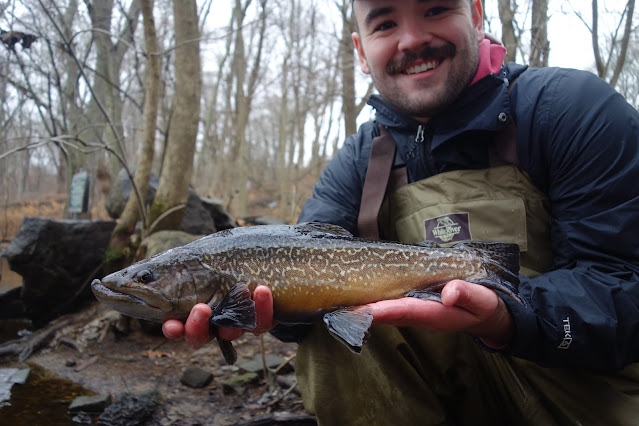
Slamming Tiger Trout

 CT has been stocking tiger trout again. Though the practice isn't something I'm much of a fan of, as is generally the case with stocking any non-native, domesticated fish, they are admittedly more fun and interesting than the run of the mill domestic rainbows and horridly deformed or dully colored browns that predominate CT's hatchery production. They also behave differently than those other fish, and act almost a as a cohesive unit. If a bunch of tiger trout are dumped in one river, they tend to end up pretty far away from wherever they were put but still pretty close to each-other and often in predictable places. This is something that has taken me a longer time to figure out than it probably should have. But now... oh boy. 

Tigers, regardless of their origin, are excessively aggressive in my experience. Wild ones are and stocked ones certainly are. I'll never forget having a tiger hit a mouse 12 times in about 8 minutes, getting hooked twice- and even staying hooked and fighting briefly once  -but eating again and again until I actually landed it. I then caught the same fish again on the same mouse a few days later. This is a notable example of the biological phenomena known as hybrid vigor. 

Over the last couple months I had great success specifically targeting tigers using big streamers, both spey casting in large, sweeping runs and stripping flies in pocket water and smaller pools. There was no best fly, nor a best way to fish the fly other than low and somewhat slow because the water was fairly cold.


 Tigers being tiger, many of these fish were caught after they'd already been missed or hooked. One day Noah was with me, and while we were fishing right next to each other a tiger hit and missed my fly, ate Noah's jig but came off, and then smashed my fly again and got hooked. That one went about 19" and was the longest I'd caught there. 


It's funny. We aren't catching much else at all here, and this spot is solidly miles from wherever these tiger were originally stocked. Tiger never make up the majority of the stocking either. What that tells me is the tigers aren't just doing what all the rest of the stocked trout are doing, or I'd be catching rainbows in the same spot. These buggers are have got their own agenda entirely. That's not necessarily a good thing for a stocked predatory fish to do ecologically, but it does make fishing for them engaging. I'll gladly book trips for these crazy things if anyone is interested. I've got one tomorrow actually, hopefully the fish take advantage of the brief warm-up.

Until next time, 

Fish for the love of fish.
Fish for the love of places fish live.
Fish for you.
And stay safe and healthy.


Thank you to my Patrons; Erin, David, John, Elizabeth, Brandon, Christopher, Shawn, Mike, Sara, Leo, C, Franky, Geof, Luke, Streamer Swinger, and Noah for making Connecticut Fly Angler possible. If you want to support this blog, look for the Patreon link at the top of the right side-bar in web version.

Tuesday, January 4, 2022

Monster Rogue Brown Trout

 Trout wander. Some go upstream, some down. Some wander down a tributary, up the river it flows into, then into another tributary. This is how fish spread and proliferate, it's a necessary function of their evolution and survival. Sometimes this results in trout, be they stocked or wild, finding their way into water that isn't looked at by most fly anglers as trout water. I'm talking about the trout that go way down, as far as they can. Some go to big, slow, lower river channels, some end up in lakes or ponds, and some end up in estuarine waters and become sea run trout. These trout often get big on a greater abundance of bait fish, or they already are big and that's how they survive- usually the sort of places these fish end up have larger predators that happily chow down on small trout. Encountering these fish takes a lot of skill and even more luck if you intentionally try to catch one. Most of the time though these trout get caught by people casting lures for bass, stripers, walleye, and other species that are well known to inhabit the water they're fishing. 

I still remember my first encounter with a rogue trout. It was a wild brook trout caught out of my home lake, a place nobody would ever rightly expect to catch such a fish. I did not catch it, my friend Dalton did... on a wacky rigged senko of all things. The fish was near the mouth of the tributary it had undoubtedly come out of, feeding on corn that had been thrown into the lake to attract carp. It remains the most impressive wild brook trout I've personally seen caught in CT. 

My own history with actually catching these rogue trout in Connecticut, be they sea run, lake runs, or what I call "river runs" that drop from tributaries into large slow rivers, is filled mostly with disappointment. I've caught only one definitive sea run brown trout, a small but stunning wild fish that I landed back in 2014. River run and lake run fish have been just as scarce for me, though I've had my encounters. Then, just a couple weeks ago, Lady Luck smiled and I happened into a monster. 

I'd been putting a fair bit more effort into trout in general but particularly big, rogue trout this fall and early winter. With a summer of exceptional rainfall allowing- and in some cases forcing- trout to move around, I figured there'd be a better chance of running into big ones in what some might consider unlikely places. After a bunch of trips without the sort of success I was really hoping for, I set out one morning under cloudy skies and cold conditions to cover a piece of water that could hold some large trout. I fished thoroughly, starting at the uppermost point I thought I might encounter a trout and working down towards the mouth of the river. Not everywhere was reachable or fishable, some of it was too deep and swift and chunks of the bank were private or just too treacherous, but I felt I would be able to cover enough. 

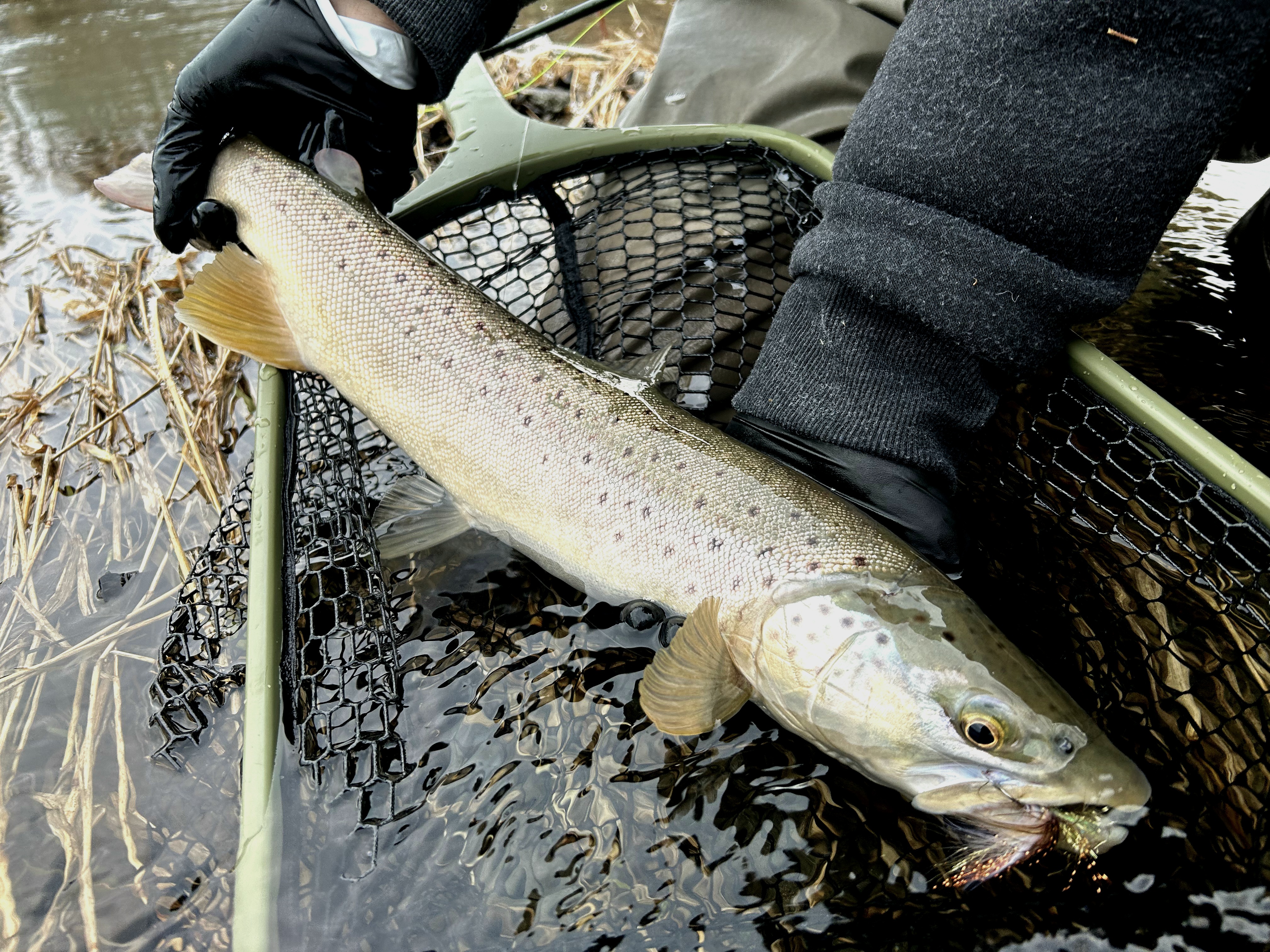
The fish came at the tailout of a large pool, in slick gliding water like I'd expect an Atlantic salmon to roll in. In fact, the fish rolled my fly, a big white Drunk & Disorderly, very much like a salmon. The squared off tail that began slapping the water, though, said monster brown trout. That's exactly what it was, a huge rogue brown trout. The fish gave a pretty good fight on my 6wt, running a bit, thrashing on the surface, and dogging deep. Soon she was in the shallows and I had her. The still-worn fins signified that the fish was of hatchery origin, but proportionally she was shaped like she'd been around a while. She was miles from anywhere such trout are stocked, and had the wounds to show that she'd been around the block. Scars on one side of here head were clearly left when an angler removed the trebles of a large striper plug. This is a brown trout that has been cruising around striped bass and maybe even bluefish haunts. 


At the time, since I knew it wasn't a wild fish, I wasn't as excited as I probably could have been. It was an exceptional and in many ways unlikely fish. Considering how long I've known that catching these rogue fish was possible, I'm really glad it came to fruition. Now I just want to do it better. I want more, I want bigger, and I want wild. 

I'm obsessed. I probably need help. I'm in the salmonid mood again and I'm hell-bent on catching the biggest trout I've ever seen.

Until next time, 

Fish for the love of fish.
Fish for the love of places fish live.
Fish for you.
And stay safe and healthy.


Thank you to my Patrons; Erin, David, John, Elizabeth, Brandon, Christopher, Shawn, Mike, Sara, Leo, C, Franky, Geof, Luke, Streamer Swinger, and Noah for making Connecticut Fly Angler possible. If you want to support this blog, look for the Patreon link at the top of the right side-bar in web version.

Edited by Cheyenne Terrien

Thursday, December 23, 2021

Giant Brown Trout in the Dark

 It was never going to be a warm night, but if the temperatures don't dip into the teens and the other conditions are tolerable, I take what nights I can get between the end of November and the end of March. Trout eat at night all year, especially really large wild trout, so when an angler wants to catch the largest wild brown trout they can, taking winter nights off isn't a good idea. But perhaps neither is the original intent if you value your sanity. Cold, dark, long winter nights rarely produce the excitement that summer and fall can give. Hookups are few and far between and rarely is there not at least one body part- usually more -that's in pain. The air hurts you in the winter. 

Garth had texted me asking if I'd like to night fish the Farmington with him earlier that day, and I said yes but with a caveat. We wouldn't fish the Farmington, I had better ideas. I wouldn't tell him the names of the streams though. He rolled into my driveway a bit after 9:00 asking if we were going to this river or that river... none were correct answers. Eventually I had to tell him where we were going, but all I said was "head like you're going to that one burger joint." That was enough of an answer for him. "No!" he replied. "There? No!"

He'd fished the same spot, I knew that. But never for trout, and I was sure he didn't think there'd be wild brown trout there let alone giant ones. Most people wouldn't think there could be large wild trout at this spot, and I'm okay with that. This was exactly the sort of place I target when looking for monster nocturnal browns. 

We covered one run for a little while without anything to show for it but ice crystals in our guides. I kept thinking about the next run downstream, which was essentially the head of one excessively long glide. I knew from a recent daylight visit that there were lots of fallfish down there, on the order of hundreds, and up to 14 inches. There were also lots of spot tail shiners and juvenile white suckers. This was exactly the sort of place a large brown trout would visit under the cover of darkness. It was much too shallow and visible for such a fish to spend any time there in daylight, but without the sun shining down on this run, a big predatory fish could do its dirty deeds without eagles, herons, or people seeing it. Perhaps there would be one exception tonight. Maybe Garth and I would get to see one of these fish. 

We made our way down and slowly worked the run. I was fishing a large, black articulated streamer, about the size of many of the smaller fallfish and suckers. I swung the fly through every possible feeding lane, working it slowly, only manipulating it very slightly with small twitches. I got about as far down the run as I'd reasonably expect a trout to be when one decided to interrupt my routine. The take was subtle, just a faint tick. I lifted the rod decisively but not too sharply, and felt an initial jerky head-shake. I stripped down to bury the hook if it wasn't already and that told the fish something was really up. It began making sweeping head-shakes, yet not breaking the surface, and made a decisive turn to head downstream. This told me just how large this trout must be. It had control here, I couldn't have easily turned it. I didn't feel I needed to though, and instead opted to follow. Garth heard this commotion but wasn't yet sure exactly what was going on. 

Suddenly movement ceased, and there were a couple faint sensations of tension changing. Nothing felt good. I pulled and nothing pulled back. The fly was stuck on something and that was no longer the fish. I could tell that it was a branch, probably quite a small one as there was a bit of flex. As only a handful of fish had managed before, this beast had perfectly transferred my fly to a branch. I can picture a lot of the fish that have done this to me before because I've seen most of them. But this one I don't know. I could let my imagination run wild. It could be a giant silvery hen, with black spots like bits of pepper. Or perhaps a lean, heavily kyped buck with giant red spots and an orange belly. But I don't know, and I never will. All I know is that it was huge. Garth and I discussed the situation and decided to continue with our night as if that could happen again. Maybe it could have, but it didn't. We crept around in the glow of street lights and businesses trying not to cast shadows over deep pools and log jams. The sense I got was that monsters lurked here. Perhaps I'll encounter one some other night. Maybe I'll even get to hold it for a moment. 


Happy Holidays everybody. Stay safe, healthy, and warm. Fish when you can. Be good to the people around you. 

Until next time, 

Fish for the love of fish.
Fish for the love of places fish live.
Fish for you.
And stay safe and healthy.


Thank you to my Patrons; Erin, David, John, Elizabeth, Brandon, Christopher, Shawn, Mike, Sara, Leo, C, Franky, Geof, Luke, Streamer Swinger, and Noah for making Connecticut Fly Angler possible. If you want to support this blog, look for the Patreon link at the top of the right side-bar in web version.

Edited by Cheyenne Terrien

Wednesday, December 15, 2021

Surprise Giant Rainbow

 On one of my salmon outings this November, I was working my way through a shallow run that I sometimes move a salmon or two in with a conehead Ally's Shrimp. I must credit Ben Bilello for my knowledge and use of this fly, which has become a top five fly for me for CT broodstock salmon. When the water is low and warm I fish a very small unweighted version, but in the moderate to high flows that dominate November and December the conehead has the way to go. On this unfortunately sunny, breezy day the conehead Ally's had already moved one nice salmon that never actually touched the fly, nor would it come back. I'd tried to play the rest and re-tie game but that fish just wasn't having it. 

Now, working down this run, I was starting to think this day was going to end in a skunking. Then suddenly I was tight. The fish had hit in the deepest, fastest slot, somewhere there's often fish but in a place I've always had trouble fishing a fly well when the water is up, just due to the casting distance and angle. I feel like I've cracked the code now though, as I was able to make it work even with my 5wt by adjusting my position a bit. 

The fish was head shaking a lot and felt heavy, but wasn't acting out like some salmon do. I gained line as it lazily came towards me, throbbing a bit but seeming not to know what was going on. Once it got about twelve feet from me the fish came up, and instead of the colors and patterns I could expect to see on a broodstock salmon I saw an awful lot of pink. There was a short standoff in which time the fish gave me enough time to decipher that if was, in fact, a preposterous rainbow, before it decided to try to take some evasive action. Gigantic though she was, this was still a domesticated stocked trout and I made fairly quick work of her. 


What this really made me want was the opportunity to swing big flies for native rainbows, be they steelhead or just big non-migratory ones. These hatchery fish just don't fill the void for me. It's unfortunate that I have to to drive clear across the country for that. 

For now, though, if you want to pull on some of these guys, book a trip! They're decent practice for a lot of other fishing situations, especially now that they've settled into at least somewhat "natural" trout behavior. I spey cast for them, tight-line nymphs and streamers, indicator fish, and of course if they're rising some dry fly fly fishing is on the docket... either whatever method you'd like to focus on or whatever will work best that day, your pick. And although this particular day wasn't great for the broodstock salmon on the Shetucket and this season has been weird overall, if you book during warm and cloudy conditions I can probably get you on some fish. We're at least moving a couple on every trip.

Until next time, 

Fish for the love of fish.
Fish for the love of places fish live.
Fish for you.
And stay safe and healthy.


Thank you to my Patrons; Erin, David, John, Elizabeth, Brandon, Christopher, Shawn, Mike, Sara, Leo, C, Franky, Geof, Luke, Streamer Swinger, and Noah for making Connecticut Fly Angler possible. If you want to support this blog, look for the Patreon link at the top of the right side-bar in web version.

Thursday, December 9, 2021

Local Brookies and my First Virtual Fly Fishing Class

 Back when there were still plenty of leaves on the trees and a warmth to the air strong enough to bring a fair number of snakes out, I finished a day of timber rattlesnake surveys by knocking on the door at a few local brook trout haunts I hadn't fished in a while. My idea was simple: I'd fish a stream until I caught one brookie, then move to another, and repeat the process until it was dinner time. 

I started out just down the road from a survey site. The flows were better than I've seen some years but the water was still crystal clear, putting the fish on guard. I sneaked around carefully and stripped a very simple stream down the pools, hoping to tempt an aggressive post-spawn male. That's not really what I got, but I couldn't help but admire the fortitude of this little brook trout parr. 


The second stream gave up its bounty far more rapidly and the fish was a bit more impressive. Well, it was bigger. It may not actually have been impressive in stature at all, but it was a native brook trout and any native rook trout is a thing to behold. 

Stream number three was much less inclined to give up its bounty, which was a surprise as I typically can get a dozen or so brookies there with little or now effort. I had to work for it this time. I managed to stick with the same fly though, which was cool. Three different streams within 15 minutes of my house, three wild brook trout, all on a goofy micro streamer that I actually tied for use in saltwater. 


As time progresses and I devote the days I can fish from sun-up to sun-down on other fisheries, I find myself being satisfied with a small number of brook trout from a short outing. I also fondly remember all that time I spent perusing over maps, biking as much as 60 miles in a day, and bushwacking as many small streams as I could throughout the year. My teenage fly fishing years were a lot of fun, and certainly, sometimes, I get the urge to do that sort of thing again. But I've moved on to other things. Not even bigger and better, necessarily- just different. Brook trout are just as special as they ever were, I just don't feel the obsessive urge to fish hard for them as much. That's probably good for them, and me. 

On an entirely different note, I've decided to setup my first online fly fishing class. It will occur next Friday, December 17th, at 7:00 pm. The class will run 35-45 minutes with time for questions afterward. It is titled "Flies For Night Fishing Trout" and will cover the best flies to utilize in night fishing, the best seasons and conditions to use them, and how those flies should be fished. The class will be held through Google meets, $15 per participant payable through paypal (brwntroutangler@gmail.com) or venmo (@Rowan-Lytle). The event link will be sent to you upon receiving the payment, so please include your email address in a note. Patreon supporters get $5 off. I hope to see a bunch of you there, and this will be the first of a good many classes as long as this one does reasonably well.

Until next time, 

Fish for the love of fish.
Fish for the love of places fish live.
Fish for you.
And stay safe and healthy.


Thank you to my Patrons; Erin, David, John, Elizabeth, Brandon, Christopher, Shawn, Mike, Sara, Leo, C, Franky, Geof, Luke, Streamer Swinger, and Noah for making Connecticut Fly Angler possible. If you want to support this blog, look for the Patreon link at the top of the right side-bar in web version.

Monday, November 29, 2021

Surprise Rhode Island Northern Pike

 November 12th was one of those horribly unpleasant weather days to fish in, featuring high wind and very heavy rain over most of Connecticut and Rhode Island. It was at least vaguely warm though, and it was the sort of weather that gets predatory fish fired up. Subsequently, I was going to fish. I didn't want to fish for very long or far from my partner's apartment, so I drove less than five minutes away to a spot that I knew had potential but hadn't fished before. I didn't really know what to expect but it was exactly the sort of spot fish will stack up at in late fall during high water: a big slack water with reasonable depth, just off the main river. Most of the food chain utilizes these spots, from macroinvertebrates, to small shiners and dace, to panfish, bass and larger predator fish. 

The water was high and cold; I struggled a lot last season to get fish in this same river around this time of year. I'd not yet dialed in many areas though, and I'm still doing a lot of exploring and learning here. It was a crap-shoot, this spot, and though it appeared textbook, I wasn't sure I'd catch anything. I started out simple, hopping very small jig streamers along the bottom. This served two purposes. Flies like this catch everything from suckers and panfish to trout and bass, so it would give me a good idea off what was present (if anything). It also served as a way to feel out the bottom contours and find snags or hidden structure. That inevitably meant flies were lost, but that's just part of the game. I did start picking up fish. First, some pretty yellow perch. Nothing huge but nice to see and great to get the skunk off with. Then, a few good bluegills, and a roughly 2 pound smallmouth that I lost. That stung a little as larger smallmouth are pretty rare in this river and that was the largest I'd hooked here. 

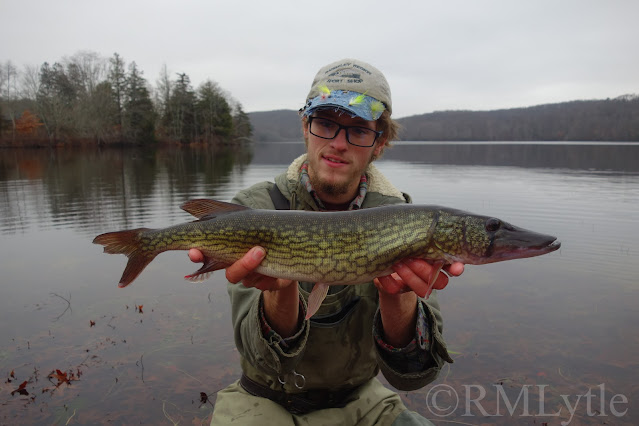
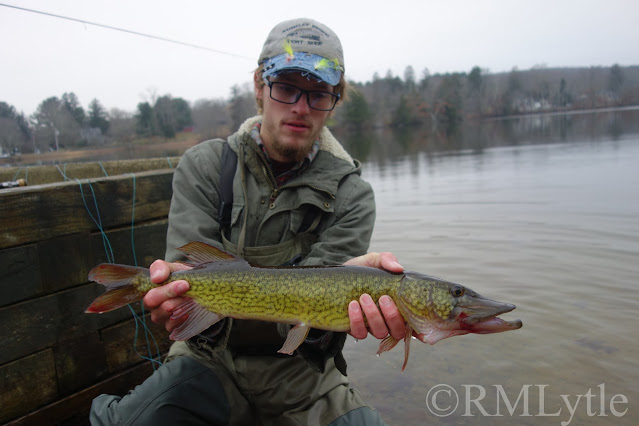
I eventually decided to tie on a larger streamer, namely a conehead Marabou Muddler, and try to tempt a larger predator. This did not go the way I expected it to when, merely three casts later, the fly was smashed to rod lengths from me by a northern pike, and not a small one either. I didn't know there were even pike in the watershed so I was taken completely by surprise. I hooked it, but immediately was sure I'd lose the fish. I was using 10lb tippet and I'd seen the take; there seemed little hope my fly was pinned at the tip of the snout or somewhere else that would make a landing possible. I felt a bite-off was inevitable. Miraculously that never happened. I actually landed the fish. I was giddy. I hadn't targeted pike much at all this season, and with the exception of the one lone big one I got early in the season, hadn't encountered many of this species in 2021. To get one five minutes from the apartment in a watershed I didn't know had them during just atrocious weather was awesome- let alone on a 5wt and 10lb tippet. The fish was snub-nosed, which was a big factor in why I was able to land it. It was very healthy in terms of bulk and energy though. 


I stuck it out for a little while longer with only a few more perch, but I was sure the fight with the pike had disturbed the spot a lot. I left soaked to the bone and happy as can be, with a new task to latch onto- find even more pike in Rhode Island. Up until then I'd only heard about one body of water within the state that had any. Since then I've done quite a bit of research and scouting though and have half a mind to put in a solid effort to dial in some bites over here. It's funny how much one fish can change your mindset sometimes. 


Until next time, 

Fish for the love of fish.
Fish for the love of places fish live.
Fish for you.
And stay safe and healthy.


Thank you to my Patrons; Erin, David, John, Elizabeth, Brandon, Christopher, Shawn, Mike, Sara, Leo, C, Franky, Geof, Luke, Streamer Swinger, and Noah for making Connecticut Fly Angler possible. If you want to support this blog, look for the Patreon link at the top of the right side-bar in web version.

Edited By Cheyenne Terrien

Thursday, November 18, 2021

Late Fall and Winter Trout Season

 We're progressing into a colder weather pattern here in New England and the fishing is changing. Dropping water temperatures and higher average stream flows mean generally slower fish behavior. That doesn't mean slower fishing though. It actually took me a fair bit of time to really dial in the late season trout bite on my local waters. Part of what it took to dial that bite in was just incessant bobber fishing and small but stupid heavy streamers. Since that isn't a fishing style I liked for a long time, I ended up missing out on a large amount of the season. Once I did pick it up though, I covered copious amounts of water to figure out where the wintering holes were, and when I did find them I found loads of trout stacked up. 


I then of course wanted to answer a question: could I catch these trout at night? It turns out the answer was yes. Even in the dead of winter, with fine tuned strategies and slow ad methodical approach, I was still able to pull on fish after dark.


If you are looking to improve your success during the late season, or learn new water and techniques, I'll be booking trout trips throughout the winter. Both daylight and nighttime trips will be available- hand warmers included on all trips, haha! 

A big thank you goes out to those of you that booked me already this year, you've all been fantastic and I greatly appreciate your business. I hope I'll get to see some of you folks again! 

In the meantime, I'm considering starting a series of zoom classes on fly fishing strategies, fly design, and reading water. If that sounds interesting to any of you, please comment to let me know. 

Until next time, 

Fish for the love of fish.
Fish for the love of places fish live.
Fish for you.
And stay safe and healthy.


Thank you to my Patrons; Erin, David, John, Elizabeth, Brandon, Christopher, Shawn, Mike, Sara, Leo, C, Franky, Geof, Luke, Streamer Swinger, and Noah for making Connecticut Fly Angler possible. If you want to support this blog, look for the Patreon link at the top of the right side-bar in web version.