Showing posts with label Spey Casting. Show all posts

Wednesday, January 12, 2022

Slamming Tiger Trout

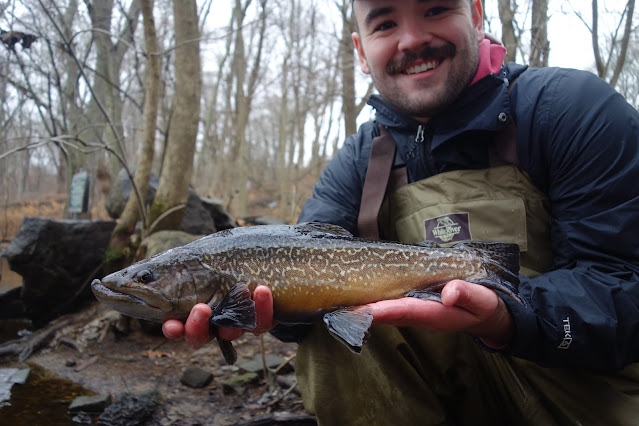
 CT has been stocking tiger trout again. Though the practice isn't something I'm much of a fan of, as is generally the case with stocking any non-native, domesticated fish, they are admittedly more fun and interesting than the run of the mill domestic rainbows and horridly deformed or dully colored browns that predominate CT's hatchery production. They also behave differently than those other fish, and act almost a as a cohesive unit. If a bunch of tiger trout are dumped in one river, they tend to end up pretty far away from wherever they were put but still pretty close to each-other and often in predictable places. This is something that has taken me a longer time to figure out than it probably should have. But now... oh boy. 

Tigers, regardless of their origin, are excessively aggressive in my experience. Wild ones are and stocked ones certainly are. I'll never forget having a tiger hit a mouse 12 times in about 8 minutes, getting hooked twice- and even staying hooked and fighting briefly once  -but eating again and again until I actually landed it. I then caught the same fish again on the same mouse a few days later. This is a notable example of the biological phenomena known as hybrid vigor. 

Over the last couple months I had great success specifically targeting tigers using big streamers, both spey casting in large, sweeping runs and stripping flies in pocket water and smaller pools. There was no best fly, nor a best way to fish the fly other than low and somewhat slow because the water was fairly cold.


 Tigers being tiger, many of these fish were caught after they'd already been missed or hooked. One day Noah was with me, and while we were fishing right next to each other a tiger hit and missed my fly, ate Noah's jig but came off, and then smashed my fly again and got hooked. That one went about 19" and was the longest I'd caught there. 


It's funny. We aren't catching much else at all here, and this spot is solidly miles from wherever these tiger were originally stocked. Tiger never make up the majority of the stocking either. What that tells me is the tigers aren't just doing what all the rest of the stocked trout are doing, or I'd be catching rainbows in the same spot. These buggers are have got their own agenda entirely. That's not necessarily a good thing for a stocked predatory fish to do ecologically, but it does make fishing for them engaging. I'll gladly book trips for these crazy things if anyone is interested. I've got one tomorrow actually, hopefully the fish take advantage of the brief warm-up.

Until next time, 

Fish for the love of fish.
Fish for the love of places fish live.
Fish for you.
And stay safe and healthy.


Thank you to my Patrons; Erin, David, John, Elizabeth, Brandon, Christopher, Shawn, Mike, Sara, Leo, C, Franky, Geof, Luke, Streamer Swinger, and Noah for making Connecticut Fly Angler possible. If you want to support this blog, look for the Patreon link at the top of the right side-bar in web version.

Monday, November 1, 2021

Swinging New York Salmon

Spey casting for Great Lakes salmon and steelhead is kind of a fools errand. The fish aren't like native salmon, they leave a freshwater lake and enter a freshwater river... by the time they get in front of anglers they've mostly already gone though their transition into spawn-focused automatons. There's a reason you can find videos galore of Alaskan cohos smashing topwater flies and none of that from the Great Lakes. They're long done with that by the time they come in. There's also to many damn people. Even in the Douglaston Salmon Run. You can't really rotate when there's a dozen nymphers standing in the run, flogging the same water for hours. The fish also see more flies than any fish should ever have to see. If they were actually native, I'd have a huge problem with the ethics of it, but since they're introduced my problem with it is completely selfish- I want to fish for them the way I want to fish for them, and that just happens to be spey casting which requires room and the ability to cover water. 

So, all that said, there's no other way I'll fish for Great Lakes salmon and steelhead. Even if it's the hardest way. Hey, at least I know my fish ate when I hook one (yeah, I went there). There's very little better than that tight line grab, even if it only happens a few time in a whole day of fishing. 

Rick invited Charlie and I to go to Pulaski and fish the Douglaston Salmon Run again this fall. The weather was very different this go around. It was excessively warm for mid October, and that negatively impacted the fishing. We could easily have wet waded the water was so warm. The kings were around but a lot were entering the river less than fresh. Steelhead were far from numerous and mostly holding in very fast water. And there were of course lots of guys on the run as that week is often the peak, so space to swing was at a premium. I was lucky enough a few times to be able to rotate with a couple other spey casters or have enough water to myself to cover a bit of it before another angler slipped in in front of me, but I got a bit less lucky than last year. 

The fish I wanted most was an adult coho. I'd gotten my first swing steelie last fall and some juvenile cohos this winter. I really hoped for a big, chrome, fired up coho. I ended up getting just that. The fish ate a size 4 Ally's Shrimp and put on a fantastic fight. It was also properly chrome, more chrome I'd ever personally seen before. 


The next couple of fish were all ugly kings. One on an olive and black Intruder, one on a large grey Bugger, one on a Gartside Soft Hackle Streamer. They were in various states of decay. The freshest put up a ridiculous fight with loads of jumps before bolting downriver an forcing me to really reef on it to land it in a waste deep bank trough. 


The to most unusual and unexpected fish of the trip was a native species, a Northern hogsucker that grabbed a blue charm of all things. I love these goofy suckers and their odd black lip coloration. This was the first large one I've caught. My lifer was very small, caught in Western Pennsylvania last fall. This one was much more impressive.


For he next couple days, all I was able to get grabs from was kings, and not many kings at that. A couple of them were pretty seriously big at least. They weren't the best looking fish though. 


Rick and Charlie weren't spey casting and they weren't having fast fishing either. Charlie ended up being the hot hand though with unquestionably the best fish of the trip, and possibly a fish of a lifetime: a gorgeous chrome buck steelhead, a huge one, that took him on a hell of a ride. That's certainly the sort of fish I'd have loved to run into. Of course, I'll have more opportunities. I don't get out there much but I'm slowly figuring things out and refining my technique and fly selection. How many more times will I put up with all the nonsense? Probably way too many times. 


Until next time, 

Fish for the love of fish.
Fish for the love of places fish live.
Fish for you.
And stay safe and healthy.


Thank you to my Patrons; Erin, David, John, Elizabeth, Brandon, Christopher, Shawn, Mike, Sara, Leo, C, Franky, Geof, Luke, Streamer Swinger, and Noah for making Connecticut Fly Angler possible. If you want to support this blog, look for the Patreon link at the top of the right side-bar in web version.

Saturday, June 26, 2021

Convergence '21: Shad

 Once each spring, I make a run north to get on the American shad run. The American shad draw big striped bass, just as the river herring do, but I'm not after them for that reason. Unlike the herring, the shad are big and aggressive enough to be an excellent game species. Large American shad are hard fighting, often acrobatic chrome beauties that still have traces of that saltwater pull left in them even once they're 100 miles or more inland. And that's where I chase them, because if I'm honest the shad fishery in Massachusetts- at least for a fly rodder -is leaps and bounds better than what we have in Connecticut. 

Catching shad on a fly is simultaneously very simple and very complex. The flies and general fishing style are not complicated. I carry a bunch of very simple, colorful, flashy, weighted flies. Most of them use either a bead or dumbbell eyes, chenille, and flash... nothing more. The method is swinging. When it gets right down to it though, there's quite a bit of minutia involved. The fish can move a lot. They may change what color they want at the drop of a hat. Depth control and swing speed are incredibly key. Casting angle can make a huge difference. Well, it really isn't that simple is it? Some days it is, the shad go nuts and hit anything almost anywhere in the water column. But it's best to be prepared for it not to be that way. 

On my one trip this year, I was showing my friend Mark Alpert the ropes. Mark is a more than adept fly angler but had never caught a shad and this was his first time looking for them in Massachusetts. I knew what we'd likely be met with and was prepared for a decent day. The fishing played out very differently for each of us. 

Upon arrival, I was making constant little adjustments until I finally got a take. Depth, color, retrieve or lack thereof, position, etc. Eventually I finally started getting fish. They were in a seam right next to some pretty hard water and it was a pretty tight swing. By the time I'd called Mark and he'd gotten over to me, they were done there. 

After a spell we changed location entirely. Once there, it took me a while to dial things in. I was picking up fish, but not the way I wanted to (every cast), until I got my casting angler and swing honed just right. Then I had a steady pick that lasted a little while. Mark, fishing with a single hander, was compromised. I was able to lob a very long cast even with a steep slope right at my back. 


When that dried up, I wanted to return to the pool we'd started on. I felt that even if things picked up again where we were, Mark would have a better shot at the original pool. It was pretty immediately active upon our return, and I soon honed in on a color and swing speed that were working very well. That got me a good number of fish including a few beautiful big fresh roe shad, one of which was my personal best.


Eventually Mark was starting to get his presentation more tuned in as well and he was starting to get hits. Unfortunately, the bite slowed and then stopped completely, right before we had to leave anyway. I felt bad, but I knew it had nothing to do with his skill and encouraged him to make another trip. Mark got his first shad a few days later, as I expected he would. 

Shad are a perplexing and mysterious fish. They're a filter feeder at sea, so it is bizarre that they are so inclined to bite a fly so man miles inland. They've managed to survive through American industrialization, no minor miracle. Though they're far from my favorite fish, I think I'll always make that one trip a year. Maybe, if I get skunked, two. Catching a good shad bite is a pivotal part of experiencing the convergence of anadromous fish on inland rivers. It remains one of the greatest shows of life each spring.


Until next time, 

Fish for the love of fish.
Fish for the love of places fish live.
Fish for you.
And stay safe and healthy.


Thank you to my Patrons; Erin, David, John, Elizabeth, Brandon, Christopher, Shawn, Mike, Sara, Leo, C, Franky, Geof, Luke, and Noah for making Connecticut Fly Angler possible. If you want to support this blog, look for the Patreon link at the top of the right side-bar in web version. 

Edited by Cheyenne Terrien

Wednesday, April 7, 2021

The Agony of Swinging Steelhead

I picked Noah (Garth) up well before the sun rose and we started the drive to western New York. Our destination was the famous Salmon River and our target was steelhead. Perhaps more precisely, our target was lake run rainbows whose ancestors were steelhead. I’d fished the Salmon River twice already and caught steelhead on both trips, but this time it was my trip. Noah had never been, he had never fished for steelhead at all. This trip would put him closer to a salmonid over 30 inches than he’d ever been. Even though I’d been already, I had very little experience. This trip would test me. It would be my first real foray into Great Lakes steelheading. 

We got on the water around 9:00am, leaving us with most of the day to explore water that would mostly be new to both of us. We didn’t know exactly what to expect, other than a struggle. Winter steelheading pretty much always is. It would be especially so for me because I decided to dedicate myself to swinging. I faltered only a couple of times and fished with an indicator or sight cast with small streamers, but for the most part it was just big flies and spey casts. My other goal was to fish away from the crowds, outside of Altmar, and we managed to accomplish that. We walked a lot, though we didn’t actually need to. At times we found water devoid of fisherman right around the bridges. 

The weather was pleasant. It was only cold in the morning, and we took wading breaks because the water certainly wasn’t warm. The sky was clear though, and I didn’t think that helped the fishing. Yes, the fishing was slow. Very slow. We saw two other anglers hook fish and we saw steelhead, most of them tucked into log jams. We were struggling though, and by the evening of that first day I was expecting to skunk. 

Then, in the most promising run we found that day, I abruptly came tight. The fly was an olive and purple marabou pattern, a swing fly I’d had a steelhead take and caught a couple kings on back in the fall. The fish grabbed at the tail of the run, in a classic spot. I registered the take with astonishment, set the hook hard, and my spey rod doubled under the weight of a grumpy steelhead. Then I f’d up. The fish came to the surface and began violently head shaking, but I kept the rod high. The fly came out, and my heart plummeted.


It’s hard to express that feeling. Most people who don’t fish would just think it’s silly. But it was pure agony. I felt this deep sense of loss for the rest of the trip. We never came close to getting another steelhead. But that’s the game, and I’m proud that I managed a grab on a big fly when nobody was doing all that well, regardless of tactics. That certainly is a very bitter consolation though. I need to do more of this steelheading thing. 

Until next time, 

Fish for the love of fish.
Fish for the love of places fish live.
Fish for you.
And stay safe and healthy.


Thank you to my Patrons; Erin, David, John, Elizabeth, Brandon, Christopher, Shawn, Mike, Sara, Leo, C, Franky, Geof, Luke, and Noah for making Connecticut Fly Angler possible. If you want to support this blog, look for the Patreon link at the top of the right side-bar in web version. 

Friday, November 27, 2020

One Foggy Thanksgiving Night

 One foggy and warm Thanksgiving eve four years ago, I caught a gorgeous walleye on a spur of the moment outing. Unlike my Christmas Eve tradition, which was started from a similar spontaneous outing and a monstrous small stream wild brown trout, I didn't decide to make this a yearly trip. But when I glanced outside on Thursday night to see my street bathed in fog I couldn't resist. I rigged my spey rod, and though the conditions were poor to horrible for night trout fishing I set out into the mist to swing large streamers in the black waters of my nearest trout river big enough for such pursuits.


In the eerie and quiet desolation I cast and pondered, allowing my black and blue Intruder to dance the current breaks and look enticing enough to tempt whatever trout may be slightly active. Maybe. Probably not.

Passive tactics allow for contemplation. Thanksgiving has never been a huge favorite holiday of mine, for a variety of reasons personal and ethical. But that's not to distract from the importance of gratitude. And as I stood there in frigid water, waders leaking, waiting for a grab that would never come, I smiled. I'm one lucky bastard. 

This has been an awful year, but I'd recon you've all still got something to smile about. So go stand in your favorite river or lake or ocean and smile about it. 

Until next time,

Fish for the love of fish.
Fish for the love of places fish live.
Fish for you.
And stay safe and healthy.


Thank you to my Patrons; Erin, David, John, Elizabeth, Brandon, Christopher, Shawn, Mike, Sara, Leo, C, and Franky for supporting this blog on Patreon.

Thursday, November 19, 2020

Salmon River Salmon and Steelhead: Becoming a Snob

Lake Ontario's native Atlantic salmon went extinct in the 1800's, for much the same reasons salmon all over the East Coast were suffering: dams, pollution, and overfishing. As seems to be human nature given just about any and all similar cases turn out the same, those in charge of such things immediately started trying to replace those Atlantics with something different. These attempts included the first stockings of Pacific salmon in Lake Ontario. These early attempts to establish cohos and chinooks failed, but hope was never truly lost, and when the extirpation of lake trout in the middle of the 20th century resulted in a huge boom and overpopulation of alewives the stockings again commenced. By 1974 a run had been established in New York's Salmon River. 

The early years of this fishery were, to put it politely, an absolute shit-show. People didn't believe the fish would voluntarily take a lure or bait, so they deliberately snagged them. Though already illegal and widely considered unfair chase on most waters, it remained common practice on Lake Ontario tributaries where salmon runs occurred until 1995. Fear of economic impacts to the now wildly popular fisheries was surpassed by the overwhelmingly obvious problems with such an unethical practice. Illegal activity, fist fights, harvesting salmon eggs for profit, and other such behavior were rampant. The snagging ban inevitably did cause a decrease in fishing effort but over time, as people discovered that the fish could indeed be caught on flies and bait if targeted the right way, it once again boomed. It is estimated that $201,000,000 is spent by anglers fishing the Salmon River annually. And though things have gotten more civilized, there is still a lot of buffoonery. My friend Rick invited me and fellow fish head Charlie to join him on a trip during the peak of the salmon run. We'd spend one day fishing the public water and two on the private Douglaston Salmon Run, giving us the chance to see both the chaotic and the more civilized side of this fishery. 


When Rick and I went to fish winter steelhead, we'd stayed well upriver, in and around Altmar. This time the idea was to fish further down where the fish were freshest. Not far above the Douglaston, Town Pool is one of the first holding spots above the private water. We just wanted to watch there, as this spot is rarely anything less than pure chaos. It was a fun show to watch, though I'm certainly not the type to want to take part in this sort of fishing. Fish were snagged, lines were crossed, and it was the furthest thing from socially distant. But the behemoth fish we could see in the waters below shed light on why it was this way. For most of these people, chances to catch fish of this size (in a small river no less) don't come that often and the allure surpasses the rest of the experiences that would make someone like myself turn their nose up to it. 


Snobbery, or some semblance of it, had already set in. 

We drove around a bit before settling in to fish at Pineville. I was eager to do some wandering and walk to try to get away from crowds. It turned out that this was possible, but it wasn't easy to find water that had both fish and less people. I know I never found any water that had both some fish and no people. But I did find some and less, and that seems to be about the best you can do.


My expectation were low that first day, but I tried a bit of everything some swinging big flies with my spey setup to nymphing and dredging eggs to sight fishing with small streamers. I hooked one fish while sight fishing, and it wasn't the one I was targeting but the more beat up individual it was next to. It made an unexpected move and I suddenly found myself attached to it by the dorsal fin. Try as I might, I couldn't roll cast the fly off of it, but the fish was fresh enough to put up a solid fight so I decided to use this as an opportunity to decipher the limitations of my tackle against these fish. I put as much pressure on the fish as I was willing to plucked my woolly bugger out as soon as it got close enough. From then on I decided to break fish off that were clearly snagged. 

When I made it back to where Rick and Charlie were, Rick was hooked up. I stood on the bridge to watch and shoot photos. Eventually the fish came unpinned, unfortunately, and by that time we were hungry and decided to head out


We got a pizza at Paulanjo's in Pulaski than headed to the hotel and eked out what precious little sleep we could. In the morning, we went to the Douglaston. After New York senator Doug Barclay got sick of fisherman trespassing and behaving despicably, on his large property on the lower reaches of the Salmon River, he turned his property into a private, regulated fishery. Anglers who are willing to can pay for the privilege of smaller crowds and better behavior on prime water under the watchful eye of the Douglaston's river keepers, who make sure everything is on the up n' up. 

I very quickly came to the conclusion that I'd never fish the public water on the Salmon during the mid fall season again. Yet another level of snobbery had been reached.

Rick and Charlie decided to settle in at one of the major pools, but the wandering itch was bugging me and wander I did. I spent some time in the riffles trying to get some chinooks holding in the pockets to react to flies, but I inevitably found my camera better at capturing these fish than my fly rods.


I wandered my way downriver before settling in to fish hard in a stretch that looked good but wasn't especially busy. I started out bouncing heavy flies, doing what basically everyone else was doing, and kept doing that for a while, through a couple missed fish and a couple intentional break-offs of fouled fish. As the day wore on though I began to bore of it. In time the pool cleared out nearly entirely, and I switched to the spey rod, started at the head, and began to cast and swing. 

10 casts in, my intruder got smoked. I swung and whiffed, and a chrome steelhead did one cartwheel in retaliation. I swore under my breath and my arms fell to my sides. That I had not expected, not so soon. That moment right there sold me completely. I was swinging for the rest of the trip. I felt affirmed half an hour later when a big dark king smoked my weird olive and purple fly and put up an admirable fight. It was my first chinook, my first Lake Ontario salmon, and my first salmonid approaching 20 pounds. 


Lifelist fish #178: Chinook salmon, Oncorhynchus tshawytscha. Rank Species

I had a couple more wonderful experiences with chinooks that day and the following. Very few of them ended with a fish to hand. The largest fish I hooked took a big yellow Gartside softackle streamer around sunset and was likely in the 40lb class. It roared off, leaving the run I hooked it in, the leaving the pool below it, then entering the next long run below that before turning, jumping, landing on my leader, and breaking off. I felt pretty under-gunned with my 11'6" 8wt. The next day a fish of similar size gave me the same sort of battle but this time I landed, unfortunately it turned out to be hooked outside the mouth, so though it was a gorgeous quite fresh beast of a fish I didn't photograph it. The first fish I'd hooked that day was also the same sort of gigantic male, but not on for very long and did definitely eat the fly, a huge pink marabou spey fly. After doing some crazy frantic runs; charging up, down, across and back but never for than 30 feet; it launched completely out of the water sideways and threw the fly. The image of a 35-40lb chinook two feet above the river, spray sparkling like shards of glass haloing it, and my fly falling out of its big toothy maw will forever be burned in my brain. 
Later on the second day I got the freshest king I'd been able to land. He was a little fellow, and almost fooled me into thinking he was a big brown trout. It was a pretty cool fish nonetheless. 


The fish that made the trip for me though came in the first evening on the Douglaston. I was working a bend very thoroughly, trying to drive one of the big kings or cohos I'd seen in there crazy to the point of snapping at my irritating white and grizzly swing fly. That didn't happen. Instead, my fly got crushed at the end of the swing, and a silver bullet came flying out of the water when I set the hook. It was a steelhead, a chrome psychopath, and it came upstream and went right by me spending more time in the air than in the water. My heart was pounding. The rest of the fight was pretty much a blur but I do know I was utterly floored by how hard this fish was fighting for its size. By some miracle, I got it to hand, and couldn't stop uttering expletives under my breath. This was my first fresh steelhead, my first steelhead on a streamer, and my first on the swing. It completed my transition to snobbery. My days of nymphs, split shot, and dredging up Great Lakes salmon and steelhead are probably over. It had never sat well with me anyway, I gravitated towards spey fishing in the same way I was drawn to fishing for Atlantic salmon and sea run trout with traditional flies and methods. It felt like it did the fish justice, as if the fish were made for the methods instead of the other way around. 


I'd never be so bold as to suggest superiority, I don't care how you catch your salmon and steelhead so long as it falls within the bounds of what is legal and fair-chase. Bait, center pinning, chuck and duck... they're all completely valid and ethical when done right. But for me, I can nymph trout, fallfish, bass, suckers, and other such species. I would like to swing my flies without additional weight for my migratory fish. It just feels right to me. That was my takeaway from this trip. I became a spey snob. I can't wait to make a steelhead trip and swing flies for hours upon hours for scant few 
takes. I really can't.


Rick with a big hen chinook that took an egg.

It took much too long for me to experience the Pulaski salmon run. It's such a huge part of Northeast fishing culture that one can't can't live here, be serious about fishing, and get away without making the trip at least once. There wasn't anyone I'd rather have taken the trip with than Rick. Though Charlie and I had never been, Rick has a long history with this fishery. He knows it well, he's seen it morph and change a bit over the years, and he's caught a lot of salmon and steelhead there. Charlie was also great company. I'm sure the three of us will fish the Salmon River again sometime, Covid willing.
Until next time,

Fish for the love of fish.
Fish for the love of places fish live.
Fish for you.
And stay safe and healthy.


Thank you to my Patrons; Erin, David, John, Elizabeth, Brandon, Christopher, Shawn, Mike, Sara, Leo, C, and Franky for supporting this blog on Patreon.

Friday, July 10, 2020

Convergence '20: American Shad

Each year I make one trip up to Massachusetts to fish for American shad. It's a something of a rebellion trip, because a lot of people get cray for shad in CT and start fishing early in the run. Spots are often pretty near shoulder to shoulder and there are a fair number of boats on the river. I've fished for shad in CT once and my urge to do so again is fairly limited. I go to a tributary in Massachusetts once the season is well underway, catch a bunch, and quench my thirst. My friend Ben started me on this tradition a number of years ago. I caught my first shad with him towards the end of the run. Since then, I just keep going to the same spots on the same river and fishing the same flies. This year I thought it might not happen, but after a full night of striper fishing I found myself holding my short spey rod in the turbulent dark waters of my favorite shad river, swinging my simple red fly, one of five that I'd hurriedly whipped up in the time between getting home from the river and, well, leaving for the river again. Before the sun, which wouldn't have been visible anyway as it was completely cloudy, made its way over the horizon, my rod bent double and the first shad of the day was hooked.


These silvery clupeid fish are intrinsically linked with New England spring. They have run the rivers to spawn in large numbers for many year, becoming vitally important to indigenous peoples, then Europeans when they crossed the Atlantic. John McPhee's book The Founding Fish covers the historical importance of this species and should be required reading for pretty much anyone reading this right right now. 
Despite their integral part in American history, and actually partly because of it, American shad were in decline by the early 1900's. Dams, pollution, and overfishing have been responsible for declines in returning shad throughout the Eastern U.S. Strong efforts by many state and federal programs, however, have resulted in a strong resurgence and the CT River and others routinely beats previous records for shad numbers. In an age when good conservation news is uncommon, the story of shad is a shining star and a sign of what can be achieved when we actually try. As I slid another shimmering fish into the shallows, I imagined looking upstream and seeing Native Americans removing shad from a net and tossing them in a pile on the bank. The illusion dissolved rapidly, consumed by the urban jungle as horns blared across the street. It was morning rush hour now. The large brick building behind me suggested nothing of the wild lands that once sprawled in every direction. But the shad at my feet was still here, a relic of the old America, headed upstream to spawn. 


I plucked my fly out of that trademark paper thin mouth, then watched America's founding fish rooster-tail back into the flow of this gritty, urban river. A vision of perfection in a world of confused destruction, this fish was completely unaware of the part it was playing. These fish are the heroes of this story... along with the many people that have toiled day in and day out over the years to keep them running. May they run all my days, and may they continue running well after I'm gone from this world.
Until next time,
Fish for the love of fish.
Fish for the love of places fish live.
Fish for you.
And stay safe and healthy.


Thank you to my Patrons; Erin, David, John, Elizabeth, Brandon, Christopher, Shawn, Mike, Sara, Leo, and Franky for supporting this blog on Patreon. 

Friday, January 10, 2020

The Mystery Fish


Swinging streamers has never been much my style. Part of that is to do with the species I have easy access to. I suspect if I were very frequently fishing for salmon and steelhead I'd be swinging flies much more often, but it is my opinion an experience that a down and across swinging streamer for the trout in the waters I fish is one of the least effective methods of presenting a meaty fly an getting trout to pounce on it. I'm far more inclined to present a streamer up and across with a fast retrieve when fish are aggressive, or straight up with a slow retrieve for less active fish, even dead drifting tight lined or under an indicator for the most lethargic trout. But I've realized that whether swinging is the most effective method of presenting a streamer to my trout around here or not, by not practicing on them I'm setting myself up for failure when I actually do get to go swing flies for Atlantic or Pacific salmon or steelhead. I do practice with my spey rod, here an there, very infrequently, but not enough to have a rhythm, for my cast to be automatic, or for me to know exactly what my fly is doing in the water on each swing. So practice I must, and I'm taking every opportunity to fish big water I can to do so. When my good friend Joe asked if I wanted to join him an our mutual friend Dan and suggested the Farmington, I said yes quickly. Mostly because I hadn't fished with them for far too long, but also because it would be an excellent chance to swing flies on water I've fished a lot but never applied the technique to. It was a brutally windy day, and the fishing was slow. But it was great to be out there with those guys on the river, feeling manly because we were some of the only people tough or crazy enough to be there in those conditions (Here's to Dave Machowski and the handful of other nuts that were out there in that shit with us, cheers! *clink*).


Though the fish weren't on fire, Dan an I pulled on a few. I missed some really solid grabs and caught two small fish, one a survivor strain with a red elastomer. Dan got the best fish of the day, one right about 20 inches, and lost a slob. Joe skunked out, which is surprising because typically in the winter I'm the one skunking when I fish the Farmington in the winter.

Photo Courtesy Joseph Apanowith, taken by Dan Allegue
The highlight of the day for me was seeing a trio of otters, who seemed just as surprised to see me out fishing on such a day as I was them. All three would dive and pop back up staring at me in tandem. It was really amusing and had me laughing aloud. 


In more comfortable conditions the next day I was out swinging again closer to home. On the Farmington I'd been fishing quite large intruder style flies, but I switched to smaller stuff to fish near home and it proved to be effective enough on the dumb ones.


After covering water I knew had fish, I moved upriver to water I was fairly confident wouldn't have anything but was a classic run to swing. I started at the top, made two swing, took a step, and continued that rhythm until I reached the bottom. I never felt a thing to make me think I'd touched a fish during that work through.


When I got to the end of the tailout I retrieved, grabbed my leader, an then noticed something on my fly. On closer inspection, it turned out to be two somethings. Two scales, actually. At some point while I fished that stretch of water, I had indeed made contact with some sort of mystery fish without ever noticing it. In a run I'd typically write off as a likely spot to catch a winter fish, something as simple as two scales on a hook changed my understanding of how this river I'd fished for more than 10 years could fish in the winter. I will be back for that mystery fish. I have to catch it, whatever it is.


Until next time.
Fish for the love of fish.
Fish for the love of places fish live.
Fish for you.


Thank you to my Patrons; Erin, David, John, Elizabeth, Brandon, Christopher, Shawn, Mike, and Sara for supporting this blog on Patreon.