Showing posts with label Stories. Show all posts

Saturday, November 15, 2025

Yooper Wolves

 The hour or two I spent on the Two Hearted River was tantalizing, not satiating. The Lake Superior don't have the steelhead reputation that the other lakes do, but this river's reputation proceeds itself through the writings of Hemingway. I confess, though I have read The Old Man and The Sea and Big Two Hearted River, if Hemingway had never fished the Two Hearted and written about it I'm not sure it would have changed my opinion of it for the worse at all. I mostly mention it because that's how others know of it. The Two Hearted is a low gradient, winding, tannic river whose predominant year round salmonid is the native brook trout. The lake run rainbows reportedly average about six pounds here, though my first hand experience cannot corroborate that claim as I saw no evidence of any such fish in my time there, aside from a very small number of other anglers fishing for them. Spoons seemed to be the method of choice up there, which is a departure from the float-based or bottom bouncing approach I've seen in most other places I'd fished on the Great Lakes. There were also far fewer people here. By leaps and bounds, in fact. I made for five in total on a few hundred yards of water. This certainly owes to the remoteness of the location as much as anything. Michigan's Upper Peninsula is a sparsely populated place that reminds me of Northern Maine superficially. Resource extraction is the primary industries up here. Logging and mining lead the tables. Iron and copper both come from ground here. Later in the trip we'd meet a rock shop owner on the lower peninsula who's family were Yoopers, and she talked about inheriting large pieces of float copper that were found on her family's farm. Indirectly, it was the extraction industry the got me there. On November 10th, 1975, the jewel of the Great Lakes big iron boats, the Edmund Fitzgerald, sank during a monstrous storm. Losing big boats was not a particularly rare occurrence on the lakes up until that point, but none had quite the impact on popular culture that the Fitz did, and her end was a wakeup call that essentially ended a long string of lost vessels and crew. This November 10th was the 50th anniversary of the wreck of the Edmund Fitzgerald and that was why we were on the Upper Peninsula, and how I ended up stripping streamers in the languid, black runs at the very end of the Two Hearted River.


The river almost parallels the shore of Superior at it's lower end, though it would be hard to call such a winding path parallel to anything. The very last leg almost is straight before it juts sharply north and into the lake. Before that, though, her course is a very sinuous one through the stark landscape of dunes; all sand with scattered pines, many dead. The weather on November 10th 2025 was much, much better than the weather on the same date in 1975, but a stiff breeze out of the northeast made standing facing the lake a fairly unpleasant experience. It was easy enough to avoid that, thankfully, tucking in behind the dunes. Tolerable though it may have been, and as much water as I was able to cover without impedance, no chrome flashes lit up the darkly stained water. No grabs met my slowly pulled swings either. Hours spent casting were limited, though, and perhaps a future visit will go differently. There are other animals to encounter on the Upper Peninsula, though. One is certainly rarer but less out of place than the introduced rainbows. 

Across much of the Eastern half of country, wolves are a thing of the past. They eat our cattle and sometimes us, so settlers pushed them back hard. Though rumored sightings circle, the claimed last wolf in Connecticut was killed by Isreal Putnam in the town of Pomfret. Wolves held their grasp in Michigan longer. It wouldn't be until the 1910 that wolves would be beaten down from the Lower Peninsula. Even when they were gone there, the declining UP population was faced with bounties that remained instated until 1965¹. Though granted full protection not long after, it would take Wisconsin's population rebounding for animals to filter back onto the UP and repopulated. They've grown in number since, exceeding 762 in 2024 according to Michigan DNR. Isle Royale has the most significant density, but wolves are seen in other wild parts of the peninsula. 


As I've written about before, I adore large animals, predatory animals, and dangerous animals. Though I had no delusions of getting a chance to actually lay eyes on a wild wolf- they are very good at not being seen when they don't want to be -maybe, just maybe, I might be able to hear one. 

Being some sort of strange freak, I've spent countless hours standing in the woods in the dark listening to the sounds of wildlife. From endangered frogs to owls to coyotes, to even cryptids, I've put a lot of time in "with my ears on". A cackling pack of coyotes, barking fox, or overhead barred owl alarm call stopped fazing me years ago. Hours of annotated and carefully sorted sound recordings going back to when I was just 14 of woodland noise lace multiple hard drives. To say my comfort level in the dark is high would be an understatement. That, and my cursory understanding of topography, predator habits, seasonal prey movements, and modern satellite imagery gave me the confidence to go see if I might hear the wild wolves howl. I picked a spot where a wetland river corridor abutted rolling hills with hardwoods and patchy logging cuts. It was well out of town and closer to an area with reported sightings than some other decent looking habitat. Three of us- my partner Emily, our friend Ian, and myself -split from the group at our little cabin, hopped in the rental van, and went on a little adventure. 

The woods in southern New England don't feel wild at night. It's impossible to get away from anthropogenic noise or sound, so you always know you're near dense settlement and civilization. There's always a plane going by overhead and low enough to hear. Even in the most remote place in Connecticut, on a dry night you'll hear someone's broken muffler in the distance. Light from towns illuminates the bottom of the cloud deck and reflects everywhere. The only time you can really get away from that is during a heavy snow storm. But there, down a long dirt road and away from town, the Upper Peninsula had that feel... that silence. The air wasn't moving. We heard no car, no plane. Any crunch or scrape of gravel from our feet was deafening.  Those who appreciate such desolation seem automatically inclined to speak only in hushed tones. And that we did, remarking in amazement at just how silent it really was. I just hoped, maybe, that silence would be broken by a sound that has sent shivers down the backs of our species for millennia. 

It was almost funny how long it didn't take. The three of us were all whispering when something low and distant caught my attention and I made an abrupt "Shhh, SHHH!". Ian and Emily went silent, and we all heard them. They were far away, but it was hard for me to mistake what we were hearing. Those were not coyotes. There were only a few voices, no yips and barks... just long, low, mournful howls. I stood in awe for just a moment before being overtaken by the need to get closer. "Let's go, we can get closer to them", I urged, and we hopped back in the van. The howls had come from our north, so we followed the road that direction, up into the hardwood forest. We stopped again, and after a little while, heard another- this time apparently individual -caller. It seemed just as far off as the first howls. Once again, we hopped in the van and drove north. This time, our wolves wouldn't talk again. Instead, a single truck, tooling around the dirt roads on a joy ride, interrupted the silence and darkness. It made me realize just how load and obvious our vehicle certainly was, and how unlikely it was that we'd be able to gain ground on animals that had a vested interest in not being seen. We decided to call it a night, the echo of those distant howls still reverberating in my head, another voice that would surely call me back to this place some day down the road. 

¹ James H Hammill,  2013. "Wolf Recovery in Michigan" https://wolf.org/wolf-recovery-in-michigan/

Thank you to my Patrons; Erin, David, John, Elizabeth, Brandon, Christopher, Shawn, Mike, Sara, Franky, Geof, Luke, Noah, Justin, Sean, Tom, Mark, Jake, Chris, Oliver, oddity on Display, Sammy, and Cris & Jennifer, Hunter, Gordon, Thomas, Trevor, Eric, Evan, Javier, Ryan, Dar, Eric, and Truman for making Connecticut Fly Angler possible. If you want to support this blog, look for the Patreon link at the top of the right side-bar in web version. 

Tuesday, September 23, 2025

The Great (Stocked) Trout Migration

 (This is intended to be read as if in the voice of Sir David Attenborough. If read in any other affect, it will not be received as intended)

In a concrete raceway swims a mature rainbow trout. This trout, like many others it shares it's current artifice with, lives a most peculiar life. A scheduled one, in fact. A couple times a day, always at precisely the same times, the trout partakes in a massive feeding frenzy, the likes of which are extremely rare in the wild. Fish froth at the surface on schedule as their prey, little brown pellets, enters the water. It and many of it's brethren, were all conceived, born, and reared in a highly regimented manor, by a specialized species known as "hatchery manager". The hatchery manager is at the whims of the trout as much as the trout are at the whims of the manager. He must keep them alive and growing before the migration, and they must feed, move, and breed when he says. It's an unusual sort of symbiosis. 

 This trout's schedule dictates that is must soon make his final migration, though he doesn't know it or even want to. His majestic grey and speckled sides and short nubby fins ripple as he navigates the habitat he's known his whole short life, flanked on three sides by concrete and by netting above. It's a trout's dream... consistent water temperature, regular and fattening meals, and little fear of a predator. It is a little crowded, though...

(60 seconds of seconds of b-roll of trout bouncing off of each other in a hatchery raceway set to dramatic music)

Unlike many species before they migrate, the trout has no urge, no drive to leave. But suddenly one day it is swept into a big net. Flopping franticly in a pile of it's own tank mates, the trout only knows that this is different. Not where it could be headed or what is in store. But this is, in fact, what he was born for. It is his final purpose. from the net the trout enters a tank, similar in some ways to the one he just came from but smaller, darker, and metallic. and this one is on wheels. When the lid is closed the trout is plunged into darkness. Soon, there was a sensation of moving. Nobody knows how a trout perceives the passage of time, but some say this journey feels like an eternity. In reality it is only a about 30 minutes before the lid to the tank is opened again. In a net plunges, and wriggles trout leave the vessel. The trout are frantic, and our little friend cannot see where his tank mates are going. He just knows that with each scoop of the net, there are fewer and fewer. After a few nets full, the lid closes again, and the travel continues. Next stop... the wheeled tank parks atop a concrete bridge. The hatchery workers hop out and repeat the process. Once again the trout are startled be the abrupt introduction of light when the lid opens, and once again a net enters the water. This time, it's our trout's turn. He flops in the net deliriously as it is passed between hatchery workers. Then he is dumped most unceremoniously off the side of the bridge, plunging ten feet into his new habitat and the endpoint of this admittedly short migration. This place is completely foreign to the trout, though someplace so far back in his genetic code that is barely gasps a whisper are the relics of his ancestors, trout that lived their whole lives in places like this. 

(b-roll of a wild trout with it's brighter colors, intact fins, and robust musculature swimming past the stocked trout)

This place is wholly unfamiliar. The food comes in forms the trout has never seen, and at times that seem random. There is no protective net and the trout watches some of his hatchery mates get taken by a predator just hours after reaching the destination... a heron, merciless in it's intense desire for trout, stabs a few. Incidentally, he is intended for a predator. A very specific one. The trout has no immediate fear because this predator looks exactly like the hatchery manager he could always trust. And that's the cruel trick. This predator comes bearing snacks. The trout, growing hungrier with each passing hour after the regularly scheduled feeding should have occurred, hears something enter the water and goes to see. Its a pellet, not brown like the ones he usually eats. It's bright green... but has a profuse and enticing flavor, so it must be food. The trout spends his final moments thrashing helplessly on the end of a line as a vest-wearing man sitting on a bucket reels him in. 

Thank you to my Patrons; Erin, David, John, Elizabeth, Brandon, Christopher, Shawn, Mike, Sara, Franky, Geof, Luke, Noah, Justin, Sean, Tom, Mark, Jake, Chris, Oliver, oddity on Display, Sammy, and Cris & Jennifer, Hunter, Gordon, Thomas, Trevor, Eric, Evan, Javier, Ryan, Dar, Eric, and Truman for making Connecticut Fly Angler possible. If you want to support this blog, look for the Patreon link at the top of the right side-bar in web version. 


Thursday, July 31, 2025

LLMs, Energy, & Fly Fishing's Soul

 I can't figure out how to turn off Google's AI Overview, and that is driving me batty. Ironically, the answers to "how do I turn off google ai overview?" from Google's AI Overview don't actually work, and the answers in the community help questions don't either. Some even appear to be AI generated themselves.... I'd really, really like to turn it off, and as it stands it doesn't seem to be possible. Why have I devoted close to an hour of my life just trying to disable something meant to make searching the web easier? For me, it seriously fails to actually live up to that goal. But more so, I want no part of large language models or generative artificial intelligence.

Large language models are the most advanced current form of language models; learning systems for processing language. Language models currently exist in two forms, statistical and neural, and most LLMs are the latter, more advanced form. Modern statistical models have been around a while, with pioneering working going back to the 50's and Noam Chomsky's "Three models for the description of language", (which I'm sure would mostly go right over my head if I wanted to pay $15 to access the PDF). Statistical language models use probability to determine the next words in a sequence, analyzing large quantities of text and deriving probabilities based on sequence frequencies. Neural models, by contrast, aim to mimic aspects of human brain function through a computational model based on the neural pathways utilized in creating language. LLMs are given input in the form of immense volumes of existing information- internet text, digitized books, so on -and from that are trained through machine learning; putting those inputs through the neural process. Inputs; namely language of some sort, but represented as numbers; travel from nodes (artificial neurons) down edges (artificial synapsis) to more nodes, often arranged in layers called hidden layers. After passing through the hidden layers the output layer (more nodes) are reached, and the network outputs number that are reconverted into language, images, audio... whatever. If what the network puts out is given back to it again, it will add to it. As the LLM is trained, it can be given feedback on it's outputs to further hone either accuracy or a desired outcome. The material used to train the LLM can be incredibly broad and of course can dictate the outputs, and that's one of the reasons I've tried turning off Google's. I've found it frequently provides faulty, partial, or untrue answers based on the information it's pulling from, which can come from all manor of articles, blogs, forums, and web pages that seek to answer the search prompt. Without seeing the source directly it's a bit harder to suss out its validity and I just end up searching the same way I would have anyway before the Ai Overview existed. The other thing that peeves me is that even if the answer is concise and accurate, it deprives the sources of readership, possible ad revenue, and potential future engagement if the users don't decide to follow through and see where the answer came from by following through links. That's a bit gross, I think, and I do wonder how many answers Ai has provided that have been trained through the many hundreds of things I've written over the years. To learn much of the above, I leaned on Wikipedia (I know, I know, it is fairly trustworthy though, especially with nerdy tech crap like this) and this video by Henrik Kniberg: https://www.youtube.com/watch?v=2IK3DFHRFfw. Kniberg highlights the utilities of Generative Ai too, and though none of that is lost on me and I can see some of it's value, exposure has done nothing but scare me further away from it. 

Ai generated text, images, videos, and music do nothing but improve with time, at least for the goals of the companies creating them- that's how machine learning is meant to work. I'm not letting the failures of LLMs alone dissuade me from them... the hilarious extra fingers, the ease of gaslighting chat bots, and X's Grok starting to call itself "Mechahitler" are absurd, certainly, but there are bigger problems in my opinion. Even as they get more accurate and closer to "human", they just aren't, and the products generated by Ai lack soul. That's cliché and almost meaningless, I know, but the reason writing, art, music, speech, even answers to many simple questions are often meaningful is simply the human experience. When we generate text or an image with our hands, pens, paint brushes, so on, they ring loudly of our life experience, morality, values, bias, and creativity. The way Ai generates it basically just takes from people's voice or style, or even their opinion, modifying it a little but not really creating. This is where fly fishing first comes into play in the conversation. Things have now progressed to the point that I've heard of fly anglers asking Ai what to do on the while water. 

I'm sorry if you've done this... but please get up right now, go to your closest mirror, give yourself a good hard look, then- and not too hard, I'm not trying to injure you here -slap yourself. Are you kidding me? Really? You need a robot to tell you what fly to tie on? This is getting so far from everything that is actually special about fly fishing as a pastime and as a social activity that it frankly disgusts me. There's nothing wrong with asking what you should do in a given situation of an actual human, or learning through reading or videos. You may not even get a perfect answer, or even an answer to your specific question at all, but you're always likely to glean something of worth. Say you ask Joe Humphreys what fly to use on Spring Creek when there's no hatch going on in the middle of an April day. He's liable to tell you to use his Hump's Cress Bug, or some other scud or cressbug imitation, and explain how it'll be best fished rolling on the bottom. He'll tell you how to pick the right number of shot to get down, and to space them a bit to better roll along the bottom. He might even show you how to make a good tuck cast, perhaps tell a story of some good fishing he had recently with that methodology. You'll get the implicit voice of Joe Humphreys and his experiences; his time, his successes and failures. Even if he somehow gives you the wrong answer, that has value. Now look up that same question online, and though there'll be degrees of separation you could sort through information for days, from people of all experience levels. Magazine articles, blogs, forums, images of flies, videos galore... all made by different anglers with different experiences and knowledge, varying approaches and points of view, from all over the world. That, too... incredibly valuable. It isn't immediate, it takes some work on your part, but it shouldn't be immediate. Finally, let's say you're out there on the water alone and don't have anyone there to ask or time to read through loads of information from different sources. Is it not more rewarding, enforcing, and true to the sport to experiment, observe, and try to come to your own conclusion, than it is to ask a machine? If you do ask Ai, it may give you a perfectly good, useful answer, but it will be one lacking in complete context. It'll tell you to tie on a scud because someone, somewhere, likely multiple sources in fact, said it was a good idea. You don't get to learn who all of those someones are, what their history and experience is, and why precisely they think a scud is a good idea unless you put in the extra effort, and at that point you're negating the work the Ai did for you. 

We've already left behind so many of the things that gave this sport soul as technology has continued to progress, are we really going to just ask the machines what we should do now? That sickens me. This is a sport that many of us claims "gets us closer to nature", and yet we seem to try harder and harder to remove as many natural elements from it as possible while shortening the learning curve and ascribing more value to just catching fish at all costs than to the process of exploration. Those aspects are so valuable to the sport, and initially in many respects technology seemed to provide avenues to deepen that. Now, it's skipping multiple important steps. 


Of course, there's a much more pressing concern, not only for fisheries but for whole communities. Currently and probably for perpetuity, Ai EATS energy. So much so, in fact, that it has the potential to impact the health of fisheries. Ai relies on data centers, basically huge warehouses full of computer servers. These servers need electricity to run. Some sources indicate that these data centers, which are popping up all over the US as Ai booms, are set to account for close to half of the energy growth in the country by 2030¹. Ai data centers may use close to a million MWh annually... the average household sits at about .01 MWh. There are 3,912 data centers in the US². Aside from just electricity, data centers need to cool their servers and this can be highly abusive of water resources. Not all of the water is recycled in the process, which typically uses evaporative cooling, and the amount used per day is astounding, well into the millions of gallons. That's millions of gallons per day less than would otherwise be going into people's wells and into groundwater output to spring fed coldwater streams. What water may be discharged would also be far warmer than natural groundwater, and this could have significant impacts on coldwater resource, which trout anglers rely on. Some Trout Unlimited state organizations are already concerned about this reality (mntu.org). The current administration has been pushing through legislation to deregulate data centers and Ai, and even encourage building them on federal land. At a time when water and energy use are already very problematic, and impacting communities and fisheries in a very real way, this is incredibly reckless. Communities around the country are already feeling the impacts, with some residents suddenly feeling pressed to leave places they've spent their whole lives as data centers fundamentally change- in their eyes ruin -their home. They feel no recourse as the largest corporations in the world rush to build these facilities and municipalities jump on potential tax revenue. Right now, as far as the federal government is concerned, it's full speed ahead. It's up to the the states to regulate data centers in such a way that protects towns and sensitive habitat, and there are many indications that they're failing. Though the battle may seem unwinnable, this is one every community really needs to fight.


So, this is something I simply refuse to take part in as much as I can avoid doing so. I won't knowingly interact with Ai generated content, I won't use Ai chat generators to help with my writing or my business even if that means those that do jump ahead initially, and I'll keep skipping past that damn Google overview that's inaccurate half the time anyway. Stupid as it is, it's also scary, well past what I've already discussed above. "While the Level 3 ranking is largely about the model's capability to enable renegade production of nuclear and biological weapons, the Opus also exhibited other troubling behaviors during testing." ³

What the ever living f*** are we doing? 

¹ "AI is set to drive surging electricity demand from data centres while offering the potential to transform how the energy sector works" https://www.iea.org/news/ai-is-set-to-drive-surging-electricity-demand-from-data-centres-while-offering-the-potential-to-transform-how-the-energy-sector-works

² https://www.datacentermap.com/usa/

³ Ina Fried, Axios. May 23 2025 "Anthropic's new AI model shows ability to deceive and blackmail" https://www.axios.com/2025/05/23/anthropic-ai-deception-risk

Thank you to my Patrons; Erin, David, John, Elizabeth, Brandon, Christopher, Shawn, Mike, Sara, Franky, Geof, Luke, Noah, Justin, Sean, Tom, Mark, Jake, Chris, Oliver, oddity on Display, Sammy, and Cris & Jennifer, Hunter, Gordon, Thomas, Trevor, Eric, Evan, Javier, Ryan and Dar for making Connecticut Fly Angler possible. If you want to support this blog, look for the Patreon link at the top of the right side-bar in web version. 

Thursday, July 24, 2025

17 Years

"What's up dog, want some coffee?" Levi whispered as I entered the kitchen, a little groggy but full of anticipation none-the less. "Morning, sure, thanks," I whispered back. "Hell yeah," he replied, "How stoked are you?"

"Pretty stoked."

When the cicadas last came to Central Pennsylvania, I was 11 years old. I'll be 45 when the come back next. That's a lot of time elapsed, and a lot changes. I hadn't yet picked up a fly rod in 2008, in 2042 who knows what life will be like. This year the bugs came again on their cycle and my silly addicted ass trucked it westward thrice, chasing a sickness so good it can't be beat. I've raved about the periodical cicadas before; in 2021 when I intercepted the periodicity in Maryland, and last year when a dual emergence took me to Illinois, Arkansas, Missouri, and Iowa. When magicicadas come out of the ground, I want to be there. They make up one of the last great biomass events of the sort here in the US, and while many were constant, like the buffalo, and some were annual migrations, like the passenger pigeon, there's something extra special and enchanting about an event that occurs more than a decade apart each time. It is miraculous that we still have these bugs at all, the landscape they live under is different every time the nymphs come up. That they still come up from one of the best regions for wild trout fishing East of the Mississippi... How lucky is that? Though, I suppose the same factors that have allowed the cicadas to persist have not been insignificant in providing habitat advantages for the wild trout either. 

Levi and I stepped out into the humid, warm morning air about ten minutes later with a little bit of our gear and a lot of hope for the day. "Hold on, before we go we gotta move the bugs", I said. We were staying at Levi's good friend's, Paul and Kathryn, and they were going to take down a tree in their backyard that day. It was time for a quick rescue mission. We walked over with our phone flashlights on to see dozens of pale, ghostly looking imagos and instars on the tree trunk and low branches. We collected as many as we could and moved them to nearby bushes. When periodical cicadas first emerge they come out of the ground through simple little holes, or sometimes, through turrets of soil that poke up above the ground, small towers of their own design that are made pre-emergence in wet areas in what is presumed to be a bid to keep mud and water from getting into their holes before the emerge. Those final instar nymphs climb out and go for the closest tree or bush, shed their nymphal shuck into imagos- the last, adult stage of their life cycle -and like many emerging insects, take a little while to harden up and get ready to go about their business. They'll go from pale and soft to firm, glistening, black and orange bugs, maintaining deep red eyes through the process. We shuttled as many as we could to safety before hopping in the car to head to the river. 


Central Pennsylvania holds fond memories for both Levi and I, though mine are more limited in number and a tad more recent. Levi fished trout in the limestone region the last time the cicadas came out in 2008, I first fished the area with my good friend Michael Carl in 2018. I've since returned a handful of times to poke into places I'd fished that first time, and a few new ones. Much of Pennsylvania is still Bucolic and beautiful, with sparse populations and varied terrain. Here, the Appalachians  form a series of arching, near parallel ridges. These start near Meyersdale, and you cross or cut through about a dozen spines headed East towards Chambersburg which sits in a wide lowland with rolling hills and the classic carts topography associated with limestone. East of Chambersburg is a less defined but similarly arching range of hills, encompassing Michaux State Forest and extending, broken by the Susquehanna, almost all the way to Reading. Throughout the main crux of the ridges to the west and north are smaller versions of the same sort of lowlands that Chambersburg and Carlisle sit in, each pocked with farmland and hugged on either side by tall ridges. In many of those low areas between the ridges is where the limestoners or limestone influenced creeks live, though each audaciously cuts through the ridges at some point on their journeys toward the Susquehanna, some more defiantly than others. The Little Juniata scrapes starkly through the ridge above Barree, Fishing Creek winds tightly under the steep topography on her way toward Lamar. And then Spring Creek, toward the apex of the curve of the ridges, gently wanders through a less strip of rock between Bellefonte and Milesburg. The millennia that allowed these streams to eat through these seemingly immovable stone ridges is too substantial for our simple human minds to fully grasp. It inspires aww though, when you stop and look at the landscape for a moment. 


Though not as diverse as the southern end of Appalachia, which boast the highest diversity of salamanders in the world and the largest of freshwater fish in the country, these Pennsylvania ridges aren't lacking in life. It's no surprise given that large swaths of this land are still very wild. Though logging has occurred for decades, as well as that farming down low and a slow hum of building in some towns, much of this place is still rugged. The terrain is gnarly and thick, and one can get lost if the try. This is the one of the last places in the country that still allows hunting of timber rattlesnakes, albeit in very limited and regulated form. Indeed they're quite stable here... still, I'd love to see this archaic hunt done away with. Why mess with one of the last best places this species has as a stronghold? Up on those high ridges though, we weren't hearing many cicadas. It was early though, as evidenced by the nymphs crawling out of the ground en masse that morning. We'd need to find an area where the bugs had already been out and flying for a while. Soil temperature has everything to do with emergence timing, and some places warm faster than others. We were committed though, and with windows open and ears trained to a familiar buzz, it didn't take long to find what we were looking for. 


"Mark says the shops the guys at the shop basically told him the fish aren't on them yet and not to waste his time fishing cicadas" Levi reported as we drove between spots. "Oh yeah, it's not worth it at all yet" I retorted snidely and we both laughed. We'd just had exactly the sort of fishing we'd driven over five hours for. Not size, albeit, but numbers? Whoa did we ever have that. And we'd had it to ourselves too, leap frogging up a piece of water neither of us had fished in years with not a soul in sight. Just brown trout sucking down big bugs without consequence... until our hooks pierced their lips. It was... absurd? Deranged? What dreams are made of? All of the above. When I fished Brood X in 2021, I got a modest taste of what trout fishing the periodicals could be, with a couple absurdly fat and happy wild brown trout. This was a more complete picture, as good as you hear it is. We traded remarks and shook our heads in disbelief each time we leap frogged, both reveling in the success of timing things well enough not only to have good fishing, but beat the masses. And, so long as the shops were still downplaying things, it felt like we had good chances to find pockets of stellar fishing throughout the trip. 
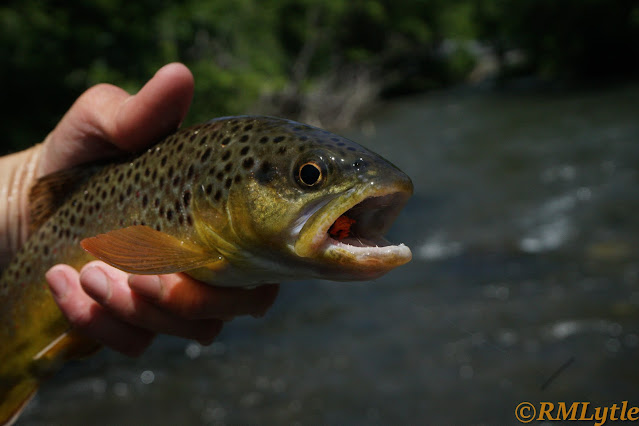


Where we were for that first pound-down wasn't a big fish location, but that didn't matter. Having trout come out of every riffle and pocket to hammer our big foam dry flies was thrilling. You can certainly work through similar water with similar flies- especially early in the morning and at times when some golden stoneflies or hoppers are present, or even if there's a modest number of annual cicadas -and pick up a few fish. This wasn't that. This was interacting with possibly as much as a quarter of the trout biomass of the stretch we fished and catching a disproportionate chunk of it. The fish were giddy. I had more than one nice fish (for this place that was 13-14") charge straight upstream a foot or more in fast shallow riffles to eat my fly. This was the dream. 

We were on our way to another spot on the same creek when we received that report from Mark, a stretch I'd fished before and done well with wild rainbows and some browns. The sound out the window as we closed in on our destination and the empty pull off when we got there said we were going to step in it again. 


The storied history of trout fishing in the area of State College is an interesting one, and though many eastern trout anglers may know bits and pieces of the story I think a lot of it has been glossed over. Spring Creek has one of the more distinct histories of course. Many may be aware that Spring Creek was a brook trout dominated fishery into the end of the 1800's, when introduced brown trout began to supplant the native char. By 1950 a native trout in Spring Creek's main stem was a rare occurrence. The origins of some of the rainbow trout that exist in the now mostly un-stocked stream remain a bit controversial, though I'd argue on behalf of some being stream born given the alkalinity, relative temperature stability, and shear perfectness of both par and adults of some specimens. of course, hatchery escapees from Benner Springs and Fisherman's Paradise, and stocked fish moving up from Bald Eagle creek contribute. Anyone who wants to can see the results of this in a tiny stretch right in Bellefonte, where you can pay a quarter or two for some pellets from a dispenser and toss them into a short, closed-to-fishing stretch where trout bigger than some of the carp present in the same spot will greedily take whatever you give them. Levi, Paul and I stood on the wall in Bellefonte one day, tossing leftover french fries and watching giant trout eat them. Those fish aren't Spring Creek's calling card though. If you've heard of the place but never been, your familiarity may start and end with the existence of the famed Fisherman's Paradise section. This piece of water was bought by the state Fish Commission in 1930 for construction of a hatchery and to demonstrate and test new stream improvement methods¹. A hatchery was built four years later. With heavy stocking and stream improvement that are now known in some cases to improve fishing more so that fishery health, the place soon boomed in popularity with anglers. The regulations then imposed ended up being quite unprecedented, and even in today's ecosystem might be though of as incredibly strict. Fishing was restricted to May through July, barbless flies were enforced, wading was prohibited, and there was a small and finite number of visits you could make. Even though some of the stricter regulations haven't carried over to present day, the popularity rivals the present day. More than 44,000 angler trips were registered in 1952. Photos from that era reflect this, with a parking lot jam full and anglers standing shoulder to shoulder on the banks of a Spring Creek that looks so different today it may as well be a different river entirely. 

In 1982, triggered by kepone and mirex contamination, the commission stopped stocking trout in Spring Creek and enforced no-harvest regulations. In turn, the wild trout population, brown trout specifically, absolutely exploded. It has been said that there have been as many as 3,000 trout per mile in Spring Creek, making it very high on (if not at the top) of the list of most densely trout populated streams in the Eastern United States. That population density has changed with time, of course, having apparently increased until 2000 and being on a downward trend since. That downward trend is likely tied to development in the watershed, and PFBC notes as much:

"In other watersheds, impervious surface area has been used as a good surrogate of urban development; when imperviousness reached 7-11%, trout populations were lost. The Spring Creek watershed had 12% impervious cover in 1995, and in the upper one-half of the watershed, impervious cover was 19%. We suggest that the reason Spring Creek is still able to sustain wild trout with this degree of urbanization is the relatively large input of groundwater into the stream. Further development that increases impervious cover, reduces groundwater recharge, or both, will certainly increase the stress on Spring Creek and reduce its ability to support wild trout."²

As development continues in the area around State College, and as climate change continues, its hard to say what the future holds for Spring Creek. What remains abundantly clear to me is that it, and even some of the more marginal trout streams in Central Pennsylvania, make even the best places we have in Connecticut look like a joke. Part of that is the nature of limestone, but part of it is an indictment on what building can do. Connecticut and our rapidly dying coldwater fisheries should be a good example of what NOT to do if you want to keep strong wild trout fisheries around when it comes to development, road salt use, lack of riparian protection, over-stocking, on and on and on. 


One thing Connecticut doesn't fail with is common carp. Europe's most popular "course" fish is highly abundant in the state and isn't going anywhere. Recently, after a number of fish had been caught over the years that could have cracked the former record, someone finally clocked one over fifty pounds. Well over, in fact. At over 58 pounds, Norbert Samok's record fish is a significant achievement. Of course, Pennsylvania has carp too. The state record was caught in 1962 by an angler named George Brown. The fish weighed 52 pounds... ha! We've got you beat there, PA. I can't gloat too much though, because instead of getting the chance to fish periodical cicada eating carp, I can't really wait around in Connecticut. It turned out Pennsylvania was going to give me a challenge too, though. 

Levi and I met Mark Hoffman in Boalsburg on our second morning for our first serving of warm water cicada mania. Haze clung to the hills as the light came up, that sort of low morning humidity that suggested a very hot day was incoming. We hopped in with Mark and headed toward a place where carp, overhanging trees, deep lake shore, and periodical cicadas all overlapped. Surface disturbance was visible as we crossed a bridge over the lake on the way in. There was heavy calling as we pulled into the launch. Anticipation was high, especially for me. I know this game a little bit, I've caught some carp on cicadas. But something was going on at the ramp that put a more than slight kink in the plan. The back cove was all muddy, and in various spots on both the near and far side there was a ruckus going on. Splashing, crashing, tail slapping, jumping... these carp were busy humping, not eating cicadas. The thing with the carp spawn is that it can kind of happen any time the water gets warm. I've seen carp spawn as early as April 10th and as late as September 3rd. Sometimes that's just a few pods of fish and plenty are still happily and busily feeding away. This wasn't that, though. We motored all over the lake and for the most part found nothing but carp making more carp. It got hotter and hotter as the day went on, and though I picked up some largemouth on cicada patterns and Levi ran a little chartreuse bugger and put a smackdown on white crappie, this wasn't what we hoped for. 


As the heat became more and more oppressive, frustration boiled over. We bailed, sweaty and ready for lunch. It wouldn't be for a couple days, right as our trip came to an end in fact, that we got a shot at the carp again. We met Mark at the same launch, just hours to spare before we needed to hit the road. This time there was no thrashing and crashing on that far bank. The carp should be feeding now, of that I was fairly confident. The most confident, in fact, as the previous attempt had shaken Levi's. In fact it had taken a bit to convince him that this could be worthwhile. We motored out of the launch and rounded the corner, travelling down the shoreline where cicadas were calling their little tymbals off. It wasn't long before I saw it: a carp tipped the wrong way, with it's head up and its tail down, orange lips at the surface, sucking down one of the bugs that had so haplessly bumbled onto the lake surface. The were here....

They weren't easy though, and we weren't the only ones on the water. A few other boats were out with fly rods, all working the banks looking for targets. Any pressure can complicate things, especially with carp. These are sensitive, shy fish. Before we found a couple willing carps, Levi managed to catch one of the nicer largemouth bass I've seen in a while. Getting big bucketmouths on cicadas isn't a bummer at all. 


Largemouth bass are America's favorite gamefish. An estimated 16 billion dollars a year is spent on bass fishing. To put that in perspective, the estimated annual market for fly fishing in the US is 750 million dollars. The people love bass, enough so that they've been moved here and there and everywhere. Where we were, just one watershed divide separated us from the native range of the northern bass, but we were fishing to non-native fish where we were. Given their widespread introduction and infusion in the fishing culture, many anglers don't realize when bass aren't native where they fish. In Connecticut, neither smallmouth nor largemouth bass were present historically, and that information is relatively available to anyone who cares to look. That said, it isn't hard at all to find anglers who insist that they are a native fish. Aa great many angler believe a great many things to be true that just aren't though, that is a reality that no longer surprises me. I just roll my eyes with my lips pursed in a tight, straight line and repeat the same statements again-- "actually, the only larger native freshwater predator species in Connecticut were chain pickerel, brown bullhead, and brook trout...." It's remarkable how much of our fisheries are made up of introduced species. In much of the northeast, we're looking at as much as, even more half of the popular target species. Even somewhere like Maine, where landlocked salmon and lake trout did exist naturally, they've been scattered about in all sorts of places they never were before. We think of fishing as a way to be in nature, failing frequently to realize that what we fish isn't actually natural. 

Even the lake we were on wasn't natural. In fact, large natural lakes are essentially non-existent in Pennsylvania. The largest natural lake in the state is Conneaut, in Crawford County. At just 243 acres, it is a piddly body of water compared to the Pymatuning Reservoir just miles away, and even it wasn't immune to human alteration. In 1834 connection to the French Creek canal raised the lake by 11 feet. The geology in Pennsylvania just doesn't make big lakes, unless you count Erie, of course. I wonder how the fishing was in the river that made this reservoir we were fishing before the dam went up, and I wondered how many more cicadas there'd been before the land they lived under was flooded. What fish would I have caught here in 1685, just 20 emergence cycles ago. Would I have been catching 20 inch fallfish here? Giant brook trout? How many billions more cicadas must there have been?

What was is now gone, and there's little left to do but find a carp, put a piece of foam in front of it, and not set the hook too early. 


¹ Tom Burrell, The Express. Dec 14 2024 The Evolution of Fisherman's Paradise

² Carline, R. F., R. L. Dunlap, J. E. Detar, and B. A. Hollender. 2011. The fishery of Spring Creek – a watershed under siege. Pennsylvania Fish and Boat Commission, Technical Report Number 1, Harrisburg, PA.

Thank you to my Patrons; Erin, David, John, Elizabeth, Brandon, Christopher, Shawn, Mike, Sara, Franky, Geof, Luke, Noah, Justin, Sean, Tom, Mark, Jake, Chris, Oliver, oddity on Display, Sammy, and Cris & Jennifer, Hunter, Gordon, Thomas, Trevor, Eric, Evan, Javier, Ryan and Dar for making Connecticut Fly Angler possible. If you want to support this blog, look for the Patreon link at the top of the right side-bar in web version. 

Sunday, July 6, 2025

Diquat Madness & The Proliferation of Fear-Based Rhetoric

 In April 2024, while pulling my canoe after a mostly unsuccessful day, I ran into a few environmental scientists that were curious about water levels and asked if I'd been out a lot recently. "We take it the river has fallen a lot over the last week," one posited. "Oh yeah," I replied, "quite a few feet". "Yeah, we're not always used to seeing the species we're surveying for six feet up in the trees." he said. These scientists were from a team working with the Army Corps of Engineers, and the species they were surveying for was a highly invasive aquatic plant called hydrilla. Hydrilla's presence in the Connecticut river is relatively new, with first confirmation coming in 2016 in Glastonbury. It is especially noxious, because any time a piece is broken off, it can sprout new roots and make a new plant. This makes it uniquely hard to control as manual removal is not longer an option once density reaches full blown infestation. Control is important, both ecologically and socially, because hydrilla is so prone to rapid spread that it has significant negative impacts on water quality, fish, native aquatic plants, and outdoor recreation like boating and swimming. So control in some form or function is paramount. And this crew was doing preliminary study for herbicide treatment. Work has been done for a number of years studying both the plant itself, monitoring it's spread, and testing possible methods of mitigation and control. This new project sought to determine the efficacy of herbicidal treatments, and the water body I was leaving was to be one of the first test sites on the first year. One of the herbicides in question is called Diquat, and though it's use and application at one site went without major public backlash in 2024, the same cannot be said for 2025. 

FOX61 interviewed protesters they described as "environmental activists" at the state capital as they voiced their concerns on the use of Diquat. One of those interviewed was Selina Rifkin, whose sentiment isn't an uncommon one currently "Spraying horrible chemicals that kill everything into our lakes and rivers. It isn't necessary." A Change.org petition headed by a photo of a handful of dead, floating fish, evidently European species- it looked like crucian and barbel to me -got the messengers point across. Diquat is going to kill everything, these folks firmly believe that. If this were true, there'd certainly be reason to protest it. How could the Army Corps so brazenly poison our waters, and why would CT DEEP sign off on it? 

Way back before I ever put pen to paper about fishing, or knew almost anything at all, my best friend and I dumped a bucket of Diquat is his farm pond. I kid you not, I have real world experience with this poison that kills everything. Young, dumb, and frustrated with summer weeds making it hard to fish the pond the way we wanted to, we sought weed control as a way to better our fishing. His dad got is a big ol' container of Diquat. We read the directions, didn't wear any safety gear of any sort, and did our best to distribute the whole jug's worth across the tiny bass pond. Memory serves me that it did kill off a fair bit of the heavy vegetation, and to our untrained young eyes, nothing else. There certainly was no fish kill, the pond still to this day is loaded with bass, sunfish, bullheads, and all of the wonderful creepy crawlies that those fish eat. We also didn't die, despite definitively doing it all wrong. Hearing and reading a lot of comments about this same herbicide "killing everything" seemed a tad strange. Of course, my experience is anecdotal at best, though perhaps of higher value than much of the commentary currently circulating because at least I have some actual first hand experience... but that isn't enough, not for me. So let's dig into everything we can, shall we? Let's start with the basics. How does this Diquat stuff work?

Diquat is short for diquat dibromide, or 6,7-dihydrodipyrido (1,2-a:2',1'-c) pyrazinediium dibromide. Now that sounds scary... but I'm not a chemist, and if it sounds scary so might this: β-D-galactopyranosyl-(1→4)-D-glucose. That's lactose, that's in natural milk... not scary at all, you just aren't a chemist, most likely. Chemicals always sound scary if you aren't hugely familiar with chemistry and reading chemical formulas. That's fine, neither am I, but we're going to have get a little cozy with chemistry here to understand what 6,7-dihydrodipyrido (1,2-a:2',1'-c) pyrazinediium dibromide does. Basically, it binds to photosynthesizing cells and inhibits that key processes of plant function- turning sunlight into energy. The chemical accepts electrons from Photosystem I, one of a plant cell's two photosynthetic systems. That electron is used to create a reactive oxygen species (ROS), which damages the cell and prevents NADPH and ATP production by that cell. NADPH helps make glucose, lipids, and nucleic acid, and ATP provides energy. It also destroys the cell membrane. Without these things, the cell dies. And when all of an aquatic plant's photosynthesizing cells die, it dies. That's how Diquat kills hydrilla and other plants. It than binds with particles of soil and sediment, usually leaving the water column free of detectable levels within a day or two, though it remains undegraded in sediment indefinitely.¹ Diquat is also used as a desiccant on potato crops and some seed crops used for feed. A desiccant, if you aren't familiar, is something used to dry things out or keep them dry. 

It is entirely reasonable to have concerns about how a chemical compound that completely kills a photosynthetic cell might effect other cells, including ours and the species we care about. This is especially true given that Diquat is banned by many countries and the European Union (many of the people I've seen bringing that point up are also the sort to suggest that the European Union is an overbearing, freedom less hell-scape, so that comes off as a little rich. Sorry, I call it like I see it... you can't have this both ways). Let's start with humans, since we tend to be a selfish lot....

A 63 year old landscaper in Florida admitted himself to the hospital about 90 minutes after drinking a gulp of herbicide from a Gatorade bottle. He would die soon after from multi organ failure. The medical professionals involved in his case did a brief case study highlighting it, as well as the need for further study on diquat poisoning. It doesn't read pleasantly. Upon admission, he was having uncontrollable urination, diarrhea and gastric emesis. By his fourth and final day is the hospital, effects had reached his brain. "On day four of hospitalization, the patient was noted to have new onset dilated pupils and was taken to receive a CT scan of his brain, which showed diffuse cerebral edema and toxic encephalopathy with cerebellar tonsillar herniation and mild hydrocephalus." ² Basically, in the body, the ROS previously mentioned makes hydrogen peroxide. Normally the body detoxifies hydrogen peroxide, but this reaction from the Diquat cycles over and over, overwhelming any chance of that. The case study notes that Diquat poisoning is quite rare, hence the need for further study it sites only 30 cases from 1969 to 1999 with a 43% mortality rate. It also sites that nearly all similar cases in which more than 12 grams of Diquat were consumed result in death within a few days. The same ROS that causes a photosynthetic cell to die leads to multi organ failure. Scared now? It's important to consider concentration. Of course, drinking a full gulp an herbicide that makes a reactive oxygen species and spurs cellular havoc is a potentially deadly proposition. So far no study I can find indicates health risks from exposure to a water body treated with diquat within just a few days of treatment, and that comes down to Diquat's affinity for organic molecules. After dispersion in a water body, it binds with with plant cells it kills, but also with tons of organic particles in the water column and in the sediment on the bottom. It becomes a more or less inert there, no longer present in the water column and allowing aquatic plants (hopefully the native ones, replacing the invasives killed by the diquat) to grow unabated. This is what I watched happen in that pond all those years ago. There was no noticeable evidence of a herbicide in the water just a short time after treatment. Sunlight also degrades diquat based on numerous studies, one citing a photodecomposition half-life of 1.6 weeks.³ So, without too much time passing, the science says there shouldn't be much to worry about so far as swimming, contact with the water, or consuming fish goes. Diquat is dispersed at low concentrations compared to the fatal dose and is largely undetectable in just days. It isn't recommended to drink water treated with diquat within three days, but, speaking as someone on and around it all the time, you don't want to drink from these Connecticut River backwaters anyway. It might kill you on a good day, Diquat or not. 

Onto other species... that Wisconsin DNR fact sheet makes mention of study on fish, all very Wisconsin. Walleye showed signs of poisoning when contained in diquat treated water, other game and panfish did not. Some fish kills have been recorded in diquat treated waters, especially small ponds. This is most likely a result of oxygenation, as rapid vegetation death and decomposition can use a lot of dissolved oxygen. This shouldn't be a significant problem in the Connecticut, where tides cause a significant amount of water exchange day in and day out. The bigger problem comes with macroinvertebrates, which are indeed vitally important. The same fact sheet states "...certain species of important aquatic food chain organisms such as amphipods and Daphnia (water fleas) can be adversely affected at label application rates." The Army Corps project isn't dismissive of the potential impacts on wildlife, as anyone who cares to sit and read available drafts and proposals for this project can find. Pretty plainly though, labeling Diquat a "poison that kills everything" is more than misleading... its just plain wrong. There is validity for concern with both human and environmental impacts, but most of the posts making the rounds on social media lack rigorous research, citations, or anything that would make them trustworthy. And that's just where the problems start. 

That same environmental activist interview by FOX61 than I mentioned earlier, Selina Rifkin, later on said "There could have been an educational campaign about what this is. There could have been a call for volunteers to pull it out by hand. There could have been some kind of examination of the other possibilities for getting rid of it is, this is, this is a financial option, and it's the easy solution." This is the point where I must admit, I get a little bit pissed off and say... are you kidding me? Every single thing she lists there has been done already, it takes just seconds to find that it has been done, and if anyone actually cares one iota about this issue these words wouldn't leave their mouth. There's a sign at just aviation every launch and put in on the lower Connecticut that tells me what Hydrilla is, how to prevent the spread, and has a nice little picture of what it looks like. The education is there. The Connecticut River Conservancy regularly holds manual water chestnuts pulls funded in part by grant money from the state's AIS program... I've already written about that. The volunteer effort is available. Information on why manual removal can in fact worsen hydrilla is immediately readily available with a Google search. Manual removal alone will not work. And this entire Army Corps hydrilla project has been about finding the best option to control the hydrilla through multiple means (read here). CT DEEP has also been exploring management options since at least 2021. In hours of research prior to and while working on this cursed blog post that I shouldn't have to write, I found source after source after source that partially or wholly refutes every argument being made by the Jonny-come-lately diquat protestors. We are a lazy, triggerable, reactive society that absolutely fails to find the forest through the trees time and time again. I'm not even here to say there isn't some merit to suggesting diquat shouldn't be used, I'm not convinced that it will be an effective treatment on its own. But it also doesn't take much research to make sense of this Army Corps project, why it's underway, and why they're using Diquat on a limited number of waters. Unfortunately, if you've made it this far, I doubt you're the sort that is causing this outrage. If you are though, thank you for sticking around. Please, go to your next argument, make your next comment, attend your next protest, or donate to your next cause armed with legitimate arguments instead of reactionary social media posts. Spend some time researching the topic with actual doctors, scientific papers, and as many different sources as possible. 

Media (both social and mainstream news) failed us on this one, as it has in the past and will continue to in the future. Facebook and Instagram made it easy for people to pass along inaccurate posts. FOX61 and others did a poor job of pointing out inaccuracies in the demonstrator's statements. A petition circled with a blatantly fear-mongering header image, with thousands of signatures and counting. I'm sick and tired of this; if all of these people could have put this energy and effort into being informed and taking action on invasive species, there'd be no need at all to apply herbicide on the Connecticut River. But here we are, fighting a government that's desperately trying to undue the problems we cause, then complain about, then complain about the potential solutions to, then complain about the cost of. It's all very tiring. I have very little hope anymore, but if so many as one person walks away from reading this less inclined to hop on the disinformation train, I guess I've done my part. Read as is spoken through clenched teeth while smashing my mouse to smithereens against my desk: Now its time for me to go clean, drain, and dry the canoe after another day of pulling water chestnuts on the big river, trying to beat a problem that could one day hit me right in the wallet the same way hydrilla has been.


Currently, the Diquat treatment has been postponed till 2026, reportedly for funding issues. 


¹ Wisconsin Department of Natural Resources, 2012. Diquat Chemical Fact Sheet, 

² Daniel M Aloise, Adam Memon, Ana Zaldiver. 2022.  Diquat Herbicide Organophosphate Poisoning and Multi-Organ Failure: A Case Report

³ Smith, A.E. and Grove, J. 1969. Photochemical degradation of diquat in dilute aqueous solution and on silica gel. J. Agric Food Chem. 17:609-613.

More: https://www.nae.usace.army.mil/Portals/74/docs/Topics/CTRiver/Images/Fact%20Sheets%20-%20updated/FACTSHEET-CTRiverHydrilla-ExecutiveSummary-May2023.pdf

https://www.nae.usace.army.mil/Missions/Projects-Topics/Connecticut-River-Hydrilla/

FOX61 Article: https://www.fox61.com/article/news/local/hartford-county/hartford/protestors-voice-concerns-over-diquat-use-in-rivers-lakes-connecticut/520-e3bc1018-b506-4f04-9795-f1c8b9d91079

Video overview of Florida landscaper case: https://www.youtube.com/watch?v=Xmu48JYFTBc

Thank you to my Patrons; Erin, David, John, Elizabeth, Brandon, Christopher, Shawn, Mike, Sara, Franky, Geof, Luke, Noah, Justin, Sean, Tom, Mark, Jake, Chris, Oliver, oddity on Display, Sammy, and Cris & Jennifer, Hunter, Gordon, Thomas, Trevor, Eric, Evan, Javier, Ryan and Dar for making Connecticut Fly Angler possible. If you want to support this blog, look for the Patreon link at the top of the right side-bar in web version. 

Tuesday, May 6, 2025

A Single Sailboat

 I take significant strides to avoid the hendrickson crowds. It's a hatch I enjoy fishing, they're such a classic ephemera that can bring up some larger wild trout under the right conditions, but that means everyone and their mother is just as keen to fish them on the major rivers. And unfortunately the hatch just doesn't happen everywhere, even in places where it used to. The Housatonic doesn't seem to have a Hendrickson hatch to speak of anymore. Nobody quite knows why, and it may be a site by site problem, but aquatic insects are, on the whole, not doing so hot. In some places, nutrient deficiency means less bugs- ironically, septic tank leaks and farm runoff with manure in it isn't always the worst thing. In others, perhaps the runoff is the issue. Streams are more "flashy" now as areas develop with paved, impervious surfaces, so flows are more sporadic and less stable. And there's that pesky road salt. So wandering to places questionable has become the mantra, wondering if there will be bugs at all. Find a rock or log next to a pool or run, sit, ponder, don't make a cast unless a trout rises. And so I found myself standing next in a pool somewhere in Massachusetts after watching sleepily for a while. There'd been some duns flying by. I caught one, looked at it for a while and took some pictures. 


Eventually, looking into the reflective glare toward the top of the pool, one of the little sailboats appeared alone. In twirled through little eddies and rode down a seem, standing out like a sore thumb. Hapless little creatures they are in this state, its no wonder trout eat them with such abandon sometimes. Though this bug was by itself, I wondered if enough fish were looking upward to intercept it or if, by emerging in such sparsity the mayflies today were making it to the air freely without exception. It drew nearer, still drifting along. This is anthropomorphizing to an egregious degree, but that little bug looked happy to me. She bobbed along with her wings perked up skyward in the bright sunlight, seemingly carefree and safe as could be. My gaze followed it as it meandered down the seem. It then fluttered once, fluttered again, and in one fateful instant before it overcame the surface tension and took to the air, a foot long trout rose and she disappeared in a small splash. "Aww..." I uttered audibly though I was alone. That's when I stood, and decided that I'd seek vengeance for that little bug. The pool was wide and deep but I made it to a comfortable rock  above and across from where the trout had taken the bug and within reach of  a forty foot cast. It was a slow effort, as I didn't want to send ripples over the only fish I'd so far seen rise in a few trips of this sort. Once there, careful triangulations were performed to determine where that trout had been as the fly was dressed. Then I let fly a cast. I'd decided that this revenge would be swift but fair, it wouldn't take more than one cast. My fly and leader landed with slack to spare, and as the fly settled into that same seem the mayfly had taken her final ride down it looked much like that singular little sailboat had. And evidently I was not the only one that thought so as the trout came to it just as willingly as it had the natural. The battle was pretty one sided, admittedly. Modern fly tackle more than capable of subduing twelve inches of squirming brown trout. At hand, I scolded the trout, removed my fly, then sent it off with a smile. That had been enough for me, and I packed it in for the day. 

Thank you to my Patrons; Erin, David, John, Elizabeth, Brandon, Christopher, Shawn, Mike, Sara, Franky, Geof, Luke, Noah, Justin, Sean, Tom, Mark, Jake, Chris, Oliver, oddity on Display, Sammy, and Cris & Jennifer, Hunter, Gordon, Thomas, Trevor, Eric, Evan, and Javier for making Connecticut Fly Angler possible. If you want to support this blog, look for the Patreon link at the top of the right side-bar in web version. 

Monday, April 21, 2025

The Nighthawk's Boom

 New Jersey's pine barrens have an ethereal quality as the sun sets. In some areas there is extraordinary uniformity- nearly perfectly flat ground and vegetation all growing to the same height -that adds to this characteristic. As the light gets low, some of the barrens critters begin to awaken. A forlorn whippoorwill call whistles through the trees and accompanies a golden glow. There's almost unsettling stillness, and it becomes easier to understand why this area has garnered enough "spook" to spawn ghost stories aplenty and it's own legendary cryptid, the Jersey Devil, and plentiful rumors of these lands being a mafia body dumping ground. Perhaps these are more than rumors, with quite a few bodies being found over the years. It isn't easy to dismiss. If something needs hidden this would be a good place to do it. The actual pine barrens, in fact, look way more ethereal a creepy than the woods in The Sopranos episode of the same name. That episode was filmed in hilly, mixed forest in Harriman State Park... and at least for me, it shreds the illusion a bit. The real barrens are such a distinct environment that it's hard to fake it.


Spooky though it may be, the pine barrens cemented themselves quickly as one of my favorite places two years ago when I first visited for a few days of looking for amphibians and reptiles. I heard my first pine barrens tree frogs on that trip, though I wouldn't lay eyes on one until a year later. That species had a special place in my memory bank. When I was only little, my mother got me a set of wildlife call cards and a reader- such a 2000's thing -The reader was just a simple device that you slipped the card into and had a speaker. You'd push a button and it would play the corresponding animal call. One card, the only one I really cared about, was frog and toad calls. And perhaps the most annoying one on their was the pine barrens tree frog. They're a very distinct, quite loud caller. I'd long wanted to see one. 

One the second trip that first year, in that waning light, I was trudging through habitat that was much too dry as the sun set just hoping beyond reason that one of those frogs might start calling. In the distance, I caught a brief, punctual, call that I thought was a green frog. Looking on the map there was no sign of water in that direction, but I started to wander in that direction. If there was a pool that had a green frog calling, maybe there was a chance there might be tree frogs around it. Trudging through the knee high  ferns and other low brush I'm woefully ignorant on identifying, there was no sign of a pool. Then came another call, this time from a different direction. More futile searching ensued. Another call. At t his point, my field partner and I were right next to each other. I turned to him; "Are green frogs just calling from out in the dry woods?".
He just shrugged. 

The sound kept happening, and I recalled hearing similar as darkness fell om the previous trip while sitting next to a breeding pool waiting for frogs to call. At the time I thought it was cars hitting rumble strips on the highway. This seemed far too distant, now. Was it the same sound? Could it really travel that far? 

Then it happened right over our heads. A bird, diminutive in size with a distinct profile, performed a rapid acceleration right over the tree tops, dipping low to them as it did so, and made a tremendous booming sound. This was a common nighthawk, specifically a male. The sound was made by the air rushing through his primary feathers. He does this during the mating time, and may have been doing so over us to try to get us to leave. He does it to ladies too but with the opposite goal in mind. Though abundant and widespread (albeit diminishingly so as many species are), I'd never knowingly been privy to this show. What a wonderful one it was! Until we gave up our dreams of finding what we have concluded is North America's quintessential tree frog that night, I was kept in good spirits by the revelation of what was making the boom. The nighthawks swooped overhead and plummeted to the ground making that wonderful sound and I chuckled at how absurdly long it had taken to figure out what it was. Wildlife is fabulous and does fabulous things, and it never fails to enchant if you maintain a sense of wonder.

Common nighthawks are cryptic while on the ground, with patterns not unlike grouse or woodcock which rely on the same crypsis to go unnoticed. They don't nest either, and their chicks rely on the same camouflage. Their eyes are like black marbles and it always looks like they're squinting at you. There's an uncannily adorable look to them. Nighthawks are bug eaters, and they perform acrobatic shows in the evening as they take to the sky to chase down prey. The species has been around a while, with fossils dating back an estimated 400,000 years. Long may these weird little birds boom over the pines of southern New Jersey, and long may their brief displays add to the mystique of a desolate landscape where rumors of a hooved, winged devil persist. The booms dwindled with the daylight, and a  setting sun was framed perfectly in the symmetry of a man made scar on the landscape. I wondered what other surprises the night bring. 


Thank you to my Patrons; Erin, David, John, Elizabeth, Brandon, Christopher, Shawn, Mike, Sara, Franky, Geof, Luke, Noah, Justin, Sean, Tom, Mark, Jake, Chris, Oliver, oddity on Display, Sammy, and Cris & Jennifer, Hunter, Gordon, Thomas, Trevor, Eric, Evan, and Javier for making Connecticut Fly Angler possible. If you want to support this blog, look for the Patreon link at the top of the right side-bar in web version.

Sunday, March 23, 2025

A Few Screws Loose

 The idea that trout don't live in ugly places is bull. Well, I guess we can find beauty in a lot of places, but the crusty railroad bridge abutment I sat on watching water slide by beneath, tucked within a couple hundred yards between roads lined with industry and shabby houses isn't most people's view of pretty. Nor mine, really. But there is an aesthetic of sorts to decay. When my neurodivergence wandered down the path of model railroading, I took joy in rust and grime and making things look old. I used chalk dust, sometimes dry sometimes not, to make streaks on iron oar cars. I tried to get walls and stonework to look worn, because that was natural. Paint chips, railroad ties crack, and metal rusts. At ten years old I was plenty conscious of that. I looked up to model makers who created urban landscapes that looked right more so than I did those who focused on dramatic natural landscapes. Perhaps that carried over with time, because though I have little interest in building a model railroad through a crumbling urban ecosystem of my own creation, there's still draw to fish a trout stream through the real thing. 

Not long ago I heard a switch-up of the old trout and beautiful places quote, this one was "trout don't live in ugly places, but they're stocked in them". This doesn't hold up either, because the very reason I sat on that bridge abutment was because this urban, grungy stream held trout that were born there. Some quite nice ones in fact. On a different day not far from where I sat I stood on the bank while my friend Grant blew a shot at a very good wild trout indeed, one we both saw enough of to make us wince when that line went slack. Of course, these were brown trout, and their ancestors had indeed been stocked. But they are wild trout none-the-less, and just one example of many in such a setting. Trout hunting has taken me past homeless encampments, under factories, and around more than a few discarded needles. In southern New England it would even seem that some of the prettier, wilder streams have all but lost their ability to produce good wild fish while some urban streams continue to kick out quality fish. It's a tenuous existence, of course. I've watched two of my favorite urban wild trout streams collapse over the last five years. These fish are riding a razor's edge. 

Just a few feet below me was clear water and rock, but also a heaping pile of nails, screws, and other discarded metal. I see a lot of things dumped from urban bridges and this was no surprise. It was quite a volume though. It would be interesting to know what becomes of this and other human metallic waste. In some places our species is creating artificial mineral deposits, some exceptionally concentrated. The current river courses of many Great Lakes tributaries could probably be mined for lead in the distant future. And this pile of rusting nails, if it doesn't just rot away first, could conceivably become some sort of iron deposit in a conglomerate rock layer of this river's substrate. 

Long before that ever happens, though, I hoped to catch some sort of stream born non-native salmonid. Ideally a robust one with orange on its belly and sharp black spots on it's flanks. A beautiful in wild thing that shouldn't be there, in a landscape of our own creation, a river marred unrecognizable from it's former glory. Sometimes, we don't even know what we had after it's gone. 

Thank you to my Patrons; Erin, David, John, Elizabeth, Brandon, Christopher, Shawn, Mike, Sara, Franky, Geof, Luke, Noah, Justin, Sean, Tom, Mark, Jake, Chris, Oliver, oddity on Display, Sammy, and Cris & Jennifer, Courtney, Hunter, Gordon, Thomas, Trevor, Eric, Evan, and Javier for making Connecticut Fly Angler possible. If you want to support this blog, look for the Patreon link at the top of the right side-bar in web version.

Thursday, March 13, 2025

My Search For a Connecticut Moose (Pt. 2)

Opening up a game camera, turning it on, and hitting replay comes with quite a feeling of anticipation, especially when the goal it to capture a rare animal and you know one had walked through the area a time or two just before you places the camera. But that anticipation is frequently followed by minor disappointment- or at least it is for me, since I have no idea what I'm doing. My first camera pull revealed only the most elusive of animals... a half dozen shots of grey squirrels. Award winning, without a doubt. 


He's there, in the bottom left. Just peaking, seemingly aware of the camera. I won't lie it took a bit for me to figure out what had triggered the camera. And I should really re-set the date and time, jeez.... 

After a few visits to the site without anything of interest on camera and no fresh sign, I started to branch out. The initial forays were just to the surrounding areas. The two old beaver meadows I'd placed the trail cameras near weren't the only good looking habitat in the surrounding area. Just downstream was a much large, still active beaver meadow and pond. That was the first obvious place too look. Perhaps the moose hadn't strayed far but had just hopped down in elevation a tiny bit to an even more sheltered area. Emily and I did a full lap of that wetland one day, and though there was deer, coyote, and bobcat sign there were no moose tracks. On the next visit, my mother and I hiked not down watershed but up, to another small beaver meadow and a clear cut. Again, no moose sign.

Answers to how far an individual moose will range very. The state of New York indicates a broad range of five to fifty square miles. Washington Department of Fish & Wildlife says "With its great size and forage demands, the home range of the average moose in any given season is approximately three to six square miles, although they habitually wander much further." The website All About Moose sites data from Alberta suggesting that bulls have a range of 55 miles in the winter and 22 in the summer. Considering all of Connecticut is 5,543 square miles, that means I'm looking at a potential 1/100 chunk of the state for my bull (I'd found both cow and bull tracks). That's not huge but it isn't insignificant either. The question then became, should I break the habitat up into pieces I think look more suitable, or take a more random approach? One method that crossed my mind was walking and driving the easier routes and trying to find tracks where an individual had crossed the road. Though there isn't a rod grid per-se in Connecticut, there are enough roads to create a multitude of closed loops. So by driving or hiking those loops, I could at least determine if a moose had crossed into or out of them, possibly pinning one down to a confined area that it hadn't yet left. This wasn't a highly appealing strategy to me, but perhaps something I could use down the road if I found tracks that were a few days old. 

The activity lull convinced me to give the area a little rest. I pulled my cameras and it was a couple weeks before I returned. Sometimes absence is important. I try to be discrete and unimpactful, but there's no such thing as being entirely so. I know I leave smells and signs when I'm out there, and animals recognize these. So I let the woods rest, let the moose do their thing if they were still anywhere nearby. 


When I returned, it was past the first day of meteorological spring, and the weather had definitely made a turn. There was still snow on the ground, a touch more than last I'd been in fact, but it was all hard and crusted over now. It was also covered with all sorts of branches and hemlock needles from a number of very windy days. Emily and I made our way to the area where sign had been turning up most consistently before, sometimes able to stay on top of the hard snow, sometimes post-holing more than we'd like. It was a loud form of travel, and I had no illusions of sneaking up on a moose this time. I just hoped we might find tracks again. Deer sign was plenty at first, but no moose. Whitetail deer are such a ubiquitous part of the northeast woodlands today. In fact, far more so than was historically the case. When the northeast was colonized, there where whitetail deer here, but apparently fewer than today. Colonists fairly rapidly hunted these deer to near or full extirpation in many places. ¹In Burrilville: As It Was, and As It Is, published in 1856, Horace A. Keach writes "To a citizen of this town, it will not seem improbable when we suggest that the last deer of Rhode Island was shot on the margin of Wallum Lake." It was likely that the reforestation of the New England and some reintroduction efforts that allowed whitetail deer to return, and likely to levels well beyond their former numbers. Deer don't do poorly in a lightly developed landscape. They tolerate suburbia, and they especially like farms. In the midwest, where corn crop makes up tens of thousands of square miles, deer flourish. In 2020 in Pennsylvania, hunters harvested 435,180 deer according to the Pennsylvania Game Commission. In tiny and developed Connecticut, there are still well over 100,000 deer. See, deer also love not being predated, and despite the complaints hunters make about coyotes and bear, we got rid of the two effective deer predators keeping New England's population in check: wolves and mountain lions. Coyote are not great deer predators, though they can take some in deep snow when the deer are post-holing and they are able to run along on top. But neither they, nor we, do that good a job of managing deer herds, to the degree that whitetail deer can be ecologically detrimental given their wide and often dense distribution. They have outsized impacts on the plants they favor to feed on, and when too numerous can clean out undergrowth in what would otherwise be more diverse and healthy forest. 

There were deer tracks everywhere in this wood, including some big ones. But eventually, finally, there it was again: that unmistakably bigger trackway of a moose. 


I decided we should follow these tracks, even though they weren't that fresh. We stood to learn a lot if we could follow this animal's movements. Like a man on a mission, step after step I followed that moose. At one point I almost lost the trackway when it went into a patch of ground the snow had thawed from. There was what I though to be a different set of prints along it, and after a bit I determined that the moose had simply bedded down in that clear patch and left it right about where it entered. The animal made a few decisions that to my mind made little sense, including back tracking on two occasions, once right on top of it's own tracks, another just a few yards off. It moved eastward but zigzagged. Mostly it traveled at the same steady pace, but at times it slowed and its path meandered more. It may have covered the ground I followed it over in much less time than it took Emily and I to- about three miles, I'd estimate. Eventually, the trackway led us to one of the biggest wetlands in the area, and that area was covered in moose tracks. I'd say we saw trackways from at least five different individuals. This was mighty encouraging. I picked a spot to put up a camera again where two individuals passed through in a logical choke point, or funnel-like form to the landscape that I hoped would force a moose in front of my camera. Following the trackways had shaken my confidence a little, though. I was less than sure another moose would pass through this spot within a few weeks. They were a little more careless and erratic in their travelling than I'd expected them to be. Of course, I don't know what made the individual we followed back track, or why it followed certain topographic contours, or why it seemed to slow when it did. If I did know that, this would all make perfectly good sense to me I'm sure. But I'm no moose. My foolish human brain wasn't evolved nor trained by life around making the same decisions that a moose has to, so I was anthropomorphizing some I'm sure. We can't help that, we think "what would I do if I was a moose", when what we should be thinking is simply "what does a moose do". In complete ignorance of what a moose does at any given time, I have to think it's path was meandering and illogical. In reality, that moose's path made complete sense... to the moose. It is under no obligation to make sense to me. 


After placing the camera, we made our own tracks out. It's very probable that a moose would look at these and think they made no sense at all. I've been followed by animals before, usually coyotes. In my mid teens I spent a lot of time wandering the woods in deep snow, and on many occasions I'd find coyote prints following my own as I back tracked not infrequently. This never worried me at all, though there are rare instances of coyotes killing. Most coyote-human interactions are extremely benign. Often, claims of coyote "attacks" wouldn't be best characterized as such, and instances of coyotes biting people as the aggressor aren't very common, though they're becoming more frequent with time.² I've never once felt threatened by coyotes. But they do follow my tracks sometimes. Why? They probably aren't hunting me, I know that. A lot of the time, I got the impression they were using my path as easier passage. The snow was light and powdery many of these occasions, such that travel would be slow going even for a light canid. My path, plowed deep as I dragged through the snow pushing stubbornly onward, must look quite inviting to any traveling animal. Perhaps it was curiosity though; I wasn't likely to spot tracks over top of mine in these woods were there not snow. Maybe I'm being followed more often than I think.

¹ I found this source through Christian McBurney's article "When Deer Became Extinct in Rhode Island" on smallstatebighistory.com, a great site with a lot of Rhode Island historical articles. The book itself is the second very old piece of locally specific literature I've now read a chunk of for the sake of one of these sorts of blog posts. It can be purchased or is available archived online and is interesting in its own right. 

² Coyote Attacks on Humans in the United States and Canada, L. A. White and S. D. Gehrt, 2009.

Thank you to my Patrons; Erin, David, John, Elizabeth, Brandon, Christopher, Shawn, Mike, Sara, Franky, Geof, Luke, Noah, Justin, Sean, Tom, Mark, Jake, Chris, Oliver, oddity on Display, Sammy, and Cris & Jennifer, Courtney, Hunter, Gordon, Thomas, Trevor, Eric, Evan, and Javier for making Connecticut Fly Angler possible. If you want to support this blog, look for the Patreon link at the top of the right side-bar in web version.