Showing posts with label Bait Fishing. Show all posts

Wednesday, August 4, 2021

Using Crayfish for Trophy Smallmouth

 After a really good day of hammering smallmouth, Noah and I became about as tired of catching them the way we had been as is possible. At a point it was no longer that engaging. It was also slowly becoming less effective. After spending a while just swimming, I started catching crayfish and got an idea. I threaded one on a jig to see just how effective they were at getting finicky fish. I suspected very. Last fall Noah, Jake, and I watched three fisherman using live crayfish catch more smallmouth than we realized were present in a creek we were fishing in Western PA. I wasn't quite sure it would work as well here, as I'd be fishing water we'd just been swimming in moments prior. I was mistaken.


The crayfish worked best threaded on the hook tail first, and drifted along the bottom as slowly as possible. The takes weren't particularly violent, but the fish I caught on live crayfish were all big. One was the largest bass I caught all day.


We didn't even fish much longer, but the proof is in the pudding. I'd never fished for bass with bait much even when I primarily fished spinning gear. Its pretty ironic that I now that I only own fly gear, I'm far more interested in fishing live bluegills or live crayfish than I ever was before.

Until next time, 
Fish for the love of fish.
Fish for the love of places fish live.
Fish for you.
And stay safe and healthy.


Thank you to my Patrons; Erin, David, John, Elizabeth, Brandon, Christopher, Shawn, Mike, Sara, Leo, C, Franky, Geof, Luke, and Noah for making Connecticut Fly Angler possible. If you want to support this blog, look for the Patreon link at the top of the right side-bar in web version. 

Thursday, July 22, 2021

Fishing Underwater

 Years ago I found a video of an angler catching a nice smallmouth bass on an ice fishing rod. None of those aspects made the video at all special. What was so remarkable is that the fish was caught while scuba diving... the man was in the water with the fish, fully submerged. It ate the jig mere feet from the guy. 

That video sparked a bit of interest in both me and Noah, interest we never acted on... until one hot day in July we decided to go fishing underwater. We launched his skiff on a clear, deep central CT lake and rigged up the tip sections of our fly rods, ready to meet the fish in their own territory instead of bringing them into ours. We set out to anchor the boat near a rock reef, then jumped out and began to fish in a way we'd never fished before.


This proved to be the most noteworthy learning experience I've had in a long time. Actually seeing the behavior of the fish in that sort of clarity from within their environment was distinctly different even from watching them in clear water from above the surface. One of the particularly interesting aspects was that every fish, regardless of species, was less weary of our presence than the would have been if we were above the water's surface. I don't know how this will apply to other fish species in fresh an saltwater, but the observations of spear fisherman seem to indicate that most saltwater species won't really care. 


Getting fish to eat was not complex. Changing flies or hooks- or re-baiting, for that matter -while swimming was an interesting new challenge. Setting the hook was different as well: more like a jab than anything. Strip setting obviously wasn't an option with a poke-pole, nor was swinging. We had to fight water resistance. Fighting the fish was interesting too. Having a smallmouth jumping above me while I was in the water looking up was one of the strangest things I've experienced in fishing.


 We also got a much deeper understanding of where fish held on different structure. We fished/dove reefs, islands, and docks, and instead of simply catching or not catching fish on those spots as we would were we to stay in the boat, we saw where fish were and how the were behaving far more intricately. Fish aren't just anywhere on a stone reef; being in the water seeing hing let us find undercuts, slopes, and holes that weren't visible from above the surface. 

This trip was really just the start, this is something we're going to explore quite a bit more. Clearly it will have some serious revelations. 

Until next time, 

Fish for the love of fish.
Fish for the love of places fish live.
Fish for you.
And stay safe and healthy.


Thank you to my Patrons; Erin, David, John, Elizabeth, Brandon, Christopher, Shawn, Mike, Sara, Leo, C, Franky, Geof, Luke, and Noah for making Connecticut Fly Angler possible. If you want to support this blog, look for the Patreon link at the top of the right side-bar in web version.

Thursday, March 4, 2021

Trophy Pickerel Ice Fishing

 I love big chain pickerel. That’s never been a secret. I get a great deal of joy out of catching the native Esox species. I especially love really big pickerel. Regrettably, I’ve not been catching many truly giant pickerel in recent years. That changed one day in February while out on the ice.

Rick and I were actually looking for panfish, mainly big bluegills and crappie. We set out on a shallow, weedy lake that we knew had a large abundance of both species in good sizes. We also knew it had a lot of chain pickerel, and we certainly wouldn’t mind catching those. The first few spots we tried weren’t especially active, we may have gotten a bluegill or two. But eventually we set up in a deeper spot and could see fish moving around in the weeds on the flasher. They were a little finicky, but we were soon slowly picking up bluegills. Eventually I got a crappie as well. There were a few “up bites” that I was missing, and these are usually indicative of crappie bites. 


I got a pickerel too, maybe half a dozen fish in. It was a small one- beautiful but not impressive in stature. I always find it fascinating that pickerel will eat a tiny tungsten jig with only one or two spikes on it; it seems so small. It’s not really in their character. They’re smaller than pike but if anything, have even more attitude. Eating such a tiny bait just seems unlike them. They will, though, and nothing could prepare me more for the next pickerel that ate my little jig. It came out of the weeds and I saw the eat clear as day on the flasher. It felt heavy and immediately began running hard. I was using the equivalent of 5x tippet, so I felt I couldn’t possibly land this fish. The fight was a jaw clenching give and take, and when I got the fish to the hole I could see that not only was it a really nice pickerel but my line was crosswise through her teeth. With my heart in my throat, I shoved my hand into the frigid water and miraculously managed to get her through the hole. 


What a fish she was! Long, but more impressively, very girthy. There were clearly a few panfish in her stomach. This was the sort of pickerel I’m hoping I’ll get on the fly sometime this month or the next. The fact that this big predator -with 3 inch panfish in her belly- felt the need to eat that miniscule jig, and that I then got her to hand? Incredible. The highlight of the ice season for me. 

We ended up picking at panfish and pickerel the rest of the outing. The bites came in bits and spurts. A couple of the pickerel were nice ones, though not nearly as impressive as the second one. It was an excellent day out on the hard water- one of my favorite days ice fishing ever.


Until next time, 

Fish for the love of fish.
Fish for the love of places fish live.
Fish for you.
And stay safe and healthy.


Thank you to my Patrons; Erin, David, John, Elizabeth, Brandon, Christopher, Shawn, Mike, Sara, Leo, C, Franky, Geof, and Luke for making Connecticut Fly Angler possible. If you want to support this blog, look for the Patreon link at the top of the right side-bar in web version. 

Edited by Cheyenne Terrien

Saturday, August 29, 2020

Fogfish

The lights of homes and business defined the shoreline as we sped back towards the launch. But where were headed was a deep, dark void, so ominous and eerie it actually made my stomach turn... because I knew it shouldn't look that way. A giant hunk of the normal shoreline landmark lights was missing. It soon became clear that the river we had launched in had become a fog machine in our absence. Things were about to get hairy.

we'd headed out that night bent on getting some dogfish. Dusky smooth hound, more specifically. These are a much maligned fish most places they're found. These benign little sharks are one of the most prominent of species considered "trash fish" in these waters. Ironically, they are also fantastic fighters and a quite good eating fish. This time we were just out to catch and release, and hopefully bring a few big ones to the boat. I quietly hoped for such an off-the-walls crazy good bite that I might be able to get one on the fly, but barring that I was more than happy to just cheat and skewer a chunk of eel on a big streamer and chuck it out there. 
It was kind of impressive how rapidly it worked, as I was soon into a sizable dogfish, which bent the 10wt deeply and went on a blistering run. I put the metal to it and soon had the fish at the boat, still pretty green. Noah boated it for me, and it beat the piss out of him. To me, this is a great fish: a really cool animal, perfectly worthy of respect and admiration.


Fought on a fly rod, but most definitely not caught on the fly... I will though. But this night, that was the only dogfish of any real substantial size to come into the boat. I got two more tiny ones, and each Noah also got one cookie cutter small dog fish each. The original Noah took forever to get his, it was almost 4:00 a.m. by the time he did. So it was that we headed back east dog tired, into the scariest fog bank I've ever seen. We pointed at the faintly visible breakwater lighthouse, and as we plunged into the cloud everything else soon disappeared... if we lost sight of that lighthouse, and at times it was very faint, we were good and truly f***** until the sun burned off the fog. We never lost sight of it, but then had to slowly edge our way along the breakwater. After a time it became clear we needed to anchor and hookup the Q-Beam, which was more of a pain in the ass than it had any right to be. And once hooked up that really wasn't much use for navigation, but made me feel better about other boats seeing us, in spite of the bow and stern lights both being imperfect working order. At one point, I spotted some sort of animal waking at the surface and hit it with the light. To Noah and my shock, it then charged the stern and briefly looked like it may jump right in the boat. I suspect we'd interrupted an otter's morning hunt.

We pressed on slowly. I, having spent a fair bit of time on boats in thick fog by that time, was most comfortable. I tried to keep as level headed, calm and decisive as possible. And Noah, though he hated every bit of it, did a great job navigating us out of a dangerous situation. I'm honestly pretty proud of how well we handled that as a team. There's a lot of reasons Noah remains my favorite person to fish with, and his ability to deal with problems like this effectively is one of them.

Soon, the sun was setting the fog aglow in blue. Dawn was here, wed been out all night. We made it safely back to the launch. All that, for a handful of dogfish. Was it worth it? I think so.


Until next time,
Fish for the love of fish.
Fish for the love of places fish live.
Fish for you.
And stay safe and healthy.

Thank you to my Patrons; Erin, David, John, Elizabeth, Brandon, Christopher, Shawn, Mike, Sara, Leo, and Franky for supporting this blog on Patreon. 

Sunday, August 23, 2020

The Largest Fish I've Ever Caught

I was awoken on the morning of July 18th by a phone call. I answered groggily. "Got plans today?" my friend Joe Apanowitch ("Boots") asked.
"No" I replied.
"Want to go fishing?"
"Yes."
"Good. I'll be there in about an, hour we're going to Block."

That woke me up.

One of the last big biomasses of huge striped bass in the Northeast summers in the cold, dark waters off Block Island. There's no place else quite like it, and the giant bass draw anglers from all the surrounding states. It is, unquestionably, an abused fishery, and not really my style (if it can be said I even have a style). But I'd wanted to go for years for one reason. I wanted to see if it was possible to get one of those huge bass out of relatively deep water on the fly. I figured it probably was, but I also wasn't seeing 50 pound Block Island fly caught stripers getting posted on social media so maybe there was a reason for that. It would be a huge challenge, requiring well thought out strategy and lots of problem solving. That, to me, was as appealing as the prospect of huge striped bass.

Later that day, I watched Race Rock come into view. Joe Karnik was at the helm. Russ "Doc" Zivcovich was inside getting some rest (they'd been out already for tuna the day prior), and Boots, Erik Badger, Sammy and I were on the deck. I was the only one who'd never done this run before. It felt strange to watch Race Rock slide by without stopping to look for breaking fish, or cast to resident bass right against that monolith in turbulent waters.

It wasn't long before our view was devoid of landmarks familiar to me. Montauk was faintly visible, and soon I was looking at Block Island from the opposite side I was used to. When we got to the big bass promised land, we were greeted by a large ocean sunfish finning at the surface. That was quite the welcome. The last time I saw an ocean sunfish was, if I remember correctly, in October 2017, with my good friend Mark Alpert back in more familiar waters in Long Island Sound. Seeing one isn't that common an occurrence. They're strange creatures, very alien looking, and only vaguely capable of moving under their own power. They eat jellyfish, so they really don't need speed, not for feeding purposes. They do get chomped by sharks and hit by boats though.

We weren't expecting lights out action right away, the tide was a little weird. But I did catch a big male black seabass before too too long. I was actually pleased with how easily I was able to get a big fly to the bottom, even in relatively deep water, without resorting to the methods I had to in Maine to get cod and haddock on the fly. I was getting the odd seabass bump, and that allowed me to take note of one of the significant issues using a fly rod in this fishery... I could barely feel those hits. It was nearly impossible to prevent there being a big bow in the line. I didn't know yet how the bass would hit the fly in this situation, so though I was sure I'd register a strike I didn't know if it would happen with enough time to react and set hard.


A got my answer earlier than I was expecting. Joe gestured to me, indicating that we were about to drift over a big pile of bass, and right on cue I got absolutely slammed. I stripped like a madman, trying to compensate for the bow in the line, and I though momentarily that I had her, as my rod bucked hard with her huge head shakes. Then, slack.

That was my one chance on this trip to get it done with the fly rod. I never had another take from a striper. I got another big seabass, and some ambiguous takes, but I blew my one real chance. Now though the gears were turning. I know I can get this done, I just need to hone my gear and tactics a little more.


After dark the guys started to hook some fish on eels and soft plastics. It was hard to watch 30-40lb class bass getting boated and keep grinding with the fly rod without any takes.


So I switched started fishing eels. The last time I'd fished live eels had been in shallow water with Mike Roy, free lined. This was very different from that in many ways, but the first time I registered a hit it brought back memories... it felt very much the same. I got a couple fish, after getting a better feel for the fishing style, and barely even registered the fact that one of them was the largest fish I'd ever caught.

Photo courtesy Joe Karnik
Then, a bit after midnight, I hooked a fish that felt a little bit larger. Judging the size on unfamiliar tackle was difficult, but when the fish came into the light it became pretty obvious what we had.


My largest striped bass, my largest fish ever, measured just a half inch under 50 and weighed just a hair under 50 pounds.
I'd never caught a fish that weighed one pound per inch before.


The night then took on a surreal quality. Thick fog periodically engulfed us, completely hiding the rest of the fleet. It was as if we were the only ones in existence... just us and the boat. Like a gigantic sensory deprivation chamber.

To add to the unique feel, huge schools of squid swam in and out of the lights. Occasionally, they were quite nervous, likely being fed on by big stripers and bluefish. I've seen squid before, leaping to evade bass in the first wave of a rip, but I'd never seen this many. There were thousands of them out there. It was remarkable to see.

We kept catching fish at a steady pace through the night and into the morning, but to me what was impressive wasn't simply the size of the bass or how many we were catching, but how effective this crew was. Doc and Joe had been doing this together quite a while, and it showed. Boots as well has been fishing Block successfully for years, and has his own techniques he employs when on his own boat. Their experience was evident in the subtleties of presentation as well as the fact the Joe could sometimes accurately call hookups before they happened.


The fog remained thick most of the morning, and I switched back to the fly rod hoping to get a second chance at glory under the fog bow.


Frankly the rest was a blur of exhaustion. I was in and out of sleep on the way back in to Niantic, despite the relatively rough conditions and sitting upright, so it wasn't really until the next day that I got to think about what had happened.

I knew it the whole time though. That very nearly 50 pound striped bass, as well as every other fish I'd caught on eels that night, was not my accomplishment to flout. Not at all. I put no work into that... everyone else on the boat had exponentially more experience in this fishery than I did. I was just along for the ride. Though that was the largest fish I've ever caught and could easily remain my largest striper for a long time, every bit of the credit goes to Boots, Joe, Doc, and Badger. That fish was their accomplishment, a testament to their hard work and dedication, not mine. Thanks guys, that was really something. I won't soon forget that experience. Those fish are amazing animals, truly something to behold. Breathtaking. Jaw dropping. It almost feels wrong, bringing such an old majestic beast out of those dark waters, a place mostly hidden from our prying eyes. I only have one need to accomplish at those waters off Block now... I need to get a 50 pound class bass on the fly. And I may not accomplish that. But I'm going to try. And if and when I've accomplished that feat, the bass at Block Island won't have me to worry about anymore. I really only want that one fish.

Until next time,
Fish for the love of fish.
Fish for the love of places fish live.
Fish for you.
And stay safe and healthy.

Thank you to my Patrons; Erin, David, John, Elizabeth, Brandon, Christopher, Shawn, Mike, Sara, Leo, and Franky for supporting this blog on Patreon. 

Wednesday, April 15, 2020

Venomous Fish and the Bridge Monster

Some fishing days are made permanently memorable with one striking occurrence, like the capture of a remarkable fish. Others are made memorable by the sum total of a bunch of independently notable moments, surroundings, and the people you are with, though individually each wouldn't have made the day as exciting as it turned out to be. This post is about a day of fishing that I will never forget because it was full of extremely exciting and independently notable events. Each event on its own would have been memorable, and put together they result in one of the most wild and unique fishing days I have ever had.

On March 5th, Noah and I returned to the bridge we fished the night prior, spurred on by our quick success there, and began targeting the reef fish there. I started out fishing small nymphs and streamers under indicators again, this time defiant on getting new species on the fly and avoiding using bait as long as possible. I worked the water like it were a trout stream, casting my rig up and across current, mending, and watching my indicator for any shudder or tick or, in the best case scenario for it to just drop abruptly. What it produced, very immediately, was a ton of hairy blennies. But eventually my rod bent under the weight of something a little more substantial, and when I saw the fish break the surface I could hardly contain my excitement. This was likely the most dangerous fish I'd ever set a hook in, and I'm the sort of person that gets enjoyment out of being around wildlife that can be dangerous under the wrong conditions; be it venomous snakes, large ungulates, big cats, or, in this case, a venomous fish. There are a number of venomous fish species in South Florida, including invasive lionfish, but in this case I'd caught myself a spotted scorpionfish... on a nymph under an indicator. Ain't that somethin'?

Spotted scorpionfish, Scopraena plumieri. Life list fish #159. Rank: species.
The dorsal spines of a scorpionfish inject a painful venom into anything they penetrate. Stepping on, poking, or grabbing a scorpionfish is not a good idea. Though not deadly, any envenomation by a scorpionfish demands medical attention. I was very careful with this fish.


Upon release it was quite clear how someone could step on a scorpionfish. He is there... can you see him?

Not that long after I caught the first, I caught another spotted scorpionfish. Look at this fish and consider everything about it and everything that went into catching it. Look how beautiful it is. Look at how well evolved it is as a small ambush predator. Now you may have some sense of exactly why it is that I do what I do. These fish are incredible.


I caught a number of other species on the fly that day, but no new species. I did catch a schoolmaster snapper, a species I'd only caught one of before.

Schoolmaster snapper, Lutjanus apodus
And, after a while, I started to fish bait in an attempt to catch enough good sized spottail pinfish for a meal later. While using bait I caught this beautiful terminal phase slippery dick: 

Halichoeres bivittatus
By midday we had a pretty decent pile of spottail pinfish and Noah decided to cut some up to use as bait. Standing in the water at the edge of the sloping concrete bridge abutment, he started to cut up the fish and discard the guts in the water next to him.

Uhh... don't do this. It's a stupid idea. Don't essentially chum the very water you are standing. 

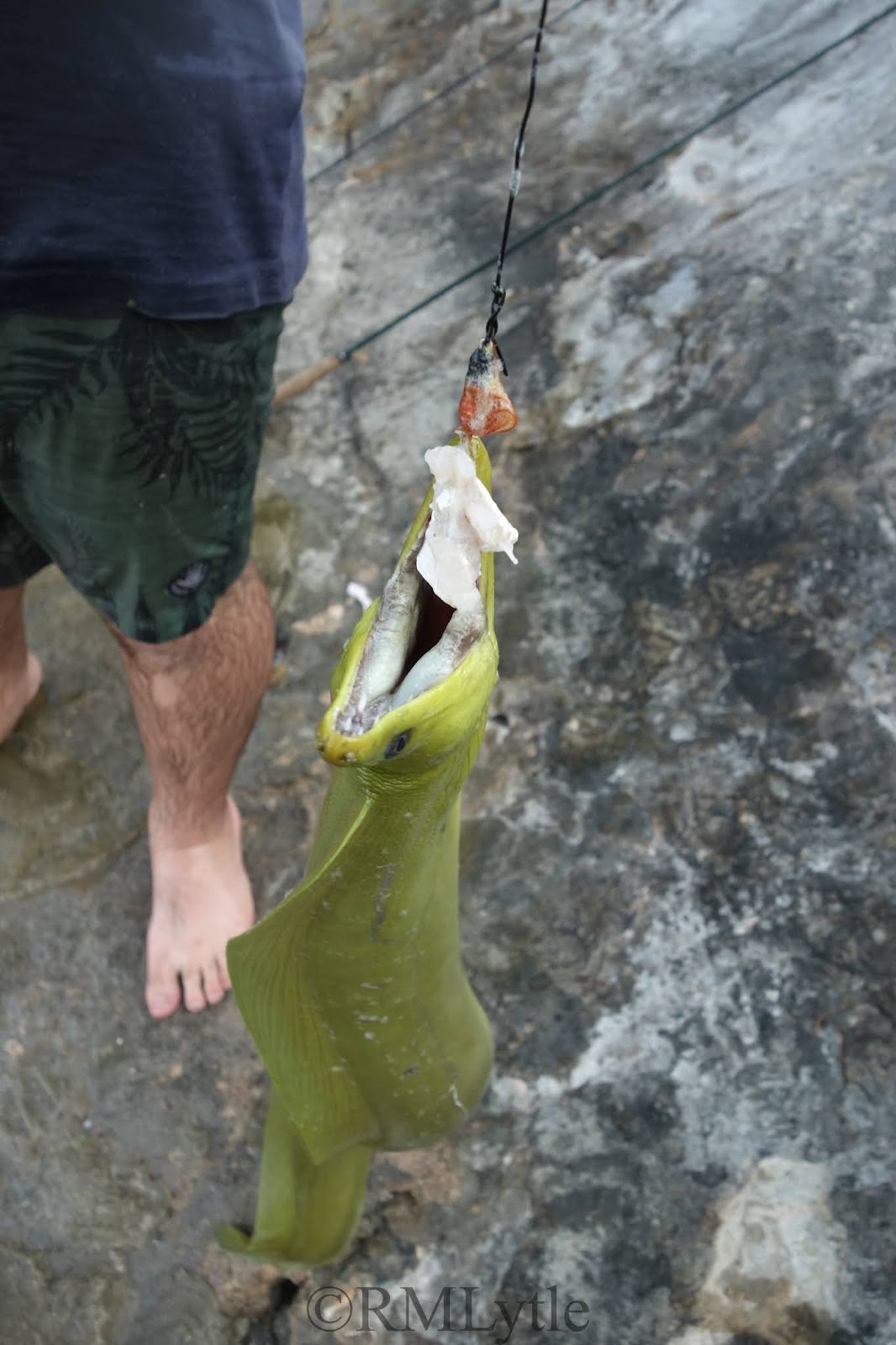
I was minding my own business 20 yards away when I heard Noah give a frightened yell and jump out of the water. He yelled "Holy s*** I just got attacked by a huge moray eel!". Attracted by the pinfish guts, a green moray eel had lunged at him and fortunately not made contact. I went over there and we looked around to see if the fish was still around. It was, we found it sticking its big scary head out of the crevice under the concrete slab. It was indeed an imposing creature. We immediately set about trying to catch it.

Noah was the first person to hook it. A chunk of pinfish very quickly got grabbed. It didn't last, and soon Noah was running up to the car for the shark rod. He hadn't even left when I put a chunk of pinfish on a fly and lobbed it to the monster. It ate, I set the hook, and it promptly retracted into the crevice. I was still on though and the fish hadn't yet buried itself. I put my hand in the face of the reel, locking it down completely, pointed the rod directly at the fish. To my enjoyment this actually worked quite well, I was able to keep the fish from going deeper into the crevice. I Even got it to come out a little further. But 30lb fluoro can only take being grated against cement for so long before it gives, and eventually it broke. But I'm confident that, had I been using wire, I'd have been able to pull that fish out of its hole with my 10 weight. I very nearly did so with fluoro. I'd been told in the past I wouldn't be able to fight and land a moray eel on a fly rod... I'm now entirely certain I could do so, but less certain I could easily convince one to eat an artificial. Noah came back with the shark rod. Things devolved into chaos. The shark rod did not last. He stood much too close to the fish's position, forcing him to have too much of a high rod angle. I repeatedly told him to walk backwards. Yes, the water was deeper behind him, but I could see what was coming. On the third time Noah hooked the big morray (this was a remarkably persistent fish), when it broke off the rod whipped back, hit the bridge piling, and exploded. I knew it would happen. High rod angles on big fish are almost always a bad idea.


Eventually, we just did what we should have done from the start and tried to handline the fish. We lost a good many hooks to it before it finally decided to leave, and perhaps the most remarkable thing is that most of the hooks we lost to it were never even in its mouth. The fish was so strong that it was able to break off the hook simply by yanking on the chunk of meat. After that monster green moray left, we were int the mood for redemption and looked round for another. There was a tiny one that I embarrassed for bit, but eventually we found  substantial one. It wasn't nearly as big as the first but big enough. I tied a size two hook only 90lb wire, and Noah and I prepared to wrench the fish out of its rocky hole as a team. I caught a hairy blenny, which the moray consumed whole, somehow without getting the hook. I caught more bait, put it in front of the fish, and this time it got hooked. We pulled like hell and walked toward the bank, wrenching that powerful creature out of its hole and finally catching the little monster. It was an incredible and even scary creature. We were on top of the moon in that moment.

Gymnothorax funebris


Sometimes, the struggle is what makes the day. When you plan on fighting the bridge troll, you'd better come prepared and with your wits about you. That first moray kicked our asses. But I've very proud that I fought it on the fly rod and it wasn't the fact that I was using fly tackle that led to the loss of the fish. I WILL catch a large moray eel on fly tackle, if only so that some people have to eat crow....

One rod, all of our pinfish, a few hairy blennies, a couple feet of line, and a bunch of hooks were lost that day. I'm not sure I'd change the outcome though. It's a much better story.
Until next time,
Fish for the love of fish.
Fish for the love of places fish live.
Fish for you.
And stay safe and healthy.


Thank you to my Patrons; Erin, David, John, Elizabeth, Brandon, Christopher, Shawn, Mike, Sara, Leo, and Franky for supporting this blog on Patreon. 

Saturday, April 11, 2020

Indicator Fishing for Reef Fish: Failure and Redemption

Maybe this would more appropriately be called float fishing for reef fish, because for the most part that's exactly what it was. Whether indicator nymphing is fly fishing is neither here nor there, I contest that it is, but I was categorically not fly fishing.

After catching three remarkable new species at Boca Raton Inlet Park, Noah and I left to try a place nearby that we'd never fished before. Satisfied with how I'd already done, I wanted to just relax and catch a bunch of fish, so I decided to fish with bait the rest of the day. I tipped my fly with squid and affixed an indicator to my leader and promptly began catching a ton of fish. Noah followed suit and started using a float as well. It was wildly effective, didn't result in as many hangups, and produced  variety of species.

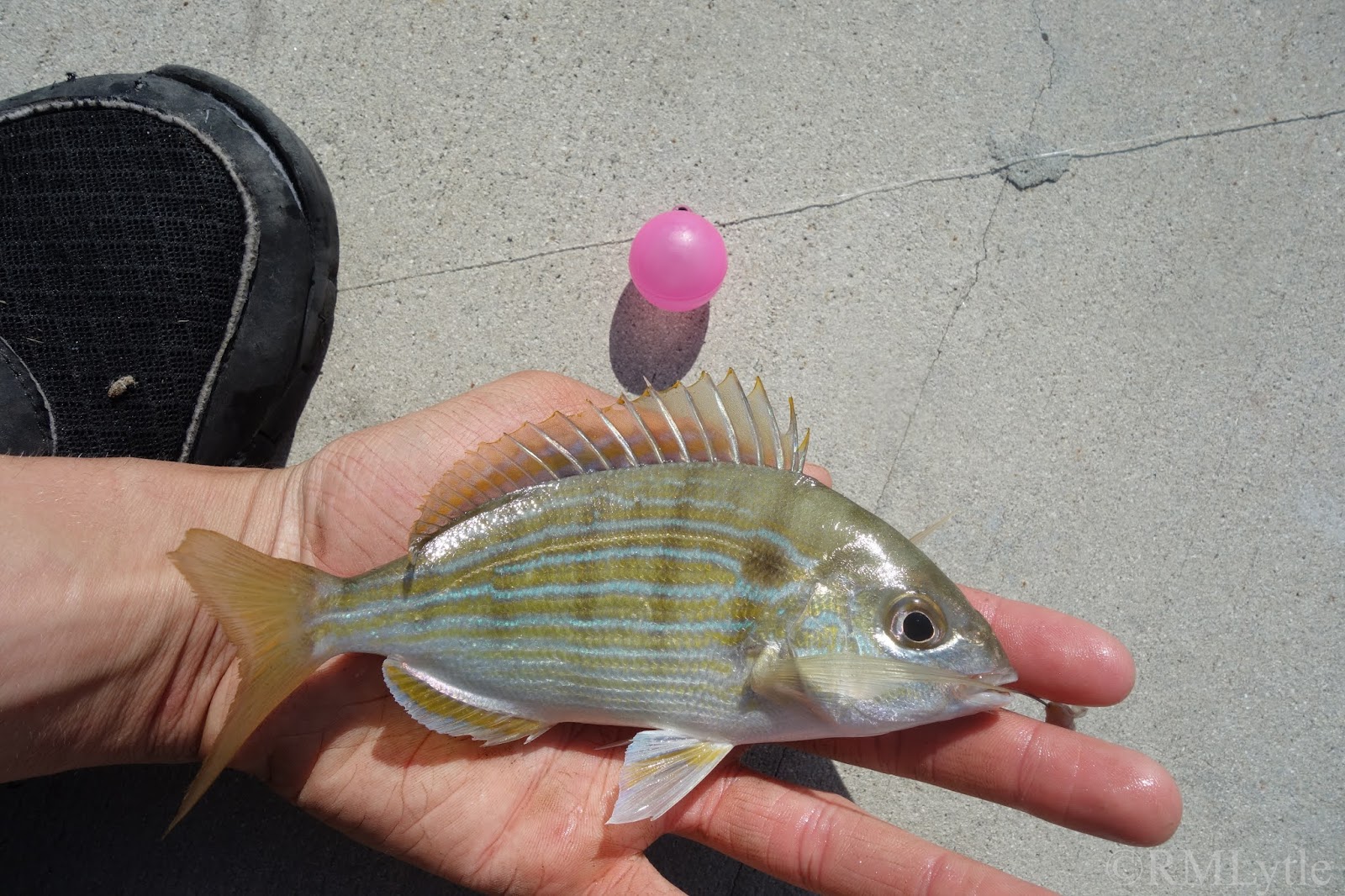
Slippery dick, Halichoeres bivittatus

Pinfish, Lagodon rhomboides

Spottail pinfish, Diplodus holbrookii 
Slippery dick, terminal phase.

 I spent a lot of the time just sitting on the wall, relaxing, enjoying a kind of fishing not comparable to anything I've done in the northeast. In the back of my mind though was the distinct and very likely possibility that I could at any point hook a species that I'd never caught before. I don't keep a hook and line lifelist, I'm not particularly interested in trying to catch every species possible on hook and line. I am really only interested in catching as many species as possible on the fly. So any species I caught doing this would represent, essentially, a failure on my part to take advantage of a possible opportunity to catch a new species on the fly.

Inevitably, I caught a species I'd not before: a lane snapper, probably the prettiest snapper species in Florida. That was a disappointment. I would have loved to have caught this fish on the fly, and maybe I could have.

Lane snapper,  Lutjanus synagris
I didn't change what I was doing though as I really wasn't that confident I'd be able to catch a lane snapper on the fly at this spot anyway. a short time later I caught a very cool looking scrawled cowfish. I was thankful I'd already caught one on the fly the same day.

Scrawled cowfish, Acanthostracion quadricornis

Mangrove snapper, Lutjanus griseus
About an hour later, another species I'd never caught before ate my squid. This time it was a grunt.

Smallmouth grunt, Haemulon chrysargyreum
With two species that would have been exciting editions to my life list caught on bait I started just fishing the fly under the indicator hoping to redeem myself, and I did catch fish on the fly... just tomtates and sergeant majors though. I left not really feeling frustrated, because what had transpired wasn't at all surprising. But I decided I'd like not to fish bit anymore that day. We headed back north but visited a place that Noah had found, a spot that definitely contained a lot of reef fish based on diving videos Noah had seen. Though it was now night, I kept with the indicator technique as I could still see it in the glare of the streetlights and it allowed me to keep the fly suspended on long drifts. I caught a new species on a small Clouser under the indicator almost immediately: a blue striped grunt. The the smallmouth grunt would remain one of only a tiny handful of fish species that I've caught but not caught on the fly, at least I'd add a fourth species of grunt to my life list. And it was a beautiful fish.

Blue striped grunt, Haemulon sciurus. Life list fish #154. Rank: Species

I then hooked and lost two fish on the same small clouser that fought in an incredibly strange fashion, completely unlike any fish I'd ever hooked before. They were both substantial, and the second broke off. In retrospect I think they could have been small morray eels but I'm not sure. The fight was closer to that of an eel than anything else I can think of. However I wasn't out of the count yet. Changing to a size 12 Hare's Ear, I then caught my lane snapper!

Lane snapper, Lutjanus synagris. Life list fish #155
I felt a bit redeemed by those two fish, and we'd be back at this same spot very soon to see what we could find there during the day. We had no idea what we were in for.
Until next time,
Fish for the love of fish.
Fish for the love of places fish live.
Fish for you.
And stay safe and healthy.


Thank you to my Patrons; Erin, David, John, Elizabeth, Brandon, Christopher, Shawn, Mike, Sara, Leo, and Franky for supporting this blog on Patreon.