Showing posts with label Cicadas. Show all posts

Thursday, July 24, 2025

17 Years

"What's up dog, want some coffee?" Levi whispered as I entered the kitchen, a little groggy but full of anticipation none-the less. "Morning, sure, thanks," I whispered back. "Hell yeah," he replied, "How stoked are you?"

"Pretty stoked."

When the cicadas last came to Central Pennsylvania, I was 11 years old. I'll be 45 when the come back next. That's a lot of time elapsed, and a lot changes. I hadn't yet picked up a fly rod in 2008, in 2042 who knows what life will be like. This year the bugs came again on their cycle and my silly addicted ass trucked it westward thrice, chasing a sickness so good it can't be beat. I've raved about the periodical cicadas before; in 2021 when I intercepted the periodicity in Maryland, and last year when a dual emergence took me to Illinois, Arkansas, Missouri, and Iowa. When magicicadas come out of the ground, I want to be there. They make up one of the last great biomass events of the sort here in the US, and while many were constant, like the buffalo, and some were annual migrations, like the passenger pigeon, there's something extra special and enchanting about an event that occurs more than a decade apart each time. It is miraculous that we still have these bugs at all, the landscape they live under is different every time the nymphs come up. That they still come up from one of the best regions for wild trout fishing East of the Mississippi... How lucky is that? Though, I suppose the same factors that have allowed the cicadas to persist have not been insignificant in providing habitat advantages for the wild trout either. 

Levi and I stepped out into the humid, warm morning air about ten minutes later with a little bit of our gear and a lot of hope for the day. "Hold on, before we go we gotta move the bugs", I said. We were staying at Levi's good friend's, Paul and Kathryn, and they were going to take down a tree in their backyard that day. It was time for a quick rescue mission. We walked over with our phone flashlights on to see dozens of pale, ghostly looking imagos and instars on the tree trunk and low branches. We collected as many as we could and moved them to nearby bushes. When periodical cicadas first emerge they come out of the ground through simple little holes, or sometimes, through turrets of soil that poke up above the ground, small towers of their own design that are made pre-emergence in wet areas in what is presumed to be a bid to keep mud and water from getting into their holes before the emerge. Those final instar nymphs climb out and go for the closest tree or bush, shed their nymphal shuck into imagos- the last, adult stage of their life cycle -and like many emerging insects, take a little while to harden up and get ready to go about their business. They'll go from pale and soft to firm, glistening, black and orange bugs, maintaining deep red eyes through the process. We shuttled as many as we could to safety before hopping in the car to head to the river. 


Central Pennsylvania holds fond memories for both Levi and I, though mine are more limited in number and a tad more recent. Levi fished trout in the limestone region the last time the cicadas came out in 2008, I first fished the area with my good friend Michael Carl in 2018. I've since returned a handful of times to poke into places I'd fished that first time, and a few new ones. Much of Pennsylvania is still Bucolic and beautiful, with sparse populations and varied terrain. Here, the Appalachians  form a series of arching, near parallel ridges. These start near Meyersdale, and you cross or cut through about a dozen spines headed East towards Chambersburg which sits in a wide lowland with rolling hills and the classic carts topography associated with limestone. East of Chambersburg is a less defined but similarly arching range of hills, encompassing Michaux State Forest and extending, broken by the Susquehanna, almost all the way to Reading. Throughout the main crux of the ridges to the west and north are smaller versions of the same sort of lowlands that Chambersburg and Carlisle sit in, each pocked with farmland and hugged on either side by tall ridges. In many of those low areas between the ridges is where the limestoners or limestone influenced creeks live, though each audaciously cuts through the ridges at some point on their journeys toward the Susquehanna, some more defiantly than others. The Little Juniata scrapes starkly through the ridge above Barree, Fishing Creek winds tightly under the steep topography on her way toward Lamar. And then Spring Creek, toward the apex of the curve of the ridges, gently wanders through a less strip of rock between Bellefonte and Milesburg. The millennia that allowed these streams to eat through these seemingly immovable stone ridges is too substantial for our simple human minds to fully grasp. It inspires aww though, when you stop and look at the landscape for a moment. 


Though not as diverse as the southern end of Appalachia, which boast the highest diversity of salamanders in the world and the largest of freshwater fish in the country, these Pennsylvania ridges aren't lacking in life. It's no surprise given that large swaths of this land are still very wild. Though logging has occurred for decades, as well as that farming down low and a slow hum of building in some towns, much of this place is still rugged. The terrain is gnarly and thick, and one can get lost if the try. This is the one of the last places in the country that still allows hunting of timber rattlesnakes, albeit in very limited and regulated form. Indeed they're quite stable here... still, I'd love to see this archaic hunt done away with. Why mess with one of the last best places this species has as a stronghold? Up on those high ridges though, we weren't hearing many cicadas. It was early though, as evidenced by the nymphs crawling out of the ground en masse that morning. We'd need to find an area where the bugs had already been out and flying for a while. Soil temperature has everything to do with emergence timing, and some places warm faster than others. We were committed though, and with windows open and ears trained to a familiar buzz, it didn't take long to find what we were looking for. 


"Mark says the shops the guys at the shop basically told him the fish aren't on them yet and not to waste his time fishing cicadas" Levi reported as we drove between spots. "Oh yeah, it's not worth it at all yet" I retorted snidely and we both laughed. We'd just had exactly the sort of fishing we'd driven over five hours for. Not size, albeit, but numbers? Whoa did we ever have that. And we'd had it to ourselves too, leap frogging up a piece of water neither of us had fished in years with not a soul in sight. Just brown trout sucking down big bugs without consequence... until our hooks pierced their lips. It was... absurd? Deranged? What dreams are made of? All of the above. When I fished Brood X in 2021, I got a modest taste of what trout fishing the periodicals could be, with a couple absurdly fat and happy wild brown trout. This was a more complete picture, as good as you hear it is. We traded remarks and shook our heads in disbelief each time we leap frogged, both reveling in the success of timing things well enough not only to have good fishing, but beat the masses. And, so long as the shops were still downplaying things, it felt like we had good chances to find pockets of stellar fishing throughout the trip. 
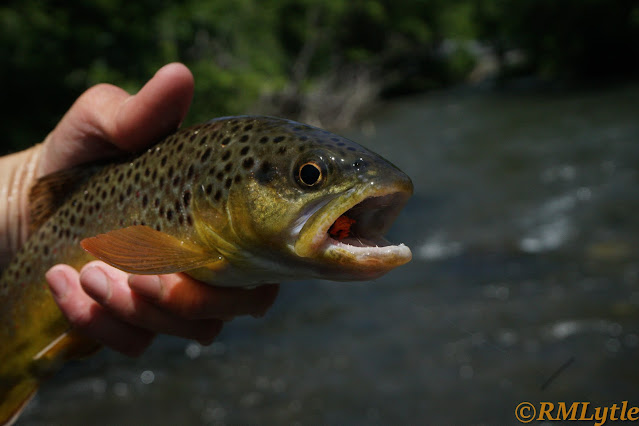


Where we were for that first pound-down wasn't a big fish location, but that didn't matter. Having trout come out of every riffle and pocket to hammer our big foam dry flies was thrilling. You can certainly work through similar water with similar flies- especially early in the morning and at times when some golden stoneflies or hoppers are present, or even if there's a modest number of annual cicadas -and pick up a few fish. This wasn't that. This was interacting with possibly as much as a quarter of the trout biomass of the stretch we fished and catching a disproportionate chunk of it. The fish were giddy. I had more than one nice fish (for this place that was 13-14") charge straight upstream a foot or more in fast shallow riffles to eat my fly. This was the dream. 

We were on our way to another spot on the same creek when we received that report from Mark, a stretch I'd fished before and done well with wild rainbows and some browns. The sound out the window as we closed in on our destination and the empty pull off when we got there said we were going to step in it again. 


The storied history of trout fishing in the area of State College is an interesting one, and though many eastern trout anglers may know bits and pieces of the story I think a lot of it has been glossed over. Spring Creek has one of the more distinct histories of course. Many may be aware that Spring Creek was a brook trout dominated fishery into the end of the 1800's, when introduced brown trout began to supplant the native char. By 1950 a native trout in Spring Creek's main stem was a rare occurrence. The origins of some of the rainbow trout that exist in the now mostly un-stocked stream remain a bit controversial, though I'd argue on behalf of some being stream born given the alkalinity, relative temperature stability, and shear perfectness of both par and adults of some specimens. of course, hatchery escapees from Benner Springs and Fisherman's Paradise, and stocked fish moving up from Bald Eagle creek contribute. Anyone who wants to can see the results of this in a tiny stretch right in Bellefonte, where you can pay a quarter or two for some pellets from a dispenser and toss them into a short, closed-to-fishing stretch where trout bigger than some of the carp present in the same spot will greedily take whatever you give them. Levi, Paul and I stood on the wall in Bellefonte one day, tossing leftover french fries and watching giant trout eat them. Those fish aren't Spring Creek's calling card though. If you've heard of the place but never been, your familiarity may start and end with the existence of the famed Fisherman's Paradise section. This piece of water was bought by the state Fish Commission in 1930 for construction of a hatchery and to demonstrate and test new stream improvement methods¹. A hatchery was built four years later. With heavy stocking and stream improvement that are now known in some cases to improve fishing more so that fishery health, the place soon boomed in popularity with anglers. The regulations then imposed ended up being quite unprecedented, and even in today's ecosystem might be though of as incredibly strict. Fishing was restricted to May through July, barbless flies were enforced, wading was prohibited, and there was a small and finite number of visits you could make. Even though some of the stricter regulations haven't carried over to present day, the popularity rivals the present day. More than 44,000 angler trips were registered in 1952. Photos from that era reflect this, with a parking lot jam full and anglers standing shoulder to shoulder on the banks of a Spring Creek that looks so different today it may as well be a different river entirely. 

In 1982, triggered by kepone and mirex contamination, the commission stopped stocking trout in Spring Creek and enforced no-harvest regulations. In turn, the wild trout population, brown trout specifically, absolutely exploded. It has been said that there have been as many as 3,000 trout per mile in Spring Creek, making it very high on (if not at the top) of the list of most densely trout populated streams in the Eastern United States. That population density has changed with time, of course, having apparently increased until 2000 and being on a downward trend since. That downward trend is likely tied to development in the watershed, and PFBC notes as much:

"In other watersheds, impervious surface area has been used as a good surrogate of urban development; when imperviousness reached 7-11%, trout populations were lost. The Spring Creek watershed had 12% impervious cover in 1995, and in the upper one-half of the watershed, impervious cover was 19%. We suggest that the reason Spring Creek is still able to sustain wild trout with this degree of urbanization is the relatively large input of groundwater into the stream. Further development that increases impervious cover, reduces groundwater recharge, or both, will certainly increase the stress on Spring Creek and reduce its ability to support wild trout."²

As development continues in the area around State College, and as climate change continues, its hard to say what the future holds for Spring Creek. What remains abundantly clear to me is that it, and even some of the more marginal trout streams in Central Pennsylvania, make even the best places we have in Connecticut look like a joke. Part of that is the nature of limestone, but part of it is an indictment on what building can do. Connecticut and our rapidly dying coldwater fisheries should be a good example of what NOT to do if you want to keep strong wild trout fisheries around when it comes to development, road salt use, lack of riparian protection, over-stocking, on and on and on. 


One thing Connecticut doesn't fail with is common carp. Europe's most popular "course" fish is highly abundant in the state and isn't going anywhere. Recently, after a number of fish had been caught over the years that could have cracked the former record, someone finally clocked one over fifty pounds. Well over, in fact. At over 58 pounds, Norbert Samok's record fish is a significant achievement. Of course, Pennsylvania has carp too. The state record was caught in 1962 by an angler named George Brown. The fish weighed 52 pounds... ha! We've got you beat there, PA. I can't gloat too much though, because instead of getting the chance to fish periodical cicada eating carp, I can't really wait around in Connecticut. It turned out Pennsylvania was going to give me a challenge too, though. 

Levi and I met Mark Hoffman in Boalsburg on our second morning for our first serving of warm water cicada mania. Haze clung to the hills as the light came up, that sort of low morning humidity that suggested a very hot day was incoming. We hopped in with Mark and headed toward a place where carp, overhanging trees, deep lake shore, and periodical cicadas all overlapped. Surface disturbance was visible as we crossed a bridge over the lake on the way in. There was heavy calling as we pulled into the launch. Anticipation was high, especially for me. I know this game a little bit, I've caught some carp on cicadas. But something was going on at the ramp that put a more than slight kink in the plan. The back cove was all muddy, and in various spots on both the near and far side there was a ruckus going on. Splashing, crashing, tail slapping, jumping... these carp were busy humping, not eating cicadas. The thing with the carp spawn is that it can kind of happen any time the water gets warm. I've seen carp spawn as early as April 10th and as late as September 3rd. Sometimes that's just a few pods of fish and plenty are still happily and busily feeding away. This wasn't that, though. We motored all over the lake and for the most part found nothing but carp making more carp. It got hotter and hotter as the day went on, and though I picked up some largemouth on cicada patterns and Levi ran a little chartreuse bugger and put a smackdown on white crappie, this wasn't what we hoped for. 


As the heat became more and more oppressive, frustration boiled over. We bailed, sweaty and ready for lunch. It wouldn't be for a couple days, right as our trip came to an end in fact, that we got a shot at the carp again. We met Mark at the same launch, just hours to spare before we needed to hit the road. This time there was no thrashing and crashing on that far bank. The carp should be feeding now, of that I was fairly confident. The most confident, in fact, as the previous attempt had shaken Levi's. In fact it had taken a bit to convince him that this could be worthwhile. We motored out of the launch and rounded the corner, travelling down the shoreline where cicadas were calling their little tymbals off. It wasn't long before I saw it: a carp tipped the wrong way, with it's head up and its tail down, orange lips at the surface, sucking down one of the bugs that had so haplessly bumbled onto the lake surface. The were here....

They weren't easy though, and we weren't the only ones on the water. A few other boats were out with fly rods, all working the banks looking for targets. Any pressure can complicate things, especially with carp. These are sensitive, shy fish. Before we found a couple willing carps, Levi managed to catch one of the nicer largemouth bass I've seen in a while. Getting big bucketmouths on cicadas isn't a bummer at all. 


Largemouth bass are America's favorite gamefish. An estimated 16 billion dollars a year is spent on bass fishing. To put that in perspective, the estimated annual market for fly fishing in the US is 750 million dollars. The people love bass, enough so that they've been moved here and there and everywhere. Where we were, just one watershed divide separated us from the native range of the northern bass, but we were fishing to non-native fish where we were. Given their widespread introduction and infusion in the fishing culture, many anglers don't realize when bass aren't native where they fish. In Connecticut, neither smallmouth nor largemouth bass were present historically, and that information is relatively available to anyone who cares to look. That said, it isn't hard at all to find anglers who insist that they are a native fish. Aa great many angler believe a great many things to be true that just aren't though, that is a reality that no longer surprises me. I just roll my eyes with my lips pursed in a tight, straight line and repeat the same statements again-- "actually, the only larger native freshwater predator species in Connecticut were chain pickerel, brown bullhead, and brook trout...." It's remarkable how much of our fisheries are made up of introduced species. In much of the northeast, we're looking at as much as, even more half of the popular target species. Even somewhere like Maine, where landlocked salmon and lake trout did exist naturally, they've been scattered about in all sorts of places they never were before. We think of fishing as a way to be in nature, failing frequently to realize that what we fish isn't actually natural. 

Even the lake we were on wasn't natural. In fact, large natural lakes are essentially non-existent in Pennsylvania. The largest natural lake in the state is Conneaut, in Crawford County. At just 243 acres, it is a piddly body of water compared to the Pymatuning Reservoir just miles away, and even it wasn't immune to human alteration. In 1834 connection to the French Creek canal raised the lake by 11 feet. The geology in Pennsylvania just doesn't make big lakes, unless you count Erie, of course. I wonder how the fishing was in the river that made this reservoir we were fishing before the dam went up, and I wondered how many more cicadas there'd been before the land they lived under was flooded. What fish would I have caught here in 1685, just 20 emergence cycles ago. Would I have been catching 20 inch fallfish here? Giant brook trout? How many billions more cicadas must there have been?

What was is now gone, and there's little left to do but find a carp, put a piece of foam in front of it, and not set the hook too early. 


¹ Tom Burrell, The Express. Dec 14 2024 The Evolution of Fisherman's Paradise

² Carline, R. F., R. L. Dunlap, J. E. Detar, and B. A. Hollender. 2011. The fishery of Spring Creek – a watershed under siege. Pennsylvania Fish and Boat Commission, Technical Report Number 1, Harrisburg, PA.

Thank you to my Patrons; Erin, David, John, Elizabeth, Brandon, Christopher, Shawn, Mike, Sara, Franky, Geof, Luke, Noah, Justin, Sean, Tom, Mark, Jake, Chris, Oliver, oddity on Display, Sammy, and Cris & Jennifer, Hunter, Gordon, Thomas, Trevor, Eric, Evan, Javier, Ryan and Dar for making Connecticut Fly Angler possible. If you want to support this blog, look for the Patreon link at the top of the right side-bar in web version. 

Wednesday, January 15, 2025

Climb Out & Scream (Pt. 2)

 An unnatural waterway meets the Rock River in Colona, Illinois, just a short distance above it's confluence with the mighty Mississippi. That waterway winds eastward to the Illinois River near the just east of of Bureau Junction, population 282, and just north of Hennepin populations 741. The latter is the town that now gives the canal it's name. Formerly known as the Illinois and Mississippi canal, the Hennepin Canal and its pools and locks sit a relic of an era when boats were a vital part of commerce in inland America. It's history is a little different than some of it's nearby contemporaries, because it was in essence already obsolete by the time the first boat made transit through it in 1907. Despite some architectural significance, including being the first canal built with concrete and no stone facings, it never got the opportunity to fulfill its roll as fully intended. After more than half a century of desire for the canal, construction began in 1892, and while it was being built work was underway to make locks on the Illinois River suitable for larger vessels. With it's narrower lock chambers the Hennepin settled into life as passage for recreational vessels rather than as an artery of commerce. 

Tiskilwa, Illinois is the embodiment of small town middle America and sits near the eastern end of the canal, near Lock #10. The canal does a sort of zig-zag North of town. In 2023, the population was 728. At it's peak there weren't many more than a thousand residents, living centered around an iconic main drag in the village center. Prior to European settlement a Potawatomi village was on this site. White man filtered in and settled along the Galena Trail, a stagecoach route that takes it's name from a lead ore mineral that occurs in deposits scattered around the Driftless Region. Galena looks the part, lead grey in color and heavy, sometimes forming beautiful crystals often cubic in habit. In fact, I have specimens with galena and fluorite from Illinois in my personal collection. Lead ore in hydrothermal replacement deposits in the limestone and agriculture on the fertile flood plains drew people to Illinois and through the spot where Tiskilwa stands now. In History of Bureau County, Illinois, published in 1885, Henry C. Bradsby notes the town's official inception out of two settlements, Indiantown and Windsor, which were consolidated and took the current name in 1840: "Tiskihca. — Names of Indiantown and Windsor changed to Tiskilwa, law, February 3, 1840, 107; town incorporated". Today, there is no sense of sprawl, suburbia, or anything else of that sort in Tiskilwa, as is consuming the soul of small towns in other parts of the country. Old homes line the street grid, along with some small businesses and a museum along the town's Main Street. The railroad completed in the middle of the 19th century arcs through town, still active. Up away from the river courses the land is flat and dominated by farms. Miles upon miles of farms. Endless farms. Save for some narrow strips between fields, there are few trees breaking up the view. This was likely part of the more than half of Illinois that wasn't forested anyway, but it must look very different now. Close to town, Rocky Run and its tributaries have carved their way down into the plain. There, trees are still very much present, and evidently have long been, as Bradsby also notes: "About Tiskilwa and on the Illinois River there is considerable rich bottom lands, covered with fine heavy timber". Where trees have persisted, so have periodical cicadas. That's what brought me to Tiskilwa, a town that is not in any way on the map for fly anglers.

Lightning strikes the flat farmlands, east of Tiskilwa a ways.

To be fair, Tiskilwa just happened to be the spot that caught my attention first as Emily and I worked eastward through Illinois. I'd pinned sites all the way into the Chicago suburb of Joliet, but when once again I cracked the window a ways outside of Tiskilwa and heard that familiar buzz, that evil grin crept across my face. The bugs had brought me somewhere new yet again, somewhere I'd never have had reason to go otherwise, somewhere with history, ecology, and culture I'd not have learned otherwise. sometimes a bug isn't just a bug. 

As I walked along the Hennepin Canal under the blazing sun, it's water flowed very sluggishly but clear, with vegetation and aquatic life all over. It's remarkable how life takes hold. In one lock I observed some gar and channel catfish milling around, as well as a few bigmouth buffalo scraping algae from the canal walls. All of these fish seemed rather averse to my presence and completely disinterested in cicadas, so I didn't linger with them long. I was a bit more interested in seeing a natural water body anyway. 

My first look at the creek I'd spent time viewing through the magic of the internet and satellite imagery came after skirting around a deep slough in grass that wasn't much shorter than I. Unlike the area I'd fished in Missouri, this was a classic freestone river with runs, riffles and pools. It had gradient and chunky limestone. It looked delightfully inviting and delicious. But did it have cicada eating fish? I stayed low and slow, eyeing the greyish green stained water for signs of life- a shadow, a waving fin, a rise form. It didn't take long. From deeper, darker water emerged the hulking form of a grass carp. It sidled up into the shallows over light colored bottom, then rose to a cicada drifting by. Slowly and carefully, I made my approach. The fish held it's ground, unaware of my presence. I'd love to say it was difficult, and maybe if I'd not done this quite a few times in the prior days it would have been, but I splatted that bug down and the grasser came to it without hesitation. The fight was on. In a log filled bend pool, I battled a freshwater giant about three feet long with a graphite stick and a glorified hand line. Much like Missouri, Illinois took me by surprise with just astoundingly good and enjoyable fishing. 


I enjoy fishing just about anywhere, especially where other people aren't. I've plied the famous trout rivers in Montana, squeaked snook out of the mangroves in the Everglades, and swung up landlocked salmon in the north Maine Woods. I've battled surf on famous spots of the striper coast and waded up legendary limestone spring creeks. None of that was any better than the fishing I had in Illinois. I don't give a damn what anyone says, this was my jam. 


I wonder what it was like in the area where Tiskilwa stands today when what are now known as Northern Illinois brood and Great Southern Brood last emerged in tandem, in 1803. There were probably still a fair few bison working the land in Illinois then. The indigenous peoples were still the dominant cultural presence. Illinois wasn't even Illinois yet. There was no railroad, no canal. The flora would have been distinctly different from what I saw. Even the river's very course may have been displaced. There were certainly no grass carp there. How many cicadas were there? Many millions more? What fish were eating them? How did the indigenous people respond to the insects abrupt emergence?

Fly fishing is largely a silly, useless hobby until we take note of everything else going on around us while doing it. The longer I stay with it, the more clear that is to me. It would be almost wholly un-stimulating to me now were I not using it as an avenue through which to explore the sciences and history. I'd give up fishing for fishing's sake before I gave up the places it takes me both mentally and physically. Fishing doesn't matter to me as an individual anymore, not the way it did. Pursuing a bug and an invasive fish eating it took me to a tiny town in the middle of Illinois. It made me want to learn about that place and it's history. So much so that months later I was combing through a book published in 1885. I grazed information about malacologist named Charles Torrey Simpson who was supposedly born in Tiskilwa and published dozens of pieces of scientific literature, including "The pearly fresh-water mussels of the United States; their habits, enemies, and diseases, with suggestions for their protection" in the Bulletin of the US Fish Commission. I learned that to pay for the operations of the Hennepin Canal, ice blocks cut from it during the winter were sold. This reminded me of ice ponds here at home in New England, and how different our lives and the land are now from just a handful of generations ago. This is all far more interesting and important than catching a fish, in my humble opinion. That's just trivial. Not the fish- the fish is just as interesting and important -but catching it? Sometimes I do think about quitting that part. 

It sure is fun though. 

Thank you to my Patrons; Erin, David, John, Elizabeth, Brandon, Christopher, Shawn, Mike, Sara, Franky, Geof, Luke, Noah, Justin, Sean, Tom, Mark, Jake, Chris, Oliver, oddity on Display, Sammy, and Cris & Jennifer, Courtney, Hunter, Gordon, Thomas, Trevor and Eric for making Connecticut Fly Angler possible. If you want to support this blog, look for the Patreon link at the top of the right side-bar in web version.

Friday, December 6, 2024

Climb Out & Scream (Pt. 1)

In a small dirt lot somewhere in Northeastern Missouri, I cracked the window of the rental car and let in a sound. It was a wavering buzz, a chorus of many singers emanating from the trees on this stiflingly hot early summer day. This was a sound I'd driven well over a thousand miles to hear. I looked over at my partner in the passenger seat and cracked a maniacal grin. We weren't too late after all!


Periodical cicadas or "magic cicadas" represent seven different species of cicada that emerge on 13 and 17 year cycles. 17 different broods emerge of separate cycles all across the Eastern United states. In 2024, two broods emerged simultaneously in the Midwest and South- the Northern Illinois Brood and the Great Southern Brood. Collectively, millions of cicadas emerged from the earth, where they spent more than 99 percent of their life, shed their nymphal shucks, and went about doing what sexually mature cicadas do best: screaming and having sex. That's probably what I'd want to do if I'd just spent the last 13-17 years living in the soil too, quite frankly.  Some people aren't particularly big fans of the sound or the bugs themselves. Personally, I think those people suffer from a severe negative attitude problem. How lucky are we that such an incredible ecological phenomena occurs in our backyard? It's such an incredible display of life, a vitally important occurrence in the habitats in which these bugs persist. Throughout parts of their range, some periodical cicadas are not doing well at all. Charles Lester Marlatt, who first assigned Roman numeric designations to the existing broods (as well as 13 others that don't actually exist) noted dramatic declines in the very brood that should emerge in the Connecticut River Valley, attributing it to deforestation and the introduction of house sparrows (Marlatt, C.L (1907). "Summary of the Habits and Characteristics of the Cicada.") Unfortunately, Brood XI was last seen in 1954 and is now extinct, an outright ecological catastrophe most southern New England residents are wholly unaware of.

As I've written about in this blog before, I'm a cicada addict. I adore periodical cicadas and everything about them, from their ornate, jewel like wings to their mechanical sounding call, to their seemingly bumbling flights as they try to evade predators. Of course, it doesn't hurt that fish like to eat them. Fish really like to eat them. Here in Missouri, I was hoping that the fish that would be really liking the cicadas would be grass carp. In North America fisherman often have a pretty poor understanding of what carp are In this area in the midwest it's made no better by a plethora of large native suckers that look vaguely like common carp, and a number of introduced Asian carp species, including grass carp. Grass carp are a bit different than the species that are often in the headlines as Asian carp, which are silver and bighead carp. Grass carp, Ctenopharyngodon idella, are the only species in their genus and look, at least to the trained eye, absolutely nothing like common carp. Nor do they act like common carp, come from the same part of the world (grass carp are from far Eastern Asia, common carp from Europe and far Western Asia. Though both species feed on or near the surface semi frequently, grass carp are built for it a little better with a terminal mouth while common carp have a more inferior mouth (this means that their mouth is on the bottom of their face, not that their mouth is worse). Both are detrimental ecologically in a variety of different ways. Both are also a heck of a lot of fun to catch on a fly rod, but to this point in my fly fishing carrier I'd caught exactly one, this monster from a park pond in the northeast: 


I really wanted more, and I really wanted to catch one without having to throw a bunch of bits of bread in the water. These calling cicadas were singing a promise to me. They were singing a promise that I was surely about to find my fix. I trotted through the brush towards the river, cicadas blundering into branches in their haste to get away from me. Upon reaching the edge of a high clay bank and peaking over, it was immediately apparent that they bugs weren't lying. A half a dozen or so grass carp cruised up and down a bubble line, picking off bugs as they went. They weren't alone though. They were joined by roughly the same number of shortnose gar, a fish species I'd gotten to see for the first time with my friend Hamilton Bell earlier in the week down in Arkansas. They'd snubbed me then (read: I blew a lot of shots), but this opportunity seemed almost too good. And they were eating bugs? What a wonderful surprise! This seemed uncharacteristic for a gar species, but I'm not one to turn down an opportunity at an odd species on a dry fly. Firs though, I had to rush back to the car to rig up. My grin was now twice as maniacal.

There's some minor complexity to catching cicada eating fish, but it isn't so technical as to be prohibitively difficult. Certain fish seem to have certain preferences at different times. I've never gotten carp to eat sinking cicadas well, though I'm sure it happens. On the tailwaters of Maryland during the 2021 emergence, I caught fat brown trout on some sinking cicadas, to exclusion of the dry fly during the midday surface activity lull. I had yet to get the opportunity to put a cicada in front of a grass carp, or a shortnose gar for that matter, but given the methodical behavior of these fish I anticipated a long drift being favorable to a splat-down, and probably minimal action on the fly. And that's exactly what I got. In fact, I was about to have two days of the best dry fly fishing I'd ever experienced. These grassers behaved much like big brown trout do. They chose the same sorts of lies a trout would, holding position in faster water and cycling in the froggy spots. They were selective but not overly so, and they fought incredibly well. They fought astoundingly well too. It was everything I could have asked for. (Short video available to Patreon supporters: www.patreon.com)


I knocked a couple grassers out really promptly, but was immediately keen on sticking a gar. It didn't take too long to find willing participants to grab the fly, they were in fact extremely keen on that, but it did take a little while to get one willing to stick (read: I whiffed a whole bunch of them). When I finally did, it was an elevating moment. My first of a gar species, my third gar species, on a periodical cicada dry fly. That just seemed absurd. But these fish were clearly keen on the bugs. They were setting up much like the grassers were, though they favored cruising the slower water over stationing up. Some were holding lies though, finning in the current and picking off cicadas as they floated by. They showed notable preference for the bugs that were still alive and moving, and in turn for a fly that was twitched like the living naturals. It was just the coolest thing, so cool I had to know if this was a well know phenomena. I reached out to Dr. Solomon David, biologist and gar specialist at the University of Minnesota about what I was seeing. Not only did he respond promptly confirming that shortnose gar are indeed known to feed intently on periodical cicadas, he told me that one of the only pieces of formal scientific literature on the species delved into their behavior while feeding on magicicadas: American Midland Naturalist Journal: Shortnose Gar - Territorial Defense of Profitable Pool Positions. 

How friggen cool is that? Solomon David then asked if I'd be able to contribute any data. I'm always looking for an excuse to provide something that could be of use to fisheries science. If I'm going to go around pricking all sorts of fish in face for fun, some sort of good should at least come of my efforts. Subsequently, for the rest of my time in Missouri, every shortnose gar I caught was accurately measured and photographed. Their behavior prior to capture and exact location were recorded, and I took photos of gar in feeding lanes, cicadas on the water, and overall shots of the river. It added some work on my part, but that isn't unfamiliar. I spent many formative years observing river herring runs to get visual estimates on returns in streams without fish ladders. The amount that can be learned by approaching fish with a scientist's eye, looking for a quantitative analysis, is significant. Fisherman aren't always good scientists, arguably rarely. The goal of catching fish doesn't always necessitate understanding exactly why fish do what they do. It doesn't take a thorough understanding of fish, across all sorts of species and waterbodies, to catch enough to be satisfied. Anglers are often not even that good at telling what species of fish they're holding in their had when they do catch one. So taking a very scientific approach, engaging with the ichthyologists and fisheries biologists, and participating in the collection of data that might further the scientific understanding of fish and their habitat presents a lot of opportunities. I'll jump at the opportunity to take part any chance I get. 


They way gar take a fly has always amused me. It's almost adorable, bordering on comical at times. With these cicadas it was no different. The fly would plop down, perhaps two or three feet ahead of the fish. Either it would respond to the fly landing or I'd twitch the bug. The gar would turn, angling toward the fly, and nose right up to it. By nose up, I don't mean put their snout under the fly. They get it next to their eye almost, next to their jaws on one side of their head or the other. If they could they'd probably be squinting at the fly at this point. If a moment passes and the gar doesn't  commit, I'm inclined to give the fly little twitches. This is usually all it takes, the gar's fins kick a little and it closes whatever gap it has between it and the fly. Then is snaps at it, opening its mouth and jerking its head to the side. Can you picture it? I've seen it countless times from four different species of gar, everywhere from Vermont to Florida to Arkansas. It's very specific, and frankly very funny. 

My satisfaction with life is heavily contingent, probably too contingent, on laborious exploration of places I've never been with either a fly rod or a camera in hand. There isn't necessarily anything relaxing about it at all, sometimes I wear myself down to zero. I beat myself to a pulp wading twelve miles of river one day and had to pull over on the side of the highway because the cramping was too severe to drive through. I forget that my body even exists in favor of paying attention to everything else instead. And when an event is ephemeral and temporary, or my time in a place is short, I can be almost frantic about it. Not so frantic that I don't take time to be completely stationary though. 

Standing on a high, sloping bank above one long, slow pool, I could see a few grassers larger than the one's I'd been catching working the surface. The rock below my feet was sheet thin layers of sedimentary strata, layer down millennia ago when this whole place was underwater. Not much had altered it since it had hardened as it was near perfectly level and didn't who much at all in the way of signs of metamorphosis from heat or pressure. The river had carved at it though, revealing the time it had been laid as step-like layers sloping down to the riverbed. On top of it was a less old form of the same process- layers of sand and clay that had been dropped by the river when it was younger. The rock made a good seat, I decided to watch the fish feed for a bit and take in as much information as I could while I had the opportunity. The larger fish were definitively wearier than the smaller ones, and didn't spend as much time hovering right under the surface. Since the water was extremely turbid they were only really visible as dark, long smudges with wavering tails. Some of the little ones stayed up and cruised around. But the larger ones, some of which were probably in the high 30 inch class, rose up from the gloom and held position for a moment or two, picked off a couple cicadas when they came by, and then sank back down. They were clearly favoring proximity to shad, though they didn't seem to need to be in it all the time. Fish treat shadows as cover,, because it is. I couldn't see them well at all when they were in the shade, but could see them fairly clearly around the periphery of it. They seemed to want to remain close to that shadow as a quick escape if it became necessary. Eventually sensing a pattern of movement with the larger fish there I eased down to the water's edge. From that level seeing the fish before they surfaced to eat was nearly impossible, so I waited with fly line in hand to make a quick but long cast. When one topped, I let it fly. The bug landed, a few seconds passed, and white lips opened around it. I held ground until the lips closed and the head turned to go back down and lifted the rod. The pool then erupted as an angry grasser mad it's feeling about being deceived known. 


I repeated the process over an over that second day, scrambilng up and down steep banks, watching fish, and walking river in deck boots and shorts, hunting and hunting some more until I was fairly satisfied with the results. I'd come, I'd seen, and I'd caught. I watched birds hunt the cicadas and seen a few snakes slide away into holes. I'd done some minor gar science and bent an eight weight on more grass carp than I'd caught up until that point prior. Understanding that the time had come to push northward, we said goodbye to Missouri- as place I'd not had anywhere near the respect for that it deserved until driving it's entire extent from south to north. But there were more bugs, more fish, and more places to be. The clock is always ticking, and I needed to find more to keep that maniacal grin on my face. Though there was a tornado to be chased in Nebraska first, the next stop on the cicada pilgrimage was Illinois. 

Thank you to my Patrons; Erin, David, John, Elizabeth, Brandon, Christopher, Shawn, Mike, Sara, Franky, Geof, Luke, Noah, Justin, Sean, Tom, Mark, Jake, Chris, Oliver, oddity on Display, Sammy, and Cris & Jennifer, Courtney, Hunter, Gordon, Thomas, Trevor and Eric for making Connecticut Fly Angler possible. If you want to support this blog, look for the Patreon link at the top of the right side-bar in web version.

Friday, July 2, 2021

Brood X: Big Trout Cicada Chaos

 I almost didn't even try. My familiarity with the extent and distribution of Brood X as well as my complete lack of experience fishing the trout waters of Western Maryland added up to a big uncertainty. But my second day looking for carp and cats was slow... I got shots of rising carp and I caught some smallmouth, and the photos from that day will at least end up on my Patreon page, but the fishing was brutally frustrating. So on my final day, and at the very end, I headed the opposite direction from home. I'd heard good things from Western Maryland, and I hoped I'd find both cicadas and wild trout feeding on them. 


I went through a couple of areas on the highway on my way west where I was splattering enough cicadas to worry about my windshield. Then, when I got off the main drag onto some lovely winding back roads I left my windows open. Often enough, I passed through an area where the bugs were deafening. I was starting to get pretty confident when I found myself parked next to a gorgeous stretch of pocket water with loads of cicadas around. Maybe it would happen after all! 

An hour later I was starting to have my doubts. The water was gorgeous and there were plenty of the periodical cicadas around, but I just wasn't getting reactions. That was precisely when a 16 inch brown torpedoed my fly and made me a believer. I missed him, but at least I knew it could work.


Not that long later, I got the first of a pair of football shaped stocker rainbows to hand on the Cicada. They certainly weren't what I was looking for but at least lifted my spirits.

I quickened my pace, sensing that the sun was on its way down. Rounding the next bend I took a spill, whacking my hand as well as my knee and shin on rocks. I got up feeling that sense that I'd be very sore in the morning, and that the river now owed me something. That is never a good thing to feel. If you feel owed a fish, you will not get it. 

That came back to bite me a short time later when an 18 inch wild brown came up and smoked my big foam cicada. I set the hook pretty well, I though. The fish tore downstream before doing some serious, powerful, deep digs. Then it just came off, leaving me standing there, slumped and dejected. There was another angler just downstream, so I opted to leave that stretch and go elsewhere. So began a short time of driving semi-aimlessly, wasting daylight, wishing I'd gotten there earlier. 

Finally I settled on an entirely different and much larger river. There I struggled to find fishy water for a little while. When I did, I missed the first fish that ate then broke of the next. Both were browns and clearly very nice ones. I was really starting to hurt now, both physically and mentally. 

But the day is always darkest right before the dawn. In this case, it was darkest for me right before the sun set. Then a football shaped male brown took my cicada, fought like a demon, and actually let me touch and photograph it. Yup, he wasn't the biggest, but I felt I'd actually earned that one. And he was gorgeous. 


Then, just 30 feet away, another good fish ate. I stuck her and like her smaller male friend she fought like an absolute psycho. This one was particularly nice. Again, not huge, but impressive in stature. It was pretty clear how full of cicadas these trout were. 


That was that, mostly. I did catch a tiny wild rainbow towards the end but those two browns, caught in quick succession, were the beginning and end of my Brood X trout success. I was happy with that. I'd gotten a couple fantastic fish from water I didn't know at all with very minimal research. All I had was prior experience in similar fisheries to go off of. Until you really know the fish in your neighborhood, you can't expect to know how to catch the same fish anywhere else they exist. 

I started heading home that night. My periodical cicada pilgrimage had ended. It was a hell of an experience. Not long after I'd return home, these bugs would finish their breeding and die. The woods would be quiet again, but the eggs of the next generation would be hidden away in dark places. I hope to encounter I get to encounter the next generation when the emerge in 17 years. I don't know where I'll be though, so I'm glad I got to experience it this time. But for now, our story ends in a cold river in Western Maryland, where a beaten and bruised angler stood smiling, looking at a sunset and woods full of cicadas that had gone quiet for the night.


Until next time, 

Fish for the love of fish.
Fish for the love of places fish live.
Fish for you.
And stay safe and healthy.

Thank you to my Patrons; Erin, David, John, Elizabeth, Brandon, Christopher, Shawn, Mike, Sara, Leo, C, Franky, Geof, Luke, and Noah for making Connecticut Fly Angler possible. If you want to support this blog, look for the Patreon link at the top of the right side-bar in web version. I truly would not be able to keep this going without you wonderful folks!

Thursday, July 1, 2021

Brood X: Catching Carp on Dry Flies

 I've caught carp on the surface before. Plenty, actually. I've had days where I got half a dozen or more carp on dry flies. However, it always required chumming them up with bread and that just felt cheap. I wanted a more natural scenario, and ideally I wanted fish eating insects, though I'd happily take berries as well. 

Brood X just so happens to emerge around some of the best carp waters on the East Coast. Carp have a known affinity for cicadas. The huge periodical emergence and the millions of big, juicy bugs plopping into ponds and rivers are going to get some carp looking up. It was one of the things I was most excited about as I made my way south. After a catfish filled morning, I began to look for something a bit bigger.

It took hours. I walked, I waded, I drove. I gave myself horrendous leg and foot cramps. I saw some cool things on the way, thankfully. I watched a Northern water snake foraging(?) for the cicadas. I watched it swim out, grab a cicada, then swim back to the river's edge where it finished consuming the bug. It then repeated the process twice more. I'm not sure this behavior has been documented in this species, though snakes are known to take advantage of the cicada emergence. You may have seen wildly titled articles about "extra copperheads" eating the cicadas- there were dozens of them popping up a few months ago -that was bull. Copperheads modify their behavior very slightly during the cicada emergence but people living within their range aren't likely to see any more than they otherwise would. I never saw one, though I looked in some viable habitat. Later in the afternoon, I saw a beautiful garter snake swimming across the river and headed it off. She had a big food bolus (the lump caused by a food item wider than the snake's own body) that was very much cicada proportioned. I got a couple shots before leaving her to her business.


Not long after that, I found what I'd been searching all day for. A school of seven carp were in a back eddy, sucking down every cicada in their path.


I frantically made my way to the gravel mound you can see in the bottom right of those two photos. Breathing heavily, I tried to calm down and collect myself to be ready for a shot. Fish were cycling through the eddy, going against the current, picking of cicadas as they went. I gave myself a few minutes before easing into position. I waited for a fish coming down the bank. One came. I made a cast. When the fish, a sizable mirror, got to the fly, he nosed it but did not take. Stay calm, Rowan.

I quietly removed my fly and waited for the next fish to come down the bank. This time it was a better common. I made my cast. The fish deviated off course to eat a natural, then turned back and came to my fly. It rose. I waited. It opened its mouth. I waited. It sucked in the fly. I waited. It turned... I set the hook. And so ended all chances I'd get another shot in that back eddy that day. This fish lost its mind when I set the hook, thrashing violently and then tearing off on a blistering run. Every other fish there spooked. I needed to land this one. The fight was long and hair raising. At one point I thought I might have to swim out to get the fly line off of a huge submerged rock, but luck was on my. Big river carp fight harder than most fish, and getting this one to hand on my 5wt TFO was a task and a half. I did it though, I got the fish. It had a big bulging gut full of cicadas and was fantastically proportioned. This was the fish I'd made the trip for. 


I'd come a long way from another of the best carp areas in the country to get the very same fish eating something different. It was worth the trip. Fly fishing is about the experiences, and it doesn't take catching a tone of hue fish to make a great experience. Set the stage with a remarkable and rare biological phenomena, add in some fickle fish of a few different species, and put them in an interesting and beautiful environment and I'm a very happy man. There's more cicada mania to come, as I headed West to colder waters with different species. 

With a satisfying and surprise lifer out of the way, I continued on my quest for fish chowing on periodical cicadas. Now I was looking for carp. It would prove to be a very rewarding challenge. 

Until next time, 

Fish for the love of fish.
Fish for the love of places fish live.
Fish for you.
And stay safe and healthy.

Thank you to my Patrons; Erin, David, John, Elizabeth, Brandon, Christopher, Shawn, Mike, Sara, Leo, C, Franky, Geof, Luke, and Noah for making Connecticut Fly Angler possible. If you want to support this blog, look for the Patreon link at the top of the right side-bar in web version. I truly would not be able to keep this going without you wonderful folks!

Monday, June 28, 2021

Brood X: Fly Fishing the Magic Cicadas

Thank you to my Patrons; Erin, David, John, Elizabeth, Brandon, Christopher, Shawn, Mike, Sara, Leo, C, Franky, Geof, Luke, and Noah for making Connecticut Fly Angler possible. If you want to support this blog, look for the Patreon link at the top of the right side-bar in web version. I truly would not be able to keep this going without you wonderful folks!

 Our story begins in the cold, damp, soil of a forest in the Mid Atlantic. In this soil stirs an alien creature with big eyes, monstrous looking legs, and a thick abdomen. He has been in this dirt for most of his life, but that is about to end. Something draws this little alien creature upward, right to the surface, where he then climbs up the nearest tree trunk. He then leaves his subterranean shell in favor of a perhaps even more alien, winged form. This little black, orange, and red bug then flies up into the tree canopy and begins to... scream. He screams as loud as he can. In time he is joined by thousands, then millions of his own brethren, creating a deafening chorus. 

These little creatures are periodical cicadas (also known as magic cicadas), and they do this every 17 years. They are not all the same species. Three different cicada species make up Brood X, which emerged to breed, lay eggs, and then die this spring throughout large parts of the Mid Atlantic and Midwest. The event is a special one that would be interesting even if the bugs didn't end up creating some very unique fishing. Towards the end of the show I made my way south, seeking the cicadas and everything else occurring in the wake of their chaotic emergence. I'd been fascinated by periodical cicadas long before I'd ever picked up a fly rod, and this was to be a very exciting trip for one totally obsessed nature nerd.


I made it a substantial distance into Maryland before I encountered the first periodical cicadas. Near the town of Thurmont I began to see cicadas flying around. I stopped and found a bunch of dead ones in a parking lot. It was a cold morning, a lot chillier than the cicadas seemed to prefer, so I wasn't yet hearing their trademark singing.

I wandered around for a while before I found both a huge number of cicadas and fish actively feeding on them. I was on a river I'd fished years ago but a part of it I hadn't visited back then. There was a substantial clay bank with overhanging trees creating shade at a bend. The current was lazy and the surface slick. Fish were sporadically rising to cicadas drifting down the river. 

Some of the bugs struggled, flailing on the surface and buzzing in an agonizing sort of way. Some just succumbed and floated unmoving. Not every cicada was eaten by a fish, but there wasn't much pattern to the feeding. Sometimes a flailing bug was the target, sometimes a still one. At times cicadas floated through unmolested for five minutes, maybe more. At other points not a single one made it past the catfish and bass that were in there. 

Catching these fish wasn't as easy as I would have liked. Precise drifts and long casts in tight quarters were necessary. Hooking the catfish also took some experience I didn't yet have- how often can you find channel cats free-rising for insects to practice on? It certainly isn't their most common feeding behavior. I missed many, but caught plenty as well. Catfish on dry flies... this was exactly the sort of thing I'd made the drive for. 


The smallmouth present in the spot weren't quite as gung-ho about the cicadas as the catfish, which may have been because the were smaller and were already about to pop; they were so full of bugs they all looked like little footballs. 


After seemingly depleting that source of active fish, I decided to explore a small tributary nearby to see if it might harbor some species I'd not yet caught. Just up from the mouth was a chub mound occupied by a pair of average sized river chubs, a species I'd first caught last summer in western Pennsylvania. I didn't have real micro fishing gear with me, so wasn't equipped to catch the dace and darters that were around the mound. 

I continued upstream hoping to encounter some mounds with other species, or perhaps fish schooled in a deep pool. I found both. In fact, a lot of fish were on mounds in this little creek. Most were river chubs, with a few super colorful common shiners mixed in. I was having a hard time catching anything but did eventually get a fairly run-of-the-mill small river chub. Since that isn't a species we have in Connecticut, it was cool to catch one again. 

All the while, the cicadas were screaming in the tree canopy. It was loud and constant, and would soon follow me even when there were no cicadas singing around me. 


I eventually found another chub mound loaded with fish and began working it. I caught a small river chub, then the largest and most unusual looking fish in the school took my nymph. A gnarly looking male of whose identity I wasn't sure of at the time came to hand. I now know it was a Central stoneroller, a quite trick species to catch on hook and line let alone on the fly, and a new species for me. My 180th life list fish was a totally unexpected one!

Lifelist fish #180, Central stoneroller, Campostoma anomalum. Rank: Species

With a satisfying and surprise lifer out of the way, I continued on my quest for fish chowing on periodical cicadas. Now I was looking for carp. It would prove to be a very rewarding challenge. 

Until next time, 

Fish for the love of fish.
Fish for the love of places fish live.
Fish for you.
And stay safe and healthy.