I pulled into a mostly empty parking lot under the cover of darkness and extremely oppressive heat. Out over the Atlantic, a cumulonimbus cloud hurled electricity into the night. It's a very foreign feeling for a New Englander to have lightning illuminate the scene while his glasses fog up upon opening the car door... it just doesn't do this sort of thing up north. Sure, there are some sticky, muggy nights in Connecticut. But not like this. I'd already adjusted and was comfortable with the heat but that didn't stop it from impressing me every time I felt it. Unfamiliarity is a good thing, and not much of this was familiar.
Wednesday, February 28, 2024
Dawn on The Beach
Thursday, November 30, 2023
Jack Attack
The cook-an-egg-hot Florida sand barely registered beneath my calloused feet as I wandered a mostly vacant beach. As it turns out, an August weekday with a heat index of 118 degrees can provide fair solitude on what might otherwise be busy beaches. I'd surprised myself with how rapidly I adjusted to the conditions, and as with many prior trips to Florida I was routinely being asked the sort of questions that would be asked of a local. My physique didn't hurt the "from here" impression: barefoot with stained khaki shorts and an unbuttoned blue long sleeve, a sling pack, a stripping basket, worn and sun bleached ball cap, 8 weight fly rod in hand, and the ends of my shoulder-length hair blonding from half a season's worth of sun and salt damage. The heat wasn't phasing me, I brushed it off like I do any natural factor. I take some pride in my ability to adapt to different places and conditions. I feel there's a lot to be said for being just as comfortable on a sun bathed strip of southern sand in mid summer as on an icy, dark urban trout river in the depths of January. At least there's merit if you intend to be as versatile an angler as I'd like to be. There's also merit, outside of fishing, to being able to relate to people anywhere you go.
I'd been on the hunt for tarpon for days now. The hope was to encounter balls of bait along the beach being marauded by silver kings, and though I'd seen tarpon there was a distinct lack of minnows to pull them in tight to the beach. The hours and miles covered had jaded me enough that for this excursion I'd left the 12 weight in the car. This beach had produced a couple small snook for me the previous day on the same tide, so I was hoping just to get tight to a favorite species of mine, size irrelevant. And that's how I found myself entirely under-gunned when one of the most remarkable shows I'd ever seen made its way up the beach.
I'd been working my way north towards a point, picking deeper parts of the trough as I went, when I looked back south and saw absolute melee in progress. large menhaden were being flung as much as eight feet into the air in car-sized whitewater explosions. My jaw about hit the sand and I began jogging in that direction. The attackers were crevalle jacks... huge ones. Suddenly, the Helios in my hand was not the tool for the job at all. It felt like a toothpick. I was quickly tying on the biggest fly in my limited arsenal though, with the chaos rapidly approaching at the same time. As the sounds of death and ravenous consumption became audible the Yak Hair Deceiver entered he fray. It was quickly consumed, followed by about 10 seconds of screeching drag before I thought better of my decisions and buttoned down to let what would have been an unlandable trophy jack break off. I traded the rod for the lens and chased the fish northward, at times just walking, at times at a full on sprint.
The visuals were incredible. Menhaden beached themselves in a desperate bid to get away from an unescapable death at the hands of one of the fastest and most powerful fish in these waters. The jacks surfed waves over the bar in groups as numerous as 30 or more, then layed siege on the desperate baits in as little as a couple feet of water. Their yellow dorsal fins sliced though the foam in a way that seemed both coordinated and erratic at the same time.
Thursday, April 20, 2023
Moments on the Fly: Iguanarama
green iguanas first turned up in Florida in the 1960's, one of many invasive fauna that took to the warm and wet subtropical climate. You may know of Florida's iguanas from famously falling out of trees during cold weather. Though they can tolerate the state's climate and indeed do well in it, they're limited in northern expansion even within the state. Like the many cichlid species present in the canals and ditches, northern extent is dictated by the animals intolerance of the cold. So there weren't many, or really any, in the first parts of Florida Noah and I saw while making our way south. But by the time we got to Boca Raton they were ubiquitous, scattered throughout the landscape right within the city. These big lizards had an almost stray dog like character. They were timid, not especially inclined to come near us if they had any choice, but carried a visible indignance if we had the audacity to interrupt their sun bathing. They were grungy and a little dopey but acted as though they were trying to carry themselves with some standard of dignity.
I of course really wanted to catch one. The little kid in me that had pocketed June beetles and lady bugs and caught every frog he could get near would not let these lizards rest. So I crept up on them, trying to get as close as I could before attempting to pounce on them. This had largely unsuccessful results but was a needed distraction from staring into the clear blue water trying to pick out rarer fish species among the swarms of sergeant majors, spottail pinfish, and tomtates. Though I never managed to catch one there my actions did result in a memory that will stick with me forever. One particular dull looking iguana was sunning on a rock right along the inlet. When I inevitably startled it in my attempt to get my hands on it, the animal saw its best escape into the water. There are semi aquatic iguanas throughout the world, notably in the Gallapagos, but green iguanas seem extremely inept at water-based activities. After plunging into the rushing inlet water. this ine thrashed and spun violently, seemingly completely unable to right itself at all. It was a blur for legs, belly and tail for a few moments until it found purchase and made its way out onto another rock. There, it exhaled seawater out of its nose and blinked, looking almost embarrassed. Perhaps my fondness of reptiles as well as my confidence in their understanding of the world around them is causing me to anthropomorphize, but I swear that iguana looked right at me. The look it gave me was one of clear irritation.
Thank you to my Patrons; Erin, David, John, Elizabeth, Brandon, Christopher, Shawn, Mike, Sara, Franky, Geof, Luke, Noah, Justin, Sean, Tom, Mark, Jake, Chris, Oliver, oddity on Display, and Sammy for making Connecticut Fly Angler possible. If you want to support this blog, look for the Patreon link at the top of the right side-bar in web version.
Thursday, June 4, 2020
Goodbye, Florida
I had a sense of urgency to see something fantastic before we had to leave. So far we'd seen very common species. The first snake we saw wasn't uncommon, it was another moccasin, but a huge one. It was stalk still when the van came to a halt but not when we approached it on foot. The snake was already on the edge of the road so it didn't have far to go to get away. I quickly made a desperate bid to keep it from getting away, grabbing the fat, powerful pit viper by the tail, letting go when it turned, then grabbing again when it continued its getaway. By then it was deep in the tangle of vines and grass and there was no way I was pulling it out without getting bit so I dropped it again. That was a minor disappointment; though being the same species I'd already photographed a bunch of times in the prior two nights, it was the most impressive and intimidating one we'd seen and I adore big intimidating snakes as much as I adore little, colorful, completely charming ones.
That is what the next snake I saw in the road was... so small it was barely noticeable. It's lack of size had me excited as I also knew right away it wasn't a corn snake, so it must be something we'd not yet seen. I could hardly contain my excitement when I saw that it was a scarlet snake, a species I'd wanted to see for years. Then I could hardly contain my horror when I saw that it was dying, presumably from a run in with a previous car. Still alive but just barely, my first ever scarlet snake was just a reminder of the damage humans have done to this place. Such a perfect beautiful living thing, destroyed by humans simply having been present.
I decided we should carry it with us to see if its condition would improve at all. I hoped it would but doubted it.
Down the road, we saw an SUV pulled over and two girls our age shining a flashlight into one of the many pools of deeper water along the road. We stopped and I asked what they were were looking for. "Oh we're just checking shit out." one of the two replied. I laughed and replied "That's basically what we're doing too but mostly looking for snakes". They then asked if we knew how to find Burmese pythons, and said no... I gave my best answer which boiled down basically to no, not really, I wish we did.... I told them about the snakes we'd been finding and about the scarlet snake, and they wanted to see it. I went and grabbed it. Unfortunately it was in far worse condition so after showing them and explaining the difference between it and a scarlet kingsnake I gently placed it under a bush. I told the girls if they cruised slowly and stayed on the lookout they'd likely at least get to see a moccasin or two. We left them and could still see their headlights behind us when we found our next moc. We heard tight and made sure the snake didn't go anywhere while we waited for them to get to us. The snake was a good boy and didn't bite me while we waited for them to reach us. They were very excited to see it, and I was more than happy to share the experience with people who enjoyed it as much as I did.
That was our last everglades snake. It was a fitting end, and the reminder I needed after finding that dying scarlet snake that not all people are destructive and careless. Dinner was... well... I guess the next photo is at least somewhat self explanatory, maybe not the bolt cutters. But you get the idea.
Any food is good food on the side of a dirt road in the woods.
An hour later, we turned the van off the Tamiami and pointed north. This time we wouldn't be turning around. We crossed my favorite river in Florida on a long bridge and I eyed the mangrove islands below. We crossed the sweltering spine of the peninsula and got on I-95. Then we drove to South Carolina. We'd said goodbye to Florida but the adventure was not yet over.
Until next time,
Sunday, May 31, 2020
Tamiami Tarpon
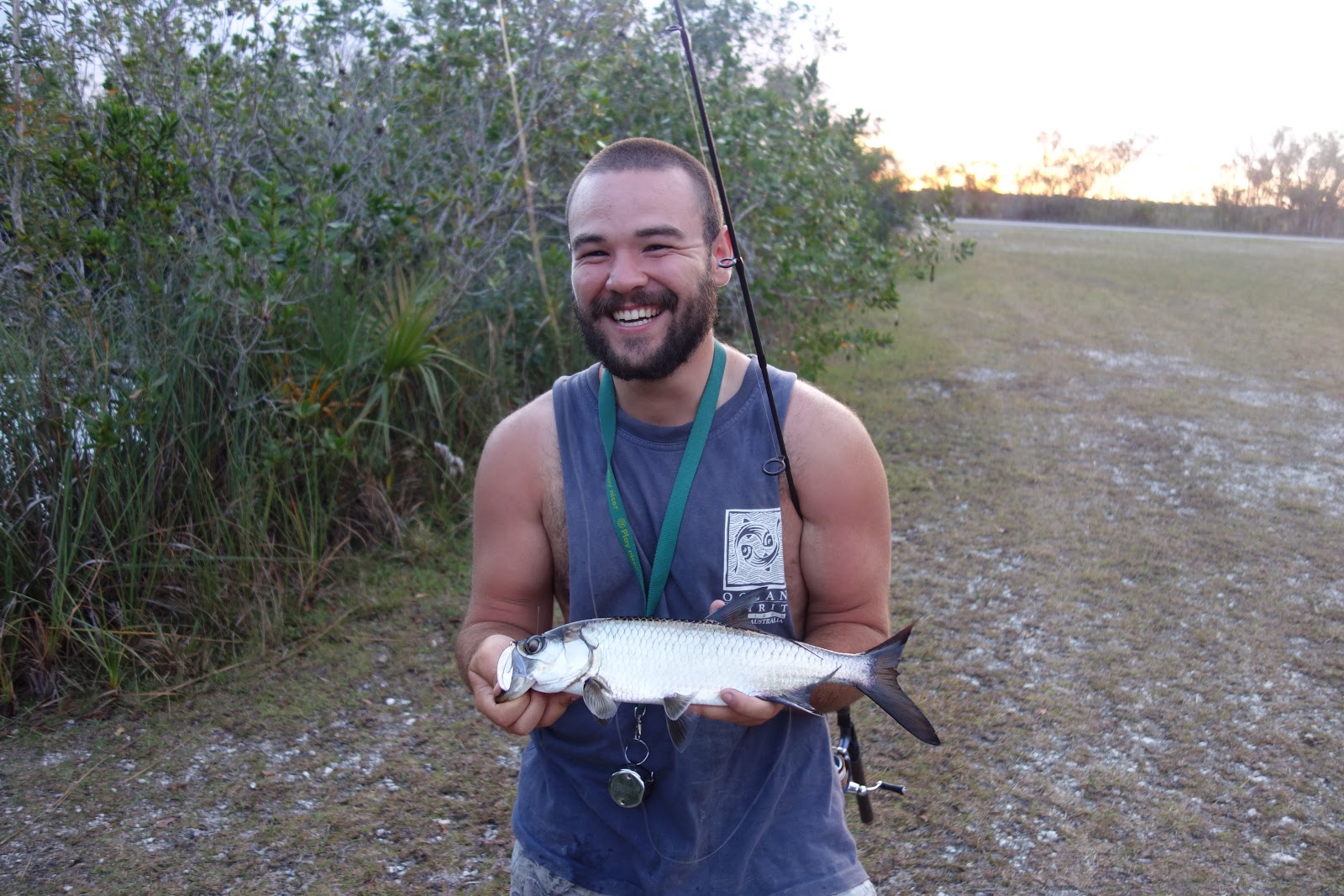
When you've been fly fishing for different species as much as I have, you know how random a lifer can find it's way to you or how much time and effort builds up to it. Tarpon will forever be an outlier for me. I'd struggled many times to even get a look from one, had hooked and lost a couple and missed others incidentally, but that didn't feel like a buildup. My first tarpon ever came a mere handful of missed takes into our evening session. Though there was tenseness (there always is when I'm after a species I've wanted for years) I also had this sensation that this time it was going to happen, without question. I've never had that before, and it was a strange feeling. But when I finally connected and that little baby silver prince went airborne, I smiled and new I was about to hold my first ever tarpon. That feeling can't really be earned; these fish, even little, have an exceptional knack for parting ways with a fly. But somehow I just knew. And there I was, smiling down at one of the very few popular game fish that I actually considered one of my most wanted lifers. Caught on a gurgler at sunset in an Everglades backwater... to quote Jose Wejebe, referring to baby tarpon in his own way, "Nice, happy goodness". This little fish had no idea what it meant to me.
| Atlantic tarpon, Megalops atlanticus. Life list fish #163. Rank: species. |
Then, as if Florida wanted to give us exactly what we wanted on our final fishing evening, Noah and I started getting hit by tarpon left and right. He got his lifer shortly after I did then we both proceeded to miss, hook, lose and land a bunch more while darkness settled in and the mosquitoes started to take the stage. Topwater blasts left right and center. Silver princes going airborne. It was worth the wait to experience proper good juvenile tarpon fishing.
Like the small snook we'd been catching all day, I was deeply aware that these little tarpon were the fish of the future. In a day and age where my hope for the future is beat down left and right, these fish give me a glimmer of optimism. In 40 years who knows what the world will look like. I can't conceive of anything less than apocalyptic. Yet, just maybe, one of the very tarpon we released will make it's annual migration as a big adult, and maybe I'll be there to meet it.
A lot of people have called species like American shad "poor man's tarpon" or called tarpon giant shiners. I've grown to hate these sort of analogies with time. Each fish species is distinct, distinct enough to warrant a different a different last name, and though we fisherman may try to describe different species by alluding to others, it falls short. Having now caught tarpon, shad, and a variety of shiner species... tarpon are tarpon, shad are shad, and shiners are shiners. You have to catch each one to really get it. Tarpon had their hooks in me before I ever had a hook in one, and I'll be back after these fish that simply cannot disappoint.
Friday, May 29, 2020
Everglades Backwater Snook
| The River of Grass, life force of south Florida and beyond. We lose this, we may as well give up completely. And folks... we are losing this. |
Our finale full day in Florida dawned much like many others had: misty, vaguely cool, and calm. I went about my morning routine with the melancholy sense that time was limited. We'd been in Florida for literally weeks. We'd had our failures and our successes. We'd seen so, so much. And now it was just a day and a morning before we pointed the van north and said goodbye. I looked through the mist in the tree line, wishing I'd catch a glimpse of a panther, then breathed deeply and decided to pretend I was just going to stay here forever. As I sit here writing this, I wish I had. I wish could've found some dilapidated shack away from any prying eyes and let Noah go home without me. I might have gotten myself killed at some point in the time between then and now... hit by a car trying to save snakes or turtles in the road, dehydrating away on some distant island of trees, or maybe wrapped around a tree by a skunk ape... I might have ended up dying but I would have been the happiest I'd ever been I think. It took very little time in the Everglades for the pull to overwhelm me completely.
It took some time for me to hit my stride and get into the snook, and it also took us a bit to get used to the fact that most times we saw fish rolling en mass from the van, it was gar not tarpon. Once you've seen enough rolls it's easy to discern the difference while standing on the bank, but not so from a moving vehicle.
We continued to bounce around hoping to suddenly luck into a pile of juvenile tarpon. In one spot I had a definite take from one, but again the rollers were predominately Florida gar.
We hit some midday doldrums after that. I hooked and lost some tilapia, I'm not sure what species, potentially something new, then managed to coax a Nile tilapia off a bed. That was a new species for me.
| Nile tilapia, Oreochromis niloticus. Life list fish #162. Rank: species. |
| (note: DO NOT hold snook even a little bit larger than these vertically as Noah and I are in this photo, their jaws don't support their body weight well.) |
As the sun dropped even more we new we had to find some tarpon. We headed to some known water, then something really special transpired.
Wednesday, May 27, 2020
Everglades After Dark (pt. 2)
The next one was by far the smallest and also the most pretty. It was a gorgeous snake.
After ushering the second cottonmouth out of the road, we decided to take a moment and shut everything off and let the darkness truly envelope us. Without the noise of the van running or any of our lights on, the Everglades consumed us entirely. These was no noticeable light pollution, road noise, or even air traffic. All we could see, because of cloud cover, was the faint outline of the tree line on each side of the road. And all we could here were the insects, frogs, and nocturnal birds that own the 'glades after the sun sets. It as one of the most extraordinary experiences of my life, on par with going dark in Mammoth Caves and seeing a mountain lion up close in the wild. It genuinely took my breath away.
Down the road a it I photographed the first night bird I'd have a chance to on this trip, a black crowned night heron. They are a really cool bird an this was only the second I'd ever seen, so I was plenty happy just to get a mediocre reference shot.
The next snake we found crossing the road was a juvenile corn snake, a little larger than the one we'd found the day before but still a little fella.
Perhaps the coolest wildlife encounter of the night, to me, was a relatively common species but something I'd wanted to see in the wild since I was very young. It was a bark scorpion, species Centruroides gracilis. I'd for some reason expected the scorpions in Florida to be small but this was a large enough arachnid to be quite impressive in person. As someone who has a tendency to fall in love with some of the most widely disliked an often feared animals, I was thrilled to be looking at me first wild scorpion. It wasn't what we'd expected to find but, in retrospect it wasn't at all surprising. It was odd that we only saw one other.
Saturday, May 23, 2020
Spot Hopping Tamiami & Big Cypress Loop
My morning ritual while we camped in Florida consisted of putting some clean clothes on, exiting our tent, stretching, then going to relieve myself. And I have to say; though this may be one of the stranger ways I've ever started a blog post; relieving myself while looking at some of the prettiest scenes I've yet gazed over each morning became such a wonderful routine that I've been disappointed each morning since returning home that I can't simply get up in the early morning, step outside barefoot, walk some distance from the house, and pee with no worries at all of human on-lookers seeing something they don't want to and a hell of a great view to look at while I go about my business. It's those simple little things in life that keep me from falling too deeply into depression. I'm a simple man, I like to watch the sun sparkle off dew and warblers flit around while I take my morning pee.
Noah is less of a morning person, so I usually had a bit of me time each morning. I enjoyed that time especially in the Everglades, because I was just so happy to finally get to see more of one of the most amazing places on the planet.
We decided our first full day would be a spot hopping day. Actually, every day ended up being that, and such is the name of the game on the Tamiami trail. Drive, look, see something fishy, fish it, move on. Or... drive, see big turtle, stop, chill with said turtle, move on.
| Apalone ferox, Florida softshell turtle |
We headed back East along the Tamiami, bouncing spot to spot without much of note for a white. There were a lot of gar and a lot of alligators, but that is to be expected.
| Lepisosteus platyrhincus, Florida gar |
| Alligator mississippiensis, American alligator |
| Lepomis gulosus, warmouth |
| Cichla ocellaris, butterfly peacock bass |
| Astronotus ocellatus, oscar |
I was most hoping for a jaguar guapote, and I saw more than one and I think I missed some takes from them too, but I just couldn't seal the deal. We bounced to a place we'd not been before pretty far east and found loads of small gar and Mayan cichlids before heading back the way we came to get to the Big Cypress loop road. We hoped that we'd find more native fish than invasives there.
| Cichlasoma urophthalmus, Mayan cichlid |
Soon the sky was darkening, and it was time once again for us to set out seeking snakes crossing the road. But that is the subject of a future post.