As most of you hopefully already know, I am a life-list angler. I target, document, and count the number of species, hybrids, and subspecies I catch, specifically on fly tackle. Because of that I spend a lot of time learning about and fishing for many different species of fish. This means I'm more adept at identifying and fishing for an extremely broad range of species than the average fly angler. This series will attempt to outline species identification, some life history, and methods for targeting with fly tackle. Maybe I'll get to every fish on my life list, but considering it is ever growing... it would take a while. Mostly, I hope this will get a few of you interested in going out and learning about or catching something new.
There is a fish that lives in the Mountain West, a salmonid with chrome flanks and gentle appearance. This fish feeds mostly on insects and small crustaceans and worms, and does sometimes rise to hatches. Not only is it good sport but it is fine table fare. Most fly fisherman who have fished for this elegant native fish speak very highly of it....
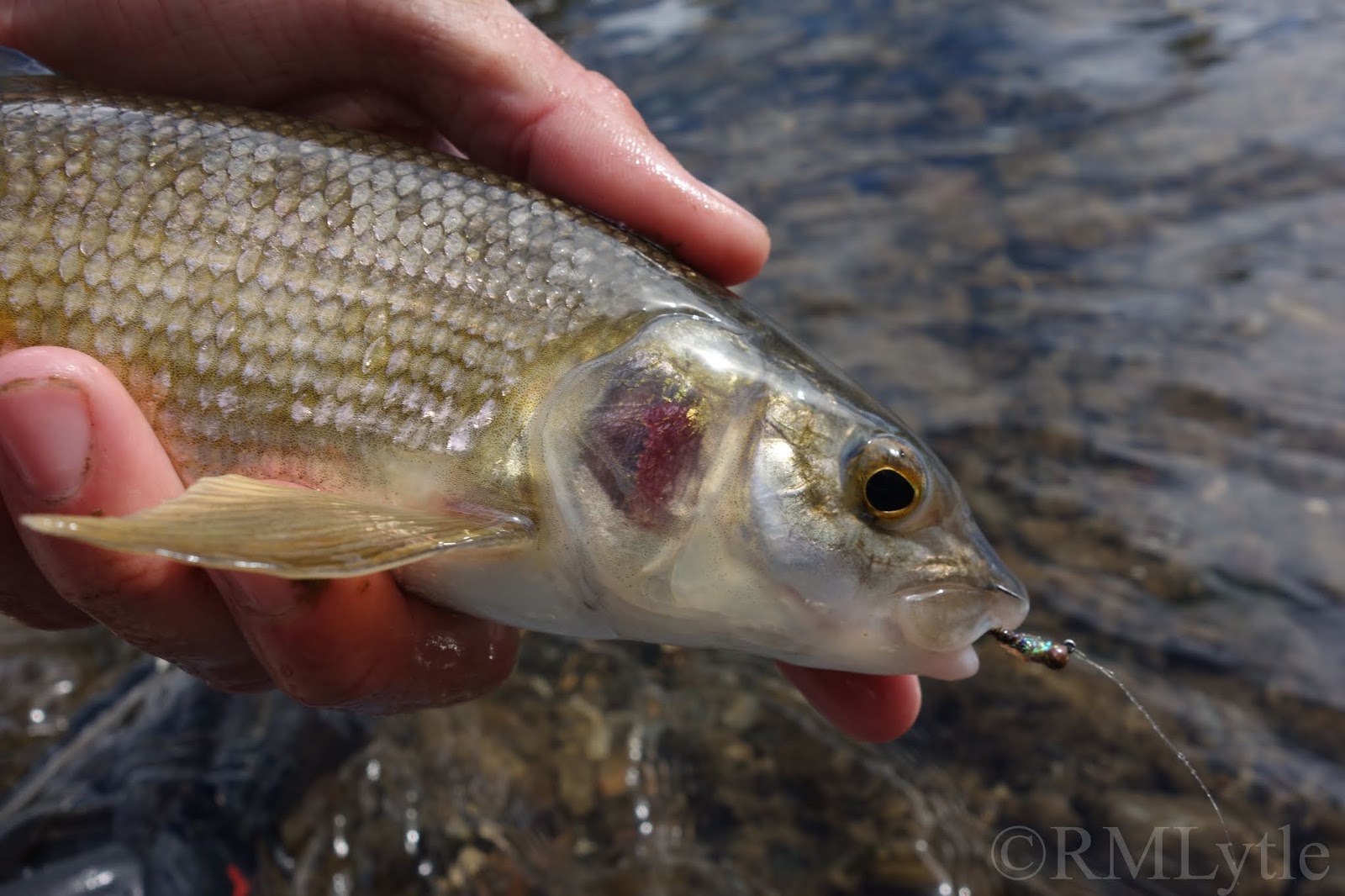
I'm kidding about that last part, the species I'm talking about today is the mountain whitefish, Prosopium williamsoni, and actually a lot of fly fisherman would be perfectly happy to never catch a mountain whitefish. I, of course, am not one of those types, so let's dive in and learn about the small-finned grayling itself, the fallfish of Montana, and try to discern what exactly it is that makes them unlikable (spoiler alert: there's no real legitimate reason they're so disliked).
Prosopium williamsoni
Mountain whitefish are found in cold, clean rivers and some lakes from the Mackenzie River drainage, non-coastal BC, and east slope of the Rockies in Alberta and Montana, most of Washington, Oregon, and Idaho, extreme northern Nevada, Northern Utah, and Northwestern Colorado. There is also a small pocket of mountain whitefish persisting in the Truckee River drainage in California.
Whitefish have much the same sort of habitat requirements as most other salmonids, cold, clean, well oxygenated water with healthy macroinvertebrate populations are necessary to sustain a population. Their overall body shape and fin arrangement is very trout like, but their slightly larger silvery scales and odd shaped face make them appear more like a cyprinid. The upper jaw of the mountain whitefish is much longer than their lower jaw, and looks sort of like a long shovel nose. This snout distinguishes them from other similar species, like cisco and lake whitefish. Mountain whitefish use their snout and pectoral fins to root in the bottom for food items.
A stretch of river in Montana home to numerous mountain whitefish.
Mountain whitefish have a white belly, silvery flanks with olive undertones, and an olive grey back. Their operculum often has a lavender or maroon coloration or iridescence. Adults average between 10 and 16 inches but can grow substantially larger than that, well into the high 20 inch range. They may live 16 years or more. Mountain whitefish spawn in from September through December, depending where in their range they are and seasonal weather trends. Like trout, they cut redds in gravel or small cobble and deposit eggs so they fall into the species between the stones. Eggs hatch in late winter and early spring.
Throughout their range, mountain whitefish are an important forage fish for large predatory fish species both native and non-native, as well as birds of prey and some mammals. Historically, they have been an important food fish and game fish.
In 2016, low and warm waters in southern Montana, conditions tied to anthropogenic climate change, facilitated the spread of a parasite, Tetracapsuloides bryosalmonae. This parasite infected cutthroat, rainbow trout, longnose suckers, sculpins, and dace, but mountain whitefish were especially prone. Massive fish kills hit the Yellowstone River in particular hard, where fish already at risk of mortality from excessively warm waters succumbed to the parasite. Montana FWP temporarily shut down the Yellowstone River to all recreational activities. The impacts of the fish kill were still evident when I fished the area in late 2018. Whitefish numbers were exceptionally diminished.
The Yellowstone
Tactics for catching mountain whitefish on the fly are basically the same as for trout, though there is almost no piscivorous aspect to their feeding, so there is no sense in fishing for them with streamers. Indicator and tightline nymphing, wet flies, and, when schools of whitefish are rising, dry fly fishing, will catch many hard fighting, beautiful whitefish. I found the handful of mountain whitefish I caught while nymphing in Montana to be great fighters for their size and a welcome change of pace from the trout, really weren't any harder to fool.
Really, the prejudices against whitefish held by a lot of fisherman today hearken back to the same sort of "trash fish" mentality that persists in any place people fish. Though "trash fish" was intended originally to refer to the food quality of a fish, it is now used to describe a plethora of wild fish with no regard to their natural importance or sporting qualities. Before whitefish were considered the undesirable species they are in the west today, it was bull trout. Bull trout were intentionally killed in huge number throughout their range, and exist now in highly diminished numbers. Though the prejudice against whitefish hasn't extended to that despicable level, it is harder to find voices advocating for the species than it is to find voices advocating for non-native brown trout, and that is unfortunate.
The mountain whitefish is an odd but beautiful little salmonid, and long may it swim the rivers and lakes of the mountain west.
Until next time,
Fish for the love of fish.
Fish for the love of places fish live.
Fish for you.
Thank you to my Patrons; Erin, David, John, Elizabeth, Brandon, Christopher, Shawn, Mike, Sara, Leo, and Franky for supporting this blog on Patreon.
As most of you hopefully already know, I am a life-list angler. I target, document, and count the number of species, hybrids, and subspecies I catch, specifically on fly tackle. Because of that I spend a lot of time learning about and fishing for many different species of fish. This means I'm more adept at identifying and fishing for an extremely broad range of species than the average fly angler. This series will attempt to outline species identification, some life history, and methods for targeting with fly tackle. Maybe I'll get to every fish on my life list, but considering it is ever growing... it would take a while. Mostly, I hope this will get a few of you interested in going out and learning about or catching something new.
Come September each year, virtually every fly and light tackle inshore angler in southern New England is chomping at the bit watching for the first reports that little tunny, also called false albacore or "albies", have infiltrated our waters.
By contrast, in Florida and along every Gulf Coast state, most anglers just wish "bonita", the exact same fish, would go somewhere else and leave them alone.
Depending on where you live, Euthynnus alletteratus might be anything from a highly welcomed seasonal visitor to a ubiquitous annoyance. But wherever they are found, little tunny are a powerful, startlingly fast moving, beautifully colored pelagic blur.
Little tunny are the most abundant tunoid species in the Atlantic Ocean, existing in virtually all tropical and seasonably warm temperate waters. In the west the are found from Brazil to Cape Cod Bay (where they only occasionally wander through the canal) as well as throughout the Caribbean and Gulf of Mexico; and in the East from Namibia to the water around the south of the UK, and throughout the Mediterranean. Some will say, even some otherwise very authoritative sources, that little tunny exist in tropical waters worldwide but this is not true. Euthynnus affinis, commonly called mack tuna or mackerel tuna, are abundant in the Pacific and Indian oceans and look nearly identical to little tunny in every way, but they are indeed a distinct species.
Little tunny are found inshore, nearshore, and offshore, nearly always at the top of the water column and in large schools except on the occasion that they wander into quite shallow water to feed. It is shaped much like other tunas and mackerels (Scombridae), with a torpedo shaped body. Its two dorsal fins and seven finlets, as well as its pectoral, pelvic, and anal fin can retract down tight, making the fish as streamlined as possible. Each fin fits perfectly into a slot on the fish's body. With a broad, crescent shaped tail, the little tunny, like every other species closely related, shoots through the water at astonishing speed. At a good clip these fish can exceed 40 miles per hour. These "albies" have white bellies, silvery iridescent sides, and olive to green to navy blue backs with black worm-like markings. There are at times dark spots just behind and under their pectoral fins, and indistinct vertical bars. They are an objectively beautiful fish. Like other tunas, little tunny are actually warm blooded and need to swim continuously to breath.
Little tunny feed in a coordinated fashion, organized schools of anywhere from just a few to hundreds corral baitfish from below then charge into the schools with mouths open, doing what Ian Devlin calls "ram induction feeding". With huge eyes they are also very adept at picking out and chasing down a single stray baitfish, even a tiny bay anchovy. This species feeds on small baitfish like silversides, anchovies, menhaden, and sardines, as well as small squids and, when they are near the surface of the water, small crabs and other crustaceans. On this diet they can grow to over 35 pounds, though depending on where you live you may never get to see one over 15lbs. Large little tunny can be found off the Carolinas and East Florida reliably at certain times of year. Mike Laptew has captured some incredible underwater video and photos of little tunny feeding for his seminar series "Focus on Fish" (Laptew Productions), and Peter Laurelli captured some extraordinary drone footage and included it in his 2018 short film SIFF18: Four Years For Life, which is worth watching every second of anyway:
Little tunny are offshore broadcast spawners. Depending where they are the may spawn anytime from April to November but typically spawn when the water is at its peek temperature. They are extremely prolific, living rarely as much as 10 years but producing millions upon millions of offspring during that time, one of a number of factors leading to their abundance. IUCN list Euthynnus alletteratus as a species of least concern. With a flavor that is generally considered undesirable there is a very limited commercial fishery for little tunny. They are a species with the sort of abundance and life cycle of mahi mahi, but they taste awful. So, though there are a few people here and there getting concerned about the increased frequency of articles about how to make an albie palatable, it is highly unlikely I'll be back here any time soon to talk about how badly we need conservation measures to be enacted to protect this species. That said, they are an ever more important fish for the light tackle charter industry here in the northeast. While striped bass numbers continue to decline, there's no fewer albies in the stock. Unfortunately though, they are not reliable here. Any given year there could be lots, there could be few, they could well not show up at all. Some years, like this year, they are highly localized, leaving shore bound anglers and boaters that don't want to burn hundreds of dollars of gas a week shit out of luck. In 2017 Noah and I caught our first little tunny of the year in CT on September 11th, and I caught the last on November 7th in RI. In 2019, I caught my only albies of the year in RI on September 14th and only saw them in CT one time, on the 15th of October. Little tunny are not something we can count on here, which is why it's so important to rebuild striper stocks if the inshore light tackle charters are to stay in business. And the reality is, as abundant as false albacore are, there is still an awful lot we don't know about them. I have yet to get a straight answer as to what they do after dark. They seem to completely vanish shortly after the sun goes down. Where do they go?
Catching little tunny on the fly isn't especially complex or difficult, but it does require the angler to be calm and collected under high-stress high-excitement situations. Little tunny feed fast and furious and fight fast and furious, if you aren't ready you WILL mess it up. In the Northeast, an 8, 9, or 10wt rod is preferable, while in the Carolinas, Florida, and the Gulf, a 11 or 12wt is preferable, not just because the fish are much larger on average there but because there are usually some sharks around that are going to try to eat a hooked fish. In the Mediterranean you are likely to use a fly rod that heavy or even more so because big tuna are sometimes mixed in with little tunny there. A reel with capacity for 200yds+ of backing and a smooth drag are necessary anywhere you fish for these speedsters. What fly line you should use is highly situational. Most will recommend an intermediate sinking line, but that's not really my style. I often fish a floating line for albies so I can skitter a fly on the surface. When I'm not fishing a floating line I'm either using some sink tip, or, especially when its windy or the fish aren't showing on the surface, a full sink. Whatever setup you choose, make sure it is something you can achieve a fast line-speed with. Making fast, long casts with as few false casts as possible is very important. Whether fishing from a boat or shore, a stripping basket is usually a good thing to have to minimize tangling and give you the ability to move around without having to reel up completely. My preferred leader is 8ft of 20lb Berkley Trilene Big Game, though sometimes fish are picky and I cut back 4ft and tie on 5ft of 15lb or 12lb, depending on exactly how picky the fish seem to be. That may seem very light for such a hard fighting fish, it really isn't. You can and should put an awful lot of pressure on 12lb tippet. I've actually used as light as 8lb in the past, and still landed these speedsters in short order.
Flies for false albacore are also fairly simple. Typical Clousers, Deceivers, and Surf Candies catch plenty of albies. It is a good idea to match the fly to the forage. Most often in southern New England false albacore are feeding on bay anchovies, peanut bunker, or silversides. Less often you need to imitate squid or butterfish. In many cases, matching very tiny bay anchovies is the key. A surf candy an inch long is probably the best fly for the job. Under flat calm conditions I've found a small gurgler is the best fly to catch tricky little tunny.
Under conditions like these, tie a size 6 or smaller gurgler on.
Finding little tunny is kind of a roll of the dice, as they seem to be both everywhere an nowhere at the same time. But they will generally be where the most food is, lie any predator fish. Good shore spots typically feature steep rocky drop offs, jetties, or piers, though beeches can sometimes also be productive. Look for schools of baitfish in the water, birds working, and the tell-tail big slashes that all tuna and mackerel make when they feed. Prime feeding windows typically run from sunrise until almost noon and for a couple hours before sunset, but I've seen little tunny feed heavily at all times of day from dawn till dusk, and under all sorts of tide and wind conditions. Moving tides are normally better, and an incoming tide is undoubtedly much better at breechways and inlets, but I've caught little tunny at slack tide on more than one occasion. One definite limiting factor is water clarity. If there is a lot of particulate in the water, if it is notably murky, you may as well fish for something else. These are sight-based predators, and they seem not to like muddy water.
Little tunny addict Mark Alpert works the end of a long jetty during a rare November bite.
Presentation varies as much as fly selection. The typical little tunny retrieve is a fast, continuous two-hand roll, and this does work most of the time. But not always. There are days or tides when the ideal retrieve is none at all: simply cast into breaking fish and let the fly sink. Other times, long, erratic strips work best. To make long strips into a stripping basket, hold your rod way out in front of you instead of into your body, it increases the distance you can strip between your rod hand and stripping basket. If and when an albie does eat the fly, keep stripping until the fish starts its initial run, then lift the rod to fight the fish. Never let go of the line with either hand until the fish is on the reel, but also make sure it can slip through your fingers without abrupt catches and stops that cause it to jump around and potentially tangle on itself, on you, on the reel, or on the rod. Remaining calm and collected is key, and it can be hard to do if you've never done this kind of fishing... in all likelihood you've never hooked a fish that fights anything like a little tunny. Keep a deep bend in the rod and fight the fish as quickly as you can. These fish can and will fight themselves to death if you let them. Once to the boat or to the rocks, grab the fish by its caudal peduncle, take photos as quickly as possible if you are going to, then release the fish either by plunging it in head first or, if it was a very short fight and brief time out of the water, just put it in the water and give it a little shove.
Mark releasing a little tunny.
Of course if you're in Florida, you don't need to worry about any of the presentation stuff, even the the little tunny down there are much bigger they seem to be much less picky and will eat just about anything you throw them. Use heavy tippet and fight them as hard as humanly possibly to keep them away from the sharks, and then kill that fish when you do land it and use it to chum in those same sharks so you can catch them on the fly. I'm only being a little facetious, I might actually be doing just that right now. But I'll never turn my nose up at a little tunny no matter where in the world I am.
Until next time,
Fish for the love of fish.
Fish for the love of places fish live.
Fish for you.
Thank you to my Patrons; Erin, David, John, Elizabeth, Brandon, Christopher, Shawn, Mike, Sara, Leo, and Franky for supporting this blog on Patreon.
As most of you hopefully already know, I am a life-list angler. I target, document, and count the number of species, hybrids, and subspecies I catch, specifically on fly tackle. Because of that I spend a lot of time learning about and fishing for many different species of fish. This means I'm more adept at identifying and fishing for an extremely broad range of species than the average fly angler. This series will attempt to outline species identification, some life history, and methods for targeting with fly tackle. Maybe I'll get to every fish on my life list, but considering it is ever growing... it would take a while. Mostly, I hope this will get a few of you interested in going out and learning about or catching something new.
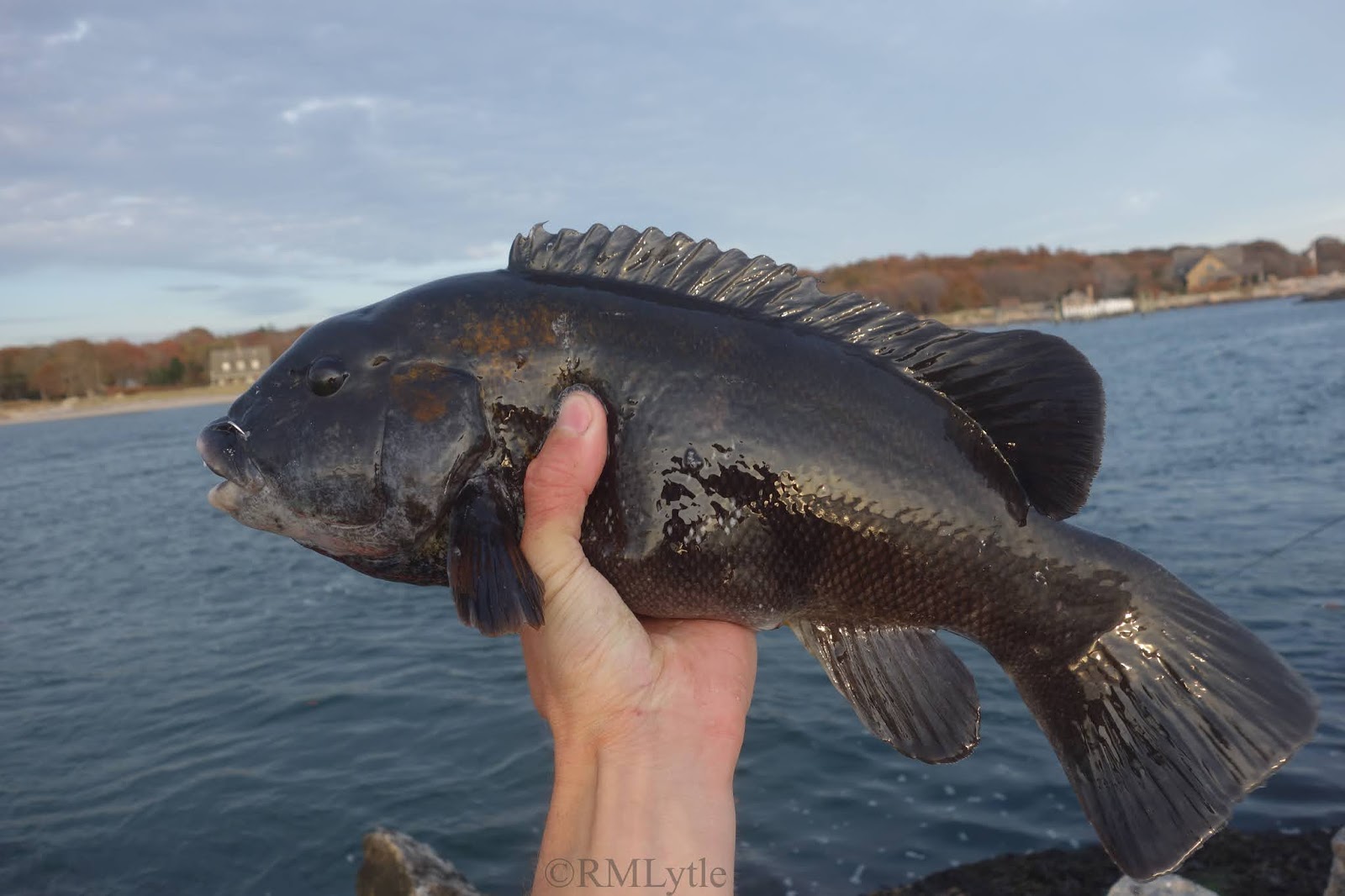
Tautog, Tautoga onitis, or blackfish, are becoming ever more popular a species to target in the saltwater here in the northeast every year. Part of that is because of the declining quality of striped bass fishing, and part of it is the length of time the season lasts. Well after the last little tunny has left and fluke fishing is over, when the last of the seasons migrating stripers are popping up here and there, the tautog bite is still going strong. But if you aren't from the Northeast, or you don't fish saltwater, you probably know nothing of this species. And, even if you do know a thing or two about tautog, you may not believe they can be caught on the fly.
Tautoga onitis
Tautog are a member of the remarkably diverse family Labridae, the wrasses. Wrasse come in a striking array of shapes, sizes, and colors, and aside from being diverse they are a notably intelligent group of fishes; more on that to come. Tautog are varied in coloration despite their commonly used nickname in the Northeast, blackfish. Tog can be mottled, brown and grey, white and black, with patches of bronze, copper, sometimes even teal or green. Juveniles are typically much more colorful than adults.
Large adults are sometimes called "white-chinners" because their lower jaw is often white in coloration, whereas smaller younger individuals are darker. Tautog are generally similar in appearance to another wrasse that inhabits the same areas and the same structure, the bergall or cunner. Tautog are more deep-bodied than cunners. Cunners have a pointed head, tautog have a round head. A large adult cunner is far smaller than even an average tautog. Both have rubbery skin, small scales, a spiny though not visibly so dorsal fin, and are very difficult to keep a hold of because of a thick but not especially unpleasant protective slime layer.
Tog can be found from South Carolina to Nova Scotia but are especially abundant from Virginia to Massachusetts. They inhabit a wide depth range from well over 100ft to just six inches of water. Migration in and out of shallow water depends on temperature, when the water is at its coldest tautog will be wintering offshore at the deepest extent of their range. As the water warms in the spring, tautog move inshore to spawn. The species shows strong preference for hard structure, be it rocky shorelines, reefs, bridge pilings, or wrecks; however they also occasionally can be found over shallow sand or mud flats. Tautog feed on a variety of crustaceans, clams, aquatic worms and sometimes other fish, but their affinity for crabs is well known. Equipped with big flat teeth and a strong jaw, they are perfectly adapted to cracking open the shells of crabs and sucking out the meat. Molar like teeth toward the back of their mouth can even crush up barnacles.
Tautog spawn during the spring in and around estuaries. I personally routinely see large adult tautog in the same places every spring, often holding to the exact same big boulders or bridge pilings each year leading up to the spawn. Some research suggests offshore spawning may occur to some extent, as well as drift of eggs and larvae from inshore waters. It seems the youngest life stages of tautog rely heavily on underwater vegetation for concealment until they reach sub-adult size and join the bergalls on the inshore rock piles. Eel grass is notably important. From NOAA Technical Memorandum NMFS-NE-118, Tautog (Tautoga onitis) Life History and Habitat Requirements, Frank W. Steimle and Patricia A. Shaheen: "In the Weweantic River Estuary (Massachusetts), the greatest abundances of eggs and larvae were collected over eelgrass (Zostera marina)-vegetated sites and near bottom (Stolgitis 1970)."
And:
Several studies reported that young tautog (less than 10 cm) prefer vegetated over unvegetated bottoms (Briggs and O’Connor 1971; Sogard et al. 1992; Dorf 1994; Dorf and Powell 1997). These preferred, vegetated habitats are reported to range from primarily eelgrass beds (Goode 1887; Grover 1982; Orth and Heck 1980; Heck et al. 1989; Sogard et al. 1992; Szedlmayer and Able 1996) or a mix of eelgrass and algal associates [i.e., sea lettuce (Ulva lactuca), Enteromorpha sp., and Polysiphonia] (Briggs and O’Connor 1971), to beds of mostly Ulva (Nichols and Breder 1926; Sogard and Able 1991).
Though like virtually all fish they grow quite rapidly as juveniles, tautog are actually a slowly maturing and slowly growing species. A tautog doesn't reach maturity until three or four years of age, with females taking on average longer than males. The incredible 28.83 pound all-tackle world record was estimated to be 22 years old and the species is estimated to live as long as 34 years or more.
Now, I've thrown in the seeds here and there, maybe you have noticed maybe you haven't... but the combination of the tautog's habitat, life history, and flavor have put them in a rough place as their popularity grows. Unfortunately, this isn't the sort of species that is popular entirely for its sporting qualities, and they do have that in spades. I mentioned earlier the intelligence of wrasse. Anyone that has spent time fishing for tautog can't deny their knack for making off with the bait without getting hooked. Tautog seem to be very inquisitive, and reacting to sounds and smells and coming in to inspect things closely. I've heard stories of spear fisherman scraping their spear on a rock to pique the interest of hiding tautog, whose curiosity then leads them into the shooter's sights. The fighting capabilities of tautog are equally impressive. They don't have long term stamina but their muscular body and big, broad tail give them all the power they need to rush back into their rocky lairs after being hooked. Set the hook on a tautog and you'd better be ready to give that fish all you've got. Unfortunately, what comes to mind most in association with tog is how good they taste. I am the last to say tautog aren't a good eating fish, they are absolutely delicious. I keep a couple most seasons, and enjoy every one. But our affinity for tautog as table fair, in combination with declining fisheries for other species like fluke and striped bass, the rising popularity of tog fishing, and their ecology is leading to declining numbers. The vegetated bottom young tog rely on for survival is being decimated up and down the coast, especially eel grass. And according to ASMFC, tautog are overfished and overfishing is occurring in Long Island Sound, New Jersey, and the NY Bight, and are overfished in Delaware, Maryland, and Virginia. It's important that we anglers start to see the value of tautog as more than just food. I'm not going to stop eating tautog just yet, and I'm not suggesting you need to either. But harvesting selectively is a good idea. Tautog don't migrate that much, your local population is pretty much your local population with a little bit of exchange between other populations. Keeping big, genetically strong tog in the gene pool is a good idea, so as much delicious meat in on that 10+ pounder, you should probably let that one swim and keep a smaller one instead. Consider going out and catching tautog just for fun sometimes with no intent to put meat in the box at all. They really are a lot of fun, great sport on light tackle... and with that let's delve into targeting them with the fly rod.
When I initially started targeting tautog on the fly I was told by quite a few people that I probably wouldn't catch any. It was difficult, and that wasn't surprising. Everybody was targeting this species with crabs on fish finder rigs and jigs, sometimes on sand worms in the spring, but hardly ever on artificials. I had to accept that, no matter how hot the bite was, I was going to have to settle for far fewer and smaller fish than I could catch on crabs. But, getting the chance to catch even one of these bulldogs on fly tackle was worth trading for the numbers.
I've found that it can be difficult to nail down a pattern to catch tautog on the fly, they are very moody and can be at times startlingly easy on artificials and at others very difficult despite taking a bait readily. Though tautog do feed on the flats, in CT they do so mostly in mid to late spring when it isn't legal to target them, so I primarily fish for them around man-made structure like jetties or bridges when the season is open. I also fish for them from boat or kayak over reefs, along breakwaters, or around islands. Crab flies like the Merkin and Simon's HoverCrab can catch a tog or two, and in situations where big tog can be sight cast to they might be the best choice. But I've caught most of my fly tautog on stonefly nymphs like Strolis' Shimmer Stone, and on simple small Clousers. Red over white, orange over white, and olive over yellow in sizes 2, 4, and 6 are my favorites, tied short. Less than an inch of hair beyond the bend of the hook is preferable as tautog are liable to nip the fly once very quickly and then never come back for a sniff again. I fish these flies on a 20 ft leader, 17ft of 20lb test Berkley Big Game to 3 feet of 16lb, either directly to the fly or to a small drop shot weight. Essentially, this is salt water mono-rig nymphing. Lob the fly or fly and weight around rocky structure and try to work it around boulders and into the holes where tautog might be residing. Sometimes I'll drop flies right into holes in jetties. When you feel a tick, set with a quick jerk in tandem with a strip. Set too hard though into a rock or an unyielding giant tog and you are liable to blow up your rod, so be careful setting the hook with this sort of vertical tight-lined presentation. If you get so lucky a to convince a tog to eat a fly and manage to set the hook, the next 15 seconds will determine whether or not you actually catch that tog. There's not much space between that angry fish and its rocky hiding spot, and it will try really, really hard to get back there. I don't own the perfect fly rod for this job yet but some of you may already have it. It's the unfortunately discontinued G. Loomis Short Stix 10/11, a beefy but also short lever that was designed with input from my friend Ian Devlin along with Mark Sedotti for entirely different purposes but may well accidentally also be the ideal tautog fly rod. I remember when I first held one in my hand a while back, knowing basically nothing about it, and my first thought was, "this would be great for tautog". That was when I was first starting to target the species and I was getting very frustrated with with conventional 9ft fly rods, I found them too long too be effective, and just not what I needed to set the hook into a tog then wrench it away from the structure. I've even gone down to 5/6wt glass rods just to get better vertical hooksets even though it meant I had less power to then land the fish because I was so tired of missing bites. I am confident any rod rated 8wt or above at a length of under 8 feet is preferable if you can get your hands on one. Not that many people are out looking for a dedicated tautog rod, but these short fly rods are incredibly versatile anyway so you can just add reefing tautog to the list of things they'd be great for.
Situationally it is possible to sight fish for tautog, and if you can see them that is ideal because you can judge their reaction to your presentation. Whether it's just to fish hanging around rocky structure or to tog tailing on the flats, sight fishing is one of the greatest learning opportunities you could be presented with. And you never know when it might happen, here's former fishing editor of Field & Stream, Joe Cermele, on the boat with Captain Eric Kerber of On a Mission Fishing Adventures, catching tautog on the fly at night on a lighted bridge:
Tautog on the fly is really one of those few remaining "final frontiers" in fly fishing in this part of the world. It is worth trying, especially since tautog and other bottom dwelling species often make themselves targets when other more traditional fly rod species don't. They've become one of my favorite fish to fish for. Being such a quirky, energetic, interesting looking species meant it didn't take much to earn them that.
Until next time,
Fish for the love of fish.
Fish for the love of places fish live.
Fish for you.
Thank you to my Patrons; Erin, David, John, Elizabeth, Brandon, Christopher, Shawn, Mike, Sara, Leo, and Franky for supporting this blog on Patreon.
As most of you hopefully already know, I am a life-list angler. I target, document, and count the number of species, hybrids, and subspecies I catch, specifically on fly tackle. Because of that I spend a lot of time learning about and fishing for many different species of fish. This means I'm more adept at identifying and fishing for an extremely broad range of species than the average fly angler. This series will attempt to outline species identification, some life history, and methods for targeting with fly tackle. Maybe I'll get to every fish on my life list, but considering it is ever growing... it would take a while. Mostly, I hope this will get a few of you interested in going out and learning about or catching something new.
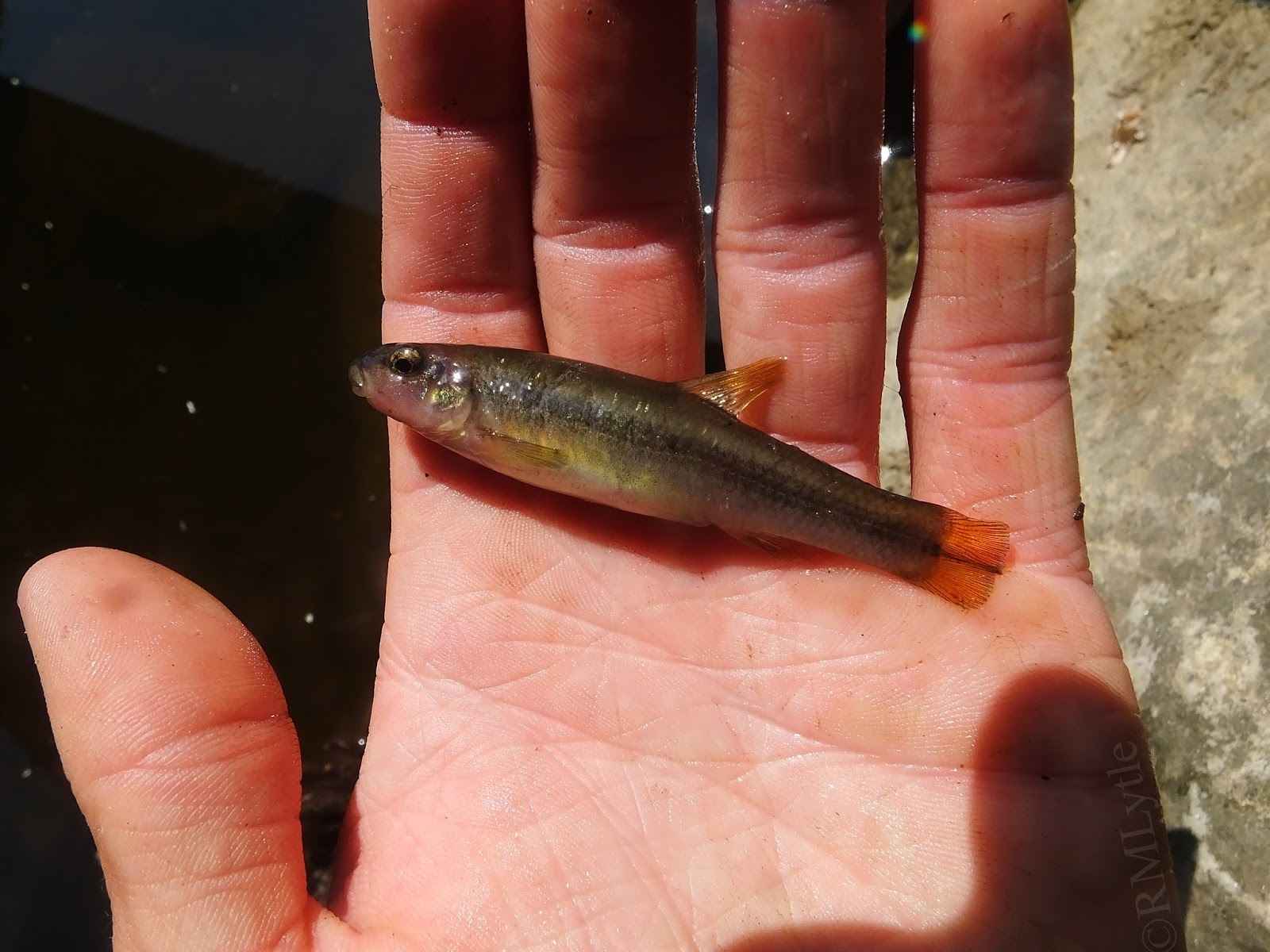
If you've ever walked around a sand flat or through a salt marsh at low tide on the Atlantic coastline, you've probably seen hoards of small fish schooled it surprisingly shallow water, sometimes just in shallow puddles cut off from the sea by the tide. In most cases, these fish are some species of killifish. Here in CT most people simply use the name mummichog, which is a killifish species, but not always the one being called by that name. There are actually more than 1000 species of killifish in numerous different families. From the northern portions of the east central Florida to New Hampshire though, if you are looking at killifish in salt water one of the likely species candidates is the striped killifish.
Fundulus majalis
Striped killifish are the largest killifish in most of the places they are found, growing to 6 or 7 inches. The largest striped killifish I've personally caught was a monster at 7 1/2 inches long. Specimens as large as 8 inches are possible. Striped killifsh are slender with a pointed mouth and upturned snout. Their belly is white in color, their sides silvery grading into an on live back. The distinct black stripes that give the species its name also serves to distinguish between males and females. Males have vertical stripes, females have mostly horizontal stripes and usually some vertical ones, a clear example of sexual dimorphism. Females also get a bit larger than males.
The fish in the first photo is a male, this one is a female
It should be noticed that most killifish from the same areas have vertical barring patterns, however the distinct dark black bands of the striped killifish set it apart from the other species it could be mistaken with.
NOT a striped killifish. Do you know what species it actually is?
Striped killifish have a high salinity tolerance and a high temperature tolerance. They can often be found in extremely shallow, hot, salty water. At low tide at night it is actually pretty easy to catch them by hand, walking around with a headlamp on. They spawn in the shallows from early spring through early fall, and individuals can spawn repeatedly in one season. Eggs may hatch in as little as 12 days in very warm water. Striped killies live three to five years on average, and feed on a variety of macroinvertebrates and microorganisms.
Catching striped killifish on the fly isn't a complex affair. Walk the edges of a bay or tidal creek between April and November and look for schools of killifish, then drop a tiny nymph into their midst. A size 18 is small enough in many circumstances, but I routinely go down to 20's or smaller and sometimes use tenago hooks when targeting killifish. Sometimes they can be a little picky towards an artificial fly, carrying a bottle of anise extract might not be a bad idea but isn't necessary most of the time. If killies are spooked though, it is hard to get them to eat anything at all.
Until next time,
Fish for the love of fish.
Fish for the love of places fish live.
Fish for you.
Thank you to my Patrons; Erin, David, John, Elizabeth, Brandon, Christopher, Shawn, Mike, Sara, Leo, and Franky for supporting this blog on Patreon.
As most of you hopefully already know, I am a life-list angler. I target, document, and count the number of species, hybrids, and subspecies I catch, specifically on fly tackle. Because of that I spend a lot of time learning about and fishing for many different species of fish. This means I'm more adept at identifying and fishing for an extremely broad range of species than the average fly angler. This series will attempt to outline species identification, some life history, and methods for targeting with fly tackle. Maybe I'll get to every fish on my life list, but considering it is ever growing... it would take a while. Mostly, I hope this will get a few of you interested in going out and learning about or catching something new.
Cutlips minnows are one of the most unique freshwater fish in North America. It may not appear to be anything out of the ordinary on first glance, as with most small freshwater fish of it's variety if the average angler caught one they'd just call it a minnow or a dace or a chub and call it a day. But if you get to know Exoglossum maxillingua, you realize how weird this little fish is.
The cutlips minnow has a relatively small range, From extreme northern North Carolina up north along the Atlantic Slope to the St. Lawrence, barely edging into western CT, MA, and VT. Introduced non-native populations exist in close proximity to their native range, where they were most likely released from bait buckets. The species prefers clean freestone streams and resides mostly in slow moving pools rather than riffles and fast water. They may also be found in some lakes. At a glance they don't differ that much from creek chubs in appearance, with an olive colored back, white belly, and frequently well defined lateral stripe, and an average size of about 5 inches. They spawn in the spring around the time most other North American cyprinids spawn. Males build small peddle mounds, similar to the spawning behavior of fallfish but on a smaller scale.
The clearest distinguishing trait of the cutlips minnow, and the one it gets its name from, is its lower lip. The lower jaw of the cutlips minnow consists of three lobes, with the middle one protruding out farther. This is an adaptation that has arisen through utilization of very small mollusks and insects as a food source. Cultlips minnows use their lower lip to scrape tiny snails and nymphs off of stream bed rocks.
But that is not all cutlips utilize their uniquely evolved mouth for. Oh no. Far from it.
They also use it to pry the eyeballs off of other live fish.
That doesn't sound right, does it? How can that possibly be true? Well, it is. When times are tough, cutlips minnows scoop the eyes out of other fish species and sometimes each other and eat them. A such, they are probably not a great choice for a multi species aquarium. Interestingly, a study done by Antonios Pappantoniou of Fordham University found that "camouflage in the form of eyespots and eye lines did act to either confuse or misdirect the eye-picking attacks of the cutlips minnow."
So, intriguingly, not only can eye like markings on various fish prevent large predator fish from successfully targeting the head of the prey in question, it can confuse the small, eye-eating cutlips minnow.
"False eye" exemplified by an adult Cichlasoma urophthalmus
If you want to catch a cutlips minnow on the fly, first of all make sure you are fishing where they exist. The methods are pretty simple. Fish small nymphs in clear pools and look for schools of minnows to cast into. When you catch one, take a close look at its lips to verify that it is indeed a cutlips. Then, marvel at the fact that the little minnow you are holding has one of the most wild and bizarre eating habits of any fish. If you choose to admire fish not only for their size, their coloration, or their edibility, but for their incredible diversity of behavior and anatomy, it opens up a whole new world of fishing to you. Fish are a amazing. That, in the end, is what the "species profile" series is all about.
Until next time.
Fish for the love of fish.
Fish for the love of places fish live.
Fish for you.
Thank you to my Patrons; Erin, David, John, Elizabeth, Chris, Brandon, Christopher, and Shawn for supporting this blog on Patreon.
As most of you hopefully already know, I am a life-list angler. I target, document, and count the number of species, hybrids, and subspecies I catch, specifically on fly tackle. Because of that I spend a lot of time learning about and fishing for many different species of fish. This means I'm more adept at identifying and fishing for an extremely broad range of species than the average fly angler. This series will attempt to outline species identification, some life history, and methods for targeting with fly tackle. Maybe I'll get to every fish on my life list, but considering it is ever growing... it would take a while. Mostly, I hope this will get a few of you interested in going out and learning about or catching something new.
I'm in a rather unique position for writing this "Species Profile" installment. Erimyzon sucetta is an interesting little fish. It rarely ever gets caught. There are two life listers that I know of that have caught a lake chubsucker: Jessel Sanchez (instagram) and a friend of his who I only know as Species Spotlight (instagram). They both caught theirs on bait in the same location. Then there's me. On the 29th of December, just after sunrise, in a little ditch outside of Jupiter, Florida, I became the first person on record to catch a lake chubsucker on the fly. I didn't even know what a lake chubsucker was before that trip, though creek chubsuckers are on my radar. But I've learned quite a bit about the species since. Certainly enough to write an accurate profile. So, lets examine one of North America's most notoriously evasive sucker species, shall we?
Lake chubsuckers belong to the genus Erimyzon with four other species. They are generally small in size, maybe reaching 10 inches, deep bodied, have a small protrusible mouth, an olive colored back, silvery to golden colored sides, and yellow to white belly. Adult males get tubercles on the head and anal fin during spawning.
Lake chubsuckers can be found in watershed from New York to Wisconsin, and down to the Gulf Coast from Texas to Florida. Though their range covers a large part of the U.S. and a bit of Canada, it has lots of gaps. Basically the entirety of the Appalachian mountain range, for example. Their preferred habitat is clean, weedy lowland swamps, lakes, and creeks. Their range reflects this: they aren't found in especially hilly places. Habitat degradation is a significant threat to the species. Mining, development, and diverting waterways put lake chubsuckers at risk. Simply changing the turbidity of a water body is enough to push this species out. They have been extirpated in a number of portions of its historical range.
Warm, clear, clean, still water with an exceptional amount of weed coverage will harbor the greatest abundance of chubsuckers. They also prefer a bottom of sand mixed with organic debris. Spawning occurs from March through July. males will clean an area of gravel or vegetation, females will disperse their eggs, and the males will then fertilize them. Individuals generally have a life span of five years. Algae, copepods, and chironomid larvae are all important food sources for lake chubsuckers, and vegetation may make up as much as 70% of their diet.
Lake chubsuckers can be exceedingly difficult to find. So much so that the state of New York isn't even entirely certain that the species still exists there and are actively trying to locate extant populations to determine whether they have been extirpated or not. This evasiveness is one of the things that makes catching the species on hook and line very difficult. The other is that diet... vegetation eaters can be extremely picky.
A marsh in Florida inhabited by lake chubsuckers
So, do you want to catch a lake chubsucker? It may well be one of the most extraordinary challenges in angling. On, fly, on bait... any method of hook and line angling... trying to catch this species will be one of the most difficult things you ever try to do. But I do have a few pointers.
Since they are very hard to find, you need to narrow your search extensively. First, make sure you are actually looking withing their range. Then, try to get in touch with local fisheries biologists. Look for electro-fishing data. Find the places that have the highest abundance of the species. Then, look for places that have big swings in water level seasonally. You want to find scenarios that will concentrate the fish. This is probably the only reason why I caught my own lake chubsucker: we were fishing a small, deep culvert ditch in the middle of a very expansive marsh during Florida's dry season. Fish that would otherwise have been spread out through weedy water where they wouldn't have been seen were concentrated in one clear pool. This is especially necessary because you are going to need to sight fish to this species. There is no other alternative. If you can't see them, you won't catch them.
If you've actually succeeded in finding a place with visible and very concentrated numbers of lake chubsuckers, start fishing it regularly, at different times of day, during different conditions. Dap small nymphs in front of as many fish as possible. Eventually, one might eat. Noah and I visited our little Florida ditch a bunch of times and on all but one visit the chubsuckers just weren't willing to move to anything. On that one outlying visit, I got a number of them to move to a Walt's Worm, and eventually did hook one. I wish I knew why they were willing on that visit, but there weren't any standout variables. Basically, catching a lake chubsucker is going to have to be the result of either a ton of luck or a ton of hard work. But I'd say it is worth the effort. These are a fascinating little fish, and, like I said, probably one of the greatest challenges in the sport of angling.
If you enjoy what I'm doing here, please share and comment. It is increasingly difficult to maintain this blog under dwindling readership. What best keeps me going so is knowing that I am engaging people and getting them interested in different aspects of fly fishing, the natural world, and art. Follow, like on Facebook, share wherever, comment wherever. Also, consider supporting me on Patreon (link at the top of the bar to the right of your screen, on web version). Every little bit is appreciated! Thank you to my Patrons, Erin, David, john, and Christopher, for supporting this blog.
As most of you hopefully already know, I am a life-list angler. I target, document, and count the number of species, hybrids, and subspecies I catch, specifically on fly tackle. Because of that I spend a lot of time learning about and fishing for many different species of fish. This means I'm more adept at identifying and fishing for an extremely broad range of species than the average fly angler. This series will attempt to outline species identification, some life history, and methods for targeting with fly tackle. Maybe I'll get to every fish on my life list, but considering it is ever growing... it would take a while. Mostly, I hope this will get a few of you interested in going out and learning about or catching something new.
It may seem strange that I'd cover such an iconic, classic, well known, broadly written about species in my species profile series, especially given the ones I've covered so far (rock bass, bluefish, sea lamprey, hickory shad), but if you think you know everything there is to know about brown trout, you probably don't. I know I don't. But my quest to learn as much about every species I fish for as possible has lead me down some very interesting paths when it comes to Salmo trutta. There are a lot of misconceptions about, well, almost every fish people like to fish for, but definitely for brown trout. This won't follow the same format as my other species profile posts, but it seeks to do the same thing: teach.
So, let's dive on in.
Fish of Many Flavors
Brown trout come in many different shapes, sizes, colors, and behaviors. Throughout their native range in Europe and North Africa, different brown trout populations had a lot of time in a variety of very different habitats to evolve into different strains, sometimes even in the same bodies of water. The amount of genetic variation in the brown trout species is staggering, and so obvious there were times when different strains or groups of strains were considered species onto themselves. In Carl Linnaeus' Systema Naturea in 1758, three different species were described that today all fall under the singular species, Salmo trutta. Salmo trutta described sea run brown trout, Salmo fario described fluvial brown trout, and Salmo lacustris described lake dwelling brown trout. Other biologists deemed the differences in strains between bodies of water or even the same lakes different enough to be worthy of species or subspecies ranking. Now, the field is a lot less crowded, and we are left with different named strains, like Loch Leven, Seeforellen, Iijoki, and Ferox, to name just some. Each have their own characteristics and even their own behaviors. Which brings me to our first two common misconception: that coloration can in any way be used to determine if a brown trout is wild or stocked, and that all U.S. trout came from "German browns".
I've been told before that all wild trout will have numerous red spots, buttery yellow color, blue cheeks, and other different permutations and color related nonsense, none of it true. Throw it all out the window. Not all trout we have here in the U.S. are from the same strain, and interbreeding between strains has even further added to the variety of patterns. Not all wild trout have red spots. Loch Leven strain fish rarely if ever do. They are also very often almost silver in coloration outside of spawning time, looking the furthest thing from "buttery yellow". Most sea run brown trout carry the same features, but not all do. My only sea run brown trout wasn't in spawning dress, I caught it in May, but it did have red spots. Or rather, what would have been red spots on a fish that hadn't up until recently spent all of its time in salt water. This fish's spots were a starling purple, and had no halos around them. Germanic brown trout usually do have red spots, but not all of them do either, wild or stocked. Basically, we've got trout here from Scotland, Germany, England, and Finland, and maybe even more places; they all look different, they all interbreed, and there's no such thing as a rule when it comes to identifying whether a fish is wild or not based on color alone. All of the photos that follow are of wild fish. Look at the variety of different colors and physical features.
Going Rogue
Giant wild brown trout aren't common, but they are more widespread than some anglers think, and they are often living right under our noses in the places we'd least expect them. Brown trout are restless creatures. As much time as they spend sitting on a lie they also just move around. Be it to look for food, cooler water, better spawning territory or just feed their urge to spread to new waters, brown trout can cover a lot of distance and often end up in places that don't fit what those who don't know any better think of as trout habitat. If a watershed has cold, oxygenated water in one or two places, good spawning conditions, and was historically stocked with brown trout, somewhere there are a few huge wild or holdover browns that just don't get caught, because nobody thought outside the box enough to find and fool them. Almost every year someone catches a large brown somewhere "unusual" in CT and it briefly gets some people talking, but it never goes far. And I'm a little glad it doesn't because there can only be so many people out there hunting rogue browns without making things more difficult, but there's a reason people don't. It's really, really, really hard. These fish are rare. They are big. They are smart. And they don't follow the rules. They often occupy urban water, places where shopping carts and used needles are just as common as the trout themselves, and much more easy to come in contact with. The fish are often piscivorous, often absurdly so, feeding on adult herring, large fallfish, even stocked trout. And they are also almost exclusively nocturnal. If you don't have the wherewithal to play the game, don't even bother trying. But if you are crazy like me, and want to catch a truly big wild or holdover trout, 24-30 inches and possibly touching 10lbs or even more, follow these simple rules and put in the time. It will probably take years to get the monster, but it is worth it.
1: Select overlooked water.
On rivers with well known stretches, TMA's, or WTMA's, go downstream. You may even have to leave that river for the one it empties into. Go the furthest down you can and still have water that isn't just conducive to holding trout but catching trout, and those do not always go hand in hand. There may be some really big trout in places you just won't be able to fly fish effectively. Focus on the places you can. The water doesn't have to be within a trout's ideal range all year, in fact, all the better if it isn't. There just needs to be somewhere nearby for the trout to go to find cold water when it s needed. Think creek mouths on big rivers, dams, pinch points in coves, bridges in frog water stretches, and riffles or runs in otherwise deep, slow, big water.
2: Find baitfish.
If there isn't a ton of small or small-ish fish for your trophy rogue trout to eat, he's not going to be there. In CT, I look at seven fish species as the best indicators when looking for giant browns. American shad, river herring, menhaden, fallfish, white suckers, common shiners, and sculpins. American shad and menhaded are important in late summer or early fall, river herring are important in spring, late summer and early fall, and the rest are important year round. Find where the biggest concentrations of protein are and you'll likely find large browns.
3: Fish at night.
Spring, summer, winter, fall, fishing at night will put you at far better odds at catching big rogue browns.
4: Just don't stop.
These fish will wear you down if you let them. Don't stop hunting, put your time in and you will get that one fish. I've not gotten mine yet but I've come really damn close a couple of times. It will happen. Persistence is key.
Where Obsession Leads to Destruction
Our love of brown trout as anglers has lead to some serious ecological problems. Throughout the places they've been introduced, brown trout have been responsible for decimating a variety of native populations, from the galaxiids of New Zealand and Australia to different trout species in the Western U.S. Though there is no escaping the fact that brown trout are here to stay, they shouldn't actually be here. We are responsible for preventing them from being spread further and, wherever feasible, extirpating them to restore endangered or threatened native species. Brown trout are spectacular animals, but so is every species we destroyed by introducing them. The ease with which sportsman slip into a one track mind is dangerous and disturbing. Brown trout are great, but don't ignore everything else.
If you enjoy what I'm doing here, please share and comment. It is increasingly difficult to maintain this blog under dwindling readership. What best keeps me going so is knowing that I am engaging people and getting them interested in different aspects of fly fishing, the natural world, and art. Follow, like on Facebook, share wherever, comment wherever. Also, consider supporting me on Patreon (link at the top of the bar to the right of your screen, on web version). Every little bit is appreciated! Thank you to my Patrons, Erin, David, john, and Christopher, for supporting this blog.
As most of you hopefully already know, I am a life-list angler. I target, document, and count the number of species, hybrids, and subspecies I catch, specifically on fly tackle. Because of that I spend a lot of time learning about and fishing for many different species of fish. This means I'm more adept at identifying and fishing for an extremely broad range of species than the average fly angler. This series will attempt to outline species identification, some life history, and methods for targeting with fly tackle. Maybe I'll get to every fish on my life list, but considering it is ever growing... it would take a while. Mostly, I hope this will get a few of you interested in going out and learning about or catching something new.
Rock bass, Abloplites rupestris, is an abundant sunfish species occupying a variety of water types. They are native to most pf the Midwest from the far east portions of the Dakota's east to the Lake Champlain watershed in Vermont and South to the very northernmost portions of Alabama and Georgia. They have been widely introduced outside of their range, including CT. In some areas where they were introduced they have wreaked havoc on native endemic species; including Roanoke bass, which are very similar, share the same niche, and can hybridize with rock bass; and an isolated population of trout-perch for which the extinction of was blamed on the introduction of rock bass.
Rock bass are generally less than 14 inches though individuals up to 16 and 17 inches have been recorded, rock bass as heavy as three pounds. An 8 inch fish is fairly typical. They may live as long as 10 years. These fish have a large mouth as sunfishes go, are deep bodied, generally golden to brown or olive in color with some dark spots and/or patches and a lighter colored belly. In the spring, when they spawn, their belly may darken, as in the large specimen below:
Six anal spines and frequently bright red eyes also help to distinguish rock bass. They can change their skin pigmentation in correlation with their surroundings so a broad range of colors and patterns exists within the species.
Rock bass are primarily carnivorous, eating other fish, insects, crustaceans, and small amphibians. They typically spawn from April through June around the time the water reaches 58 degrees. They spawn much in the same way other sunfish do, digging nests which they actively guard and frequently mate with multiple partners.
A prime location for rockbass in Vermont.
Rock bass are readily available to many anglers and are great sport on light fly tackle. They prefer clear-water lakes, rivers, and small streams, and are generally one of the most abundant species in the places they are found. Though they don't fight as hard as othe sunfish species, they do take topwater flies, streamers, and nymphs with aggression. The ideal setup is a 4wt rod with a weight forward floating line, and a 6 or 7ft leader tapering down to 3x. Small panfish poppers, Chernobyl ants, Woolly Buggers, small Clouser Minnows, and virtually any small streamer and any nymph pattern will dupe rock bass in different scenarios. I find sight casting to rock bass with nymphs in small rivers and streams and just twitching the fly in front of them to be very productive. In lakes and big rivers the effectiveness of a steady, slow figure 8 retrieve for any subsurface presentation is unparalleled.
Fish around rocky areas, as the common name of the species suggests. It is very possible to catch rock bass on the surface, especially in shallow water. But if you are interested in catching a really big rock bass it may be a good idea to swap out a floating line for a sink tip and fish larger Woolly Buggers or small Belly Scratcher Minnows on rocky structure in 10 to 20 feet of water. Targeting large rock bass can also be done during the spawn, when large fish move into the shallows to spawn.
Rock bass are a fun fish to target on occasion and they can also be very pretty. Go give them a shot when our lakes and rivers thaw out!
If you enjoy what I'm doing here, please share and comment. It is increasingly difficult to maintain this blog under dwindling readership. What best keeps me going so is knowing that I am engaging people and getting them interested in different aspects of fly fishing, the natural world, and art. Follow, like on Facebook, share wherever, comment wherever. Also, consider supporting me on Patreon (link at the top of the bar to the right of your screen, on web version). Every little bit is appreciated!