Showing posts with label Spring. Show all posts

Tuesday, June 9, 2026

June Guiding Updates & Patreon Setlist

 May was a productive month with clients with a decent array of variety and some big fish here and there! Of course, it always is, May is one of those months in Connecticut when it is pretty hard to pick what exactly to do any given day, for my own personal fishing. I did no trout trips at all in April but had a few in May, starting with Frank and Brandon. It was a mixed bag day, mostly nymphing, one cool spot and stalk with a dry, and a nice tiger trout on a mouse. Then David and Kalil came down from Massachusetts for a great day with a lot of catching shotgun nymphing the riffles of one of Connecticut's more underrated trout rivers. 


Kalil Boghban Photo

Kalil Boghban Photo

The carp spawned in bursts throughout the month, not always in the same places on the same days. The only time it pretty much screwed me was when I had Tom Cole out, and in unusual form two fish were hooked and lost out of the only feeders we found. Carp don't often come unpinned after they're suck, and I saw that both weren't fouled very early on. At least the fish viewing that day was spectacular, with hundreds upon hundreds of carp of all shapes around us, under us, even splashing us at almost all times.


The next day I had Blake, who coincidentally had a similar situation when he booked me last year, where every hooked fish managed to slip away un-netted. This time was different with multiple large carp and plenty of channel catfish caught. Most exciting, though, was this gorgeous little mirror carp!


Also getting in on the carp success in May was Michael, with his largest freshwater fish on the fly....


... and Dar, with some excellent big lake action.


To keep the variety up, shad were also heavily in the program this May. I love American shad, but for my own devices I'd gladly go make one annual pilgrimage a year for the species. Sometimes clients pull me out for them though, as Jeff and Tony did this year. For two days we slugged it out with rain and cooling temperatures. It was harder work than I like shad fishing to be but fish were caught regardless.


I'm skipping a fair bit, here, so as not to crowd out this post too much, but it was a great month with great clients and lot of good fishing. On to June, which we are now almost halfway into. I'm going to get a little bit personal, now. The start of this month has been a disaster for me. With some very expensive and necessary repair investments done on my generally trusty set of wheels, I promptly got into a car wreck that has left me with both light physical strain, significant mental trauma and stress, and a financial burden that is turning out to be far worse than it even seemed it might be initially. This has left me in a tough place for June. If you are looking to book a trip, please understand that it my take me some effort in scheduling. Walk and wade trips will be much, much easier to accomplish than canoe or raft trips, though I can at least do canoe trips here and there, it'll just take some scheduling and working things around to make sure I can borrow appropriate wheels. Because I am in such a sticky financial situation I very much would appreciate any trips I can get on the books at all, as this is setting me back on a few things I'd intended to do this year, including getting a second raft which would have hugely boosted my ability to furnish fun and exciting float trips. If you can find room in your schedule and any of my normal early summer warmwater fare- (bass, carp, bowfin, catfish) or saltwater species (scup, fluke, blackfish, stripers), as well as wade trips on the Farmington and a handful of other rivers remaining cool enough for trout -appeals to you, I'd be massively appreciative of your booking. I can't promise the easiest scheduling process but will do my absolute best. Thank you for your understanding while I work this out. 

So far this month the fishing has been good and promises to continue being. Some bowfin, catfish, and carp have found their way to the net. I did something I don't usually do much anymore and made some casts at carp one day, resulting in the largest fantail I've ever personally set eyes on. It ate the fly before it made it to the bottom on a fast cruise in clear water. It was a spectacular eat and in many respects on of the best carp I'd ever caught... so no complaints there.

Levi Opsatnic Photo


As for Patreon, we're already on a nice roll this month. Here's the setlist: 

Cow+ Posts: 

Get In Loser, We're Going Gar-ing


Videos: 

Multidisciplinary Smallmouth Nymphing

Casting Under & Into Brush

Weekly Posts:

Surface Analysis

Thing Carp Eat Sometimes

Using Soft Glass to Set Hard

Stand In Cold Water

Quick Tips:

TBD

Walt's Durability

Walt's Profile


Thank you to my Patrons; Erin, David, John, Elizabeth, Brandon, Christopher, Shawn, Mike, Sara, Franky, Geof, Luke, Noah, Justin, Sean, Tom, Mark, Jake, Chris, Oliver, oddity on Display, Sammy, and Cris & Jennifer, Hunter, Gordon, Thomas, Trevor, Eric, Evan, Javier, Ryan, Dar, Eric, and Collin for making Connecticut Fly Angler possible. If you want to support this blog and access more informative content, look for the Patreon link at the top of the right side-bar in web version!

Monday, April 20, 2026

Spring Highlights, Updates & Guiding Schedule

 This has been quite a whacky, wild, rollercoaster ride of a spring thus far. The weather has been pretty much bananas, with wild temperature swings and swaps back and forth between dry conditions and more normal, wet spring weather as well. The fishing has been more hit than miss, though by my personal standards it has been a bit frustrating. In terms of prolonged flooding, this spring has been a bit of a dud. The Connecticut is still up currently but did not get all that high for all that long. Turns out, and average snowpack in CT, below in most of MA, and average in VT and NH coupled with a quick early melt in March and inconsistent rains in early April do not make for the perfect floodplain season. This doesn't ruin the carp fishing, but it does deprive me of some of my favorite spots for one season. Believe it or not the lack of flooding has bigger ramifications for my early season smallmouth fishing, which was good but not great this year. The bigger impacts on carp fishing quality came from the temperature swings and wind. There were a lot more one and two fish days than I typically like, but my standards for carp fishing are also pretty high anyway. Here are some highlights....


The first properly netted fish (we had one throw the hook and get out an hour prior) of the season was Dar's big and super long barble-d fantail. Not a bad way to start. For a couple weeks he'd be the only one putting fish in the net, including on a couple good high numbers days (9 one day, 7 another.) 


Most difficult conditions bested goes to Ben, he got a modest wind one day then and absolute howler the next with fish in a very neutral mood, but still managed to put good carp in the net. 


 Weirdest catch goes to Dar with a one-eye blind common on his 6th session with me this spring. Again, fish were in a neutral mood this day after a very cold night, it was a tricky bite. 


Mike picked a day perfectly, as the air temperature sky rocketed and fish went into a very aggressive feeding mode, he ended up with a perfect bunch of commons, mostly bubblers. 


The next day Joey stole the title for most fish landed with a perfect dozen, mostly scrappy mid sized commons with one epic little fantail for variety. The fish began early spawning activities that day but most were still feeding. 


Spawning behavior made things trickier for the Idaho guides team of Jack and Luke, but Luke managed his first carp- a beautiful slot machine bubbler fantail -then another perfect common. Jack fooled a fantail on day one and a monster common for the flooded woods on day two. Jack has managed to bring the big fish luck two years in a row, tow commons early in 2025 were some of the biggest floodplain fish I've ever netted and his fish this year was no different. You know they're big when holding them up off your knee makes your arms shake instantly.


As for smallmouth, both Dar and Dave caught their personal biggest with me this season, and Art got the job done with some aggressive chasers. 


My schedule has a few holes I can fill in the coming week or so, the water is still up and the carp are still back in the woods for now. If we get rain enough, this can persist well into May, but that isn't particularly likely this year in my opinion. So we're likely to transition into my typical flats and river edge late spring and summer fishing, which is still very engaging and in my opinion does offer shots at some much larger fish. We're also coming into prime time for post spawn pike, smallmouth streamer trips, and soon enough, bowfin. I've been seeing a few bowfin already but none have stuck around long enough to provide shots. Soon, though, they'll be all sorts of rowdy. Flows remain fairly amicable for trout float trips in the larger rivers and any shots of rain could put the Salmon, Willimantic, and others in play as well. I have to keep a couple fairly large blocks of time open in early May, but I do have availability in the latter half of the month. June only has a handful of booked dates and is primo for anything and everything on the warmwater front as well as Farmington floats when flows allow. Let me know if anything piques your interest! 

brwntroutangler@gmail.com 

Thank you to my Patrons; Erin, David, John, Elizabeth, Brandon, Christopher, Shawn, Mike, Sara, Franky, Geof, Luke, Noah, Justin, Sean, Tom, Mark, Jake, Chris, Oliver, oddity on Display, Sammy, and Cris & Jennifer, Hunter, Gordon, Thomas, Trevor, Eric, Evan, Javier, Ryan, Dar, Eric, and Collin for making Connecticut Fly Angler possible. If you want to support this blog and access more informative content, look for the Patreon link at the top of the right side-bar in web version!


Wednesday, March 18, 2026

A Lyme-Haver's Tick Season Warning

 We all love ticks (he says entirely facetiously). These little parasitic arachnids suck, literally, and if you thought we might get a break from them to some degree this early spring, you are sorely mistaken... at least here in southern New England, where heavy snow has blanketed the ground for most of the last few months. 

The unmistakable and devilish lone star tick, Amblyomma americanum

It is generally understood that  harsh winter kills ticks. Why, then, have I already picked more than one off of my pants? It was certainly colder than average, and though it felt snowier than average it barely was at just two inches more than the statewide average. We've gotten all too used to mild winters in recent years. That snow, ironically, was the ticks' savior. In a dry stretch of extremely cold conditions, it is true that there is a higher tick mortality through the winter leading to a lower number around come spring. When a heavy snow blankets the ground, though, it provides an insulating layer that gives ticks a shot. Think of it like the ticks all having some sort of mega-igloo. They remain alive under that protective shelter, just waiting to come out once things do finally thaw. Yayyy.

Unfortunately, that provides us outdoorsman no hope of a break from tick precautions, something everyone should be taking seriously. I've been diagnosed with Lyme a number of times. Lyme is a nasty disease that takes many forms. Mine came with severe muscle aches, joint pain, and a fever bad enough to spur hallucinations. It isn't worth acquiring Lyme. Lyme isn't alone, though. Powassan, tularemia, Rocky Mountain spotted fever and plenty of other diseases all find their way around within ticks. Unfortunately, human activity has worsened this to an exceptional extent. Suburban sprawl reduces predator populations while allowing dear, rodents, and other small mammals that are ideal tick hosts to continue to thrive, not only increasing the total volume of ticks and increasing the odds that humans come in contact with them, but increasing the percentage of ticks that are carriers of these diseases. Climate change has expanded north and eastward the ranges of tick species like lone star ticks, which were not historically abundant in New England. They are becoming increasingly common as the conditions become more similar in climate to their historic range. Since not every tick species is a vector for every tick borne illness, this really does matter. 

So, treat your pants with permethrin and cuff sleeves with tick tape. Do regular checks and pay very close attention to symptoms of potential tick borne illnesses. Medicate your pets and make sure they don't carry any arachnid hangers on home. 

Thank you to my Patrons; Erin, David, John, Elizabeth, Brandon, Christopher, Shawn, Mike, Sara, Franky, Geof, Luke, Noah, Justin, Sean, Tom, Mark, Jake, Chris, Oliver, oddity on Display, Sammy, and Cris & Jennifer, Hunter, Gordon, Thomas, Trevor, Eric, Evan, Javier, Ryan, Dar, Eric, Truman, Collin, and Josey for making Connecticut Fly Angler possible. If you want to support this blog and access more informative content, look for the Patreon link at the top of the right side-bar in web version!

Monday, March 2, 2026

March Patreon Happenings

Over on Patreon this month I'm starting a new Collection (series) on chubs... that's right, something absolutely nobody asked for! I'm here for the needs of the people whether they know it or not, and I've determined that everyone needs more Semotilus and Nocomis in their lives. The first post available to all tiers comes out next month and covers the diversity and distribution of the Semotilus genus within Connecticut, to be out March 9th. One of the two monthly videos will chronicle efforts to catch the largest creek chub I can in Connecticut. Down the road I'll delve into as many chub species as I can with this collection, detailing their biology, identification, and how to catch them on the fly. 


The "Forecasting for Anglers" collection will also be built upon this month, with a cow+ tier post on locations that warm up fastest in the spring publishing later today (March 2nd) and an all member weather analog post later in the month. The other weekly posts include a sunfish ice fishing post tomorrow and a final post to be determined. The other bimonthly cow+ tier post is on targeting early season bowfin, and the other video will be one in the Small Stream Streamer Fishing Masterclass. 


As always, if you support me over on Patreon, thank you! It really does keep this whole thing going. If any of you ever has an idea for a topic you'd like to see covered, don't hesitate to reach out and ask as I'm always open to new ideas and it is a lot of work to come up with them on my own. 

Thank you to my Patrons; Erin, David, John, Elizabeth, Brandon, Christopher, Shawn, Mike, Sara, Franky, Geof, Luke, Noah, Justin, Sean, Tom, Mark, Jake, Chris, Oliver, oddity on Display, Sammy, and Cris & Jennifer, Hunter, Gordon, Thomas, Trevor, Eric, Evan, Javier, Ryan, Dar, Eric, Truman, Collin, and Josey for making Connecticut Fly Angler possible. If you want to support this blog and access more informative content, look for the Patreon link at the top of the right side-bar in web version!

Saturday, February 21, 2026

Late Winter Update & March Guiding Schedule

 Two consecutive great ice years for Connecticut, what a treat! I've been greatly enjoying putting the hours in to get much better at hardwater pursuits, traveling a little further afield, and putting in as many consecutive hours out there as possible. Noah and I have been ice camping when the opportunity arises, even in some very harsh and cold conditions. It has been extremely enjoyable and I've been very okay without casting a fly into open water in a couple months. 


Lake trout are a fish that is growing on me more and more, both in open water and on the ice. They're aggressive but also moody, capable of producing blitz level feeding windows and long, slow periods just as easily. They're very pretty too, and they don't taste bad at all either... in my limited experience of exactly one laker kept. They're oddly like small bluefish in flavor. Tremendous fish, all around. We just need to figure out big lake wild rainbows and landlocked salmon next. 

On the home front, I've been doing quite well with big bluegills, not as well with crappie as I'd like, not as well with perch as I'd like, and laying into the stocked trout because, well, of course... that never changes. On the crappie and perch front I do have a hard time believing that over harvest and the now limitless regulations aren't at least partially to blame. Time will tell, but there certainly don't seem to be as many big crappies and perch in popular locations as there were even five years ago. This probably isn't an audience to whom preaching selective harvest would make any difference to, but man... I wish people were a little more conservative with their trophy panfish harvesting. 


On to March, though. The mud month is only seven days away, and it promises to be a very muddy March this year. There's a potential blizzard on the way as I write this, and still 2-8 inches of snow on the ground from the big January storm depending where in Connecticut you are. This is good; very good in fact. We went into winter with a big deficit and depleted aquifers, the more snow we get the better. It's good for river health but also good for floating. It looks like March will present a number of opportunities to float rivers, both for trout and Atlantic salmon. March is my personal favorite salmon month during the Connecticut season. Fish are often well spread, can be aggressive, and if you do want to keep one it is definitely the best time to get one that has much better flavor than they do when they're first put in. I'll be doing floats basically whenever the weather allows, as the ice is now leaving and many days in the long term forecast exceed 40 degrees. If you'd like to try it, let me know!

John Kelly caught this show stopper with me back in December.


When the Salmon, Willimantic, and Farmington are floatable I'll be doing those as well. As it stands those aren't, but they should come into form soon. The Salmon is still iced up heavily and at the least the Merrow Rd. gauge on the Willy is reading "ice effected, so for now it's a waiting game. We had a lot of fun on both rivers last year, though, and I'm looking forward to putting the NRS down both again in 2026! The Farmington is the Farmington... if you want to fish it I'll take you. 


Alternately, the carp season is coming and coming fast. Most years we do have great fishing in March, odds aren't bad that the same is true this year even though it feels cold now. April is filling in already. If you want dates in April, reach out ASAP while I still have some schedule flexibility. It's shaping up to be a really tremendous flood plain season. It sort of always is, though. If you haven't experienced that fishery, you owe it to yourself to do so!

Pete with a good un'

Thank you to my Patrons; Erin, David, John, Elizabeth, Brandon, Christopher, Shawn, Mike, Sara, Franky, Geof, Luke, Noah, Justin, Sean, Tom, Mark, Jake, Chris, Oliver, oddity on Display, Sammy, and Cris & Jennifer, Hunter, Gordon, Thomas, Trevor, Eric, Evan, Javier, Ryan, Dar, Eric, Truman, Collin, and Josey for making Connecticut Fly Angler possible. If you want to support this blog and access more informative content, look for the Patreon link at the top of the right side-bar in web version!

Thursday, July 24, 2025

17 Years

"What's up dog, want some coffee?" Levi whispered as I entered the kitchen, a little groggy but full of anticipation none-the less. "Morning, sure, thanks," I whispered back. "Hell yeah," he replied, "How stoked are you?"

"Pretty stoked."

When the cicadas last came to Central Pennsylvania, I was 11 years old. I'll be 45 when the come back next. That's a lot of time elapsed, and a lot changes. I hadn't yet picked up a fly rod in 2008, in 2042 who knows what life will be like. This year the bugs came again on their cycle and my silly addicted ass trucked it westward thrice, chasing a sickness so good it can't be beat. I've raved about the periodical cicadas before; in 2021 when I intercepted the periodicity in Maryland, and last year when a dual emergence took me to Illinois, Arkansas, Missouri, and Iowa. When magicicadas come out of the ground, I want to be there. They make up one of the last great biomass events of the sort here in the US, and while many were constant, like the buffalo, and some were annual migrations, like the passenger pigeon, there's something extra special and enchanting about an event that occurs more than a decade apart each time. It is miraculous that we still have these bugs at all, the landscape they live under is different every time the nymphs come up. That they still come up from one of the best regions for wild trout fishing East of the Mississippi... How lucky is that? Though, I suppose the same factors that have allowed the cicadas to persist have not been insignificant in providing habitat advantages for the wild trout either. 

Levi and I stepped out into the humid, warm morning air about ten minutes later with a little bit of our gear and a lot of hope for the day. "Hold on, before we go we gotta move the bugs", I said. We were staying at Levi's good friend's, Paul and Kathryn, and they were going to take down a tree in their backyard that day. It was time for a quick rescue mission. We walked over with our phone flashlights on to see dozens of pale, ghostly looking imagos and instars on the tree trunk and low branches. We collected as many as we could and moved them to nearby bushes. When periodical cicadas first emerge they come out of the ground through simple little holes, or sometimes, through turrets of soil that poke up above the ground, small towers of their own design that are made pre-emergence in wet areas in what is presumed to be a bid to keep mud and water from getting into their holes before the emerge. Those final instar nymphs climb out and go for the closest tree or bush, shed their nymphal shuck into imagos- the last, adult stage of their life cycle -and like many emerging insects, take a little while to harden up and get ready to go about their business. They'll go from pale and soft to firm, glistening, black and orange bugs, maintaining deep red eyes through the process. We shuttled as many as we could to safety before hopping in the car to head to the river. 


Central Pennsylvania holds fond memories for both Levi and I, though mine are more limited in number and a tad more recent. Levi fished trout in the limestone region the last time the cicadas came out in 2008, I first fished the area with my good friend Michael Carl in 2018. I've since returned a handful of times to poke into places I'd fished that first time, and a few new ones. Much of Pennsylvania is still Bucolic and beautiful, with sparse populations and varied terrain. Here, the Appalachians  form a series of arching, near parallel ridges. These start near Meyersdale, and you cross or cut through about a dozen spines headed East towards Chambersburg which sits in a wide lowland with rolling hills and the classic carts topography associated with limestone. East of Chambersburg is a less defined but similarly arching range of hills, encompassing Michaux State Forest and extending, broken by the Susquehanna, almost all the way to Reading. Throughout the main crux of the ridges to the west and north are smaller versions of the same sort of lowlands that Chambersburg and Carlisle sit in, each pocked with farmland and hugged on either side by tall ridges. In many of those low areas between the ridges is where the limestoners or limestone influenced creeks live, though each audaciously cuts through the ridges at some point on their journeys toward the Susquehanna, some more defiantly than others. The Little Juniata scrapes starkly through the ridge above Barree, Fishing Creek winds tightly under the steep topography on her way toward Lamar. And then Spring Creek, toward the apex of the curve of the ridges, gently wanders through a less strip of rock between Bellefonte and Milesburg. The millennia that allowed these streams to eat through these seemingly immovable stone ridges is too substantial for our simple human minds to fully grasp. It inspires aww though, when you stop and look at the landscape for a moment. 


Though not as diverse as the southern end of Appalachia, which boast the highest diversity of salamanders in the world and the largest of freshwater fish in the country, these Pennsylvania ridges aren't lacking in life. It's no surprise given that large swaths of this land are still very wild. Though logging has occurred for decades, as well as that farming down low and a slow hum of building in some towns, much of this place is still rugged. The terrain is gnarly and thick, and one can get lost if the try. This is the one of the last places in the country that still allows hunting of timber rattlesnakes, albeit in very limited and regulated form. Indeed they're quite stable here... still, I'd love to see this archaic hunt done away with. Why mess with one of the last best places this species has as a stronghold? Up on those high ridges though, we weren't hearing many cicadas. It was early though, as evidenced by the nymphs crawling out of the ground en masse that morning. We'd need to find an area where the bugs had already been out and flying for a while. Soil temperature has everything to do with emergence timing, and some places warm faster than others. We were committed though, and with windows open and ears trained to a familiar buzz, it didn't take long to find what we were looking for. 


"Mark says the shops the guys at the shop basically told him the fish aren't on them yet and not to waste his time fishing cicadas" Levi reported as we drove between spots. "Oh yeah, it's not worth it at all yet" I retorted snidely and we both laughed. We'd just had exactly the sort of fishing we'd driven over five hours for. Not size, albeit, but numbers? Whoa did we ever have that. And we'd had it to ourselves too, leap frogging up a piece of water neither of us had fished in years with not a soul in sight. Just brown trout sucking down big bugs without consequence... until our hooks pierced their lips. It was... absurd? Deranged? What dreams are made of? All of the above. When I fished Brood X in 2021, I got a modest taste of what trout fishing the periodicals could be, with a couple absurdly fat and happy wild brown trout. This was a more complete picture, as good as you hear it is. We traded remarks and shook our heads in disbelief each time we leap frogged, both reveling in the success of timing things well enough not only to have good fishing, but beat the masses. And, so long as the shops were still downplaying things, it felt like we had good chances to find pockets of stellar fishing throughout the trip. 
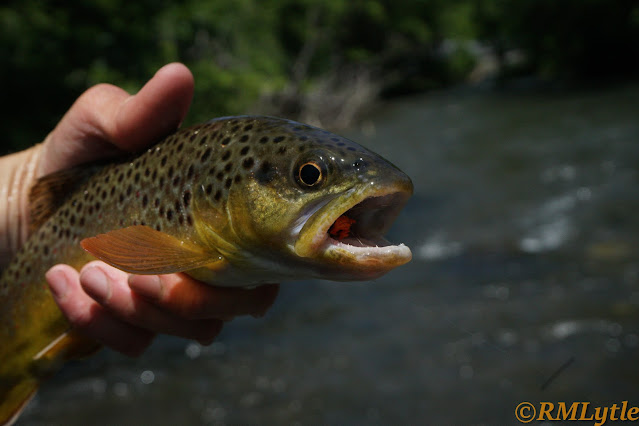


Where we were for that first pound-down wasn't a big fish location, but that didn't matter. Having trout come out of every riffle and pocket to hammer our big foam dry flies was thrilling. You can certainly work through similar water with similar flies- especially early in the morning and at times when some golden stoneflies or hoppers are present, or even if there's a modest number of annual cicadas -and pick up a few fish. This wasn't that. This was interacting with possibly as much as a quarter of the trout biomass of the stretch we fished and catching a disproportionate chunk of it. The fish were giddy. I had more than one nice fish (for this place that was 13-14") charge straight upstream a foot or more in fast shallow riffles to eat my fly. This was the dream. 

We were on our way to another spot on the same creek when we received that report from Mark, a stretch I'd fished before and done well with wild rainbows and some browns. The sound out the window as we closed in on our destination and the empty pull off when we got there said we were going to step in it again. 


The storied history of trout fishing in the area of State College is an interesting one, and though many eastern trout anglers may know bits and pieces of the story I think a lot of it has been glossed over. Spring Creek has one of the more distinct histories of course. Many may be aware that Spring Creek was a brook trout dominated fishery into the end of the 1800's, when introduced brown trout began to supplant the native char. By 1950 a native trout in Spring Creek's main stem was a rare occurrence. The origins of some of the rainbow trout that exist in the now mostly un-stocked stream remain a bit controversial, though I'd argue on behalf of some being stream born given the alkalinity, relative temperature stability, and shear perfectness of both par and adults of some specimens. of course, hatchery escapees from Benner Springs and Fisherman's Paradise, and stocked fish moving up from Bald Eagle creek contribute. Anyone who wants to can see the results of this in a tiny stretch right in Bellefonte, where you can pay a quarter or two for some pellets from a dispenser and toss them into a short, closed-to-fishing stretch where trout bigger than some of the carp present in the same spot will greedily take whatever you give them. Levi, Paul and I stood on the wall in Bellefonte one day, tossing leftover french fries and watching giant trout eat them. Those fish aren't Spring Creek's calling card though. If you've heard of the place but never been, your familiarity may start and end with the existence of the famed Fisherman's Paradise section. This piece of water was bought by the state Fish Commission in 1930 for construction of a hatchery and to demonstrate and test new stream improvement methods¹. A hatchery was built four years later. With heavy stocking and stream improvement that are now known in some cases to improve fishing more so that fishery health, the place soon boomed in popularity with anglers. The regulations then imposed ended up being quite unprecedented, and even in today's ecosystem might be though of as incredibly strict. Fishing was restricted to May through July, barbless flies were enforced, wading was prohibited, and there was a small and finite number of visits you could make. Even though some of the stricter regulations haven't carried over to present day, the popularity rivals the present day. More than 44,000 angler trips were registered in 1952. Photos from that era reflect this, with a parking lot jam full and anglers standing shoulder to shoulder on the banks of a Spring Creek that looks so different today it may as well be a different river entirely. 

In 1982, triggered by kepone and mirex contamination, the commission stopped stocking trout in Spring Creek and enforced no-harvest regulations. In turn, the wild trout population, brown trout specifically, absolutely exploded. It has been said that there have been as many as 3,000 trout per mile in Spring Creek, making it very high on (if not at the top) of the list of most densely trout populated streams in the Eastern United States. That population density has changed with time, of course, having apparently increased until 2000 and being on a downward trend since. That downward trend is likely tied to development in the watershed, and PFBC notes as much:

"In other watersheds, impervious surface area has been used as a good surrogate of urban development; when imperviousness reached 7-11%, trout populations were lost. The Spring Creek watershed had 12% impervious cover in 1995, and in the upper one-half of the watershed, impervious cover was 19%. We suggest that the reason Spring Creek is still able to sustain wild trout with this degree of urbanization is the relatively large input of groundwater into the stream. Further development that increases impervious cover, reduces groundwater recharge, or both, will certainly increase the stress on Spring Creek and reduce its ability to support wild trout."²

As development continues in the area around State College, and as climate change continues, its hard to say what the future holds for Spring Creek. What remains abundantly clear to me is that it, and even some of the more marginal trout streams in Central Pennsylvania, make even the best places we have in Connecticut look like a joke. Part of that is the nature of limestone, but part of it is an indictment on what building can do. Connecticut and our rapidly dying coldwater fisheries should be a good example of what NOT to do if you want to keep strong wild trout fisheries around when it comes to development, road salt use, lack of riparian protection, over-stocking, on and on and on. 


One thing Connecticut doesn't fail with is common carp. Europe's most popular "course" fish is highly abundant in the state and isn't going anywhere. Recently, after a number of fish had been caught over the years that could have cracked the former record, someone finally clocked one over fifty pounds. Well over, in fact. At over 58 pounds, Norbert Samok's record fish is a significant achievement. Of course, Pennsylvania has carp too. The state record was caught in 1962 by an angler named George Brown. The fish weighed 52 pounds... ha! We've got you beat there, PA. I can't gloat too much though, because instead of getting the chance to fish periodical cicada eating carp, I can't really wait around in Connecticut. It turned out Pennsylvania was going to give me a challenge too, though. 

Levi and I met Mark Hoffman in Boalsburg on our second morning for our first serving of warm water cicada mania. Haze clung to the hills as the light came up, that sort of low morning humidity that suggested a very hot day was incoming. We hopped in with Mark and headed toward a place where carp, overhanging trees, deep lake shore, and periodical cicadas all overlapped. Surface disturbance was visible as we crossed a bridge over the lake on the way in. There was heavy calling as we pulled into the launch. Anticipation was high, especially for me. I know this game a little bit, I've caught some carp on cicadas. But something was going on at the ramp that put a more than slight kink in the plan. The back cove was all muddy, and in various spots on both the near and far side there was a ruckus going on. Splashing, crashing, tail slapping, jumping... these carp were busy humping, not eating cicadas. The thing with the carp spawn is that it can kind of happen any time the water gets warm. I've seen carp spawn as early as April 10th and as late as September 3rd. Sometimes that's just a few pods of fish and plenty are still happily and busily feeding away. This wasn't that, though. We motored all over the lake and for the most part found nothing but carp making more carp. It got hotter and hotter as the day went on, and though I picked up some largemouth on cicada patterns and Levi ran a little chartreuse bugger and put a smackdown on white crappie, this wasn't what we hoped for. 


As the heat became more and more oppressive, frustration boiled over. We bailed, sweaty and ready for lunch. It wouldn't be for a couple days, right as our trip came to an end in fact, that we got a shot at the carp again. We met Mark at the same launch, just hours to spare before we needed to hit the road. This time there was no thrashing and crashing on that far bank. The carp should be feeding now, of that I was fairly confident. The most confident, in fact, as the previous attempt had shaken Levi's. In fact it had taken a bit to convince him that this could be worthwhile. We motored out of the launch and rounded the corner, travelling down the shoreline where cicadas were calling their little tymbals off. It wasn't long before I saw it: a carp tipped the wrong way, with it's head up and its tail down, orange lips at the surface, sucking down one of the bugs that had so haplessly bumbled onto the lake surface. The were here....

They weren't easy though, and we weren't the only ones on the water. A few other boats were out with fly rods, all working the banks looking for targets. Any pressure can complicate things, especially with carp. These are sensitive, shy fish. Before we found a couple willing carps, Levi managed to catch one of the nicer largemouth bass I've seen in a while. Getting big bucketmouths on cicadas isn't a bummer at all. 


Largemouth bass are America's favorite gamefish. An estimated 16 billion dollars a year is spent on bass fishing. To put that in perspective, the estimated annual market for fly fishing in the US is 750 million dollars. The people love bass, enough so that they've been moved here and there and everywhere. Where we were, just one watershed divide separated us from the native range of the northern bass, but we were fishing to non-native fish where we were. Given their widespread introduction and infusion in the fishing culture, many anglers don't realize when bass aren't native where they fish. In Connecticut, neither smallmouth nor largemouth bass were present historically, and that information is relatively available to anyone who cares to look. That said, it isn't hard at all to find anglers who insist that they are a native fish. Aa great many angler believe a great many things to be true that just aren't though, that is a reality that no longer surprises me. I just roll my eyes with my lips pursed in a tight, straight line and repeat the same statements again-- "actually, the only larger native freshwater predator species in Connecticut were chain pickerel, brown bullhead, and brook trout...." It's remarkable how much of our fisheries are made up of introduced species. In much of the northeast, we're looking at as much as, even more half of the popular target species. Even somewhere like Maine, where landlocked salmon and lake trout did exist naturally, they've been scattered about in all sorts of places they never were before. We think of fishing as a way to be in nature, failing frequently to realize that what we fish isn't actually natural. 

Even the lake we were on wasn't natural. In fact, large natural lakes are essentially non-existent in Pennsylvania. The largest natural lake in the state is Conneaut, in Crawford County. At just 243 acres, it is a piddly body of water compared to the Pymatuning Reservoir just miles away, and even it wasn't immune to human alteration. In 1834 connection to the French Creek canal raised the lake by 11 feet. The geology in Pennsylvania just doesn't make big lakes, unless you count Erie, of course. I wonder how the fishing was in the river that made this reservoir we were fishing before the dam went up, and I wondered how many more cicadas there'd been before the land they lived under was flooded. What fish would I have caught here in 1685, just 20 emergence cycles ago. Would I have been catching 20 inch fallfish here? Giant brook trout? How many billions more cicadas must there have been?

What was is now gone, and there's little left to do but find a carp, put a piece of foam in front of it, and not set the hook too early. 


¹ Tom Burrell, The Express. Dec 14 2024 The Evolution of Fisherman's Paradise

² Carline, R. F., R. L. Dunlap, J. E. Detar, and B. A. Hollender. 2011. The fishery of Spring Creek – a watershed under siege. Pennsylvania Fish and Boat Commission, Technical Report Number 1, Harrisburg, PA.

Thank you to my Patrons; Erin, David, John, Elizabeth, Brandon, Christopher, Shawn, Mike, Sara, Franky, Geof, Luke, Noah, Justin, Sean, Tom, Mark, Jake, Chris, Oliver, oddity on Display, Sammy, and Cris & Jennifer, Hunter, Gordon, Thomas, Trevor, Eric, Evan, Javier, Ryan and Dar for making Connecticut Fly Angler possible. If you want to support this blog, look for the Patreon link at the top of the right side-bar in web version. 

Monday, May 26, 2025

Guiding Updates: Rolling Into June

 May has been a pleasant little mixed bag month for me. I was away for a good third of doing non-fish things but catching fish anyway (see my last post for that tidbit). I'll probably write a little more about that trip soon, and possibly some on Patreon. But I guided a good number of trips this mo th while I was around and things were productive on the whole. The floodplain continued to spit out carp, in fact the water finally peaked while I was away and is up at a pretty good level even now if anyone wants to squeeze in one last go at my best selling type of trip. This year wasn't as good for numbers, on the whole, but was pretty darned good for size....


Dave Nguyen wins best of the season- unless something dramatic happens in the next two weeks -with two stud commons including the long 20 pounder above, and a gorgeous mirror as well!

We've been light on the morphs this season, with only one fantail/longfin, one mirror, and no ghosts. Though a bit of everything has been seen, it does seem to take a plethora of six plus fish days to get a good number of those odd ones. Other than the carp, of course, I've been floating the marginal rivers as often as I can. This has been a wonderful extended, wet, cool spring to hold the trout fishing out. This could break at any time and we could pop into high water temperatures at any time, so it's very much a "get while the gettin' is good" proposition. Eric's brother got him a trip for his birthday and he made good of a decent nymph bite and got a good smallmouth eat on the streamer as well! Those double digit days seeing hardly a soul out on some of Eastern Connecticut's best rivers is why I needed a raft and it's been great getting to work many of my old stomping grounds in a new way. 


Going into June, thing look very promising! Here's my guiding agenda for the month: 

Carp are far from over, as always that's still very much on the agenda. June is more of a classic mud flats fishing scenario, and the river can't stay high forever. It'll also eventually transition to more of a morning bite. It already had, but this cooler weather had them going all day again for a bit there. 

Bowfin are the next headliner, one of my favorites and a really engaging sight fishing target. I struggle to sell trips for them for whatever reason, but it certainly isn't the quality of the species of the fishing... people just haven't caught on yet. Don't be late to that party, they're awesome!

Because it looks like the water will stay pretty decent for a while, I'll keep doing trout trips going into June. Dry flies will be the main focus with some streamer fishing when the water levels permit. I'll also do some night time floats on a couple of the big eastern river as well if anyone is interested in that! 

Lastly as far as freshwater goes, pike... the cooler weather and rain has also extended the post spawn pike fishing, so that is yet another good option. 

On the salt, it's already sight fishing time. I've got a handful of dates on the calendar for sight fishing trips already on prime tides, and if sigh fishing for striped bass is something you'd like to learn I recommend  reaching out soon. Last year was pretty darned good when conditions were amicable, and it made up for what would end up being a very poor fall run. I'll take the flats fishing over blitzing schoolies any day, anyway. Of course I'll do multispecies salt trips as well, though that hasn't kicked off just yet, including scup, fluke, weakfish, black seabass, and whatever else wants to play, both of fly and light or ultralight spinning gear. That's been a crowd pleaser the last few years, and as far as fly and light tackle for that game goes I'll confidently toot my own horn and say no other local guides do it as much or as well as I do.


Last but not least, I'm planning on organizing a couple water chestnut pulls locally on the Connecticut River backwaters. I wrote about water caltrop here, and after seeing a few patches pop up in new places over the last two seasons, where they should be manageable with some low-impact hand pulling, I hope to keep the places that pay my bills free of this nasty aquatic invasive species. If you have a small personal watercraft like a canoe, raft, or kayaks and would like to help, reach out to via email at brwntroutangler@gmail.com and I'll keep you updated on when I'm planning of doing pulls. 

Happy almost summer everyone, thanks to all my clients and readers, and stay healthy and safe! 

Thank you to my Patrons; Erin, David, John, Elizabeth, Brandon, Christopher, Shawn, Mike, Sara, Franky, Geof, Luke, Noah, Justin, Sean, Tom, Mark, Jake, Chris, Oliver, oddity on Display, Sammy, and Cris & Jennifer, Hunter, Gordon, Thomas, Trevor, Eric, Evan, and Javier for making Connecticut Fly Angler possible. If you want to support this blog, look for the Patreon link at the top of the right side-bar in web version.