Showing posts with label Stillwater Trout. Show all posts

Saturday, October 3, 2026

Fall Guiding & Updates

 It's been a hot minute since I rolled out one of these. The last one I did was in June? Woooh boy, I'm a mess. But the fishing is pretty good. I guess I'll go over the summer's worth of work. 

Carp, carp, and more carp. Then some more carp. I put a lot of people on carp. Some regulars, some new guys... so many carp. Here's a small selection for you:

Dar's RI fully

Joey's not-a-bowfin

Connor's mop eater

Johny's 22 pounder

JK's dock demon

Hayden's first bubbler

Speaking of carp, if you're a freak for the Cyprinus like I am, it's going to be worth your while to check out United State of Carp. The first issue is soon to come, with an article by yours truly. It'll be a photo heavy publication, well styled as far as I can tell, and I'm looking forward to it and to working with Joel more in the future!

The carp are far from done for the year, of course. If you'd still like to get on some, especially if you'd like to learn late season tactics, there is time... basically until the waters freeze over, there's always a shot. But I'm ecxited for the change of season and the change of target that comes with it. CT's niche stocked salmon season is rapidly approaching. I anticipate DEEP to put the first of the season in very soon, I'd say any dat after October 15 is a guaranteed shot if you'd like to get a day on the calendar now. It'll be walk and wade only for a little while, until the water is up. 

This fall I'm also very keen on stillwater trout trips. This is something I've been doing more and more of myself and with friends, but its hard to convince clients to fish anything but rivers for trout. I find that crazy, honestly. Some of the best big trout fishing in the state currently is on lakes, not rivers. It just takes a fly angler leaving their moving water comfort zone a little bit. The rivers are there too, of course, and the Housatonic, Farmington, and Salmon will all offer great opportunities over the coming months. I've been on a dry fly bender as well, with no intention of letting up. 

As for the salt, at least for me, it's been a hot mess. My fall weakfish bite either didn't happen or just not when I was there. My clients have boated some fluke and had some shots at blitzing bass, some tailing dogfish, and a couple short opportunities at hard tails, but it has been really kicking my teeth in the few chances there've been to get out, for me. 


So, the freshwater fall agenda persists: there is still great carp fishing ahead, there is still great smallmouth bass fishing ahead, and the pike, salmon, and trout offer a plethora of opportunities I am thrilled to offer to my clients! 

Thank you to my Patrons; Erin, David, John, Elizabeth, Brandon, Christopher, Shawn, Mike, Sara, Franky, Geof, Luke, Noah, Justin, Sean, Tom, Mark, Jake, Chris, Oliver, oddity on Display, Sammy, and Cris & Jennifer, Hunter, Thomas, Trevor, Eric, Evan, Javier, Ryan, Dar, Eric, Collin, and James for making Connecticut Fly Angler possible. If you want to support this blog and access more informative content, look for the Patreon link at the top of the right side-bar in web version!


Wednesday, October 19, 2022

Kokanee (& Trout) In The Dark

As an obsessive nighttime angler, I'm constantly looking to d to my repertoire. One thing I've done very little of is target trout in stillwaters at night. Here in CT, many of our stillwater fisheries are composed of stocked trout with very poor holdover rates, so that makes them generally uninteresting to me. There are some lakes with a half decent holdover rate but most take some travel. There's also some lakes with other species of interest. It was kokanee that got me fairly intrigued to try one particular stillwater.

Kokanee are landlocked sockeye salmon. They were brought top CT in the 1940's to build a recreational fishery. Why the state of CT is expending resources on this only lightly fished species that isn't native is beyond me, but at least kokanee aren't going to spread far and wide. In fact, landloacked alewives, also a non-native, have almost completely wiped out kokanee fisheries in Ct in the past. Kokanee have an affinity for nocturnal activity, though kokanee feeding is focused on zooplankton. They're essentially a salmonid that filter feeds... not quite like menhaden or American shad, but they focus on such tiny food items when foraging. Transferring their nocturnal feeding habits over to the spawning run- when the strike mainly out of aggression -doesn't necessarily follow. But at least in my mind, nocturnal is nocturnal and I should be able to get some to strike. If not, rainbows would be around the same areas. 

I set out on a brightly moonlit night with a plan in mind. I'd fish two methods, both with relatively small and bright colored flies as that's what has worked for kokanee in the past. I'd start out fishing them under indicators. With the aid of the moon, as well as nearby artificial light, I'd be able to see the indicator drop if I was getting takes. If that failed, I'd slow pull the same flies as well as some streamers with a figure eight retrieve

Upon arrival to the spot, I could actually see the schools of fish. There were huge numbers of kokanee out there, as well as loads of trout. It soon proved very easy to get the trout to take. Me indicator dropped time and time again.


The trout seemed to have very little preference in the way of flies. I caught them on Green Weenies, eggs, Walt's Worm with pink collar, Sawyer's Pheasant Tail, and small buggers. I kept switching mostly to try to pull out a kokanee, but it wasn't proving to be especially easy. Even on the best of days they test a good angler's resolve. Each Pacific salmon has a different attitude during their spawning run., and it differs place to place as well. Kings in New York are heavily pressured and often hard to convince to snap at something, which is why many anglers fish eggs, bits of foam, and smaller flies with immense amounts of weight. This differs from large and less pressured river chinooks in Alaska, which are caught on large flies and lures. It also differs from less pressured water elsewhere in the great lakes. Coho, wherever they are, seem to be on the aggressive side of the spectrum, as do pinks. Chum salmon are definitely quite inclined to take large streamers and lures. Kokanee seem to be one of the finickiest. This results in a lot of people intentionally snagging them, which is just ridiculous. Its also illegal, and I call the TIP hotline any time I see it happening. As should you. Anglers often complain about poachers in CT, and yes ENCON is understaffed and won't always respond, but you should still call. The more calls get made the more poachers will get caught. Please do your part. 

I, of course, was just patiently waiting for a kokanee to actually grab a fly. It took a couple hours before one finally did, but it was a wonderful proof of concept. I could, in fact, catch a kokanee at night. The first one sunk the indicator just like the trout had been doing. The fly of choice? The good old Green Weenie.


That wasn't really the start of a pattern though. Kokanee are moody and erratic, and I often get them seemingly at random. Indeed I ended up with three that night in five hours of fishing, and each was on a different fly. The first was the only one to take under the indicator. The second took on a slow retrieve and the third took and egg on the fall. 


I lost a couple couple kokanee that I clearly saw as well, and a few that may have been. largely though the night was a very trouty one. I must have caught between 35 and 40 of them, and I even specifically tried to avoid them at times in hopes of picking up more salmon. As it turns out, that nighttime indicator strategy in particular is wildly effective. I've considered fishing indicators at night in rivers as well and this really did some convincing. I've lightly fiddled with the idea in the past, putting glow in the dark tape on indicators, but it never really got me anywhere I think its time to in some glowing thingamabobbers. 


The night game is such a fascinating one. I've always felt that it builds on an anglers understanding of the water they're fishing. If the right casts and presentations can be made or even things as simple as getting to the productive locations can be accomplished without aid of the light of day, it builds your understanding of the water. But something I sometimes forget, and likely equally important: fish behave differently at night. Fishing in the dark builds your understanding of your query as well. I feel I have a better understanding of landloacked sockeye now having caught them at night. 

Thank you to my Patrons; Erin, David, John, Elizabeth, Brandon, Christopher, Shawn, Mike, Sara, Franky, Geof, Luke, Noah, Justin, Sean, Tom, Mark, Jake, and Chris for making Connecticut Fly Angler possible. If you want to support this blog, look for the Patreon link at the top of the right side-bar in web version.

Sunday, August 18, 2019

White Mountain Brook Trout and Bears

New Hampshire's White Mountains have long held a special place in my heart. Every time I go there I find something special. The last time I fished there was in 2015 (Brookies in the White Mountains). It has been a while. I've missed the place. To say it had been too long would be an understatement. In the case of the White Mountains, it's the place that attracts me more than the fish. It doesn't have the diversity of species that many other places do, or particularly large wild fish either, but it does have a handful of colorful native fish species living in some of the most dramatic terrain in the Northeast. The white Mountains are proper mountains. Big, rocky, steep, with a real tree line in places... they look like mountains, not like the hills that are mountains in most Appalachia. Granite. I love granite. In the past I'd gone to the Whites specifically to dig for smokey quartz, microcline, flourite, and other minerals in open cavities in the granite. I can't help but poke around looking for new prospects while fishing  any time I'm there now, but it's been even longer since I've been there specifically to dig crystals. I didn't get to dig on my latest trip either, but it was just wonderful to be there.


My mom, brother. old dog and I made the drive up in the rain but got to where we'd camp as skies cleared. The mountains were draped in fog and evening light, and the air was clean and cool. I could breath again here. We camped basically right on one of my favorite streams I've fished up there, and I was able to catch a few brookies before it got dark, but the next morning would be the start of the real fishing.
I was up before everyone else, including the sun, because I had a few miles to walk to get to my destination and they were all up will. After a a brisk walk, I reached the upper boreal zone and and isolated small aquamarine pond that contained one and only one species of fish, Salvelinus fontinalis. When I got there, a cow moose was having breakfast on the far side. It left before I could get close enough to get a shot, but it was a beautiful thing to see.


Being that it was summer and the surface water was quite warm, there wasn't much rise activity except over the spring holes. The springs themselves. seeping out of the ground around the pond, into tiny streams that entered it, and up through the bottom of the pond itself, were so cold that I assume that ground they were seeping from may well have still been frozen not that long ago. Just sitting down near one of the springs I'd get really cold even in a flannel and long pants with the sun on me. One seep I found was 38 degrees... fathom that. Only six degrees above freezing, in July! The larger streams further down in elevation were about 60 degrees and the surface temperature of the pond itself was 68, though just two feet down is was cold enough to induce shivers. The fish were deep, and it took me a while to get the message that they were so deep I ought to be fishing with a fair number of shot and just as slow as I could tolerate. I kept with a slow pick for almost an hour before I changed to a beadhead Hare's Ear Soft Hackle and two shot, and even that alone wasn't enough. Once I started counting the fly down for seven to nine second and slow figure eight crawling it along. That worked really well, and though I caught a ton of gorgeous fish, it was the two largest that got me really excited. See, this pond is big enough that it could circumstantially produce fish to, say, 18 inches, but it is at an elevation where the fish get a really short growing season. Too warm in late summer, too cold in the winter. Of course, were it lower it may get too warm for the fish to survive, were it higher it could ice too much for them to make it either. Trophies are relative, and for this little pond in the mountains these two fish were extraordinary trophies.
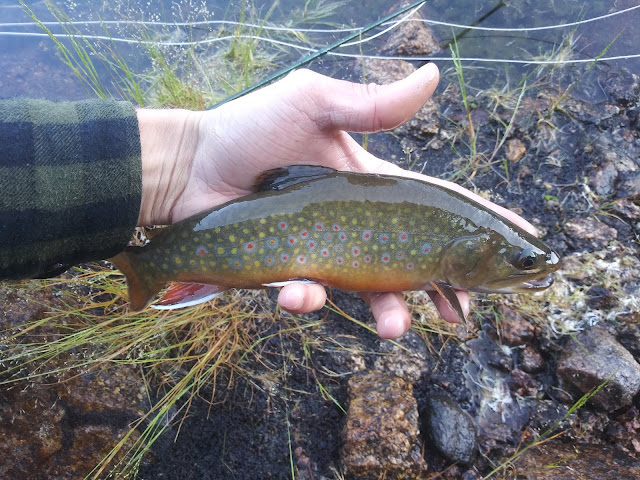


As the sun reached the upper end of the pond the activity dissipated and I headed back down slope. I fished the outlet stream of the pond and every other body of water I passed on my way back to camp. I caught brook trout in all of them. I encountered a little black bear at close range. I got some serious exercise too. The sloped down to some of those creeks are no joke, nor the brush you need to plow through getting up and down them.

(Beaver stick from Deboullie)
After I got back, we went for a drive to see some of the area that I've come to love so much. I really wished I'd had my camera on this trip, but it was being mailed back because it had a periodically occurring issue and needed to be replaced.


A while after getting back and having lunch, I set out to fish a couple miles of the stream we were camped on.


My dad and I had done well here when we'd been four years before and I'd already fished it just enough to know that it was about as good as it had been back then, but I wasn't prepared for just what I'd find.


For most of the long stretch I fished, I got the sort of steady pick of four to six inch brook trout on dries and wet flies that I'd come to expect from freestones in this area. They are gorgeous and aggressive fish, and most of the larger ones are fairly old because these streams don't have much in the way of food for these fish. The only baitfish are smaller brook trout and these streams don't have the kind of macro invertebrate populations that slower, warmer, muckier and sandier streams do. So these fish just don't grow that fast or that big.


Then, somewhat inexplicably, I stumbled into one 100yd stretch of water where the fish were just bigger for some reason. I'm not really sure why they were there, nothing above or below seemed particularly different from that stretch. But they were, and they were quite spectacular old specimens, likely 4 to 6 year old fish. They all took a classic Picket Pin.


I stuck to it for a while but eventually bored of bothering brook trout and headed back to camp to just relax for a while.


Not long after getting back there, a little male black bear showed up. He crossed the creek and headed up the other side, then doubled back and went back the way he came.


That night, my brother and I hiked up to the pond to see the night sky. Watching the light fade there, the stars and planets start to reveal themselves, and then the milky way itself, all while a hexegenia hatch was going one and brook trout were splashing all over the pond... that was just magical. Again... I wished I'd had my real camera.


The next morning I went back up again for one last blast in the pond. Really, I don't feel the need to explain how it went. It was... it was special.


Until next time.
Fish for the love of fish.
Fish for the love of places fish live.
Fish for you.


 If you enjoy what I'm doing here, please share and comment. It is increasingly difficult to maintain this blog under dwindling readership. What best keeps me going so is knowing that I am engaging people and getting them interested in different aspects of fly fishing, the natural world, and art. Follow, like on Facebook, share wherever, comment wherever. Also, consider supporting me on Patreon (link at the top of the bar to the right of your screen, on web version). Every little bit is appreciated! Thank you to my Patrons; Erin, David, john, Elizabeth, and Christopher, for supporting this blog.

Wednesday, July 31, 2019

Catching the Elusive Blueback Trout (PT. 3)

It is so often the case that if you want to find a rare fish, you have to do close to the maximum amount of work. Come midday on our third day in Deboullie, I knew that we'd have to do a little more than paddling and short portages in the connected lakes to get a blueback. Black pond, the second smallest of the four ponds in the cluster that hold bluebacks, seemed like our best shot at these rare char. Small is good. Fewer places for the fish to be. Pushineer is the smallest pond but also shallower and far down the watershed, and therefore the warmest in the summer. Black Pond is very deep, with only a couple small stillwaters above it. It is also a little over a half mile hike one way. So it definitely isn't prone to getting as much pressure as the comparatively easy to access ponds over the ridge from it. So Noah and I made the portage up and over the ridge and down into Black Pond. It was a haul with a bunch of gear and two kayaks, especially Noah's, which doesn't drag well and is much heavier than my own. But we made it, and were soon fishing the deep, dark waters of possibly the most productive pond in the area.


Much more sheltered and oriented differently than the other ponds, Black was flat calm. Had there been a good rise going, we'd have been able to see fish surfacing from a hundred yards away. Unfortunately, though there wasn't a complete lake of rising fish, there definitely weren't many. We worked our way down the shoreline toward the outlet, Noah fishing a jig and me fishing streamers on a sinking line. Action was sluggish. We got to the outlet and turned back around, aiming now for the inlet and deeper water. As we drew closer we started to hear the odd big splash. It was so dead silent out there, much more so than the big ponds where the other campers reminded us that other humans did indeed still exist. The lack of anthropogenic and wind noise on the other side of the ridge meant we could hear these splashed from more than 100 yards away. So we kind of had some idea of where they were coming from, but we couldn't actually see them. Eventually, not far from the inlet, We found these huge schools of common shiners. And after fishing under them for a while, a big brook trout broke repeatedly not far from me, attacking the shiners. The fish had practically been blitzing on shiners. I'd never seen anything quite like that. I fished under the bait balls for a long time with different flies trying to draw a strike. I was very surprised to find that these fish seemed unwilling to come to a perfect artificial imitation of what they were ravenously feeding on. By this time there were a few odd rises out over very deep water, so I made a couple drifts out there. No luck. I was starting to be nearly certain neither of us were going to catch our target species. I became so disgruntled by the lack of salmonid action that Noah and I both started specifically targeting yellow perch to take back to camp for dinner. I stayed with the fast sinking tip and just downsized to a little brown calf tail and olive brown ice dub micro-jig streamer. Funny enough, before I caught a perch big enough to take, I caught a small brook trout. 


I continued working around the brush piles, catching a few perch here and there that were big enough to take. Noah was loading up as well. Then I drifted out a ways off the structure that was holding most of the perch. I got a couple bumps so I just kept doing what I was doing. Than I came tight to something that was clearly not a perch. It wasn't acting like a brook trout either. It was really making some quick, hard, deep runs. As I got it up higher in the water column and I got a bit of a look at it, my heart started to pound. In moments it was yak-side, and there was absolutely no doubt. I couldn't believe it. 

I had caught a blueback trout.

Noah was a ways away from me, so I started shouting or, uh... squealing. Like a complete maniac. My voice went up three octaves. I could barely contain my shock and excitement. I jumbled my words, I started shaking, I nearly dropped my rod in the lake... this was a fish I'd wanted to catch since I was about 15. It wasn't big, most bluebacks aren't. Being mid July it was still very silvery, with just a faint yellow orange on the belly, silver and nearly spotless flanks, and a true-to-the-name blueish grey back. The dorsal was transparent and lacking any markings at all. The tail was deeply forked. The anal, pelvic, and pectoral fins were a shade of orange I'd never seen on a brook trout's fins, more yellow than pink or red. A pristine white strip edged those fins, the char trademark. This was a beautiful fish.

Lifelist fish #137, Blueback trout, Salvelinus alpinus oquassa. Rank: subspecies


Noah and I both basked in the presence of the rarest fish either of us had ever seen before I let go and watched it go straight down into the dark. A fish that, for a long time, most believed couldn't be caught fly casting, only existing in a little more than 10 lakes in the U.S., and in low numbers in a number of those, had just been in my hand. What a feeling. 

Of course, knowing that bluebacks school and all, we stuck around there for a while, hoping Noah might get one. But as the sky slowly darkened and some large unknown animal made noise in the brush up on the hill, we decided it was time to leave. I didn't know if I'd see this pond again any time soon, but I was glad we had taken the effort to reach it on this evening. Had the weather been better the next day we might have gone back, but the wind was just too much. I do, without a doubt, know that I will return there, probably more than once. And to some of the other ponds containing bluebacks that we didn't go to on this trip. I want to catch more, to see more, to hold more in my hands, because the may not be there anymore when I get too old to make the trip. Regrettably, that can be said of a lot of fish species and subspecies.

I do believe I ought to explain why I've been so open with the location we were fishing here. There are a few reasons. First being that there really isn't a good way to conceal it without drifting so far off of the real story that it just wouldn't be as impactful. Second, this is no secret. If you want to find out where bluebacks are found, a search online will reveal literally every lake in Maine that contains them if you look long enough. Third, it isn't free or easy to fish this place. Right out the gate, some people just won't want to go through the trouble just for the slight chance at these fish. Those that do are likely the kind of people that already have a deep respect for them and the wilderness they live in. I don't mind people that care fishing for such rare and sensitive fish. They need advocates. Climate change threatens their coldwater pond habitats. "Bucket biologists" could wipe out a population in a matter of years. For some ludicrous reason, Maine still allows people to keep blueback trout, counting them towards their brookie limit. Going through the work it takes to catch one and then getting to briefly hold such beautiful animals makes it personal. It makes it all the easier to fight for their protection.

If you respect the animal, and respect where it lives, and are competent enough to handle and release one safely, please do go to these places. Try to catch a blueback. 

But if you can't respect blueback trout, or any other kind of fish for that matter, and have the gall to sully the places they live with your presence....
You have made an enemy of me. And that's a position you don't want to be in. 

If you want to do something to further protection and research of Maine's arctic char, consider donating to Native Fish Coalition and/or signing up for their newsletter. 
Until next time.
Fish for the love of fish.
Fish for the love of places fish live.
Fish for you.

 If you enjoy what I'm doing here, please share and comment. It is increasingly difficult to maintain this blog under dwindling readership. What best keeps me going so is knowing that I am engaging people and getting them interested in different aspects of fly fishing, the natural world, and art. Follow, like on Facebook, share wherever, comment wherever. Also, consider supporting me on Patreon (link at the top of the bar to the right of your screen, on web version). Every little bit is appreciated! Thank you to my Patrons; Erin, David, john, and Christopher, for supporting this blog.