Showing posts with label New Hampshire. Show all posts

Thursday, August 20, 2026

Granite State Brookies

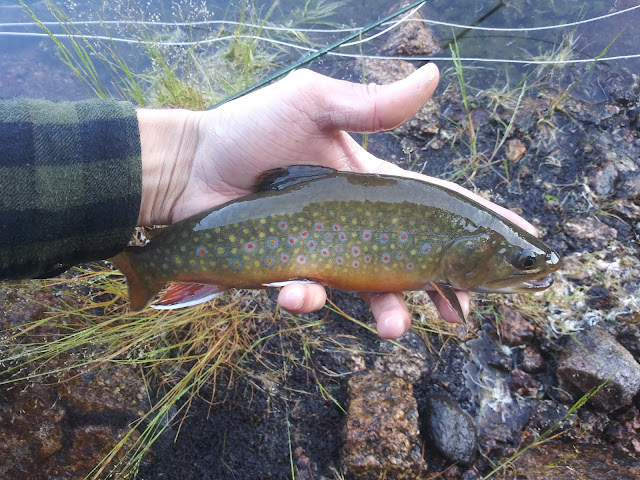
 There's no consensus on why exactly the White Mountains are called the White Mountains. One theory is the granite that composes them, which is pale in color. That includes the white mountains. This is especially true in the places where water has gouged out the sides of these old mountains, leaving wide stream beds filled with light colored boulders. I don't think that's enough to call these mountains "white", but some people do. The streams that roll through this geology are cold and very clean, but they also lack nutrients. Granite doesn't lend much dissolved mineral wealth to water like limestone, sandstone, or even just sand or mud With low insect populations, and even lower baitfish populations, the trout that live in these streams don't have much to grow large on. Nor are they even particularly numerous. They are, however, beautiful wild fish that are often of the brook trout persuasion. And small fish have never been a massive dissuasion for me. 

Picking my way up these rocky, inhospitable landscapes with a four weight in hand and nothing but dry flies to throw, I leave complexity behind in favor of hard work for small fish. In many of these streams since distribution is relatively low and most of the fish are really tiny, it takes sorting through a lot of water to find just a handful of brook trout that exceed 6 or 7 inches. Some days, or on some streams, you simply might never see one that makes that mark. Other streams are a bit more prolific. But to me, part of the appeal is covering ground and checking streams off the list in my head. It's glorified hiking, with casts between steps. Exercise with a fly rod. The fish aren't a bonus though, the sunday simply wouldn't be a sunday without the fish. I wouldn't cover so many miles of stream if there weren't at least some promise of fish. 


As I progress as an angler, small stream wild trout fishing has become a much smaller part of the equation for me. A big part of this has been watching the decline in my home state. If you haven't blue-lined long, you probably haven't noticed it, but in the last 15 years I've seen it get so, so much worse, and it just feels wrong to continue to pursue fish that are under such immense strain. That means that pursuit which I love so much is now more relegated to when I can travel. That is a shame, because I do love it, but distance does make the heart grow fonder and perhaps I'd still be doing less of this type of fishing if I did live somewhere like Wyoming or Maine or West Virginia... I really can't say. 


All I do know is that when I watch a bejeweled native char rise to the surface in a crystal clear granite lined plunge pool, it rights some wrongs in my little world. 

Thank you to my Patrons; Erin, David, John, Elizabeth, Brandon, Christopher, Shawn, Mike, Sara, Franky, Geof, Luke, Noah, Justin, Sean, Tom, Mark, Jake, Chris, Oliver, oddity on Display, Sammy, and Cris & Jennifer, Hunter, Thomas, Trevor, Eric, Evan, Javier, Ryan, Dar, Eric, and Collin for making Connecticut Fly Angler possible. If you want to support this blog and access more informative content, look for the Patreon link at the top of the right side-bar in web version!


Tuesday, April 12, 2022

Jon Zukowski and The Brink

Editors Note: Recently, the New England fly fishing community lost a prominent figure to an extremely unfortunate accident that occurred on a well known New Hampshire trout river while in the presence of two other experiences fishing guides. Jon Zukowski's passing has sent shock waves through the community, as he was a well liked shop owner, all around good and humble character, extremely skilled angler, and native fish advocate. The accident that resulted in his death is something that could happen to any one of us. This post was written by Jon's friend Nate Hill, another well known and liked NH guide. He kindly gave me permission to share it here. He feels it is important for as many people to see it as possible and I very much agree. The takeaways here are all to clear and we could all use the reminder that all it takes is one wrong step. 

Jon Zukowski, how do I find the words. I first learned about Jon from my good friend Milan, who kept sending me pictures of Jon holding giant trout. We couldn't comprehend how Jon was catching such fish on the fly rod. I spent the next eight years trying to catch up. In doing so I began running into Jon on the water. What started as casual hello's soon evolved into a deep friendship. We both had a burning love for wild trout and wild places and I had never found another NH angler who matched my passion and surely exceeded my ability in catching them. Over time Jon and I began fishing together, often on the bookends of the seasons when our schedules finally lined up. Later we both joined the NH chapter of Native Fish Coalition. Then when Jon bought Mountain High fly I jumped on board as one of the shops fishing guides. 

While I lived across the state I made sure to stop in the shop whenever I could, always spending way more money and time than I planned. Our conversations of life, fly fishing and fly design went from minutes to hours. The last time I was in the shop, back in March, my son Ellis was with me. Jon and I talked for so long I couldn't believe how good Ellis was being. Then I looked over and saw him fast asleep on the floor. Jon and I laughed about how he was a born shop rat. 

Jon was one of the few anglers who had the ability to imagine and create flies that not only caught the attention of the biggest fish but also looked darn good hanging from their mouths. He was an engineering genius at the vice and his flies will live on forever. 

While Jon's fishing prowess is what drew me to hang out with him it was his genuine and humble-beyond-reason personality that kept him at the top of my fishing buddy list. Jon would glowingly speak of friends and family. Especially his father who he admired more than anyone. "My pops caught this pike, shot this deer" he would often say pointing to pictures on the shop walls. I had to be the one to point to the pictures of Jon holding fish. " Jon that brown looks to be a state record!" I would comment in awe. " I think she probably was" he would shrug with no interest or care in finding out as it would have meant the death of one of his favorite creatures. I have never and will never meet a more brilliant yet humble angler. 

Unfortunately it was Jon's need to put others before himself that became fatal. We all know when standing near the edge of a cliff which step will be fatal. If a personal possession were to fall from such a perch none of us would jump to retrieve it, knowing certain death would result. Like cliffs rivers all have edges, that when crossed, are fatal. Unfortunately in rivers that edge is not visible to the naked eye. It is ever moving and shifting with changes in flow, water temperature, substrait and our attire. When Jon saw our boat floating away he weighed the safety of himself against the safety of the group, he was aware that the edge was near. He hesitated on the brink but in moving water the brink is not something you can stop even close to. Half a step too far was all it took. It was a mistake that almost every angler I know has made themselves. You are wading a river comfortably, you want to get a little better cast. You feel you have control, but a rock rolls, or your foot slips, you end up off your feet, over your head. Most times we are able to right ourselves, scramble to shore and chock it up as a silly mistake. None of us, still here, know how close we have really come to that edge.

 Let us all work to keep ourselves and eachother safely away from that edge. 

To all those who knew, loved, lived and laughed with Jon, my heart is with you always.  Jon, you will be with us forever, mountain high and river wide. Never stop casting to the big ones my friend.


Nate Hill will be a series of swiftwater safety events this spring and summer. The first will be a seminar on May 14th at Ledge Brewing Company in Intervale, NH. I will post updates as needed.

If you'd like to donate to help Jon's memorial service and aid in keeping his shop, Mountain High Fly, running, follow this link: www.gofundme.com. 

Stay safe out there folks. The risks are bigger than we sometimes believe. My deepest condolences go out the Jon Zukowski's family and friends. 

Monday, September 6, 2021

Brook Trout By Definition

 Most of us know what a brook trout is. If you have read my ramblings for any significant length of time, I would hope you have some idea, at least. But in New Hampshire, or at least in New Hampshire's fishing rule books, rainbow trout are brook trout. Oh, and so are brown, golden, and Loch Leven trout and their hybrids. On the other hand brook trout, Salvelinus fontinalis, are their state fish.

If you think that's absurd, so do I. Brook trout are brook trout. They are one of only two native char left in New England. Given they are also New Hampshire's state fish, you'd think they'd want to try to protect them. Perhaps it's unsurprising though that a state that defines brook trout as a number of species and strains of fish that are definitively not brook trout- and most of which are not native -in the very set of rules set in place to govern angling, is in fact doing a very bad job of protecting its native char. 

Native Fish Coalition has published an open letter to New Hampshire regarding this absurdity. Read it here: nativefishcoalition.org.

This is a brook trout.

This is not a brook trout. 

Until next time, 

Fish for the love of fish.
Fish for the love of places fish live.
Fish for you.
And stay safe and healthy.


Thank you to my Patrons; Erin, David, John, Elizabeth, Brandon, Christopher, Shawn, Mike, Sara, Leo, C, Franky, Geof, Luke, Streamer Swinger, and Noah for making Connecticut Fly Angler possible. If you want to support this blog, look for the Patreon link at the top of the right side-bar in web version.

Edited by Cheyenne Terrien

Sunday, August 18, 2019

White Mountain Brook Trout and Bears

New Hampshire's White Mountains have long held a special place in my heart. Every time I go there I find something special. The last time I fished there was in 2015 (Brookies in the White Mountains). It has been a while. I've missed the place. To say it had been too long would be an understatement. In the case of the White Mountains, it's the place that attracts me more than the fish. It doesn't have the diversity of species that many other places do, or particularly large wild fish either, but it does have a handful of colorful native fish species living in some of the most dramatic terrain in the Northeast. The white Mountains are proper mountains. Big, rocky, steep, with a real tree line in places... they look like mountains, not like the hills that are mountains in most Appalachia. Granite. I love granite. In the past I'd gone to the Whites specifically to dig for smokey quartz, microcline, flourite, and other minerals in open cavities in the granite. I can't help but poke around looking for new prospects while fishing  any time I'm there now, but it's been even longer since I've been there specifically to dig crystals. I didn't get to dig on my latest trip either, but it was just wonderful to be there.


My mom, brother. old dog and I made the drive up in the rain but got to where we'd camp as skies cleared. The mountains were draped in fog and evening light, and the air was clean and cool. I could breath again here. We camped basically right on one of my favorite streams I've fished up there, and I was able to catch a few brookies before it got dark, but the next morning would be the start of the real fishing.
I was up before everyone else, including the sun, because I had a few miles to walk to get to my destination and they were all up will. After a a brisk walk, I reached the upper boreal zone and and isolated small aquamarine pond that contained one and only one species of fish, Salvelinus fontinalis. When I got there, a cow moose was having breakfast on the far side. It left before I could get close enough to get a shot, but it was a beautiful thing to see.


Being that it was summer and the surface water was quite warm, there wasn't much rise activity except over the spring holes. The springs themselves. seeping out of the ground around the pond, into tiny streams that entered it, and up through the bottom of the pond itself, were so cold that I assume that ground they were seeping from may well have still been frozen not that long ago. Just sitting down near one of the springs I'd get really cold even in a flannel and long pants with the sun on me. One seep I found was 38 degrees... fathom that. Only six degrees above freezing, in July! The larger streams further down in elevation were about 60 degrees and the surface temperature of the pond itself was 68, though just two feet down is was cold enough to induce shivers. The fish were deep, and it took me a while to get the message that they were so deep I ought to be fishing with a fair number of shot and just as slow as I could tolerate. I kept with a slow pick for almost an hour before I changed to a beadhead Hare's Ear Soft Hackle and two shot, and even that alone wasn't enough. Once I started counting the fly down for seven to nine second and slow figure eight crawling it along. That worked really well, and though I caught a ton of gorgeous fish, it was the two largest that got me really excited. See, this pond is big enough that it could circumstantially produce fish to, say, 18 inches, but it is at an elevation where the fish get a really short growing season. Too warm in late summer, too cold in the winter. Of course, were it lower it may get too warm for the fish to survive, were it higher it could ice too much for them to make it either. Trophies are relative, and for this little pond in the mountains these two fish were extraordinary trophies.


As the sun reached the upper end of the pond the activity dissipated and I headed back down slope. I fished the outlet stream of the pond and every other body of water I passed on my way back to camp. I caught brook trout in all of them. I encountered a little black bear at close range. I got some serious exercise too. The sloped down to some of those creeks are no joke, nor the brush you need to plow through getting up and down them.

(Beaver stick from Deboullie)
After I got back, we went for a drive to see some of the area that I've come to love so much. I really wished I'd had my camera on this trip, but it was being mailed back because it had a periodically occurring issue and needed to be replaced.


A while after getting back and having lunch, I set out to fish a couple miles of the stream we were camped on.


My dad and I had done well here when we'd been four years before and I'd already fished it just enough to know that it was about as good as it had been back then, but I wasn't prepared for just what I'd find.


For most of the long stretch I fished, I got the sort of steady pick of four to six inch brook trout on dries and wet flies that I'd come to expect from freestones in this area. They are gorgeous and aggressive fish, and most of the larger ones are fairly old because these streams don't have much in the way of food for these fish. The only baitfish are smaller brook trout and these streams don't have the kind of macro invertebrate populations that slower, warmer, muckier and sandier streams do. So these fish just don't grow that fast or that big.


Then, somewhat inexplicably, I stumbled into one 100yd stretch of water where the fish were just bigger for some reason. I'm not really sure why they were there, nothing above or below seemed particularly different from that stretch. But they were, and they were quite spectacular old specimens, likely 4 to 6 year old fish. They all took a classic Picket Pin.


I stuck to it for a while but eventually bored of bothering brook trout and headed back to camp to just relax for a while.


Not long after getting back there, a little male black bear showed up. He crossed the creek and headed up the other side, then doubled back and went back the way he came.


That night, my brother and I hiked up to the pond to see the night sky. Watching the light fade there, the stars and planets start to reveal themselves, and then the milky way itself, all while a hexegenia hatch was going one and brook trout were splashing all over the pond... that was just magical. Again... I wished I'd had my real camera.


The next morning I went back up again for one last blast in the pond. Really, I don't feel the need to explain how it went. It was... it was special.


Until next time.
Fish for the love of fish.
Fish for the love of places fish live.
Fish for you.


 If you enjoy what I'm doing here, please share and comment. It is increasingly difficult to maintain this blog under dwindling readership. What best keeps me going so is knowing that I am engaging people and getting them interested in different aspects of fly fishing, the natural world, and art. Follow, like on Facebook, share wherever, comment wherever. Also, consider supporting me on Patreon (link at the top of the bar to the right of your screen, on web version). Every little bit is appreciated! Thank you to my Patrons; Erin, David, john, Elizabeth, and Christopher, for supporting this blog.

Wednesday, July 25, 2018

A First, Ever, By Anyone: Summer New England Coastal Tour

Sunday the weather was horendous. As a weather system that would be in place over New England for days pushed onshore in western ME Noah and I were looking for stripers in a large tidal creek with ripping currant. There were some fish there. We saw a brief blitz on the other side. But as the wind shifted from ENE to SSW it became clear we weren't catching anything here.


We made a last ditch effort to catch one of our other target species, pollack, in Portsmouth. Heavy rain and wind chased us out of there, but it had already become quite clear to us that we weren't going to get any harbor pollack there. 


Next up, back in Gloucester, this time on the north side of town. Clear water, great current and wind. Not one fish to be found.


Then, our fateful last step. We decided to pay a visit to Rhode Island, and some water I hadn't fished in a while. 
We found stripers there, but the conditions had made it excessively difficult to fish for them. I got some chases and takes, including from one exceptionally large bass. But it was just not meant to be. We paddled out through the breachway, working hard against a very strong flood tide being enhanced by powerful southerly winds. I spent most of the time, as I usually do, looking at what was in the water. I saw bait everywhere. Then I saw this fish roll, right off the bow of my kayak. I thought it was a schoolie bass. As I approached the weed clump under which the roll had occurred I saw something there I had never seen before. 
It looked to me like some sort of dark colored, ugly permit or pompano. I simply did not know what it was. But I had to catch it. And somehow, luck was at my side. That weird little fish hung around long enough not only for me to get multiple shots at hooking it but long enough that Noah was able to figure out what it was, which was also by luck. He had read a brief on the water article about a strange little fish caught in the Cape Cod Canal. A barrelfish, it was called. Hyperoglyphe perciformis. So named because until fishing and boat technology reached a point where species that existed in 600 feet of water or deeper could be targeted, this species was only known by it's juvenile form, which often were found in floating debris, such as barrels. Every once in a while one of those barrels, buckets, or clumps of weeds gets blow way out of the normal territory of barrelfish. It is rare, but these deepwater, offshore fish occasionally show up inshore. Their adult form is caught fairly frequently in water as deep as 1700 feet off of the Carolinas and Florida, but they had never been observed underwater until 2005. I've found exactly two photos of juvenile barrelfish caught inshore and read of other instances after hours of diligent searching. Information on this species in general is sparse. We know exceptionally little about them. 

What I can say with near certainty is that until July 22nd 2018, nobody had ever documented catching a barrelfish on the fly. 


It has been, for a number of years now, a goal of mine to catch a species that had never before been caught on the fly. If there were any on my life list that I suspected could already be that fish, it was bluespotted sunfish. But there is too much uncertainty there for me to actually say that this is  true. But this weird, uncommon fish, barrelfish... this is it, the holy grail for me. I am nearly certain of it. Nobody had ever put a fly in one of these fish until I did. 

It was unexpected. It was luck. It was absolutely unpredictable. But it happened. And since Sunday I have felt like a balloon being over-inflated and about ready to pop, because holy hell Noah and I just documented catching a fish nobody else had with a fly rod. I'd say this is right up their with my Salmon River Atlantic salmon but other people had done that. This was one in a million. This was extraordinary. And I'm not sitting here tooting my own horn, that's not what this is. I am immensely grateful to have been presented with the opportunity to hold that little fish. It was a privilege like no other I've ever been given, thanks to a powerful storm that blew the exact right clump of debris into the exact right breachway at the exact right time. This was a fish of a lifetime. 


I'm grateful that Noah let me make the casts. I'm grateful that the fish didn't leave the scene. I'm grateful that I was even there to see that fish in the water, let alone catch it. 

This is a first for me, and given how many fish species there are out there and how few people are out building fly rod specific life lists, I doubt it will be a last. But in the end, the goal for me, and for many lifelisters, is to catch that one fish. A fish that nobody has ever seen before. Something without a name. To do that with a fly rod, that is my ultimate.