Tuesday, April 9, 2019

When The Stars are Aligned

Every angler has his day. Some of us fish so much we have a lot more than one. I put in 270 or more days on the water most years, so I generally expect to have about a dozen or so days that are just stupid good, unforgettable, spectacular events. They are usually a combination of good luck, lots of time on the water, and lots of time observing and recording patterns. Last night between sunset and 8:45 was a bite window so bat s*** crazy that I will never forget it. It was just ridiculous. In that short window, in which I had predicted there would be a good bite at a specific spot, I caught more crappie by weight then I've probably ever caught in a single outing with a relatively small total number of fish, a couple jumbo yellow perch, and three walleyes, two of which I'd consider big. It was insane, and a perfect show of what happens when you actually put in the work to narrow down a pattern and have the bite window so dialed in that you can be sure you don't miss even a second of it.

Once again, just like last time (Finally, Something to Chew On), I saw the conditions lining up well in advance. I kind of wanted to fish during the day, but I had work to do that took longer than I expected. I finished up, went and did the first real river herring check of the year, then got geared up in time to get to the spot before the bite would start. Walleye were what I was there for, but I expected big crappie too given the previous trip. But I couldn't possibly have predicted what was about to happen.

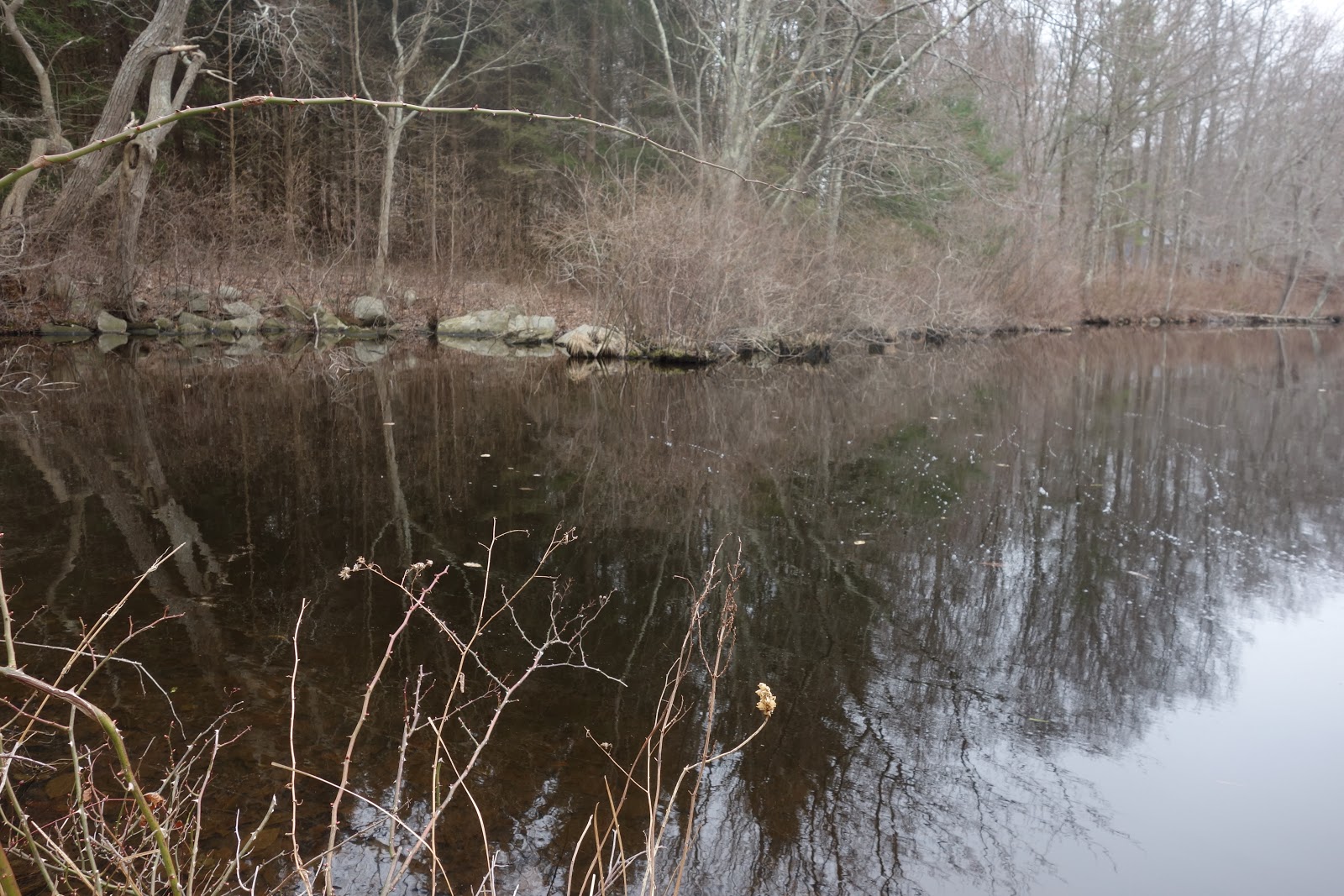
I sat on the spot for a little while, enjoying the view and watching big carp jumping. It was a beautiful foggy evening.


Then, as the sun set, I started to get takes. First came a small yellow perch. Then a few misses. I quickly downsized from a chartreuse zonker to a white woolly bugger, because I was seeing the fish flash but not coming tight. This and every other fly change I did was made faster and easier by the Tactical Anglers micro power clips Alberto had given me at the Hartford expo. I was always kind of skeptical about clips, but they have really grown on me. I don't promote products often. Hardly ever, actually. But these work and work well. Especially for a warm water nighttime fly angler, TA clips are a good investment.


The next fish to come up absolutely blew blew me away. It was a crappie, and a big one. Even for this lake. And I'm used to catching 14 inchers here. What I've told people before has always been "I don't catch many crappies there, they're hardly even targetable, but when I do catch one it's almost always a giant". Well, this one was a giant, the biggest crappie I have ever seen in person. Just a monstrosity in all dimensions. The photos just did't do the fish justice, at all. It was huge. A measured 16 1/2 inch black crappie. It didn't look real.


I got another big yellow perch, then it was just slab crappie city for another 20 minutes. Most of them were over a pound. It was just silly. I'd never caught more than 3 crappies in a trip to this lake and now I was in the middle of the most wide open big crappie bite I'd ever seen.


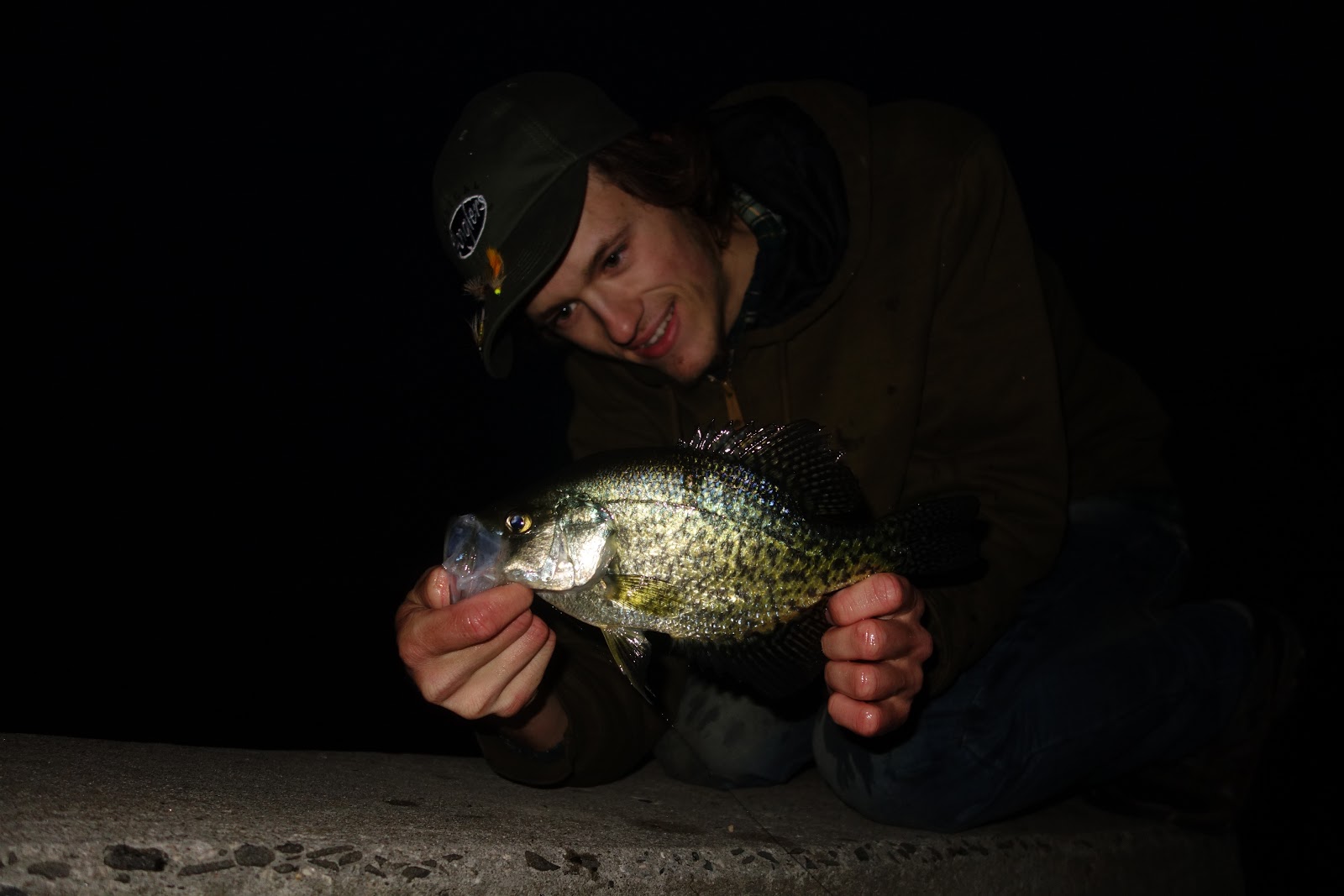
This was the dink of the night.
Then, when it had finally gotten fully dark, I felt the tell tail faint bump that told me a walleye had just inhaled my little fly. Sure enough, after a good brawl, I was soon holding a pretty good walleye, the first of a string of three with two more crappies between the first and second.


The second and third walleyes came when I switched casting positions. Like I said in the previous post about this location and bite window, sometimes just changing which direction you're pulling your fly over structure can be the deciding factor. The walleyes were on a really shallow sand bar adjacent to the hole the crappie were in, and while fighting them I could see their buddies spook off. There were probably a dozen or more there, cruising in from the deep water, feeding, then going back out.


After the third 'eye, I got a few more mega crappies, including one that had a pretty big meal in its stomach. Then I felt the bite window slam shut. I had gotten everything out of it that I could have, though. I was laughing loudly and cursing quietly through the whole event. This was really, really special. But also probably repeatable. The longer I've fished the more I've come to appreciate when a good bite window and trophy fish are reached not through luck or being given a hot tip, but through hard work and dedication. Thank you to everyone who has ever helped me along the way. I am utterly grateful to call some really exceptional anglers and upstanding people my friends. My successes are as much yours as they are mine.

When the stars align catching trophy fish looks easy. But when you begin to align the stars yourself, you actually start to understand what makes catching big fish special. You begin to respect them even more.


If you enjoy what I'm doing here, please share and comment. It is increasingly difficult to maintain this blog under dwindling readership. What best keeps me going so is knowing that I am engaging people and getting them interested in different aspects of fly fishing, the natural world, and art. Follow, like on Facebook, share wherever, comment wherever. Also, consider supporting me on Patreon (link at the top of the bar to the right of your screen, on web version). Every little bit is appreciated! Thank you to my Patrons, Erin, David, john, and Christopher, for supporting this blog.

Monday, April 8, 2019

Shifting Perspectives After Dark

I started night fishing for trout in 2015 and started doing it consistently in 2016. I have learned an awful lot from just following my own path, instead of doing what everyone else before me has done, and especially what is most popular. The biggest thing I've learned, to modify a quote from the late great Lefty Kreh, is that there is more bs in night fishing for trout than there is in a Kansas feed lot. Talking to fly fisherman you'd think everyone and their mother is out there on the river at night. Then you get out there, and even on the most popular rivers on the calmest, clearest, warmest of nights, and there's a few other fisherman out at most. In a few places it's enough to make an appreciable difference, but overall, the vast majority of fly fisherman that claim to night fish regularly talk the talk but just don't walk the walk. How many of you are really out there fishing a trout stream for 6 or more hours in a night even just once a month? I know of a handful of consistent night fisherman in CT, one or two in Mass, a handful in NY, a few in PA, and a bunch in Michigan. Even just reading pieces in various publications, I get the feeling the writers are more or less just just regurgitating the same stuff, maybe with a little bit of a twist. It is only infrequently that I see something really worth digging into . Domenick Swentosky (troutbitten) has written some really good stuff, and Field and Stream's Joe Cermele has done quite a bit to separate the bull from the fact on fishing mouse flies at night (Hook Shots Podcast: Mousing Straight Dope Live From Camp Carnivore).

There are other good examples too, but they are all the exceptions to the rule. If you really want good information, don't look to today's anglers, look at George Harvey and Joe Humphreys. They were the OG's. Joe could still put almost anyone that claims to be a good night fisherman to shame at 90 years old.

One of my own variations on George Harvey's pusher wetfly, used and abused.

Since I started this path, I've progressive had throw away my own previously held notions, all of which had roots in what I heard and read regularly on the subject of night trout fishing. First it was the need to fish big mice and streamers aggressively. I quickly found that mice and large articulated streamers do work, and fairly frequently, but I had to fish them differently than the ways I was being told to. Then I found out that fishing smaller, more subtle presentations with wet flies and streamers got the job done way more frequently than big flies. My idea that night fishing was really just a way to get a giant brown trout was shattered too. Yes, big browns are often primarily nocturnal, but if you go out expecting to only get the hawgs, quit before you even start because this probably isn't for you. Night fishing is actually just another way to effectively target trout of all sizes. I've caught 4 inch brookies and 24 inch rainbows at night. Night fishing works on all sizes and species them when done in the right way for the situation.


My last big notion was that night fishing for trout was a warm weather deal. Summertime, low water, warm nights... that was the oft repeated mantra. In July I found a river that seemed completely dead after dark. In December I had more than one giant brown boil on baitfish at my feet on a night when the low was 26. I saw Swentosky write about night fishing in the winter. I started to question whether the summertime low water paradigm existed because that was actually a real rule, or because anglers that wouldn't have otherwise just resorted to night fishing during the summer because that's the only time the fish were really active. I'm now pretty sure that's the case. On some waters, night fishing is successful year round. On some others, it is best in the spring and in the fall. On yet others, it is best from mid summer through late fall. Time of year isn't actually the deciding factor on whether night fishing is going to be productive on a given day. Flow, available food, type of stream structure, and a few other things matter far more. The only real way to know is to go. You might be missing something amazing.


On Saturday night I fished my part time home water from sunset until about 11:30. The flow was moderately low, the water was 49 degrees, and the night was mild. I saw rises both in the little remaining light after sunset and in the reflections of artificial lights in houses and businesses. That was a good sign. Then, in the tailout of a big pool, I had a big fish slam my mouse just feet away from me.
Okay. This could work.
I met up with Michael Carl (he walks the walk, btw) a little while later. We chatted for a little, then I used my light to see if I could spot any baitfish swimming in the margins. I had already found a ton of tessellated darters in one spot downstream, but there weren't many things swimming around in that spot. I turned off the light and we continued to chat when, behind Mike and to his left, there was a massive explosion that startled us both, slashing through a fast, shallow riffle. It clearly wasn't a beaver or mink. It was a fish eating something. A huge fish eating something.
More confirmation that I was on the right track night fishing this river early.
Mike caught some stockers on streamers and I blew some more great chances with mice. But I finally felt like I was getting somewhere here. Since I caught the first wild brown on a mouse in this river a year ago I've made precious little progress. Now I feel like I've got the groundwork laid to make big things happen, both there and on other rivers. All it took was one night.

On the ride back from fishing two western CT rivers yesterday morning, Mike Andrews and I were talking about night fishing. Mike walks the walk too. He's put up some huge trout at night over the years. We talked about the TMA I live closest to. "You could fish the _____ tonight!" Mike said. I told him that I don't typically start night fishing there until May, when the water is lower and there are hatches after dark to bring the fish up. But I thought about that a little more when I got home and I realized that the only few times I had night fished it earlier in the year I didn't really know what I was doing yet. It was certainly low enough, and this would be another warm night.

I went for it. And hot damn am I glad I did.


I fished from 9:00 until 12:30 with a steady pick of fish. A couple pretty decent ones came to hand. And they fought stupid hard compared to what I typically experience there at night, often jumping 6 times or more. It was all in the approach. The water was higher than I typically night fish there, and colder, and there were fewer fish in the river (stocked river, very few holdovers). I had to fish a heavy tail fly, and a bigger wet than I'd oftentimes need (sz. 14's work well there at night in June), to get the rig down, provide a good moving silhouette, and be able to slow the swing down enough. I fished mice fore a short time without success, which didn't surprise me much.

Really, I know everything I need to know about night fishing for trout. And that's simply that I know hardly anything about night fishing for trout. Starting from there, I can actually make progress and maybe even change the game. Follow the crowd of people that just talk the talk though, and there's not much progress to be made.

If you enjoy what I'm doing here, please share and comment. It is increasingly difficult to maintain this blog under dwindling readership. What best keeps me going so is knowing that I am engaging people and getting them interested in different aspects of fly fishing, the natural world, and art. Follow, like on Facebook, share wherever, comment wherever. Also, consider supporting me on Patreon (link at the top of the bar to the right of your screen, on web version). Every little bit is appreciated! Thank you to my Patrons, Erin, David, john, and Christopher, for supporting this blog.

Friday, April 5, 2019

Cannibalism

In a wonderful little pond not far from my home, there is a very nearly entirely native populous of fishes. For a while I was pretty sure it was just pickerel eating pickerel in there. But then Noah, who lives even close confirmed there are golden shiners and bluegills, and I have since found pumpkinseeds. So, aside from bluegill, every species in that pond is one that is supposed to be there. Despite the descovery of other fish for the pickerel to feed on, they are oddly still the most abundant fish in the pond. Throughout the year I see vast clouds of young of the year pickerel, and hardly any other bait fish. It is very atypical for the apex predator species to also be the most abundant in a given body of water, but that seems to be the case here. And, as such, I find I do best with flies that look like juvenile pickerel.


I have caught more pickerel on the fly above in this pond than any other. And I don't mean that pattern. I mean that specific fly in the photograph. It is a dead ringer for a juvi pickerel, with some color and flash exaggeration. Of course that doesn't hurt when targeting members of the Esox genus. I find it especially deadly on a two hand retrieve.The fish just slam it. And such was the case on my most recent visit.


The air temperature was down and so was the water, and whereas I had found all the fish in the shallower NW corner of the pond on the previous trip, where the seem to stage to spawn, this time the fish were most concentrated in the slightly deeper NE corner. I had found them a bit "chasey" but not super willing to eat last time, and far more aggressive on the fly this time. That may seem counter-intuitive with colder water, but these fish aren't far from spawning. Spawning pickerel don't really eat, so it follows that the closer the water is to the ideal spawning temperature, the less likely they are to grab.


Every fish took while I was doing a two-hand. The most spectacular eat was, unsurprisingly, purported by the biggest fish. It waked on the fly from just moments after it it the water, swirled one it, them at it with gills flared and fins tucked in. I could see it clearly eve though it was 50 ft away. What a show.


With five fish to hand, it wasn't a bad little outing. I went back out later with different targets and less hospitable conditions. It was almost as successful. I may write about it, I may not. From the looks of it I won't be. There are a lot of fish to be caught and things to be learned this weekend.


If you enjoy what I'm doing here, please share and comment. It is increasingly difficult to maintain this blog under dwindling readership. What best keeps me going so is knowing that I am engaging people and getting them interested in different aspects of fly fishing, the natural world, and art. Follow, like on Facebook, share wherever, comment wherever. Also, consider supporting me on Patreon (link at the top of the bar to the right of your screen, on web version). Every little bit is appreciated! Thank you to my Patrons, Erin, David, john, and Christopher, for supporting this blog.

Thursday, April 4, 2019

New Water, New Ideas

Mark Phillipe and I went west yesterday to explore new waters. What we found was a place I think we both know we'll be back to. Despite it being a windy day it was pleasantly warm and felt, smelled, and sounded like spring. Bugs were on and around the water and the fish were active, and, despite there being other anglers out and about, I was confident.


A stonefly doing what early stoneflies do. 


Mark and I saw another angler coming downstream from where we had intended to fish from the start, so we decided to head downstream and let that water rest before we started up. That was a good move. We each had one take while waiting it out down there, and within minutes of starting our upstream trek, I pulled two browns out of the very same holding spot on my small stonefly nymph dropper. The first had an unusual green edge to its operculum, something I personally have never seen so distinct. 


Salamander egg masses.
 Pushing further up I came to a huge deep hole that I had been told be friend John Huber held some quite large browns. Sure enough, after watching for a while, and taking a few casts, I got to a high point from which I could view the whole pool and, sure enough, there were some monsters down there on the bottom. Huge brown trout, beyond all proportions to be expected from stream this small. In this area. Though they were fully unwilling to move, one of their smaller comrades down there wasn't. I brought a truly impressive brook trout to hand. 


Mark came up and we just observed those fish for a little while. It was pretty clear that we'd need to come back for them, and that it would likely be a nocturnal mission. My only debate now is which method I will catch one of the two biggest fish with: a mouse, or a pair of big wetflies? Last year was a good mouse year for me but my confidence still remains in the smaller, more sublet, swinging presentations. Especially after I duped a behemoth rainbow in the Gallatin last fall with a simple black leech at night. But I also know good mouse water when I see it and that stream is loaded with it. Decisions, decisions. 


After bothering those fish with our presence, we pressed onward, and found a 'Little Labrador" as Mark called it. Water loaded with wild brook trout. In the pools, they were rising to the emerging stoneflies. 


A "get out of my territory" bite. 

In one pool, I found brook trout rising consistently rising to emerging stones. That was a sight for sore eyes after a long winter. Mark and I took turns and caught some gorgeous fish.


The last fish rising in the pool was real stud. Thick across the back and well into the low teens in length, this was one of my better CT wild brook trout.


We had run out of room in that direction and headed back downstream. I pestered the giants for a little while (and almost had one, though I'd prefer to wait to go into detail on that). But the only fish either of us caught on the way back down was a brookie that gave itself away with a classic splashy attack of a fluttering stone. I was afforded the room to make a long cast so I took that opportunity. A skated CDC stone did the job perfectly, though it took a few casts.

Photo courtesy Mark Phillipe
We headed even further downstream towards new water, this time not on foot. In a new stretch the river had changed character entirely, with a lower gradient, less hemlock, and less large rock.

Takes were numerous down there for both Mark and I, but they were also easily missed. More than once my Ausable Ugly got slammed so hard I could hear the hit as the fly line quickly went taught in the guides. I tight line nymph at night sometimes, and I always use a leader short enough to have fly line in the guides because it's often that sound that tells me to set. Swinging and dangling flies during the day though, the audible take is much less frequent. Eventually we both managed hookups, and though mine wasn't an especially large fish, Mark's was the biggest of the day.


Notice how much lighter in color this fish is. It was sitting over sand.

Having found such small water with big fish potential, that outing pushed me to reevaluate some of my night fishing strategies. I have night fish large and medium sized water a lot, and small streams a little. Knowing exactly where these big fish live in this stream affords me an opportunity I haven't had before night fishing a small stream. I need to have things well thought out. It's a substantial drive to get there and I really want to nail it in as few as possible. So I've been thinking. 

Stay tuned.

If you enjoy what I'm doing here, please share and comment. It is increasingly difficult to maintain this blog under dwindling readership. What best keeps me going so is knowing that I am engaging people and getting them interested in different aspects of fly fishing, the natural world, and art. Follow, like on Facebook, share wherever, comment wherever. Also, consider supporting me on Patreon (link at the top of the bar to the right of your screen, on web version). Every little bit is appreciated! Thank you to my Patrons, Erin, David, john, and Christopher, for supporting this blog.