Monday, July 29, 2019

Search for the Elusive Blueback Trout (Pt. 2)

After my brief morning jaunt alone, Noah and I set back out after having some breakfast to explore a bit more of these lakes. We had just barely scratched the surface of these waters on our first afternoon, but we certainly had made progress.


We made more progress on day two, at least in terms of catching fish. We found Hexegenia emerging over most of the larger mud and sand flats, and brook trout and yellow perch eating them. Though I might have caught a fish or two on dries, I was rigged with a heavy sink tip and a small silver Kreelex was working... like, really well. So I kept doing that. Many fish took on the ascent, which told me they were likely keyed on emerging and swimming nymphs more so than duns. The Kreelex is also a wicked bright fly. Those fish could see it from a long way off, so I think it may have been better than, say, a dull hex nymph. Since I was using a tip with such a rapid fall rate, my line bowed significantly and my take to hookup ratio was not exactly ideal. I missed a lot of fish. But I caught a lot of fish too, and I don't know for sure if I would have had I fished a floater or slower sinking line. When I trolled, which was every time I re-set my drift, I hooked every fish that took. But trolling isn't particularly fun so I didn't devolve to just trolling. 
The fish weren't particularly large. Some got comfortably into the low-mid teens. These were classic wild Maine stillwater brook trout though, something I've not done a whole lot of, so it was fun. I didn't photograph more than two of them, which I somewhat regret because not only did I not photograph most of the biggest ones, but somewhat don't because honestly, as brook trout go, these were pretty dull. 


We caught a fair number of yellow perch, which, if big enough to be worth the effort, came back with us for dinner. We ended up with a pretty good meal, though we could easily have taken more and probably should have some days. The fresh meat is very much worth the minimal effort it takes to obtain in this wilderness. We left the bigger lakes pretty early after being beat down by wind for a few hours. We spent most of the rest of the second afternoon not fishing for salmonids, actually, though we did go back out in the evening. It didn't really produce much though. We got some new species right by camp, which did keep things feeling productive. A weather change was coming. It rained a bit overnight, and the east wind that had persisted since we got out switched to a west wind. I wasn't sure how it would effect the fishing, but we were on to our third day and I knew we needed to make stuff happen if we wanted to catch a blueback. We decided to cover new ground even further from camp, but still on the connected lakes. Basically, we continued to find fish in the same sorts of places we had the days before, but not in the exact same places. Given that the fishing in the lakes was pretty slow now, we spent as much time exploring as we did just focusing on fishing. Our surroundings were far more grand than the fishing was at that time. So, naturally, we wandered. And wondered.


Eating peanut butter off an ultralite

We ended that session with a handful of brook trout and perch each, and realized we really ought to make a somewhat more drastic move, leaving these connected, easier to access ponds for greener horizons. 
Until next time.
Fish for the love of fish.
Fish for the love of places fish live.
Fish for you.

 If you enjoy what I'm doing here, please share and comment. It is increasingly difficult to maintain this blog under dwindling readership. What best keeps me going so is knowing that I am engaging people and getting them interested in different aspects of fly fishing, the natural world, and art. Follow, like on Facebook, share wherever, comment wherever. Also, consider supporting me on Patreon (link at the top of the bar to the right of your screen, on web version). Every little bit is appreciated! Thank you to my Patrons; Erin, David, john, and Christopher, for supporting this blog.

Sunday, July 28, 2019

Search for the Elusive Blueback Trout (PT. 1)

There are few salmonids that have captivated me to the extent that Maine's relict Arctic char. Ask any fly fisherman what their fish bucketlist is and you're likely to hear a bunch of different classic salmonid species and subspecies, from Gila trout to hucho taimen, along with those flats favorites... tarpon, bonefish, permit, and giant trevally, and maybe a few freshwater giants, like golden dorado or peacock bass. My fly rod bucketlist is longer than most and littered with strange fish you probably haven't heard of, like giant kokopu, goonch catfish, mountain mullet, peacock flounder, or sicklefin redhorse. If you asked me to list my top 25, only four, right now, would be salmonids: sheefish (a whitefish on steroids), softmouth trout, longfin char, and hucho taimen (Longfin char are probably the fish I want most of every known species. Obviously catching an unclassified species would top that).

Up until very recently, blueback trout were one of the 25 fish I wanted most. Though not a distinct species, Maine's Arctic char lived in isolation for long enough to drift away from their less land-locked brethren. Blueback trout are currently considered a subspecies of Arctic char, Salvelinus alpinus oquassa. Originally found in Vermont, New Hampshire, Maine, and Quebec, S. a. oquassa was once classified as three different species, split by region, carrying the common name "sunapee" in Vermont and New Hampshire, "blueback" in Maine, and "red trout" in Quebec. Research determined that these populations had all been isolated for the same amount of time, so all three regional populations are now considered the same subspecies. There seems to still be some wiggle room as to whether they could be a separate species rather than a subspecies of Arctic char, and in my own totally worthless, not entirely scientific opinion, they probably should be given a species classification. Now only the Maine and Quebec populations exist. Mainers call their char bluebacks and sunapees interchangeably, and that isn't entirely wrong in places where stocks seem to have actually been introduced from New Hampshire. Red trout seems to be exclusively a Quebec name. Given that the most common name used to describe Maine's population, throughout history, seems to have been blueback trout, that is what I will be calling them from this point forward.

Bluebacks are a rare fish. Introductions of other species into their natal lakes and ponds, especially rainbow smelt, have pushed them out of their own habitat. The Rangeley Lakes, which once had a unique and thriving population that literally fed the giant brook trout that put them on the map, are now devoid of bluebacks largely because of smelt and land locked salmon. The Vermont and New Hampshire populations are gone too. Bluebacks are the poster child for why introducing new species into a niche is a bad idea. They now are found in only a handful of lakes and ponds in Maine.

I could easily write another ten paragraphs about blueback trout, why they are so cool, why they were in the top 25 on my bucketlist, and other such things. But instead I'll leave that to someone infinitely more qualified. Here is a link to a piece written by Ted Williams, originally for Fly Rod & Reel, now on the Native Fish Coalition blog: Whither Yankee Char.
Please do give that a read before finishing this post. It is important to note that although Wadleigh and Big Reed have now both been reclaimed, many of the problems William's discussed in this article still face these remarkable fish.

I had some serious research to do and decisions to make before Noah and I even left CT in regards to our search for bluebacks. The bodies of water that still harbor these fish are scattered throughout the state almost evenly, and there is an interesting variation from one pond to the next. I eventually narrowed down to three places, two of which were isolated lakes, and the third a cluster of ponds in far north Aroostook County. I consulted with Bob Mallard, then made my pitch to Noah. I thought our best chance at encountering these rare char at a less than ideal time of year existed in the unique cluster of waters that was the furthest away.

We were going further north than either of us had never been.
We were going to the most remote place either of us had ever been.
We were going to Deboullie.


We left Mt. Desert Island and got on I95 in Bangor. We went 80 miles to the town of Sherman, over a few gradual rises hills but mostly swampy flat lands.


At Sherman we got on Rt. 11, which took us 68 miles over rolling hills and farmland and a whole lot of nothing and nobody, all the way to the town of Portage.


In Portage, we said goodbye to the paved roads, cell reception, and permanent residences, and our own sanity. Five miles down the logging roads we stopped at the North Maine Woods, Inc. checkpoint to pay our fees and get better directions (it turns out my hand written ones improvised using the newest available satellite imagery were dead on anyway). 20 something miles worth of gravel road later...


...we reached our home for the next four nights.


Pushineer pond, the bottom of the three connected ponds with blueback trout populations, would be our base of operations. Although it was the smallest of the four total ponds in the cluster it was also the shallowest, so it wasn't likely to produce our bluebacks in mid July. Surface temperatures every afternoon were reaching 70 degrees in Pushineer and Deboullie, but seemed colder in Gardner and Black Pond, which is about what I expected. Hatch activity was fairly strong but there weren't enough fish rising to warrant dry fly fishing, which is what I expected. And our best chance at a blueback seemed to be making the portage to Black.
Which is what I expected.

What I didn't expect was how hard it would be to get fish that we marked with Noah's fish finder to eat. On the first evening we fished Pushineer and Deboullie and marked fish consistently at the same depth regardless of overall depth. They were clearly favoring a certain part of the thermocline as much as they were structure. Noah took the first few fish, all small brook trout, vertical jigging. I trailed behind with only one brookie and a couple perch on white jigs. Later in the evening we found a sporadic rise and I managed one decent fish on a Mickey Finn two hand retrieved.


My first Deboullie brookie
That night we learned that the sun sets later and for much longer that far north. Rather, we knew this to be true already but had never seen it before. A hatch came off at the outlet of the pond, some kind of size 14 dark grey mayfly I had never seen before. It brought common shiners and lake chubs to the surface, but those and the other species we found while in Deboullie will have to be the subject of a different mini-series.


We cooked dinner, noted how severely black fly bites bled and how red the turned, then turned in for the night.
Morning came pretty quickly. I rose with the sun and was out on the water and back before Noah was completely up and ready to fish. It wasn't a particularly productive morning session, but I did cover some new territory and had a possible brief encounter with the target species.

Hexegenia limbata


I'd gotten a couple small brookies casting and two hand retrieving, but wasn't getting enough takes to make that effort worthwhile. I set up to troll and basically used the wind to my advantage, changing heading to cover different contours and speed up and slow down the fly. Coming across a point, I felt the line come tight. The fight was noticeably strong for the size of the fish, and when I got it to hand I saw no spots at all and a bit of a forked tail. Then the little bugger released itself. I don't know if that was a blueback. I'm inclined to think that it probably was. That was a pretty serious disappointment, but things would get better soon.
Until next time.
Fish for the love of fish.
Fish for the love of places fish live.
Fish for you.

 If you enjoy what I'm doing here, please share and comment. It is increasingly difficult to maintain this blog under dwindling readership. What best keeps me going so is knowing that I am engaging people and getting them interested in different aspects of fly fishing, the natural world, and art. Follow, like on Facebook, share wherever, comment wherever. Also, consider supporting me on Patreon (link at the top of the bar to the right of your screen, on web version). Every little bit is appreciated! Thank you to my Patrons; Erin, David, john, and Christopher, for supporting this blog.


Thursday, July 25, 2019

Acadia Pollock on the Fly From Shore

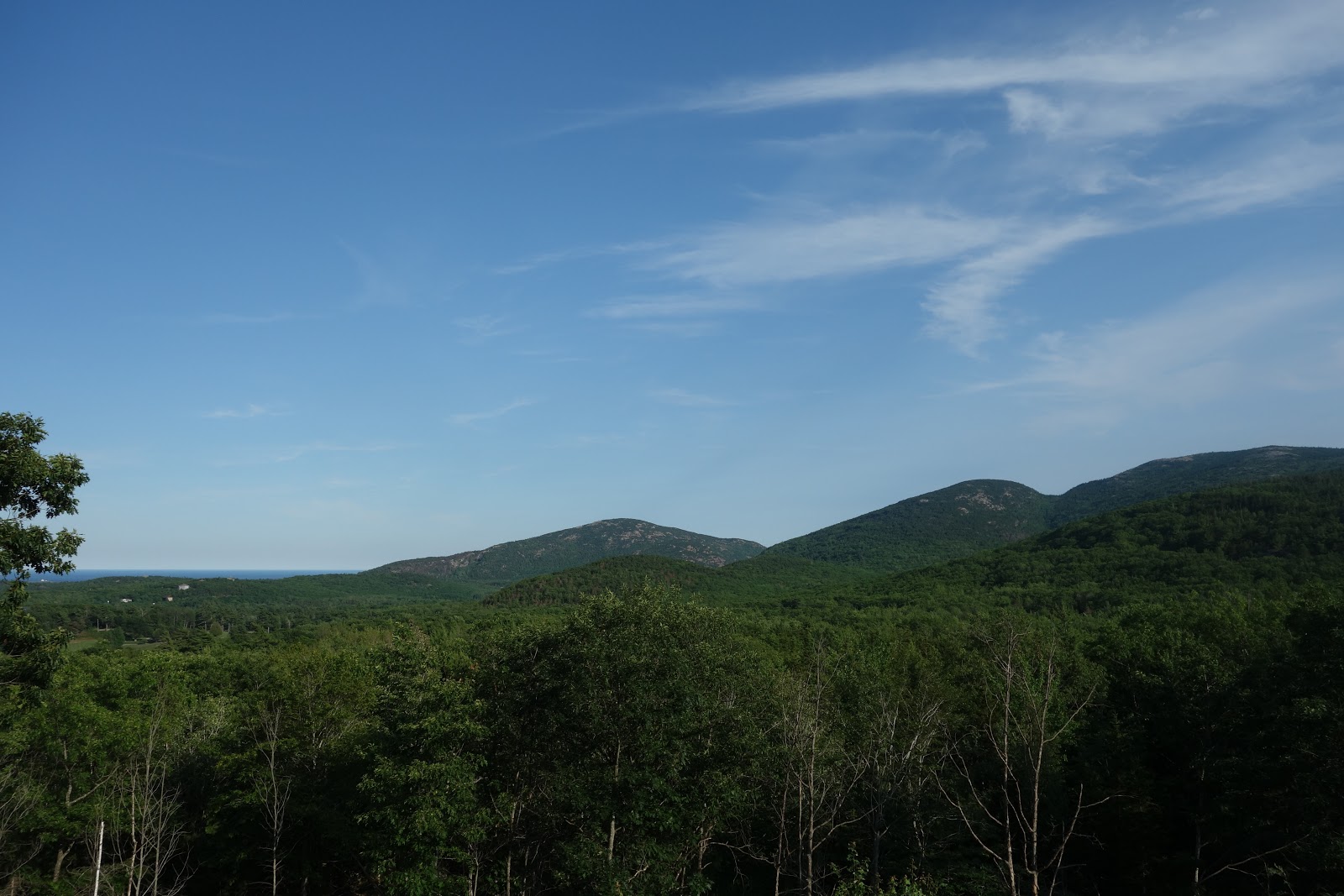
As Noah and I came around a corner and caught our first glimpse of Mt. Desert Island, my brain told me I couldn't possibly be looking at an island. That was an easy leap to make, we couldn't see the ocean yet. But we could see the hills. Hills that big, covered in mixed forest, with big rocks painted in colorful lichens, small mountain brook trout streams, and massive talus slopes, well... to my less than well traveled mind, those hills didn't belong right next to the Atlantic Ocean. But there there it all was.


Acadia is one of, if not the most grand place I have ever been. Those old hills still stand proud after ages of tectonic activity, glaciation, and gradual weather, even as the monstrous ocean mercilessly pounds at their feet. In the place where the island and the sea battle each other nearly constantly, at the foot of the cliffs, Atlantic pollock and mackerel swim.

Noah and I had spent time seeking pollock in Cape Cod, Gloucester, and Maine already without luck. We hadn't been after adult pollock because they were pretty much out of our range of capabilities on foot and on kayaks most of the time. The surf fishing for pollock in Montauk, Rhode Island, the Cape, and even in Maine just isn't what it once was. Giant pollock from shore is a thing of the past. Human greed is to blame. But there are still pollock to be caught in the surf. Harbor pollock are basically their species' equivalent of snapper blues. Small, abundant, and aggressive, they provide some fun surf fishing wherever the structure is right and the water cold enough. That's what Noah and I were after. And this time, we found them.

Lifelist fish #134, Atlantic pollock, Pollachius virens. Rank: species
It turned out that a big part of the deal was going further north to colder water. Though there are still pollock inshore in the summer in a lot of parts of Massachusetts and Maine (NH doesn't have enough shoreline to count. NH is just Maine extra. You'd think it would be easier to just include New Hampshire than go on this little rant. That is true. And yet, here we are.) the further you go, the colder the water, the rockier the shoreline, the more there are around in July. And Acadia was just loaded. Within our first hour in the park we'd both caught our lifer pollock.


Oh, and it wasn't just pollock. Atlantic mackerel also joined the party. I was pretty pleased to get some of them, seeing as I haven't caught all that many mackerel. Actually, by the time we left the Maine shoreline for the north woods, I'd tallied up a larger lifetime number of pollock than mackerel, including both Atlantic and Atlantic chub mackerel.


Scomber scombrus

The first evening was pretty good. I caught a bunch of pollock and a few mackerel on a simple white jighead streamer. Noah caught a ton of mackerel and a few pollock on a sabiki rig. The next morning was all pollock. We got thing a bit more down to a science, and frankly it was all too obvious.


It seemed that wherever there was both submerged ledge and white water there were pollock, and they were all too willing to take a white streamer fished on floating line with the 5wt. That gear for those fish was just perfect. It was a blast.


Aside from just being fun, these were beautiful little fish. Their copper and bronze colored flanks really shone in a way that photography couldn't quite capture. The subtle blue of their lateral line was unexpected, to me at least. Beyond that, they were the easiest fish to handle. No spines, no big teeth, no sharp gill plate. Nothing to cut, puncture or abrade you at all. Pollock taste really good too. Seriously, what's not to love. I left Acadia with a few things and one of them was a whole new appreciation for this species.


 Our time on Mt. Desert Island was short, but I know I have to go back there. It is an undeniably beautiful place, and Noah and I just barely scratched the surface of it. But we were both getting a bit sick of the driving and tourists there. It was time to go north; about as far north as we could go without crossing into Canada.
Until next time.
Fish for the love of fish.
Fish for the love of places fish live.
Fish for you.

 If you enjoy what I'm doing here, please share and comment. It is increasingly difficult to maintain this blog under dwindling readership. What best keeps me going so is knowing that I am engaging people and getting them interested in different aspects of fly fishing, the natural world, and art. Follow, like on Facebook, share wherever, comment wherever. Also, consider supporting me on Patreon (link at the top of the bar to the right of your screen, on web version). Every little bit is appreciated! Thank you to my Patrons; Erin, David, john, and Christopher, for supporting this blog.