Friday, August 16, 2019

Some Housatonic Smallmouth

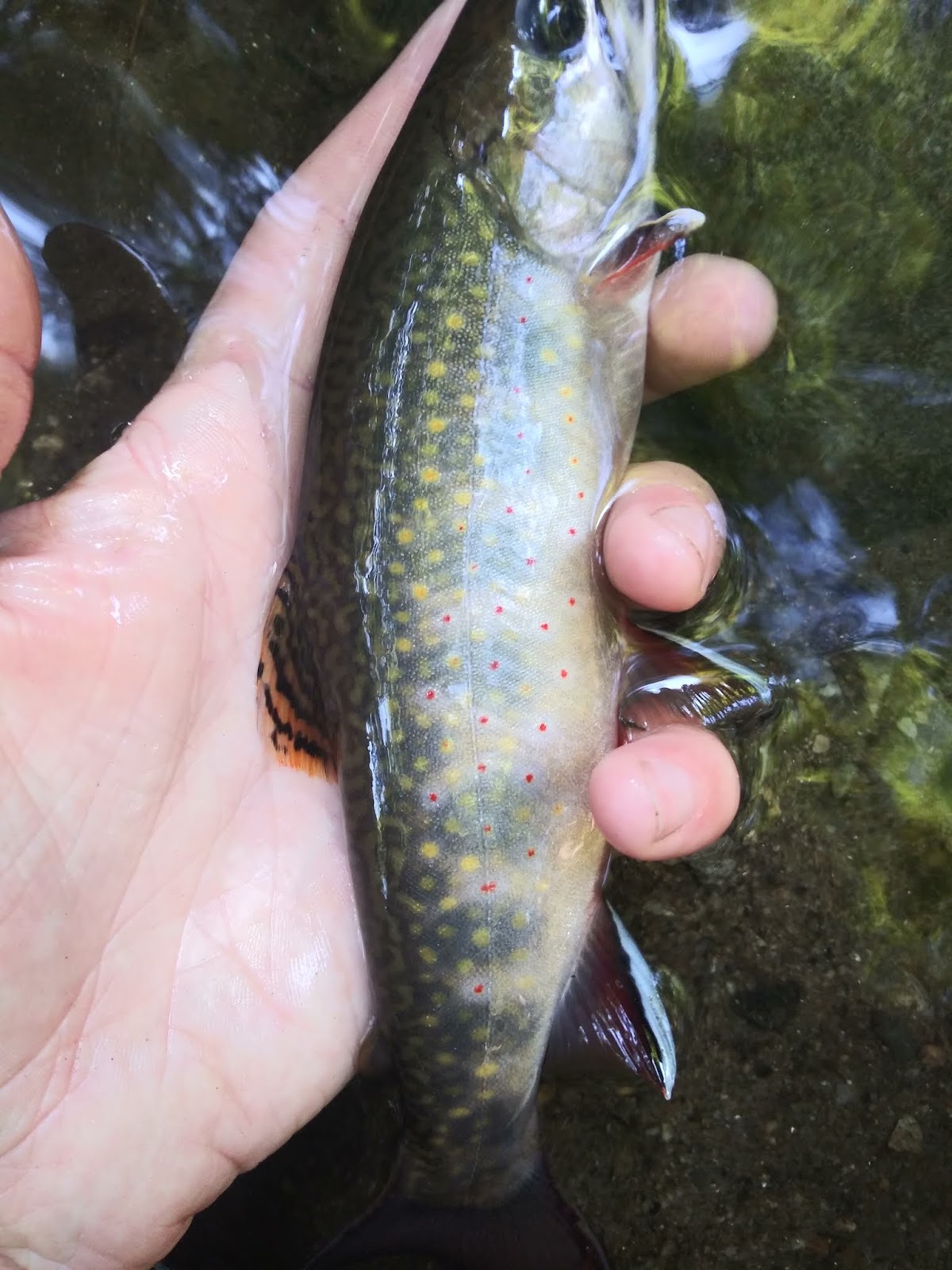
A while back, my friend Rick, his grandson and I made an afternoon and evening trip to the Housatonic after smallmouth bass. I don't get to the Housy often so it was a nice change of pace from the more local freestones which have much lower densities of those acrobatic brown bass. Of course, passing a bridge pool on the way down to our first stop, I couldn't help but deviate from the plan and catch a beautiful wild brookie to start out.


The first spot turned out to be about dead. Despite seeing a few fish roll, which may actually have been carp, none of us got so much as a bump there. This really surprised me, as this had been an exceptionally productive spot the last time I'd fished it. We moved upriver, and our second stop wasn't any more productive. Third time's the charm though... fast pocket water in the shade gave up a couple small fish of crazyfish imitations tied on jig heads.


Following that pattern, we moved to a fourth spot, which also featured pocket water but was above a large deep hole. Bigger bass like the cover deep water provides and the food the fast water provides, so in the evening they are likely to slide up into the pocket water to feed. This proved to be the most fruitful fishing of the day. I took one half decent sized bass as well as a number of smaller ones, as did Rick. Nick got bit off by a pike!


The jiggy crayfish remained the most productive tool through the evening.


I thought things would really kick up late, especially if we got a hatch. We did, and some bass were rising, but poppers nor good mayfly imitations got the job done, and neither did wet flies or streamers. Overall, the catching was mediocre... I've done much better, I've done much worse. But it did just go to show how good the Housatonic is for bass. A steady pick of small fish over a couple hours is slow there. That river is just full of fish!
Until next time.
Fish for the love of fish.
Fish for the love of places fish live.
Fish for you.


 If you enjoy what I'm doing here, please share and comment. It is increasingly difficult to maintain this blog under dwindling readership. What best keeps me going so is knowing that I am engaging people and getting them interested in different aspects of fly fishing, the natural world, and art. Follow, like on Facebook, share wherever, comment wherever. Also, consider supporting me on Patreon (link at the top of the bar to the right of your screen, on web version). Every little bit is appreciated! Thank you to my Patrons; Erin, David, john,Elizabeth, and Christopher, for supporting this blog.

Wednesday, August 14, 2019

Hawaiian Wild Rainbow Trout

(Editors note: I met my good friend Matthew Kimball (@plumber_mattyk on instagram) through mineral collecting years ago. We've dug and prospected together all over CT and in NH, and had some great adventures. Matt fishes as well and a while back moved to Hawaii and has periodically been telling me about some of his fishing there, from mountain stream smallmouth bass to free diving and spear fishing. I've been hoping he'd do a guest post for the blog for a while, and, well... here it is.)

The cool mountain air of Kokee felt refreshingly crisp compared to the unbearable heat and humidity we'd been experiencing down at the coast for the past week. A dense layer of mist still lingered. As I signed in at the self-serve angler station covering the park's upper stream system, I noted with satisfaction that the log book's last entry was my own nearly a month ago. The bucket crowd seems plenty satisfied with the overgrown goldfish the state chucks into the reservoir each year. I really can't blame them. Navigating miles of poorly maintained 4wd roads followed by hiking some truly gnarly terrain definitely doesn't appeal to everyone. Of course, there are the adventurous few out there who need a good challenge.

Hawaiian Rainbow
A brief history:

Sugar plantation owners first introduced rainbow trout to the Hawaiian island of Kauai around 1920. While a tropical island would generally not be considered the most optimal trout habitat, the fish thrived in the cool higher altitude freestone streams of the remote Kokee region on the island's west side. Stocking occurred regularly until being abruptly discontinued in the early 90's due to concerns regarding the trout's impact on native damsel fly populations. These days stocking is limited to a single reservoir that receives rather high fishing pressure during the short 3 month season. Meanwhile, in a select few remote mountain streams, far removed from the hook of your average would-be angler, trout still swim in the cool, tea stained waters. Wild trout in one of the single most unique natural settings you'll ever encounter. An angler's dream to be sure.

Waimea Canyon, Grand Canyon of the Pacific

My primary focus was to explore the downstream section of a particular small stream. Completely new territory for me. Stream flow was down. Way down from my last visit. Signs of fish were scant, a stark contrast to the abundance of fingerlings and fry I was encountering in the stream's upper reaches during my last visit. Definitely doesn't help that trout season takes place smack dab in the middle of the island's dry season (love to know who's brilliant idea that was). I worked my way downstream in search of larger pools that could offer refuge during dry spells. Invasive ginger and blackberry bushes choked the banks in many places, making travel difficult. I pressed on deeper into the valley. About an hour was spent trying to negotiate a single waterfall that dropped a sheer 60 feet. Then another 80 footer.

surprisingly easier climbing back up than down

Having gained access into the lower valley, the terrain changed. Ginger and blackberry were almost absent. Huge boulders, some refrigerator sized, littered the valley floor. Steep slopes climbed hundreds of feet on either side. Definitely a flash flood zone in the wetter months. By this point the stream had been joined by a few tributaries and had much better flow. I spotted a fair size trout in one of the waterfall pools and made a sight cast with a size 10 woolly bugger. The result was instantaneous. After a short but frantic scramble from the ledge on which I was perched I had in hand a truly stunning little fish.


I continued downstream, catching a few more trout as I went, though nothing quite like the first of the day.


Finally, I reached a third falls. I managed to carefully pick my way halfway down before determining further progress to be impossible. A sheer drop of at least 100 feet, likely more, lay below. The valley below was tantalizingly close yet simultaneously unobtainable (Not without repelling gear, anyway). A double step pair of falls dropped hundreds of feet on the valley's opposite wall. Deep pools interrupted by long stretches of riffles enticingly scattered the valley floor. 

forbidden valley
After a few minutes to drink it all in, it was time to begin the slog back up the valley. The pools yielded up a few more of it's precious little living gems. Finally, I had to tear myself away. there was a bowl of warm chili back at the lodge with my name on it. Until next time, Kokee...


 If you enjoy what I'm doing here, please share and comment. It is increasingly difficult to maintain this blog under dwindling readership. What best keeps me going so is knowing that I am engaging people and getting them interested in different aspects of fly fishing, the natural world, and art. Follow, like on Facebook, share wherever, comment wherever. Also, consider supporting me on Patreon (link at the top of the bar to the right of your screen, on web version). Every little bit is appreciated! Thank you to my Patrons; Erin, David, john, and Christopher, for supporting this blog.

Tuesday, August 13, 2019

Maine Retrospective

 It's easy to get cheesy about travel. Experience different cultures, expand your mind, live life to the fullest. All these fund baby millennial and gen-x'rs out there going to exotic places and writing up faux deep captions to put under photos of almost disturbingly blue water and white building with red roofs are enough to make me sick to me stomach. That's just too much cheese. And I eat a lot of cheese.

That being said, whether you are an angler, hunter, hiker... whatever you like to do, it is endlessly enriching to do new things as much as you possibly can. I'm a fish person. That's my primary motivation for going, well, anywhere. Of course, for a fish person like myself, seeing fish places and meeting other fish people is as important as the fish themselves. That's basically a very archaic and yet also somewhat longer way of saying that I'm endlessly fascinated by fish and the places they live and take every opportunity to meet and talk to other people whose lives are also entwined with the pursuit of fish. It really doesn't matter where I go in the world, I'm likely to find exactly what I'm looking for, because there are fish, fisherman, and scientists that study fish virtually everywhere.
The best thing about that is, if you are ate about by fish, you really don't have to go far to experience something wildly different a new to you. For Noah and I, Maine was just a hop, a skip, and a jump away, and filled with possibilities.


Any good journey has stops along the way. For Noah and I, really, there's an end destination other than home, just a string of stops going from and then back to. If you can visit family or friends, that's every bit as important as a fishing destination.


Take time to be in awe. Nowhere I've ever been didn't have something to look at and be amazed by. Nowhere.


Try to meet new people. Chat with locals. Go to tackle shops, and not the big box ones, the small ones that actually might have things you've never seen before and whose owners and employees know the local scene well, because they take part in it day in and day out. Go on a charter if you can afford to do so. Learn as much from the captain and crew that you can in what time you have with them.


Or, do none of that. Stay home. See the things you see every day. Never learn anything. Never be happy. Not everyone can just on a whim drive to far Northern Maine to fish for relict Arctic char, or Florida to look for big snook or exotic cichlids and catfish, much less fly to Montana for a few days to fish for wild cutthrout or to the Seychelles for giant trevally, but I guarantee every one of you have the means to do something you've never done before. Open your mind. I promise it will make you a better angler.
Maine was awesome. I can't believe I got to catch a blueback trout. I held a cod in my hands that I'd wrenched 160 feet from the bottom of the ocean with a 10wt fly rod. I watched a wild brook trout over 20 inches rise up, gulp down my dry fly, then turn back down towards the bottom. I watched a hailstorm bear down on me at a remote mountain lake. I saw fish and birds and reptiles I'd never seen before. I am a very lucky person. We all are. Look around you. This planet is unfathomably spectacular. 
Until next time.
Fish for the love of fish.
Fish for the love of places fish live.
Fish for you.


 If you enjoy what I'm doing here, please share and comment. It is increasingly difficult to maintain this blog under dwindling readership. What best keeps me going so is knowing that I am engaging people and getting them interested in different aspects of fly fishing, the natural world, and art. Follow, like on Facebook, share wherever, comment wherever. Also, consider supporting me on Patreon (link at the top of the bar to the right of your screen, on web version). Every little bit is appreciated! Thank you to my Patrons; Erin, David, john, and Christopher, for supporting this blog.

Monday, August 12, 2019

Haddock, Cod, and (almost) Hake on the Fly

After tooling around southwest Maine somewhat aimlessly for a day and a half, Noah and I found ourselves in the quaint little town of Ogunquit among a very un-quaint, very annoying crowd of tourists. I'm not a fan of tourists. Noah and I technically fit the definition of tourists but we don't look or act like them, to the extent that wherever we go we at some point end up being mistaken for locals. As such we believe we've earned the right to bass the kind of tourists that walk slowly down the middle of the road or poke a Portuguese man of war while taking a photo of it with their phone... Noah and I are idiots but I'd like to think we never look that dumb. We also try to avoid tourist traps as much ass possible, it was part of the reason we didn't spend much time in Acadia.
But there we were in Ogunquit during tourist season, getting annoyed by all the other people that were there. We didn't have a choice though, that's the town out of which the Bunny Clark runs. Noah and I had been talking for a while about booking a headboat trip in Maine. We knee it would be a good way to knock out some new species that we just wouldn't be able to catch by our own means. I was fully prepared to use conventional gear if need me, but I'd fished for tautog and seabass with a fly rod and artificial flies in 60 feet of water. With a very heavy lead and modifications to my bottom fishing rig, I figured I could potentially fish up to 200ft. The problem would be fly line... Fly line is thick and get pushed by current. It would be the biggest issue in presentation, because I refuse to count fish caught on a rig that doesn't utilize fly line as a key part of the equation. I opted for a long length of braid ahead of the fly line, allowing enough of the full sink fly line in the water that it would impact my presentation. In fact, every inch of mu fly line would be in the water, and it would prove to let me bounce my rig around in a very effective way.
The big question was, would the crew actually let me use a fly rod?

We'd booked the afternoon four hour trip. It didn't seem to be quite full but there were enough of us to take up most of the fishing space on the deck. After the first mate and captain, Anthony and Ian, had given a quick talk about what we were going to do and Ian had distributed gear and teasers and whatnot, I made my proposal. Unsurprisingly, it took them both a little by surprise. But I was given the green light as long as I got up on the bow. Braid tangles easily, being further from everyone else made sense regardless of what kind of rod I was using. When we got about 16 miles off shore, Noah and I took our place on the bow and got ready to fish.


I let my two fly rig, weighed down with an awful lot of lead, plummet to the bottom. It felt like it sank forever, but eventually my weight clunked onto the sea floor, 160 feet down. My fly line caused the line to bow, so when I lifted and dropped, my rig moved probably 4 feet laterally. That was great, my fly line was allowing me to actually cover water a bit. Unfortunately that also limited me, because after a few lifts and drops, or just a little while letting the rig sit, I lost all sense of contact with my rig. And cranking it back up, with or without a fish on, was hell.
It didn't take long at all for me to get hits though, and in no time I was pulling up something. Unfortunately, it turned out to be less than a whole red hake, so I can't really count it as a new species. It did give me confidence though... I could do this with a fly rod.

1/3 of a red hake, Urophycis chuss

Noah caught the first whole fish, a really cool looking cusk.

Cusk, Brosme brosme

In a short time I felt a take, slammed it, and cranked from the depths a new species.

Lifelist fish #139, haddock, Melanogrammus aeglefinus. Rank: species


A short time later Ian moved the vessel to the next spot. My first drop went without a take, but as I brought it back up I felt something take and start to fight. It ended up being a much larger pollock than any of the little harbor sized schoolies we'd caught in Acadia.


A few drops later I really got rattled, and after some serious cranking, brought up a cod pollock double! I was very pleased with the cod, it was quite a handsome fish.


Lifelist fish #140, Atlantic cod, Gadus morhua. Rank: species
Although it felt like barely any time had passed, it wasn't much longer before it was time to head back to shore. Noah and I were already discussing plans to return. Though we each only got a small number of new species, we'd seen a number of things caught by others that were strange to us, and one sea robin that was nothing like anything listed from the Gulf of Maine at all.


We'd already known the potential to catch a ton of new species, but now we had some understanding of how we could better get that done. Besides that, the crew was great, the boat itself was great, and the price was great. I'd go back just for the fun of it. Noah and I both plan to make the trip again just to fish on the Bunny Clark. 


That evening we fried up the cusk Noah had caught. It was one of the best eating fish I've ever had, no question. Just delicious. The next morning, after an unproductive stop in Kittery hoping to find some winter flounder, we were on our way home at last. Maine is amazing. Just an incredible place. I can't wait to go back.
Until next time.
Fish for the love of fish.
Fish for the love of places fish live.
Fish for you.


 If you enjoy what I'm doing here, please share and comment. It is increasingly difficult to maintain this blog under dwindling readership. What best keeps me going so is knowing that I am engaging people and getting them interested in different aspects of fly fishing, the natural world, and art. Follow, like on Facebook, share wherever, comment wherever. Also, consider supporting me on Patreon (link at the top of the bar to the right of your screen, on web version). Every little bit is appreciated! Thank you to my Patrons; Erin, David, john, and Christopher, for supporting this blog.

Friday, August 9, 2019

Giant Maine Brook Trout & Landlocked Salmon

Well, it worked. It was the perfect morning to look for a mouse bite: foggy, cloudy, and eventually rainy. The flow was perfect. We got there early. Withing minutes of arriving at the river, I'd had one big fish swipe at the mouse and miss and then another slightly smaller one pinned just briefly. Then one slob came up and just slurped it and I was into my largest wild brook trout yet. With 1x and my 5wt, the fight wasn't much to write home about, though I'd certainly only hooked a handful of brook trout that had given such a battle. My personal best wild brook trout, in Maine, on a master splinter, in daylight... this was totally bad ass. But it wasn't over... oh no, it was just beginning.


I missed a number more takes from slob brookies on the mouse just out of pure shock that it was working as well as it was. Of course, as I got over it, it kind of stopped working as well. I waffled for a while, trying to nail down a pattern, but I was only catching small fish again. But then I changed to a streamer, a dace imitation of my own devising that I call "Ace of Dace", and that worked. In a pocket just above where I'd lost my monster the day before a good sized brookie jumped on the take, clearing two feet easy. It refused to come back though, so I rested that fish and came back later. In the intervening time, I found some small fish and some quartz crystals.


When I came back, the fish had moved up the pocket, but it was still there and it was still hungry. It wasn't a slob like the first fish, but it was big, fat, and very pretty. It had about the most extraordinary gill plate marbling I'd ever seen on a brook trout. 


I felt I had found the pattern now. Twitching the Ace of Dace through deep buckets, just under the surface, seemed to be the way. 


I found a place where I was semi-comfortably able to get across the river, which was fun and definitely very dangerous, then started working back up that shore. I worked the buckets and caught and moved some good fish, and eventually I did find another big one. In fact, it was even larger than my first fish. I broke my personal best a second time, with an even better looking large male. 


After watching that absolute stud disappear back into the depths, I continued upstream, now starting to semi-regularly miss large brook trout, but replacing them with fair sized landlocked salmon. I was good with that. Little else fights like a landlocked salmon. They tend to spend more time in the air than in the water after the hook is set. 


After bumping up through some serious pocket water, catching five or six landlocked salmon in the loiw to mid teens, one brookie of about 15, and missing some larger brook trout, I came to one of the only big pools around. There were some risers in there but I decided instead to cast my dace imitation up a seem and two hand retrieve it back down. Just moments into the retrieve there was a big explosion and I came tight to 24 inches of very angry, very muscular landlocked salmon. The fish began launching itself over and over, cartwheeling down the pool, headed downstream. It made it just to the tail out and I managed to stop it. I was relieved for that, if it had kept going there was no chance I was catching it. This pool basically dumped right into a set of waterfalls. When the fish turned upstream, it didn't stop jumping, which I was OK with because it was expending energy doing that instead of running and I could land it faster and hopefully handle it easier. That ended up not quite being true. After five minutes and 22 total jumps I had my biggest landlocked salmon at my feet, literally tearing itself up in rage. I saw a couple small plumes of blood exit puff out of it's mouth and knew I had to act quick. I grabbed the fly my the nose and pushed it out quickly, turned the fish around, and let it swim off. I didn't even consider trying to photograph that fish. Any time out of the water and that fish would very likely have expired. She was stunningly thick and very chrome, the best looking salmon I'd ever seen in person, and true beast western Maine landlocked, but I value a fish's life more than a photo. 

That fish had put down the rest of the pool, so I decided to head downstream to try to get some of the fish I'd missed on the way up. I didn't, but standing on a boulder above a big back eddy, I watched an absolutely huge brook trout come up five feet from the bottom three times to take large golden stones off the surface. I tied on a mouse and drifted it over him and he had no interest in it at all. I dug through my boxes, looking for something that might tempt this fish, and I wasn't seeing anything that really struck me as being right. Then I happened to glance, out of the corner of my eye, the perfect fly. It wasn't my own, someone had evidently dropped it there. It was a classic salmonfly dry fly. I tied it on, made one cast, and watched the biggest brook trout head I'd ever seen engulf it. I set the hook and the battle was on. This brookie basically sounded (not the noise kind of sound) like a false albacore or tuna, diving to the bottom, turning broadside, swimming in circles, and just flat out refusing to come up. Eventually I did leverage it up from the bottom. I slid down the rock and put my hand under this beast's head. It wasn't as colorful as some of the fish had been, though it had serious shoulders and a huge kype. I put it up against my rod to get an idea of how long it was. When I later measured, it was between 21 and 22 inches in length. I held it there for a moment, just shaking my head and smiling. I reached for my pack and camera momentarily then hesitated. 

My biggest wild brown and my biggest wild rainbow had both been at hand almost long enough for me to get shots of them before deciding they just weren't into it. And to an extent I'm actually proud of that. Those fish were for me... I and only I remember exactly how they were caught, how big they were, and what they looked like. It somehow felt wrong to now turn a lens towards the largest wild brook trout I'd ever seen in person. So I didn't. The images of the two largest fish I'd caught on unquestionably the best morning of brook trout fishing I'd ever experienced both exist only in my memory and in watercolor, and I am more than satisfied with that. They left their mark in more ways than one. 


What I do regret is not promptly taking that lucky stonefly off and securing it somewhere. I do have the parachute sulphur I caught my biggest brown on and the black leach I got my giant rainbow on, but the salmonfly I caught my largest wild brook trout on is presently in a tree in Western Maine. 

I headed upstream to see if the landlocked salmon had turned back on in the pool I caught the big one in. They had, and they were still very hip to a two hand retrieve, tough I did eventually have to change to a weighted fly to tempt the last few. I did get a pretty good one, though nothing of the 
caliber of the first that pool had given up. 


And that was that, really. I probably could have stayed there another two or three hours and just stayed on fish the whole time, but I was satisfied. I had come to get big brook trout and I did. I was ready to say "goodbye until next time" to the Rangeley Region. 


This is what Noah and I do. We roll into town for a few days, say "We've come for your fish", and with surprising frequency, manage to do as well or better than we'd planned. I take pride in having a big enough base of knowledge of how rivers, lakes, and ocean shores are structured and how fish behave to go pretty much anywhere and have some amount of success. Put the best trout angler in the world on a stretch of southern New England shoreline and tell them to catch a false albacore, they probably won't get the job done. It is my opinion that the best anglers also have the broadest range of species, water types, and tactics in their skill set. If I can, I would like to be the best fly angler I possibly can be. To achieve this, I have a lot of time and work to put in, and I have to regularly try to do things I've never done before. And the day after we left Rangeley, Noah and I were going to do something neither of us had ever done, and it was going to be really really cool. 
Until next time.
Fish for the love of fish.
Fish for the love of places fish live.
Fish for you.


 If you enjoy what I'm doing here, please share and comment. It is increasingly difficult to maintain this blog under dwindling readership. What best keeps me going so is knowing that I am engaging people and getting them interested in different aspects of fly fishing, the natural world, and art. Follow, like on Facebook, share wherever, comment wherever. Also, consider supporting me on Patreon (link at the top of the bar to the right of your screen, on web version). Every little bit is appreciated! Thank you to my Patrons; Erin, David, john, and Christopher, for supporting this blog.