Sunday, June 28, 2020

On Point

May 12th. The sky was clear, the sun was bright, and the wind was cranking. From virtually any perspective, these conditions were less than ideal. But Noah and I aren't ones to shy away from a challenge and the fishing had been exceptional, so we dropped the boat in the lake and prepared to be brutalized by wind in the hopes that we might find some smallmouth.

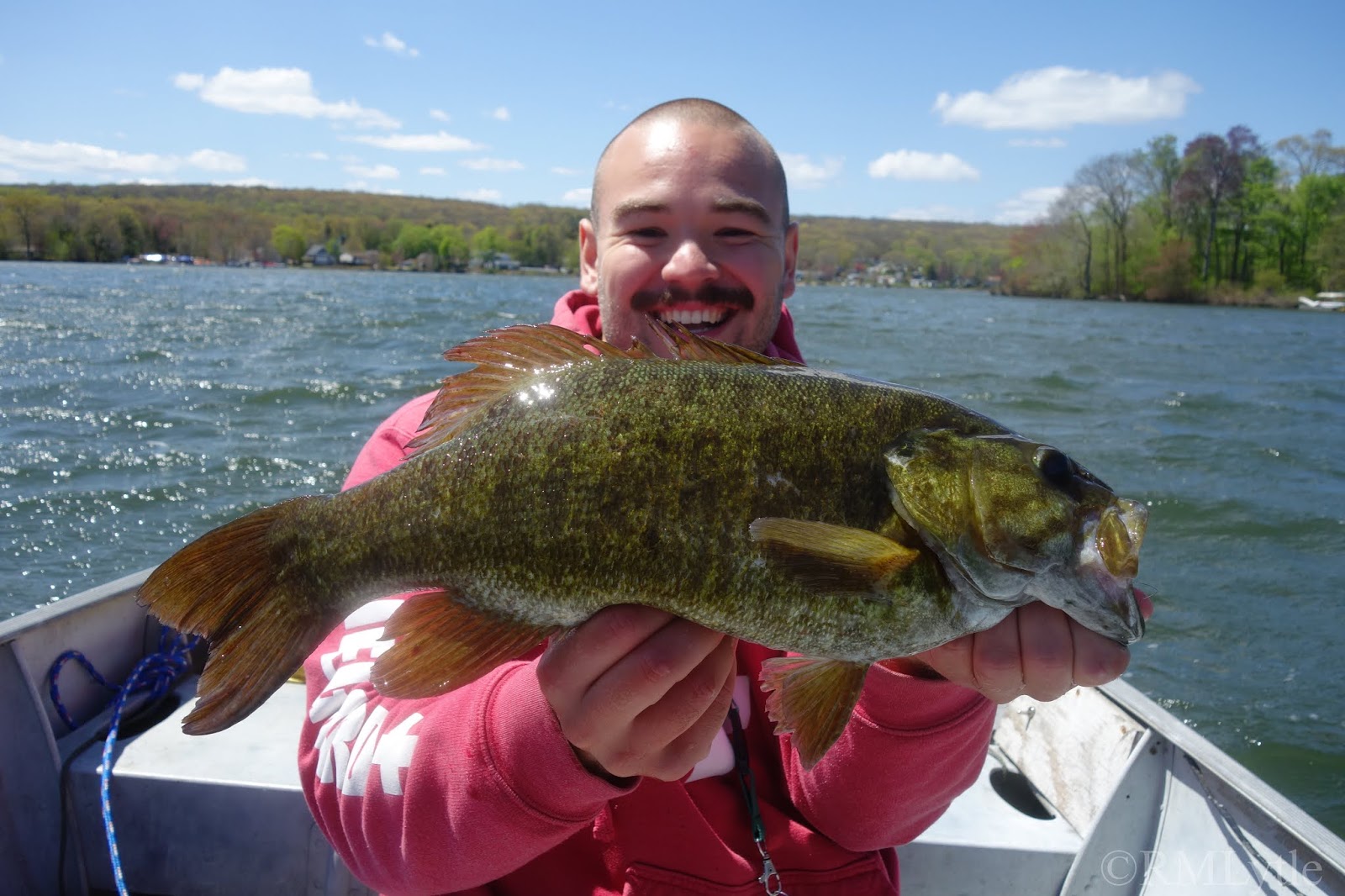
We hit the first, most consistently productive spot. Nothing. No surprise there. I then suggested we try a point to the south. The wind was absolutely rushing around this rocky point, creating current and an eddy in the lee. I got grabbed in a few casts, then again, missing both. The second felt huge. Then I heard Noah say "snagglepus" and turned to see him bent double, very clearly hung up. A short time passed, then "Snagglepus" started jumping.
A frantic battle ensued, but we inevitably put a 19" (measured, no guesswork) fat smallmouth in the net. Snagglepus was a hog.

A short time later I caught a much less impressive fish and then a much much less impressive fish. Fish were very clearly stacked on this wind blown point, a classic setup in the early season.


After seemingly exhausting the windward side of the point we moved to the lee. We worked our way closer and closer to the current seem running off the tip of the point, and as I'd expected that's where the fish were holding. Noah took center stage with a couple more good quality smallmouth while I piddled around with the dinky males.


Our success was so key to this pone piece of structure, quite frankly the only point on the lake that was in play on this particular weather pattern. Lakes and ponds are often refereed to as "stillwaters" by fly fisherman, but that is a misnomer. Wind and temperature differences both cause current in lakes and ponds, and on bigger water bodies the current created by either factor are very significant. Finding where the current in a lake moves and concentrates food puts an angler in much better position to catch higher caliber fish, or simply to avoid skunking on an otherwise potentially fruitless day. Finding the sweet-spot on a wind blown point is as simple a fishing it thoroughly from on side to the other. Often, especially in the early season, there isn't just one bass, but a whole pile of them.

On another note of tactics, I primarily fished flies tied on 8th and 16th oz. jigs for smallmouth this spring. I didn't have many in my arsenal though, and on this day the color patterns I did have were significantly out fish by Noah's black bucktail jig. In this case there could have been no difference in productivity between fly rod and spin, and in certain circumstances, fishing a hair or feather jig on a fly rod with floating line, rather than a spinning rod with fine diameter braid or flouro, keeps the jig in the strike zone without hanging up as often.
Until next time,
Fish for the love of fish.
Fish for the love of places fish live.
Fish for you.
And stay safe and healthy.


Thank you to my Patrons; Erin, David, John, Elizabeth, Brandon, Christopher, Shawn, Mike, Sara, Leo, and Franky for supporting this blog on Patreon. 

Friday, June 26, 2020

Convergence '20: Catalyst

Herring are the catalyst. My schedule from April through to mid June revolves around them. Without them, there's little to draw me and many other predators to the tidal rivers that are my office in the spring. Herring are the largest baitfish that runs a lot of these rivers in numbers. In some places shad take that designation, but herring are king where I fish. Their caloric content is the biggest draw. Imagine a river full of swimming cheeseburgers, a virtual buffet. It doesn't hurt that it's full of french fries too: spotfin shiners, glass or yellow eels, perch... the list goes on.

Unfortunately in the current fishery having a lot of herring in the river doesn't mean there's good fishing. I said in the last Convergence post that this was my worst herring run year yet, and that wasn't because there weren't herring. Despite my horrible mental state and erratic motivation causing my hours to plummet, I still managed to be on the water for some of the most remarkable pushes of blueback herring I've ever seen.


May 4th brought with it possibly the biggest push of herring I'd ever seen, and, oddly enough, I didn't fish in the dark at all. The run was extremely heavy right in the middle of the day, and though the fishing was unexceptional the sheer volume of bluebacks filled a need to see something spectacular and I left before the good fishing would even start. 


Under the water were the shimmering apparitions of thousands of 6-11 inch fish, almost invisible in the the deeper water but boisterously obtrusive in the shallows, where the males all jockeyed for position behind the fat, egg laden females. They occupied most of the river, a school of fish so impressive even someone with little interest in ichthyology or fishing would be impressed. As is so often the case I struggled to capture what I was really seeing in the water with my camera.


Were the bass there? Yes. Yes they were. Not a ton, not huge, and because it was in the middle of the day they were finicky. But a flatwing given slight manipulations every now and then got slammed a few times. I only photographed the smallest fish of four... because size doesn't always matter. 


So... the catalyst, the herring, were out in force this year. That just leaves two ingredients needed for a good successful spring mission: hard hours and numbers of larger striped bass. Unfortunately neither I nor the bass would hold up our ends of the deal.
Until next time,
Fish for the love of fish.
Fish for the love of places fish live.
Fish for you.
And stay safe and healthy.


Thank you to my Patrons; Erin, David, John, Elizabeth, Brandon, Christopher, Shawn, Mike, Sara, Leo, and Franky for supporting this blog on Patreon. 

Tuesday, June 23, 2020

Black Bass After Hours

Some might think my obsession for night fishing originated in trout. I do, indeed, put in a lot of hours each year fishing for salmonids between sunset and sunrise, and have been for about six years. But they're not the fish that sparked my interest in fishing after dark. That honor, actually, belongs to the black basses. Long before I learned to cast a fly rod I wanted to know the behaviors and patterns of big bass at night. Though I was too young to be granted permission to night fish like I do now, I got out when I could, and I caught some big bass doing so. I hate to say it but I'm out of practice these days, I can't even remember the last time I caught a truly impressive largemouth bass at night, but I do venture out from time to time seeking hawgs after dark, albeit with different gear.

Early May this year was exceptionally chilly, it even snowed. Such weather patterns wouldn't seem conducive to nocturnal bass bites, but I hit it right on one particular night.
Big flies come to mind far too often when night fishing is brought up, regardless of species. Though low light conditions routinely make predator fish drop their guard and feed on larger prey, that's doesn't mean small to medium sized presentations won't fish better. Never underestimate a well tied and well presented Woolly Bugger for bass at night.


Now, I should admit that the four cookie cutter smallmouth and single healthy above average largemouth I got on this cold May eve were not expected, I wasn't there specifically for bass. Catching a couple wouldn't have been a surprise at all. But this pile of reasonably good quality fish was noteworthy. Though I wasn't able to get out enough to determine if it were a repeatable pattern, it's in the logbook now and come the same time next year further exploration of a potential predictable yearly bite window is warranted. That said, it may have been a one off. I don't really know.


I've fished for black bass a lot more this year than I typically do and I've had a few pretty good fish, but I'm just not satisfied. With summer very much here now, my efforts will need to be directed at low light periods, and that includes night fishing. Ideally, this is the year I regain my big bass mojo. Let's see what I can learn and re-learn along the way.
Until next time,
Fish for the love of fish.
Fish for the love of places fish live.
Fish for you.
And stay safe and healthy.


Thank you to my Patrons; Erin, David, John, Elizabeth, Brandon, Christopher, Shawn, Mike, Sara, Leo, and Franky for supporting this blog on Patreon. 

Sunday, June 21, 2020

Convergence '20: It Begins Thusly

Later than I'd have liked, the first herring run bass of the year hit my hollow fly and peeled drag after I gave him a couple quick punches. It wasn't a big fish at all but very welcomed, these stripers are tied so tightly to my soul that to feel that grab and set the hook is no longer something I want but something I need. I'd already been out a half dozen times this year and though there'd been herring, at times lots, It'd felt lie there just weren't many bass around. This night, May 2nd, there still weren't many, but a modest amount of herring and bass were present. When I lipped the fish and and got another little blast of endorphins, all was right. He was a pretty little bass in the mid 20 inch range, the most abundant size of fish in the current fishery. In all likelihood this bass had wintered over in CT somewhere, and the first pushes of herring had drawn him from his winter holding place into this small tidal river. I gave him a kiss and whispered sweet nothings to him, aware that, to the fish, I was an annoyance at least and a threat of death at most, but I can't help but talk sweetly to a beautiful thing I love.


Not long later, I was greeted by another tug and gave it the tough love again. Another similarly sized bass made its way to hand, despite its best efforts to avoid me.


Another endorphin boost, another kiss on the head, another fish released... the herring run was beginning to feel official. I can't remember if I caught another fish that night. I could go back and look at my logs if I really felt like it, but I don't and I'm not going to. Though the season of mass convergence had started more than a month prior, I was just now finally joining the party. This year would be a strange one in every capacity. My drive was not what it had been other years and I would be so depressed at times it kept me from taking full advantage. I was in perhaps the worst mental health of my life, and though I at times tried not to let them, these fish, herring and stripers, that have become so important to me, managed to keep me from teetering over the edge. It would be, not to spoil it, the worst herring run year yet for me. But perhaps the most important. This year the convergence of baitfish, predator fish, and birds of prey would remind me what I need most out of life, and that if I don't let these fish and the places they live consume me wholly I'm more lost then ever.
Until next time,
Fish for the love of fish.
Fish for the love of places fish live.
Fish for you.
And stay safe and healthy.


Thank you to my Patrons; Erin, David, John, Elizabeth, Brandon, Christopher, Shawn, Mike, Sara, Leo, and Franky for supporting this blog on Patreon. 

Friday, June 19, 2020

A Spontaneous Romp in North Carolina

Life sometimes takes funny turns, and such was the was the case when I ended up in North Carolina in the middle of a pandemic. I wasn't there to fish but you can bet I was going to. I'd never fished North Carolina before, and there was ample opportunity for new species. Of course when you aren't focused on fishing new species become hard to get.


The first water I fished in North Carolina was a small, murky creek full of sunfish. My firs ever fish in North Carolina was a green sunfish. This was extraordinarily unsurprising. I'd catch quite a few of that species, and none particularly big or pretty, unfortunately.


Fliers, however, made a very pleasant appearance... I'd not have caught these guys had I stayed at home! After my first taste (not literally) of the species in Virginia, I'd wanted to catch some more. That this one took the Okefenokee Swamp Sally, very much a fly for them, was fitting. 


Another place I fished featured a winding creek with log jams and deep runs, brushed in heavily.


More interesting than the creek itself were the small oxbow ponds in its flood plain. These small, shallow cut-off ponds were actually full of fish, much to my pleasure. This ended up being the a very memorable fishing experience. Walking through thick woods to reach these oxbow ponds full of sunfish and redfin pickerel was awesome. It didn't feel like there should be fish in these places, and yet there were.


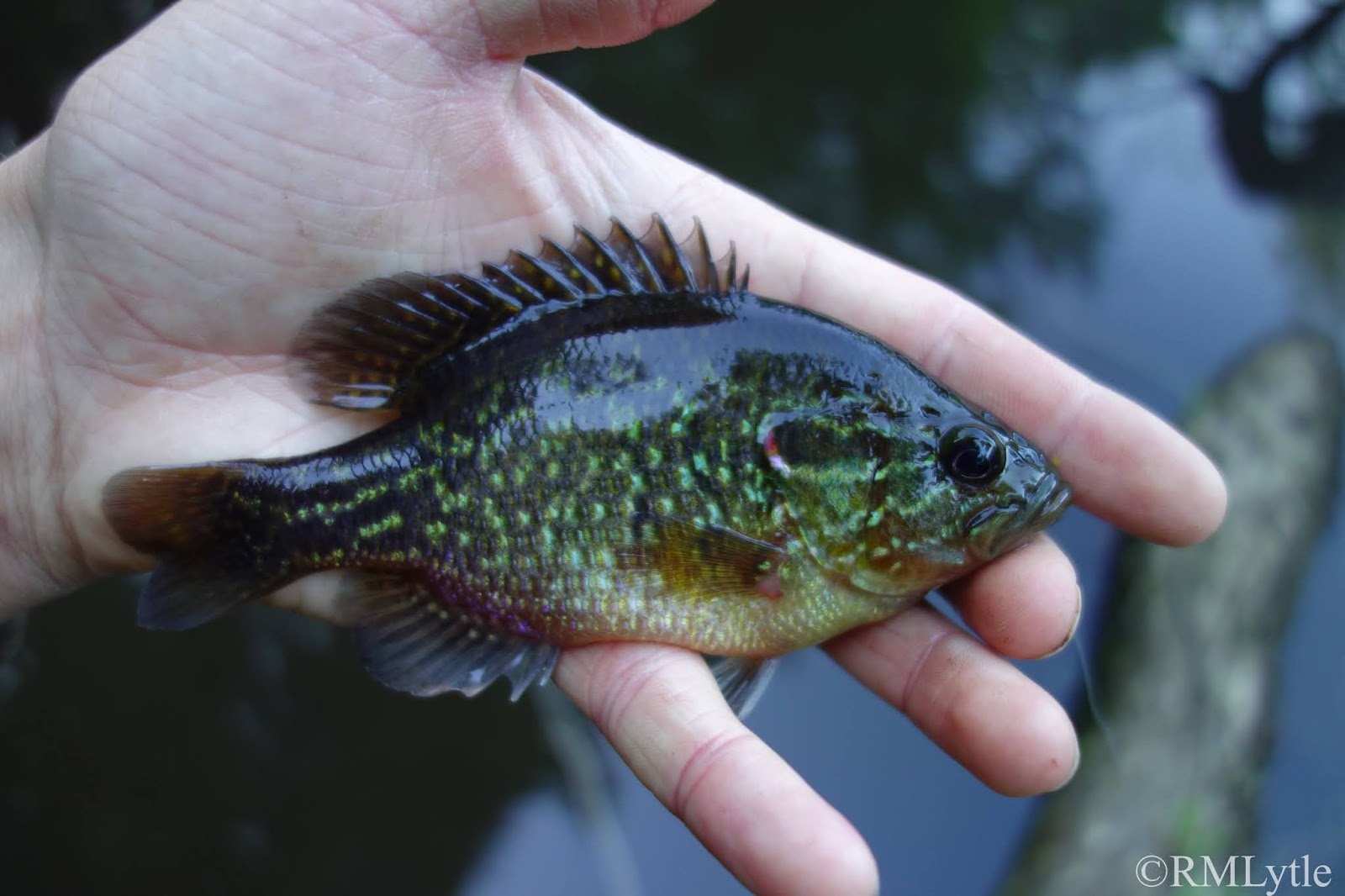
The best fish I caught out of any of those oxbows was, in my opinion, the stunning little warmouth pictured below. The colors on it were stunning.


The creek itself produced redbreast sunfish, and I had takes and misses by some small shiners. What those shiners were I do not know, though they were very likely a species I'd never caught before.


I ended up fishing the same waters after dark one night in an attempt to spotlight a new species. I caught no fish at all, though I did see a lot of wildlife. Freshwater shrimp were notable, a species I'd never seen before.


The last fishing I did in North Carolina, on this trip I should say as I will definitely fish there again, was in a huge reservoir. Something I'd always wanted to see was going on there... the shad spawn. Threadfin shad are very common in the southeast and are an important baitfish. With such spawning action happening I hoped I'd find large bass feeding on them.


Instead what I found was the most carp I'd ever seen feeding, rooting around for the shad eggs in the flooded timber. It would have been remarkably easy fishing... were these not carp, and in flooded timber. I hooked and lost fish after fish, all small but big enough to wrap me around one of the many, many branches... I wasn't losing flies much, but time after time after time the hook pulled. I hooked and lost more carp than I can typically expect to in a year. Eventually I got one ugly little fella to hand, and I decided not to photograph it. But I mostly regret not spending more time photographing all the hundreds of tailing fish. I let a fantastic opportunity slide in that regard.


North Carolina was weird in every capacity... how I ended up there, my time there, and what transpired afterward. But if nothing else I learned a few things. Take chances but don't be stupid. I'll be back, almost certainly for the express purpose of fishing next time.
Until next time,
Fish for the love of fish.
Fish for the love of places fish live.
Fish for you.
And stay safe and healthy.


Thank you to my Patrons; Erin, David, John, Elizabeth, Brandon, Christopher, Shawn, Mike, Sara, Leo, and Franky for supporting this blog on Patreon.