Frank Mundus fished for monsters. Monsters meant one thing: sharks. The living inspiration for Captain Quint, Mundus was apparently a fittingly eccentric individual to be a pioneer of shark fishing charters out of Montauk. According to Mundus, at the time he started, if shark charters were offered, people turned up their noses. But get people on the deck with the selective marketing of a "monster charter" and they have a lot of fun catching sharks... and probably want to come back and do it again. And some of the sharks Mundus brought to the dock in the years prior to the prohibition on fishing for great white sharks truly did embody the monstrous designation with their shear stature alone. Not to mention how some of them were caught. Mundus' largest white shark weighed in at 4,500 pounds and was harpooned next to a whale carcass off of Block Island in 1964. There's a photo of someone, who at least to me doesn't look like Capt. Mundus himself, standing on the floating humpback whale carcass while a white shark gnaws off a chunk of blubbery flesh. That grainy image, which is hard to find online and only as a photo of the framed photo, captivated me for years. The idea of finding massive sharks grazing on the megalithic carcass of one of Earth's largest living creatures was hard to shake. At the time, whale carcasses were far from unheard of, and finding the odd carcass has long been an effective strategy for finding sharks.
Then, many decades later, whale carcasses started to become a bit more common. In 2016, what NOAA calls a humpback UME (unusual mortality event) would begin that has at this point not met its end. At this time, 229 humpbacks have died along the east coast. That tally is increased when large numbers of other cetaceans, including two critically endangered Atlantic right whales, are added to it. It's a heart breaking statistic that brings a stall to what had been a successful recovery of many cetacean species along the Eastern Seaboard, and a crushing one for anyone that adores whales and dolphins. When I was a younger lad I was drawing whales obsessively... in the time period just before I was drawing tornadoes obsessively. And, if you asked, I'd say that Atlantic right whales were my favorite animal. I'll never forget seeing my first baleen whale in the wild. They are remarkable creatures, and seeing them makes me feel far less important as an individual of the human species. But it wasn't until after 2020 that I noted the whale strandings starting to make waves in the fishing world, and for interesting reasons.
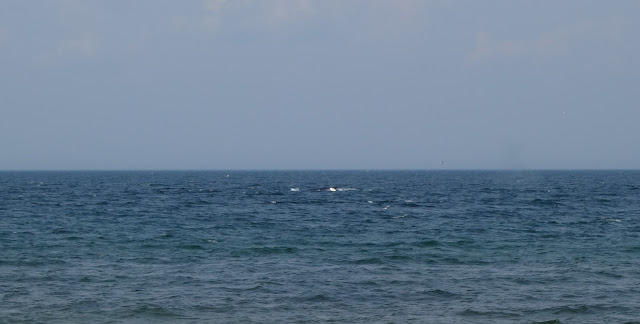 |
| A humpback surfaces within sight of the beach at Race Point on Cape Cod, July 2020 |
"Today, the Biden-Harris Administration is announcing the 10th approval of a commercial-scale offshore wind project. With this approval, the nation has now approved more than 15 gigawatts of offshore wind projects – enough to power 5.25 million homes, and equivalent to half of the capacity needed to achieve the 30 gigawatt goal." -White House press release, September 05, 2024.
With a high level of climate related anxiety, much of it warranted, and an example set by countries that have embraced wind power, both offshore and onshore, a democratic administration made a fateful decision to lease the ocean floor to both domestic and foreign energy companies in hopes of adapting the domestic electrical grid to a less carbon intensive form of power. That has become an extremely contentious decision and is especially hotly debated in the saltwater fishing world in the northeast. And in merely engaging in this debate, I put myself in an unfortunate position. The political climate in this country has become so volatile, so contentious, that I know I stand to anger and lose some of my audience with this post, potentially even run off a client or two, shake up friendships, and risk future revenue streams for my business. But, frankly, I can be silent on this no longer. This issue and the way it is debated anger me to the core, and I need to speak out. I have already lost friends over this, lost them of my own accord. I could no longer stand by and watch people make unsound argument after unsound argument, preaching to a choir instead of making claims with a legitimately strong basis of facts and research to an audience that would actually change their minds, if fed the information in a form that didn't come off as unhinged lunacy. If I dared to say anything contrary to their point, even if I was in agreement broadly, they'd deflect to an entirely unrelated note. So I've had enough, I'm coming out with what I know and what I believe about offshore wind on the Atlantic coast.
"Green energy" is the term often used to describe non-carbon emitting, renewable energy. Immediately that definition gets sloppy, as the existing infrastructure to build any energy source, whether that source emits carbon when up and running or not, emits carbon, as does the maintenance of it. The "green" also invokes a feeling that such an energy source will be good for the environment, despite the fact that developing undeveloped space is, without fail, going to be damaging to the biome it is built upon. So it becomes clear that green, or in fact clean, are relative terms in this respect. Hydropower burns carbon upon it's initial construction, then creates a barrier that both negatively impacts the hydrology of the river in question and prevents fish species from effectively migrating. So despite the carbon free and often very affordable and efficient product ("The levelized cost of electricity (LCOE) of hydropower worldwide has remained relatively stable throughout the past decade, amounting to 0.06 U.S. dollars per kilowatt-hour in 2022. Hydropower had an average cost of around 6.1 cents per kilowatt-hour that year." -www.statista.com) us anglers in particular have come to consider hydropower very un-clean, and dams are coming down all over the US and Canada. Though the product of finished offshore wind facilities doesn't emit carbon, how much damage occurs to get there, and is it worth it? That's the big question.
The offshore landscape is no stranger to the sort of development and surveying that goes into making a wind farm. The first drilling in saltwater occurred in the Santa Barbara Channel in 1896. Nearshore drilling began in the Gulf of Mexico in the 1930's. Soon the interest in maintaining control over oil deposits was changing the ownership of the ocean floor when President Truman extended the American ownership of the seafloor out to the edge of the continental shelf in 1945. Today, offshore drilling works like this: the government leases out a section of seafloor to a company. That company then surveys that piece of seafloor using seismic blasting, basically using sound to map out the seafloor and what is underneath, looking for deposits of oil and natural gas. If that company finds a profitable deposit, they will likely extract it using some form of drilling platform, some of which are fixed, some float. The crude oil is then piped or transported to shore. Throughout this process, these companies are regulated and observed to prevent potential environmental impacts. Of course, there's no avoiding negative impacts. The seismic air guns used for oil and gas surveys create a sound at up to 250 decibels, and is shown to be potentially harmful to marine mammals. The drilling process, construction of an oil rig, and pipelines to move the oil also disrupt the ocean floor and existing marine life. Personally, I'd argue that this process is disruptive and not worth it's yield (About 14.6 percent of crude oil and 2.3 percent of gas in the United States were produced from offshore drilling in 2022 -nrdc.org). At this point what already exists it isn't removable in the near future, nor would it make sense to, but each presidential administration brings forward a new set of offshore leases for oil and gas, including the Biden-Harris administration (His Interior Department, which oversees the federal oil program, outpaced the Trump administration in approving new drilling permits. At the same time, Biden leased the smallest amount of public land for drilling in his first 18 months in office than any president since Harry Truman. -Politico) So the proverbial whoring off of the seafloor is neither new nor ending, though to those of us looking out into the Atlantic seeing wind turbines it may sure seem new. I, personally, am not comfortable with these offshore leases in any context and have argued against both oil and gas and wind offshore leases. But let's be careful with equivalency before we've got the facts straight.
Here's where the whales dying along the Atlantic coast comes in. The construction of wind turbines offshore also requires sea floor mapping using sound, and the leading argument against the offshore wind leases is that this surveying, as well as the noise created by the construction itself, are responsible for the rapid increase in strandings of marine mammals. The data to indicate that is occurring is quite scant. There are some that would argue that this is intentional, that it is being suppressed maliciously to push an agenda. And this is where I'm going to lose a few people, even though I'm going to try to convince you all that these windmills are the wrong move ecologically and economically regardless of your stance on climate change, whales, or clean energy. Once someone believes the truth is being suppressed, and that that's why there isn't data, it's very hard to dig them out of that belief. But belief not only in the absence of evidence but because of the absence of evidence is problematic, improvable by it's nature. We lock into it with such gusto as humans, almost as though it were a biological imperative. Should I interview a psychologist about that? Maybe. I could also prop up any belief with the same claim if someone disagrees to exactly the same effect. Don't believe in Sasquatch? It's being censored. FACEBOOK IS HIDING MY POSTS! THIS ADMINISTRATION IS LYING TOOO YOUUUUUU! I'm not impressed by the main stream media, but the online world isn't remotely trustworthy and if you can't back up your claim without resorting to claiming censorship or pointing to extremely questionable sources that have absolutely no provability, I'm going to dismiss your claim and I'm not sorry about that.
The people that have already dug in their heels are going to scoff at this. But I don't see much real evidence of censorship or hiding the truth. It's too conjectural, and most of the people involved with collecting the data are not partisan enough to bother "hiding the truth". What truth we do have is that the surveying methods used for wind farms have not been proven to be harmful to cetaceans in the way seismic air gun surveys for oil and gas have, though in most areas where offshore wind development has already been underway for an extended time there are very few large whales to effect anyway. So the data isn't there yet. Even boat traffic noise has been proven to have extremely harmful effects on whales and dolphins ("Researchers placed tracking and noise recording devices on northern and southern resident killer whales in the Salish Sea that sits between British Columbia and Washington state between 2009 and 2014. They found that louder ship noise resulted in longer hunting times for the orcas (Orcinus orca). 'Vessel noise negatively impacts every step in the hunting behavior of northern and southern resident orcas: from searching to pursuing and finally capturing prey,' said lead author Jennifer Tennessen, a senior research scientist at the University of Washington’s Center for Ecosystem Sentinels, in a press release." - Boat noise hampers orcas’ hunting ability, September 26, 2024, The Wildlife Society). Add to that the fact that NOAA issued incidental take permits to offshore wind companies for multiple cetacean species. So, though absence of evidence is a concern, it isn't evidence of absence, and the actions of the regulatory body among increasing cetacean strandings are suggestive that even they aren't confident that the projects aren't harmful to these species. I do have a concern that the surveying and construction process is killing some whales. There are some efforts being made to prevent it, but my own personal bias when it comes to industry and protecting the environment says its simply never enough, regardless of whether a project is billed as "green". Industrialization kills, period.
The problem for these activists is that even if the windmills are killing whales it certainly isn't all of them, and many among the crowd claiming to be in favor of the whales turn a blind eye to many known, proven hazards that definitely are killing whales, including the boat noise they themselves make on their way to fish offshore. In fact, I found an article about the very orca study I shared above because one of the activists I was once friends with shared it. When I commented, they immediately deflected to wind despite the fact that nothing in the article discussed it, nor the study, nor is any wind lease underway where it took place. Now, anytime a whale, dolphin or porpoise floats up dead or strands, hundreds of people jump to the conclusion that offshore wind killed it before any data is available at all. That is completely in spite of the fact that whales have been floating around since the days Frank Mundus killed white sharks with harpoons and well before. If you argue against something on such shaky ground, no matter how passionately, you are going to look like a fool. The totality of the stranding events hasn't lined up completely with the surveying or construction, though some data extrapolation suggests some concurrence. Clearly, many of the dead whales fell victim to boats and lost fishing gear, both of which are proven hazards effecting marine ecosystems around the world. Another confirmation bias exists as well: more cetaceans are present in the inshore waters of the northeast now than 50 years ago. More whales and dolphins total, more whales and dolphins show up dead. There is more at play here than just wind development, and the rest vitally needs to be addressed too as there is no sign of this unusual mortality event stopping regardless of what happens with the wind industry. That is a heartbreaking fact, and I wish I could do a lot more to stop it. I truly do love marine mammals and whales especially, and it hurts me to see them dying due to any human impact. Ideological consistency, knowledge of the many threats to whales today, knowledge of the history of commercial whaling past and present, and arguments against the countless other things killing whales are scarce among many who have made whale deaths their primary calling card against offshore wind. I wonder why that is? An argument made frequently without definitive data, in ignorance of other issues, with clear biases is an argument that turns people away, even if at the core what you're arguing for has validity.
Whales aren't all there is to the environment. Like drilling rigs, fixed wind turbines have a large footprint on the seafloor and in the largest planned offshore wind farms there are going to be a lot of them. Some are leased on extremely concerning ground. One often contested has been the Revolution Wind project, part of whose lease extended onto Cox Ledge, an area of vital importance to an already struggling cod fishery. ("BOEM, NOAA Fisheries and fishermen have long debated how to protect cod habitat in the region if turbine arrays are built, with NOAA experts specifically pointing to likely impacts around Cox Ledge. The often-bitter debate was one factor in the Sept. 1 mass resignation of the Rhode Island Fishermen’s Advisory Board, whose members charged the state Coastal Resource Management Council is too deferential to wind development interests at the expense of habitat and fisheries impacts." - Activists seek lockdown on New England wind project, April 25, 2024, Work Boat, Kirk Moore) NOAA designated an area including Cox Ledge as an area of particular concern due to it's value as cod spawning habitat on March 6th, 2024. There are also concerns that fish may not cross the high voltage cables that will bring power ashore from the turbines. There is some data that suggests certain fish species have aversions to or are impacted by these cables, but the data is not very complete as the abstract from one Harvard study on multiple fish species interactions with cables indicates: "Despite this concern, few studies have investigated these effects in free-living species." Wyman, M. T. ; Kavet, R. ; Klimley, A. P., 2016. The mere fact that these concerns are being dealt with post-leasing, and without broad study of the potential impacts, is troubling. Environmentally, from my perspective, this is the biggest screw up. Some will tie it to mal intent, everything I see suggests negligence, haste to catch up to other nations, failures of bureaucracy, and failures of industry and it's urge to obtain more capital quickly. This is also nothing new, environmental studies around drilling leases both in the ocean and on land are not taken as seriously as they should be. We don't always know how the construction, operation, or existence of some infrastructure is going to effect wildlife before it is approved, and at times that means well meaning people approve projects without knowing how detrimental they are going to be. That's not evil, it's dumb. It's a kind of dumb that crosses party lines, trades, ethnicities and disciplines all around the world. It's a part of the human condition. Connecticut recently proposed a bill that would allow housing projects to be pushed through regulatory barriers quicker, which sounds all fine and dandy if you're struggling to afford housing and the housing that gets built doesn't immediately get swept up by corporate landlord... but sounds really bad if you're a box turtle, spadefoot toad, or eastern hognose. Thankfully that legislation did not come to pass, yet. Point being, development without fully taking into account environmental impacts is far, far too common across the board. Even when research does exist, it doesn't always mean regulatory action does everything possible to prevent conflict either.
 |
| This adult timber rattlesnake exists in a population that is losing foraging habitat and more and more prone to road crossing mortality due to development, despite years of radio telemetry study and being listed as endangered in the state of CT. |
Environmental impacts came to a head in July of this year when one of Vineyard Wind's recently constructed turbines had a blade fail and crumble into the ocean. Beachgoers have been finding debris on the Cape, the Islands, Rhode Island, and Long Island ever since. I've seen debris from this failure myself in both Rhode Island and Massachusetts. For one of what is to be hundreds of turbines to fail and spew debris into the ocean that has lingered for months is not in any way a confidence boost that these projects are in fact "clean" and "green". CNN reported that this wasn't the first time a blade built by the same manufacture failed in this way (
"Several GE Vernova blades have broken on onshore and offshore turbines in Germany, Sweden, Lithuania and the United Kingdom in recent years." -The broken wind turbine near Nantucket was ‘highly unusual and rare.’ But it wasn’t the first, Ella Nilsen, CNN, July 20, 2024). This incident pulled even more people into the advocacy against windmills, and for good reason. It was an unsightly source of pollution and environmental mess.
It seems to me that wind isn't a step down enough from the negative impacts of carbon-based offshore resource extraction, but how exactly does it scale on a cost effect basis? Wind isn't going away, after all, it is a legitimately renewable resource. But building and maintaining large pieces of infrastructure in the turbulent Atlantic is a costly effort. Vineyard Wind's project is estimated to cost 4 billion for 62 turbines, Ørsted had put 4 billion into two projects in New Jersey that were expected to cost 10 billion. but have now already been canceled, and many billions are being invested into other projects, some of which is being federally subsidized. Offshore wind consistently ranks among the costliest sources of electricity. ("The levelized cost of electricity of a subsidized US offshore wind project has increased to $114.20 per megawatt-hour in 2023, up almost 50% from 2021 levels in nominal terms, according to BloombergNEF calculations" -Soaring Costs Stress US Offshore Wind Companies, Ruin Margins, BloombergNEF, Atin Jain, August 1, 2023). Land based wind, solar, combined cycle gas, and geothermal are all cheaper per mega watt hour and are efficient and may in cases be comparatively cleaner and greener than offshore wind. As is always the case, consumers are going to foot the bill when costs are high. Connecticut Governor Ned Lamont is already wavering on contracts that Rhode Island, Massachusetts, and Connecticut were slated to enter over concerns of the high cost and how it will impact Connecticut residents ("Lamont said he’s concerned about the price the states will receive from vendors. His decision comes as customers continue to raise frustrations with a July 1 electricity rate hike, but Lamont said his concern goes back longer than that." -State not joining regional wind power purchase amid price concerns, Mike Savino, NBC Connecticut, September 18, 2024).
So offshore wind is expensive, may be being built without enough environmental scrutiny, and already some turbines are crumbling into the ocean. What do we do, then, if someone doesn't think offshore is detrimental, what's the best way to convince them? For me, it was political sycophancy that kept me away from the topic for a while, and that's what I watched a whole slough of fisherman settle into. Some reading this who don't know me well could possibly be working backwards from a conclusion. I'm against offshore wind. Donald Trump is vehemently against offshore wind. So I must be voting Trump?
There are people who are doing that; that's one of their biggest reasons for voting and publicly advocating for the republican nominee. For me that couldn't be further from the truth. Conservation is indeed one of the biggest issues I vote on- without healthy ecosystems, clean water, biodiversity, and so on we are screwed. Almost every detail I see doesn't paint the potential future republican presidential administration in a very pro-conservation light at all. Those voting based on the candidate's position on offshore wind apparently are blind to the fact the he has out-rightly advocated for rendering species extinct. A "tiny little fish" as Trump once said at a rally in 2016, the functionally extinct delta smelt is a signifier for the health of the vitally important and endangered Sacramento–San Joaquin River Delta. Water diversion from the delta to agriculture and cities in California puts the ecosystem, and restoration efforts for the delta smelt, in jeopardy. With reintroduction efforts struggling, the small species became a talking point for Trump, who essentially argued that sucking the Delta even drier for the sake of feeding the water-starved industries and people of California was much more important than a species on the brink. This rhetoric revolved around the idea that water was being let out to sea instead of used, failing to take any consideration for exactly how the existing reservoir system works or how the delta itself functions. If less fresh water were allowed to flow through the delta, saltwater would back-up into the tidal estuary, rendering a lot more of it less usable by agriculture. So it's kind of rich to see anyone hitching their anti-wind car to the anti conservation train of a pro-extinction, completely science illiterate candidate whose platform has included fully eliminating the EPA and NOAA as well as landmark environmental protections like the Clean Water Act and Clean Air Act, and who already eliminated protections for vital sea-floor habitat in the Atlantic not far from where these wind leases exist. There's inarguably more at stake from the expanding of oil and gas drilling, mining, selling off public lands, ignoring climate change, and putting lobbyists and businessmen in positions of authority in government agencies controlling environmental regulation than in offshore wind alone. There's some reasons to support Trump that I understand (but don't agree with), but conservation? It's laughable, and it's one of the reasons many of those fighting the fight against windmills struggle to gain ground among those that don't already agree with them, aside from just making bad arguments unjustified by data and just being outrageously despicable to the people that disagree and even threatening the marine biologists that work on examining stranded marine mammals and saving those that are still alive.
By the same token, I won't be a sycophant for the Democratic Party's environmental failures. Though the Biden administration made some significant improvements and provided funding for some projects that will preserve the sanctity of some habitats and species, it wasn't enough. In the case of offshore wind I do believe its a step in the wrong direction. I long ago understood that under any administration I'll be fighting a hard- often even losing -battles to protect habitat and species. It's just a matter of who will make things measurably worse across the board for that battle. That leads me to the solution... if it isn't wind, how should we modernize our electrical grid, to diminish reliance on carbon based energy and preserve as much habitat as possible, while also keeping the cost to the population down? Obviously any solution is going to be complex and multi-facetted, but I'd argue that solar power should be a huge part of the equation. Specifically, solar on existing developed infrastructure instead of solar fields on what could otherwise be preserved woodlands, meadows, or farmland. There are acres upon acres of land that we've already paved or built on. Somehow, we need to integrate solar energy production into that already developed land ("This is how it typically goes with solar arrays: We build them on open space rather than in developed areas. That is, they overwhelmingly occupy croplands, arid lands, and grasslands, not rooftops or parking lots, according to a global inventory published last month in Nature."-Why Putting Solar Canopies on Parking Lots Is a Smart Green Move, Richard Conniff, Yale Environment 360, November 22, 2021). The infrastructure would blend well into the modern landscape anyway, and could likely be integrated into the grid in a way that is less susceptible to both damage from severe weather and foreign interference. Strong, modernized nuclear power, though it has a wide cost range and can be very expensive, does have a place in filling the void given the intermittent nature of solar power. Geothermal energy also has a fitting place despite some complexity issues. We also need to be advocating for less energy intensive development and simply be using less as much as possible, moving away from suburban sprawl, adapting cities and towns to walkability and public transportation, and so on. These are workable goals, and if more of the electorate were informed and advocating for them we could be in a far, far better place across the board with environmental issues, energy efficiency and safety, cost to the public at large, traffic, jobs... the list is extensive. I think the fishing community, which is predisposed to activism in many ways, has a real potential to make positive impact. The problem is we keep falling prey to the conspiracy ridden world of being chronically online. Information is spread quickly and without forethought or real insightful skepticism. Nuance and complexity is also often thrown aside. Many view these issues and the world as black and white, which they absolutely are not. That mindset and the bad arguments it breeds taints the conversation, scares away people that would otherwise be great advocates, and results in losing ground that didn't need to be lost. My advice is simple: get the hell of social media, read scientific literature, get involved hands on with real conservation groups with proven track records of in-field work, take steps to mitigate your own impacts, actually listen to people that have something to say that is contrary to your own opinion, but be critical of whether something is factually based or just an opinion. It's also okay to be wrong. In a world where ignorance is used as an insult and everyone is ignorant to most of the vast swath of knowledge there is to know or not know, we need to change the perception of ignorance. You definitely are ignorant. You reading this... you are wrong about something. You might even be very, very wrong about something. That's okay, as long as you're willing to allow room for your mind to be changed. It's when ignorance is willful that it becomes problematic. I'm definitely wrong about things, no question. But I'm also entirely willing to have my mind changed and will do so when the facts dictate it. We need to be less certain as individuals. And just fucking be kind for God's sake. I ended my last post with this sentiment and I mean it: We can do better. We need to do better.


