Friday, November 13, 2020

Bridge and Creek Hopping Striped Bass

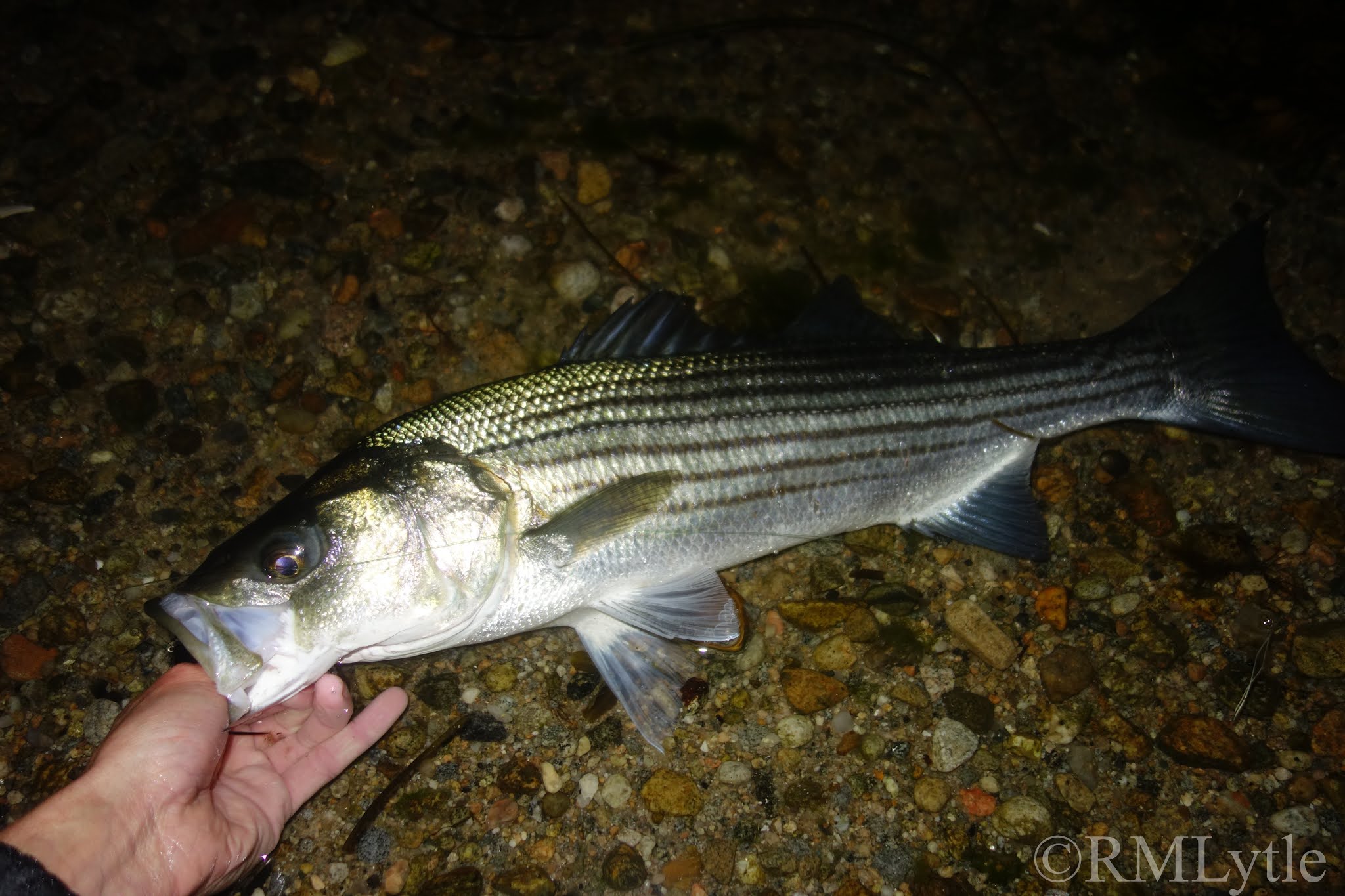
 October 5th, 2020: I stepped off Ian's skiff just before sunset and walked up the beach, pants rolled up to my knees, and more fishing gear than I could comfortably carry in my arms. My day was not over. I walked back to the car and readied myself for an evening of targeting stripped bass on foot. My saltwater fly fishing roots are in seeking creek and backwater "big schoolies", 26 to 36 inch bass. Not cows, not rats. Fish is this size range used to be much more abundant, and maybe they will be again though the current slot limit is, well... bad, and it won't help. Anyway, I was ready to buckle down and do the kind of fishing that got me into stripers in the first place for the next few nights. This was the first of many to come and I was starting out in a spot, on a tide, and with a fly that were all proven. Success was assured and success was had. 


With half a dozen fish around 26-27 inches to hand at the first bridge before it got too dark for reaction bites on a gamechanger, I moved to a more well lit bridge to swing Snake Flies and flatwings along and across the shadow lines, where hungry bass were waiting on station for silversides to swim through. Like trout rising to mayflies, bass held in strong current and moved left, right and up to intercept food. Fly fisherman used to fishing to blitzing schoolies take time to adjust to this sort of fishing, which really is more like fishing dries or wets to stationed trout. I love it. I love that there are so many ways to catch striped bass, so many different behaviors to decipher, and so many habitats to explore. The amount of variety within this one species is remarkable.


October 6th, 2020: I went west instead of east this night. I wanted to fish some areas I hadn't in a long while. 

The first spot I'd fished as recently as August but the others had all at least been 4 years. The last time I'd fished the finale stop, I'd not even yet caught my first striped bass on the fly. These were all bridges, one lit, two not. And they were all holding fat little schoolies. The average size was far smaller than the night before, but the fish were more interested in bigger attractor snake flies, which was more fun. One fat 25 incher stood out as the fish of the night. 


At the last spot, I stood on the bridge as I'd quit fishing and just watched fish working the shadow line. I was transfixed, leaning over the guardrail, watching stripers do what stripers should do. A lone car sped by me at twice the speed limit and I glanced at their taillights momentarily before looking back down to the water. I must have stood there 20 minutes before I realized I would have to head home or I'd get dangerously tired.

October 7th, 2020: The wind was howling and I went east again, but started in a place I'd not tried much after dark. I parked the car more than a mile from where I'd fish, and got out my bike. I then rode through the woods, dodging fallen limbs, rushing to the beach. When I got to the sand I concealed the bike and started walking. Partway own the beach a haunting shadow loomed. I turned my light back on and saw two beached sailboats, apparently abandoned by their crews, tilted at concerning angles, high and dry. 

I left that creepy scene didn't stop until I reached the mouth of a creek, and headed up to the first bend to start fishing. Signs of life were limited. I heard but two striped bass pop. I only had one follow and swipe, and it can't have been a striper. I could see the tail swirl behind the fly, and if the fish's nose was a foot behind the fly it was four feet long. This must have been a huge dogfish or average brown shark. I made one big swipe before turning away. I left a little disturbed, bound for the same bridge I'd fished after dark on the 5th. There, when he tie slacked, I had a tiny window of opportunity to get a true cow when a school set up on the up-current shadow line in the slow, lazy current. Big bass are, after all, much slower and lazier than small ones. One came up and inhaled my black flatwing. But it was off within seconds and the opportunity for a truly large fish was over, the rest dispersed.

A few small schoolies kept the skunk off that night. 

Until next time,

Fish for the love of fish.
Fish for the love of places fish live.
Fish for you.
And stay safe and healthy.


Thank you to my Patrons; Erin, David, John, Elizabeth, Brandon, Christopher, Shawn, Mike, Sara, Leo, C, and Franky for supporting this blog on Patreon.

Wednesday, November 11, 2020

Puddle Shiners and Rock-flipping Sculpins (Western PA Pt. 7)

 Our finale full day in Pennsylvania was upon us and Noah, Jake and I wanted to end the trip on a high note. With lower pressure, cloud cover, and showers in the morning forecast we hoped our luck with the bigger predators might improve. Add to it, my grandfather would be joining us on the water for the first bit of the day, it seemed nothing could be better. At first we may be in luck, as the redhorse, drum, and carp were much more active. One thing I forgot to count on is how bad I sometimes am at hooking bottom feeding roughfish, especially suckers and carp. I have days where I just whiff take after take and this was one of them. I whiffed a few carp. I whiffed a nice drum. Then I reefed the set on a huge redhorse and my leader snapped with a sickening whip-crack. It's a good thing I can nymph channel catfish, apparently, because I got a few of them. They weren't big but I'll take any cat on the fly any time, and indicator nymphing them was new to me. 


Jake ended up getting himself one smallmouth redhorse on a worm, but as the morning wore on it seemed we might not get the big fish we were hoping to. We all aught fish at least, and for my money, Some of Noah's were the funniest. There was a puddle on the walkway above the tunnel, where fisherman stand and soak bait in the deep, roiling dam discharge below. They'd clearly been discarding their minnows in that puddle as it was full of them. 


He got one golden shiner, and I think a spottail shiner too. That these fish were surviving effectively in the puddle demonstrates the problems with discarding live bait. A heavy rain could so easily provide these fish a way into the river, and these weren't all native species. Fisherman are not conscious enough about such things, a tiny cyprinid species could wreck havoc on some important native species and the habitat they need.  


As it began to seem our options at this spot were exhausted, we decided to move along. My grandfather headed out and Noah, Jake and I went to the next spot. It was a small freestone stream suggested to us by my grandfather, where we stood a reasonable shot at Jake getting his lifer rainbow trout, as well as catching good catfish bait for that night in the form of big creek chubs. We filled the bait quota but found no trout, but the odd bass instead.


As we were fishing downstream, a family hopped in just below us and continued on down. Not wanting to fish water that had just been fished, we turned back upstream and headed back towards the cars. Noah rushed ahead as Jake and I lollygagged and fished our way up. We ended up finding a pool with some good darter and sculpin habitat, and started micro fishing it. I flipped some rocks and found that some large mottled sculpins were residing under them. It didn't take long for both Jake and I to catch one, and when Noah wondered where the hell we were and came back down he had little trouble getting them to eat either. At the time, this was a lifer for me, but sine then I'e learned that the tiny sculpin I got further up in the Allegheny watershed was a mottled too. 

Lifelist fish #176, Mottled sculpin, Cottus bairdii. Rank: Species

Sculpins are awesome, I really do adore them. They are beautiful little fish and very charismatic. And honestly, any fish that has the gall to still eat after you've essentially lifted up the roof of his house in order to find him is pretty cool. 

Jake then diverted attention to darters and it payed off, he got a lovely fan tail, a lifer for him.

Fantail darter, Etheostoma flabellare

Then we all caught bluntnose minnows, which were lifers for Noah and I.

Lifelist fish #177. Bluntnose minnow, Pimephales notatus. Rank: species.

With lifers now under our belts, at least we felt some goals had been met and we decided to change spots again and seek bigger fish yet again. 
Until next time,

Fish for the love of fish.
Fish for the love of places fish live.
Fish for you.
And stay safe and healthy.


Thank you to my Patrons; Erin, David, John, Elizabeth, Brandon, Christopher, Shawn, Mike, Sara, Leo, and Franky for supporting this blog on Patreon.

Friday, November 6, 2020

Albies are Stupid

 Okay, they objectively aren't, though little tunny certainly not as intelligent as many Northeast anglers like to think. But this was a very irritating season for mostly land based CT light tackle guys like myself, who have somewhat limited schedules. My work during this tunny season was not conducive to targeting those fish at all, but was great for striped bass fishing which I enjoy more anyway. And they just weren't around thick for long, and not at all in the places I needed them to be. Sure, Cape Cod and Montauk had it pretty good. But CT just f'n sucked and RI was only great in brief fits and spurts, which I missed. The fishing reports overstated the quality of the fishing as usual, things were just strange, and you can be forgiven if you felt frustrated and lost... though I wasn't particularly, I personally predicted this season might be a complete no-show in CT and it wasn't that bad. 

I never had a shot at an albie in RI this year, I'm positive none of the thousand or so casts I made in that state this year got in front of any. I saw them on two days, biblical feeds on one of those days, but not at all within range. Mostly I burned gas fruitlessly, stood on beaches and jetties and cliffs feeling like a fool, and some might say wasting time and money that I could have put towards stripers and smallmouth with far better results.  


I got one shot and one... well, I don' know what to call the second thing, but one shot in CT this year. It was a workday. Ian told me he was heading out east that day and though I knew I couldn't make it out for the whole trip, I called him when I left work and we decided on a place to meet. about an hour later I was in a parking lot next to a small beach in Eastern CT, when my phone rang. "I found them, I'll be right over". He didn't have far to go. Ian had found a school working an eddy behind the adjacent point, and had already gotten a 10 pounder. Soon I was hopping aboard and we headed over to where the fish were working. They were patternable, working a clear circuit, and eventually I did get a cast in them and had one boil on and refuse the fly. That was my one shot in CT this year. The tunny soon spread out as the tide slowed, and Ian and I found some bass to play with. 


A few days later I was fishing for bass when I encountered something highly anomalous. I was in a back bay with two bridges between where I was and the open sound, at low outgoing, when a pod of albies came blasting in through the channel. They followed the large Gamechanger I had tied on nearly to the bank but were much too small to fit it in their mouths. I changed up but couldn't get a good cast in them again.  That strange situation summed up the strange season pretty well. It's November 6th. I got an albie on November 7th in 2017, but that's not happening this year. This is the first year since 2016 that I haven't caught one. 

Until next time,

Fish for the love of fish.
Fish for the love of places fish live.
Fish for you.
And stay safe and healthy.


Thank you to my Patrons; Erin, David, John, Elizabeth, Brandon, Christopher, Shawn, Mike, Sara, Leo, and Franky for supporting this blog on Patreon.

Friday, October 30, 2020

Redhorse, Shiners, and Crayfish Eating Snakes (Western PA Pt. 6)

 As dawn broke on our second morning in Pennsylvania, it became abundantly clear to Jake, Noah and I that we needed to make a pretty drastic change. We'd struggled the whole day prior and well into the night to find larger fish that were willing to eat, and we just weren't successful. And now it was the coldest morning any of us had felt in months. Temperatures had dropped below 50 overnight. We hit the same creek where Noah and I had found wild trout the first day, and Jake quickly got his lifer, but we then dropped south. Even though we were inland and not even travelling an hour, we were going into slightly warmer weather. We were headed to another area I'd spent a lot of time around as a kid, but still hadn't fished much. 


We dropped further down the Allegheny watershed, towards a town called Vandergrift and the surrounding area. Vandergrift is where my mother grew up and where my grandparents still live, northeast of Pittsburgh. We'd spend the second half of our trip fishing this area, which is just as species rich though much more impacted industrial activity. It would be interesting to see how the native species were faring in these waters. 

The first spot we decided to check out was a spillway my grandfather has been telling me about for years. It was a spot he'd caught a number of muskellunge at over the years. That was certainly a big draw, but it was a spillway... from shiners to redhorse to huge catfish, spillways draw fish. They're both a barrier to upstream travel, a food delivery funnel, and a provider of deep holding water. We knew the likelihood of encountering things like drum, sauger, redhorse, and buffalo would be pretty high at such a place. And he first few minutes were not disappointing, as we saw multiple sized and species of redhorse. Some were just flashing, but others were actually tailing like carp. Or, frankly, like bonefish. Because if I were going to consider any North American freshwater fish a bonefish, it would be redhorse. They're sleeker than carp and I'm convinced they fight harder, pound for pound. 

As it turned out though they aren't as easy to catch. I was getting snubbed constantly no matter what I presented these fish. This surprised me a bit, I'd expected these fish to be about as difficult as carp and a little easier than white suckers, but at least in the conditions we'd been presented so far they were about as tricky as white suckers if not more. Even with bait they were far from pushovers. 

Incidentally, the first notable catch, by Jake, wasn't a fish, but a reptile. He'd actually caught one the night before as well, albeit a juvenile, and that one had been my lifer. It was a queen snake, an unassuming but beautiful semi-aquatic natricine that feeds primarily on crayfish. They're cool snakes but that's all I really knew about them, I hadn't even realized they lived in the area. 


These were very cool snakes, I saw them exhibit behavior more aquatic in nature than any snake species I'e observed besides actual water snakes (Nerodia). They'd poke out of crevices with everything but their heads under the surface, and spent extended periods of time completely submerged. They seemed especially abundant too, we saw lots of them. 

Eventually I finally caught something noteworthy while indicator nymphing, something very noteworthy. My indicator gave a little shudder, very bluegill like, but I set into something much larger than I'd hooked all day and when it started thrashing at the surface I could see that it was a redhorse, so no matter what it would be a new species. It turned out to be a smallmouth redhorse, endemic to the Ohio drainage and an especially good looking redhorse speceis. It had nibbled a beadhead Hare's Ear soft hackle. 

Lifelist fish #174, smallmouth redhorse, Moxostoma breviceps. Rank:species.


That was a gorgeous fish, a native species that is largely overlooked and an exceptional challenge to catch. I promptly fell in love and had a big goofy smile plastered on my face as I let the fish slip from my hands and back into the muddy river. 


I kept indicator nymphing for a while hoping that might be the effective method, and I did get a few more fish, but not anything exciting. 


By the time I gave up on that, Jake and Noah were hammering down on micros, including streamline chubs which I thought I needed (I'd not yet ID'd mine from the day before). Jake was also catching the odd logperch. So I rigged a tanago and got to it. Of course I could only seem to catch species I already had, but luckily I take photos of fish that may not be new but have some relatives that are similar enough... what I thought was a spottail shiner I'm now as sure as I an be is a rosyface shiner.

Lifelist Fish #175, rosyface shiner, Notropis rubellus. Rank: species.


With two new species on the fly under my belt, I ended the day's outing photographing another queen snake.


From the river we headed to my grandparents' house, where we'd get to say in relative luxury for two nights in their camper. It was great to see them, though strange due to the necessity of social distancing due to coronavirus. Living a few states away from my family leaves long gaps between visits, so though I'd been there and seen them all much more recently than I'd seen Franklin, a lot had changed. It held more of a familiarity though, it felt much less strange. Perhaps the presence of people I know and love is all there is to that.

Until next time,

Fish for the love of fish.
Fish for the love of places fish live.
Fish for you.
And stay safe and healthy.


Thank you to my Patrons; Erin, David, John, Elizabeth, Brandon, Christopher, Shawn, Mike, Sara, Leo, and Franky for supporting this blog on Patreon.


Saturday, October 24, 2020

Fall on the Family Secret

 With nighttime air temperatures plummeting and a few shots of rain rejuvenating small wild trout streams, I felt it was time to pay a visit to a stretch of water known to a small group of Connecticut small stream fisherman as "The Family Secret". It is special water for a variety of reasons, and I've spent many enjoyable hours on it both alone and with some of my favorite people. 

This year I've fished for brook trout only very infrequently, less than I have any year since 2013, so I was giddy to do one of my favorite things: fast strip small streamers straight downstream for pre-spawn fish. This is a known but not often discussed tactic that is especially effective and fun in early fall. At that time of year, the brook trout almost at like mini Esox, charging down and hammering streamers with impressive aggression. Stripping a fly downstream seems to amplify their aggression, which makes sense as this is both how bait fish like dace and common shiners attempt to escape and how smaller rival trout will try to run away when battling over a redd. So when a brook trout sees what looks like some sort of fish booking down current past it, most especially this time of year, it flips a switch and the fish goes ballistic. I've never seen so much aggression from any salmonid at any time of year before. It is gnarly, beautiful, and awesome. That is what I sought on this glorious autumn day, and that is exactly what I found. 


A bunch of different flies were utilized, all to the same sort of effect. Mickey Finns, Edson Tigers, Grey Ghosts, Pine Specials, Muddlers, and other such traditional style streamers are ideal. I target that flats, pools, and runs that pre-spawn brook trout like to hold in, cast straight upstream, and strip back down at a blistering pace. Sometimes I'll even two-hand retrieve. Often, the fish wake downstream after the fly and finally hit it right in the tailout. The only real downside to this method honestly is the frequency of missed and lost fish, for some reason good hookups don't seem to happen often. 


Of course the fish I'm looking for on this sort of outing is a nice sized male, starting to dress up for fall. When the colors on the fish match the colors of the leaves and water... that's fall on a New England small stream. The handsome fellow below was my trophy for the evening. He wasn't quite fully colored up yet, but he was hefty and colorful enough. He also slammed my hornburg on the surface mere moments after it hit the water, making him my October dry fly fish, though I'm still trying to get a broodstock Atlantic on a dry this season, a challenge I'm very much enjoying.


As the sun set, I decided to call it a day. I'd attempted to night fish this stream once before, but it proved extraordinarily difficult. I may try again, but the brushy surrounding make for minimal leeway with casting, and the tree canopy makes it pitch black in there at night. I may attempt it in December on a warmer night, though I try not to fish it too often as it is very visible, public, and does get some fishing pressure. Alas, the Family Secret isn't completely a secret, though I hope it remains as much of one as possible. 


Until next time,

Fish for the love of fish.
Fish for the love of places fish live.
Fish for you.
And stay safe and healthy.


Thank you to my Patrons; Erin, David, John, Elizabeth, Brandon, Christopher, Shawn, Mike, Sara, Leo, and Franky for supporting this blog on Patreon.