Friday, December 11, 2020

Small Flies and Double-Handing for CT Broodstock Salmon

 The early season for CT broodstock Atlantic salmon the last few years has come with very low warm water. These conditions are less than enjoyable and prevent me from fishing for these salmon the way I really want to: traditional flies, swinging, spey casting. Though this isn't a real salmon fishery, I like to fish it like it is. About the only upside of the early season low water and warmth is the opportunity to get the fish to take a dry fly or riffle hitched wet, witch of course still falls in the bounds of classic Atlantic salmon tactics and is also very exciting. This year I was finally able to actually put time into this fishery and go at it on my own, and I badly wanted to get one on a dry. That said I also wanted to catch fish. So when I moved a small salmon twice with a Bomber, then couldn't get it to rise again even after a ten minute rest, I did what I knew would work and two hand retrieved a tiny Mickey Finn over it and the fish quickly obliged. 

Pinkie out for Salmo salar


 The fish was small but a firecracker. It spent a lot of time in the air and tried to make some runs, though it wasn't even close to heavy enough that I couldn't turn it without any fear of my 8lb tippet failing. The take was the highlight, I love when an Atlantic wakes up on a fly that on or just under the surface, and it always feels nice to come tight when two hand retrieving saltwater style. This is an underutilized method on freshwater rivers. I'd picked it's use up for broodstock salmon from my friend and experienced salmon fisherman Ben Bilello (actually my use of basically every tactic in the post should be credited to Ben) some year back and have applied it effectively on both salmon and trout since. Sometimes keeping the fly moving more or less continuously is very important. In this sort of fishing, down and across swinging for fish willing to move for the fly, it means the angler isn't relying on the pace of the current to set the speed of the swing. I can get the fly swinging fast in water it would otherwise be moving uncomfortably sluggish.

The next run down yielded no moved fish to a hitched wet, so I made another pass at it with the same little Mickey Finn. I sent another small salmon airborne there that didn't stay pinned. Later on, I moved another with the bomber before it went silent until, again, a two handed Mickey got it up and stuck. Once more it was a fantastic fighter though not at all a big fish. 


Always pinkie out.

My confidence with fine wire hook size 10-14 Mickey Finns for early season broodstock salmon is three fold. First off, red and yellow can do no wrong with these fish for the first month and a half of the short season. Second, small fine hooks are much easier to bury in a fish's mouth. Third, once they're in the fish they're more inclined to stay there. Perhaps some of this confidence originates in the first adult salmon I caught, my only true sea-run Atlantic, which was taken on a size 14 Sedgehammer. In low water the salmon are more inclined to notice and strike such a small fly, so it is a good move to take advantage of this and set your presentation apart from the crowd of big flies, spoons, and spinners these fish are being bombarded with as well as something more likely to get a good solid hookup. 

Fish for the love of fish.
Fish for the love of places fish live.
Fish for you.
And stay safe and healthy.


Thank you to my Patrons; Erin, David, John, Elizabeth, Brandon, Christopher, Shawn, Mike, Sara, Leo, C, Franky, and Geof for making Connecticut Fly Angler possible. 

Monday, December 7, 2020

Catching Ladyfish and Jacks in Connecticut

 Over the last few years I've encountered a number of generally considered southern species that find their way into Connecticut waters in late summer and early fall as ocean temperatures peak. I've caught blue runners, banded rudderfish, and Spanish mackerel, and seen cobia and mangrove snappers. This year was an exceptional one for such vagrants locally: abundant cownose rays and Spanish macks in the western sound, frigate mackerel in RI and and even Eastern CT, and plenty of other anomalies. I lucked out with one frigate mackerel and saw some banded rudderfish but didn't really get in on the action until October, when the cooling temperatures lead the less tolerant fish to either leave or seek what warm water they could find. It was a day like many other October days, except instead of finding stripers blitzing Noah and I found jacks and ladyfish along with uncountable Atlantic needlefish and the odd Spanish mackerel.

At first it was all needlefish. There were hundreds if not thousands of them. Any cast got followed by a squadron of these odd shaped monsters, all snapping at any lure or fly we ripped past them. They'd even blast a spook. It was nuts.

Strongylura marina


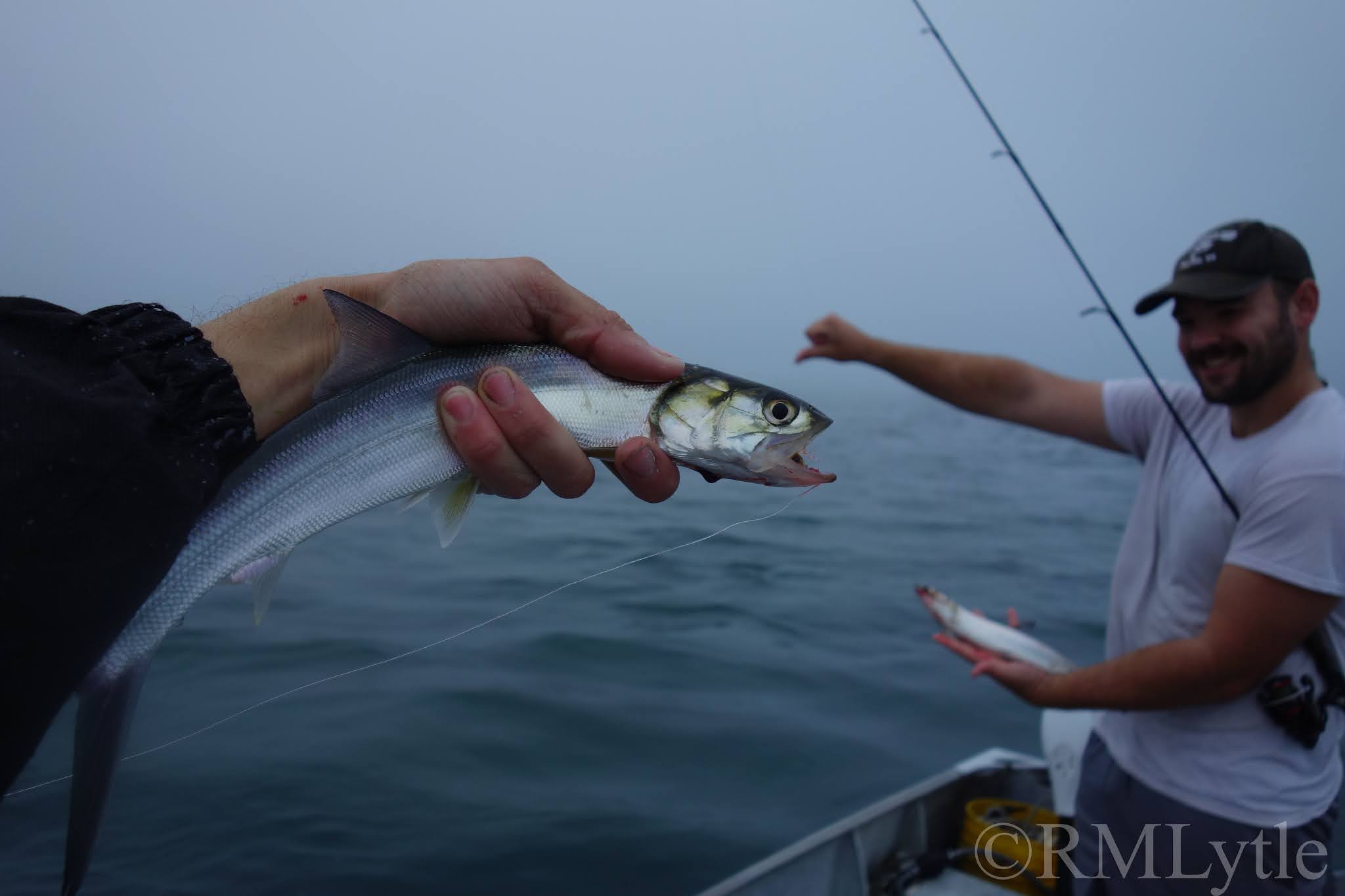
Then came the ladyfish. I'd caught my first ladyfish a few years ago in Florida, where they are a year-round resident and often considered irritating, sometimes even trash fish. Of course I quickly fell in love with these acrobatic silvery fish. Catching them locally is something I've long known was possible and has been a goal of mine, I was very pleased to see it come to fruition. Soon ladyfish were making their way into the little Lone Star Skiff with regularity, including at least one that jumped into the boat still green. Noah and I were having a hysterical time catching these high flying fish, in greater numbers than we ever got in Florida. We'd never really gotten to savor the experience there, so it was exceptionally unique to catch enough locally to really get a good feel for it... and these fish are seriously fun. There's nothing in New England waters that fights quite the same. Bluefish and hickory shad don't jump as much or as high, and landlocked salmon don't zip away quite so fast, though they're probably the closest in fighting style.


Noah with the first large one.

If you look at the tail on a ladyfish, it's not dissimilar from that of some of the fastest running saltwater species like bonefish and milkfish. It's not surprising that they fight as hard as they do. It is a little surprising that people don't enjoy catching them more. Sure, they are aggressive and easily duped; and yes their maxillary has a sandpaper texture and can snarl too light a leader, but damn is it a riot when they take off. 


It wasn't long before we became aware of another southerner in our midst when the aquatic equivalent of a swarm of bees followed my fly in... a school of tiny crevalle jacks, and one of them did find steel.

Caranx hippos. On a Woolly Bugger. In CT. 

Yet another member of the Caranx genus turned up just a few casts later, the blue runner. Unlike ladyfish and crevalle jacks this is a species I'd caught locally, and New England is actually where I got my lifer. 

Caranx crysos, blue runner, this one took a gurgler.

The slay fest continued as fish suddenly began to blitz. There were clearly bluefish and ladyfish there but I also saw some scombrid like slashes and jumps. Though I managed to maintain my season long skunking of  larger scombridae and only piked up a few bluefish, Noah managed a nice Spanish mackerel. By now it really felt like we were actually fishing in Florida.


When the blitzes subsided we resumed the ladyfish and jack beat-down along the rocky shoreline. For someone who likes variety, getting these species mixed in with more locally and seasonally ubiquitous ones like needlefish and bluefish was awesome. We were doubling up on ladyfish constantly and laughing hysterically for hours. It was just visually spectacular uncomplicated fun. 


I've been playing around a lot with flies tied on lead and tungsten jigs this year. Their applications for trout, bass and panfish were already well explored but they definitely have application in the salt too.


As darkness fell we weren't sure what would happen, whether the bite would slow or stop, or change at all. It actually improved because the needlefish seemed to stop feeding, and because they are so difficult to hook we were getting a higher percentage of fish hooked and boated once the needlefish stopped biting. They were still so balled up though that I was regularly foul hooking them. I received a few bites from needlefish, they are unpleasant to say the least. I'll lump needlefish in with bluefish, mangrove snapper, and skates as fish that seem to very intentionally try to bite you, and needlefish are very good at it. 

As darkness fell I hooked the biggest of the ladyfish I'd gotten. The initial run was so hard and fast I thought it must be a Spanish mackerel, but when it came up that silver slender form was a nice surprise. This was one of my favorite fish fights this year, actually. And there have been some memorable ones.


The night proceeded with loads more ladyfish and one especially memorable visitation from a huge predator. We left genuinely shaken, but so excited we came back the next day for more.


Those two evenings will surely remain some of my most memorable saltwater days in the northeast. 
I love what I get to do.  
Fish for the love of fish.
Fish for the love of places fish live.
Fish for you.
And stay safe and healthy.


Thank you to my Patrons; Erin, David, John, Elizabeth, Brandon, Christopher, Shawn, Mike, Sara, Leo, C, and Franky for supporting this blog on Patreon

Thursday, December 3, 2020

Catch The Lake

 I am not a "numbers guy" particularly, when it comes to fishing. I routinely seek quality over quantity, be it in my trout fishing; often head hunting or streamer fishing rather than nymphing or fishing a dry dropper; or my striper fishing which especially in the spring revolves around forgoing the massive amounts of schoolies in favor of a shot at 35 inch fish or bigger. I'm ate up with Atlantic salmon and sea run brown trout... if that isn't a quality over quantity game I don't know what is. But that doesn't mean I don't also love to catch an excessive amount of fish sometimes. Conveniently, quantity is also occasionally the avenue to quality. One such occasion sets up on my home lake in the fall. It can still be very possible to catch big bass on the reefs, ledges, and points in the fall, but sometimes the best move is just to go where the biomass is. On this lake, finding the biomass means finding the white perch.


One day this fall Noah and I were having a hell of a bad time on our typical bass spots. After a bit we opted to start hitting areas we knew would be loaded with perch. It was a consolation option, we thought, forgetting that both of us have often caught larger fish; be it bass, walleye, or pickerel while on top of the white perch biomass. 


The first spot we fished didn't produce anything but white perch. After the first few we decided to start keeping. White perch are both delicious and, in CT's landlocked waters, a destructive invasive. While our native tidal anadromous populations are in sorry shape, our landlocked introduced white perch are excessively overpopulated. As such we had no qualms about killing a whole bunch, and soon decided to fill the boat. There is no limit on white perch in non-tidal water in CT, since they are introduced fish, easily overpopulate, and not considered a game species. So we were going to fill the boat. It wouldn't even put notable dent in this lake's numbers, as much as we wish we could. 

After running dry at the first location we wandered a bit before deciding to head over to a spot where Noah had found another pile of perch a week prior. They were still there and we started really hammering them. We were both fishing pretty simple, light presentations. I was running simple streamers tied on 1/32oz Eurotackle tungsten jigs, on two rods: one with an indicator, which I set down and dead sticked, and one that I actively cast and figure eight retrieved. Sometimes I was doubling up and fighting fish on both rods simultaneously. Noah was fishing jigs with strait tail soft plastics. We were really putting a beat down on these fish. It was a lot of fun. 

Then, suddenly, I hooked something that felt different and bigger. From the dark green water a monster black crappie rose up into view. Moments later, Noah hooked one of his own. Finding the biomass had just proven it's worth in locating trophy fish.


We continued the perch slay fest but it wasn't all that longer before I was into another quality fish, this time a smallmouth which put up a hell of a nail biting battle before we got it in the net. This was exactly the sort of fish we'd been hoping for this day. 


As the sun began to near the horizon, we made way to the boat ramp with a literal boat load of white perch, a few yellows, and two trophy crappies and one smallmouth released. In not long we'd be doing the dirty work of cleaning more than 100 white perch so they were freezer-ready. 


Sometimes finding big fish means forgoing small ones, but sometimes it pays to catch the lake looking for big fish... even if most of the lake is 8 inch white perch. There are often big fish wherever the biggest biomass is. 
Until next time,

Fish for the love of fish.
Fish for the love of places fish live.
Fish for you.
And stay safe and healthy.


Thank you to my Patrons; Erin, David, John, Elizabeth, Brandon, Christopher, Shawn, Mike, Sara, Leo, C, and Franky for supporting this blog on Patreon

Monday, November 30, 2020

Autumn Bubblers: Fall Carp on the Fly

 Fall is one of my favorite times of year to target carp. They often put on the feed bag during any autumn warm spell, bulking up before the cooling waters slow their metabolic processes, and it can be a time of high rewards. It can also be a time of difficulty, especially if an angler is looking for fish to act like they were earlier in the season. They often don't. Shallow feeding becomes rather infrequent; carp are much more likely to be feeding on deeper mud flats. Subsequently, with the long shadows of the shortening day, fall doesn't lend itself to sight casting to visibly feeding fish as often as spring and summer. But that doesn't mean we need to slow twitch flies on the bottom hoping a carp finds it by chance. A convenient natural phenomena and the basic feeding behavior of common carp allow the observant fisherman to see carp they can't actually see. I put this to use one day after work this October.

I started the afternoon on a pond that has some true monster carp in it, but is also loaded with bass. I worked my way around the bank casting a woolly bugger, slow stripping it, pulling up chunky little largemouth after chunky little largemouth, waiting to see the telltale sign that a carp was feeding in the water in front of me. Unfortunately I never really saw it at that pond, but the dink largemouth quota was satisfied by the time I'd made my way around to where I'd started.


I then moved along to a creek up the road, a spot I don't think I've ever visited without seeing evidence of carp feeding. It's a heavily altered body of water, not a natural state freestone stream at all. It has man-made pools along it's length, and in these deep pools some carp winter over. These deep holes have big deep mud flats full of settled detritus, dragon fly nymphs, and crayfish. Carp feed on these flats in the fall and winter, and it's the ideal scenario for seeing fish you can't actually see. 

What I mean by this is seeing the reel time signifiers that a carp is rooting in the bottom. This is something I've written about before, but I do think its worth a refresher. Decomposition of organic matter on the bottom of lakes, ponds, and streams creates nitrogen gas, which gets trapped in little pockets in the muck. As a bottom feeding fish like a carp or catfish roots around, digging out macro invertebrates, vegetation, or dead organisms, it liberates these bubbles of nitrogen and they rise to the surface in a steady stream. It takes experience to discern between the natural release of gasses that isn't caused by a living creature moving around, turtles mucking on the bottom, and carp. With time on the water it becomes second nature. It then takes more time to learn to read what the bubbles mean as far as the fish's behavior. That's the biggest problem with this type of fishing: knowing where the fish is facing and getting a fly close enough that it can see it. Sometimes a bubbler has a clear path of travel, sometimes it wanders aimlessly, sometimes it sits in a spot for a while then hops over 10 feet before digging in again. This deviant behavior is compounded by the fact that a fly doesn't simply sink straight down to the bottom from where it hits the water. It gets effected by current, the leader, the fly line, it's own shape and weight balancing...  it's very complex. Really you need to make quite a lot of experimental casts at bubbling carp to get in front of the fish. I've been doing this for years and I still don't know what I'm doing. That said, even a blind squirrel can find a nut... or the smaller nut eating the big nut's leftovers.


A common repercussion of casting at feeding carp is catching other fish that are looking to feed on anything the carp may kick up. I've caught lots of smallmouth, largemouth, perch, and sunfish in this scenario but this was the first time I'd caught a fallfish. It was nice to get a native fish out of this highly altered water. Both fallfish and white suckers use this waterway, and their niches overlap some with carp. I'm glad it seems the carp aren't impacting their populations much. 


As often happens the carp the fallfish was following spooked when I hooked it's little buddy. Fortunately there were plenty more bubblers to cast to and eventually I got my woolly bugger in exactly the right spot. I'd led the bubbler quite a bit and gave the fly one little hop when it looked like the fish had lifted its head (the bubbles subsided briefly). The take was very committed, and not at all subtle. I just abruptly came tight and the fish was peeling line. It wasn't big but I'll take any carp, any way, any time.


Bubblers aren't easy. I pulled that carp out of about four feet of water just making educated guesses at it's position and direction of travel. So though I couldn't buy another carp that evening despite plenty being around, I was more than happy to have caught that one.

As we roll on into winter, bubbling will become pretty much the only way to locate carp in most waters. If you're ate up with carp on the fly like I am, I'd say it's probably worth practicing fishing to the ones you can't actually see... even though it's the opposite of the shallow tailers that got most of us into the game.

Until next time,

Fish for the love of fish.
Fish for the love of places fish live.
Fish for you.
And stay safe and healthy.


Thank you to my Patrons; Erin, David, John, Elizabeth, Brandon, Christopher, Shawn, Mike, Sara, Leo, C, and Franky for supporting this blog on Patreon

Friday, November 27, 2020

One Foggy Thanksgiving Night

 One foggy and warm Thanksgiving eve four years ago, I caught a gorgeous walleye on a spur of the moment outing. Unlike my Christmas Eve tradition, which was started from a similar spontaneous outing and a monstrous small stream wild brown trout, I didn't decide to make this a yearly trip. But when I glanced outside on Thursday night to see my street bathed in fog I couldn't resist. I rigged my spey rod, and though the conditions were poor to horrible for night trout fishing I set out into the mist to swing large streamers in the black waters of my nearest trout river big enough for such pursuits.


In the eerie and quiet desolation I cast and pondered, allowing my black and blue Intruder to dance the current breaks and look enticing enough to tempt whatever trout may be slightly active. Maybe. Probably not.

Passive tactics allow for contemplation. Thanksgiving has never been a huge favorite holiday of mine, for a variety of reasons personal and ethical. But that's not to distract from the importance of gratitude. And as I stood there in frigid water, waders leaking, waiting for a grab that would never come, I smiled. I'm one lucky bastard. 

This has been an awful year, but I'd recon you've all still got something to smile about. So go stand in your favorite river or lake or ocean and smile about it. 

Until next time,

Fish for the love of fish.
Fish for the love of places fish live.
Fish for you.
And stay safe and healthy.


Thank you to my Patrons; Erin, David, John, Elizabeth, Brandon, Christopher, Shawn, Mike, Sara, Leo, C, and Franky for supporting this blog on Patreon.