Monday, March 15, 2021

Big Early Season Pike on the Fly

 I nearly always manage to miss the pre-spawn pike fishing here in Connecticut, even when I’m trying to find them. It has been a combination of lack of experience, lack of time, and lack of luck. Despite the fact that I sometimes went to likely places, they simply did not produce. It ended up leading to lots of skunking since there’s very little else around to eat a 10 inch fly in the sort of water pike move into in March and April. March 9th, 2021 though finally broke the long lasting bad luck regime- and in spectacular fashion.  
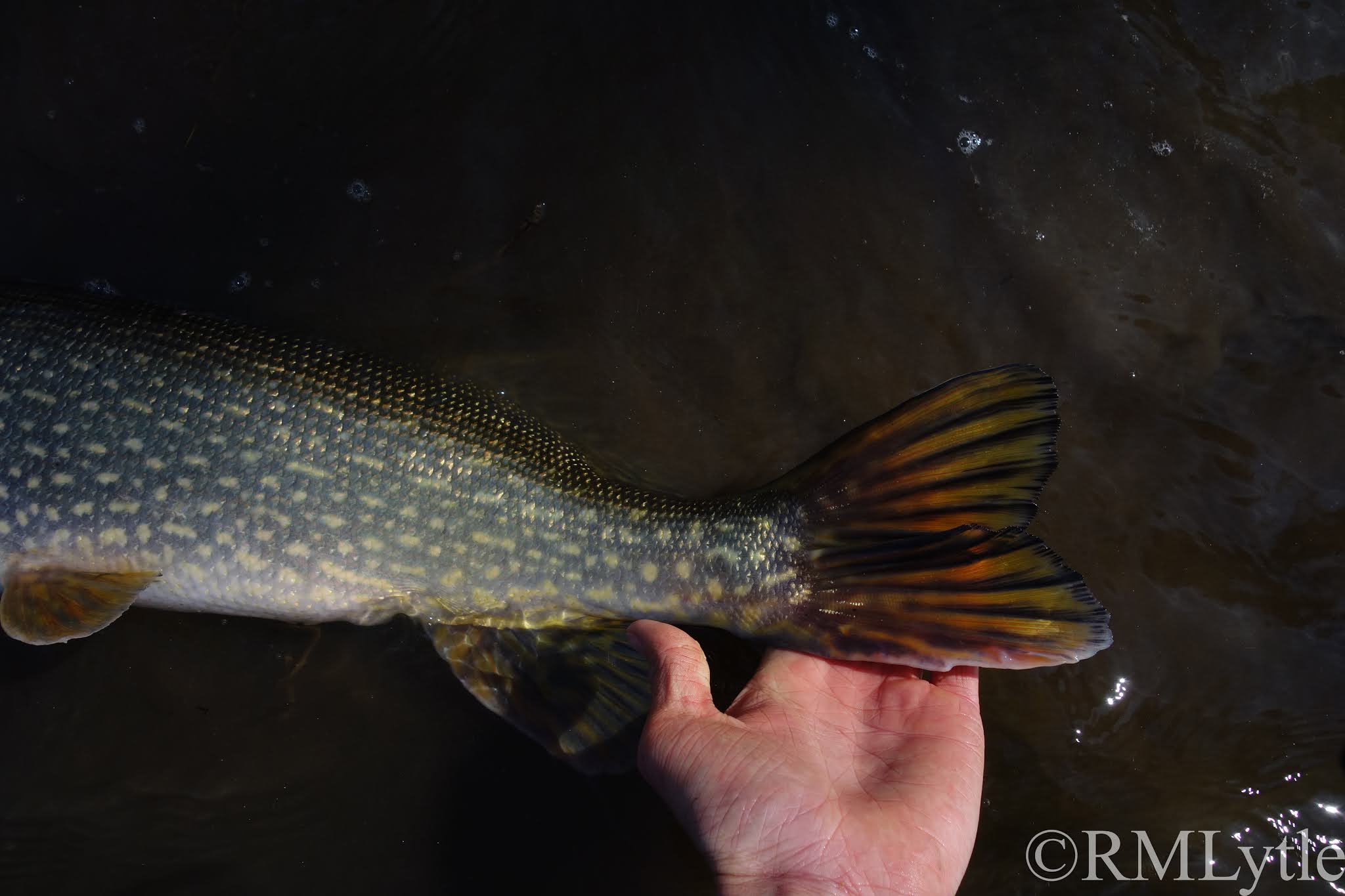
It was the first day of the first legitimate warm spell of the year. It was very comfortable out but also extremely bright. Noah and I headed north, but our target wasn’t pike. We did know that pike were a possibility and would be fishing a known pike spot. But I didn’t really think I’d be catching one. Big fish were my target though and I was rocking my new 12wt Heritage rod and Lamson Litespeed G5, far and away the nicest outfit in my possession at the moment. I’d fiddled with the rod a bit in late fall with the 11wt line I bought for it and struggled to cast as well as I knew I should have been. Rather than upsizing the line right away, I instead switched to my 10wt SA Mastery Titan, and damn if that thing didn’t suddenly become a cannon! Even with a 11 foot sink tip linked to the end and a heavy 9 inch Flashtail Clouser tied on I could get all of the fly line and 2 feet of backing out the tip of the rod… that’s a long fly cast- about 108 feet when my leader turned over completely. That’s the exact rigging I was using on this day.

The river was low and clear and this made our main target species (which will remain nameless, for now) less likely to move into the shallow water we were fishing. It seemed like a setup to skunk, but we went through the motions anyway. I was limited by trees for backcast space, but was able to shoot about 60 feet with a really strong haul. This gave me just enough of distance to effectively fish the contour. It was when the fly came up over the drop off that, to my shock, it got slammed by what was clearly a big fish. Despite having fished for very little other than trout and panfish for a few months, I strip set well. The fish made a short but hard run for deeper water and for a while I wasn’t sure what it was. As it got closer though I could tell it was a pike, and a pretty good one. Without too much hassle I was able to slide the fish up into shallow water and tail her. It was a very girthy fish, likely a gravid female, and probably the heaviest pike I’d ever caught. 

I was absolutely elated. The adrenaline rush from catching a big fish is hard to describe, but if you’ve experienced it you know how addicting it is. I’d feel high for the rest of the day after catching that pike, and though we left that spot shortly thereafter, the excitement wasn’t over yet. But I need more. I'll always need more.

Until next time, 

Fish for the love of fish.
Fish for the love of places fish live.
Fish for you.
And stay safe and healthy.


Thank you to my Patrons; Erin, David, John, Elizabeth, Brandon, Christopher, Shawn, Mike, Sara, Leo, C, Franky, Geof, and Luke for making Connecticut Fly Angler possible. If you want to support this blog, look for the Patreon link at the top of the right side-bar in web version. 

Edited by Cheyenne Terrien

Saturday, March 13, 2021

Simple But Deadly: The Christmas Ornament

Throughout the years, I've very infrequently delved into fly tying on this blog. That may partly be because fly tying feels more like actual work to me than fishing does, but that's neither here nor there. Whatever the reason, I only occasionally have written actual fly tying posts, with recipes, tips, and productive patterns. And because I do routinely mention specific fly patterns, and have over the years simplified and honed my own fly selection down to relatively simple to tie but extremely effective patterns that can fool more than one species of fish, it's high time I started a fly tying series. Most of these flies, basically all of them, are other tyer's designs. A few are my own. But they all work, and I have an immense amount of faith in them. This series is not written for beginner tiers who are still learning simple methods and steps, but for experienced tiers looking to diversify their fly selection that can understand very simplified instructions that don't cover every step in detail. This is "Simple But Deadly."

Flash flies are a loose collection of different patterns composed mostly or entirely of synthetic flash material. There are a number of notable patterns I’d call flash flies, from the salmon and steelhead pattern by the very name “Flash Fly,” to the Empie Shiner and Kreelex. I semi-accidentally came up with my own flash fly in 2018- an abomination of material some would say should never be graced with the designation of being a fly- but it just catches fish so damn well.

The Christmas Ornament was born when I brought home a beat up musky cowgirl lure I found on the side of the road. The wire, hooks, and blades were flattened, unquestionably from being run over by cars a time or two. But the flashy skirt was in good enough shape that it seemed like something I could use to tie flies with. It was a multicolored mylar material, like Hedron Saltwater Flashabou. I tied an utterly hideous fly out of that, articulated and intended for muskie and big pike. The material from the musky lure wasn’t long enough for the tail, so I blended rainbow krystal flash and holographic flashabou in a couple sizes and colors. The fly ended up being pretty useless, but on one day on Lake Champlain, I realized I needed something durable and flashy. I cut off the back hook of that fly, and not only proceeded to catch pike and pickerel but even largemouth ate that silly thing. And thus the Christmas Ornament was born. The fly has caught numerous big bass for me, as well as stripers and bluefish. Mostly, though, it is just a pike catching machine. 


Materials:

Tail: Hareline Krystal Flash, rainbow. Hedron Saltwater Flashabou, Gold. Hedron Holographic Saltwater Flashabou, gold. Hedron Holographic Flashabou, green. Hedron Holographic Flashabou, gold. Equal parts, hand blended.

Body: Hareline Saltwater Flashabou, gold. Hedron Holographic Saltwater Flashabou, rainbow. 1 part gold, 2 parts rainbow, hand blended. 

Thread: UTC 140 Fl. Fire Orange

Hook: Size 4-2/0 Gamakatsu B10S

Hand blending flash takes some practice. Lay out the flash on a flat surface, obviously keep the fibers parallel. Make sure the colors are evenly distributed. Then bundle it all together. The tail fibers should be 3 to 4 times the length of the hook shank. For the body, tie in 3 or 4 clumps about 4 inches long, tied in halfway between the ends and then folded back, almost like a reverse tying bucktail. You can add eyes to this fly if you’d like but they aren’t necessary. Using lead wrap to weight the fly is also useful in some situations. Yes, these are very simplistic directions, but this is a very simple fly. I didn’t feel a photographic guide to tying it was necessary. It also doesn’t need to be perfect, just full-bodied, even, and durably tied.  


Until next time, 

Fish for the love of fish.
Fish for the love of places fish live.
Fish for you.
And stay safe and healthy.


Thank you to my Patrons; Erin, David, John, Elizabeth, Brandon, Christopher, Shawn, Mike, Sara, Leo, C, Franky, Geof, and Luke for making Connecticut Fly Angler possible. If you want to support this blog, look for the Patreon link at the top of the right side-bar in web version. 

Edited by Cheyenne Terrien

Thursday, March 11, 2021

Just One Slab: Ice Fishing Big Crappie

One notably unpleasant day in February, Rick invited me for a run up to Massachusetts to fish a well known crappie and perch hot spot. A gusting Northwest wind would prevent comfort out in the open, so it was a really good thing Rick had both shelter and a portable heater. We set out, brimming with confidence and some idea of what to expect since Rick had just fished the spot a few days prior. 

Trophy panfish seems like an oxymoron to some fishermen. I’ve met a few folks that turn up their noses to bluegill, crappie and perch entirely. This runs contrary to my own opinions of those species. Panfish, large ones in particular, are something I borderline obsess over. That’s why it’s fun to fish with Rick, he will never shy away from a good panfish bite. Having ice fished for them all over the northeast for many years, he also has far more experience than I and I value the knowledge I’ve been able to pick up from him. Still, neither of us is good enough to catch every time we go out though, still. And that’s part of what keeps panfishing exciting. It isn’t as simple as just going out and jigging on a body of water that holds the species. 

On this day we never fully got a grasp on the bite. There were fish under us sporadically throughout the afternoon and evening and we were able to get bites sometimes. However, they were not, for the most part, the sort of bites we were looking for. Most of the fish caught were small sunfish, perch, and spottail shiners. After spending a while at the first set of holes we moved over just a short distance. Immediately we had marks under us and promptly each caught a crappie. Mine was a slab. It wasn’t as big as we were really hoping for at 12 inches and change, but it had shoulders and was certainly a good fish. 

We thought it was on, but we didn’t get another crappie all evening. From right around sunset on we even had loads of big marks beneath us, a huge school of fish. We could sporadically get them to follow but they seemed to have no interest at all in eating anything we tried to feed them. We can’t be sure what species these were since we didn’t catch one, but it certainly was befuddling. This is exactly what keeps fishing engaging for anglers like Rick and I: we want to either figure out how to catch these fish or figure out how to know when it isn’t possible. One fish, a pretty good one, made the trip, but it was those that we could see on the flasher but failed to fool that made me want to figure this spot out. 

Until next time, 

Fish for the love of fish.
Fish for the love of places fish live.
Fish for you.
And stay safe and healthy.


Thank you to my Patrons; Erin, David, John, Elizabeth, Brandon, Christopher, Shawn, Mike, Sara, Leo, C, Franky, Geof, and Luke for making Connecticut Fly Angler possible. If you want to support this blog, look for the Patreon link at the top of the right side-bar in web version. 

Monday, March 8, 2021

Surprise Brown Trout

 One warm day in February, the first day it seemed we might be moving out of the long standing cold weather pattern, Cheyenne and I went for a hike along a tiny river valley stream. Like many of the streams in the same rock formation, this one seems nearly immune to low water and ice issues often inhibit the seasonal fishing quality of streams in the adjacent upland areas. Though tiny, I was aware it held sizable wild trout or at least had historically. Having only fished it once prior and caught just one tiny brown trout, I of course had a rod along with me. 

Tied to my tippet was a green weenie, a fly I’ve never quite given credit to. I’ve rarely ever tied or fished the green weenie for some reason. I’m not quite sure what had come over me but I’d churned out a half dozen one day before this outing and decided that would be the fly I’d throw. It’s a dead on inch worm or caterpillar imitation. That is, in fact, what it was tied to imitate. And yet I felt compelled to use it during a time of year notably lacking in such larvae. Fishing the green weenie in the winter certainly isn’t unheard of, not at all. Plenty of angler have fished and caught with the green weenie in the winter. It’s just funny to me that having confidence in a bright green worm when there’s more than half a foot of snow on the ground is possible.

Since fishing wasn’t top priority, I was fairly selective about how much casting I was doing. I occasionally handed off the rod to Cheyenne, too. I wasn’t really expecting anything. We came upon a deep, log-filled bend hole. I made one short bow and arrow cast into the soft water on the inside of the bend. As soon as the fly got to depth, my line came tight and a substantial fish was on. It was more than twice the size of any fish I’d seen in this stream prior. A brown trout of wild origins (it has been a great many years since this stream had been stocked), this specimen was an impressive example of what CT lowland creeks and brooks are capable of producing. 


I know the same stream has brook trout as well. Though that was the only fish I or Cheyenne caught this day, I know return is inevitable. I’d like to see a large brook trout there- something the size of that brown. I am sure there are a few. 

Until next time, 

Fish for the love of fish.
Fish for the love of places fish live.
Fish for you.
And stay safe and healthy.


Thank you to my Patrons; Erin, David, John, Elizabeth, Brandon, Christopher, Shawn, Mike, Sara, Leo, C, Franky, Geof, and Luke for making Connecticut Fly Angler possible. If you want to support this blog, look for the Patreon link at the top of the right side-bar in web version. 

Edited by Cheyenne Terrien

Thursday, March 4, 2021

Trophy Pickerel Ice Fishing

 I love big chain pickerel. That’s never been a secret. I get a great deal of joy out of catching the native Esox species. I especially love really big pickerel. Regrettably, I’ve not been catching many truly giant pickerel in recent years. That changed one day in February while out on the ice.

Rick and I were actually looking for panfish, mainly big bluegills and crappie. We set out on a shallow, weedy lake that we knew had a large abundance of both species in good sizes. We also knew it had a lot of chain pickerel, and we certainly wouldn’t mind catching those. The first few spots we tried weren’t especially active, we may have gotten a bluegill or two. But eventually we set up in a deeper spot and could see fish moving around in the weeds on the flasher. They were a little finicky, but we were soon slowly picking up bluegills. Eventually I got a crappie as well. There were a few “up bites” that I was missing, and these are usually indicative of crappie bites. 


I got a pickerel too, maybe half a dozen fish in. It was a small one- beautiful but not impressive in stature. I always find it fascinating that pickerel will eat a tiny tungsten jig with only one or two spikes on it; it seems so small. It’s not really in their character. They’re smaller than pike but if anything, have even more attitude. Eating such a tiny bait just seems unlike them. They will, though, and nothing could prepare me more for the next pickerel that ate my little jig. It came out of the weeds and I saw the eat clear as day on the flasher. It felt heavy and immediately began running hard. I was using the equivalent of 5x tippet, so I felt I couldn’t possibly land this fish. The fight was a jaw clenching give and take, and when I got the fish to the hole I could see that not only was it a really nice pickerel but my line was crosswise through her teeth. With my heart in my throat, I shoved my hand into the frigid water and miraculously managed to get her through the hole. 


What a fish she was! Long, but more impressively, very girthy. There were clearly a few panfish in her stomach. This was the sort of pickerel I’m hoping I’ll get on the fly sometime this month or the next. The fact that this big predator -with 3 inch panfish in her belly- felt the need to eat that miniscule jig, and that I then got her to hand? Incredible. The highlight of the ice season for me. 

We ended up picking at panfish and pickerel the rest of the outing. The bites came in bits and spurts. A couple of the pickerel were nice ones, though not nearly as impressive as the second one. It was an excellent day out on the hard water- one of my favorite days ice fishing ever.


Until next time, 

Fish for the love of fish.
Fish for the love of places fish live.
Fish for you.
And stay safe and healthy.


Thank you to my Patrons; Erin, David, John, Elizabeth, Brandon, Christopher, Shawn, Mike, Sara, Leo, C, Franky, Geof, and Luke for making Connecticut Fly Angler possible. If you want to support this blog, look for the Patreon link at the top of the right side-bar in web version. 

Edited by Cheyenne Terrien